

Microsoft is bringing Sysmon — the long-favored Sysinternals tool for deep Windows telemetry — into Windows itself as an optional, native capability for Windows 11 and Windows Server 2025, a change that promises to simplify deployment, add official support, and shift how enterprises collect OS-level security signals.
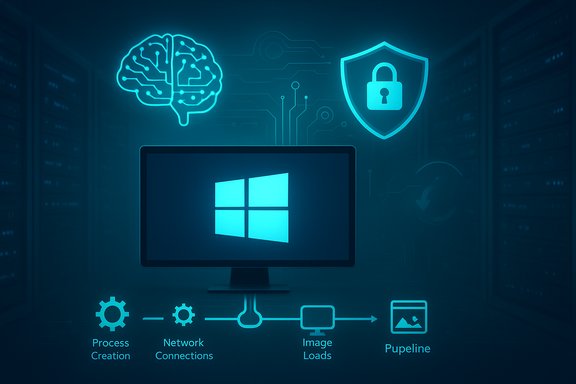
Sysmon (System Monitor) has been a de facto standard for endpoint visibility among security teams for well over a decade. It runs as a system service and device driver, producing high-fidelity events for process creation, network connections, image loads, WMI activity, raw disk reads, and many other OS-level actions that are otherwise invisible to stock Windows event channels. Those events are typically collected by SIEMs and EDR/SOC pipelines for threat detection, hunting, and forensic investigations. Until now, organizations have had to download, deploy, and manage the standalone Sysmon binaries and driver from the Sysinternals suite. That approach allowed rapid community-driven improvement and configuration flexibility, but it also created operational friction: manual rollout, disparate update cadences, and no formal Microsoft production support when running Sysmon across thousands of endpoints. The native integration promises to remove many of those pain points.
The native implementation will support custom XML configuration files—the same approach long used by the community—writing generated events into the Windows event log so existing SIEM, log collection and detection pipelines remain compatible. Comprehensive documentation is promised at general availability.
Source: BetaNews Microsoft to make Sysmon a native Windows 11 tool
 Background
Sysmon (System Monitor) has been a de facto standard for endpoint visibility among security teams for well over a decade. It runs as a system service and device driver, producing high-fidelity events for process creation, network connections, image loads, WMI activity, raw disk reads, and many other OS-level actions that are otherwise invisible to stock Windows event channels. Those events are typically collected by SIEMs and EDR/SOC pipelines for threat detection, hunting, and forensic investigations. Until now, organizations have had to download, deploy, and manage the standalone Sysmon binaries and driver from the Sysinternals suite. That approach allowed rapid community-driven improvement and configuration flexibility, but it also created operational friction: manual rollout, disparate update cadences, and no formal Microsoft production support when running Sysmon across thousands of endpoints. The native integration promises to remove many of those pain points. What Microsoft announced
Native, optional feature serviced by Windows Update
Mark Russinovich—creator of Sysinternals and a senior technical leader at Microsoft—announced that Sysmon functionality will be delivered natively via upcoming Windows updates for Windows 11 and Windows Server 2025. Administrators will be able to enable it through the operating system’s standard feature controls and have updates flow through the Windows Update servicing channel. Microsoft frames this as reducing deployment complexity and operational risk while adding customer support for Sysmon in production environments.Activation and compatibility
Microsoft says Sysmon functionality will be activatable using the “Turn Windows features on/off” capability and installed with the familiar command-line install command:sysmon -iThe native implementation will support custom XML configuration files—the same approach long used by the community—writing generated events into the Windows event log so existing SIEM, log collection and detection pipelines remain compatible. Comprehensive documentation is promised at general availability.
Roadmap highlights: enterprise management and on-device AI
Russinovich also indicated that native Sysmon is only the starting point. Microsoft plans to add enterprise-scale management and AI-powered inferencing that could run locally to reduce dwell time on detection tasks—examples given include faster identification of credential theft or lateral movement patterns using edge AI fed by Sysmon’s granular signals. These features are described as planned investments rather than GA commitments and will arrive over time.Why this matters: benefits for IT and security teams
- Simplified deployment and maintenance. No more packaging binaries, custom installers, or chasing driver updates across thousands of endpoints; Sysmon functionality will be an optional Windows feature and serviced via Windows Update. This change reduces operational overhead and the risk from inconsistent versions.
- Official customer support. One of the most-requested items from enterprise sysadmins—formal support when running Sysmon in production—will be addressed. Microsoft explicitly lists customer service support as one of the operational benefits. This reduces the "unsupported" anxiety for compliance and security teams that previously relied on a community tool.
- Preservation of existing workflows. Microsoft intends to honor the established Sysmon model: XML configuration files, writing to Microsoft-Windows-Sysmon/Operational, and producing event IDs familiar to SOC analysts. Community templates and SIEM mappings should remain usable with minimal change.
- Faster patching and unified lifecycle. Fixes and feature updates for the Sysmon functionality will be distributed as part of the standard Windows update pipeline, reducing the lag between releases and improving consistency across an estate.
- Potential for local AI inference. If Microsoft ships robust on-device inferencing tied to Sysmon signals, defenders could gain new, low-latency detections without shipping all telemetry to the cloud—an appealing model for latency-sensitive or data-sensitive environments. This is a forward-looking promise, not an immediate GA feature.
Technical details and compatibility
What stays the same
Sysmon’s core value proposition—granular OS-level telemetry written to the event log—remains. Existing configuration files from community repositories (for example SwiftOnSecurity and the sysmon-modular project) are expected to be supported, preserving years of detection content and SIEM ingestion schemas. The canonical installation command and XML configuration model are retained for administrator familiarity.What changes
- Sysmon will be offered as an Optional Feature in Windows. Administrators will flip a feature on and then run the install command (e.g., sysmon -i or sysmon -i config.xml) to start the service. That single-command install flow echoes the existing standalone workflow but runs off binaries and drivers packaged with Windows itself.
- Servicing and updates become aligned with Windows Update. That is a double-edged sword: it simplifies patching but also binds the Sysmon update cadence to Windows servicing policies and schedules.
Events and schemas
Microsoft highlighted a range of event types the native Sysmon will provide (for example, WMI events such as Event ID 20 & 21). The native logging will use the Windows event log channels SOC teams already reference, enabling continued use of existing SIEM queries and correlation rules. The full event catalog and schema will be published with the product documentation at GA.Operational considerations and best practices
Test and tune configs before wide rollout
Sysmon configurations vary widely by environment. Community templates like SwiftOnSecurity’s and the sysmon-modular repository offer strong starting points, but organizations should tailor and test for noise, performance impact, and SIEM ingestion costs before broad deployment. Those repositories explicitly warn that verbose configurations can generate explosive telemetry volumes.- Clone a community config (or generate a tailored config).
- Deploy to a pilot group of endpoints.
- Monitor CPU, memory, disk I/O, and event ingestion volumes.
- Adjust excludes and event filters before scaling.
Plan your ingestion strategy
High-fidelity Sysmon telemetry is a boon for detection but expensive to ingest and store in cloud SIEMs if left unfiltered. Security teams should coordinate with logging architects to define what to ship and for how long, and possibly leverage on-device pre-filtering or local analytics to reduce data transfer and cost. Community and vendor docs already highlight the need to weigh visibility versus ingestion cost.Integrate with endpoint management and CI/CD
Even though Sysmon will be an Optional Feature, modern enterprise rollouts should use MDM (Intune), Group Policy, or configuration management tooling to enable and configure the feature consistently. Keep a single source-of-truth for your XML configuration and automate configuration changes to avoid drift. Logging of configuration changes (Sysmon emits service/configuration change events) is useful for detecting tampering.Security implications and risks
Reduced attack surface from inconsistent versions — but new questions remain
By centralizing Sysmon delivery, Microsoft reduces the risk associated with stale or inconsistent Sysmon versions across an estate. However, several operational and security questions must be clarified before trusting the new model completely.- Will the native Sysmon driver and service be harder for attackers to tamper with than the current standalone driver? Microsoft’s messaging suggests improved lifecycle control, but the exact hardening model and protection against tampering are not yet documented publicly. This is an area to monitor at GA. Flagged as pending confirmation.
- How will third-party tool compatibility be handled? Many community tools and scripts reference the Sysmon binaries (file names, driver names, CLI flags). Microsoft says it will preserve functionality and configuration compatibility, but administrators should validate any third-party integrations before a large migration.
Data privacy and regulatory scrutiny
Sysmon produces high-resolution telemetry that can include file paths, command lines, process ancestry, and other potentially sensitive artifacts. Organizations operating under strict privacy or data residency rules must still treat Sysmon logs as sensitive data and enforce access controls, retention policies, and minimization strategies. Native delivery does not change the sensitivity of the logs; it only changes the distribution mechanism.Cost and telemetry volume
If organizations migrate to a verbose GA configuration without filtration, storage and SIEM ingestion costs can rise rapidly. Community repositories and vendors have repeatedly warned about this, and Microsoft’s guidance to enable custom configurations should be treated as a requirement—not an option—to keep operational costs under control.Potential for new privilege or supply-chain concerns
Packaging Sysmon with Windows tightens its supply chain (Windows Update), but it also creates a single point of failure: if an update contains a bug or regression, it could affect many endpoints simultaneously. Enterprises should weigh Windows servicing policies, test updates in rings, and rely on change control practices to mitigate mass-impact risks. This is not a reason to avoid the feature, but it should inform rollout planning.The AI inferencing promise: opportunity and caution
Microsoft’s hint at AI-powered inferencing running locally on the device is the most disruptive roadmap claim in the announcement. In theory, running models at the edge that consume Sysmon signals could spot lateral movement patterns and credential theft more rapidly than cloud-only analytics, reducing time-to-detection and dwell time. There are three important caveats:- The actual models, their capabilities, and how they are updated or controlled are not yet specified. This means features like label drift, false positives, model explainability, and governance remain open questions until Microsoft releases implementation details. Flagged as a planned feature requiring verification at GA.
- Running AI locally raises resource and privacy trade-offs. Models can consume CPU, memory, and storage; administrators will need the ability to control or disable inferencing in sensitive environments. A careful operational policy must accompany any rollout of on-device AI.
- Local inferencing could be a double-edged sword if not auditable. SOCs will require clear telemetry about model decisions and an ability to extract evidence supporting automated actions. Microsoft’s enterprise-scale management promise will be judged on how well it enables governance and forensic transparency. Flagged as a requirement for enterprise adoption.
Practical migration checklist for teams
- Inventory current Sysmon deployments and community configs in use.
- Identify pilot groups (workstations, servers, and high-sensitivity systems) and baseline performance and telemetry volumes.
- Test native activation on pilot systems when the feature becomes available: enable the Optional Feature and run sysmon -i with your existing configuration file to validate compatibility.
- Evaluate SIEM ingestion rules and retention to avoid surprise costs; tune configs to limit noisy events.
- Confirm third-party integrations (parsers, dashboards, scripts) still function with the native implementation.
- Plan a phased rollout using update rings and MDM/GPO controls.
- Develop governance for any AI inferencing capabilities: what runs, how it’s updated, how results are audited.
What to watch for at GA
- Full documentation of the native Sysmon schema and event IDs, including any differences from the standalone binary. Microsoft has promised comprehensive documentation at general availability; verify that schemas exactly match the ones your SIEM rules expect.
- Detailed guidance on enterprise management and policy controls (how to deploy, update, and centrally manage Sysmon configs at scale). The initial announcement signals this is planned, but the enterprise management feature set will be decisive for large organisations.
- Precise statements about how Microsoft will support customer incidents involving native Sysmon behavior, and the scope of that support relative to Defender and other Microsoft security products. Microsoft cites customer service support as a benefit; confirm support SLAs and escalation paths at GA.
- Implementation and governance details for AI inferencing, including update cadence for models, explainability controls, and resource management options. This capability is transformative if built with enterprise-grade governance.
Conclusion
Bringing Sysmon into Windows as a native, optional feature is a major operational shift that can materially reduce deployment friction and give security teams a formally supported, highly consistent way to gather the fine-grained telemetry many detections depend on. The announced model preserves the familiar configuration-based approach while promising centralized servicing and future investments in management and AI inferencing. For defenders, the upside is clear: faster, more reliable access to forensic-quality signals and fewer moving pieces during rollout. At the same time, organizations should approach the transition with measured planning: pilot the native feature, tune configurations to control noise and cost, validate third-party integrations, and insist on clear governance for any AI features. Several operational and governance questions—particularly around tamper-resistance, on-device AI governance, and the exact servicing model—remain to be fully answered at general availability. Those details will determine whether native Sysmon is merely more convenient or genuinely transformational for enterprise detection and response. Native Sysmon is a big step toward making advanced diagnostic signals a first-class, supported part of Windows security operations. The change simplifies lifecycles and unlocks potential new detection workflows—provided enterprises invest in tuning, governance, and careful rollout planning when the feature reaches production.Source: BetaNews Microsoft to make Sysmon a native Windows 11 tool
