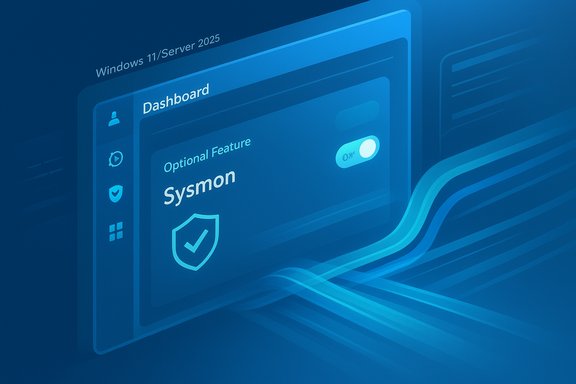
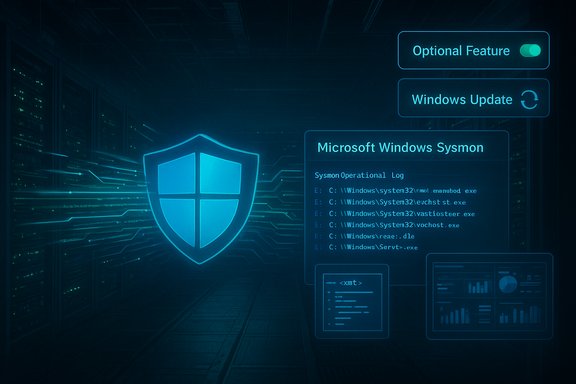
Microsoft is shipping System Monitor (Sysmon) functionality as a built‑in Windows capability next year, moving the venerable Sysinternals monitoring tool from a standalone download into the Windows servicing pipeline and official support surface — a shift that promises easier deployment, automatic updates via Windows Update, and formal customer support for a tool long indispensable to incident responders and threat hunters.
Sysmon — short for System Monitor — grew out of the Sysinternals toolkit created by Mark Russinovich and colleagues. For more than a decade it has been one of the most relied‑upon Windows security utilities: a resident service plus a kernel driver that logs rich telemetry (process creation, network connections, file activity, WMI activity and more) into a dedicated Event Log channel so security teams can hunt threats, perform forensic triage, and feed SIEMs. The tool’s depth of telemetry and configurable filtering made it a de‑facto standard for enterprise detection engineering. Until now, organizations had to download the Sysmon binary from the Sysinternals site, install it per endpoint (sysmon -i), manage configuration files, and maintain updates outside the Windows Update lifecycle. That workflow created operational friction and risk at scale: missed updates, inconsistent configurations, and limited official support were recurring complaints from admins responsible for thousands of endpoints. Microsoft’s announcement says that will change: Sysmon functionality will be included in upcoming Windows updates for Windows 11 and Windows Server 2025, with broad availability planned in 2026. The integration is presented as an optional Windows feature administrators can enable and then install with familiar Sysmon commands.
The inclusion of Sysmon functionality in Windows marks a notable milestone in the platform’s security telemetry story: defenders gain an easier path to high‑fidelity signals, while Microsoft gains responsibility for a widely used detection tool. The net effect should be stronger, faster detection for organizations that plan and govern the rollout carefully — but thoughtful pilot programs, telemetry governance, and vendor coordination will be essential to realize the full benefits while avoiding the predictable operational and compliance pitfalls.
Source: TechSpot Microsoft is baking Sysmon directly into Windows 11 and Windows Server
 Background / Overview
Sysmon — short for System Monitor — grew out of the Sysinternals toolkit created by Mark Russinovich and colleagues. For more than a decade it has been one of the most relied‑upon Windows security utilities: a resident service plus a kernel driver that logs rich telemetry (process creation, network connections, file activity, WMI activity and more) into a dedicated Event Log channel so security teams can hunt threats, perform forensic triage, and feed SIEMs. The tool’s depth of telemetry and configurable filtering made it a de‑facto standard for enterprise detection engineering. Until now, organizations had to download the Sysmon binary from the Sysinternals site, install it per endpoint (sysmon -i), manage configuration files, and maintain updates outside the Windows Update lifecycle. That workflow created operational friction and risk at scale: missed updates, inconsistent configurations, and limited official support were recurring complaints from admins responsible for thousands of endpoints. Microsoft’s announcement says that will change: Sysmon functionality will be included in upcoming Windows updates for Windows 11 and Windows Server 2025, with broad availability planned in 2026. The integration is presented as an optional Windows feature administrators can enable and then install with familiar Sysmon commands. What changes — technically and operationally
How the native feature will behave
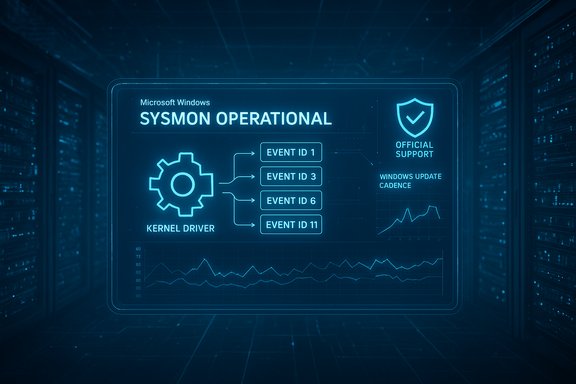
- The built‑in implementation preserves the core model of the existing Sysmon utility: a service and driver remain resident (driver is boot‑start) and write detailed events into the Windows eventing system (Applications and Services Logs → Microsoft → Windows → Sysmon → Operational). Administrators will still be able to use a custom configuration file to control which events are recorded and filter noise.
- Microsoft explicitly lists common detection events that will be available out‑of‑the‑box under Sysmon functionality: Event ID 1 (process creation), Event ID 3 (network connection), Event ID 8 (process access), Event ID 11 (file creation), Event ID 20/21 (WMI events), Event ID 25 (process tampering), among others. These event IDs mirror the existing Sysmon schema used by responders today.
- Activation will be familiar: enable the Sysmon functionality as a Windows feature and run the standard command (for example, sysmon -i) to start the service and driver. Microsoft will route updates for the integrated Sysmon through the Windows Update channel, eliminating the need for separate binary distribution. Microsoft also intends to provide official customer support for the native functionality.
Where telemetry goes and how you will use it
- Events will be written into the Event Log channel dedicated to Sysmon (Applications and Services Logs / Microsoft / Windows / Sysmon / Operational). That log location is consistent with the standalone Sysmon utility and ensures seamless compatibility with existing log collection and SIEM ingestion pipelines.
- Because Sysmon writes structured events with rich fields (full command line, parent process, hashes, network endpoints, registry keys, WMI consumer/filter metadata, and more), the native implementation should be fully usable by existing detection rules and hunt playbooks after minimal retuning.
Why this is a meaningful change for enterprises
Reduced operational overhead
Large fleets typically deploy Sysmon with configuration management tooling (GPO, SCCM/Intune, configuration management pipelines). Integrating Sysmon into Windows and updating it via Windows Update removes a separate patch/distribution lifecycle, lowering the risk of stale binaries or missed security fixes. For teams struggling with manual rollouts and configuration drift, this is a direct reduction in attack surface caused by operational gaps.Official support and lifecycle alignment
Historically Sysmon was a community‑facing Sysinternals tool without guaranteed Microsoft production support. Making the capability native brings it into Microsoft’s customer support and servicing model, meaning organizations can escalate issues through standard Microsoft support channels rather than relying solely on community forums. This changes the risk calculus for regulated or highly critical environments.Consistency for detection engineering
Because the native feature will expose the same event IDs and fields, detection engineers should be able to reuse existing Sysmon‑based rules, hunts, and SIEM parsers with minimal changes. That continuity protects prior investments in detection content while simplifying rollout.What remains to be clarified (and what to validate when GA arrives)
Microsoft’s announcement answers high‑level operational questions but leaves several important implementation and management details for the general availability documentation promised in 2026. Administrators should watch for clarity on:- Exact servicing cadence: Microsoft says updates will come through Windows Update, and the blog references monthly updates; the specific servicing policy (security vs. feature cadence, whether preview channels get early builds) needs explicit documentation.
- Configuration management APIs: Will there be new Group Policy, MDM (Intune) controls, or Windows Update for Business settings to centrally configure Sysmon on thousands of endpoints? Native enterprise‑scale management hooks are mentioned as a future investment area, but details are not yet published.
- Compatibility and co‑existence: Many organizations run third‑party EDRs, detection agents, and existing Sysmon installations. Guidance is required about upgrading existing standalone installs to the native feature, avoiding double‑instrumentation, and managing driver/service version compatibility.
- Telemetry governance and retention: Built‑in telemetry at scale raises questions about local log retention, data export costs to cloud SIEMs, and privacy/regulatory considerations. Microsoft’s GA docs should specify defaults and enterprise controls.
Benefits: what organizations stand to gain
- Simplified deployment — Enable a Windows feature instead of distributing a standalone binary per endpoint. This reduces operational complexity and configuration drift.
- Automatic updates — Security fixes and improvements will flow through Windows Update, ensuring more homogeneous versions across the estate and reducing the attack window introduced by out‑of‑date agents.
- Formal support — Problems with the native implementation can be raised with Microsoft support rather than being handled only by community channels. This matters for regulated environments that require vendor support SLAs.
- Seamless SIEM integration — The native events will land in the same Event Log location as today’s Sysmon, allowing existing log collection, enrichment, and alerting pipelines to keep functioning with minimal change.
- Potential for additional capabilities — Microsoft says future investments include enterprise‑scale management and AI‑assisted analysis on device telemetry. If done correctly, this could reduce time‑to‑detect and accelerate triage by highlighting high‑risk signals.
Risks, tradeoffs, and operational considerations
1) Increased telemetry — storage, cost, and noise
Sysmon is verbose by design. When enabled broadly, the volume of log data can grow rapidly and increase costs for storage and SIEM ingestion. Detection engineering must include sampling and filtering strategies (via configuration) to avoid drowning in noise and ballooning telemetry costs.2) Privacy and compliance concerns
Because Sysmon records command lines, file paths, hashes, network endpoints, and potentially user‑identifying metadata, enabling it enterprise‑wide requires privacy impact assessment and alignment with data protection rules (GDPR‑style disclosure, data minimization, and retention policies). That governance must be baked into deployment plans.3) Performance and reliability implications
Native driver and service instrumentation that runs from boot into operational workloads can affect performance in edge cases or interact badly with poorly tested drivers. IT teams should pilot aggressive configurations in staging prior to mass rollout and monitor system performance counters after enabling Sysmon.4) Attack surface and supply chain considerations
Integrating Sysmon into Windows increases the criticality of its code. While routing updates through Windows Update centralizes patching, it also consolidates trust: a compromised update channel or buggy driver rollout could have broader impact. Conversely, Microsoft support and standardized testing could reduce certain risks relative to disparate community binaries. Both sides of that tradeoff must be considered.5) Co‑existence with third‑party EDRs and existing Sysmon installs
Many security vendors already collect the same signals or depend on the existing Sysmon binary. Organizations must plan for co‑existence, avoid duplicate logging, and ensure vendor compatibility. Expect vendor advisories and possibly updated detection guidance as the native feature rolls out.Practical rollout guidance and recommendations
The native Sysmon feature simplifies some tasks but does not eliminate the need for careful deployment strategy. The following steps distill best practices that teams should follow now and when the native feature becomes available.- Inventory current usage: map which endpoints already run standalone Sysmon, third‑party agents that rely on Sysmon events, and which detection rules in your SIEM depend on specific Sysmon fields.
- Pilot early: enable the built‑in feature in a lab or pre‑production ring and validate event formats, sizes, and vendor compatibility. Keep the standalone binary available for comparison.
- Use curated configs: start with trusted community configurations (for example, high‑quality templates from established repos) and then tune for your environment to balance fidelity and noise. Test schema compatibility between standalone and native implementations.
- Throttle and filter: configure Sysmon to avoid recording low‑value noisy events at scale. Use configuration rules to include only the fields and event types required for your detection objectives.
- Align retention and export: plan log retention, archival, and secure export to your central SIEM. Estimate ingestion costs and set appropriate filters to control bill shock.
- Update governance: add Sysmon to your telemetry policy, documenting privacy, roles, access controls, and retention schedules. Ensure legal and compliance teams sign off on command‑line and file path collection.
- Communicate with vendors: ask EDR, SIEM, and log management vendors for explicit guidance and test their integrations during the pilot.
How detection engineering and AI might change
Microsoft’s announcement includes a public commitment to continued investment in detection capabilities and AI‑powered inferencing on telemetry. That roadmap suggests two likely directions:- Edge‑assisted triage: on‑device AI models could pre‑score or prioritize Sysmon events (for example flagging suspicious parent/child process relationships or anomalous network endpoints) before telemetry leaves the endpoint, reducing analyst workload and SIEM noise.
- Cloud‑assisted correlation: central AI services may correlate Sysmon telemetry across endpoints to detect lateral movement patterns or novel attacker TTPs faster than rule‑based engines.
What administrators should do today
- Treat the Microsoft announcement as an opportunity to streamline Sysmon management, but not as an automatic green light to flip the switch in production without testing.
- If you already run standalone Sysmon, start planning the migration path — catalog configuration versions, custom rules, and vendor guidance. Expect Microsoft to provide migration documentation in 2026; prepare for a staged migration once the guidance lands.
- If you don’t use Sysmon yet, evaluate a small pilot now using the standalone binary to determine detection value, expected telemetry volumes, and operational costs. Use community configs as a baseline and refine for your environment.
- Update procurement and vendor engagement processes to include questions about compatibility with native Sysmon and how vendors will adjust their telemetry collectors.
Final assessment: pragmatic win with real work to do
Making Sysmon a native Windows feature is a strategic and practical improvement: it reduces deployment friction, brings a critical telemetry source into the Windows servicing model, and gives enterprises an officially supported path to richer endpoint visibility. That is a clear win for defenders who have depended on community tooling but wanted the assurances of product support and automated updates. At the same time, the change is not a magic bullet. Administrators will still need to make deliberate decisions about configuration, data governance, vendor co‑existence, and costs. The technical details Microsoft has promised for 2026 — enterprise management APIs, explicit servicing cadence, and migration guidance — will determine how smooth the transition is for large organizations. Until those documents are published, the announcement should be treated as a major positive development that still requires disciplined planning and careful validation before broad rollouts.Quick reference: what to watch for from Microsoft (GA checklist)
- Official documentation of the native Sysmon feature, including configuration schema and supported event IDs.
- Migration guidance for farms with existing standalone Sysmon installations.
- Enterprise management controls (GPO/MDM/Intune) and recommended upgrade/servicing cadence.
- Vendor compatibility bulletins from major EDR and SIEM vendors.
- Privacy and retention defaults plus documentation on secure export and access controls.
The inclusion of Sysmon functionality in Windows marks a notable milestone in the platform’s security telemetry story: defenders gain an easier path to high‑fidelity signals, while Microsoft gains responsibility for a widely used detection tool. The net effect should be stronger, faster detection for organizations that plan and govern the rollout carefully — but thoughtful pilot programs, telemetry governance, and vendor coordination will be essential to realize the full benefits while avoiding the predictable operational and compliance pitfalls.
Source: TechSpot Microsoft is baking Sysmon directly into Windows 11 and Windows Server