

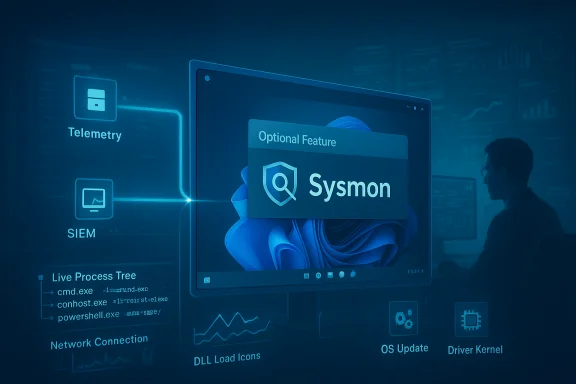
Microsoft will ship native Sysmon functionality inside Windows, a move that promises to turn the longtime Sysinternals staple for deep endpoint visibility into a formally supported, update‑managed OS capability and to dramatically simplify how organizations collect forensic‑grade telemetry across Windows 11 and Windows Server 2025 fleets. The change shifts Sysmon from an optionally downloaded Sysinternals utility into an Optional Feature delivered and serviced through the Windows servicing pipeline, and Microsoft says administrators will enable it through the OS feature controls and the familiar command-line install (sysmon -i). This article unpacks what that change means for IT admins, security teams, and threat hunters — verifying the announcement against Microsoft’s own blog and independent coverage, explaining the operational and technical details, and mapping a pragmatic rollout strategy that balances the clear benefits with the governance and cost risks that come with high‑fidelity telemetry.
Sysmon (System Monitor) from Sysinternals has been a de facto standard for Windows host telemetry for more than a decade. It runs as a system service with a kernel component and emits high-fidelity events — process creation with full command line and parent process data, process image loads, network connections attributed to processes, file creation and tampering events, WMI persistence artifacts, and other signals used by SIEMs, EDRs, and human threat hunters. That granularity is the reason defenders rely on Sysmon for investigations, lateral movement detection, and root‑cause analysis.
Historically, deploying Sysmon required downloading the Sysinternals package, distributing the sysmon.exe and its driver, and managing version and configuration parity with custom scripts, Intune, ConfigMgr, or third‑party tooling. Those operational burdens produced gaps: not all endpoints were instrumented at first contact, updates lagged across estates, and organizations ran an unsupported community tool in production — a supply‑chain and support headache at scale. Microsoft’s announcement frames native Sysmon functionality as the solution to this operational friction, moving delivery into the Windows update ecosystem and pledging customer support and documentation for the in‑box capability.
Microsoft’s move to make Sysmon a first‑class, in‑box telemetry capability is a consequential platform change for Windows security. It simplifies a previously manual lifecycle, promises better consistency and support, and opens the door to on‑device analytics that could materially reduce dwell time — but the enterprise value depends on careful verification, disciplined rollout, and explicit governance at GA.
Source: Cyber Press https://cyberpress.org/sysmon-comin...ns-security-professionals-and-threat-hunters/
 Background / Overview
Sysmon (System Monitor) from Sysinternals has been a de facto standard for Windows host telemetry for more than a decade. It runs as a system service with a kernel component and emits high-fidelity events — process creation with full command line and parent process data, process image loads, network connections attributed to processes, file creation and tampering events, WMI persistence artifacts, and other signals used by SIEMs, EDRs, and human threat hunters. That granularity is the reason defenders rely on Sysmon for investigations, lateral movement detection, and root‑cause analysis.Historically, deploying Sysmon required downloading the Sysinternals package, distributing the sysmon.exe and its driver, and managing version and configuration parity with custom scripts, Intune, ConfigMgr, or third‑party tooling. Those operational burdens produced gaps: not all endpoints were instrumented at first contact, updates lagged across estates, and organizations ran an unsupported community tool in production — a supply‑chain and support headache at scale. Microsoft’s announcement frames native Sysmon functionality as the solution to this operational friction, moving delivery into the Windows update ecosystem and pledging customer support and documentation for the in‑box capability.
What Microsoft announced — the verified facts
- Microsoft states Sysmon functionality will be available natively as an Optional Feature in Windows 11 and Windows Server 2025, delivered via Windows Update. This is published on the Windows IT Pro / Microsoft Community Hub blog and repeated in independent reporting.
- The native capability will support custom configuration files and write Sysmon‑style events into the Windows event log, preserving the ingestion model used by SIEMs and SOC pipelines. Microsoft’s blog specifically highlights support for custom XML configs and writing to the event log.
- Administrators will be able to enable the feature from the OS (for example, “Turn Windows features on/off” or the Optional Features UI) and run the familiar command-line install syntax, such as sysmon -i, to start the service and install the driver. Independent outlets and Microsoft’s post both reference the same activation model.
- Microsoft positions this as a first step: the roadmap includes enterprise‑scale management and on‑device AI‑powered inferencing as planned investments — but Microsoft frames those as future capabilities rather than GA commitments with fully specified controls. Independent coverage echoes the roadmap while warning that the details remain to be published.
How this differs from the standalone Sysmon model
What stays the same
- Event semantics and operator model. Microsoft intends to preserve the Sysmon telemetry model: administrators will continue to manage configuration via XML-style filters and will receive similar event IDs and fields in a Sysmon-like event channel so existing SIEM parsers and community rules remain usable. That promise is explicit in Microsoft’s blog and in early reporting.
What changes
- Distribution and servicing. The Sysmon binary and driver will be delivered as an OS Optional Feature and updated via Windows Update, eliminating per‑host manual binary distribution and consolidating patching under the Windows servicing model. This simplifies lifecycle management but binds the feature cadence to Microsoft’s update schedule.
- Official support. Native delivery brings formal Microsoft customer support for the feature in production environments, addressing a long‑standing concern among enterprise teams who previously ran a community tool at scale without product support.
- Potential for new controls. Microsoft has signaled future investments in enterprise management (Intune/GPO integration, centralized config rollout) and in‑device AI inferencing to accelerate detections. Those are roadmap items, not immediate GA features.
Operational benefits — why many orgs will treat this as a net win
- Lower deployment friction. Removing the need to package and push an external binary reduces engineering overhead and the risk of drift. Organizations that image new devices or deploy at scale will find it easier to ensure baseline instrumentation is available from first boot.
- Consistent patching & lifecycle. Windows Update servicing reduces the chance that fleets run mixed Sysmon versions where behavioral differences or bugs cause inconsistent telemetry. Consistency improves the reliability of detection rules and community content.
- Official support and documentation. Formal Microsoft support and published operational guidance should shorten troubleshooting paths and make Sysmon‑class telemetry a more palatable corporate standard.
- Community and vendor acceleration. When the telemetry source is a supported in‑box feature, SIEM vendors and open detection repositories can publish more reliable, out‑of‑the‑box rules and dashboards that work predictably across customers. This reduces duplication and raises the collective baseline for Windows detection.
Technical signals Sysmon native will expose (what defenders can expect)
Microsoft’s announcement and reporting confirm the native implementation will cover the core signals defenders rely on today. Expect coverage (subject to final schema documentation) for:- Process creation/termination with full command line and parent process info.
- Network connection events tied to processes (helpful for identifying C2 and suspicious exfil).
- Image/DLL loads for detecting sideloading and suspicious module injection.
- File creation and tampering events (including FileExecutableDetected style signals).
- WMI activity detection (Event IDs called out in the announcement, e.g., WMI consumer/persistence events).
Practical migration playbook — a recommended staged plan
- Inventory current Sysmon usage and configs. Catalog which endpoints run standalone Sysmon, which XML templates are in use, and what detections depend on which event IDs.
- Establish a pilot group. Choose a representative set of endpoints (workstation models, server images, VDI) and enable the native feature there first. Measure CPU, memory, disk I/O, and event volumes under realistic workloads.
- Validate config compatibility. Import or map existing XML configs; verify critical rules trigger as expected and that fields line up with SIEM parsers. If Microsoft supplies a migration tool, use it but verify results.
- Tune and filter. Sysmon‑class telemetry is high‑fidelity and potentially high‑volume. Define what to ingest centrally (full process and network events? only suspicious families? and set retention/retention tiers to control storage and egress costs.
- Stage a rollout via update rings. Use Intune/GPO and update rings to expand gradually, monitoring for compatibility problems and SIEM ingestion costs. Keep rollback and communication plans in place.
- Coordinate vendors. Confirm SIEM, managed SOC, and EDR vendors have updated connectors and parsing guidance. Share test artifacts and expectation matrices.
Key risks and points that need careful governance
- Schema and compatibility uncertainty. Microsoft has promised compatibility with existing workflows, but the precise schema parity and field-level behaviors need validation at GA. Organizations that rely on exact field names and event IDs should not flip the feature into broad production until they confirm mappings. Flagged for verification.
- Telemetry volume and cost. Sysmon can produce large volumes of telemetry. Unfiltered ingestion into cloud SIEMs can materially increase licensing and storage bills. Teams must budget and tune retention.
- Privacy and regulatory exposure. High‑fidelity logs include command lines and file paths that can reveal sensitive data. Organizations in regulated industries must define access controls, retention windows, and redaction processes before broad rollout.
- Centralized attack surface and supply‑chain risk. Moving delivery into Windows Update reduces version drift but concentrates risk: any problematic update could affect many endpoints. Lockstep rollout and ring testing are essential, and teams should verify Microsoft’s tamper‑resistance and driver hardening model for the in‑box components. Pending documentation — flagged for verification at GA.
- On‑device AI governance. Microsoft’s roadmap includes local AI inferencing over Sysmon signals, which could accelerate detections. But model governance, update cadence, explainability, and resource controls will determine whether that promise is enterprise‑ready. These elements are currently aspirational and require explicit enterprise controls before being trusted in regulated environments. This remains a planned investment, not a GA capability.
Compatibility and partner impact
Embedding Sysmon functionality as an OS feature will ripple through the security ecosystem. Third‑party EDR vendors, SIEM providers, Managed SOCs, and community projects will need to:- Update parsers and ingestion guides to support any subtle schema changes.
- Validate compatibility with agent‑based integrations that previously parsed the standalone Sysmon channel.
- Rework documentation and potentially supply migration tools or scripts to translate existing Sysmon XML configs to any new policy channels (Intune/GPO) Microsoft provides.
Detection engineering: what to expect and immediate priorities
- Preserve high‑value rules. Map existing high‑confidence detections to the native event channel and verify behavior for tactics like credential dumping, process hollowing, DLL sideloading, and suspicious network patterns.
- Leverage community templates — cautiously. Community configs (for example, widely used templates) remain a strong starting point, but every enterprise must test and tune to their environment to avoid noise.
- Plan for staged ingestion. Begin ingesting high‑value events that have high signal‑to‑noise (e.g., process creation with parent/child, network connect events tied to processes) and delay ingesting very verbose file or raw disk signals until you can measure costs.
- Audit configuration changes. Ensure the event stream and the OS expose configuration change events so SOCs can detect tampering with instrumented rules. Sysmon historically emits config change events; verify the in‑box feature does the same.
What remains unconfirmed (and why that matters)
- Exact SKU availability and default state. Microsoft stated the feature will be available in Windows 11 and Windows Server 2025, but GA notes must be consulted to determine which editions and channels include it by default and whether the feature is opt‑in or opt‑out. This matters for privacy, capacity planning, and regulatory compliance. Verification required at GA.
- Schema parity guarantees. Microsoft says it will honor the Sysmon model and allow custom configs, but whether field names, event IDs, and behavior are byte‑for‑byte identical across every Sysmon version is not yet confirmed. Detection content that depends on exact IDs must be tested. Verification required at GA.
- On‑device AI design and controls. The promise of local inferencing is compelling, but the operational model — how models are updated, audited, and disabled, and how their outputs are surfaced and explained — has not been published. Enterprises should demand explicit governance and explainability before enabling such features broadly. Verification required as these features are released.
Short checklist for security leaders (practical next steps)
- Inventory existing Sysmon deployments and prioritized detection rules.
- Subscribe to Microsoft’s official Windows IT Pro and Sysinternals channels and plan to review the GA KB for exact schema, SKU coverage, and management controls.
- Prepare pilot images and test the native feature in a tightly monitored test ring; measure telemetry volume and SIEM costs before expansion.
- Define retention, access, and redaction policies for the new telemetry before rollout.
- Coordinate with SIEM, EDR, and managed SOC vendors to validate ingestion parsers and dashboards.
Final assessment — practical judgment for teams
Native Sysmon functionality in Windows is a material improvement in operational ergonomics for defenders. It addresses a long‑standing pain point — the manual deployment and update churn of a critical telemetry component — while adding the benefits of vendor support and a single service lifecycle. For many organizations, that will make Sysmon‑class telemetry easier to adopt and maintain, improving first‑contact visibility and reducing blind spots during early incident investigations. However, the change is not a panacea. It centralizes a powerful capability and creates new governance responsibilities: schema verification, cost control, access management, and model governance if on‑device AI arrives. The sensible operational posture is staged: pilot the native feature, validate detection parity, tune filtering aggressively, and insist on transparent controls around any AI inferencing capabilities before enabling them broadly. Those steps will let organizations reap the productivity and detection benefits while managing the cost, privacy, and supply‑chain trade‑offs the native approach introduces.Microsoft’s move to make Sysmon a first‑class, in‑box telemetry capability is a consequential platform change for Windows security. It simplifies a previously manual lifecycle, promises better consistency and support, and opens the door to on‑device analytics that could materially reduce dwell time — but the enterprise value depends on careful verification, disciplined rollout, and explicit governance at GA.
Source: Cyber Press https://cyberpress.org/sysmon-comin...ns-security-professionals-and-threat-hunters/
