

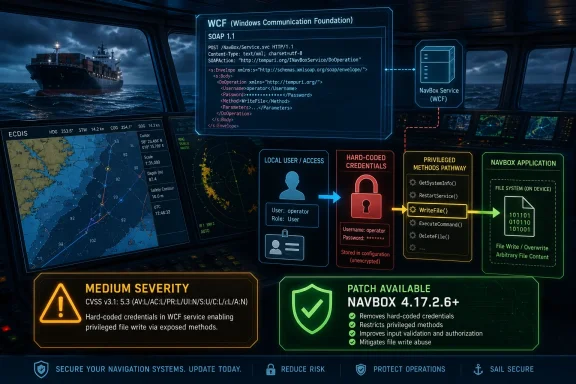
A Medium-Severity Bug With a Very Maritime Blast Radius
The headline score is modest: CVSS 3.1 rates CVE-2026-21404 at 6.3, while CVSS 4.0 places it at 5.8. Those numbers are easy to skim past in an enterprise vulnerability queue already drowning in critical browser bugs, edge-device zero-days, and VPN advisories. The catch is that NavBox is not just another Windows-adjacent application sitting on a clerk’s workstation.
NAVTOR’s NavBox sits in a maritime context, where chart updates, navigation data movement, and ship-shore workflows are operationally meaningful. A file write in a normal business app may mean corrupted reports or a nuisance outage. A file write inside a navigation-data workflow may mean delayed updates, broken trust in transferred data, or a system that has to be pulled into manual verification at exactly the wrong moment.
CISA’s advisory is careful about scope. The vulnerability requires local access, prior low privileges, high attack complexity, and enabled SOAP functionality. It is not remotely exploitable by default, and CISA has no reported evidence of public exploitation targeting this specific flaw.
That combination explains the score. It does not explain the risk posture. Maritime OT environments often run as a mix of vendor appliances, Windows systems, legacy integration points, satellite links, and bridge-adjacent networks that were designed more for reliability than hostile lateral movement. In that setting, “local attacker” can mean someone who has already landed on a nearby system and is now looking for quiet ways to turn access into operational leverage.
The Hard-Coded Credential Is the Oldest Shortcut in the Newest Stack
The technical core of CVE-2026-21404 is depressingly familiar: hard-coded credentials. In this case, the credentials exist within NavBox’s Windows Communication Foundation implementation for SOAP. If the relevant SOAP functionality is enabled, an attacker with local access can extract credentials and use them to bypass the intended transfer workflow.
That phrase, “intended transfer workflow,” matters. Many industrial and maritime systems depend on narrow pathways: data should move from one component to another through a vendor-approved process, with assumptions about validation, sequencing, and permissions. The vulnerability does not merely expose a password; it exposes a trust boundary that the product itself was supposed to enforce.
Once authenticated to the SOAP interface, the attacker can access privileged WCF methods. CISA describes the impact as the ability to write or overwrite files within application-defined paths. That is not arbitrary remote code execution, but it is still operationally serious because files are how these systems express state, configuration, update packages, logs, and handoffs.
Hard-coded credentials are especially toxic in packaged operational technology because customers usually cannot rotate them, inspect them easily, or place them under normal identity governance. In a corporate domain, a compromised service account can be disabled, reissued, scoped, audited, and monitored. In an embedded or appliance-like workflow, the secret may be welded into the product until the vendor ships a fix.
SOAP Was Supposed to Be Boring, Which Is Why It Still Matters
SOAP and WCF do not have the cultural glamour of modern API security. They are the plumbing of older enterprise software: verbose, structured, strongly typed, and often wrapped around internal workflows that were never expected to become the front line of an intrusion. That is precisely why defenders should care when CISA calls out a SOAP implementation in a maritime product.
Windows Communication Foundation was built for service-oriented applications and remains present in many environments because it solved real integration problems. Vendors could expose methods, define contracts, and move data between components in a way that felt disciplined compared with ad hoc scripts and shared folders. Over time, those service layers became part of the hidden nervous system of industrial products.
The problem is that internal service interfaces often accumulate privilege. They are built to make the product work, not to survive creative abuse by someone already inside the network. If authentication is anchored to a secret that ships with the product, then the interface may be strong only against honest clients.
That is the lesson for Windows administrators reading a maritime advisory and wondering why it belongs on their radar. WCF, SOAP, and vendor service layers remain common across industrial software, medical systems, manufacturing tooling, fleet management products, and niche enterprise applications. The code may be old-fashioned; the risk is current.
The Local-Only Limitation Is Comforting Until It Isn’t
CISA explicitly says this vulnerability is not exploitable remotely. That should shape response priorities. It means organizations do not need to assume every exposed internet scan is about to become a NavBox compromise chain. It also means patching can be handled with operational planning rather than panic, especially where connected systems are already receiving automatic updates.
But “not remotely exploitable” is not the same as “not useful to an attacker.” Many serious OT incidents begin with mundane IT footholds: stolen credentials, phishing, remote access abuse, exposed management services, or compromised vendor laptops. Once inside, attackers look for exactly this kind of flaw: an internal interface with more privilege than its users, weak assumptions about local trust, and a narrow but meaningful operational effect.
The CVSS vector captures this nuance. Attack complexity is high, privileges are required, and the attack is local. At the same time, integrity and availability impacts are high under CVSS 3.1. That is a sharp contrast: difficult to reach, but consequential if reached.
For defenders, the right mental model is not “drop everything.” It is “do not let this become the quiet second step.” If a bridge-adjacent or vessel operations network already has weak segmentation, shared credentials, overbroad administrator access, or rarely reviewed vendor services, a local-only flaw can become part of a realistic intrusion path.
Automatic Updates Are the Best Case, Not a Governance Strategy
NAVTOR’s remediation is straightforward: version 4.17.2.6 and later includes the fix. The vendor says users with an active NavBox connection will automatically be kept up to date, with no user action required. That is the kind of sentence administrators like to read, and in many environments it will be enough to close the immediate exposure.
Still, automatic updating in OT is never quite as simple as it sounds. Ships may have intermittent connectivity, maintenance windows, bandwidth constraints, or operational policies that delay vendor updates. Some operators may have systems intentionally isolated, partially connected, or dependent on support channels that do not match the vendor’s ideal deployment model.
That means the practical question is not only “did NAVTOR ship a patch?” It is “which installed units are actually running 4.17.2.6 or later?” In an IT estate, that would be a routine inventory query. In maritime environments, especially across fleets and mixed ownership models, it may require coordination among ship operators, IT teams, ECDIS administrators, vendors, and managed service providers.
The advisory’s reassuring “no user action required” should therefore be treated as a hypothesis to verify, not a conclusion to file away. Connected NavBox deployments may already be fixed. Disconnected or irregularly connected deployments deserve a manual check.
CISA’s Boilerplate Is Doing Real Work Here
The defensive guidance attached to the advisory is standard CISA ICS language: minimize network exposure, keep control systems off the internet, place control networks and remote devices behind firewalls, isolate them from business networks, and use updated VPNs for remote access where necessary. Because that language appears so often, it is tempting to read it as compliance wallpaper.
In this case, it is directly relevant. The vulnerability requires local access and enabled SOAP functionality. Segmentation, remote access discipline, and firewalling are exactly the controls that determine whether “local” means “a tightly controlled maintenance host” or “any compromised laptop on a flat vessel network.”
CISA also recommends impact analysis and risk assessment before deploying defensive measures. That caveat matters in maritime systems because security fixes can have operational side effects. Blocking a service, changing a network path, or interrupting a vendor update workflow without understanding dependencies can create the very disruption defenders are trying to prevent.
The sober approach is to verify version status first, then inspect exposure. Is SOAP enabled? Which hosts can reach the interface? Which users can log on locally or interact with the system? Are vendor support pathways restricted and logged? Are file paths touched by the application monitored for unexpected writes?
This Advisory Fits a Pattern Around NavBox Scrutiny
CVE-2026-21404 is not arriving in isolation. Earlier reporting this year described other NAVTOR NavBox issues involving missing authentication, path traversal, and exposure of operational information in older versions. Those previous flaws were different in mechanics and impact, but they pointed at the same broader theme: maritime connectivity products are increasingly being examined as cyber-physical trust brokers rather than simple appliances.
That scrutiny is healthy. For years, the maritime sector’s security conversation focused heavily on satellite communications, port systems, ransomware, and regulatory pressure. The bridge and navigation-data ecosystem sometimes sat in a quieter category: important, specialized, and vendor-managed. As researchers spend more time with these products, the hidden assumptions in update flows, service interfaces, and local APIs are becoming more visible.
It would be unfair to treat one advisory as proof of systemic failure by a vendor. NAVTOR has issued a fix, CISA lists no known exploitation, and the attack path is constrained. But it would also be naïve to see this as a one-off programming mistake divorced from architecture.
The real issue is how much trust operational products place in locality, obscurity, and fixed secrets. A device can be safely designed for a world where only authorized software calls its internal methods. The moment an attacker gets close enough to impersonate that software, the whole bargain changes.
Windows Admins Should Read This as an Identity Story
For WindowsForum readers, the most interesting detail may not be maritime at all. It is identity. A WCF SOAP interface protected by hard-coded credentials is an identity system that cannot adapt when the environment changes.
Modern Windows administration has spent years moving away from static secrets: managed service accounts, certificate-based authentication, conditional access, endpoint detection, privileged access workstations, and just-in-time administration all exist because fixed credentials are brittle. Yet niche vendor software often still carries old assumptions into environments that are now heavily monitored, remotely administered, and exposed to supply-chain pressure.
The result is a split brain. The enterprise domain may be governed by mature controls, while the vendor application beside it uses internal authentication that no domain policy can rotate. The SIEM may know every failed Entra ID login, while a local service method accepts a credential no one in IT can manage.
That is why vulnerability management should include application-level service interfaces, not just operating systems and ports. A patched Windows host can still run a vendor service with dangerous internal assumptions. Conversely, a medium-severity vendor advisory can point to a privilege boundary more important than its numeric score implies.
The Patch Is Simple; The Verification Is the Work
The immediate mitigation is refreshingly concrete: get to NavBox 4.17.2.6 or later. For actively connected deployments, NAVTOR says the update should arrive automatically. For everyone else, the job is to confirm, document, and avoid assuming.
Fleet operators should treat the advisory as a prompt to reconcile inventory. Which vessels or sites run NavBox? Which versions are installed? Which devices have active update connections? Which systems are isolated or lagging behind? Which support contracts or vendor channels are responsible for manual remediation?
Security teams should also review whether SOAP functionality is enabled and reachable beyond what is operationally necessary. If the interface is not needed, disable or restrict it according to vendor guidance. If it is needed, make sure reachability is narrow, monitored, and isolated from broader user networks.
The file-write consequence deserves particular attention. Application-defined paths can sound limited, but operational products often define paths that matter. Monitoring unexpected modifications, validating update packages, and protecting configuration directories may provide useful detection even where the underlying patch is already being deployed.
The Real Fix Is to Stop Shipping Secrets as Architecture
Hard-coded credentials are not merely a vulnerability class; they are a product-management failure mode. They usually appear because a system needs a service-to-service trust relationship, and the fastest way to create one is to hide a credential in the code or configuration. That can work for years, right up until the system becomes interesting enough for someone to reverse engineer it.
The better patterns are well known: unique per-device credentials, customer-rotatable secrets, certificate enrollment, scoped tokens, least-privilege service accounts, and explicit administrative controls for enabling or disabling interfaces. None of these are exotic. They are simply harder to implement in constrained products, legacy codebases, and operational environments where breaking compatibility is expensive.
Vendors serving critical infrastructure should assume that local interfaces will be examined, credentials will be extracted, and “trusted network” assumptions will fail. That does not mean every product must be hardened like a cloud identity provider. It does mean secrets should not be universal, unchangeable, and powerful enough to bypass intended workflows.
Customers, meanwhile, should stop accepting black-box trust as a feature. If an appliance exposes local services, administrators should ask how those services authenticate, whether credentials are unique, whether they can be rotated, and what happens if the interface is abused. Those questions are procurement issues as much as security issues.
The NavBox Lesson Is Smaller Than a Breach and Larger Than a Patch
The practical response to CVE-2026-21404 is narrow, but the lesson is wider. Treat this as a contained advisory that exposes a recurring weakness in operational software design: privileged internal workflows are often protected by assumptions rather than adaptable controls.
- NAVTOR NavBox 4.16.1.20 is affected by CVE-2026-21404 when the SOAP functionality is enabled.
- NAVTOR says NavBox 4.17.2.6 and later contains the fix, with automatic updates for systems that maintain an active NavBox connection.
- CISA says there is no known public exploitation targeting this vulnerability and that it is not remotely exploitable.
- The vulnerability still matters because successful local abuse can grant access to privileged WCF methods and allow writes or overwrites within application-defined paths.
- Administrators should verify installed versions rather than assume automatic updating has completed across every vessel, site, or isolated deployment.
- Segmentation, restricted remote access, and monitoring of vendor service interfaces are the controls that keep local-only bugs from becoming useful intrusion steps.
The maritime industry has been moving steadily from isolated equipment toward connected operational platforms, and advisories like this show the cost of that transition in miniature. The fix for this specific NavBox flaw is already available, but the strategic work is slower: inventory the systems that quietly move trusted data, challenge the hidden credentials inside them, and design the next generation of operational software so that “local” no longer means “trusted by default.”
References
- NAVTOR NavBox CISA · 2026-06-04T12:00:00+00:00