

The Department of the Navy awarded four Joint Warfighting Cloud Capability task orders in June 2026 to Amazon Web Services, Microsoft Azure, Google Public Sector, and Oracle America, giving each provider a dedicated vehicle for consolidated Navy and Marine Corps cloud consumption. The move is not merely another GovCon win for the hyperscalers. It is the Navy admitting that cloud modernization now depends as much on acquisition plumbing as it does on servers, regions, and AI services. If Neptune works as advertised, the sea services get faster buying, better volume pricing, and a cleaner route from mission need to approved cloud capacity.
For years, federal cloud modernization has been narrated as a technology story: agencies escaping data centers, developers embracing elastic compute, commanders demanding data at the edge, and security teams trying to bring order to sprawling environments. The Navy’s Neptune awards point to a less glamorous but more decisive layer of the problem. The bottleneck is often not whether AWS, Azure, Google Cloud, or Oracle Cloud can technically host a workload; it is whether a mission owner can acquire, connect, secure, and fund that capability quickly enough to matter.
That is why the phrase “one dedicated task order” matters. Each of the four cloud providers now has a consolidated task order covering the department’s use of that provider’s services. In plain English, the Navy is trying to stop every program office from having to reinvent cloud procurement on its own.
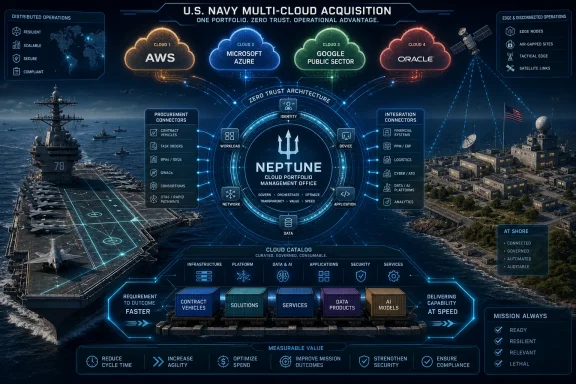
Neptune’s role is equally important. Chartered by Navy CIO and acquisition leadership, the Neptune Cloud Management Office is positioned as the Navy’s primary cloud portfolio manager and unified point of entry for cloud services. That sounds bureaucratic until you consider the alternative: fragmented cloud buys, inconsistent governance, uneven discounts, and mission teams spending too much time navigating process instead of delivering capability.
The Navy is not abandoning multi-cloud; it is trying to make multi-cloud administratively survivable. In a defense environment where workloads may span unclassified collaboration, secret processing, tactical edge operations, and classified analytics, “use the cloud” is not a strategy. A portfolio office that can match mission requirements to approved providers, standard patterns, and known security boundaries is the strategy.
JWCC was the reset. Awarded in December 2022 to AWS, Microsoft, Google, and Oracle, it gave the Defense Department a multiple-award, indefinite-delivery/indefinite-quantity vehicle worth up to $9 billion. The intent was obvious: preserve access to commercial cloud at multiple classification levels while avoiding the optics and operational risks of betting the department’s future on one vendor.
But creating a multi-vendor contract vehicle does not automatically produce a working cloud ecosystem. It creates a menu. Someone still has to manage ordering, usage, governance, security patterns, cost controls, and the messy reality that different missions will land in different clouds for reasons that are sometimes technical, sometimes contractual, and sometimes historical.
That is where Neptune’s awards fit. They are not the birth of the Pentagon’s cloud program; they are a sign that the Navy is moving from contract availability to portfolio discipline. The department is trying to make JWCC usable at scale, not merely available in theory.
The second promise is cost control. By centralizing consumption, the Navy expects steeper volume discounts from providers. Hyperscale cloud pricing rewards commitment, predictability, and aggregated demand; fragmented buyers often pay for optionality without receiving enterprise-level leverage.
This is where government cloud has always been awkward. Agencies want the elasticity and service breadth of commercial cloud, but federal acquisition rewards planning, approvals, and controls. Neptune is trying to square that circle by making the Navy look more like a single enterprise customer to the hyperscalers while still allowing mission owners to choose among providers.
There is also a governance benefit that may matter more than the headline discounts. When usage is consolidated, visibility improves. Spend can be tracked more consistently, security baselines can be enforced with fewer exceptions, and duplicate environments become easier to identify before they harden into permanent budget lines.
The risk, of course, is that centralization can become another gate. If Neptune becomes a service broker that accelerates mission teams, the Navy gains leverage. If it becomes a slow approval layer with better branding, cloud buyers will route around it or wait resentfully in line.
The earlier Google and Oracle JWCC task orders, awarded through PEO Digital in late 2025, already showed where the Navy wants this to go. Those awards emphasized Google Cloud Platform and Oracle Cloud Infrastructure landing zones, cross-cloud interoperability, cloud computing through Impact Level 6, air-gapped edge options, and access to AI and machine learning tools. In defense cloud language, that is not a generic modernization checklist; it is a signal that the Navy wants mission owners to treat cloud as a warfighting substrate.
Microsoft’s Azure Government Secret offering was another piece of the same puzzle. The Navy had already worked with Microsoft in classified government cloud, and the new consolidated Azure task order gives that relationship a clearer portfolio wrapper. AWS, meanwhile, remains foundational across much of the government cloud market and is now part of the same consolidated Navy consumption model.
The result is not a perfectly neutral marketplace. Each provider brings different strengths, accreditation histories, service catalogs, pricing models, and operational assumptions. But the Navy is increasingly structuring its cloud estate so that “which cloud?” becomes an engineering and mission decision rather than a procurement adventure every time.
That is why the Navy’s reference to AI and machine learning capabilities in earlier Google and Oracle awards matters. AI workloads are hungry for data locality, high-performance compute, identity controls, and access to governed datasets. They also expose the weakness of fragmented infrastructure faster than almost any traditional application.
A mission team that wants to train, tune, deploy, or run inference against sensitive operational data cannot afford months of acquisition delay followed by bespoke security engineering. It needs approved landing zones, defined data paths, identity integration, and connectivity that can survive both compliance review and operational stress. Neptune’s model is designed to make those patterns repeatable.
This does not mean every Navy workload becomes an AI workload. It means AI is forcing the cloud estate to become less artisanal. The old pattern of isolated cloud projects, each with its own funding path and security model, is poorly suited to systems that need shared data, scalable compute, and auditable controls.
Azure Government and Azure Government Secret have obvious relevance for Microsoft-heavy environments. Many federal customers already depend on Microsoft identity, productivity, endpoint, and security tooling, and cloud task orders can deepen that gravity. A Navy program that standardizes around Microsoft services may find easier integration with Entra ID, Defender, Intune, Windows Server workloads, and existing administrator skill sets.
But the multi-cloud framing means admins should not assume a single-stack future. A mission application could live on AWS, analytics could use Google tooling, a database-heavy workload could land on Oracle infrastructure, and identity or endpoint controls could still intersect with Microsoft services. The operational challenge becomes less “learn one cloud” and more “operate securely across several clouds without losing visibility.”
That is where centralized portfolio management can help or hurt. If Neptune standardizes identity patterns, logging expectations, network connectivity, and authorization models across providers, administrators get a fighting chance. If each provider task order evolves into its own kingdom, the Navy may simply trade procurement fragmentation for operational fragmentation.
Cloud in this context does not always mean a workload running in a distant commercial region. It can mean cloud-like services deployed closer to the mission, synchronized when possible, and governed under the same security and operational model as larger environments. The edge is where elegant cloud strategy meets saltwater reality.
The Pentagon’s broader cloud direction has increasingly emphasized AI, edge computing, and cross-domain operations. Neptune’s task orders should be read in that context. The Navy is trying to build a cloud marketplace and management model that can support both office productivity and mission systems operating under severe constraints.
The hard part will be lifecycle management. Edge systems need patching, monitoring, credential handling, data synchronization, and incident response. They also need to remain usable when disconnected from the very enterprise services that make cloud manageable in the first place.
Cloud pricing is notoriously difficult even in commercial environments. Egress fees, reserved capacity, managed services, support tiers, specialized compute, compliance overhead, and migration costs can all distort simple comparisons. A low unit price can become expensive if the workload architecture is wrong; a premium service can be cost-effective if it eliminates months of engineering.
Neptune’s challenge is therefore analytical as much as contractual. It has to know what the Navy is buying, which services are being consumed, where workloads are overprovisioned, and when one provider is being chosen for habit rather than mission fit. The office cannot merely route demand; it has to develop enough technical and financial literacy to challenge demand.
This is where FinOps becomes a defense issue. Cloud cost management is not just a spreadsheet discipline when workloads support operational missions. Poor visibility can waste money, but it can also mask architectural fragility, unused attack surface, and ungoverned data movement.
That reflects a broader shift in how defense IT thinks about cloud. The question is no longer whether commercial cloud can be made compliant enough for sensitive workloads. The question is whether it can be integrated into mission architectures that continue functioning under stress.
Multi-cloud can improve resiliency, but it can also create complexity that becomes its own failure mode. Applications rarely become portable simply because an agency has contracts with four hyperscalers. Data models, identity systems, managed services, observability tools, and security controls all create dependencies.
The Navy appears to understand that provider diversity is not the same thing as resilience. That is why the emphasis on landing zones, dedicated connections, and central management matters. The architecture around the cloud is as important as the cloud provider itself.
That should not diminish the awards. If anything, it makes them more significant. The Navy is building muscle memory for centralized cloud consumption before the next procurement framework fully arrives.
The risk is transition churn. Defense IT has a long history of programs reaching maturity just as the contract vehicle, policy language, or organizational chart changes underneath them. Neptune’s work will be valuable only if its patterns survive beyond the current JWCC construct.
The opportunity is that the Navy can shape the successor by proving what actually works. If consolidated task orders reduce acquisition time, increase discount leverage, and improve operational visibility, those lessons should carry into the next cloud marketplace. If they do not, the Pentagon will have another abstraction layer to redesign.
That matters because cloud delay is often disguised as caution. Some caution is warranted, especially in classified and operational environments. But when every migration becomes a bespoke procurement and compliance expedition, the organization quietly chooses legacy risk over modernization risk.
The Navy is trying to change that default. By consolidating provider usage under dedicated task orders, Neptune is saying that the department wants cloud consumption to become a managed enterprise function rather than an exception-driven activity.
The move does not guarantee better software, better security, or better mission outcomes. It does, however, remove one of the most common institutional excuses for slow modernization: that the path to approved cloud capacity is too confusing, too fragmented, or too slow to navigate.
 The Navy Is Turning Cloud Buying Into a Command Function
For years, federal cloud modernization has been narrated as a technology story: agencies escaping data centers, developers embracing elastic compute, commanders demanding data at the edge, and security teams trying to bring order to sprawling environments. The Navy’s Neptune awards point to a less glamorous but more decisive layer of the problem. The bottleneck is often not whether AWS, Azure, Google Cloud, or Oracle Cloud can technically host a workload; it is whether a mission owner can acquire, connect, secure, and fund that capability quickly enough to matter.That is why the phrase “one dedicated task order” matters. Each of the four cloud providers now has a consolidated task order covering the department’s use of that provider’s services. In plain English, the Navy is trying to stop every program office from having to reinvent cloud procurement on its own.
Neptune’s role is equally important. Chartered by Navy CIO and acquisition leadership, the Neptune Cloud Management Office is positioned as the Navy’s primary cloud portfolio manager and unified point of entry for cloud services. That sounds bureaucratic until you consider the alternative: fragmented cloud buys, inconsistent governance, uneven discounts, and mission teams spending too much time navigating process instead of delivering capability.
The Navy is not abandoning multi-cloud; it is trying to make multi-cloud administratively survivable. In a defense environment where workloads may span unclassified collaboration, secret processing, tactical edge operations, and classified analytics, “use the cloud” is not a strategy. A portfolio office that can match mission requirements to approved providers, standard patterns, and known security boundaries is the strategy.
JWCC Was Born From JEDI’s Failure, but Neptune Is About the Day After
The Joint Warfighting Cloud Capability contract exists because the Pentagon’s earlier cloud gamble collapsed under the weight of its own politics and procurement design. The canceled Joint Enterprise Defense Infrastructure contract was built around a single-award model, with Microsoft selected for a deal that could have reached $10 billion. Legal protests, vendor rivalry, and questions over the acquisition eventually made JEDI more famous as a cautionary tale than as an IT program.JWCC was the reset. Awarded in December 2022 to AWS, Microsoft, Google, and Oracle, it gave the Defense Department a multiple-award, indefinite-delivery/indefinite-quantity vehicle worth up to $9 billion. The intent was obvious: preserve access to commercial cloud at multiple classification levels while avoiding the optics and operational risks of betting the department’s future on one vendor.
But creating a multi-vendor contract vehicle does not automatically produce a working cloud ecosystem. It creates a menu. Someone still has to manage ordering, usage, governance, security patterns, cost controls, and the messy reality that different missions will land in different clouds for reasons that are sometimes technical, sometimes contractual, and sometimes historical.
That is where Neptune’s awards fit. They are not the birth of the Pentagon’s cloud program; they are a sign that the Navy is moving from contract availability to portfolio discipline. The department is trying to make JWCC usable at scale, not merely available in theory.
Consolidation Is the Real Product Being Bought
The most immediate promise is faster acquisition. Neptune says the task orders should help mission owners acquire cloud services more quickly and shorten acquisition timelines. That is the line every agency writes in every modernization announcement, but here it has a concrete mechanism behind it: fewer one-off contracting paths and more usage flowing through consolidated provider-specific task orders.The second promise is cost control. By centralizing consumption, the Navy expects steeper volume discounts from providers. Hyperscale cloud pricing rewards commitment, predictability, and aggregated demand; fragmented buyers often pay for optionality without receiving enterprise-level leverage.
This is where government cloud has always been awkward. Agencies want the elasticity and service breadth of commercial cloud, but federal acquisition rewards planning, approvals, and controls. Neptune is trying to square that circle by making the Navy look more like a single enterprise customer to the hyperscalers while still allowing mission owners to choose among providers.
There is also a governance benefit that may matter more than the headline discounts. When usage is consolidated, visibility improves. Spend can be tracked more consistently, security baselines can be enforced with fewer exceptions, and duplicate environments become easier to identify before they harden into permanent budget lines.
The risk, of course, is that centralization can become another gate. If Neptune becomes a service broker that accelerates mission teams, the Navy gains leverage. If it becomes a slow approval layer with better branding, cloud buyers will route around it or wait resentfully in line.
Multi-Cloud Is No Longer a Slogan for the Sea Services
The Navy’s expanded lineup is being sold around competition, catalog breadth, and resiliency. Those are familiar cloud talking points, but they carry particular weight in a military environment. A commercial enterprise might pursue multi-cloud to avoid lock-in or optimize costs; a military department also has to think about disconnected operations, classified enclaves, mission assurance, and the possibility that a workload may need to move closer to the fight.The earlier Google and Oracle JWCC task orders, awarded through PEO Digital in late 2025, already showed where the Navy wants this to go. Those awards emphasized Google Cloud Platform and Oracle Cloud Infrastructure landing zones, cross-cloud interoperability, cloud computing through Impact Level 6, air-gapped edge options, and access to AI and machine learning tools. In defense cloud language, that is not a generic modernization checklist; it is a signal that the Navy wants mission owners to treat cloud as a warfighting substrate.
Microsoft’s Azure Government Secret offering was another piece of the same puzzle. The Navy had already worked with Microsoft in classified government cloud, and the new consolidated Azure task order gives that relationship a clearer portfolio wrapper. AWS, meanwhile, remains foundational across much of the government cloud market and is now part of the same consolidated Navy consumption model.
The result is not a perfectly neutral marketplace. Each provider brings different strengths, accreditation histories, service catalogs, pricing models, and operational assumptions. But the Navy is increasingly structuring its cloud estate so that “which cloud?” becomes an engineering and mission decision rather than a procurement adventure every time.
AI Makes the Cloud Fight More Urgent
The timing is impossible to ignore. Defense cloud modernization is no longer only about moving applications out of legacy hosting environments. It is about creating the compute, data, and security foundation for artificial intelligence, autonomous systems, cyber defense, and faster operational planning.That is why the Navy’s reference to AI and machine learning capabilities in earlier Google and Oracle awards matters. AI workloads are hungry for data locality, high-performance compute, identity controls, and access to governed datasets. They also expose the weakness of fragmented infrastructure faster than almost any traditional application.
A mission team that wants to train, tune, deploy, or run inference against sensitive operational data cannot afford months of acquisition delay followed by bespoke security engineering. It needs approved landing zones, defined data paths, identity integration, and connectivity that can survive both compliance review and operational stress. Neptune’s model is designed to make those patterns repeatable.
This does not mean every Navy workload becomes an AI workload. It means AI is forcing the cloud estate to become less artisanal. The old pattern of isolated cloud projects, each with its own funding path and security model, is poorly suited to systems that need shared data, scalable compute, and auditable controls.
The Windows Angle Is Identity, Endpoint, and the Admin Reality
For WindowsForum readers, the obvious hook is Microsoft Azure, but the practical story is broader than one provider. Navy and Marine Corps cloud modernization will touch identity, endpoint management, zero trust enforcement, secure collaboration, application hosting, and hybrid administration. Those are the places where Windows administrators, Azure engineers, and security teams will feel cloud portfolio decisions long before they see a glossy AI demo.Azure Government and Azure Government Secret have obvious relevance for Microsoft-heavy environments. Many federal customers already depend on Microsoft identity, productivity, endpoint, and security tooling, and cloud task orders can deepen that gravity. A Navy program that standardizes around Microsoft services may find easier integration with Entra ID, Defender, Intune, Windows Server workloads, and existing administrator skill sets.
But the multi-cloud framing means admins should not assume a single-stack future. A mission application could live on AWS, analytics could use Google tooling, a database-heavy workload could land on Oracle infrastructure, and identity or endpoint controls could still intersect with Microsoft services. The operational challenge becomes less “learn one cloud” and more “operate securely across several clouds without losing visibility.”
That is where centralized portfolio management can help or hurt. If Neptune standardizes identity patterns, logging expectations, network connectivity, and authorization models across providers, administrators get a fighting chance. If each provider task order evolves into its own kingdom, the Navy may simply trade procurement fragmentation for operational fragmentation.
The Edge Will Test the Whole Model
The Navy’s cloud problem is harder than a headquarters IT migration because ships, submarines, expeditionary Marine units, and forward-deployed commands do not live in tidy enterprise network conditions. Connectivity can be constrained, contested, intermittent, or deliberately isolated. That is why air-gapped edge options and dedicated connections matter.Cloud in this context does not always mean a workload running in a distant commercial region. It can mean cloud-like services deployed closer to the mission, synchronized when possible, and governed under the same security and operational model as larger environments. The edge is where elegant cloud strategy meets saltwater reality.
The Pentagon’s broader cloud direction has increasingly emphasized AI, edge computing, and cross-domain operations. Neptune’s task orders should be read in that context. The Navy is trying to build a cloud marketplace and management model that can support both office productivity and mission systems operating under severe constraints.
The hard part will be lifecycle management. Edge systems need patching, monitoring, credential handling, data synchronization, and incident response. They also need to remain usable when disconnected from the very enterprise services that make cloud manageable in the first place.
Competition Is Useful, but Only If the Navy Can Measure It
The Navy says the expanded lineup will increase competition among providers, drive pricing and innovation, and give mission owners a wider catalog. That is plausible, but competition inside a government cloud vehicle is not automatic. Vendors compete when buyers can compare offerings, switch when appropriate, and understand total cost beyond the first invoice.Cloud pricing is notoriously difficult even in commercial environments. Egress fees, reserved capacity, managed services, support tiers, specialized compute, compliance overhead, and migration costs can all distort simple comparisons. A low unit price can become expensive if the workload architecture is wrong; a premium service can be cost-effective if it eliminates months of engineering.
Neptune’s challenge is therefore analytical as much as contractual. It has to know what the Navy is buying, which services are being consumed, where workloads are overprovisioned, and when one provider is being chosen for habit rather than mission fit. The office cannot merely route demand; it has to develop enough technical and financial literacy to challenge demand.
This is where FinOps becomes a defense issue. Cloud cost management is not just a spreadsheet discipline when workloads support operational missions. Poor visibility can waste money, but it can also mask architectural fragility, unused attack surface, and ungoverned data movement.
The Security Story Is Resiliency, Not Just Compliance
Government cloud announcements often lean heavily on compliance language: impact levels, authorizations, classified environments, and approved services. Those details matter, but the Navy’s stated emphasis on resiliency is the more interesting security claim. Dedicated connections and private infrastructure are being framed as ways to reduce single points of failure.That reflects a broader shift in how defense IT thinks about cloud. The question is no longer whether commercial cloud can be made compliant enough for sensitive workloads. The question is whether it can be integrated into mission architectures that continue functioning under stress.
Multi-cloud can improve resiliency, but it can also create complexity that becomes its own failure mode. Applications rarely become portable simply because an agency has contracts with four hyperscalers. Data models, identity systems, managed services, observability tools, and security controls all create dependencies.
The Navy appears to understand that provider diversity is not the same thing as resilience. That is why the emphasis on landing zones, dedicated connections, and central management matters. The architecture around the cloud is as important as the cloud provider itself.
The Contract Vehicle Is Already Looking Toward Its Successor
JWCC’s original period of performance points toward 2028, and the Pentagon has already been discussing what comes next. Recent reporting around the follow-on cloud framework has emphasized a more marketplace-oriented model, expanded AI and edge capabilities, and a broader ecosystem of offerings. In other words, the Navy’s Neptune awards are happening while the Defense Department is already designing the next turn of the crank.That should not diminish the awards. If anything, it makes them more significant. The Navy is building muscle memory for centralized cloud consumption before the next procurement framework fully arrives.
The risk is transition churn. Defense IT has a long history of programs reaching maturity just as the contract vehicle, policy language, or organizational chart changes underneath them. Neptune’s work will be valuable only if its patterns survive beyond the current JWCC construct.
The opportunity is that the Navy can shape the successor by proving what actually works. If consolidated task orders reduce acquisition time, increase discount leverage, and improve operational visibility, those lessons should carry into the next cloud marketplace. If they do not, the Pentagon will have another abstraction layer to redesign.
Neptune’s Four-Cloud Bet Leaves Administrators With Fewer Excuses
The practical reading is that cloud adoption inside the Navy and Marine Corps should become easier to start and harder to ignore. Mission owners will still have to solve application modernization, security engineering, budgeting, and data governance. But the acquisition pathway is being deliberately cleaned up.That matters because cloud delay is often disguised as caution. Some caution is warranted, especially in classified and operational environments. But when every migration becomes a bespoke procurement and compliance expedition, the organization quietly chooses legacy risk over modernization risk.
The Navy is trying to change that default. By consolidating provider usage under dedicated task orders, Neptune is saying that the department wants cloud consumption to become a managed enterprise function rather than an exception-driven activity.
The move does not guarantee better software, better security, or better mission outcomes. It does, however, remove one of the most common institutional excuses for slow modernization: that the path to approved cloud capacity is too confusing, too fragmented, or too slow to navigate.
The Contract Details Are Dry, but the Consequences Are Concrete
The important points are easy to lose under the weight of acronyms, but they are not abstract.- The Navy now has dedicated JWCC task orders for AWS, Microsoft Azure, Google Public Sector, and Oracle America.
- Each provider’s task order is intended to consolidate the department’s consumption of that provider’s cloud services.
- Neptune is positioned as the Navy’s primary cloud portfolio manager and unified entry point for cloud services.
- The Navy expects centralized consumption to shorten acquisition timelines and improve pricing through larger-volume commitments.
- The strategy keeps the Navy on a multi-cloud path while trying to reduce the administrative chaos that multi-cloud can create.
- The real test will be whether Neptune improves operational visibility, security consistency, and edge-ready mission delivery rather than merely creating a cleaner procurement front door.
References
- Primary source: ExecutiveBiz
Published: 2026-06-17T04:30:53.582099
Navy's Neptune Awards Four JWCC Cloud Task Orders
The Navy's Neptune Cloud Management Office awarded JWCC task orders to AWS, Microsoft Azure, Google and Oracle. www.executivebiz.com
- Related coverage: executivegov.com
Navy Awards JWCC Task Orders to Google, Oracle for Cloud Capabilities
Google and Oracle will provide the Navy access to cloud landing zones and advanced tools, such as generative AI.www.executivegov.com - Related coverage: dvidshub.net
DVIDS - News - Department of the Navy awards cloud computing task orders for Google Cloud Platform, Oracle Cloud Infrastructure
The U.S. Navy’s Program Executive Office for Digital and Enterprise Services has awarded Joint Warfighting Capability Cloud task orders to Google Public Sector and Oracle America to expand the Department of the Navy’s cloud computing portfolio. The agreements, managed through the Neptune Cloud...www.dvidshub.net - Related coverage: techtarget.com
Amazon, Google, Microsoft, Oracle win JWCC contract | TechTarget
Four major cloud vendors won the Department of Defense Joint Warfighting Cloud Capability (JWCC) contract to speed DOD's access to cloud services and tech.www.techtarget.com - Related coverage: landoffset.com
JWCC Unified Cloud Marketplace (UCM): Pentagon's Next-Generation Cloud Acquisition Framework - DOD Tech Market - Never land on the X
Joint Warfighting Cloud Capability Unified Cloud Marketplace (JWCC UCM) Program Designation: JWCC Unified Cloud Marketplace (UCM) Previous Designation: JWCC Next Contracting Agency: Defense Information Systems Agency (… landoffset.com
- Related coverage: govconfeed.com
Pentagon Unveils JWCC Successor With New AI, Edge, and…
DISA's draft performance-of-work statement for the JWCC Unified Cloud Marketplace introduces a three-tier structure with a first-ever dedicated on-ramp for small and nontraditional cloud firms, mandates AI/ML at all classification levels, and requires edge cloud operations in DDIL...govconfeed.com
- Related coverage: afcea.org
Lofty Goals for the Next Version of the Military Cloud
DISA officials update next steps for cloud, storage and compute services.www.afcea.org - Related coverage: datacenterdynamics.com
Oracle nabs $88.1m cloud contract from US Air Force - DCD
The latest contract issued under the Cloud One programwww.datacenterdynamics.com - Related coverage: defensescoop.com
Pentagon’s JWCC follow-on would create cloud marketplace, expand AI and edge computing | DefenseScoop
The Pentagon's next iteration of the Joint Warfighting Cloud Capability (JWCC) contract would establish a cloud marketplace for military users while expanding support for AI, edge computing and cross-domain operations, according to a draft solicitation.defensescoop.com - Related coverage: oracle.com
Untitled
Secure, low-cost, AI-enabled cloud infrastructure supporting the Department of Defense through JWCCwww.oracle.com
- Related coverage: compmittlilme.weebly.com
- Related coverage: pages.awscloud.com
