
Nestlé’s announcement that it has joined a high-profile industry initiative to scale enterprise AI is more than a PR milestone — it’s a clear signal that the world’s largest food-and-beverage company is moving from experimental pilots to operationalized, company-wide AI. The company’s Chief Information Officer, Chris Wright, put it bluntly: “AI isn’t a pilot at Nestlé; it’s already at work from farm to fork.” That claim is echoed across multiple corporate and industry statements describing a unified digital backbone built on a single ERP template, broad deployment of Microsoft Copilot across the workforce, and large-scale use cases ranging from contract review and recipe optimization to factory digital twins and personalized consumer recommendations. For IT leaders and WindowsForum readers, Nestlé’s approach is a real-world playbook for turning enterprise AI into measurable business processes — and a case study in the trade-offs that come with scale.
Nestlé’s AI push is anchored on two foundational moves that few consumer goods companies can match at scale: consolidation of global operations on a single Enterprise Resource Planning platform, and rapid adoption of AI productivity tools by a significant portion of the workforce.
Benefits:
What digital twins enable:
How it works:
Advantages:
Benefits:
At the same time, the program exemplifies the intrinsic trade-offs of enterprise AI: dependency on large platform vendors, the need for airtight governance, and the imperative of human oversight to prevent errors in safety-critical and consumer-facing scenarios. For IT leaders, the lesson is clear: the path from pilot to production requires more than models — it demands standardized data, rigorous MLOps, robust governance, and sustained investment in people and processes.
As AI moves from novelty to operational backbone, the companies that succeed will be those that treat AI not as a toolkit but as an integrated element of enterprise architecture — one governed with the same discipline applied to finance, manufacturing, and food safety. Nestlé’s experience offers a forward-looking blueprint, but it also reminds the industry that scale amplifies both opportunity and responsibility.
Source: AI Magazine Frontier Firm AI: How Nestlé Uses AI to Drive Performance
 Background / Overview
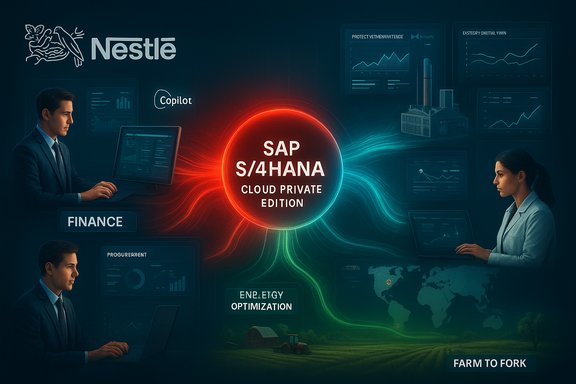
Nestlé’s AI push is anchored on two foundational moves that few consumer goods companies can match at scale: consolidation of global operations on a single Enterprise Resource Planning platform, and rapid adoption of AI productivity tools by a significant portion of the workforce.- The company operates on a single ERP business process template, a standardization effort that dates back decades and has recently been modernized on SAP S/4HANA Cloud Private Edition. That digital core is explicitly framed as the platform upon which automation and AI can reliably run across finance, procurement, manufacturing, sales, and HR.
- Nestlé reports that more than 100,000 employees — a sizeable share of its global headcount — are regular users of AI tools such as Microsoft Copilot, with usage metrics averaging over 40 prompts per user per month. Those numbers represent company-reported operationalization rather than experimental pilot activity.
- The firm has positioned applied AI use cases across the value chain: contract analysis in procurement, digital twins and energy/asset optimization in factories, R&D recipe optimization, forecasting and logistics, and personalized consumer engagement.
How Nestlé Built an AI-Ready Digital Backbone
The single-ERP strategy: why it matters
Standardizing on a single ERP template isn’t merely an IT convenience — it’s a strategic enabler of enterprise AI. When business processes are harmonized across markets and functions, data flows become predictable, master data is consistent, and model inputs are comparable. That makes it feasible to deploy:- Cross-domain analytics and models that rely on unified financial, procurement, and production data.
- Conversational agents and copilot integrations that can surface context-specific insights (for example, “show me stock levels for SKU X in region Y”) without translating across incompatible systems.
- Enterprise agents and workflows that automate routine work while preserving audit trails.
Data foundations and shared services
A modern enterprise AI program needs more than a unified ERP — it requires shared data lakes, identity and access controls, MLOps pipelines, and API-first integration layers. Nestlé’s public descriptions emphasize:- Centralized data foundations that standardize product, supplier, and plant master data.
- Integration of conversational AI directly into business systems (ERP copilot integrations).
- Use of enterprise-level agents that act as domain-aware assistants attached to workflows.
Practical Use Cases: From Procurement to the Factory Floor
Procurement and contract analytics
Procurement at multinational companies is notoriously complex: suppliers span geographies, local terms differ, and contracts can number in the hundreds of thousands. Nestlé describes using AI to automate contract review and to detect inconsistencies between global template language and local execution.Benefits:
- Rapid detection of exceptions and non-standard clauses at scale.
- Faster supplier onboarding and renegotiation workflows.
- Reduced legal and commercial risk through consistent review.
- Contract analysis models must be tuned for legal nuance and local law variations. Automated flags are useful, but final legal judgment requires human review.
- Data privacy and confidentiality for supplier contracts require careful access controls and encryption.
Factory optimization and digital twins
Nestlé runs hundreds of factories globally. The company reports using digital twins — virtual replicas of equipment, lines, and processes — to monitor energy consumption, predict equipment failures, and maintain food safety compliance.What digital twins enable:
- Predictive maintenance that reduces downtime and lowers maintenance costs.
- Energy optimization by testing parameter changes in silico before applying them to production lines.
- Continuous monitoring of critical quality parameters to reduce food-safety risk.
- Digital twin fidelity depends on sensor granularity and data pipeline quality. Low signal-to-noise ratios or missing telemetry reduce model utility.
- Integration with operational technology (OT) must include robust cybersecurity controls to prevent attack vectors between enterprise networks and industrial control systems.
R&D and recipe optimization
One of the more visible consumer-facing uses is AI-assisted recipe optimization. Nestlé’s R&D teams reportedly use tools that balance consumer preference, nutrition, cost, and sustainability impact to design new products or reformulate existing ones.How it works:
- Models ingest sensory preference data, ingredient properties, cost inputs, and emissions/sustainability scores.
- Optimization algorithms propose formulations that meet multi-objective constraints.
- Human experts validate sensory outcomes and regulatory compliance before commercialization.
- Sensory and cultural preferences are complex and sometimes poorly captured by datasets. Human tasting and iterative trials remain essential.
- Ingredient supply constraints and regulatory labeling rules in different markets can invalidate an otherwise optimal formulation.
Forecasting, planning, and logistics
AI-driven demand forecasting and inventory optimization are some of the most immediate productivity plays for consumer goods companies. Nestlé highlights improvements in planning and logistics that come from combining ERP data with machine learning.Advantages:
- Better alignment of production with demand reduces stockouts and excess inventory.
- Route and logistics optimization lower transport emissions and costs.
- Scenario modeling supports resilience planning for supplier disruptions.
- Forecasting models must incorporate seasonality, promotions, retail partner actions, and macroeconomic signals.
- Models should be continuously recalibrated; stale models can lead to costly mis-forecasts.
Personalization and consumer engagement
AI recommendation systems power more relevant content and product suggestions across digital channels. Nestlé mentions consumer personalization — for example, in pet care services and targeted content — as part of its AI footprint.Benefits:
- Higher engagement and conversion through tailored experiences.
- Better understanding of consumer preferences to guide product innovation.
- Personalization requires careful consent management, particularly when combining first-party, second-party, and inferred behavioral signals.
- Regulatory regimes (privacy laws, advertising standards) vary by market and must be respected.
Technical Architecture and Tools
Core platforms
- SAP S/4HANA Cloud Private Edition as the ERP backbone provides unified master data, finance, procurement, and manufacturing processes.
- Microsoft Copilot and Copilot Chat supply conversational AI interfaces and productivity enhancements across the workforce.
- Enterprise agents and embedded copilot capabilities are described as being integrated into business workflows and ERP screens.
Model lifecycle and MLOps
Large-scale AI deployment requires MLOps discipline:- Data ingestion and cleaning pipelines with schema validation.
- Model training with reproducible environments and version control.
- Continuous evaluation using holdout test sets and real-world performance monitoring.
- Deployment into production via API gateways with observability and rollback capabilities.
- Periodic retraining and governance reviews to ensure models remain accurate and fair.
Measured Benefits and Business Impact
Nestlé frames the business case around speed, quality, and scale:- Faster time-to-market for products via recipe optimization and standardized rollout processes.
- Efficiency gains in procurement and operations through automation of routine review tasks and predictive analytics.
- Improved sustainability outcomes by optimizing energy usage and reducing waste in factories.
- Productivity uplift from Copilot-enabled knowledge work, with company-reported high engagement metrics.
Risks, Trade-offs, and Governance Challenges
Large-scale AI adoption in a consumer goods context introduces several risks that require explicit mitigation:- Vendor concentration and platform lock-in. Heavy reliance on a particular ERP vendor and a single cloud/AI provider increases strategic exposure. Negotiation leverage, portability, and exit plans should be part of procurement strategy.
- Data governance and trust. Centralized data platforms simplify modeling but also centralize risk. Proper access controls, encryption, and provenance tracking are mandatory to avoid unauthorized data exposure.
- Model risk and hallucinations. Generative AI, if used for content or recipe suggestions, can hallucinate facts or misattribute scientific claims. Human review and verification are essential for any consumer-facing output, particularly in nutrition and safety contexts.
- Privacy and regulatory compliance. Personalization and consumer analytics must adhere to privacy laws across jurisdictions. Consent management, data minimization, and audit trails are required.
- Cybersecurity. OT integration for digital twins introduces lateral attack risks. Segmentation, identity management, and intrusion detection on industrial networks are critical.
- Workforce impacts. While Copilot can increase productivity, it also changes skill requirements. Reskilling programs and clear role definitions are essential to avoid dislocation.
- Sustainability claims verification. Using AI to estimate sustainability is valuable, but quantifying emissions and supply-chain impacts often relies on indirect proxies. Independent verification and transparent methodologies are needed to substantiate claims.
Operational Best Practices: How to Make Enterprise AI Work
For organizations seeking to replicate Nestlé’s playbook, the following operational practices are recommended:- Standardize processes and master data before scaling models. Clean inputs yield reliable outputs.
- Start with high-impact, low-regret use cases (contract review, forecasting) to build credibility and governance.
- Invest in MLOps and observability from day one to ensure model reliability and explainability.
- Embed human-in-the-loop checkpoints for any model that affects safety, compliance, or consumer-facing outputs.
- Build cross-functional teams: data scientists, domain experts (procurement, manufacturing, R&D), legal, and IT/security.
- Create a vendor strategy that balances innovation access with portability and contractual protections.
- Provide company-wide training so employees can use copilots responsibly and understand model limitations.
- Publish clear AI policies addressing privacy, acceptable use, and escalation paths for model errors.
Strategic Implications for the Industry
Nestlé’s approach underscores two strategic truths for enterprise AI:- Scale multiplies both benefit and risk. When AI is embedded across thousands of plants and tens of thousands of employees, small model errors or governance gaps can have outsized operational and reputational consequences.
- Platform plays matter. Companies that invest in a single, consistent operational backbone (ERP + data foundation) enable repeatable AI use cases. That advantage can translate into faster global rollouts and more consistent consumer experiences.
What to Watch Next
- The degree to which Nestlé opens its playback and measurement to independent review will determine how influential its playbook becomes as an industry standard.
- Progress on explainability and audit tooling for AI in regulated contexts (food safety, nutrition claims) will be a bellwether for broader adoption across fast-moving consumer goods.
- Advances in copilot integrations embedded in ERP (conversational queries that directly trigger workflows) will reveal how much routine knowledge work can be automated without degrading control or oversight.
- Responses from regulators and consumer groups — particularly in markets with stringent privacy and advertising rules — will shape acceptable guardrails for personalization and content generation.
Conclusion
Nestlé’s stated strategy — anchored by a unified ERP core, broad employee access to Copilot-style tools, and targeted AI applications across procurement, manufacturing, R&D, and consumer engagement — represents one of the most mature enterprise AI deployments in consumer goods. The benefits are tangible: faster product development, smarter forecasting, more efficient factories, and personalized consumer interactions.At the same time, the program exemplifies the intrinsic trade-offs of enterprise AI: dependency on large platform vendors, the need for airtight governance, and the imperative of human oversight to prevent errors in safety-critical and consumer-facing scenarios. For IT leaders, the lesson is clear: the path from pilot to production requires more than models — it demands standardized data, rigorous MLOps, robust governance, and sustained investment in people and processes.
As AI moves from novelty to operational backbone, the companies that succeed will be those that treat AI not as a toolkit but as an integrated element of enterprise architecture — one governed with the same discipline applied to finance, manufacturing, and food safety. Nestlé’s experience offers a forward-looking blueprint, but it also reminds the industry that scale amplifies both opportunity and responsibility.
Source: AI Magazine Frontier Firm AI: How Nestlé Uses AI to Drive Performance
