

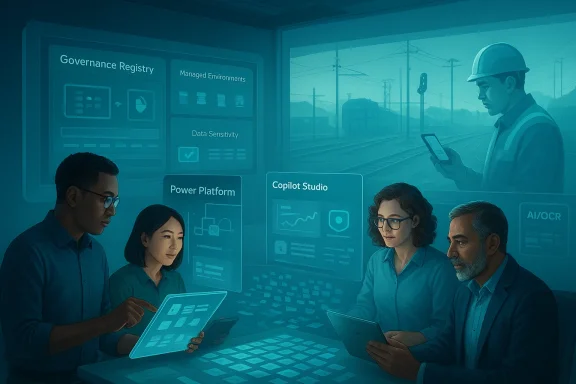
Over 2,500 makers at Network Rail are now building business solutions with Microsoft Power Platform and Copilot Studio, and that scale matters far beyond a single customer success story. It points to a broader shift in enterprise software: governed low-code is no longer just a productivity sidecar, but a core operating model for large, complex organizations. Network Rail’s approach shows how an industrial business can combine citizen development, professional engineering, and AI-assisted governance without letting the whole thing descend into chaos. The real story is not merely that people are building more apps; it is that the company is trying to build a repeatable system for innovation at scale.
Network Rail’s use of Power Platform sits squarely in the mainstream of Microsoft’s current low-code strategy, where the emphasis has moved from simple app creation to managed, AI-assisted business transformation. Microsoft has repeatedly positioned Power Platform and Copilot Studio as tools for both citizen developers and professional teams, with managed governance, AI generation, and enterprise controls layered into the workflow. Network Rail’s story reflects that direction closely, especially in the way it combines maker empowerment with a central center of excellence and a formal cataloging process.
The rail operator’s environment makes this particularly interesting. Large transport organizations tend to have a mix of field operations, asset management, compliance obligations, and legacy systems that are difficult to modernize through traditional software delivery alone. In that context, low-code becomes more than convenience; it becomes a way to distribute solution creation closer to the work itself while keeping the technology stack manageable.
Microsoft’s customer story suggests that Network Rail has leaned into this model with unusual breadth. The company has built a maker community, introduced governance and registration mechanisms, and expanded the use of premium services like Dataverse. It has also started using AI Builder, Plans in Power Apps, and generative pages to speed development, which indicates a move from “low-code as automation” to “low-code as AI-native delivery.”
The significance is twofold. First, it shows that a large operational business can support thousands of makers if it invests in community and guardrails. Second, it shows that the next phase of low-code will likely be defined by agentic assistance and natural-language solution assembly, not just drag-and-drop development.
That scale creates a very different governance challenge. When only a few dozen people build apps, the central team can afford to know each solution intimately. When the population reaches the thousands, the bottleneck becomes visibility, standards, and reuse. Network Rail appears to have recognized that the only sustainable answer is to make the community itself part of the operating model.
The story also highlights the social infrastructure behind the technology. Monthly community calls, lunch-and-learns, and an internal communication site help makers support one another instead of relying on a small core team for every “how do I?” question. That is a major point, because most low-code programs fail not on tooling, but on the absence of shared habits, patterns, and trust.
That registry is more than an inventory. It is a way to answer the questions that keep enterprise architects awake at night: What exists? Who owns it? What data does it touch? Is anyone actually using it? And can we avoid building three different solutions to solve the same problem? In a highly distributed maker environment, those questions are not administrative trivia; they are the difference between scaling innovation and accumulating hidden technical debt.
The use of Managed Environments is especially important here. Microsoft has increasingly positioned this capability as the operational backbone for organizations with lots of apps and flows, and Network Rail’s adoption of it suggests the company is serious about maintaining control without slowing makers down. Automated sharing limits, routing from default to productivity environments, maker welcome content, and quality checks all help keep the system from drifting into sprawl.
According to the customer story, Network Rail values Dataverse’s out-of-the-box security model, including data retention and auditing controls, along with the ability to create custom roles. Those features matter because the minute an organization begins digitizing operational processes at scale, questions of data lineage, access control, and auditability become central business issues rather than IT concerns.
It is also notable that Network Rail wants to leverage its knowledge base more widely across applications while keeping control. That suggests an architectural goal of standardization: instead of every team inventing its own data structure, the organization can centralize important reference data and business logic in a more governable layer.
This is where low-code starts to merge with conversational computing. Instead of filling in forms manually, makers can ask an agent to help classify a solution, capture its business purpose, or guide them through registration requirements. In practice, that reduces friction at the exact point where governance often loses the battle—when users are in a hurry and compliance feels optional.
The story also aligns with Microsoft’s broader push toward agentic workflows. Copilot Studio is increasingly positioned as a tool for building business agents that can assist with tasks, connect systems, and automate process steps without custom code. Network Rail’s use case is especially interesting because it is not customer-facing; it is operational and internal, where speed, correctness, and discoverability matter more than polished UX.
That may sound modest compared with “AI transformation” rhetoric, but operationally it is the kind of change that delivers real value. Paper-based processes are slow, error-prone, and difficult to integrate into modern reporting workflows. A mobile, AI-assisted capture process can cut rework, reduce transcription errors, and improve timeliness for downstream systems.
The broader implication is that low-code plus AI works best when it solves an annoying, repetitive task that people already tolerate. Those are exactly the cases where organizations can generate measurable savings without asking workers to change everything about how they operate.
This dramatically compresses the ideation-to-prototype cycle. According to the story, the tools helped produce a prototype for a leadership conference in less than an hour, and Connelly says what used to take days or weeks can now be done in hours or minutes. The exact speed will vary by complexity, of course, but the directional change is hard to miss.
For enterprises, this is not just about developer productivity. It changes how business stakeholders engage with technology teams. If a prototype can be produced while the customer is still describing the problem, then the feedback loop becomes much tighter and the risk of building the wrong thing falls sharply.
That matters because the best enterprise low-code programs are hybrid programs. They blend citizen developers, analysts, operations staff, and professional engineers into a single capability model. In that arrangement, pro developers can set architectural standards, extend the platform when needed, and mentor less technical makers without becoming a bottleneck.
The quote praising former apprentices also hints at a long-term workforce strategy. Rather than treating technical skill as something imported only from outside, Network Rail is cultivating it internally. That can improve retention, strengthen cultural alignment, and create a more sustainable talent pipeline for digital transformation.
That combination is attractive to large organizations already invested in Microsoft 365, Azure, and adjacent security and identity services. The more a company uses Microsoft’s stack, the easier it becomes to extend that environment into low-code development and AI-driven workflows. For rivals, that means the challenge is no longer just feature parity; it is meeting customers where they already work.
There is also an ecosystem effect. The more makers and professional teams build on Power Platform, the more internal standards, templates, and skills accumulate around it. That creates inertia, which is valuable for customers and formidable for competitors. Once a platform becomes embedded in daily operations, switching costs are not only technical but organizational.
For consumers, the impact is more indirect but still meaningful. When organizations like Network Rail improve asset workflows, field operations, and decision speed, the effects can ripple outward into more reliable services and better operational performance. Consumers do not see the app catalog or the governance registry, but they do feel the downstream consequences of better internal execution.
That distinction is important because enterprise tech stories often overstate the visible glamour of AI while understating the mundane value of process improvement. Here, the visible layer is the maker story, but the real effect lives in faster readings, better data, and more dependable operations.
At the same time, the story suggests that Microsoft’s vision for Power Platform is maturing. The company is no longer just selling “citizen development” in the abstract; it is selling a complete enterprise operating model in which AI assists makers, governance protects the platform, and data control keeps the whole thing coherent. Network Rail is a strong example of how that vision can take root in a real business.
In that sense, the story is less about a product announcement than about a management breakthrough. The real achievement is the alignment of people, process, and platform at a scale that few organizations can sustain. If Network Rail keeps that balance intact, the next chapter may matter even more than the current milestone.
Source: Microsoft Network Rail empowers over 2,500 makers to build innovative business solutions with Power Platform and Copilot Studio | Microsoft Customer Stories
 Overview
Network Rail’s use of Power Platform sits squarely in the mainstream of Microsoft’s current low-code strategy, where the emphasis has moved from simple app creation to managed, AI-assisted business transformation. Microsoft has repeatedly positioned Power Platform and Copilot Studio as tools for both citizen developers and professional teams, with managed governance, AI generation, and enterprise controls layered into the workflow. Network Rail’s story reflects that direction closely, especially in the way it combines maker empowerment with a central center of excellence and a formal cataloging process.The rail operator’s environment makes this particularly interesting. Large transport organizations tend to have a mix of field operations, asset management, compliance obligations, and legacy systems that are difficult to modernize through traditional software delivery alone. In that context, low-code becomes more than convenience; it becomes a way to distribute solution creation closer to the work itself while keeping the technology stack manageable.
Microsoft’s customer story suggests that Network Rail has leaned into this model with unusual breadth. The company has built a maker community, introduced governance and registration mechanisms, and expanded the use of premium services like Dataverse. It has also started using AI Builder, Plans in Power Apps, and generative pages to speed development, which indicates a move from “low-code as automation” to “low-code as AI-native delivery.”
The significance is twofold. First, it shows that a large operational business can support thousands of makers if it invests in community and guardrails. Second, it shows that the next phase of low-code will likely be defined by agentic assistance and natural-language solution assembly, not just drag-and-drop development.
The Scale of the Maker Community
The headline figure is striking: more than 2,500 makers are contributing to business solutions inside Network Rail. That is not a pilot, and it is not a small departmental initiative. It is evidence of a broad internal culture shift in which employees are expected to help solve operational problems rather than simply submit requests to IT.That scale creates a very different governance challenge. When only a few dozen people build apps, the central team can afford to know each solution intimately. When the population reaches the thousands, the bottleneck becomes visibility, standards, and reuse. Network Rail appears to have recognized that the only sustainable answer is to make the community itself part of the operating model.
The story also highlights the social infrastructure behind the technology. Monthly community calls, lunch-and-learns, and an internal communication site help makers support one another instead of relying on a small core team for every “how do I?” question. That is a major point, because most low-code programs fail not on tooling, but on the absence of shared habits, patterns, and trust.
Why community matters more than tooling
Tooling can make app creation easier, but only community makes scale possible. When makers can learn from peers, re-use components, and see examples in context, the organization’s rate of adoption rises without a matching increase in central staffing. That is especially important for a company like Network Rail, where the business demand for solutions will always outpace the supply of specialist developers.- Peer support reduces dependency on the central team.
- Shared examples accelerate new maker onboarding.
- Community rituals make low-code feel legitimate, not hobbyist.
- Informal networking helps identify reusable solution patterns.
- Cross-functional visibility lowers the risk of duplicated effort.
Governance at Enterprise Scale
If the maker community is the engine, governance is the chassis. Network Rail’s approach makes it clear that a large Power Platform footprint cannot be managed by enthusiasm alone. The company is working on a registration system that catalogs apps and flows, captures ownership, and records business value, data sensitivity, and usage.That registry is more than an inventory. It is a way to answer the questions that keep enterprise architects awake at night: What exists? Who owns it? What data does it touch? Is anyone actually using it? And can we avoid building three different solutions to solve the same problem? In a highly distributed maker environment, those questions are not administrative trivia; they are the difference between scaling innovation and accumulating hidden technical debt.
The use of Managed Environments is especially important here. Microsoft has increasingly positioned this capability as the operational backbone for organizations with lots of apps and flows, and Network Rail’s adoption of it suggests the company is serious about maintaining control without slowing makers down. Automated sharing limits, routing from default to productivity environments, maker welcome content, and quality checks all help keep the system from drifting into sprawl.
What governance looks like when it works
Good governance in low-code is invisible when it succeeds and painfully obvious when it fails. In the Network Rail model, the goal is not to restrict makers but to shape their behavior early, before one-off solutions become hard-to-manage dependencies. That is a subtle but crucial distinction.- Registration creates accountability.
- Cataloging enables discovery and reuse.
- Data sensitivity tracking supports compliance.
- Usage reporting highlights business relevance.
- Automated controls reduce manual review load.
Dataverse as the Control Plane
Network Rail’s expanded use of Dataverse deserves attention because it signals a move toward a more structured application backbone. In Microsoft’s ecosystem, Dataverse is not just another data store; it is the platform’s security, governance, and application data layer. That makes it especially valuable for organizations that want low-code speed without sacrificing control.According to the customer story, Network Rail values Dataverse’s out-of-the-box security model, including data retention and auditing controls, along with the ability to create custom roles. Those features matter because the minute an organization begins digitizing operational processes at scale, questions of data lineage, access control, and auditability become central business issues rather than IT concerns.
It is also notable that Network Rail wants to leverage its knowledge base more widely across applications while keeping control. That suggests an architectural goal of standardization: instead of every team inventing its own data structure, the organization can centralize important reference data and business logic in a more governable layer.
Why Dataverse changes the equation
Dataverse is useful not because it is fashionable, but because it shifts low-code development from a collection of isolated apps into a more coherent platform. For enterprises, that means better lifecycle management, clearer security, and a lower risk of data fragmentation.- Security is built into the data layer.
- Auditing supports compliance and investigation.
- Custom roles help align access with job functions.
- Shared data reduces duplication across apps.
- Standardization makes support easier over time.
Copilot Studio and Natural-Language Registration
One of the most forward-looking parts of the story is the plan to add an AI agent to the registration system using Copilot Studio. The idea is simple but powerful: makers will be able to complete governance tasks faster by describing what they need in natural language. That is the kind of workflow change that sounds small until you imagine it repeated across thousands of users.This is where low-code starts to merge with conversational computing. Instead of filling in forms manually, makers can ask an agent to help classify a solution, capture its business purpose, or guide them through registration requirements. In practice, that reduces friction at the exact point where governance often loses the battle—when users are in a hurry and compliance feels optional.
The story also aligns with Microsoft’s broader push toward agentic workflows. Copilot Studio is increasingly positioned as a tool for building business agents that can assist with tasks, connect systems, and automate process steps without custom code. Network Rail’s use case is especially interesting because it is not customer-facing; it is operational and internal, where speed, correctness, and discoverability matter more than polished UX.
AI as a governance accelerator
The best AI use cases in enterprise software are often the least glamorous. They do not necessarily dazzle with chat interfaces; they quietly remove steps, interpret intent, and help users do the right thing more consistently. That is exactly the promise here.- Natural-language input lowers the barrier to compliance.
- Agents can standardize how makers describe solutions.
- Faster registration improves catalog quality.
- Guided onboarding reduces support tickets.
- Automation frees the central team for higher-value work.
AI in the Field
Network Rail is not using AI only to support makers; it is also using it to improve frontline work. One example in the story is a solution that helps field workers capture gas and electricity meter readings more efficiently. By using OCR capabilities in AI Builder, the company has replaced a manual paper-based process with a digital one that should improve speed and accuracy.That may sound modest compared with “AI transformation” rhetoric, but operationally it is the kind of change that delivers real value. Paper-based processes are slow, error-prone, and difficult to integrate into modern reporting workflows. A mobile, AI-assisted capture process can cut rework, reduce transcription errors, and improve timeliness for downstream systems.
The broader implication is that low-code plus AI works best when it solves an annoying, repetitive task that people already tolerate. Those are exactly the cases where organizations can generate measurable savings without asking workers to change everything about how they operate.
From manual capture to digital workflow
Field operations are often the hardest part of enterprise digitization because they happen in variable environments with limited time and connectivity. That makes them ideal candidates for pragmatic AI applications that do one thing well.- OCR reduces manual transcription.
- Digital capture improves data quality.
- Faster entry shortens processing delays.
- Less paper reduces operational friction.
- Standardized forms improve reporting consistency.
AI-Assisted Development Speed
The customer story says Network Rail is also using Plans in Power Apps and generative pages to accelerate solution development. That is significant because it shifts the conversation from app building to app co-creation. Makers can describe a use case, let the system draft a solution structure, and then refine the result using natural language.This dramatically compresses the ideation-to-prototype cycle. According to the story, the tools helped produce a prototype for a leadership conference in less than an hour, and Connelly says what used to take days or weeks can now be done in hours or minutes. The exact speed will vary by complexity, of course, but the directional change is hard to miss.
For enterprises, this is not just about developer productivity. It changes how business stakeholders engage with technology teams. If a prototype can be produced while the customer is still describing the problem, then the feedback loop becomes much tighter and the risk of building the wrong thing falls sharply.
Why rapid prototyping changes stakeholder behavior
When the prototype appears quickly, decision-making changes. Stakeholders are more likely to refine ideas in real time rather than wait for a distant delivery date. That can improve requirements quality and reduce the organizational overhead of long discovery cycles.- Faster prototypes shorten time to validation.
- Business users see ideas become tangible sooner.
- Feedback is based on real screens, not slide decks.
- The team can test feasibility before overcommitting.
- Iteration becomes part of the conversation from day one.
Talent, Apprenticeships, and the Pro-Developer Pipeline
A strong maker ecosystem needs more than enthusiastic business users. It also needs professional developers who can handle the complex or highly integrated work that low-code tools should not be expected to solve alone. Network Rail appears to have understood that balance, and its apprenticeship scheme has helped produce top developers who now lead the pro-development side of the team.That matters because the best enterprise low-code programs are hybrid programs. They blend citizen developers, analysts, operations staff, and professional engineers into a single capability model. In that arrangement, pro developers can set architectural standards, extend the platform when needed, and mentor less technical makers without becoming a bottleneck.
The quote praising former apprentices also hints at a long-term workforce strategy. Rather than treating technical skill as something imported only from outside, Network Rail is cultivating it internally. That can improve retention, strengthen cultural alignment, and create a more sustainable talent pipeline for digital transformation.
Building a hybrid delivery model
The most successful Power Platform organizations tend to recognize that not every solution should be built the same way. Simpler departmental workflows can be handled by makers, while complex integrations and mission-critical services need professional oversight.- Apprenticeships create internal career paths.
- Pro developers anchor technical quality.
- Citizen makers address local needs quickly.
- Shared standards keep the portfolio coherent.
- Mentorship helps spread best practice.
The Competitive Landscape
Network Rail’s story also has competitive implications, even if they are indirect. Across industries, Microsoft is competing with other low-code, automation, and AI platforms that promise similar outcomes with different trade-offs. The differentiator here is not just app creation, but the combination of governance, enterprise data control, AI assistance, and ecosystem familiarity.That combination is attractive to large organizations already invested in Microsoft 365, Azure, and adjacent security and identity services. The more a company uses Microsoft’s stack, the easier it becomes to extend that environment into low-code development and AI-driven workflows. For rivals, that means the challenge is no longer just feature parity; it is meeting customers where they already work.
There is also an ecosystem effect. The more makers and professional teams build on Power Platform, the more internal standards, templates, and skills accumulate around it. That creates inertia, which is valuable for customers and formidable for competitors. Once a platform becomes embedded in daily operations, switching costs are not only technical but organizational.
Why rivals should pay attention
The market is moving toward platforms that can support both scale and governance. Organizations do not want “shadow IT” masquerading as innovation, and they do not want heavy central IT processes to slow everything down. The companies that solve that tension most convincingly will have an advantage.- Low-code must scale without losing oversight.
- AI features must reduce friction, not create noise.
- Governance has to be built-in, not bolted on.
- Community and training are strategic assets.
- Platform stickiness increases with successful reuse.
Enterprise vs Consumer Impact
For enterprises, the message is clear: Power Platform and Copilot Studio are increasingly being used as infrastructure for serious business operations, not just quick departmental tools. Network Rail’s use of governance systems, Dataverse, and managed environments shows that low-code can support regulated, operationally intensive work when the right controls are in place.For consumers, the impact is more indirect but still meaningful. When organizations like Network Rail improve asset workflows, field operations, and decision speed, the effects can ripple outward into more reliable services and better operational performance. Consumers do not see the app catalog or the governance registry, but they do feel the downstream consequences of better internal execution.
That distinction is important because enterprise tech stories often overstate the visible glamour of AI while understating the mundane value of process improvement. Here, the visible layer is the maker story, but the real effect lives in faster readings, better data, and more dependable operations.
Internal efficiency versus external service
The best enterprise platforms ultimately have to serve both sides of the organization: the employees who build and run systems, and the customers or citizens affected by those systems. If the internal machinery gets better, external outcomes often improve too.- Better governance supports continuity.
- Faster prototyping improves responsiveness.
- Cleaner data improves operational quality.
- More automation reduces avoidable delays.
- Shared platforms create standard operating patterns.
Strengths and Opportunities
Network Rail’s approach has several obvious strengths, and just as importantly, it reveals where the next wave of value may come from. The combination of community, governance, and AI-assisted development gives the organization a credible path to scaling innovation without losing control. It also suggests that the company is building for the long term rather than chasing isolated productivity wins.- Scale with structure: More than 2,500 makers can contribute without overwhelming the central team.
- Community-led adoption: Peer support reduces dependence on formal help desks.
- Governed innovation: Cataloging and ownership rules reduce duplication and shadow IT.
- Dataverse discipline: Stronger data control improves security and reuse.
- AI acceleration: Copilot Studio and generative tools can cut delivery time dramatically.
- Hybrid talent model: Apprenticeship and pro-dev pathways strengthen resilience.
- Operational relevance: Field and back-office use cases tie technology to real business outcomes.
Risks and Concerns
The same factors that make the story compelling also create risk. A maker community of this size can produce tremendous value, but it can also create fragmentation if governance slips, if data standards vary, or if the AI tools generate incomplete or misleading guidance. The promise of speed is real, but so is the danger of becoming too fast to supervise effectively.- Solution sprawl: Thousands of apps can become hard to track without disciplined inventory management.
- Quality drift: Rapid creation can lead to inconsistent user experiences and brittle workflows.
- AI errors: Natural-language assistance may misclassify requirements or oversimplify controls.
- Change management: Users may resist new governance steps if they feel slowed down.
- Data sensitivity risks: Poor classification could expose sensitive operational information.
- Overreliance on a platform: Heavy dependence on one vendor can increase strategic lock-in.
- Support complexity: As the portfolio grows, debugging and lifecycle management become more demanding.
Looking Ahead
The next phase for Network Rail will likely be defined by whether it can turn these tools into a self-reinforcing operating system for innovation. If the registration agent, governance controls, and maker community all work together, the company could reduce friction enough to make app creation feel almost routine. That would be a substantial achievement, especially in a sector where reliability and compliance matter deeply.At the same time, the story suggests that Microsoft’s vision for Power Platform is maturing. The company is no longer just selling “citizen development” in the abstract; it is selling a complete enterprise operating model in which AI assists makers, governance protects the platform, and data control keeps the whole thing coherent. Network Rail is a strong example of how that vision can take root in a real business.
- Expansion of AI-assisted governance through Copilot Studio.
- Broader adoption of Dataverse-backed applications.
- Further automation of field and operational workflows.
- Continued growth of maker-to-maker support structures.
- Deeper use of generative features for rapid prototyping.
- Potential reuse of successful patterns across more business units.
In that sense, the story is less about a product announcement than about a management breakthrough. The real achievement is the alignment of people, process, and platform at a scale that few organizations can sustain. If Network Rail keeps that balance intact, the next chapter may matter even more than the current milestone.
Source: Microsoft Network Rail empowers over 2,500 makers to build innovative business solutions with Power Platform and Copilot Studio | Microsoft Customer Stories
Last edited:
