

The New Zealand Geotechnical Database has become a striking example of how public-interest infrastructure can evolve when engineering data, cloud computing, and AI assistants are brought together with clear rules and strong governance. Born from the hard lessons of the February 2011 Christchurch earthquake, the platform started as a practical way to stop geotechnical information from being trapped in silos and duplicated across projects. In its latest form, it runs on Microsoft Azure, is surfaced through Beca’s BEYON digital twin platform, and now uses an agentic AI layer to help users query sub-surface data in plain language. That combination is not just a technology refresh; it is a model for how a country can turn recovery-era data into a long-lived national asset. (building.govt.nz)
The story of the NZGD starts with a disaster that reshaped New Zealand’s approach to engineering knowledge. The 22 February 2011 Christchurch earthquake killed 185 people and left the city center badly damaged, forcing engineers to make urgent decisions about repair, demolition, land stability, and future rebuilding. That challenge exposed a simple but expensive problem: geotechnical data existed, but it was scattered, inconsistent, and often inaccessible when people needed it most.
From that need came the Canterbury Geotechnical Database, launched in 2013 under the Canterbury Earthquake Recovery Authority. Its purpose was not glamorous, but it was consequential: centralize subsurface data so engineers could reuse what had already been gathered instead of drilling fresh boreholes every time a new project began. Building Performance guidance later noted that the database has grown into a searchable web-based resource and that the Canterbury response produced a major body of lessons about ground behavior, liquefaction, and foundation design.
Over time, the platform expanded beyond Canterbury and was rebranded as the New Zealand Geotechnical Database. By the time the Ministry of Business, Innovation and Employment sought proposals for a new host, the database had accumulated thousands of users and roughly 168,000 geotechnical tests had been uploaded and shared. That scale matters because geotechnical information becomes more valuable as more contributors add to it; the database is not just storage, it is a compounding knowledge base. (building.govt.nz)
Beca’s proposal to host the updated NZGD on BEYON, its digital twin platform, was accepted, and the modern version launched in November 2024. The platform moved onto an SQL database on Microsoft Azure, with access controls such as Azure Entra ID, and Beca framed the overhaul around secure, standards-compliant, spatially aware data management. In late 2025, the company then added an agentic AI layer built with Microsoft Foundry to let users filter, query, and extract data using natural language. (building.govt.nz)
The important shift is not just technical but operational. Traditional geotechnical workflows often require specialists to dig through reports, coordinate across agencies, and reconcile inconsistent formats before they can reach a decision. An AI layer that can surface the right borehole logs, test results, or site records faster changes the economics of decision-making, especially in time-sensitive projects where delays are costly and risk is high. The NZGD is therefore a case study in how cloud modernization and controlled AI can improve an already critical civic workflow. (building.govt.nz)
That variability is why the original database idea landed so strongly. Instead of treating subsurface information as a project-by-project byproduct, Christchurch’s recovery effort treated it as a shared resource. This was a practical answer to a painful problem: if one consultant already drilled, logged, and analyzed a site, another team should not have to start from zero. The result was a stronger evidence base for rebuilding decisions and a more disciplined approach to urban resilience. (building.govt.nz)
That is why a shared repository has long-term value. It reduces duplication, improves consistency, and gives engineers access to richer context when they are assessing ground conditions for transport corridors, housing, utilities, or public works. The NZGD’s role is not merely archival; it is to make engineering work faster and more reliable. (building.govt.nz)
The phrase “national asset” is not marketing fluff here; it describes a reusable public-good dataset that can inform multiple sectors. That includes housing, transport, water infrastructure, and climate adaptation planning. The more data is uploaded, the more useful the database becomes, which is exactly the kind of network effect infrastructure policymakers like to see. (building.govt.nz)
The cloud migration also made access management more robust. With Azure Entra ID in place, the platform can support stronger identity controls and a more enterprise-grade security posture. For a database that contains technical data used in real-world decisions, that is not a minor improvement; it is a prerequisite for broader trust and adoption. (building.govt.nz)
This is where the upgrade becomes strategically interesting. A database that can connect geotechnical records to spatial analytics can help users see context, not just records. In engineering, context is often the difference between a useful answer and a misleading one, so the platform’s architecture is doing real analytical work even before AI enters the picture. (building.govt.nz)
Enterprise users care about reliability, interoperability, and permissioning. A system that is secure, searchable, and standards-based is easier to embed into corporate workflows, regulatory submissions, and project planning. The business case is therefore both direct and indirect: better tools can support better engineering outcomes, which in turn reinforce the firm’s value proposition. (building.govt.nz)
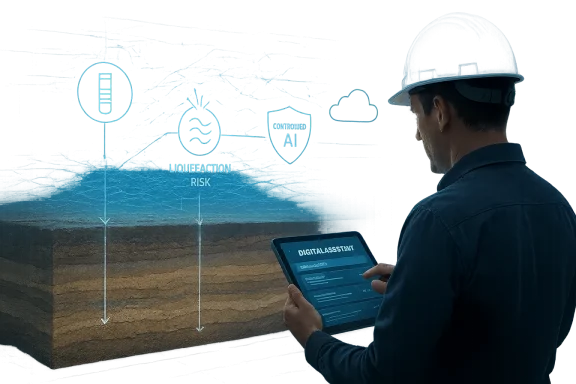
But this is not a free-form analysis bot, and that distinction is crucial. Beca says the assistant was designed in Microsoft Foundry with guardrails and is not allowed to do geotechnical analysis. In other words, the AI helps users locate and organize information, but it does not replace professional engineering judgment. That is the right division of labor, and probably the only defensible one in a high-stakes domain. (building.govt.nz)
That approach also reflects a maturing AI playbook in regulated or safety-sensitive fields. Rather than asking a model to do everything, Beca is using it as a retrieval and navigation layer. This careful design is exactly what makes the use case credible to engineers, public agencies, and enterprise customers. (building.govt.nz)
That does not eliminate the need for expertise. It simply moves experts closer to the evidence. When the right data is easier to find, professionals spend less time on clerical work and more time interpreting risk, comparing options, and making judgement calls. (building.govt.nz)
Microsoft has also been emphasizing its New Zealand presence more broadly, including its datacenter investments and local cloud footprint. That matters for organizations that care about data residency, latency, and public-sector confidence. In this case, the platform’s technical choices align neatly with the expectations of a national infrastructure asset. (digital.govt.nz)
There is also an ecosystem effect. If engineering firms, councils, and infrastructure operators become comfortable using modern cloud services for geotechnical data, they may be more willing to digitize other technical records as well. That could expand the role of cloud platforms in the broader construction and resilience sectors. (building.govt.nz)
That model could apply to environmental data, transport assets, or urban planning repositories. The common ingredients are familiar: strong stewardship, cloud migration, standards compliance, and a user experience that makes technical knowledge easier to access. In that sense, NZGD is a useful reference point for digital public infrastructure. (building.govt.nz)
For councils and other public agencies, the platform can support more consistent evidence use across projects. If multiple teams are drawing from a common technical record, planning decisions can become better aligned and less duplicative. That may also improve transparency when agencies need to justify why a certain site requires special treatment or foundation design. (tonkintaylor.co.nz)
There is also a broader trust dividend. When engineering decisions can be traced to shared, well-managed data, the public can have more confidence that rebuilding and infrastructure investments are grounded in evidence rather than guesswork. That is an especially valuable outcome in a country that has had to learn hard lessons about seismic risk.
The competitive pressure extends to other consultancies and software vendors as well. Firms that rely on static document management or fragmented legacy systems may find themselves at a disadvantage when clients expect searchable, governed, cloud-based data environments. The bar is rising from "we have the report" to "we can make the report usable." (building.govt.nz)
For software vendors, the lesson is different but related. Vertical AI in engineering must be embedded in actual workflows, not bolted on as a demo. The NZGD case works because the AI sits atop a real data model, a real user base, and a real engineering purpose. (building.govt.nz)
The broader lesson for New Zealand is that AI can be useful in high-stakes environments when it is constrained, governed, and connected to authoritative data. This is not about replacing specialists. It is about giving them a faster path to the evidence they already need, which is often the difference between a slow answer and a timely one.
Source: Microsoft Source Pairing geotechnical data with AI helps New Zealand to build better - Source Asia
 Overview
The story of the NZGD starts with a disaster that reshaped New Zealand’s approach to engineering knowledge. The 22 February 2011 Christchurch earthquake killed 185 people and left the city center badly damaged, forcing engineers to make urgent decisions about repair, demolition, land stability, and future rebuilding. That challenge exposed a simple but expensive problem: geotechnical data existed, but it was scattered, inconsistent, and often inaccessible when people needed it most.From that need came the Canterbury Geotechnical Database, launched in 2013 under the Canterbury Earthquake Recovery Authority. Its purpose was not glamorous, but it was consequential: centralize subsurface data so engineers could reuse what had already been gathered instead of drilling fresh boreholes every time a new project began. Building Performance guidance later noted that the database has grown into a searchable web-based resource and that the Canterbury response produced a major body of lessons about ground behavior, liquefaction, and foundation design.
Over time, the platform expanded beyond Canterbury and was rebranded as the New Zealand Geotechnical Database. By the time the Ministry of Business, Innovation and Employment sought proposals for a new host, the database had accumulated thousands of users and roughly 168,000 geotechnical tests had been uploaded and shared. That scale matters because geotechnical information becomes more valuable as more contributors add to it; the database is not just storage, it is a compounding knowledge base. (building.govt.nz)
Beca’s proposal to host the updated NZGD on BEYON, its digital twin platform, was accepted, and the modern version launched in November 2024. The platform moved onto an SQL database on Microsoft Azure, with access controls such as Azure Entra ID, and Beca framed the overhaul around secure, standards-compliant, spatially aware data management. In late 2025, the company then added an agentic AI layer built with Microsoft Foundry to let users filter, query, and extract data using natural language. (building.govt.nz)
The important shift is not just technical but operational. Traditional geotechnical workflows often require specialists to dig through reports, coordinate across agencies, and reconcile inconsistent formats before they can reach a decision. An AI layer that can surface the right borehole logs, test results, or site records faster changes the economics of decision-making, especially in time-sensitive projects where delays are costly and risk is high. The NZGD is therefore a case study in how cloud modernization and controlled AI can improve an already critical civic workflow. (building.govt.nz)
Why the Christchurch earthquake changed everything
The Christchurch earthquake sequence did more than damage buildings; it exposed how much engineering depends on reliable ground truth. When liquefaction, settlement, and lateral spreading are in play, surface observations alone are not enough. Engineers need to know what lies beneath the ground, often at a scale where two boreholes placed only meters apart can produce very different results. (building.govt.nz)That variability is why the original database idea landed so strongly. Instead of treating subsurface information as a project-by-project byproduct, Christchurch’s recovery effort treated it as a shared resource. This was a practical answer to a painful problem: if one consultant already drilled, logged, and analyzed a site, another team should not have to start from zero. The result was a stronger evidence base for rebuilding decisions and a more disciplined approach to urban resilience. (building.govt.nz)
The hidden cost of fragmented data
Fragmentation sounds like an IT issue, but in geotechnical engineering it becomes a financial and safety issue. When data is locked in different agencies, private archives, or legacy file formats, firms waste time reconstructing what already exists. They may also over-drill, over-test, or duplicate analysis because they cannot trust the completeness of the information they have. (building.govt.nz)That is why a shared repository has long-term value. It reduces duplication, improves consistency, and gives engineers access to richer context when they are assessing ground conditions for transport corridors, housing, utilities, or public works. The NZGD’s role is not merely archival; it is to make engineering work faster and more reliable. (building.govt.nz)
From local recovery to national asset
What began as a Canterbury-specific response eventually became a wider national platform. That evolution is significant because geological variability does not stop at regional boundaries, and neither do infrastructure projects. A national database creates the possibility of pattern recognition across soil types, geographies, and construction histories that a local archive would never capture. (tonkintaylor.co.nz)The phrase “national asset” is not marketing fluff here; it describes a reusable public-good dataset that can inform multiple sectors. That includes housing, transport, water infrastructure, and climate adaptation planning. The more data is uploaded, the more useful the database becomes, which is exactly the kind of network effect infrastructure policymakers like to see. (building.govt.nz)
What changed in the 2024 NZGD upgrade
The November 2024 relaunch was more than a facelift. Beca moved the platform to Microsoft Azure and modernized the underlying stack to improve security, scalability, and standards compliance. That matters because older engineering repositories often become fragile over time, especially when they must serve large external communities and integrate data contributed by many organizations. (building.govt.nz)The cloud migration also made access management more robust. With Azure Entra ID in place, the platform can support stronger identity controls and a more enterprise-grade security posture. For a database that contains technical data used in real-world decisions, that is not a minor improvement; it is a prerequisite for broader trust and adoption. (building.govt.nz)
Why digital twin architecture matters
Beca chose BEYON because digital twin technology is well suited to complex, interconnected engineering data. A digital twin approach allows the database to be more than a document store; it can become a structured environment where spatial, geological, and project information can sit alongside one another in a way that is easier to query. In practice, that makes the platform more useful for decision support. (building.govt.nz)This is where the upgrade becomes strategically interesting. A database that can connect geotechnical records to spatial analytics can help users see context, not just records. In engineering, context is often the difference between a useful answer and a misleading one, so the platform’s architecture is doing real analytical work even before AI enters the picture. (building.govt.nz)
The enterprise case for modernization
For Beca, the NZGD upgrade also shows how a consultancy can translate domain expertise into a managed digital product. That is important because engineering firms increasingly compete on the quality of their data platforms as much as on their design capabilities. In effect, the platform becomes part of the firm’s legacy and a differentiator in the market. (building.govt.nz)Enterprise users care about reliability, interoperability, and permissioning. A system that is secure, searchable, and standards-based is easier to embed into corporate workflows, regulatory submissions, and project planning. The business case is therefore both direct and indirect: better tools can support better engineering outcomes, which in turn reinforce the firm’s value proposition. (building.govt.nz)
How AI changes the workflow
The most eye-catching part of the current NZGD story is the agentic AI layer added in late 2025. According to Beca, the assistant lets users filter, query, and extract geotechnical data using natural language. That matters because it lowers the barrier between a question and the underlying technical record, especially for users who may not know the exact schema or terminology used in the database. (building.govt.nz)But this is not a free-form analysis bot, and that distinction is crucial. Beca says the assistant was designed in Microsoft Foundry with guardrails and is not allowed to do geotechnical analysis. In other words, the AI helps users locate and organize information, but it does not replace professional engineering judgment. That is the right division of labor, and probably the only defensible one in a high-stakes domain. (building.govt.nz)
Guardrails as a feature, not a compromise
In many AI deployments, guardrails are described as limitations. Here they are a strength. A system that can answer natural-language questions but not invent engineering conclusions is less likely to mislead users in contexts where a bad assumption can become a costly design error. The platform’s value comes from helping experts move faster, not from pretending to be an expert itself. (building.govt.nz)That approach also reflects a maturing AI playbook in regulated or safety-sensitive fields. Rather than asking a model to do everything, Beca is using it as a retrieval and navigation layer. This careful design is exactly what makes the use case credible to engineers, public agencies, and enterprise customers. (building.govt.nz)
From search to decision support
The practical payoff is that users can cut through information overload. Geotechnical investigations often produce long logs, annotations, scans, and reports, and the useful detail can be buried deep inside them. Natural-language access means a site engineer can ask for what they need in plain English instead of translating a question into database logic first. (building.govt.nz)That does not eliminate the need for expertise. It simply moves experts closer to the evidence. When the right data is easier to find, professionals spend less time on clerical work and more time interpreting risk, comparing options, and making judgement calls. (building.govt.nz)
The Microsoft Azure and Foundry angle
The platform’s Microsoft stack is notable because it shows how cloud and AI products are being used in a relatively conservative, technically rigorous industry. Azure provides the infrastructure, identity, and scaling layer; Microsoft Foundry provides the controlled AI environment. Together they create a path for organizations that want modern capabilities without sacrificing governance. (building.govt.nz)Microsoft has also been emphasizing its New Zealand presence more broadly, including its datacenter investments and local cloud footprint. That matters for organizations that care about data residency, latency, and public-sector confidence. In this case, the platform’s technical choices align neatly with the expectations of a national infrastructure asset. (digital.govt.nz)
Why local cloud matters
For sensitive or mission-critical data, being able to operate in a local or regionally trusted cloud environment can make procurement and compliance easier. That becomes especially relevant for government-related platforms and data ecosystems tied to national resilience. The more the platform fits into local policy and security norms, the more likely it is to be adopted widely. (digital.govt.nz)There is also an ecosystem effect. If engineering firms, councils, and infrastructure operators become comfortable using modern cloud services for geotechnical data, they may be more willing to digitize other technical records as well. That could expand the role of cloud platforms in the broader construction and resilience sectors. (building.govt.nz)
A template for other public-good databases
The NZGD may prove important not just because of what it contains, but because of how it is structured. Many public-interest datasets are created in response to crises and then struggle to survive the handoff from emergency management to steady-state governance. NZGD shows a different path: retain the dataset, modernize the stack, and add carefully constrained AI on top. (building.govt.nz)That model could apply to environmental data, transport assets, or urban planning repositories. The common ingredients are familiar: strong stewardship, cloud migration, standards compliance, and a user experience that makes technical knowledge easier to access. In that sense, NZGD is a useful reference point for digital public infrastructure. (building.govt.nz)
Impact on engineers, councils, and builders
For practitioners, the biggest benefit is speed. Engineers like Ellis-Garland can retrieve relevant investigation logs and reduce the time spent sifting through fragmented records. In a workflow where deadlines are tight and the consequences of missing a critical soil condition can be severe, that is a real productivity gain. (building.govt.nz)For councils and other public agencies, the platform can support more consistent evidence use across projects. If multiple teams are drawing from a common technical record, planning decisions can become better aligned and less duplicative. That may also improve transparency when agencies need to justify why a certain site requires special treatment or foundation design. (tonkintaylor.co.nz)
Consumer impact is indirect but real
Most homeowners will never open the NZGD themselves, but they will feel its effects through faster rebuilds, better site decisions, and fewer avoidable surprises. That is especially true in earthquake-prone or geologically complex areas, where foundation choices can have long-term implications for safety and cost. Better upstream information often means fewer downstream failures. (building.govt.nz)There is also a broader trust dividend. When engineering decisions can be traced to shared, well-managed data, the public can have more confidence that rebuilding and infrastructure investments are grounded in evidence rather than guesswork. That is an especially valuable outcome in a country that has had to learn hard lessons about seismic risk.
A numbered view of the workflow improvement
- Search time drops because users can ask questions in natural language.
- Duplicate effort falls because existing records are easier to discover.
- Decision quality rises because context is easier to gather quickly.
- Project risk is better managed because the platform surfaces relevant technical history.
- Specialists stay in control because the AI does not replace engineering judgment. (building.govt.nz)
Competitive implications for the engineering market
This is also a quiet signal about where engineering consultancies are heading. Data-rich service firms increasingly compete on their ability to build platforms, not only to deliver one-off projects. If Beca can make BEYON a credible geotechnical interface on top of a national database, it strengthens its position as both a technical advisor and a digital operator. (building.govt.nz)The competitive pressure extends to other consultancies and software vendors as well. Firms that rely on static document management or fragmented legacy systems may find themselves at a disadvantage when clients expect searchable, governed, cloud-based data environments. The bar is rising from "we have the report" to "we can make the report usable." (building.govt.nz)
Data stewardship becomes a market differentiator
Whoever controls the trusted workflow often controls the customer relationship. In this case, stewardship of the NZGD gives Beca a role in national infrastructure knowledge that few rivals can easily replicate. That creates reputational value, but it also imposes responsibility, because the platform’s credibility depends on neutrality, reliability, and technical rigor. (building.govt.nz)For software vendors, the lesson is different but related. Vertical AI in engineering must be embedded in actual workflows, not bolted on as a demo. The NZGD case works because the AI sits atop a real data model, a real user base, and a real engineering purpose. (building.govt.nz)
Strengths and Opportunities
The strongest feature of the NZGD story is that it solves a real and persistent problem rather than chasing novelty. It combines public value, technical modernization, and AI in a way that is pragmatic, not flashy. That makes it easier to defend and more likely to endure.- Better reuse of existing geotechnical data instead of repeated drilling
- Faster engineering workflows through natural-language search
- Stronger security and identity controls via Azure Entra ID
- Improved scalability on Microsoft Azure
- More consistent standards compliance across a national platform
- A credible digital twin foundation for future analytics
- A safer AI pattern because the assistant is not allowed to perform geotechnical analysis
Risks and Concerns
The same qualities that make the platform promising also create obligations. A national engineering database must remain accurate, current, and trusted, and any failure in governance could undermine confidence quickly. In a safety-sensitive domain, small mistakes can have outsized consequences.- Model overconfidence if users treat AI retrieval as expert judgment
- Data quality drift if uploads are inconsistent or poorly standardized
- Access control complexity as more organizations contribute and consume data
- Vendor dependence if the platform becomes too tightly coupled to one stack
- Governance risk if stewardship responsibilities are unclear
- Uneven adoption if smaller firms lack training or integration capacity
- Security exposure if sensitive technical records are not managed carefully
Looking Ahead
The next phase for NZGD will likely be judged less by launch headlines than by how well it performs in daily engineering use. If users trust the assistant, if search results are relevant, and if the platform keeps improving without becoming cumbersome, then the project will have moved from innovation to infrastructure. That is the real test of any digital public-good system.The broader lesson for New Zealand is that AI can be useful in high-stakes environments when it is constrained, governed, and connected to authoritative data. This is not about replacing specialists. It is about giving them a faster path to the evidence they already need, which is often the difference between a slow answer and a timely one.
- Adoption growth among engineers, councils, and contractors
- Broader data ingestion across more regions and project types
- Deeper spatial analytics integrated into the digital twin
- More advanced search and retrieval without expanding AI autonomy
- Potential export of the model to other public-data domains
Source: Microsoft Source Pairing geotechnical data with AI helps New Zealand to build better - Source Asia
