

Newham Is Buying the Plumbing Before the Politics Arrives
Local government digital stories are often sold as citizen-experience stories: better portals, faster answers, fewer forms, and cleaner casework. Newham’s pipeline is more prosaic, and therefore more revealing. It is a list of systems that residents rarely think about until they fail.
The largest item is a planned Microsoft Enterprise, Azure, and Microsoft Azure Consumption agreement worth up to £12 million including VAT. That contract is pencilled in for April 2028 to March 2032, with a tender notice expected in November 2027. In plain terms, Newham is preparing the next major commercial wrapper around the software and cloud estate that will likely underpin much of its internal productivity, identity, data, hosting, and integration work.
That timing matters. A 2028 start date is far enough away that the council is not merely refreshing a licence tomorrow morning. It is signalling to the market that its cloud and enterprise software assumptions are already central to medium-term planning.
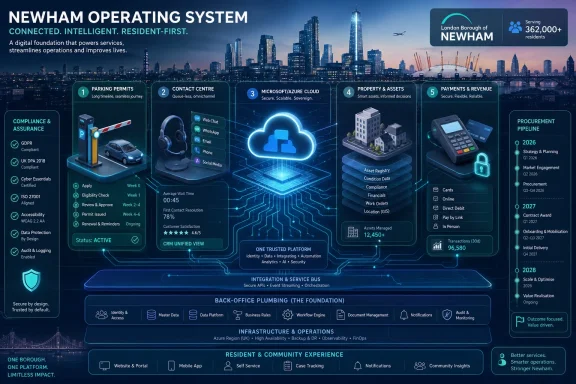
The rest of the pipeline is narrower but no less consequential. Parking, contact-centre and CRM tooling, property asset management, and payments are the machinery through which councils collect money, answer residents, manage land and buildings, and enforce local rules. These are not glamour platforms. They are the systems that decide whether digital government feels competent or brittle.
The Procurement Act Turns a Roadmap Into a Public Signal
The notices sit under the UK’s new public procurement regime, where pipeline notices are designed to give suppliers earlier visibility of future public contracts. That is not just a bureaucratic change. It alters the information balance between incumbent suppliers, larger framework players, and smaller firms trying to decide where to invest bid effort.
Historically, a council technology renewal could feel visible only to those already close to the buyer, the framework, or the incumbent ecosystem. Pipeline notices do not magically level the field, but they do make the future more searchable. A supplier can now see, well in advance, that Newham expects to revisit parking operations in 2026, property asset management in 2026, customer contact in 2027, payments in 2027, and Microsoft enterprise arrangements in 2027.
That visibility is particularly important for SMEs, because smaller vendors cannot afford to chase every rumour. A ten-year parking-system opportunity, explicitly flagged as suitable for small and medium-sized enterprises, gives the market time to form partnerships, study integration needs, and prepare credible evidence. In theory, this is exactly the kind of competition the new regime is supposed to encourage.
The caveat is that visibility is not the same as openness. Newham has also reserved the right to use existing Public Contracts Regulations 2015 framework agreements and dynamic purchasing systems where appropriate. That is sensible commercial hygiene, but it means suppliers should read the pipeline as a warning flare, not a promise of a fully open contest.
Microsoft Remains the Gravity Well
The £12 million Microsoft enterprise and Azure agreement is the most obvious signal in the pipeline because it sits above the rest financially and architecturally. Councils may talk about digital innovation, but their ability to modernise often depends on the licensing and cloud agreements that determine what tools staff can use, where workloads can run, and how identity, security, collaboration, and data platforms are stitched together.
For WindowsForum readers, this is familiar territory. Microsoft is not just another vendor in public-sector IT; it is the default environment in which many councils operate. Microsoft 365, Entra ID, Azure, Teams, Defender, Power Platform, and related licensing bundles increasingly define what “modern workplace” and “cloud transformation” mean in practice.
That brings advantages. A council that standardises sensibly can reduce fragmentation, improve identity governance, automate workflows, and consolidate security controls. For overstretched IT teams, buying into an integrated platform can be more practical than maintaining a zoo of smaller tools with separate authentication, patching, audit, and procurement cycles.
But the gravity well has costs. Azure consumption agreements can reward speed while making long-term spend harder to predict. Enterprise licensing can simplify procurement while deepening dependency. Power Platform and low-code tooling can unlock departmental innovation while creating governance headaches if citizen data, workflows, and permissions sprawl faster than IT can manage them.
Newham’s pipeline does not say it is doubling down on Microsoft at the expense of every alternative. It does say that, by 2028, the borough expects Microsoft enterprise and Azure consumption to remain important enough to justify a multi-year agreement worth more than any other item in the package. That is not a surprise, but it is a useful reminder that council digital transformation increasingly begins with platform economics.
Parking Is the Sleeper System With the Longest Shadow
The planned back-office parking system and permits contract is the second-largest item, valued at £7.2 million including VAT. It is also the longest, expected to run from February 2027 to January 2037. Ten years is a serious commitment in civic software, especially for a domain that mixes enforcement, payments, permits, printing, appeals, resident eligibility, and integration with other council records.
Parking systems are easy to underestimate because they sit at the unromantic edge of digital government. Yet they are highly visible to residents and politically sensitive. If permit renewals break, appeals vanish, tariffs are wrong, or enforcement workflows misfire, the failure is not abstract. It lands as a ticket on a windscreen or a resident unable to park near home.
The planned scope is broad: car park management, transaction processing, application services, and permit printing. That suggests Newham is looking at the operational core, not simply a cosmetic web front end. In a dense East London borough, where parking is bound up with housing, business activity, emissions policy, street management, and resident trust, that system becomes a civic pressure point.
The SME suitability note is interesting here. Parking technology is one area where specialist vendors can compete credibly against larger generalist IT providers, provided the procurement does not drown them in integration and compliance overhead. The council’s challenge will be writing requirements that reward domain expertise without locking itself into another decade of hard-to-change workflows.
Customer Contact Is Where Transformation Meets the Queue
The planned £3 million telephony contact-centre and CRM contract is smaller than the Microsoft and parking deals, but it may be the one residents feel most directly. Councils can publish polished digital strategies, but if the phone queue is punishing, the case history is fragmented, and residents must repeat the same story to multiple departments, the transformation has failed at the point of contact.
A contact-centre and CRM system is not just a call-handling upgrade. It is the front door to housing queries, benefits questions, environmental complaints, licensing, social care signposting, and the long tail of local-government interactions. It determines whether staff can see context, whether cases are routed intelligently, and whether online, phone, and in-person channels share a common view.
Newham’s planned five-year term, with a tender notice expected in March 2027, lands in a period when public bodies are under pressure to adopt AI-assisted service tools without losing accountability. The pipeline notice does not describe AI, automation, or chatbots. Even so, any 2027 contact-centre procurement will likely be evaluated in a market where speech analytics, agent assist, automated triage, and knowledge-management tools are normal parts of the vendor pitch.
That creates a policy tension. Automating low-risk interactions can free staff to deal with complex cases, but residents with complex needs are often the first to be harmed by badly designed digital channels. The procurement will need to distinguish between genuinely better service design and the lazy version of digital transformation: moving friction away from the council and onto the resident.
Property Data Is the Quiet Test of Whether “Data-Led” Means Anything
The property asset management system, valued at £3.6 million including VAT, is perhaps the most revealing piece of the pipeline because it connects directly to the practical meaning of a data-led council. Newham has already framed its 2025–2027 data strategy around real-time insight, shared data platforms, and accountable digital innovation. Property assets are where that rhetoric meets spreadsheets, leases, maintenance liabilities, compliance records, valuations, occupancy, and capital planning.
The council currently operates Civica as part of its system landscape, according to the procurement summary, and is seeking to understand market capability for an integrated digital solution. That phrase — integrated digital solution — is doing a lot of work. In local government, integration is often the gap between a transformation slide and an officer’s daily reality.
Property asset systems tend to accumulate complexity over years. Data may sit across finance, estates, facilities management, GIS, legal, housing, and regeneration teams. If records are incomplete or hard to reconcile, councils struggle to make confident decisions about maintenance, disposals, decarbonisation, utilisation, and risk.
A better asset platform will not by itself fix those issues. Software can expose bad data as readily as it can organise good data. But the decision to procure a new or modernised system shows Newham understands that digital government is not only about customer-facing services. It is also about knowing what the authority owns, what condition it is in, what it costs, and how it supports the borough’s wider priorities.
Payments Sit at the Edge of Trust
The smallest item in the pipeline, a £1.8 million merchant payment acquiring services contract, may look like routine financial plumbing. It is not glamorous, but it is essential. If residents and businesses cannot pay securely, reliably, and conveniently, every other digital service is weakened.
Payment acquiring touches banking, processing, clearing, reconciliation, fraud controls, and operational resilience. It is also one of the places where councils must balance user convenience against compliance and security. Residents expect card payments and online transactions to feel as smooth as retail. Public bodies must deliver that while handling public money, audit requirements, accessibility duties, and procurement constraints.
The contract is expected to run for four years, with a tender notice pencilled in for February 2027. By then, payment expectations will be even less forgiving. The council will need services that support online channels, back-office reconciliation, in-person payment contexts where they remain necessary, and resilience when something fails.
This is also where cyber risk becomes mundane. Payment systems are not merely financial services; they are part of the attack surface. A modern acquiring arrangement must be judged not only on transaction fees and service coverage, but on its ability to integrate securely with council systems without multiplying data exposure.
The Real Programme Is Integration, Not Procurement
Viewed separately, the five notices look like ordinary renewals. Viewed together, they describe a council trying to modernise the connective tissue between residents, staff, assets, money, and cloud platforms. The risk is that each procurement succeeds on its own terms while the overall architecture remains fragmented.
That is the classic local-government technology trap. A parking system can be “best of breed,” a CRM can be modern, a property platform can be feature-rich, payments can be reliable, and Microsoft licensing can be comprehensive — yet the council can still end up with disconnected data, duplicated workflows, and inconsistent identity and access controls. Transformation fails not because the tools are bad, but because the seams are unmanaged.
Newham’s data strategy gives the pipeline a broader context. If the borough wants shared insight and accountable innovation, then procurement teams cannot treat these contracts as isolated commercial events. They must ask how each system contributes to common data standards, API access, auditability, retention rules, cyber posture, and service design.
That is not easy. Vendors prefer to sell platforms, not subordinate themselves to another vendor’s architecture. Departments prefer systems that solve their immediate operational pain. Finance teams want predictable pricing. Security teams want fewer exceptions. Residents just want the thing to work.
The job of digital leadership is to hold those pressures together. The pipeline shows where the contracts are. It does not yet show whether Newham can turn them into a coherent operating model.
Long Contracts Demand Escape Routes
The proposed ten-year parking contract is the clearest example of a broader concern: long contracts can buy stability, but they can also freeze assumptions. In civic technology, a decade is long enough for user expectations, cloud models, data standards, accessibility requirements, and security threats to change substantially.
That does not mean long contracts are inherently wrong. For complex operational platforms, councils may need time to implement, stabilise, train staff, migrate data, and realise benefits. Suppliers may price more keenly when they can see a longer revenue horizon. Residents may benefit from continuity if the system is well managed.
The danger is complacency. A ten-year term without strong break clauses, performance metrics, data portability, and integration obligations can become a slow-motion lock-in. The public sector has learned this lesson many times, but the incentives that create it remain stubbornly alive.
The same applies to Microsoft cloud consumption, albeit in a different form. Enterprise agreements can make the first phase of modernisation easier, then make alternatives harder to consider later. The answer is not performative vendor neutrality. It is commercial discipline: know what must remain portable, know what is strategically standardised, and know which costs are being deferred rather than eliminated.
SMEs Get a Window, But Not Yet a Door
The pipeline’s transparency should help smaller suppliers, particularly in specialist areas such as parking, property systems, service design, or integration. But a pipeline notice alone does not create SME access. It merely gives SMEs a date to circle.
The real test comes later, in how Newham packages requirements. If the council bundles too much into single monolithic lots, smaller firms may be pushed into subcontracting roles beneath larger systems integrators. If insurance, turnover, certification, and evidence requirements are disproportionate, SMEs may self-exclude before they ever submit a bid. If integration specifications are vague, only incumbents or large vendors may feel able to price the risk.
Conversely, if Newham is serious about SME suitability, it can design procurements that make room for domain specialists while protecting the council from fragmentation. That might mean clearer lots, open standards, practical implementation phases, realistic data-migration expectations, and evaluation models that reward support quality rather than slideware.
The public sector often says it wants innovation from smaller firms. Procurement is where that aspiration either becomes real or quietly dies. Newham’s early signalling gives the market time. The next step is giving it a fair route in.
The Data Strategy Will Be Judged in the Back Office
Newham’s data ambitions provide a useful lens for judging this pipeline, because most of the planned systems are data-heavy. Parking permits generate eligibility and enforcement data. Contact centres generate demand, case, and sentiment data. Property systems generate asset, compliance, and utilisation data. Payment acquiring generates transaction and reconciliation data. Microsoft cloud platforms may host, secure, analyse, and automate around all of it.
That makes governance the unglamorous heart of the programme. If these systems are procured without common principles for data quality, access, retention, reporting, and interoperability, the borough may simply modernise its silos. The screens will look newer, the contracts will be refreshed, and the same organisational blind spots will persist.
A genuinely data-led council needs more than dashboards. It needs reliable source systems, clear ownership, lawful sharing, well-designed permissions, and officers who trust the information in front of them. It also needs humility about what data cannot show, particularly in high-need communities where digital exclusion and complex life circumstances can distort neat metrics.
That is why Newham’s pipeline is more consequential than the individual contract values suggest. These procurements will shape the data environment in which policy decisions are made. The borough’s strategy will be judged less by launch events than by whether these systems produce usable, accountable information.
The Calendar Now Belongs to the Market
One underappreciated effect of publishing a pipeline is that the council loses some control over who starts planning around it. Vendors will map incumbents, frameworks, partner channels, likely evaluation criteria, and political priorities. Competitors will begin shaping propositions before the tender notices appear. Consultants and systems integrators will look for ways to position themselves between the council and the software market.
That is not a bad thing. Good market engagement can improve requirements and reduce procurement failure. Suppliers often know where similar councils have stumbled, which integrations are harder than they look, and which requirements accidentally inflate costs.
But early market visibility also creates narrative pressure. Vendors will attempt to define the problem in terms that fit their products. The council’s task is to listen without being captured. The best procurements use the market to sharpen requirements; the worst use market engagement as a preview of the sales deck that later wins.
Newham’s repeated caveat that details are indicative and subject to change is therefore important. It gives the authority room to refine scope, choose routes, and adjust timelines. The challenge will be maintaining that flexibility while still giving suppliers enough certainty to prepare seriously.
Newham’s Modernisation Bet Is Now Specific Enough to Test
The useful thing about this pipeline is that it turns digital ambition into a set of testable commitments. It gives residents, suppliers, councillors, and IT professionals a way to watch whether the borough’s modernisation story becomes operational reality.
- Newham’s largest planned digital spend is the £12 million Microsoft Enterprise, Azure, and Microsoft Azure Consumption agreement expected to start in April 2028.
- The earliest major tender is currently expected to be the £7.2 million back-office parking system and permits contract, with notice publication planned for August 2026.
- The contact-centre and CRM procurement will be a key test of whether the borough can improve resident experience without simply shifting service pressure onto digital channels.
- The property asset management system will reveal whether Newham’s data strategy can reach into complex back-office records rather than remaining a high-level ambition.
- The payment acquiring contract is small compared with the rest of the pipeline, but it will matter for security, reliability, reconciliation, and resident trust.
- The biggest risk is not that any one system is procured badly, but that all five are procured competently while the wider architecture remains fragmented.
The next two years will show whether Newham’s pipeline is merely a tidy compliance artefact or the beginning of a more disciplined digital estate. The opportunity is real: better service data, more resilient platforms, clearer supplier competition, and systems that make council work less painful for staff and residents alike. But the hard part starts after the notices, when commercial choices become architecture, architecture becomes daily workflow, and the promise of modernisation is tested by the next resident trying to pay, park, call, complain, or get an answer.
References
- Newham maps out pipeline of digital modernisation UKAuthority · 2026-06-02T07:30:10.231535