

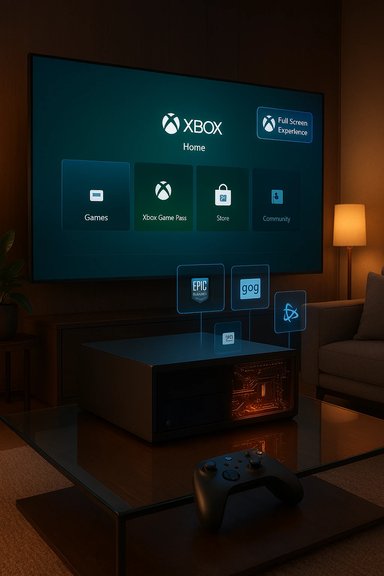
Microsoft’s next Xbox may arrive less like a traditional closed console and more like a TV‑focused Windows 11 PC with a console‑style front end, according to multiple reports and Microsoft’s own preview work — a shift that would place the Xbox Full Screen Experience (FSE) and the Xbox PC app at the center of a hybrid console‑PC strategy while raising new questions about pricing, performance trade‑offs, and platform policy.
Microsoft has been quietly building a technical and UX foundation that makes a Windows‑rooted living‑room gaming device feasible. The company shipped the Xbox Full Screen Experience as the default launcher on the ASUS ROG Xbox Ally handhelds and has folded the FSE plumbing into Windows 11 Insider preview builds, signaling that the experiment is moving beyond one or two OEM prototypes. Official channels describe the FSE as a controller‑first, full‑screen shell that launches the Xbox PC app at sign‑in while deferring non‑essential Windows desktop services to reclaim runtime resources for gaming. At the same time, reporting by Windows Central — and subsequent coverage across industry outlets — places the next full‑sized Xbox squarely on top of that work. Journalists with access to platform teams say Microsoft is testing a model in which the console would boot into a TV‑optimized Xbox shell while keeping the full Windows 11 stack available underneath, enabling users to exit into the Windows desktop and run third‑party PC storefronts or native Windows apps when desired. That layered model is the defining rumor shaping coverage.
Readers should treat concrete hardware specs, pricing and launch timing as unproven until Microsoft formally announces them; the technical groundwork and UX previewing are real, but the final commercial product will determine whether the hybrid vision becomes a practical, affordable reality or an expensive niche for high‑end buyers.
Source: AltChar Next Xbox may run full Windows 11 full screen experience, report suggests
 Background
Microsoft has been quietly building a technical and UX foundation that makes a Windows‑rooted living‑room gaming device feasible. The company shipped the Xbox Full Screen Experience as the default launcher on the ASUS ROG Xbox Ally handhelds and has folded the FSE plumbing into Windows 11 Insider preview builds, signaling that the experiment is moving beyond one or two OEM prototypes. Official channels describe the FSE as a controller‑first, full‑screen shell that launches the Xbox PC app at sign‑in while deferring non‑essential Windows desktop services to reclaim runtime resources for gaming. At the same time, reporting by Windows Central — and subsequent coverage across industry outlets — places the next full‑sized Xbox squarely on top of that work. Journalists with access to platform teams say Microsoft is testing a model in which the console would boot into a TV‑optimized Xbox shell while keeping the full Windows 11 stack available underneath, enabling users to exit into the Windows desktop and run third‑party PC storefronts or native Windows apps when desired. That layered model is the defining rumor shaping coverage. What’s being reported (the short version)
- Microsoft is preparing major updates to the Windows 11 Full Screen Experience (FSE) and positioning it as the default front door for a future living‑room Xbox.
- The Xbox PC app is evolving into an aggregated launcher that can discover and surface installed titles from Steam, Epic, Battle.net, GOG and more, while remaining the curated Xbox home experience.
- The next Xbox is reported to run “full‑bore Windows” beneath a console‑style shell, preserving drivers, DRM and anti‑cheat while offering the flexibility to run PC storefronts.
- Xbox leadership has publicly described the device as a “very premium, very high‑end, curated experience,” language that implies higher performance targets and, likely, a higher retail price than previous generations.
- Backwards compatibility with existing Xbox libraries (Xbox One and Xbox Series X|S) is expected to remain a priority, based on reporting and Microsoft’s compatibility track record.
Overview: how this hybrid would work
A layered model — shell over kernel
The core technical idea is straightforward: present a specialized, controller‑first session on top of Windows 11 rather than replace Windows itself. Under that session runs the Windows kernel, device drivers and the standard anti‑cheat and DRM subsystems; above it sits the FSE, which acts as the console‑grade UI and launch environment. Users would get a “turn on and play” console experience by default, but could switch to a traditional Windows desktop to access other stores or productivity apps. This approach was validated in the wild by the ROG Xbox Ally devices and has been surfaced in Insider builds.Aggregated storefronts and launch orchestration
The Xbox PC app’s aggregated library is the first practical building block for running third‑party stores on a console‑like device. In practice this means:- The Xbox PC app shows a unified library containing Game Pass entries, Microsoft Store purchases and discovered installs from Steam, Epic, GOG, Battle.net and similar clients.
- When anti‑cheat or DRM requires it, the Xbox app will likely hand off to native clients; when it can, it will launch executables directly. Expect hybrid behavior rather than a universal bypass for every storefront’s protection.
Technical realities and verification
What FSE actually does (and what it doesn’t)
Multiple hands‑on writeups and Microsoft’s own documentation make the distinction clear: FSE is a session posture layered over Windows, not a separate operating system or a kernel replacement. When FSE is active it:- Launches a chosen “home app” (usually the Xbox PC app) full‑screen at sign‑in.
- Defers desktop ornamentation (wallpaper, Explorer decorations) and delays non‑essential startup apps to free memory and reduce idle CPU wakeups. Reported memory reclamation on tuned handhelds is directionally around 1–2 GB, though results vary by device and installed software. Treat these headline numbers as engineering estimates, not guarantees.
- Adapts Game Bar and Task View for controller navigation and provides controller‑first UX affordances like an on‑screen controller keyboard.
Cross‑stack features Microsoft is shipping
Microsoft has been coordinating OS, graphics and distribution updates to make Windows gaming more console‑like. Notable technical pieces include:- Advanced Shader Delivery (ASD) — precompiled shader bundles to reduce first‑run stutters.
- Auto Super Resolution (Auto SR) — an OS‑level AI upscaler that can use on‑device NPUs to increase apparent resolution with low GPU cost.
- DirectX and Agility SDK updates to stabilize frame pacing and improve runtime predictability.
What this means for gamers and developers
Benefits
- Unified living‑room access to PC content. Players could browse and launch titles from multiple stores on a single device without swapping to a separate PC.
- Console‑grade onboarding with PC flexibility. Mainstream users get the familiar Xbox flow; power users can switch to the Windows desktop to mod, tune, or use alternate storefronts.
- Reduced friction for ports. Developers familiar with the Windows toolchain may find porting and QA easier when the target device uses the same OS and drivers they already support.
- OS‑level performance improvements. Precompiled shaders and OS upscaling reduce common pain points on PC, especially on thermally constrained devices.
Caveats and developer implications
- Anti‑cheat and certification complexity. Some PC anti‑cheat systems and DRM require kernel‑mode components or vendor attestations. Those subsystems still control whether a game can run, which means not every PC title will be a plug‑and‑play experience on a console‑first device without additional testing and certification.
- Fragmentation risk. Offering a fully unlocked Windows desktop alongside a curated Xbox experience risks creating multiple support matrices — signed console‑like experiences, hybrid PC paths, and user‑managed desktop installs — all of which increase QA surface and customer support load.
- Monetization and subscription dynamics. A device that surfaces both Game Pass and third‑party stores pushes Microsoft into a nuanced commercial position; early reporting suggests Microsoft will not lock users to a single storefront, but how the company balances promotions, discovery, and incentives (Game Pass features, exclusive offers) is a strategic question with consumer welfare implications.
Backwards compatibility and libraries
Reports indicate Microsoft sees backwards compatibility as essential and that Xbox One and Xbox Series X|S titles will continue to run on the next device. That fits Microsoft’s long‑standing compatibility commitments and the company’s technical approach: because the Windows kernel and Xbox runtime layers will remain available, older Xbox titles should still be executable under the compatibility shims Microsoft already maintains. But precise guarantees — especially around performance boosts, remasters, or software‑based enhancements (Auto SR, frame generation) — depend on final firmware/APU choices and will require official confirmation.Hardware, cost and the “very premium” positioning
Xbox leadership’s public language — notably Xbox president Sarah Bond’s comment that the next device will be a “very premium, very high‑end, curated experience” — has been widely reported and signals a move toward higher‑Spec hardware with correspondingly higher BOM costs. That echoes the ROG Xbox Ally family’s premium pricing and suggests Microsoft is comfortable testing whether consumers will accept a higher entry price in exchange for a hybrid PC/console feature set. A few practical hardware consequences:- More RAM and higher memory bandwidth will be necessary to comfortably support a full Windows stack plus high‑end gaming: Windows desktop services and multiple storefront clients increase baseline memory needs compared with a traditional console OS.
- Thermal and power targets for a 4K living‑room device that runs both Windows and high‑TDP gaming workloads imply a high‑end APU design, likely co‑engineered with AMD based on Microsoft’s public partnership roadmaps.
- Price sensitivity. Rising component costs (memory, packaging for GPUs, NPUs) could push retail pricing above past console generations’ sweet spots; some analysts are already speculating that the next Xbox could command a significant premium. These are informed projections, not confirmed MSRP figures.
Timing and reveal — what’s plausible and what isn’t
Some reports mention GDC 2026 or late‑2026 windows as moments where Microsoft could reveal more about its platform direction. That timing fits Microsoft’s pattern of staged previews and partner OEM rollouts: features like FSE and the Ally hardware serve as experiments and public validation before committing to a mass‑market living‑room device. However, any specific launch or reveal date remains speculative. Historical precedent shows Microsoft often previews platform strategy at developer events, but a formal hardware reveal — complete with SKUs, pricing and ship dates — typically follows months later. Treat GDC 2026 mention as a plausible signaling event, not confirmation.Strengths of the approach
- Engineering efficiency. Using Windows as the base reduces duplicate engineering across PC and console stacks, letting Microsoft focus investment on rendering, shader delivery and platform services that benefit both ecosystems.
- User choice. The layered model preserves the Xbox curated onboarding while offering power users the full Windows desktop and the ability to install competing stores — a major consumer flexibility win.
- Developer continuity. Studios that ship to PC already have Windows‑targeted pipelines; bringing Xbox to the same runtime reduces friction for multiplatform titles and could accelerate releases on Xbox storefronts.
Risks and open questions
- Price vs. market expectations. Making the next Xbox “very premium” risks excluding buyers who expect console‑level affordability. High BOM costs for RAM, discrete‑level APUs and NPUs could push MSRP into territory that reduces install base growth — a strategic trade‑off that must be managed carefully.
- Support complexity. Supporting native third‑party storefronts, Windows desktop installs and console‑grade certification presents a triage problem for QA and customer support. Microsoft will have to define clear policies about what is certified on the console‑fronted experience and what remains a user‑managed desktop responsibility.
- Security and anti‑cheat. Allowing multiple storefronts while preserving competitive fairness and online safety requires continued investment in anti‑cheat integration and validation; any misstep could push publishers to restrict titles or impose additional requirements.
- Policy and monetization ambiguity. Reports of a possible removal of the multiplayer paywall for the new hardware remain unverified and would represent a seismic business change. Such claims should be treated with caution until Microsoft issues explicit policy guidance.
Which claims are verified and which remain rumors
Verified or demonstrable today:- The Xbox Full Screen Experience exists, shipped on the ROG Xbox Ally family, and is available to Windows Insiders as a preview for more form factors. Microsoft’s Xbox Wire announcement and multiple independent hands‑on reports confirm this rollout.
- The Xbox PC app is moving toward an aggregated library that can discover and surface installed titles from other PC storefronts. Public beta and Insider features demonstrate this behavior.
- A final retail Xbox shipping as a Windows 11 device with unrestricted, native storefront access and exact hardware specs (APU TDP, RAM sizes, pricing) is not confirmed. Multiple outlets report Microsoft is exploring the model, but no official product announcement has fixed specs, price or a ship date. Treat leaked APU numbers, price estimates, and timing windows as provisional.
- Business model changes such as removing the online multiplayer paywall for the next device are reported in some leaks but remain unconfirmed and speculative. Exercise caution until Microsoft makes a formal policy announcement.
Practical advice for WindowsForum readers (owners, developers, buyers)
- If you own a compatible handheld or are curious: join the Windows Insider and Xbox Insider programs to preview FSE safely and provide feedback through official channels. Microsoft is gating FSE via entitlements and staged rollouts, so the Insider path is the supported preview route.
- Developers should track Microsoft’s SDK and Agility updates for shader delivery and runtime features. These OS‑level improvements (ASD, Auto SR) will affect performance profiles across PC and any Windows‑based Xbox hardware.
- If you’re considering buying a premium handheld like the ROG Xbox Ally: understand it is a Windows 11 device first with a console‑style shell optional — you can run Steam, Epic and other stores, but the experience and support levels vary compared with dedicated consoles.
Conclusion
The narrative that Microsoft is preparing a Windows‑rooted next Xbox with a TV‑optimized Xbox Full Screen Experience layered on top is now backed by public product moves (ROG Xbox Ally, Windows Insider FSE previews), executive positioning and multiple independent reports. The approach promises the best of both worlds — a console‑grade, plug‑and‑play living‑room experience with the openness and breadth of Windows PC gaming — but it also raises hard questions about pricing, certification complexity, anti‑cheat integration and how Microsoft will manage competing storefronts on a single device.Readers should treat concrete hardware specs, pricing and launch timing as unproven until Microsoft formally announces them; the technical groundwork and UX previewing are real, but the final commercial product will determine whether the hybrid vision becomes a practical, affordable reality or an expensive niche for high‑end buyers.
Source: AltChar Next Xbox may run full Windows 11 full screen experience, report suggests
