

Microsoft’s Xbox business entered July 2026 facing a convergence of reported studio-cut threats, next-generation hardware uncertainty, component-cost pressure, and a new leadership regime under Xbox CEO Asha Sharma, as Windows Central’s Zac Bowden and Jez Corden laid out on the July 2 Windows Central Podcast. The episode’s real value was not that it “solved” Xbox’s future, because nobody outside Microsoft’s senior ranks can do that. It was that it placed the console brand’s crisis in the correct frame: Xbox is no longer merely fighting PlayStation for living-room share. It is fighting the economics of the entire games business.
That distinction matters because the public argument around Xbox still tends to lapse into old console-war grammar. Did Microsoft “lose”? Will the next box be more powerful? Are exclusives coming back? Those questions are not irrelevant, but they are downstream of a harsher one: can Microsoft still justify subsidized gaming hardware, massive first-party headcount, and day-one subscription economics when the industry’s old flywheel has cracked?
For most of the past decade, Xbox’s troubles could be read as strategic confusion wrapped in public-relations overcorrection. The Xbox One era began with an infamous always-online, TV-first pitch that alienated core customers before the machine reached shelves. The Phil Spencer years then rebuilt trust around backward compatibility, Game Pass, cross-play, PC support, and a warmer promise that Xbox was a community rather than a plastic box.
That rehabilitation was real, but it also deferred a reckoning. Microsoft bought studios, bought ZeniMax, bought Activision Blizzard, and built a sprawling content empire whose logic depended on scale finally overpowering hardware weakness. The bet was that Xbox could become less like Nintendo or PlayStation and more like Windows: a platform layer, not a single device.
The Windows Central Podcast episode, featuring senior Xbox editor Jez Corden, makes clear that the bill for that bet is now arriving. Corden’s reporting and commentary sit alongside recent coverage from The Verge, Windows Central, and others describing potential cuts, studio sales, and project reviews across Microsoft’s gaming division. The specifics remain fluid and in some cases disputed, but the pattern is not: Xbox is being forced to justify every part of itself as a business line.
That is why Asha Sharma’s arrival as Xbox CEO is more than a personnel story. Windows Central, Bloomberg, and GeekWire all reported in February that Sharma succeeded Phil Spencer after his long Microsoft tenure, bringing a background associated more with platform operations and Microsoft’s AI-era priorities than with the old Xbox cultural establishment. Whether that makes her the right executive for the moment depends on what one believes Xbox is now supposed to be.
If Xbox is still a console maker, the job is to win back customers with price, performance, and games. If Xbox is a Microsoft platform business, the job is to keep gaming strategically useful while cutting away anything that cannot meet corporate return thresholds. The uncomfortable possibility is that Microsoft now wants both answers at once.
This is where the gaming story intersects with the Microsoft story. The company’s Azure and AI ambitions have required enormous spending on data centers, GPUs, networking, energy, and memory. Microsoft is not alone here; the entire hyperscale technology sector has been reorienting around AI capital expenditure. But Microsoft’s internal consequence is simple: divisions that once justified themselves through strategic promise are increasingly being asked to show cleaner returns.
That is the context for reported Microsoft-wide belt-tightening and Xbox-specific fears. When a company is spending aggressively on AI capacity, “efficiency” becomes the language of survival everywhere else. Gaming is not immune just because players love the brand or because Game Pass remains culturally visible.
The hard part for Xbox employees and fans is that the division can be simultaneously successful and vulnerable. A year with strong content revenue, healthy engagement, or profitable releases does not protect every studio if leadership decides the portfolio is too sprawling or too slow. In corporate terms, a studio is not judged only by whether it makes good games. It is judged by whether its next three to six years of cost, risk, and output fit the company’s new model.
That is why rumors around names like Ninja Theory, Undead Labs, Compulsion, Double Fine, or Arkane hit so hard. These are not anonymous support teams. They are the studios Microsoft once used to tell a story about creative breadth: prestige narrative games, survival sandboxes, quirky adventures, immersive sims, and the kind of mid-sized experiments that made Game Pass feel meaningfully different from a storefront.
If those teams become candidates for closure, sale, or spinoff, the symbolic damage is larger than the balance-sheet line. Xbox’s acquisition spree was sold partly as preservation — a way to give talented teams stability under Microsoft’s umbrella. The new fear is that the umbrella only lasts until the forecast turns.
But either way, the message to the industry is brutal. Microsoft spent years acquiring capability, then discovered that capability is expensive to carry when blockbuster timelines stretch past half a decade. State of Decay 3, Perfect Dark, Fable, Everwild, Contraband, and other long-gestating projects became shorthand for the same anxiety: Xbox can announce worlds faster than it can ship them.
This is not uniquely Microsoft’s disease. AAA development has become slower, riskier, and more financially absurd across the industry. Teams build larger worlds, target more platforms, support longer live-service tails, and operate under player expectations that every major release arrive polished, cinematic, content-rich, and endlessly updated. The result is a production culture where six years can disappear before a game has even proved its market.
Corden and Bowden’s frustration with the AAA cycle is therefore not just pundit impatience. It reflects a structural mismatch between subscription-platform ambition and prestige-game production. Game Pass needs a steady cadence. AAA studios increasingly produce at geological speed. Microsoft tried to solve the cadence problem by buying more studios, but buying more studios also bought more burn rate.
This is why smaller, cheaper, globally distributed development has become newly fashionable. Bloober Team and other leaner studios come up in these conversations not because every game should imitate them creatively, but because their cost structures look sane compared with the West Coast mega-studio model. A $70 million success can be repeated. A $300 million bet that misses its window can become a corporate trauma.
Xbox’s stated problem used to be that it lacked enough first-party games. Its current problem may be worse: it owns many studios, but not enough of them can reliably produce the right games at the right cost on the right schedule.
Traditional console economics relied on a familiar bargain. The platform holder sells hardware at little profit or even a loss, then recovers margin through software royalties, subscriptions, accessories, services, and first-party games. That model works when the platform holder can predict costs and when enough users spend heavily inside the platform’s store.
Both assumptions are now under pressure. AI data centers have increased competition for memory supply, including high-bandwidth and conventional DRAM. Analysts and supply-chain reports throughout 2026 have described AI demand pushing memory prices upward and making consumer electronics planning more difficult. Consoles, which lock in specifications years ahead of launch, are especially vulnerable to that kind of squeeze.
The free-to-play economy adds a second crack. A console user who buys Fortnite skins through the platform storefront still contributes to the model. A console user who primarily plays free-to-play games, spends little, watches video apps, or migrates spending to another ecosystem is less valuable. The hardware subsidy assumes future platform revenue; the modern living-room user does not always comply.
This is one reason the next Xbox hardware conversation has become so strange. If the machine is cheap, Microsoft may lose money on every unit and risk never recovering it. If the machine is expensive, the console audience shrinks. If the machine is open to Steam and other PC stores, Microsoft gains a compelling consumer pitch but risks subsidizing hardware for Valve’s benefit.
That is the Helix dilemma in miniature. Microsoft wants the appeal of a console, the flexibility of a PC, the economics of a storefront, and the strategic reach of Windows. The problem is that those goals pull against one another.
As a product idea, that is thrilling. It would finally acknowledge how many players actually think about games in 2026: libraries spread across platforms, PC handhelds in the house, cloud saves expected, Discord normalized, and storefront loyalty weaker than ecosystem convenience. A living-room device that makes Windows gaming feel appliance-simple could be the most Microsoft thing Xbox has ever done.
As a business model, it is terrifying. If Microsoft sells Helix at a loss and users buy most of their games on Steam, Xbox becomes a hardware charity for a rival storefront. If Microsoft prices Helix at the real cost of premium PC-like hardware, the device may land closer to $1,000 than to the psychologically familiar console range. At that point, it competes less with PlayStation and more with gaming PCs, handheld docks, and boutique living-room rigs.
The Windows Central Podcast discussion of Matthew Ball and Microsoft rethinking Helix underlines this tension. Whatever title Ball holds in Microsoft’s current gaming strategy orbit, the strategic question is not subtle: how open can Xbox afford to be? Openness is a consumer virtue, but a platform holder has to monetize the openness somehow.
Valve can sell the Steam Deck with the knowledge that Steam is the default gravity well. Nintendo can sell hardware because Nintendo software is the gravity well. Sony can sell PlayStation because the PlayStation Store, PlayStation Plus, and exclusive content keep many users inside the walls. Microsoft’s proposed hybrid device would need to make Xbox the best place to spend, not merely the best place to boot.
That is a much harder product problem than “make a powerful console.” It is an identity problem. A closed Xbox risks irrelevance against PC and PlayStation. An open Xbox risks becoming a Windows PC with worse margins.
Xbox is already more comfortable with digital distribution than most of its audience was in 2013. Game Pass, Xbox Play Anywhere, cloud saves, digital entitlements, remote installs, and cross-device libraries have spent more than a decade normalizing the logic that the account matters more than the disc. The old Xbox One pitch failed partly because Microsoft tried to impose that future before trust, broadband, pricing, and consumer habits had caught up.
Now the industry has caught up, but the ownership concern has not gone away. Players who own hundreds of discs are not irrational for worrying that “digital future” can become “licensed disappearance.” Store shutdowns, delistings, rights expirations, and account bans have made the consumer case for physical ownership more than sentimental. A disc may no longer contain the whole game in an era of day-one patches, but it still represents transferability, resale, and a measure of independence.
That is why the reported Xbox feature codenamed Positron is so interesting. Windows Central has described it as a disc-to-digital system that could let a player insert a physical disc, claim a digital license to a Microsoft account, and retain access unless the disc is later registered elsewhere. If accurate, it is an elegant attempt to square the circle: preserve some value of the disc while preparing for hardware that may not include a drive.
It is also a DRM system by another name. That does not make it bad. Every digital license system is a rights-management system. The question is whether Microsoft can make it feel like customer protection rather than customer capture.
Positron’s success would depend on policy details that matter enormously to collectors and preservationists. Which discs qualify? What happens with delisted games? Can used games still circulate? How many times can a license move? What happens if a publisher disappears, a music license expires, or Microsoft changes its authentication servers? These are not edge cases to the people most likely to use the feature.
If Helix ships without a disc drive, Positron becomes less of a convenience and more of a political necessity. Microsoft would be telling longtime Xbox customers: trust us, your library is coming with you. After 2013, that promise has to be engineered, documented, and messaged with almost painful clarity.
But being directionally correct is not the same as earning the right to lead people there. The Xbox One reveal failed because Microsoft asked customers to surrender familiar ownership rights in exchange for benefits that were vague, constrained, and poorly communicated. It sounded less like a better future than a corporate compliance program for the living room.
The irony is that Xbox now has a stronger foundation for the same transition. Backward compatibility rebuilt trust. Game Pass made digital access feel valuable. Xbox Play Anywhere tied console and PC together in a way PlayStation still does not fully match. Microsoft accounts already carry large libraries across generations.
Yet the trust reservoir is not infinite. Studio closure rumors, price hikes, subscription changes, and hardware uncertainty all drain it. A consumer who feels Microsoft might close beloved studios, raise console prices, and abandon discs will not automatically applaud a disc-to-digital bridge, no matter how technically clever it is.
This is the central communications challenge for Sharma’s Xbox. Microsoft must avoid sounding like it is dressing austerity as innovation. If Helix is expensive, say why. If discs are going away, show the migration plan. If studios are being sold, explain the business logic without pretending nothing painful is happening. The audience may not like the answers, but evasiveness would be worse.
The service still matters, and its value proposition can still be excellent for active players. But the economics are more complicated than the marketing. Day-one first-party releases, third-party deals, cloud infrastructure, family sharing experiments, price tiers, and regional pricing all have to be paid for. The more expensive games become, the harder it is for a flat subscription to feel magical without becoming financially burdensome.
Recent reporting around Game Pass pricing, third-party deal scrutiny, and Microsoft’s broader budgeting suggests the company knows this. The service cannot be an infinite subsidy machine any more than the console can. It has to become more disciplined, more segmented, and probably more expensive at the high end.
That does not mean Game Pass is doomed. It means Game Pass is maturing from growth story to margin story. Netflix went through the same psychological transition when investors stopped rewarding subscriber growth at any cost and started demanding profit, pricing power, and advertising strategy. Xbox’s version is messier because games are interactive, expensive, platform-bound, and culturally tied to ownership.
For Windows users, this may ultimately mean a more PC-centric Game Pass. Microsoft’s strongest gaming advantage is not a box under the TV; it is Windows, identity, cloud infrastructure, developer tools, and a giant content catalog. If the next Xbox hardware becomes a Windows gaming appliance, Game Pass becomes one pillar of a broader Microsoft gaming account rather than the single magic answer.
But that only works if the catalog feels coherent and the software experience improves. A Windows-based Xbox that drops users into driver weirdness, launcher sprawl, shader compilation misery, and storefront fragmentation will not feel like a console revolution. It will feel like a PC with a nicer boot animation.
But Microsoft should be careful not to overplay it. Xbox has already sold digital-only consoles. It has pushed subscriptions, cloud access, and account-based ownership for years. If Helix also drops the disc drive, Xbox will not be the last defender of physical media. It will be the company trying to make the digital transition less hostile.
That may still be enough. The winning position in 2028 may not be “we kept discs forever.” It may be “we handled your existing discs better than anyone else.” If Sony’s future treats physical libraries as yesterday’s problem and Microsoft gives users a credible conversion path, Xbox can turn a weakness into a loyalty play.
The catch is that backward compatibility is costly, legally complicated, and never complete. Music licenses, publisher rights, middleware, online services, and regional versions can all interfere with a clean migration. Xbox has done better than its competitors here, but “better” is not the same as universal.
The other catch is price. If Xbox’s customer-friendly migration path requires buying a premium Helix device that costs far more than a traditional console, many users will simply keep their Series X alive, move to PC, or buy whatever PlayStation offers. Good policy cannot fully overcome bad affordability.
That is why Bowden and Corden’s discussion of grandfathering the Series X and Series S into a longer cross-generation life is plausible. Microsoft may need the current machines to remain the budget Xbox tier while Helix becomes the premium frontier. The next generation may not be a clean break. It may be a stack.
If Microsoft keeps Series S and Series X alive as low-cost access points while launching Helix as a premium Windows-based device, Xbox becomes less like a console cycle and more like an iPad lineup. Different devices would serve different budgets and performance expectations, with software spanning as much of the ladder as possible. That is messy for developers but attractive for a platform holder trying not to abandon millions of existing users.
The Series S complicates this vision. Developers have already complained, sometimes privately and sometimes publicly, about supporting the lower-memory device. Extending its life deep into the next generation could preserve affordability while dragging technical baselines. Killing it too quickly could strand the very budget customers Xbox most needs.
Series X is easier to imagine as a durable middle tier. It remains capable, familiar, and already attached to disc libraries in its optical-drive configuration. If memory prices make a cheap next-gen box difficult, the Series X may become Xbox’s accidental value console for longer than originally planned.
Helix, then, would not simply replace the Series family. It would redefine the top of the Xbox stack. That has precedent in PC gaming, where users expect scalable settings and varied hardware. But console development culture is built around fixed targets. Microsoft would need tools, certification rules, and storefront messaging that prevent the ladder from becoming chaos.
For IT-minded WindowsForum readers, this is where the Xbox story intersects with Microsoft’s broader platform instincts. A tiered Xbox ecosystem would look less like the old console business and more like Windows hardware: varied devices, shared account infrastructure, compatibility layers, and a persistent tension between openness and fragmentation. That may be Microsoft’s natural habitat. It is not necessarily the natural habitat of console customers.
This matters because console makers historically monetized captive attention. A player bought the box, bought games for the box, subscribed through the box, and bought accessories for the box. The platform holder controlled the commercial rails. Today, a player may use an Xbox controller with a PC handheld, buy skins in a cross-platform account, subscribe to Game Pass for a month, play Roblox without spending, and watch Discord streams instead of buying a new release.
That fragmentation weakens every subsidy assumption. It also weakens exclusivity as a universal cure. Exclusive games can still sell hardware; Nintendo proves that every generation. But Microsoft has trained its audience to expect Xbox games across Xbox, PC, cloud, and sometimes rival consoles. Reversing that expectation would be difficult and potentially self-defeating.
Sharma’s reported emphasis on “must-have exclusive content” therefore needs nuance. Xbox does need games that make the ecosystem desirable. But exclusivity may increasingly mean exclusive value inside the Microsoft account system rather than absolute device lock-in. Cross-buy, cloud saves, PC-console continuity, Game Pass inclusion, mod support, and backward compatibility may be the new exclusivity bundle.
That kind of exclusivity is less emotionally simple than “you can only play Halo here.” It is also more Microsoft. The company’s best historical businesses made platforms sticky by making them useful, compatible, and hard to leave. Xbox’s future may depend on applying that enterprise-platform logic without draining the joy out of games.
That distinction matters because the public argument around Xbox still tends to lapse into old console-war grammar. Did Microsoft “lose”? Will the next box be more powerful? Are exclusives coming back? Those questions are not irrelevant, but they are downstream of a harsher one: can Microsoft still justify subsidized gaming hardware, massive first-party headcount, and day-one subscription economics when the industry’s old flywheel has cracked?
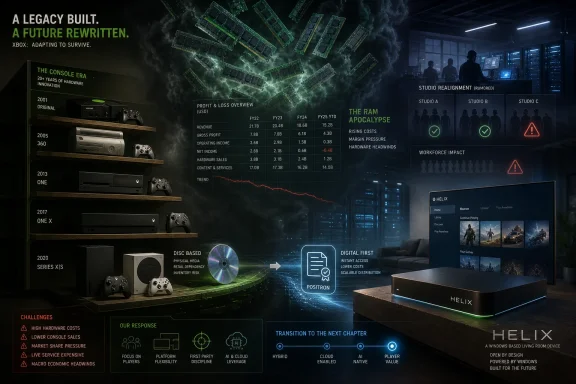 Xbox’s Crisis Is Not a Messaging Problem Anymore
For most of the past decade, Xbox’s troubles could be read as strategic confusion wrapped in public-relations overcorrection. The Xbox One era began with an infamous always-online, TV-first pitch that alienated core customers before the machine reached shelves. The Phil Spencer years then rebuilt trust around backward compatibility, Game Pass, cross-play, PC support, and a warmer promise that Xbox was a community rather than a plastic box.That rehabilitation was real, but it also deferred a reckoning. Microsoft bought studios, bought ZeniMax, bought Activision Blizzard, and built a sprawling content empire whose logic depended on scale finally overpowering hardware weakness. The bet was that Xbox could become less like Nintendo or PlayStation and more like Windows: a platform layer, not a single device.
The Windows Central Podcast episode, featuring senior Xbox editor Jez Corden, makes clear that the bill for that bet is now arriving. Corden’s reporting and commentary sit alongside recent coverage from The Verge, Windows Central, and others describing potential cuts, studio sales, and project reviews across Microsoft’s gaming division. The specifics remain fluid and in some cases disputed, but the pattern is not: Xbox is being forced to justify every part of itself as a business line.
That is why Asha Sharma’s arrival as Xbox CEO is more than a personnel story. Windows Central, Bloomberg, and GeekWire all reported in February that Sharma succeeded Phil Spencer after his long Microsoft tenure, bringing a background associated more with platform operations and Microsoft’s AI-era priorities than with the old Xbox cultural establishment. Whether that makes her the right executive for the moment depends on what one believes Xbox is now supposed to be.
If Xbox is still a console maker, the job is to win back customers with price, performance, and games. If Xbox is a Microsoft platform business, the job is to keep gaming strategically useful while cutting away anything that cannot meet corporate return thresholds. The uncomfortable possibility is that Microsoft now wants both answers at once.
The New Xbox Boss Inherits Phil Spencer’s Empire and Satya Nadella’s Spreadsheet
The podcast’s early discussion lands on a tension that has defined Microsoft gaming since the Activision Blizzard acquisition closed: Xbox is both bigger than ever and more exposed than ever. Owning Call of Duty, Blizzard, Bethesda, Mojang, and the historic Xbox Game Studios roster should, in theory, give Microsoft unmatched leverage. In practice, it also gives Microsoft an unusually large cost base inside a company pouring capital into AI infrastructure.This is where the gaming story intersects with the Microsoft story. The company’s Azure and AI ambitions have required enormous spending on data centers, GPUs, networking, energy, and memory. Microsoft is not alone here; the entire hyperscale technology sector has been reorienting around AI capital expenditure. But Microsoft’s internal consequence is simple: divisions that once justified themselves through strategic promise are increasingly being asked to show cleaner returns.
That is the context for reported Microsoft-wide belt-tightening and Xbox-specific fears. When a company is spending aggressively on AI capacity, “efficiency” becomes the language of survival everywhere else. Gaming is not immune just because players love the brand or because Game Pass remains culturally visible.
The hard part for Xbox employees and fans is that the division can be simultaneously successful and vulnerable. A year with strong content revenue, healthy engagement, or profitable releases does not protect every studio if leadership decides the portfolio is too sprawling or too slow. In corporate terms, a studio is not judged only by whether it makes good games. It is judged by whether its next three to six years of cost, risk, and output fit the company’s new model.
That is why rumors around names like Ninja Theory, Undead Labs, Compulsion, Double Fine, or Arkane hit so hard. These are not anonymous support teams. They are the studios Microsoft once used to tell a story about creative breadth: prestige narrative games, survival sandboxes, quirky adventures, immersive sims, and the kind of mid-sized experiments that made Game Pass feel meaningfully different from a storefront.
If those teams become candidates for closure, sale, or spinoff, the symbolic damage is larger than the balance-sheet line. Xbox’s acquisition spree was sold partly as preservation — a way to give talented teams stability under Microsoft’s umbrella. The new fear is that the umbrella only lasts until the forecast turns.
The Studio Rumor Mill Points to a Bigger Portfolio Problem
The Verge has reported that Microsoft has been weighing layoffs, closures, spinoffs, and cancellations around Xbox, while Windows Central’s Jez Corden has discussed Microsoft seeking buyers in some cases rather than simply shutting projects down. That distinction matters. A sale or spinoff can be a lifeboat. A closure is a funeral.But either way, the message to the industry is brutal. Microsoft spent years acquiring capability, then discovered that capability is expensive to carry when blockbuster timelines stretch past half a decade. State of Decay 3, Perfect Dark, Fable, Everwild, Contraband, and other long-gestating projects became shorthand for the same anxiety: Xbox can announce worlds faster than it can ship them.
This is not uniquely Microsoft’s disease. AAA development has become slower, riskier, and more financially absurd across the industry. Teams build larger worlds, target more platforms, support longer live-service tails, and operate under player expectations that every major release arrive polished, cinematic, content-rich, and endlessly updated. The result is a production culture where six years can disappear before a game has even proved its market.
Corden and Bowden’s frustration with the AAA cycle is therefore not just pundit impatience. It reflects a structural mismatch between subscription-platform ambition and prestige-game production. Game Pass needs a steady cadence. AAA studios increasingly produce at geological speed. Microsoft tried to solve the cadence problem by buying more studios, but buying more studios also bought more burn rate.
This is why smaller, cheaper, globally distributed development has become newly fashionable. Bloober Team and other leaner studios come up in these conversations not because every game should imitate them creatively, but because their cost structures look sane compared with the West Coast mega-studio model. A $70 million success can be repeated. A $300 million bet that misses its window can become a corporate trauma.
Xbox’s stated problem used to be that it lacked enough first-party games. Its current problem may be worse: it owns many studios, but not enough of them can reliably produce the right games at the right cost on the right schedule.
The “RAM Apocalypse” Turns Console Hardware Into a Liability
The most important part of the podcast may be the least emotionally satisfying: memory costs. Corden and Bowden discuss a “RAM apocalypse” in which rising memory prices make console profitability uglier for both Microsoft and Sony. That phrase sounds like forum hyperbole until one remembers that modern consoles are, in effect, fixed-price PC-like devices sold into a volatile component market.Traditional console economics relied on a familiar bargain. The platform holder sells hardware at little profit or even a loss, then recovers margin through software royalties, subscriptions, accessories, services, and first-party games. That model works when the platform holder can predict costs and when enough users spend heavily inside the platform’s store.
Both assumptions are now under pressure. AI data centers have increased competition for memory supply, including high-bandwidth and conventional DRAM. Analysts and supply-chain reports throughout 2026 have described AI demand pushing memory prices upward and making consumer electronics planning more difficult. Consoles, which lock in specifications years ahead of launch, are especially vulnerable to that kind of squeeze.
The free-to-play economy adds a second crack. A console user who buys Fortnite skins through the platform storefront still contributes to the model. A console user who primarily plays free-to-play games, spends little, watches video apps, or migrates spending to another ecosystem is less valuable. The hardware subsidy assumes future platform revenue; the modern living-room user does not always comply.
This is one reason the next Xbox hardware conversation has become so strange. If the machine is cheap, Microsoft may lose money on every unit and risk never recovering it. If the machine is expensive, the console audience shrinks. If the machine is open to Steam and other PC stores, Microsoft gains a compelling consumer pitch but risks subsidizing hardware for Valve’s benefit.
That is the Helix dilemma in miniature. Microsoft wants the appeal of a console, the flexibility of a PC, the economics of a storefront, and the strategic reach of Windows. The problem is that those goals pull against one another.
Helix Is the Promise and the Trap
Windows Central has reported that Microsoft’s next-generation Xbox hardware, codenamed Helix, has been envisioned as a more open, Windows-based device that could support PC-like storefront flexibility. The pitch is obvious: what if the next Xbox were not merely a closed console, but a polished living-room Windows gaming box that could run Xbox content, Game Pass, Steam, and perhaps Epic Games Store titles in a console-friendly interface?As a product idea, that is thrilling. It would finally acknowledge how many players actually think about games in 2026: libraries spread across platforms, PC handhelds in the house, cloud saves expected, Discord normalized, and storefront loyalty weaker than ecosystem convenience. A living-room device that makes Windows gaming feel appliance-simple could be the most Microsoft thing Xbox has ever done.
As a business model, it is terrifying. If Microsoft sells Helix at a loss and users buy most of their games on Steam, Xbox becomes a hardware charity for a rival storefront. If Microsoft prices Helix at the real cost of premium PC-like hardware, the device may land closer to $1,000 than to the psychologically familiar console range. At that point, it competes less with PlayStation and more with gaming PCs, handheld docks, and boutique living-room rigs.
The Windows Central Podcast discussion of Matthew Ball and Microsoft rethinking Helix underlines this tension. Whatever title Ball holds in Microsoft’s current gaming strategy orbit, the strategic question is not subtle: how open can Xbox afford to be? Openness is a consumer virtue, but a platform holder has to monetize the openness somehow.
Valve can sell the Steam Deck with the knowledge that Steam is the default gravity well. Nintendo can sell hardware because Nintendo software is the gravity well. Sony can sell PlayStation because the PlayStation Store, PlayStation Plus, and exclusive content keep many users inside the walls. Microsoft’s proposed hybrid device would need to make Xbox the best place to spend, not merely the best place to boot.
That is a much harder product problem than “make a powerful console.” It is an identity problem. A closed Xbox risks irrelevance against PC and PlayStation. An open Xbox risks becoming a Windows PC with worse margins.
Physical Media Is Becoming a Transitional Problem, Not a Pillar
The disc-drive debate is where nostalgia, ownership, preservation, and manufacturing economics collide. Sony’s reported move away from physical PlayStation discs beginning in 2028, covered by outlets including TechCrunch, The Washington Post, TechRadar, and Windows Central, has sharpened the industry’s sense that the next console generation will treat discs as legacy baggage rather than core infrastructure. Even where details vary by report and interpretation, the direction is unmistakable: physical media is losing its place in the default console business.Xbox is already more comfortable with digital distribution than most of its audience was in 2013. Game Pass, Xbox Play Anywhere, cloud saves, digital entitlements, remote installs, and cross-device libraries have spent more than a decade normalizing the logic that the account matters more than the disc. The old Xbox One pitch failed partly because Microsoft tried to impose that future before trust, broadband, pricing, and consumer habits had caught up.
Now the industry has caught up, but the ownership concern has not gone away. Players who own hundreds of discs are not irrational for worrying that “digital future” can become “licensed disappearance.” Store shutdowns, delistings, rights expirations, and account bans have made the consumer case for physical ownership more than sentimental. A disc may no longer contain the whole game in an era of day-one patches, but it still represents transferability, resale, and a measure of independence.
That is why the reported Xbox feature codenamed Positron is so interesting. Windows Central has described it as a disc-to-digital system that could let a player insert a physical disc, claim a digital license to a Microsoft account, and retain access unless the disc is later registered elsewhere. If accurate, it is an elegant attempt to square the circle: preserve some value of the disc while preparing for hardware that may not include a drive.
It is also a DRM system by another name. That does not make it bad. Every digital license system is a rights-management system. The question is whether Microsoft can make it feel like customer protection rather than customer capture.
Positron’s success would depend on policy details that matter enormously to collectors and preservationists. Which discs qualify? What happens with delisted games? Can used games still circulate? How many times can a license move? What happens if a publisher disappears, a music license expires, or Microsoft changes its authentication servers? These are not edge cases to the people most likely to use the feature.
If Helix ships without a disc drive, Positron becomes less of a convenience and more of a political necessity. Microsoft would be telling longtime Xbox customers: trust us, your library is coming with you. After 2013, that promise has to be engineered, documented, and messaged with almost painful clarity.
The 2013 Xbox One Vision Was Early, Not Wrong — But That Does Not Vindicate It
The podcast’s retrospective point about the Xbox One launch deserves a careful reading. Yes, much of the 2013 vision now looks prescient. Digital libraries became standard. Disc drives became optional. Game sharing, account-based entitlements, cloud saves, multimedia boxes, and always-connected services became normal parts of console life. Microsoft was broadly correct about where the market was going.But being directionally correct is not the same as earning the right to lead people there. The Xbox One reveal failed because Microsoft asked customers to surrender familiar ownership rights in exchange for benefits that were vague, constrained, and poorly communicated. It sounded less like a better future than a corporate compliance program for the living room.
The irony is that Xbox now has a stronger foundation for the same transition. Backward compatibility rebuilt trust. Game Pass made digital access feel valuable. Xbox Play Anywhere tied console and PC together in a way PlayStation still does not fully match. Microsoft accounts already carry large libraries across generations.
Yet the trust reservoir is not infinite. Studio closure rumors, price hikes, subscription changes, and hardware uncertainty all drain it. A consumer who feels Microsoft might close beloved studios, raise console prices, and abandon discs will not automatically applaud a disc-to-digital bridge, no matter how technically clever it is.
This is the central communications challenge for Sharma’s Xbox. Microsoft must avoid sounding like it is dressing austerity as innovation. If Helix is expensive, say why. If discs are going away, show the migration plan. If studios are being sold, explain the business logic without pretending nothing painful is happening. The audience may not like the answers, but evasiveness would be worse.
Game Pass Can No Longer Be the Answer to Every Xbox Question
Game Pass remains Xbox’s most important consumer product, but it has also become a rhetorical crutch. For years, every anxiety about Xbox could be answered with some version of “but Game Pass.” No exclusives this quarter? Game Pass. Buying publishers? Game Pass. PC strategy? Game Pass. Cloud gaming? Game Pass. Hardware weakness? Game Pass.The service still matters, and its value proposition can still be excellent for active players. But the economics are more complicated than the marketing. Day-one first-party releases, third-party deals, cloud infrastructure, family sharing experiments, price tiers, and regional pricing all have to be paid for. The more expensive games become, the harder it is for a flat subscription to feel magical without becoming financially burdensome.
Recent reporting around Game Pass pricing, third-party deal scrutiny, and Microsoft’s broader budgeting suggests the company knows this. The service cannot be an infinite subsidy machine any more than the console can. It has to become more disciplined, more segmented, and probably more expensive at the high end.
That does not mean Game Pass is doomed. It means Game Pass is maturing from growth story to margin story. Netflix went through the same psychological transition when investors stopped rewarding subscriber growth at any cost and started demanding profit, pricing power, and advertising strategy. Xbox’s version is messier because games are interactive, expensive, platform-bound, and culturally tied to ownership.
For Windows users, this may ultimately mean a more PC-centric Game Pass. Microsoft’s strongest gaming advantage is not a box under the TV; it is Windows, identity, cloud infrastructure, developer tools, and a giant content catalog. If the next Xbox hardware becomes a Windows gaming appliance, Game Pass becomes one pillar of a broader Microsoft gaming account rather than the single magic answer.
But that only works if the catalog feels coherent and the software experience improves. A Windows-based Xbox that drops users into driver weirdness, launcher sprawl, shader compilation misery, and storefront fragmentation will not feel like a console revolution. It will feel like a PC with a nicer boot animation.
Sony’s Disc Retreat Gives Xbox an Opening, but Not a Free Win
Sony’s reported path away from physical discs gives Microsoft a tempting contrast. Xbox can say it respects old libraries, supports backward compatibility, and is building Positron-like migration technology while PlayStation moves toward a cleaner digital break. That is a real opening, especially among collectors and preservation-minded players.But Microsoft should be careful not to overplay it. Xbox has already sold digital-only consoles. It has pushed subscriptions, cloud access, and account-based ownership for years. If Helix also drops the disc drive, Xbox will not be the last defender of physical media. It will be the company trying to make the digital transition less hostile.
That may still be enough. The winning position in 2028 may not be “we kept discs forever.” It may be “we handled your existing discs better than anyone else.” If Sony’s future treats physical libraries as yesterday’s problem and Microsoft gives users a credible conversion path, Xbox can turn a weakness into a loyalty play.
The catch is that backward compatibility is costly, legally complicated, and never complete. Music licenses, publisher rights, middleware, online services, and regional versions can all interfere with a clean migration. Xbox has done better than its competitors here, but “better” is not the same as universal.
The other catch is price. If Xbox’s customer-friendly migration path requires buying a premium Helix device that costs far more than a traditional console, many users will simply keep their Series X alive, move to PC, or buy whatever PlayStation offers. Good policy cannot fully overcome bad affordability.
That is why Bowden and Corden’s discussion of grandfathering the Series X and Series S into a longer cross-generation life is plausible. Microsoft may need the current machines to remain the budget Xbox tier while Helix becomes the premium frontier. The next generation may not be a clean break. It may be a stack.
The Next Xbox Generation May Look More Like a Product Ladder Than a Reset
Console generations used to be ritual events. A new box arrived, the old box faded, developers shifted targets, and the market reset around a fresh baseline. That model has been weakening for years, but Helix could break it more decisively.If Microsoft keeps Series S and Series X alive as low-cost access points while launching Helix as a premium Windows-based device, Xbox becomes less like a console cycle and more like an iPad lineup. Different devices would serve different budgets and performance expectations, with software spanning as much of the ladder as possible. That is messy for developers but attractive for a platform holder trying not to abandon millions of existing users.
The Series S complicates this vision. Developers have already complained, sometimes privately and sometimes publicly, about supporting the lower-memory device. Extending its life deep into the next generation could preserve affordability while dragging technical baselines. Killing it too quickly could strand the very budget customers Xbox most needs.
Series X is easier to imagine as a durable middle tier. It remains capable, familiar, and already attached to disc libraries in its optical-drive configuration. If memory prices make a cheap next-gen box difficult, the Series X may become Xbox’s accidental value console for longer than originally planned.
Helix, then, would not simply replace the Series family. It would redefine the top of the Xbox stack. That has precedent in PC gaming, where users expect scalable settings and varied hardware. But console development culture is built around fixed targets. Microsoft would need tools, certification rules, and storefront messaging that prevent the ladder from becoming chaos.
For IT-minded WindowsForum readers, this is where the Xbox story intersects with Microsoft’s broader platform instincts. A tiered Xbox ecosystem would look less like the old console business and more like Windows hardware: varied devices, shared account infrastructure, compatibility layers, and a persistent tension between openness and fragmentation. That may be Microsoft’s natural habitat. It is not necessarily the natural habitat of console customers.
Microsoft’s Real Competitor Is the Cost of Attention
It is easy to frame Xbox’s next few years as a fight with Sony, but the deeper competition is for time, spending, and default habits. Fortnite, Roblox, Minecraft, Call of Duty, Steam, Discord, Twitch, YouTube, TikTok, and mobile games all compete with the console platform model. Some of those live inside Xbox. Some bypass it. Some make hardware choice less important.This matters because console makers historically monetized captive attention. A player bought the box, bought games for the box, subscribed through the box, and bought accessories for the box. The platform holder controlled the commercial rails. Today, a player may use an Xbox controller with a PC handheld, buy skins in a cross-platform account, subscribe to Game Pass for a month, play Roblox without spending, and watch Discord streams instead of buying a new release.
That fragmentation weakens every subsidy assumption. It also weakens exclusivity as a universal cure. Exclusive games can still sell hardware; Nintendo proves that every generation. But Microsoft has trained its audience to expect Xbox games across Xbox, PC, cloud, and sometimes rival consoles. Reversing that expectation would be difficult and potentially self-defeating.
Sharma’s reported emphasis on “must-have exclusive content” therefore needs nuance. Xbox does need games that make the ecosystem desirable. But exclusivity may increasingly mean exclusive value inside the Microsoft account system rather than absolute device lock-in. Cross-buy, cloud saves, PC-console continuity, Game Pass inclusion, mod support, and backward compatibility may be the new exclusivity bundle.
That kind of exclusivity is less emotionally simple than “you can only play Halo here.” It is also more Microsoft. The company’s best historical businesses made platforms sticky by making them useful, compatible, and hard to leave. Xbox’s future may depend on applying that enterprise-platform logic without draining the joy out of games.
The Xbox Road Ahead Is Written in Margins, Memory, and Migration
The Windows Central Podcast episode is useful because it resists the fantasy that one showcase, one executive memo, or one hardware reveal will settle Xbox’s direction. The next version of Xbox is being shaped by component markets, AI capital spending, subscription math, studio productivity, digital ownership policy, and Microsoft’s appetite for risk. That is a less fun story than teraflops, but it is the real one.- Microsoft’s next Xbox hardware strategy appears to be constrained as much by memory and subsidy economics as by traditional console performance goals.
- Project Helix sounds most compelling as an open Windows-based gaming device, but that openness creates a serious monetization problem if players spend primarily through rival storefronts.
- Reported studio closures, sales, or spinoffs would signal that Microsoft is no longer willing to carry creative breadth without clearer financial returns.
- Project Positron could become a crucial bridge for disc owners if future Xbox hardware drops optical drives, but its value will depend on transparent licensing rules.
- Game Pass remains central to Xbox, but it is moving from a growth-at-all-costs narrative into a stricter margin-and-tiering phase.
- The Series X and Series S may live longer than a normal console generation if Microsoft turns Xbox into a product ladder rather than a clean generational reset.
References
- Primary source: Windows Central
Published: 2026-07-05T08:17:08.719292
Windows Central Podcast: The path ahead for Xbox with Jez Corden | Windows Central
On this week's episode: Zac and Jez discuss the state of Xbox as a business, recent rumors around studio closures, and what Microsoft is planning for Project Helix.,www.windowscentral.com - Related coverage: techtimes.com
Xbox July Layoffs Confirmed as CEO Sharma Eyes Affordable Console Tier
Xbox layoffs 2026 are confirmed for July as CEO Asha Sharma’s Reset memo discloses a $500 million revenue decline over five years, a 3% profit margin, and hints at a more affordable Xbox consolewww.techtimes.com - Related coverage: techradar.com
Xbox might be following PlayStation's lead, as new reports claim Microsoft is testing a new disc-to-digital game feature called 'Positron', and the next-gen Project Helix console won't have a disc drive | TechRadar
Project Helix will reportedly not feature a disc drive, as sources claim Xbox is testing a disc-to-digital feature that will digitize a user's game library.www.techradar.com - Related coverage: geekwire.com
Xbox chief Phil Spencer retiring after 38 years at Microsoft; Asha Sharma named new gaming CEO – GeekWire
Phil Spencer, who reshaped Xbox through landmark acquisitions and a bet on cloud gaming, is stepping down. His successor, Asha Sharma, has roots in the Seattle startup community, with deep experience in consumer platforms. Xbox President Sarah Bond is leaving.www.geekwire.com - Related coverage: techrepublic.com
Microsoft Xbox Leadership Shake-Up Signals AI Shift - TechRepublic
Microsoft is reshuffling Xbox leadership, retiring Phil Spencer and naming CoreAI exec Asha Sharma CEO of Microsoft Gaming, signaling an AI shift.www.techrepublic.com
- Related coverage: bloomberg.com
- Related coverage: gamesradar.com
Xbox CEO confirms it's "winding down" Microsoft Copilot on mobile and ending it on console | GamesRadar+
Xbox originally announced Copilot for console in Marchwww.gamesradar.com - Related coverage: gamermarkt.com
Xbox Project Positron: Disc-to-Digital Conversion Explained
Microsoft is developing Project Positron to convert physical Xbox game discs into digital licenses for the upcoming all-digital Xbox Helix console. Here's what we know.www.gamermarkt.com - Related coverage: tomshardware.com
Xbox CEO Asha Sharma kills Copilot for Gaming — overhauls leadership with CoreAI veterans | Tom's Hardware
Xbox seeks to reverse a revenue slump.www.tomshardware.com - Related coverage: gamespot.com
Xbox "Must Have Exclusive Content," CEO Says
Asha Sharma looks ahead to her next 100 days as Xbox CEO while addressing exclusivity and the steps needed to make Microsoft's console #1.www.gamespot.com - Related coverage: pcgamer.com
New Xbox boss promises no 'soulless AI slop' after moving over from Microsoft's CoreAI products division | PC Gamer
"We will not chase short-term efficiency or flood our ecosystem with soulless AI slop," said Asha Sharma, the new CEO of Microsoft Gaming.www.pcgamer.com - Related coverage: tbreak.com
Undead Labs Named in Xbox Studio Closure Wave
Undead Labs, the State of Decay 3 studio, is reportedly facing Xbox closure with ~110 jobs at risk — weeks after its 2027 reveal at the showcase.tbreak.com - Related coverage: allthings.how
Xbox Reportedly Closing Compulsion, Double Fine, and Ninja Theory
Three acclaimed studios face shutdown or independence as Microsoft moves toward broad gaming cuts after June 30.allthings.how