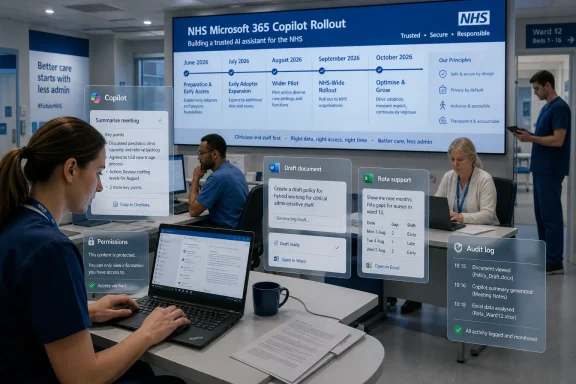
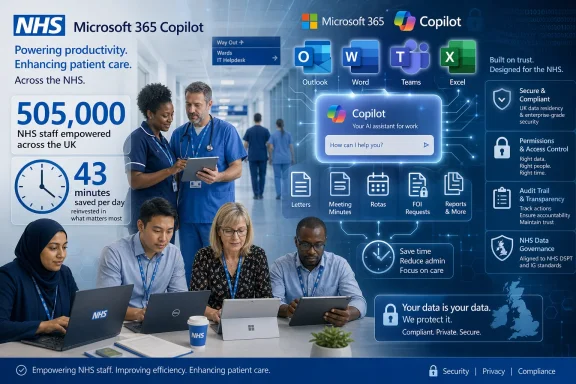
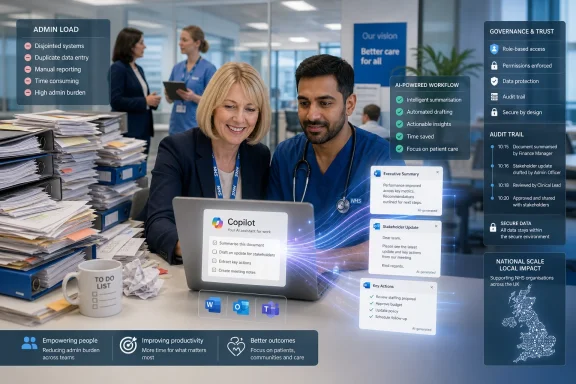
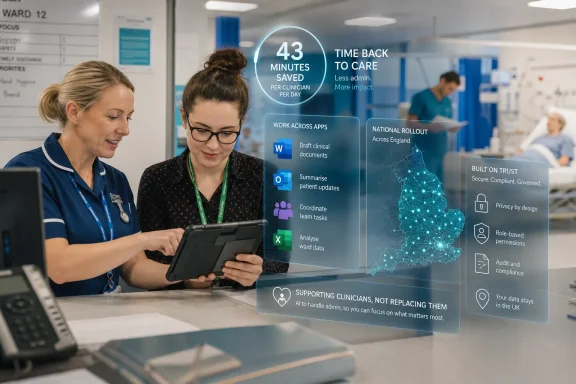
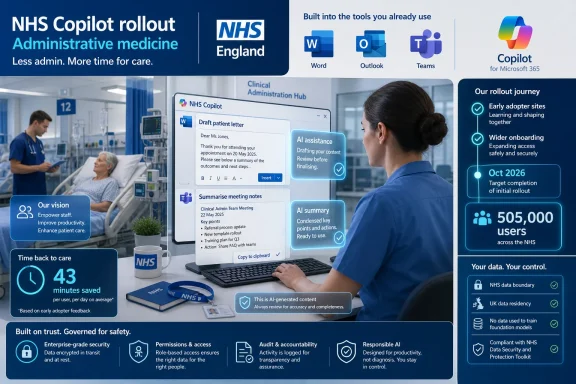
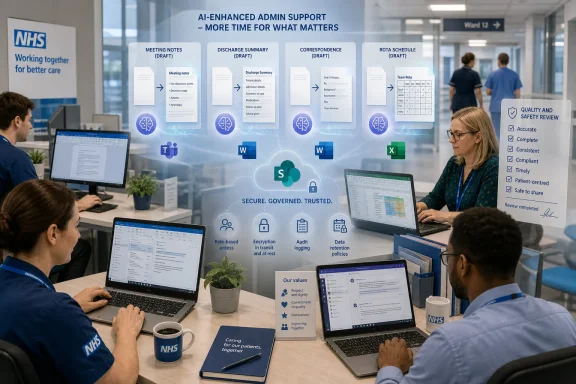
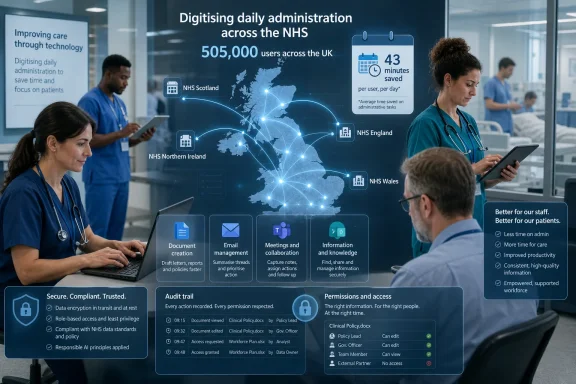
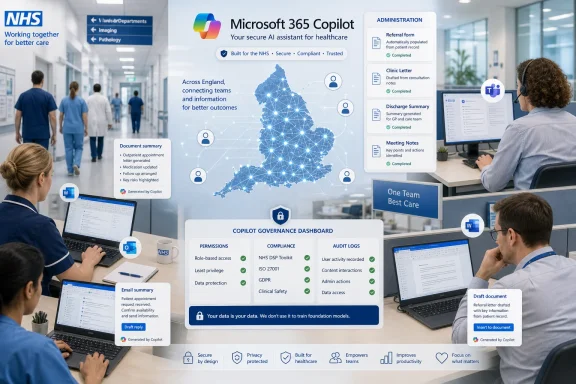
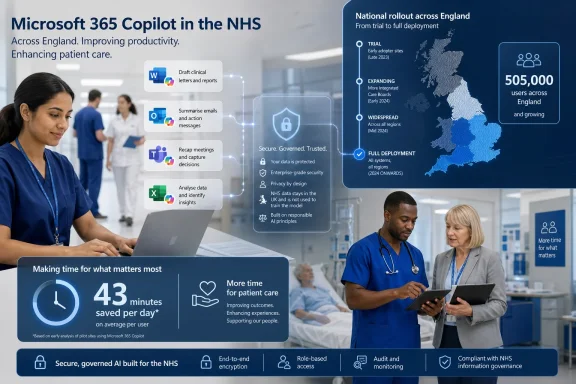
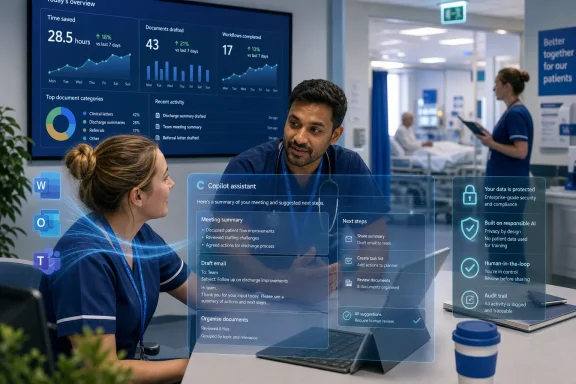
NHS England has announced a national rollout of Microsoft 365 Copilot to 505,000 clinicians and support staff, giving workers across English trusts access to Microsoft’s AI assistant for administration, analysis, document drafting, workflow automation, and internal service support. The stated ambition is not to make medicine more futuristic, but to make the ordinary machinery of healthcare less punishing. That distinction matters, because this is less a moonshot than a very large bet on clerical gravity: if AI can reduce the time staff spend wrestling with email, minutes, rotas, discharge paperwork, and reports, the NHS may recover capacity without adding headcount at the same pace. The risk is that a productivity tool sold as relief becomes another system to govern, audit, train, secure, and explain.
The headline number is the obvious one: 505,000 staff. In public-sector technology terms, that is not a pilot, a lighthouse project, or a ministerial photo opportunity with a dashboard in the background. It is a national-scale deployment of generative AI into one of the world’s most operationally stressed healthcare systems.
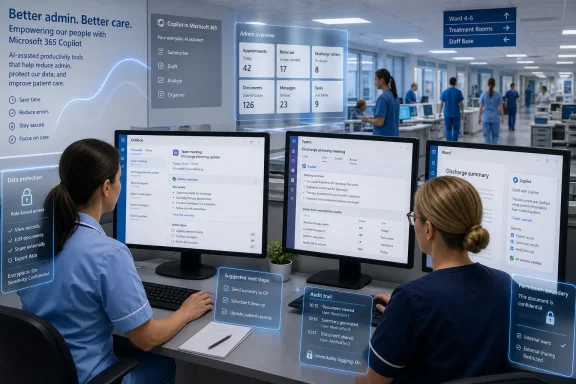
Microsoft and NHS England are framing the move around administrative drag. Ward clerks could use Copilot to help with discharge processes, rota building, bed management, and service data analysis. Medical secretaries could use it to produce meeting minutes and standard templates. Managers could use it to draft board papers, briefings, and organisational analysis. HR, finance, and procurement teams are also in scope.
That makes the deployment less glamorous than the public imagination of AI in healthcare. This is not primarily about diagnostic algorithms reading scans or a synthetic clinician advising patients at home. It is about the work that fills the spaces between care: summaries, approvals, reporting, scheduling, inbox triage, procurement notes, complaints handling, freedom of information requests, and the constant production of institutional paperwork.
That is exactly why the move is consequential. The NHS does not need AI to be magical for the rollout to matter. It needs AI to be boring, useful, and safe enough to shave minutes from repeated tasks at huge scale.
That existing footprint is Microsoft’s advantage. A health service does not need to procure a wholly separate AI environment before testing whether staff can save time drafting minutes or summarising long documents. It can add the assistant to a familiar productivity stack and argue that the data boundary, compliance model, and user experience are already partly understood.
The NHS rollout also extends beyond Microsoft 365 Copilot itself. NHS organisations will have access to Copilot Studio, allowing teams to build agents that automate or streamline workflows. NHS England will be able to create and deploy agents centrally, while individual trusts can build custom agents for local problems.
That local-versus-central split is important. The NHS is a national system, but it is not a single workplace. A trust drowning in helpdesk tickets, a finance team trying to process invoices faster, and a hospital service managing complaints backlogs may all need different automations. Copilot Studio gives Microsoft a way to say that Copilot is not just a writing assistant but a platform for institution-specific process change.
Agent 365 is being positioned as the governance layer for those agents, ensuring that they follow organisational policies and rules. That is the part of the story Microsoft will want every CIO to remember. The productivity promise sells the license; the governance promise gets the deployment past the people whose job is to imagine what happens when it goes wrong.
That is the kind of number that changes procurement conversations. At a small scale, 43 minutes sounds like a nice convenience. Across hundreds of thousands of workers, it becomes a political argument: millions of hours could be redirected away from administration and toward patient-facing or operational work.
But average time-savings figures deserve careful handling. They can conceal wide variation by role, task, training level, confidence, local workflow, and the quality of underlying data. A secretary preparing recurring meeting minutes may see an immediate benefit. A clinician working with complex, fragmented, or sensitive patient context may need more guardrails and may save less time. A manager already comfortable with templates, macros, and disciplined document workflows may see a different return from someone drowning in unstructured email.
The more interesting question is not whether 43 minutes is precisely repeatable across half a million users. It is whether the NHS can identify the job families and workflows where those minutes are real, measurable, and sustainable after the novelty fades. AI productivity tools often look best in demonstrations and early pilots, when enthusiastic users are selected, training is fresh, and the use cases are curated. National rollouts expose the long tail: reluctant users, messy permissions, inconsistent document hygiene, inaccessible data, and managers who want AI benefits without redesigning the work around it.
That is why the planned 12-month onboarding programme matters as much as the license count. NHS England says the deployment will include a rapid scale-up of 200,000 users within the first six months, alongside extensive training and adoption support. The rollout will succeed or fail not on whether Copilot can draft a memo, but on whether the NHS can turn a tool into a habit without adding yet another layer of bureaucratic friction.
The near-term value sits in workflow integration. If a ward clerk can ask Copilot to summarise relevant information for a discharge-related document, that is only useful if the clerk has access to the right information, understands what can be included, and remains accountable for checking it. If a trust builds an agent to triage HR questions, the agent is only as good as the policy documents, identity controls, escalation route, and audit trail behind it.
This is where public-sector AI becomes less exciting and more difficult. The hard work is not getting a fluent answer from a large language model. The hard work is defining what the assistant is allowed to know, what it is allowed to do, when it must refuse, when it must escalate, and who owns the error when a confident draft becomes a faulty decision.
Healthcare sharpens that problem. Even when Copilot is used for administration rather than clinical diagnosis, administrative mistakes can affect care. A delayed discharge note, a mis-summarised meeting action, an error in a rota, or an incomplete response to a complaint can have consequences beyond office productivity. The NHS will therefore need to treat “admin” as operationally important, not as harmless paperwork.
Microsoft’s pitch is that Copilot works inside established enterprise controls. That helps, but it does not dissolve the problem. Permissions in large organisations are often historically messy. Documents live in shared drives long after their owners have changed roles. Teams channels accrete members. SharePoint sites drift. A generative assistant that can surface and recombine internal information makes those old access-control problems more visible and potentially more consequential.
That may be rational. Large public organisations rarely have the luxury of building equivalent tools from scratch, and the NHS has immediate operational pressures. Microsoft can offer scale, integration, commercial certainty, and a familiar enterprise procurement path. In that sense, the rollout is an example of a practical public-sector bargain: accept vendor concentration in exchange for faster deployment and a clearer support model.
But concentration has costs. Once staff workflows, local agents, templates, automations, training materials, and management dashboards are built around Copilot, moving away becomes harder. The more successful the deployment is, the more embedded the dependency becomes. That is not a reason to reject the technology, but it is a reason to govern it as infrastructure rather than as an office add-on.
The NHS should also be wary of turning productivity claims into budget assumptions too quickly. A tool can save time without reducing costs in a simple, cashable way. If a clinician saves 43 minutes, that does not automatically become 43 minutes of additional patient appointments. The time may be fragmented across the day, consumed by other backlogged work, or absorbed by new documentation expectations. In overloaded systems, efficiency often prevents collapse before it produces visible surplus.
That point is politically awkward but operationally essential. The best case for Copilot may not be that it magically solves waiting lists. It may be that it reduces burnout, improves responsiveness, cuts duplication, and lets staff spend more of their working day on tasks that require judgment. Those are real gains, but they are not always easy to express as a neat savings line.
A document-drafting assistant generally waits for a user to ask for help. An agent can be designed to perform a defined workflow: answer HR questions, gather information, route requests, summarise cases, prepare briefings, or analyse financial data. In a complex organisation, that is attractive because so many processes are repetitive but not quite simple enough for traditional automation.
The NHS examples are telling. Reducing helpdesk burdens, accelerating complaints and freedom of information responses, and improving financial analysis are not futuristic tasks. They are exactly the kind of administrative choke points that irritate staff and patients alike. If agents can reduce time spent searching for policy, assembling background material, or rekeying information between systems, they may deliver more value than a general chat assistant.
But agents also move AI closer to action. A bad draft can be corrected before it is sent. A badly designed agent may route a request incorrectly, omit a crucial caveat, provide outdated policy guidance, or create a false sense that a process has been handled. The more agentic the system becomes, the more important it is to define approval checkpoints and monitor outcomes.
This is why Microsoft’s language about secure agents following organisational policies is not a side note. It is the heart of the deployment. NHS England and individual trusts will need a catalogue of agents, ownership models, testing standards, logging, incident response processes, and retirement plans for automations that no longer reflect policy. In other words, they will need AI service management, not just enthusiasm.
The Windows and Microsoft 365 ecosystem has already trained administrators to think in terms of identity, conditional access, data loss prevention, endpoint posture, retention, eDiscovery, and audit logs. Copilot adds another axis: what can the AI infer, summarise, generate, and automate from the information users can reach? That does not replace existing controls; it makes their weaknesses harder to ignore.
The NHS rollout will therefore be watched far beyond healthcare. If a large, regulated, politically scrutinised organisation can deploy Copilot to hundreds of thousands of staff without a public governance failure, Microsoft gains a powerful reference case. If the rollout produces confusion, poor adoption, data-access scares, or disappointing returns, sceptics across the public sector will have a different lesson ready.
For sysadmins, the practical message is that AI adoption is becoming less optional at the organisational level. Individual workers may or may not love Copilot, but boards, ministers, and executive teams increasingly see AI assistants as the next productivity mandate. IT departments will be expected to make them safe, measurable, and supportable.
That support burden should not be underestimated. Users will need training not only on prompts but on verification. Service desks will need scripts for Copilot-related issues. Security teams will need to understand whether unexpected outputs reflect hallucination, bad grounding, or excessive permissions. Records and compliance teams will need policies for AI-generated drafts, meeting summaries, and automated responses.
If Copilot can reduce some of that burden, it will be welcomed by many users. The most credible AI success stories tend to be the least theatrical: summarising long email chains, turning rough notes into a usable draft, extracting action items from a meeting, creating a first version of a report, or helping a user make sense of a spreadsheet. These are not replacements for professional judgment. They are accelerants for tasks people already know how to do.
Yet adoption cannot be commanded into existence by contract. Workers who distrust the tool, fear surveillance, worry about errors, or simply lack time to learn it may not use it meaningfully. Others may overuse it, accepting drafts too readily or allowing generic language to flatten important nuance. Both failure modes are plausible.
The NHS will need to make the tool feel like support rather than managerial pressure. If staff experience Copilot as another productivity target, the rollout may deepen cynicism. If they experience it as a way to clear low-value work and regain control of the day, adoption has a chance.
That is a cultural project as much as a technical one. Training should not pretend that AI is effortless. It should teach when not to use it, how to check outputs, what data should not be included, and how to report problems. The message should be neither “trust the machine” nor “fear the machine,” but “use it under professional control.”
The safest answer is not a slogan about responsible AI. It is documentation, transparency, and limits. NHS organisations will need to explain which use cases are approved, which are prohibited, what human review is required, and how incidents are handled. They will also need to distinguish between using Copilot to draft a board paper and using AI in ways that might affect individual care.
This is where the rollout could become a test of public trust. The NHS has a long history of ambitious digital programmes, some successful and some bruising. Patients may tolerate AI helping staff reduce paperwork; they may be far less comfortable if they believe sensitive information is being casually poured into a black box. The distinction must be made visible.
The challenge is that generative AI blurs categories. A meeting summary may mention patients. A complaint response may involve personal data. A discharge workflow may intersect with clinical and administrative information. The NHS cannot rely on a simplistic division between “clinical” and “non-clinical” use when real workflows often combine both.
That does not make the rollout reckless. It makes governance the product. The public-sector organisations that handle AI well will be the ones that publish clear rules, monitor actual use, update controls as failures emerge, and resist the temptation to treat AI assurance as a one-time procurement checkbox.
The NHS also gives Microsoft a particularly powerful story. If Copilot can help one of the most pressured public healthcare systems in the world reduce administrative burden, that is more compelling than another case study about faster slide decks. Healthcare gives the productivity narrative moral weight.
That does not mean Microsoft’s claims should be swallowed whole. Vendor case studies naturally highlight success, and the economics of AI remain under scrutiny across the industry. Running generative AI at scale is expensive, and customers are still learning which use cases justify paid licenses. The NHS rollout will be part of that broader market experiment.
But Microsoft has one advantage many AI challengers lack: distribution. Copilot does not need to persuade users to visit a new destination if it is embedded in the tools they already open every morning. That does not guarantee adoption, but it lowers the barrier. In enterprise software, being present at the point of work is often half the battle.
The NHS deployment also reinforces Microsoft’s attempt to make agents the next layer of competition. If trusts begin building local agents for local workflows, Microsoft becomes not just the supplier of an assistant but the platform on which process automation is designed. That is a much stickier business.
For internal operations, that means measuring backlog reduction, response times, document quality, meeting load, rota accuracy, onboarding speed, and staff satisfaction. For patient-adjacent workflows, it means watching whether discharge processes, complaints responses, and administrative communications become faster without becoming less accurate or more impersonal. For security and governance, it means tracking incidents, inappropriate use, over-permissioned data exposure, and the rate at which AI outputs require correction.
The NHS should also measure who benefits. AI tools can widen gaps between confident digital users and those who already feel overwhelmed by software. If the biggest gains accrue to managers and office-heavy roles while frontline staff see little relief, the politics of the rollout may become uncomfortable. Conversely, if ward clerks, secretaries, and operational teams gain meaningful time back, the programme could earn legitimacy from the ground up.
The uncomfortable truth is that productivity technology often shifts work rather than eliminating it. A faster draft can create an expectation of more drafts. Easier analysis can create demand for more reports. Meeting summaries can encourage more meetings because the documentation burden feels lower. Without discipline, Copilot could help the NHS produce more bureaucracy faster.
That is why leadership matters. The goal should not be to increase the volume of administrative output. It should be to reduce unnecessary work, simplify processes, and reserve human attention for judgment, care, and accountability. AI can support that goal, but it cannot supply the organisational courage required to delete pointless tasks.
The sensible view is neither utopian nor dismissive. Microsoft 365 Copilot will not fix the NHS, and it should not be allowed to become a political shortcut for deeper workforce, funding, and process problems. But if NHS England can use the rollout to remove administrative sludge, impose better information governance, and give staff tools that genuinely reduce daily friction, this may be the point at which enterprise AI stops being a boardroom slogan and starts becoming part of the operating system of public services.
 The NHS Is Not Buying a Chatbot So Much as Buying Time
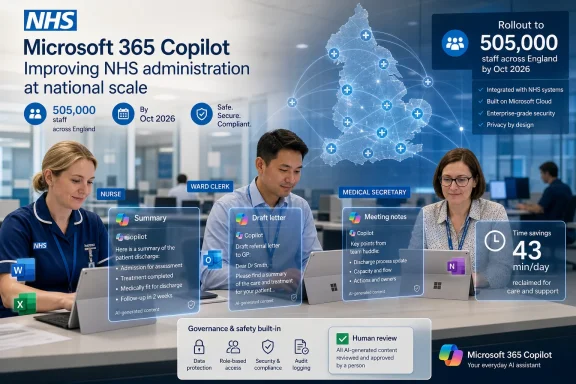
The headline number is the obvious one: 505,000 staff. In public-sector technology terms, that is not a pilot, a lighthouse project, or a ministerial photo opportunity with a dashboard in the background. It is a national-scale deployment of generative AI into one of the world’s most operationally stressed healthcare systems.Microsoft and NHS England are framing the move around administrative drag. Ward clerks could use Copilot to help with discharge processes, rota building, bed management, and service data analysis. Medical secretaries could use it to produce meeting minutes and standard templates. Managers could use it to draft board papers, briefings, and organisational analysis. HR, finance, and procurement teams are also in scope.
That makes the deployment less glamorous than the public imagination of AI in healthcare. This is not primarily about diagnostic algorithms reading scans or a synthetic clinician advising patients at home. It is about the work that fills the spaces between care: summaries, approvals, reporting, scheduling, inbox triage, procurement notes, complaints handling, freedom of information requests, and the constant production of institutional paperwork.
That is exactly why the move is consequential. The NHS does not need AI to be magical for the rollout to matter. It needs AI to be boring, useful, and safe enough to shave minutes from repeated tasks at huge scale.
Microsoft Has Found the AI Use Case Governments Understand
Microsoft’s enterprise AI pitch has sharpened over the past two years. Rather than selling a general-purpose assistant as a clever toy, it now sells Copilot as a layer inside the software estates governments and large employers already use. For organisations standardised on Microsoft 365, the attraction is obvious: the AI arrives in the same world as Outlook, Teams, Word, Excel, SharePoint, and corporate identity management.That existing footprint is Microsoft’s advantage. A health service does not need to procure a wholly separate AI environment before testing whether staff can save time drafting minutes or summarising long documents. It can add the assistant to a familiar productivity stack and argue that the data boundary, compliance model, and user experience are already partly understood.
The NHS rollout also extends beyond Microsoft 365 Copilot itself. NHS organisations will have access to Copilot Studio, allowing teams to build agents that automate or streamline workflows. NHS England will be able to create and deploy agents centrally, while individual trusts can build custom agents for local problems.
That local-versus-central split is important. The NHS is a national system, but it is not a single workplace. A trust drowning in helpdesk tickets, a finance team trying to process invoices faster, and a hospital service managing complaints backlogs may all need different automations. Copilot Studio gives Microsoft a way to say that Copilot is not just a writing assistant but a platform for institution-specific process change.
Agent 365 is being positioned as the governance layer for those agents, ensuring that they follow organisational policies and rules. That is the part of the story Microsoft will want every CIO to remember. The productivity promise sells the license; the governance promise gets the deployment past the people whose job is to imagine what happens when it goes wrong.
The Trial Gave Ministers the Number They Needed
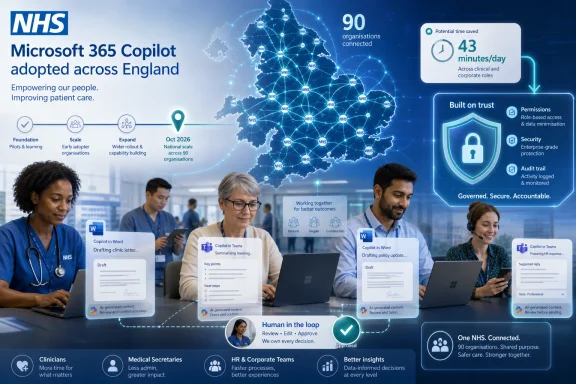
The rollout follows a large NHS trial that gave more than 30,000 workers across 90 organisations access to Microsoft 365 Copilot. According to the government and Microsoft’s account of the findings, the trial suggested average savings of 43 minutes per staff member per day, equivalent to roughly five working weeks per person each year.That is the kind of number that changes procurement conversations. At a small scale, 43 minutes sounds like a nice convenience. Across hundreds of thousands of workers, it becomes a political argument: millions of hours could be redirected away from administration and toward patient-facing or operational work.
But average time-savings figures deserve careful handling. They can conceal wide variation by role, task, training level, confidence, local workflow, and the quality of underlying data. A secretary preparing recurring meeting minutes may see an immediate benefit. A clinician working with complex, fragmented, or sensitive patient context may need more guardrails and may save less time. A manager already comfortable with templates, macros, and disciplined document workflows may see a different return from someone drowning in unstructured email.
The more interesting question is not whether 43 minutes is precisely repeatable across half a million users. It is whether the NHS can identify the job families and workflows where those minutes are real, measurable, and sustainable after the novelty fades. AI productivity tools often look best in demonstrations and early pilots, when enthusiastic users are selected, training is fresh, and the use cases are curated. National rollouts expose the long tail: reluctant users, messy permissions, inconsistent document hygiene, inaccessible data, and managers who want AI benefits without redesigning the work around it.
That is why the planned 12-month onboarding programme matters as much as the license count. NHS England says the deployment will include a rapid scale-up of 200,000 users within the first six months, alongside extensive training and adoption support. The rollout will succeed or fail not on whether Copilot can draft a memo, but on whether the NHS can turn a tool into a habit without adding yet another layer of bureaucratic friction.
The Real Test Is the Workflow, Not the Model
Generative AI has a habit of making every technology story sound like a model story. Which model? How many parameters? How good is the reasoning? How close is it to replacing a human expert? In the NHS rollout, those questions are secondary.The near-term value sits in workflow integration. If a ward clerk can ask Copilot to summarise relevant information for a discharge-related document, that is only useful if the clerk has access to the right information, understands what can be included, and remains accountable for checking it. If a trust builds an agent to triage HR questions, the agent is only as good as the policy documents, identity controls, escalation route, and audit trail behind it.
This is where public-sector AI becomes less exciting and more difficult. The hard work is not getting a fluent answer from a large language model. The hard work is defining what the assistant is allowed to know, what it is allowed to do, when it must refuse, when it must escalate, and who owns the error when a confident draft becomes a faulty decision.
Healthcare sharpens that problem. Even when Copilot is used for administration rather than clinical diagnosis, administrative mistakes can affect care. A delayed discharge note, a mis-summarised meeting action, an error in a rota, or an incomplete response to a complaint can have consequences beyond office productivity. The NHS will therefore need to treat “admin” as operationally important, not as harmless paperwork.
Microsoft’s pitch is that Copilot works inside established enterprise controls. That helps, but it does not dissolve the problem. Permissions in large organisations are often historically messy. Documents live in shared drives long after their owners have changed roles. Teams channels accrete members. SharePoint sites drift. A generative assistant that can surface and recombine internal information makes those old access-control problems more visible and potentially more consequential.
The NHS Wants Relief, but It Also Gets a New Dependency
There is an unavoidable strategic trade-off in this rollout. The NHS is buying speed by deepening its dependence on Microsoft. For many trusts, that dependence already exists through Microsoft 365, Teams, Entra identity, security tooling, and cloud services. Copilot intensifies the relationship by making Microsoft’s AI layer part of everyday administrative work.That may be rational. Large public organisations rarely have the luxury of building equivalent tools from scratch, and the NHS has immediate operational pressures. Microsoft can offer scale, integration, commercial certainty, and a familiar enterprise procurement path. In that sense, the rollout is an example of a practical public-sector bargain: accept vendor concentration in exchange for faster deployment and a clearer support model.
But concentration has costs. Once staff workflows, local agents, templates, automations, training materials, and management dashboards are built around Copilot, moving away becomes harder. The more successful the deployment is, the more embedded the dependency becomes. That is not a reason to reject the technology, but it is a reason to govern it as infrastructure rather than as an office add-on.
The NHS should also be wary of turning productivity claims into budget assumptions too quickly. A tool can save time without reducing costs in a simple, cashable way. If a clinician saves 43 minutes, that does not automatically become 43 minutes of additional patient appointments. The time may be fragmented across the day, consumed by other backlogged work, or absorbed by new documentation expectations. In overloaded systems, efficiency often prevents collapse before it produces visible surplus.
That point is politically awkward but operationally essential. The best case for Copilot may not be that it magically solves waiting lists. It may be that it reduces burnout, improves responsiveness, cuts duplication, and lets staff spend more of their working day on tasks that require judgment. Those are real gains, but they are not always easy to express as a neat savings line.
Agents Make the Deal Bigger Than Office Productivity
The inclusion of Copilot Studio changes the shape of the announcement. Microsoft 365 Copilot is the visible assistant; agents are the attempt to turn AI into process machinery. That is where the NHS rollout could become more transformative, and also where governance becomes more demanding.A document-drafting assistant generally waits for a user to ask for help. An agent can be designed to perform a defined workflow: answer HR questions, gather information, route requests, summarise cases, prepare briefings, or analyse financial data. In a complex organisation, that is attractive because so many processes are repetitive but not quite simple enough for traditional automation.
The NHS examples are telling. Reducing helpdesk burdens, accelerating complaints and freedom of information responses, and improving financial analysis are not futuristic tasks. They are exactly the kind of administrative choke points that irritate staff and patients alike. If agents can reduce time spent searching for policy, assembling background material, or rekeying information between systems, they may deliver more value than a general chat assistant.
But agents also move AI closer to action. A bad draft can be corrected before it is sent. A badly designed agent may route a request incorrectly, omit a crucial caveat, provide outdated policy guidance, or create a false sense that a process has been handled. The more agentic the system becomes, the more important it is to define approval checkpoints and monitor outcomes.
This is why Microsoft’s language about secure agents following organisational policies is not a side note. It is the heart of the deployment. NHS England and individual trusts will need a catalogue of agents, ownership models, testing standards, logging, incident response processes, and retirement plans for automations that no longer reflect policy. In other words, they will need AI service management, not just enthusiasm.
Windows Admins Will Recognise the Pattern
For WindowsForum readers, the NHS announcement has a familiar rhythm. A major Microsoft platform starts as an optional productivity layer, then becomes a managed enterprise surface, then becomes a governance problem for IT. Copilot is following that path quickly.The Windows and Microsoft 365 ecosystem has already trained administrators to think in terms of identity, conditional access, data loss prevention, endpoint posture, retention, eDiscovery, and audit logs. Copilot adds another axis: what can the AI infer, summarise, generate, and automate from the information users can reach? That does not replace existing controls; it makes their weaknesses harder to ignore.
The NHS rollout will therefore be watched far beyond healthcare. If a large, regulated, politically scrutinised organisation can deploy Copilot to hundreds of thousands of staff without a public governance failure, Microsoft gains a powerful reference case. If the rollout produces confusion, poor adoption, data-access scares, or disappointing returns, sceptics across the public sector will have a different lesson ready.
For sysadmins, the practical message is that AI adoption is becoming less optional at the organisational level. Individual workers may or may not love Copilot, but boards, ministers, and executive teams increasingly see AI assistants as the next productivity mandate. IT departments will be expected to make them safe, measurable, and supportable.
That support burden should not be underestimated. Users will need training not only on prompts but on verification. Service desks will need scripts for Copilot-related issues. Security teams will need to understand whether unexpected outputs reflect hallucination, bad grounding, or excessive permissions. Records and compliance teams will need policies for AI-generated drafts, meeting summaries, and automated responses.
The Human Factor Is Bigger Than the AI Factor
The strongest argument for the NHS rollout is that staff need relief. Anyone who has dealt with healthcare administration knows how much of the system’s energy is consumed by coordination. Clinicians and support staff often operate inside a dense mesh of forms, meetings, inboxes, referrals, reporting obligations, and local workarounds.If Copilot can reduce some of that burden, it will be welcomed by many users. The most credible AI success stories tend to be the least theatrical: summarising long email chains, turning rough notes into a usable draft, extracting action items from a meeting, creating a first version of a report, or helping a user make sense of a spreadsheet. These are not replacements for professional judgment. They are accelerants for tasks people already know how to do.
Yet adoption cannot be commanded into existence by contract. Workers who distrust the tool, fear surveillance, worry about errors, or simply lack time to learn it may not use it meaningfully. Others may overuse it, accepting drafts too readily or allowing generic language to flatten important nuance. Both failure modes are plausible.
The NHS will need to make the tool feel like support rather than managerial pressure. If staff experience Copilot as another productivity target, the rollout may deepen cynicism. If they experience it as a way to clear low-value work and regain control of the day, adoption has a chance.
That is a cultural project as much as a technical one. Training should not pretend that AI is effortless. It should teach when not to use it, how to check outputs, what data should not be included, and how to report problems. The message should be neither “trust the machine” nor “fear the machine,” but “use it under professional control.”
The Privacy Debate Will Not Stay Quiet
Microsoft and NHS England are emphasising security and policy compliance, as they should. But healthcare data carries a special charge in public debate. Even if Copilot is aimed at administration and governed through enterprise controls, the public will understandably ask what information is being processed, where it resides, how prompts and outputs are handled, and whether AI-generated content enters patient records or decision pathways.The safest answer is not a slogan about responsible AI. It is documentation, transparency, and limits. NHS organisations will need to explain which use cases are approved, which are prohibited, what human review is required, and how incidents are handled. They will also need to distinguish between using Copilot to draft a board paper and using AI in ways that might affect individual care.
This is where the rollout could become a test of public trust. The NHS has a long history of ambitious digital programmes, some successful and some bruising. Patients may tolerate AI helping staff reduce paperwork; they may be far less comfortable if they believe sensitive information is being casually poured into a black box. The distinction must be made visible.
The challenge is that generative AI blurs categories. A meeting summary may mention patients. A complaint response may involve personal data. A discharge workflow may intersect with clinical and administrative information. The NHS cannot rely on a simplistic division between “clinical” and “non-clinical” use when real workflows often combine both.
That does not make the rollout reckless. It makes governance the product. The public-sector organisations that handle AI well will be the ones that publish clear rules, monitor actual use, update controls as failures emerge, and resist the temptation to treat AI assurance as a one-time procurement checkbox.
Microsoft Gets a Public-Sector Showcase at Exactly the Right Moment
For Microsoft, this is a strategically useful win. The company has spent heavily to make Copilot the front door to enterprise AI, but broad awareness does not always translate into paid, sustained, high-value usage. Large deployments provide proof points for investors, customers, and partners that the product is moving beyond experimentation.The NHS also gives Microsoft a particularly powerful story. If Copilot can help one of the most pressured public healthcare systems in the world reduce administrative burden, that is more compelling than another case study about faster slide decks. Healthcare gives the productivity narrative moral weight.
That does not mean Microsoft’s claims should be swallowed whole. Vendor case studies naturally highlight success, and the economics of AI remain under scrutiny across the industry. Running generative AI at scale is expensive, and customers are still learning which use cases justify paid licenses. The NHS rollout will be part of that broader market experiment.
But Microsoft has one advantage many AI challengers lack: distribution. Copilot does not need to persuade users to visit a new destination if it is embedded in the tools they already open every morning. That does not guarantee adoption, but it lowers the barrier. In enterprise software, being present at the point of work is often half the battle.
The NHS deployment also reinforces Microsoft’s attempt to make agents the next layer of competition. If trusts begin building local agents for local workflows, Microsoft becomes not just the supplier of an assistant but the platform on which process automation is designed. That is a much stickier business.
The NHS Should Measure Friction, Not Just Minutes
The headline metric from the trial is time saved. It is useful, but it should not be the only measure. A health service under pressure needs to know whether Copilot changes outcomes that staff and patients actually feel.For internal operations, that means measuring backlog reduction, response times, document quality, meeting load, rota accuracy, onboarding speed, and staff satisfaction. For patient-adjacent workflows, it means watching whether discharge processes, complaints responses, and administrative communications become faster without becoming less accurate or more impersonal. For security and governance, it means tracking incidents, inappropriate use, over-permissioned data exposure, and the rate at which AI outputs require correction.
The NHS should also measure who benefits. AI tools can widen gaps between confident digital users and those who already feel overwhelmed by software. If the biggest gains accrue to managers and office-heavy roles while frontline staff see little relief, the politics of the rollout may become uncomfortable. Conversely, if ward clerks, secretaries, and operational teams gain meaningful time back, the programme could earn legitimacy from the ground up.
The uncomfortable truth is that productivity technology often shifts work rather than eliminating it. A faster draft can create an expectation of more drafts. Easier analysis can create demand for more reports. Meeting summaries can encourage more meetings because the documentation burden feels lower. Without discipline, Copilot could help the NHS produce more bureaucracy faster.
That is why leadership matters. The goal should not be to increase the volume of administrative output. It should be to reduce unnecessary work, simplify processes, and reserve human attention for judgment, care, and accountability. AI can support that goal, but it cannot supply the organisational courage required to delete pointless tasks.
The 505,000-Seat Bet Comes Down to These Practical Tests
The NHS has chosen scale, and scale will reveal what small pilots cannot. The deployment’s success will depend less on the novelty of generative AI than on whether NHS England and local trusts can translate it into safer, simpler, and more measurable work.- The rollout gives 505,000 NHS clinicians and support staff access to Microsoft 365 Copilot, with 200,000 users expected to be scaled up within the first six months.
- The business case rests heavily on trial findings that suggested average savings of 43 minutes per staff member per day across more than 30,000 workers and 90 NHS organisations.
- The most immediate use cases are administrative rather than diagnostic, including discharge support, meeting minutes, rota work, board papers, HR, finance, procurement, complaints, and information requests.
- Copilot Studio and agents could matter more than chat-style assistance because they allow NHS England and individual trusts to automate local workflows.
- The deployment’s hardest problems will be governance, permissions, training, verification, measurement, and public trust rather than whether the AI can produce fluent text.
The sensible view is neither utopian nor dismissive. Microsoft 365 Copilot will not fix the NHS, and it should not be allowed to become a political shortcut for deeper workforce, funding, and process problems. But if NHS England can use the rollout to remove administrative sludge, impose better information governance, and give staff tools that genuinely reduce daily friction, this may be the point at which enterprise AI stops being a boardroom slogan and starts becoming part of the operating system of public services.
References
- Primary source: Microsoft UK Stories
Published: Sun, 07 Jun 2026 06:58:10 GMT
NHS England rolls out Microsoft 365 Copilot to 505,000 staff
NHS England has announced that it is significantly accelerating AI adoption across healthcare services by providing 505,000 clinicians and support staff with access to Microsoft 365 Copilot.ukstories.microsoft.com - Related coverage: gov.uk
Major NHS AI trial delivers unprecedented time and cost savings
Microsoft 365 Copilot trial demonstrates monthly time savings of potentially 400,000 hours for NHS staff.www.gov.uk
- Official source: microsoft.com
- Related coverage: resultsense.com
HMRC scales Microsoft Copilot to 28,000 staff with 50,000 target
HMRC's first Chief AI Officer outlines a rollout of Microsoft 365 Copilot to 28,000 staff with plans to extend to 50,000, plus agentic complaint-handling pilots.www.resultsense.com
- Related coverage: techradar.com
Microsoft spent billions on Copilot, but only 3.3% of users are actually paying for the AI tools | TechRadar
Microsoft spent $37.5 billion on AI tools, with limited returns so farwww.techradar.com - Related coverage: uctoday.com
8,000 Staff. Custom AI Agents. Is Your Microsoft 365 Copilot Strategy This Far Along? - UC Today
UC Today delivers insights for IT leaders and buyers covering Agentic AI, Agentic AI in the Workplace, AI Agents, AI Copilots & Assistants, Copilot, Generative AI, Productivity, UCaaS, UCaaS & CCaaS Convergence, collaboration, employee experience and workspace tech. www.uctoday.com
- Related coverage: itpro.com
Accenture has been trialling Microsoft Copilot since 2023 – now it’s rolling out the AI tool to all 743,000 staff | IT Pro
Accenture will roll out Microsoft Copilot to 743,000 employees after years of testing.www.itpro.com - Related coverage: windowscentral.com
Shadow AI tools threaten UK privacy, Microsoft warns | Windows Central
A new Microsoft study says AI could save the UK economy 12.1 billion per year, but warns Shadow AI tools pose serious privacy and security risks.www.windowscentral.com - Related coverage: cdn.ps.emap.com
- Official source: adoption.microsoft.com
- Related coverage: assets.publishing.service.gov.uk
- Official source: news.microsoft.com