NHS England has announced a national rollout of Microsoft 365 Copilot to 505,000 clinicians and support staff, giving workers across English trusts access to Microsoft’s AI assistant for administration, analysis, document drafting, workflow automation, and internal service support. The stated ambition is not to make medicine more futuristic, but to make the ordinary machinery of healthcare less punishing. That distinction matters, because this is less a moonshot than a very large bet on clerical gravity: if AI can reduce the time staff spend wrestling with email, minutes, rotas, discharge paperwork, and reports, the NHS may recover capacity without adding headcount at the same pace. The risk is that a productivity tool sold as relief becomes another system to govern, audit, train, secure, and explain.

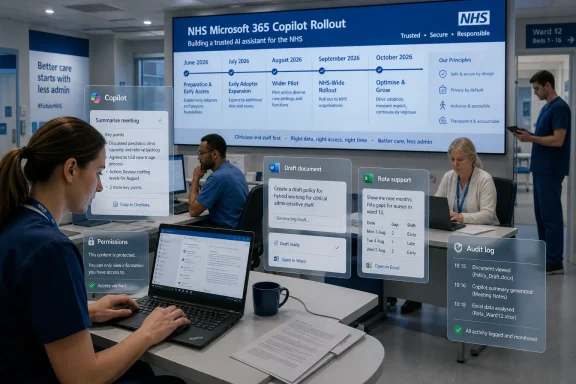
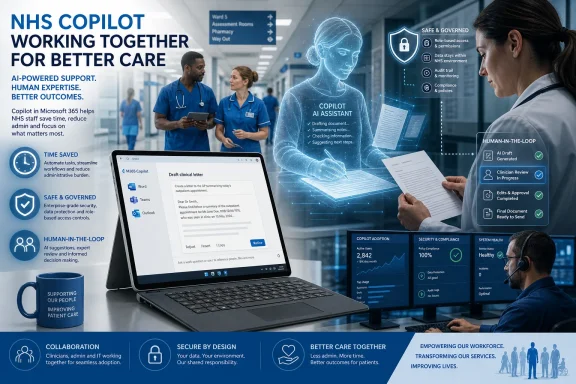
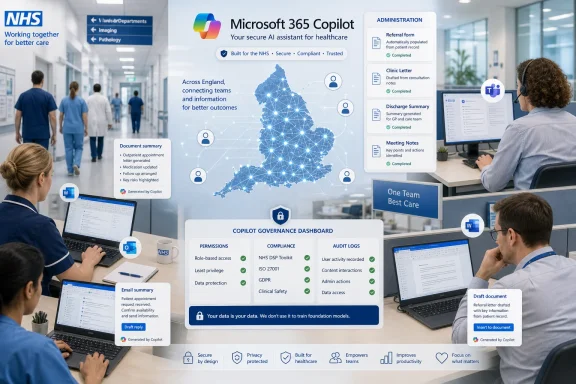
Hospital staff use Microsoft 365 Copilot dashboards on multiple monitors to manage patient admin tasks.The NHS Is Not Buying a Chatbot So Much as Buying Time​

The headline number is the obvious one: 505,000 staff. In public-sector technology terms, that is not a pilot, a lighthouse project, or a ministerial photo opportunity with a dashboard in the background. It is a national-scale deployment of generative AI into one of the world’s most operationally stressed healthcare systems.
Microsoft and NHS England are framing the move around administrative drag. Ward clerks could use Copilot to help with discharge processes, rota building, bed management, and service data analysis. Medical secretaries could use it to produce meeting minutes and standard templates. Managers could use it to draft board papers, briefings, and organisational analysis. HR, finance, and procurement teams are also in scope.
That makes the deployment less glamorous than the public imagination of AI in healthcare. This is not primarily about diagnostic algorithms reading scans or a synthetic clinician advising patients at home. It is about the work that fills the spaces between care: summaries, approvals, reporting, scheduling, inbox triage, procurement notes, complaints handling, freedom of information requests, and the constant production of institutional paperwork.
That is exactly why the move is consequential. The NHS does not need AI to be magical for the rollout to matter. It needs AI to be boring, useful, and safe enough to shave minutes from repeated tasks at huge scale.

Microsoft Has Found the AI Use Case Governments Understand​

Microsoft’s enterprise AI pitch has sharpened over the past two years. Rather than selling a general-purpose assistant as a clever toy, it now sells Copilot as a layer inside the software estates governments and large employers already use. For organisations standardised on Microsoft 365, the attraction is obvious: the AI arrives in the same world as Outlook, Teams, Word, Excel, SharePoint, and corporate identity management.
That existing footprint is Microsoft’s advantage. A health service does not need to procure a wholly separate AI environment before testing whether staff can save time drafting minutes or summarising long documents. It can add the assistant to a familiar productivity stack and argue that the data boundary, compliance model, and user experience are already partly understood.
The NHS rollout also extends beyond Microsoft 365 Copilot itself. NHS organisations will have access to Copilot Studio, allowing teams to build agents that automate or streamline workflows. NHS England will be able to create and deploy agents centrally, while individual trusts can build custom agents for local problems.
That local-versus-central split is important. The NHS is a national system, but it is not a single workplace. A trust drowning in helpdesk tickets, a finance team trying to process invoices faster, and a hospital service managing complaints backlogs may all need different automations. Copilot Studio gives Microsoft a way to say that Copilot is not just a writing assistant but a platform for institution-specific process change.
Agent 365 is being positioned as the governance layer for those agents, ensuring that they follow organisational policies and rules. That is the part of the story Microsoft will want every CIO to remember. The productivity promise sells the license; the governance promise gets the deployment past the people whose job is to imagine what happens when it goes wrong.

The Trial Gave Ministers the Number They Needed​

The rollout follows a large NHS trial that gave more than 30,000 workers across 90 organisations access to Microsoft 365 Copilot. According to the government and Microsoft’s account of the findings, the trial suggested average savings of 43 minutes per staff member per day, equivalent to roughly five working weeks per person each year.
That is the kind of number that changes procurement conversations. At a small scale, 43 minutes sounds like a nice convenience. Across hundreds of thousands of workers, it becomes a political argument: millions of hours could be redirected away from administration and toward patient-facing or operational work.
But average time-savings figures deserve careful handling. They can conceal wide variation by role, task, training level, confidence, local workflow, and the quality of underlying data. A secretary preparing recurring meeting minutes may see an immediate benefit. A clinician working with complex, fragmented, or sensitive patient context may need more guardrails and may save less time. A manager already comfortable with templates, macros, and disciplined document workflows may see a different return from someone drowning in unstructured email.
The more interesting question is not whether 43 minutes is precisely repeatable across half a million users. It is whether the NHS can identify the job families and workflows where those minutes are real, measurable, and sustainable after the novelty fades. AI productivity tools often look best in demonstrations and early pilots, when enthusiastic users are selected, training is fresh, and the use cases are curated. National rollouts expose the long tail: reluctant users, messy permissions, inconsistent document hygiene, inaccessible data, and managers who want AI benefits without redesigning the work around it.
That is why the planned 12-month onboarding programme matters as much as the license count. NHS England says the deployment will include a rapid scale-up of 200,000 users within the first six months, alongside extensive training and adoption support. The rollout will succeed or fail not on whether Copilot can draft a memo, but on whether the NHS can turn a tool into a habit without adding yet another layer of bureaucratic friction.

The Real Test Is the Workflow, Not the Model​

Generative AI has a habit of making every technology story sound like a model story. Which model? How many parameters? How good is the reasoning? How close is it to replacing a human expert? In the NHS rollout, those questions are secondary.
The near-term value sits in workflow integration. If a ward clerk can ask Copilot to summarise relevant information for a discharge-related document, that is only useful if the clerk has access to the right information, understands what can be included, and remains accountable for checking it. If a trust builds an agent to triage HR questions, the agent is only as good as the policy documents, identity controls, escalation route, and audit trail behind it.
This is where public-sector AI becomes less exciting and more difficult. The hard work is not getting a fluent answer from a large language model. The hard work is defining what the assistant is allowed to know, what it is allowed to do, when it must refuse, when it must escalate, and who owns the error when a confident draft becomes a faulty decision.
Healthcare sharpens that problem. Even when Copilot is used for administration rather than clinical diagnosis, administrative mistakes can affect care. A delayed discharge note, a mis-summarised meeting action, an error in a rota, or an incomplete response to a complaint can have consequences beyond office productivity. The NHS will therefore need to treat “admin” as operationally important, not as harmless paperwork.
Microsoft’s pitch is that Copilot works inside established enterprise controls. That helps, but it does not dissolve the problem. Permissions in large organisations are often historically messy. Documents live in shared drives long after their owners have changed roles. Teams channels accrete members. SharePoint sites drift. A generative assistant that can surface and recombine internal information makes those old access-control problems more visible and potentially more consequential.

The NHS Wants Relief, but It Also Gets a New Dependency​

There is an unavoidable strategic trade-off in this rollout. The NHS is buying speed by deepening its dependence on Microsoft. For many trusts, that dependence already exists through Microsoft 365, Teams, Entra identity, security tooling, and cloud services. Copilot intensifies the relationship by making Microsoft’s AI layer part of everyday administrative work.
That may be rational. Large public organisations rarely have the luxury of building equivalent tools from scratch, and the NHS has immediate operational pressures. Microsoft can offer scale, integration, commercial certainty, and a familiar enterprise procurement path. In that sense, the rollout is an example of a practical public-sector bargain: accept vendor concentration in exchange for faster deployment and a clearer support model.
But concentration has costs. Once staff workflows, local agents, templates, automations, training materials, and management dashboards are built around Copilot, moving away becomes harder. The more successful the deployment is, the more embedded the dependency becomes. That is not a reason to reject the technology, but it is a reason to govern it as infrastructure rather than as an office add-on.
The NHS should also be wary of turning productivity claims into budget assumptions too quickly. A tool can save time without reducing costs in a simple, cashable way. If a clinician saves 43 minutes, that does not automatically become 43 minutes of additional patient appointments. The time may be fragmented across the day, consumed by other backlogged work, or absorbed by new documentation expectations. In overloaded systems, efficiency often prevents collapse before it produces visible surplus.
That point is politically awkward but operationally essential. The best case for Copilot may not be that it magically solves waiting lists. It may be that it reduces burnout, improves responsiveness, cuts duplication, and lets staff spend more of their working day on tasks that require judgment. Those are real gains, but they are not always easy to express as a neat savings line.

Agents Make the Deal Bigger Than Office Productivity​

The inclusion of Copilot Studio changes the shape of the announcement. Microsoft 365 Copilot is the visible assistant; agents are the attempt to turn AI into process machinery. That is where the NHS rollout could become more transformative, and also where governance becomes more demanding.
A document-drafting assistant generally waits for a user to ask for help. An agent can be designed to perform a defined workflow: answer HR questions, gather information, route requests, summarise cases, prepare briefings, or analyse financial data. In a complex organisation, that is attractive because so many processes are repetitive but not quite simple enough for traditional automation.
The NHS examples are telling. Reducing helpdesk burdens, accelerating complaints and freedom of information responses, and improving financial analysis are not futuristic tasks. They are exactly the kind of administrative choke points that irritate staff and patients alike. If agents can reduce time spent searching for policy, assembling background material, or rekeying information between systems, they may deliver more value than a general chat assistant.
But agents also move AI closer to action. A bad draft can be corrected before it is sent. A badly designed agent may route a request incorrectly, omit a crucial caveat, provide outdated policy guidance, or create a false sense that a process has been handled. The more agentic the system becomes, the more important it is to define approval checkpoints and monitor outcomes.
This is why Microsoft’s language about secure agents following organisational policies is not a side note. It is the heart of the deployment. NHS England and individual trusts will need a catalogue of agents, ownership models, testing standards, logging, incident response processes, and retirement plans for automations that no longer reflect policy. In other words, they will need AI service management, not just enthusiasm.

Windows Admins Will Recognise the Pattern​

For WindowsForum readers, the NHS announcement has a familiar rhythm. A major Microsoft platform starts as an optional productivity layer, then becomes a managed enterprise surface, then becomes a governance problem for IT. Copilot is following that path quickly.
The Windows and Microsoft 365 ecosystem has already trained administrators to think in terms of identity, conditional access, data loss prevention, endpoint posture, retention, eDiscovery, and audit logs. Copilot adds another axis: what can the AI infer, summarise, generate, and automate from the information users can reach? That does not replace existing controls; it makes their weaknesses harder to ignore.
The NHS rollout will therefore be watched far beyond healthcare. If a large, regulated, politically scrutinised organisation can deploy Copilot to hundreds of thousands of staff without a public governance failure, Microsoft gains a powerful reference case. If the rollout produces confusion, poor adoption, data-access scares, or disappointing returns, sceptics across the public sector will have a different lesson ready.
For sysadmins, the practical message is that AI adoption is becoming less optional at the organisational level. Individual workers may or may not love Copilot, but boards, ministers, and executive teams increasingly see AI assistants as the next productivity mandate. IT departments will be expected to make them safe, measurable, and supportable.
That support burden should not be underestimated. Users will need training not only on prompts but on verification. Service desks will need scripts for Copilot-related issues. Security teams will need to understand whether unexpected outputs reflect hallucination, bad grounding, or excessive permissions. Records and compliance teams will need policies for AI-generated drafts, meeting summaries, and automated responses.

The Human Factor Is Bigger Than the AI Factor​

The strongest argument for the NHS rollout is that staff need relief. Anyone who has dealt with healthcare administration knows how much of the system’s energy is consumed by coordination. Clinicians and support staff often operate inside a dense mesh of forms, meetings, inboxes, referrals, reporting obligations, and local workarounds.
If Copilot can reduce some of that burden, it will be welcomed by many users. The most credible AI success stories tend to be the least theatrical: summarising long email chains, turning rough notes into a usable draft, extracting action items from a meeting, creating a first version of a report, or helping a user make sense of a spreadsheet. These are not replacements for professional judgment. They are accelerants for tasks people already know how to do.
Yet adoption cannot be commanded into existence by contract. Workers who distrust the tool, fear surveillance, worry about errors, or simply lack time to learn it may not use it meaningfully. Others may overuse it, accepting drafts too readily or allowing generic language to flatten important nuance. Both failure modes are plausible.
The NHS will need to make the tool feel like support rather than managerial pressure. If staff experience Copilot as another productivity target, the rollout may deepen cynicism. If they experience it as a way to clear low-value work and regain control of the day, adoption has a chance.
That is a cultural project as much as a technical one. Training should not pretend that AI is effortless. It should teach when not to use it, how to check outputs, what data should not be included, and how to report problems. The message should be neither “trust the machine” nor “fear the machine,” but “use it under professional control.”

The Privacy Debate Will Not Stay Quiet​

Microsoft and NHS England are emphasising security and policy compliance, as they should. But healthcare data carries a special charge in public debate. Even if Copilot is aimed at administration and governed through enterprise controls, the public will understandably ask what information is being processed, where it resides, how prompts and outputs are handled, and whether AI-generated content enters patient records or decision pathways.
The safest answer is not a slogan about responsible AI. It is documentation, transparency, and limits. NHS organisations will need to explain which use cases are approved, which are prohibited, what human review is required, and how incidents are handled. They will also need to distinguish between using Copilot to draft a board paper and using AI in ways that might affect individual care.
This is where the rollout could become a test of public trust. The NHS has a long history of ambitious digital programmes, some successful and some bruising. Patients may tolerate AI helping staff reduce paperwork; they may be far less comfortable if they believe sensitive information is being casually poured into a black box. The distinction must be made visible.
The challenge is that generative AI blurs categories. A meeting summary may mention patients. A complaint response may involve personal data. A discharge workflow may intersect with clinical and administrative information. The NHS cannot rely on a simplistic division between “clinical” and “non-clinical” use when real workflows often combine both.
That does not make the rollout reckless. It makes governance the product. The public-sector organisations that handle AI well will be the ones that publish clear rules, monitor actual use, update controls as failures emerge, and resist the temptation to treat AI assurance as a one-time procurement checkbox.

Microsoft Gets a Public-Sector Showcase at Exactly the Right Moment​

For Microsoft, this is a strategically useful win. The company has spent heavily to make Copilot the front door to enterprise AI, but broad awareness does not always translate into paid, sustained, high-value usage. Large deployments provide proof points for investors, customers, and partners that the product is moving beyond experimentation.
The NHS also gives Microsoft a particularly powerful story. If Copilot can help one of the most pressured public healthcare systems in the world reduce administrative burden, that is more compelling than another case study about faster slide decks. Healthcare gives the productivity narrative moral weight.
That does not mean Microsoft’s claims should be swallowed whole. Vendor case studies naturally highlight success, and the economics of AI remain under scrutiny across the industry. Running generative AI at scale is expensive, and customers are still learning which use cases justify paid licenses. The NHS rollout will be part of that broader market experiment.
But Microsoft has one advantage many AI challengers lack: distribution. Copilot does not need to persuade users to visit a new destination if it is embedded in the tools they already open every morning. That does not guarantee adoption, but it lowers the barrier. In enterprise software, being present at the point of work is often half the battle.
The NHS deployment also reinforces Microsoft’s attempt to make agents the next layer of competition. If trusts begin building local agents for local workflows, Microsoft becomes not just the supplier of an assistant but the platform on which process automation is designed. That is a much stickier business.

The NHS Should Measure Friction, Not Just Minutes​

The headline metric from the trial is time saved. It is useful, but it should not be the only measure. A health service under pressure needs to know whether Copilot changes outcomes that staff and patients actually feel.
For internal operations, that means measuring backlog reduction, response times, document quality, meeting load, rota accuracy, onboarding speed, and staff satisfaction. For patient-adjacent workflows, it means watching whether discharge processes, complaints responses, and administrative communications become faster without becoming less accurate or more impersonal. For security and governance, it means tracking incidents, inappropriate use, over-permissioned data exposure, and the rate at which AI outputs require correction.
The NHS should also measure who benefits. AI tools can widen gaps between confident digital users and those who already feel overwhelmed by software. If the biggest gains accrue to managers and office-heavy roles while frontline staff see little relief, the politics of the rollout may become uncomfortable. Conversely, if ward clerks, secretaries, and operational teams gain meaningful time back, the programme could earn legitimacy from the ground up.
The uncomfortable truth is that productivity technology often shifts work rather than eliminating it. A faster draft can create an expectation of more drafts. Easier analysis can create demand for more reports. Meeting summaries can encourage more meetings because the documentation burden feels lower. Without discipline, Copilot could help the NHS produce more bureaucracy faster.
That is why leadership matters. The goal should not be to increase the volume of administrative output. It should be to reduce unnecessary work, simplify processes, and reserve human attention for judgment, care, and accountability. AI can support that goal, but it cannot supply the organisational courage required to delete pointless tasks.

The 505,000-Seat Bet Comes Down to These Practical Tests​

The NHS has chosen scale, and scale will reveal what small pilots cannot. The deployment’s success will depend less on the novelty of generative AI than on whether NHS England and local trusts can translate it into safer, simpler, and more measurable work.
  • The rollout gives 505,000 NHS clinicians and support staff access to Microsoft 365 Copilot, with 200,000 users expected to be scaled up within the first six months.
  • The business case rests heavily on trial findings that suggested average savings of 43 minutes per staff member per day across more than 30,000 workers and 90 NHS organisations.
  • The most immediate use cases are administrative rather than diagnostic, including discharge support, meeting minutes, rota work, board papers, HR, finance, procurement, complaints, and information requests.
  • Copilot Studio and agents could matter more than chat-style assistance because they allow NHS England and individual trusts to automate local workflows.
  • The deployment’s hardest problems will be governance, permissions, training, verification, measurement, and public trust rather than whether the AI can produce fluent text.
The NHS rollout is therefore both a Microsoft win and a public-sector stress test. If it works, it will make AI feel less like a speculative technology and more like the next layer of office infrastructure. If it disappoints, it will remind every CIO that buying access to AI is far easier than redesigning work around it.
The sensible view is neither utopian nor dismissive. Microsoft 365 Copilot will not fix the NHS, and it should not be allowed to become a political shortcut for deeper workforce, funding, and process problems. But if NHS England can use the rollout to remove administrative sludge, impose better information governance, and give staff tools that genuinely reduce daily friction, this may be the point at which enterprise AI stops being a boardroom slogan and starts becoming part of the operating system of public services.
References​

  1. Primary source: Microsoft UK Stories
    Published: Sun, 07 Jun 2026 06:58:10 GMT
  2. Related coverage: gov.uk
  3. Official source: microsoft.com
  4. Related coverage: resultsense.com
  5. Related coverage: techradar.com
  6. Related coverage: uctoday.com
 

NHS England announced on June 8, 2026, that 505,000 clinicians and support staff will receive access to Microsoft 365 Copilot, with the national rollout expected to reach participating organisations by October 2026. The headline is not that the NHS has discovered generative AI; it is that Britain’s largest public service is now treating it as productivity infrastructure. If the numbers hold, this is a serious attempt to buy time back from administration. If they do not, it becomes an expensive lesson in how hard it is to turn demo-room AI into operational capacity.

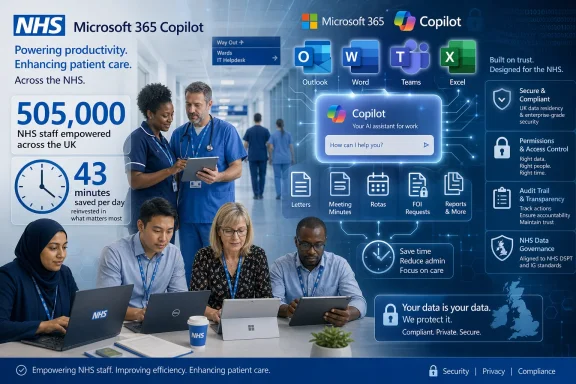
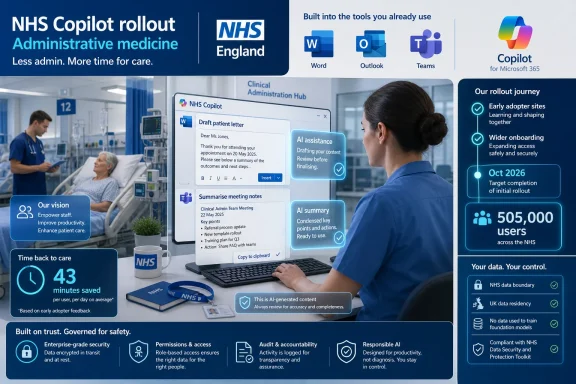
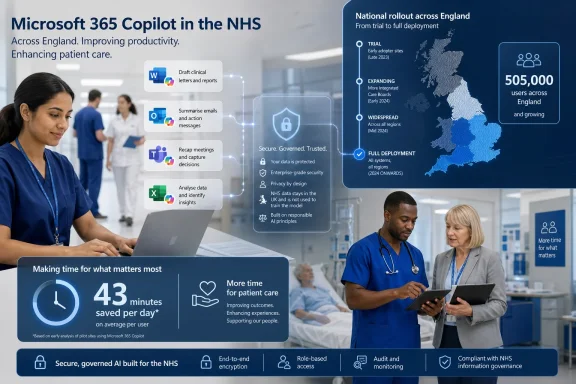
NHS staff review Microsoft 365 Copilot rollout materials on monitors in a hospital meeting room.Microsoft’s NHS Deal Turns Copilot From Office Add-On Into Public Infrastructure​

Microsoft 365 Copilot began life, at least in the enterprise imagination, as a premium assistant for Word, Excel, PowerPoint, Outlook, and Teams. In the NHS rollout, it becomes something larger and more politically exposed: a system-wide attempt to reduce paperwork across one of the world’s most scrutinised healthcare organisations.
That change matters because the NHS is not a neat corporate tenant with a few harmonised workflows. It is a sprawling federation of trusts, clinical settings, administrative teams, legacy processes, local governance practices, and urgent operational pressures. A tool that saves time for a finance analyst in one organisation may create review burdens for a ward clerk in another.
The promise is straightforward. Copilot can draft routine text, summarise meetings, analyse documents, help prepare reports, and surface information from Microsoft 365 data that staff already use. NHS England says the technology could free an average of two days per month from administrative duties, which is the kind of claim that turns an AI procurement into a workforce policy.
The risk is just as straightforward. Time saved inside an application is not automatically time returned to patients. The NHS must convert individual task efficiency into real organisational capacity, and that is a far harder problem than giving half a million people another button in the ribbon.

The Trial Gave Ministers a Number Too Tempting to Ignore​

The rollout follows a trial involving more than 30,000 NHS workers across 90 organisations. NHS England and government communications say that trial found Microsoft 365 Copilot could save an average of 43 minutes per staff member per day, equivalent to roughly five weeks per person each year. For any health system under pressure, those figures are irresistible.
They are also the figures that will define the rollout’s credibility. Forty-three minutes a day across 505,000 users implies a colossal pool of potential time, even allowing for partial adoption and uneven usefulness. At public-sector scale, small improvements compound quickly; so do disappointments.
This is why the wording around the trial deserves careful attention. The reported saving is an average, derived from a pilot environment, across selected organisations and use cases. Trials tend to attract motivated users, attentive programme teams, visible executive sponsorship, and workflows chosen because they are likely to benefit.
A national deployment is messier. Some users will find Copilot immediately useful for writing, summarising, and formatting. Others will ignore it, mistrust it, or discover that their most painful admin work sits outside Microsoft 365 entirely. The difference between those groups will determine whether this becomes a genuine NHS productivity story or simply a very large software licensing story.

The NHS Is Buying Time, Not Magic​

The strongest case for the deployment is not that Copilot will transform healthcare, but that it may chip away at the administrative drag that makes healthcare feel less human for staff and patients alike. Modern medicine runs on documentation: referrals, discharge notes, meeting actions, rota coordination, incident reports, policy drafts, data returns, HR forms, finance papers, and endless email.
That work is necessary, but it is not evenly valuable. Some of it protects patients and records clinical decisions. Some of it exists because the system has grown layers of reporting and coordination around scarcity. Copilot’s useful role is not to make clinical judgment automated; it is to make routine knowledge work less punishing.
The examples cited around the NHS deployment are telling. Ward clerks may use Copilot to support discharge processes, rota building, bed management, and service data analysis. Medical secretaries may use it to produce drafts and summaries. Back-office teams may use it for HR, finance, and administrative workflows that already live in Microsoft’s ecosystem.
That is a practical framing. It avoids the hype of AI doctors and instead aims at the dull, expensive substrate of healthcare operations. The irony is that the dull work is where the stakes are highest: a faster discharge summary, a clearer meeting record, or a better-prepared rota can have real effects, but only if reviewed and embedded in the right process.

Copilot’s Best Use Case Is the Work Nobody Wanted to Call Strategic​

The NHS has spent years being told that digital transformation will modernise care. Too often, that phrase has meant large programmes with long timelines, unclear accountability, and disappointing frontline experience. Copilot is different because it starts where staff already spend much of their day: Outlook, Teams, Word, Excel, and SharePoint.
That proximity is powerful. Workers do not need to learn an entirely new platform to benefit from automatic summarisation or first-draft assistance. Administrators do not need to move every workflow to a bespoke AI application before seeing some return. Microsoft’s advantage is not that Copilot is the only possible AI assistant; it is that Microsoft already owns the office layer.
For Windows and Microsoft 365 administrators, that is both the attraction and the lock-in. Copilot becomes useful precisely because it has access to organisational context through Microsoft Graph, permissions, files, meetings, mail, chats, and calendars. The more NHS workflows depend on that context, the more Microsoft becomes embedded not merely as a productivity vendor but as an operational dependency.
That dependency is not automatically bad. The NHS already relies heavily on Microsoft tooling, and central buying can reduce fragmentation. But public infrastructure built on commercial AI assistants deserves scrutiny because procurement choices made for productivity today can shape data architecture, security posture, and negotiating leverage for years.

The Governance Burden Arrives Before the Productivity Dividend​

The most serious challenge is not whether Copilot can draft a document. It can. The challenge is whether hundreds of NHS organisations can govern its use safely enough, consistently enough, and visibly enough to justify the scale of the deployment.
Healthcare is unforgiving territory for generative AI. Hallucinated details, misplaced confidence, incorrect summaries, and misunderstood context can be dangerous if staff treat output as authoritative. Microsoft and NHS England can emphasise that Copilot is an assistant rather than a decision-maker, but real-world systems are shaped by workload, time pressure, and habit.
The NHS will need clear rules about where Copilot is appropriate, where human verification is mandatory, and where the tool should not be used at all. Drafting a meeting summary is one thing. Summarising information that might influence patient communication, operational escalation, or clinical documentation is another.
There is also the permissions problem. Copilot can only be as safe as the information boundaries beneath it. If SharePoint sites, Teams channels, mailbox access, or document libraries are over-permissive, an AI assistant can make old access-control mistakes newly visible and newly searchable. Many administrators have already learned that Copilot readiness is, in practice, a data hygiene audit wearing an AI badge.

The NHS Cannot Afford a Shadow Productivity Metric​

The trial’s 43-minute figure will be quoted everywhere because it is simple. But simple metrics can become dangerous if they are not connected to outcomes. A staff member who saves 43 minutes may spend that time on patient contact, backlog reduction, training, supervision, extra documentation, another meeting, or simply absorbing pressure that would otherwise have become overtime.
That is not a reason to dismiss the saving. In an overstretched system, making work less exhausting has value even before it appears in waiting-list statistics. But policymakers should resist pretending that reclaimed time automatically turns into visible service improvement.
The NHS will need to measure several things at once. Adoption rates matter, but so does meaningful usage. User satisfaction matters, but so does whether output quality improves or degrades. Time saved matters, but so does whether departments can translate that time into faster discharge, reduced duplication, better staff retention, or lower agency spend.
The uncomfortable truth is that Copilot may work best in places that are already organised enough to use it well. Teams with good document discipline, sensible permissions, standardised templates, and active management may see strong gains. Teams drowning in fragmented systems and unclear processes may find that AI merely accelerates the production of more clutter.

This Is Also a Microsoft Strategy Story​

For Microsoft, the NHS rollout is a showcase at exactly the right moment. The company has spent years pushing Copilot across Windows, Microsoft 365, GitHub, security tooling, and enterprise workflows. Yet the central business question remains whether organisations will pay for AI assistance at scale after the novelty fades.
A 505,000-seat public-sector deployment gives Microsoft a reference customer few rivals can match. Healthcare is complex, regulated, politically sensitive, and operationally demanding. If Microsoft can argue that Copilot works there, it can argue that it works almost anywhere.
The timing is notable because enterprise AI adoption has moved beyond curiosity but has not fully settled into proof. Many organisations are still trying to distinguish useful assistance from expensive autocomplete. Government departments and large employers have run pilots, but pilots do not answer the hard questions about long-term cost, user behaviour, and measurable productivity.
The NHS deployment therefore becomes a test case for Microsoft’s broader claim that Copilot is not a feature but a new work layer. If the rollout shows durable savings and manageable governance, it strengthens Microsoft’s hand across the public sector. If it produces mixed results, rivals and sceptics will point to the NHS as evidence that the economics of broad AI licensing remain uncertain.

The Real Rollout Is an Administrative Transformation Programme​

The phrase “rollout” makes this sound like a licensing event. It is not. Giving staff access to Copilot is the easiest part of the programme; changing how work is designed around it is the real job.
Trusts will need training that goes beyond cheerful prompt-writing sessions. Staff must understand when to use Copilot, how to review its output, how to protect sensitive information, and how to avoid turning a rough draft into an unexamined final document. Managers must decide which tasks should be redesigned rather than merely assisted.
That redesign point is crucial. If Copilot simply helps staff produce the same reports, emails, meeting notes, and spreadsheets faster, the NHS gets efficiency at the margins. If it prompts teams to question why so much duplicated admin exists in the first place, the gains could be more meaningful.
But institutions rarely achieve that second outcome by accident. They need process owners, not just software champions. They need local feedback loops. They need examples of good practice that can be copied without pretending every trust works the same way.

The Windows Admin Angle Is Less Glamorous and More Important​

For WindowsForum.com readers, the obvious story is not only AI in healthcare but enterprise administration at a daunting scale. Microsoft 365 Copilot is a user-facing product, but its success depends heavily on identity, endpoint, data, compliance, and support teams.
Licensing must be allocated sensibly. Support desks must be ready for confusion about what Copilot can access, why answers differ between users, and why some documents appear in responses while others do not. Security teams must revisit retention labels, sensitivity labels, conditional access policies, audit logging, and data loss prevention rules.
The operational burden will not fall evenly. Central allocations may typically start around 2,000 seats per trust, but each organisation will have its own readiness profile. Some will have mature Microsoft 365 governance. Others will discover that years of organic Teams and SharePoint growth have produced a permissions thicket.
The lesson for any enterprise is blunt: Copilot deployment is not just an AI project. It is an information architecture project. Organisations that treat it as a quick productivity upgrade may learn, painfully, that AI makes hidden mess easier to find.

Staff Trust Will Decide More Than Executive Announcements​

NHS workers have seen many technology promises arrive with fanfare and then add friction to already difficult jobs. For Copilot to matter, staff must believe it helps them rather than monitors them, replaces them, or creates new expectations that every spare minute be filled with more work.
That trust cannot be assumed. Generative AI has a reputation problem because people have seen it produce confident nonsense, flatten nuance, and invent details. In healthcare, even administrative work can be close enough to patient care that errors feel consequential.
The most credible adoption strategy will present Copilot as a drafting and summarising tool under human control, not as a substitute for professional judgment. It should save staff from blank pages, repetitive formatting, meeting note drudgery, and first-pass analysis. It should not be sold as an invisible workforce.
There is a labour politics dimension here as well. “Freeing time for patients” is a persuasive phrase, but staff will watch what happens next. If AI savings become a rationale for higher workloads without corresponding improvements in conditions, enthusiasm may cool quickly.

The October Deadline Leaves Little Room for Magical Thinking​

A full rollout expected by October 2026 is ambitious but not absurd, given that NHS organisations already use Microsoft 365 and that the trial infrastructure has created a base of experience. The compressed timetable suggests NHS England wants momentum before pilots decay into another layer of strategy documents.
Speed, however, changes the risk profile. Fast deployments favour standardisation, central communications, and broad enablement. Safe deployments in healthcare favour local governance, careful evaluation, and staged adoption. The programme must do both.
The danger is not that Copilot will suddenly take over clinical decisions. The more likely failure mode is mundane: uneven training, unclear policy, inconsistent support, poor data hygiene, and a gap between central claims and local reality. That is how large technology programmes disappoint without ever producing a dramatic scandal.
The opportunity is equally mundane and therefore more plausible. If thousands of NHS teams can remove small amounts of friction from daily work, the aggregate effect could be meaningful. The NHS does not need Copilot to be miraculous; it needs it to be reliably useful.

Britain’s AI State Is Being Built in Office Documents​

There is a broader public-sector story hiding inside this announcement. Governments have spent years talking about AI strategy, sovereign capability, digital transformation, and public-service reform. In practice, one of the first truly mass deployments of generative AI in the state is arriving through Microsoft 365.
That says something about how enterprise technology power works. The AI revolution is not entering many organisations as a bespoke model trained for a single mission. It is entering through existing productivity suites, identity systems, and cloud contracts. The future arrives as an add-on to the tools people already use.
For the NHS, that may be the only practical path. Building a national AI assistant from scratch would be slower, riskier, and probably more expensive. But relying on Microsoft also means accepting that public-sector AI capability will be shaped by a US vendor’s product roadmap, licensing model, and security architecture.
This is where political scrutiny will sharpen. The NHS holds sensitive data and occupies a unique place in British public life. Any expansion of AI inside its workflows will raise questions about data protection, vendor dependence, transparency, and whether public value is being captured by private platforms.

The Benchmark Is No Longer the Pilot​

The NHS Copilot trial has done its job. It produced a headline number, convinced decision-makers, and supplied enough evidence to justify a national rollout. From here, the benchmark changes.
The relevant test is no longer whether selected users can save time under trial conditions. It is whether ordinary staff across varied NHS settings keep using Copilot after the launch campaign fades. It is whether managers can identify tasks where AI assistance improves throughput without reducing quality. It is whether governance catches problems early rather than after they become front-page stories.
There should also be honesty about uneven results. Some roles will benefit more than others. Some trusts will implement better than others. Some use cases will be abandoned because they do not survive real-world scrutiny. That is normal, but public-sector AI programmes often damage themselves by overpromising uniform transformation.
A mature rollout would publish enough evidence to show where Copilot works, where it does not, and what has changed since the trial. That evidence should include not only time savings but error rates, staff feedback, adoption patterns, security findings, and examples of workflows redesigned or retired.

The NHS Copilot Bet Comes Down to These Practical Tests​

The story is big because the number is big, but the outcome will be decided in smaller places: the ward office, the medical secretary’s inbox, the rota spreadsheet, the Teams meeting nobody wanted to minute, and the SharePoint folder whose permissions should have been fixed years ago.
  • The rollout gives 505,000 NHS clinicians and support staff access to Microsoft 365 Copilot, with national implementation expected by October 2026.
  • The business case rests heavily on a 30,000-worker trial across 90 organisations that reported average savings of 43 minutes per person per day.
  • The most credible early gains are likely to come from drafting, summarising, rota support, meeting administration, reporting, and other knowledge-work tasks already inside Microsoft 365.
  • The biggest technical risk is not science-fiction AI autonomy but ordinary enterprise hygiene: permissions, data governance, user training, auditability, and support readiness.
  • The biggest policy risk is treating time saved in an application as though it automatically becomes better patient access, shorter waits, or lower costs.
  • The rollout will become a reference case for Microsoft, the NHS, and every large organisation trying to decide whether generative AI is now core infrastructure or still an expensive experiment.
The NHS is making the right kind of AI bet in the hardest possible environment: not replacing doctors with chatbots, but attacking the administrative burden that keeps skilled people trapped in clerical gravity. The next four months will show whether that bet has been prepared as a serious transformation programme or merely purchased as software at scale. If NHS England can turn Copilot from a personal assistant into measurable organisational capacity, it will set the template for public-sector AI adoption; if it cannot, the lesson will be just as valuable, and far more expensive.

References​

  1. Primary source: Resultsense
    Published: Mon, 08 Jun 2026 08:47:54 GMT
  2. Related coverage: england.nhs.uk
  3. Related coverage: theagenttimes.com
  4. Official source: ukstories.microsoft.com
  5. Related coverage: gov.uk
  6. Related coverage: support.nhs.net
  1. Related coverage: windowsforum.com
  2. Official source: microsoft.com
  3. Official source: fpc.microsoft.com
  4. Related coverage: assets.publishing.service.gov.uk
 

NHS England announced on June 8, 2026, that it will give 505,000 clinicians and support staff access to Microsoft 365 Copilot, expanding a trial across 30,000 NHS workers into one of healthcare’s largest generative AI deployments. The headline number is large enough to make this sound like a procurement story, but the real story is operational: Microsoft’s AI assistant is being positioned as a pressure valve for a health service drowning in paperwork. If the rollout works, it could normalize generative AI inside public healthcare administration faster than almost any previous digital program. If it disappoints, it will become another reminder that the NHS’s hardest technology problems are rarely about buying software.

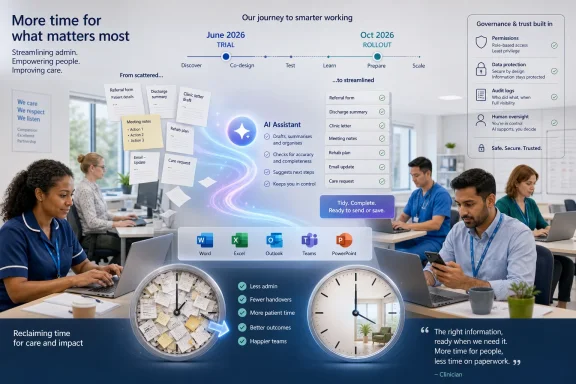
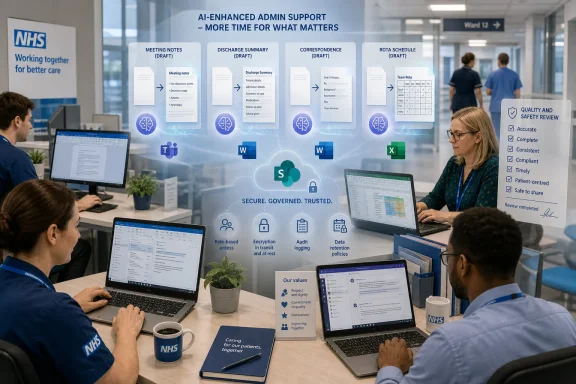
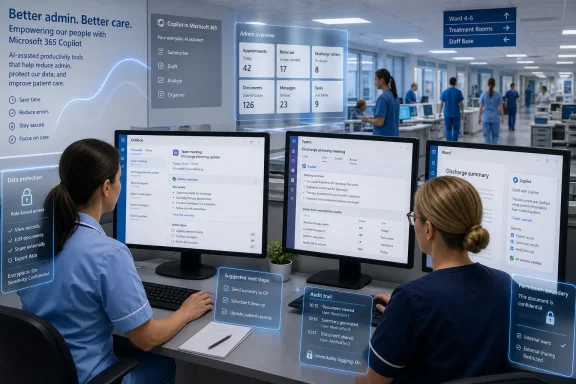
NHS staff collaborate with Microsoft 365 Copilot in a futuristic office infographic promoting productivity and patient care.Microsoft Wins the NHS Productivity Argument Before the Rollout Begins​

Microsoft and NHS England are selling this deployment with a deceptively simple claim: staff who used Copilot in the trial saved an average of 43 minutes per day on administrative work. That number is now doing most of the political and commercial work. It translates neatly into “five weeks per person annually,” “two days every month,” and, at full scale, millions of hours redirected away from inboxes, documents, meeting notes, rota work, data analysis, and policy paper churn.
Those figures matter because NHS technology programs have often been defended in the language of modernization rather than relief. This one is being pitched in the language of time. The promise is not that AI will diagnose disease, replace clinicians, or conjure capacity from nowhere; it is that it will shave friction from the daily sludge of work that keeps doctors, nurses, secretaries, ward clerks, managers, HR teams, finance departments, and procurement units stuck in Microsoft 365 all day.
That makes the Copilot rollout politically shrewd. It avoids the more explosive claim that generative AI should directly intervene in patient care, and instead plants itself in the lower-risk but higher-volume territory of documents, summaries, templates, emails, minutes, board papers, briefings, and workflow support. In healthcare, the fastest route to scale may not be the glamorous clinical model; it may be the assistant that helps a medical secretary produce a letter more quickly.
The question is whether this is a genuine productivity unlock or a very large experiment in measuring felt efficiency. The trial result gives NHS England a powerful rationale for scale, but it also creates a benchmark that will be difficult to defend once Copilot moves from motivated pilot users to half a million people working across messy, uneven, and overstretched local organizations.

The NHS Is Buying an Admin Layer, Not a Robot Doctor​

The most important detail in the announcement is what Copilot is expected to do. NHS England’s use cases are administrative by design: drafting letters, helping with registrar training material, supporting discharge processes, analyzing service data, building rotas, assisting with bed management, preparing meeting minutes, creating templates, and helping back-office functions such as HR, finance, and procurement.
That framing is not accidental. Healthcare AI has a credibility problem whenever vendors imply that software can safely take on clinical judgment at scale. The NHS has deep experience with digital optimism running ahead of operational reality, and the public has good reason to be wary of anything that looks like automation being inserted between patient and clinician. Copilot’s first mass role in the NHS is therefore not to practice medicine. It is to reduce the clerical drag around medicine.
For Microsoft, this is ideal terrain. Microsoft 365 Copilot lives where NHS staff already spend much of their administrative life: Outlook, Word, Excel, Teams, PowerPoint, and the broader Microsoft 365 environment. The assistant does not need to replace a clinical system to become important. It only needs to sit beside the existing digital estate and make common tasks feel faster.
That is also why this rollout matters to WindowsForum readers. Copilot is increasingly less a chatbot than an operating layer over enterprise work. For Windows shops, Microsoft 365 tenants, Entra identity, Purview controls, Teams governance, SharePoint permissions, data loss prevention policies, retention rules, and endpoint management are becoming the real infrastructure of generative AI. The AI assistant is the visible part; the Microsoft cloud control plane is the thing that decides what it can see, what it can summarize, what it can leak, and what it can automate.
The NHS deployment is a test case for whether that control plane can handle public-sector complexity. A local trust is not a tidy corporate department. It has legacy applications, shared mailboxes, clinical records, outsourced services, uneven data hygiene, and a workforce that includes clinicians, administrators, temporary staff, trainees, and support teams with sharply different permissions and risk profiles.

Half a Million Licenses Create a Governance Problem Overnight​

The agreement includes access to Copilot Studio, which allows organizations to build AI agents that automate or streamline workflows. NHS England says centrally built agents can be deployed across the system, while individual trusts will be able to build custom agents for local problems such as help desk demand, complaints handling, freedom of information requests, financial analysis, and internal process automation. Microsoft’s Agent 365 is being presented as the governance framework that keeps those agents secure and aligned with organizational rules.
That is where the rollout gets more interesting, and more hazardous. Microsoft 365 Copilot by itself is an assistant. Copilot Studio turns the assistant into a platform for building workflow actors. At NHS scale, that distinction is enormous.
An AI assistant that drafts a meeting summary can be reviewed, corrected, and discarded. An agent that routes requests, extracts data, escalates cases, answers internal queries, or supports financial processing starts to participate in the machinery of an organization. The more useful the agent becomes, the more important its permissions, auditability, lifecycle management, and failure modes become.
The NHS will need to answer mundane questions with high consequences. Who can publish an agent? Who approves the data sources it can query? How are prompts, outputs, and actions logged? What happens when an agent gives a plausible but wrong answer about policy, staffing, or a patient-adjacent process? How does a trust retire an agent that has become embedded in work but was built by a team that no longer owns it?
Microsoft’s governance story is stronger than the free-for-all era of public chatbots, but governance is not a SKU. It is a practice. The NHS can buy the platform centrally, but it cannot centrally wish every trust into mature information architecture.

The 43-Minute Claim Is Powerful Because It Is Also Fragile​

The figure that will follow this program everywhere is 43 minutes per staff member per day. It is easy to understand, easy to repeat, and easy to convert into dramatic national totals. It is also the kind of metric that deserves careful handling.
Productivity in knowledge work is notoriously difficult to measure. A user can finish a first draft faster and still spend time checking it. A Teams meeting can produce a summary instantly and still require someone to correct omissions. A spreadsheet analysis can be accelerated while creating a new obligation to verify formulas, assumptions, and source data. The time saved by the tool may be real, but the net gain depends on how much work shifts into review, governance, training, and exception handling.
The NHS trial was large by healthcare AI standards: more than 30,000 workers across 90 organizations. That gives the result more credibility than a boutique pilot with handpicked champions. But pilots often benefit from novelty, support, and motivated users. Scaling to 505,000 staff means moving into the long tail of users who may be less enthusiastic, less digitally confident, more time-constrained, or embedded in workflows where Copilot is less obviously useful.
There is also the danger of arithmetic becoming policy. If leaders multiply 43 minutes by 505,000 staff and treat the result as bankable capacity, they will overpromise. Time saved in fragments is not the same as staff capacity released in blocks. A clinician who saves eight minutes on a letter, six minutes on an email, and ten minutes preparing notes may feel less burdened, but that does not automatically become an extra appointment, a shorter waiting list, or a measurable reduction in cost.
That does not make the savings meaningless. In a system under strain, reducing cognitive and clerical load has value even when it cannot be cleanly converted into cash. But NHS England will need to resist the temptation to treat Copilot like a magic spreadsheet that turns prompt completions into patient outcomes.

The Real Deployment Is Training, Not Licensing​

NHS England says the deployment will be supported by a 12-month onboarding plan, with a rapid scale-up of 200,000 users within the first six months. That is an aggressive timetable for any enterprise software rollout, let alone one involving generative AI across healthcare. The licensing deal may be centralized, but the adoption burden will be local, human, and uneven.
Copilot is not difficult to open. It is difficult to use well. The difference between “summarize this meeting” and a safe, useful, context-aware workflow can be large. Staff need to know when to use the tool, when not to use it, how to check its output, what data can be included, and how to avoid letting confident prose disguise uncertainty.
That training challenge is not just about prompt engineering. It is about professional judgment. An HR team using Copilot to draft policy text faces different risks from a ward clerk using it to support discharge administration. A medical secretary drafting patient correspondence needs different guardrails from a finance analyst building a budget summary. The tool is horizontal; the risk is vertical.
The most successful organizations will probably treat Copilot adoption as a redesign of work rather than a mass enablement exercise. They will identify repeatable tasks, build approved templates, define review steps, clarify data boundaries, and measure whether the work actually improves. The least successful will turn on licenses, run a few webinars, and then wonder why usage is shallow or risky.
For sysadmins and Microsoft 365 administrators, this is where the work begins. Permissions that were tolerable when humans browsed SharePoint become more consequential when an AI assistant can summarize across accessible content. Overshared documents, stale Teams sites, ambiguous sensitivity labels, and orphaned groups are no longer housekeeping issues; they become AI exposure issues.

Microsoft’s Healthcare Strategy Moves From Specialist AI to Everyday AI​

Microsoft already has a healthcare AI story through Dragon Copilot and clinical documentation tools. Those products speak to a more specialized market: clinicians dictating notes, ambient documentation, clinical summaries, and workflow support closer to the point of care. The NHS England announcement is different. It is about Microsoft 365 Copilot as a general-purpose productivity assistant for the entire health service bureaucracy.
That matters because healthcare is not only hospitals, wards, and consultations. It is also procurement, scheduling, governance, training, complaints, finance, meetings, reports, and correspondence. The NHS’s administrative load is not a side issue; it is part of the system’s capacity problem. Microsoft is betting that the path to deep healthcare adoption runs through the same enterprise productivity stack it sells everywhere else.
The company also gains a powerful reference customer. A deployment to 505,000 NHS staff gives Microsoft an answer to every public-sector CIO who asks whether Copilot can scale beyond corporate early adopters. It also gives Microsoft a flagship example in a sector where budgets are constrained, scrutiny is intense, and the politics of automation are sensitive.
For the wider enterprise market, the NHS rollout helps normalize a shift in how Microsoft sells productivity software. Office used to be a suite of applications. Microsoft 365 became a subscription cloud platform. Copilot turns that platform into an AI-mediated work environment. Once organizations accept that model, the marginal step from “assistant” to “agent” becomes easier to sell.
That is why this announcement is not merely about health IT. It is about Microsoft’s attempt to make generative AI a standard enterprise utility, bundled into the daily workflow of huge institutions. The NHS is not buying an experimental chatbot; it is buying into Microsoft’s thesis that the future of work happens inside a governed AI layer attached to identity, documents, meetings, and business processes.

Public Healthcare Is a Hard Place to Learn in Public​

The NHS is a uniquely visible proving ground. If Copilot helps staff reduce admin, the benefits could be politically valuable and operationally meaningful. If it produces embarrassing errors, privacy concerns, dubious automation, or inflated savings claims, the backlash will not stay inside IT departments.
Healthcare data is among the most sensitive information any organization holds. Even when Copilot is used for administrative work, the boundary between administrative and patient-related information can be porous. Patient letters, discharge processes, complaints, FOI requests, rota planning, and service analysis may all touch data that needs careful handling.
The good news for Microsoft is that enterprise Copilot is designed to respect existing Microsoft 365 permissions and organizational controls. The bad news for every large organization is that existing permissions often reflect years of compromise, drift, convenience, and underfunded governance. AI does not create every data exposure problem, but it can make existing ones easier to exploit accidentally.
That is why trust-level readiness will vary. Some organizations will have mature information governance, clean sensitivity labeling, strong adoption teams, and clear clinical safety processes. Others will be wrestling with legacy file shares, overloaded IT departments, inconsistent training capacity, and unclear ownership of data assets. A national rollout can create common standards, but local execution will decide whether those standards mean anything.
The public will also judge outcomes differently from executives. A minister may see millions of hours saved. A patient may care whether a letter is accurate, whether a complaint is handled fairly, whether a discharge process is safe, and whether staff seem more available. The reputational risk is that AI becomes a visible explanation for any bureaucratic failure, even when the underlying cause is human, financial, or structural.

The Windows Enterprise Lesson Is Permission Hygiene Before Prompt Craft​

For WindowsForum’s core audience, the NHS rollout should be read as a warning shot for every Microsoft-heavy estate. Copilot deployments are not primarily about installing a client or teaching users clever prompts. They are about whether the organization’s identity, data, compliance, endpoint, and collaboration foundations are ready for software that can reason over whatever a user is allowed to access.
That reframes familiar admin chores. SharePoint sprawl, guest access, Teams lifecycle management, overshared OneDrive folders, stale distribution lists, unclassified documents, and inconsistent retention policies are no longer background mess. In a Copilot-enabled organization, they shape the assistant’s working memory.
There is a temptation to treat generative AI governance as a new discipline detached from old IT operations. The opposite is closer to the truth. Copilot makes old governance debt more visible. It rewards organizations that already know where their data lives, who owns it, how it is classified, and what users are allowed to do with it.
The NHS program will likely produce a familiar pattern. Early success stories will come from tasks with clear inputs and outputs: meeting summaries, draft letters, board paper preparation, service analysis, and standard communications. Harder problems will emerge where workflows cross organizational boundaries, where data quality is poor, where accountability is diffuse, or where users are uncertain whether an AI-generated output is safe to rely on.
That is not a reason to reject the rollout. It is a reason to measure it honestly. The value of Copilot should be judged not only by usage dashboards and self-reported time savings, but by whether it reduces rework, improves timeliness, preserves accuracy, and avoids creating new categories of hidden labor.

The NHS Is Now Microsoft’s Biggest Public Test of AI Normalization​

The scale of the NHS deployment gives Microsoft something more valuable than a customer win: a social proof engine. If more than half a million healthcare workers can be onboarded to Microsoft 365 Copilot, then the argument for similar deployments across government, education, finance, and large regulated industries becomes easier. The NHS becomes a demonstration that generative AI is no longer a side experiment; it is part of the enterprise software baseline.
But the NHS also gains leverage it should use. A deployment of this size should come with tough expectations around transparency, auditability, support, accessibility, contractual flexibility, and measurable public value. Microsoft is not donating a magic wand. It is selling a product into one of the world’s most important public services.
That means procurement cannot be the end of scrutiny. NHS England should publish enough information over time for staff, patients, and administrators to understand whether the program is meeting its claims. Not every operational metric needs to be public, but the broad shape of the evidence should be. Where the technology works, the NHS should say why. Where it fails, it should say that too.
The risk is not simply vendor lock-in, though that risk is real in any Microsoft 365-dependent organization. The deeper risk is narrative lock-in: a productivity story becomes so politically useful that contradictory evidence is treated as resistance rather than feedback. AI adoption in healthcare will need skepticism not as an obstacle, but as a safety mechanism.
For Microsoft, the rollout is a chance to prove that enterprise AI can deliver practical help without turning into hype. For NHS England, it is a chance to show that national digital programs can be focused, incremental, and grounded in staff pain points. For staff, it will come down to whether Copilot removes work or merely changes the shape of it.

The Numbers That Will Decide Whether This Is More Than a Press Release​

The deployment now has enough specificity to move beyond abstract AI boosterism. The first six months will be the crucial period, because NHS England plans to scale to 200,000 users during that window before reaching more than 500,000 staff by October 2026. That is fast enough to generate momentum and fast enough to expose weaknesses.
The most concrete takeaways are the ones that will still matter after the launch-day language fades:
  • NHS England is expanding Microsoft 365 Copilot to 505,000 clinicians and support staff after a 30,000-user trial across 90 NHS organizations reported average time savings of 43 minutes per person per day.
  • The rollout is focused first on administrative and operational work, including document drafting, meeting support, rota building, discharge administration, service analysis, HR, finance, procurement, and management briefings.
  • Copilot Studio and Agent 365 make this more than a chatbot rollout, because NHS England and individual trusts will be able to build governed agents for local and national workflows.
  • The practical success of the program will depend heavily on permissions, data governance, training, review processes, and whether local trusts can turn generic AI access into well-designed work patterns.
  • The headline productivity claim should be treated as a starting hypothesis, not a guaranteed system-wide saving, because fragmented time savings do not automatically become extra clinical capacity.
  • For Microsoft-heavy enterprises, the NHS deployment is a preview of the next wave of Windows and Microsoft 365 administration, where identity, compliance, and information architecture define what AI can safely do.
This is the right kind of AI bet for a strained health service: close to the work, focused on administrative drag, and embedded in tools staff already use. It is also the kind of bet that can quietly fail if leaders mistake access for adoption and demos for durable workflow change. The NHS has not bought itself out of bureaucracy; it has bought a new layer through which bureaucracy may be compressed, exposed, or accidentally amplified. The next year will show whether Microsoft 365 Copilot becomes a genuine pressure release for staff or simply the latest national technology promise asked to carry more political weight than software can bear.

References​

  1. Primary source: Home | Digital Health
    Published: Mon, 08 Jun 2026 12:31:46 GMT
  2. Independent coverage: TradingView
    Published: 2026-06-08T12:00:18.693958
  3. Independent coverage: Morningstar
    Published: Mon, 08 Jun 2026 12:00:00 GMT
  4. Related coverage: england.nhs.uk
  5. Related coverage: resultsense.com
  6. Related coverage: techmarketview.com
  1. Related coverage: theagenttimes.com
  2. Related coverage: dig.watch
  3. Related coverage: support.nhs.net
  4. Official source: news.microsoft.com
  5. Official source: microsoft.com
  6. Related coverage: miphealth.org.uk
  7. Official source: fpc.microsoft.com
  8. Related coverage: nhsproviders.org
 

NHS England said on June 8, 2026, that it will give 505,000 clinicians and support staff access to Microsoft 365 Copilot, expanding a national healthcare AI rollout across trusts in England with deployment expected to reach more than half a million users by October 2026. The announcement is not just another enterprise software deal dressed up in the language of productivity. It is a test of whether generative AI can become boring enough, governed enough, and useful enough to survive contact with one of the world’s most operationally strained public health systems. For Microsoft, it is a showcase account; for the NHS, it is a wager that administrative time is now a clinical resource.

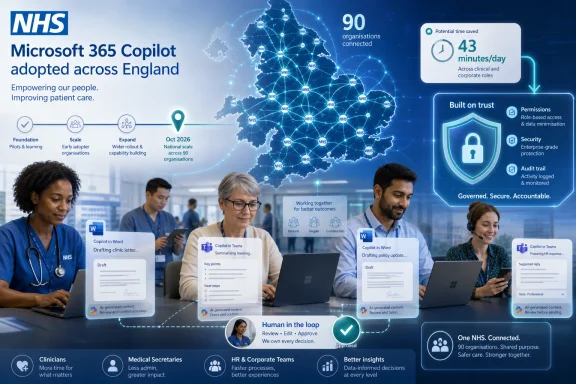
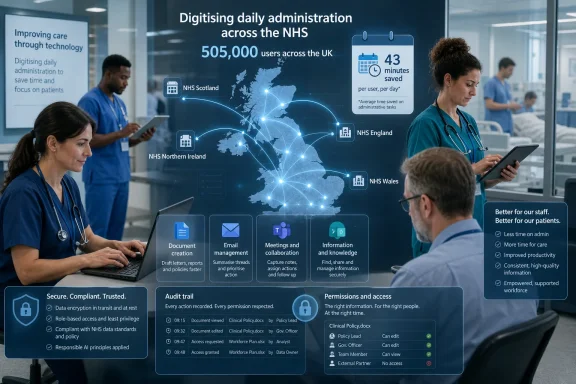
NHS clinicians use an AI copilot dashboard to automate secure admin workflows in a modern office.Microsoft’s Biggest NHS Win Is Really an Admin Bet​

The most important word in the NHS announcement is not “AI.” It is “admin.” Microsoft 365 Copilot is being positioned less as a diagnostic assistant than as a pressure valve for the paperwork, correspondence, summarisation, rota planning, board-paper drafting, service analysis, and template production that sit around patient care.
That distinction matters. The NHS is not saying that half a million staff will soon be asking an AI model whether a patient has sepsis, which medication to prescribe, or whether an X-ray shows pneumonia. The public pitch is narrower and more defensible: doctors, nurses, secretaries, ward clerks, managers, and back-office teams spend too much time turning information into documents, and Microsoft’s assistant can reduce some of that drag.
The claimed prize is substantial. NHS England says a trial involving more than 30,000 staff across 90 NHS organisations found average time savings of 43 minutes per staff member per day, equivalent to roughly five weeks per person annually. That kind of number practically writes its own ministerial press release, because it can be translated into “more time for patients” without explaining the messy operational path from saved minutes to shorter queues.
But that path is the story. Productivity in healthcare is not the same as productivity in a call centre or a software company. A saved hour may become more patient-facing time, but it may also become breathing space, reduced burnout, faster discharge paperwork, better meeting preparation, or simply the ability to leave work closer to time. All of those are valuable. Not all of them show up neatly in waiting-list statistics.

The NHS Is Buying Scale Before the Evidence Is Fully Settled​

The rollout follows what Microsoft and NHS England describe as the largest AI trial of its kind in healthcare. That is significant, but it should not be confused with the kind of long-term, independent, clinically grounded evidence base that normally gives health technology its legitimacy. A broad workplace AI pilot can tell an organisation that users like summarisation, drafting, and meeting assistance. It cannot, by itself, prove that a national deployment improves care quality, reduces harm, or produces durable system-wide savings.
That does not mean the NHS is acting recklessly. In fact, the choice of Microsoft 365 Copilot is in some ways the conservative version of AI adoption. The NHS already has a large Microsoft estate, a national Microsoft 365 agreement dating from the pandemic era, and an operational workforce deeply embedded in Teams, Outlook, Word, Excel, SharePoint, and PowerPoint. Putting AI into the tools people already use is less disruptive than asking trusts to procure dozens of separate point products.
The risk is that familiarity can make a profound change look like a software update. Copilot sits inside the office suite, but it changes how staff create, interpret, and reuse information. A clinician asking Copilot to summarise a long email thread about discharge planning is not performing a clinical diagnosis, but the output could still affect clinical workflow. A manager asking it to analyse service data may not be treating a patient, but the resulting interpretation could influence staffing, escalation, or resource allocation.
That is why the governance burden shifts from procurement to usage. Buying the licences is the easy part. The harder job is deciding where Copilot is genuinely helpful, where it must be supervised, where it should be blocked, and where staff need explicit training not to mistake fluency for reliability.

Copilot Moves From Office Assistant to Healthcare Infrastructure​

Microsoft has spent the past two years trying to turn Copilot from a premium add-on into the default AI layer of workplace computing. The NHS deal is a useful proof point because it moves Copilot beyond the early-adopter phase and into something closer to public-sector infrastructure. When 505,000 healthcare workers are given access to the same AI assistant, the question is no longer whether a few enthusiasts can save time. The question is whether the system can absorb AI at institutional scale.
That scale has several implications for Windows and Microsoft 365 administrators. Identity, permissions, data classification, retention policies, audit logs, endpoint controls, and user training are no longer background concerns. They become the conditions under which the AI deployment is safe enough to justify itself.
Copilot’s usefulness depends heavily on access to organisational content. That is also its danger. If SharePoint sites, Teams channels, mailboxes, and document libraries have accumulated years of loose permissions, an AI assistant can make bad access hygiene more visible and more consequential. It does not need to “hack” anything to surface information a user is technically allowed to see but never realistically would have found.
This is the uncomfortable truth for every large Microsoft 365 tenant watching the NHS rollout: Copilot is a governance amplifier. It rewards clean information architecture and punishes entropy. If an organisation has treated permissions as an afterthought, generative AI does not create the problem, but it can make the problem searchable in natural language.

The Promise Is Time, but the Cost Is Trust​

The NHS’s public framing is built around time savings. That is understandable. Time is the universal currency of a stressed health service, and administrative burden has become one of the least controversial villains in modern healthcare. If Copilot can draft routine letters, summarise meetings, help produce board papers, and speed up internal analysis, the case for adoption is intuitive.
Yet trust will matter more than raw speed. A tool that saves ten minutes but requires fifteen minutes of verification is a novelty. A tool that saves ten minutes and sometimes introduces subtle errors into patient correspondence is a risk. A tool that saves ten minutes reliably, inside clear boundaries, with staff trained to check its work, becomes part of the everyday machinery of care.
The difficulty is that generative AI often fails in ways that feel plausible. It may omit a caveat, smooth over uncertainty, merge similar facts, or write with a confidence that exceeds the source material. In a corporate setting, that can mean an awkward memo. In healthcare administration, it can mean a letter that misstates next steps, a briefing that over-interprets data, or a summary that leaves out the uncomfortable but important detail.
This is why the NHS deployment should not be judged by adoption dashboards alone. Microsoft can show active users, prompts submitted, documents drafted, and time saved. The public interest lies in a harder set of questions: whether outputs are reviewed, whether errors are tracked, whether staff understand the limits of the system, and whether productivity gains are being reinvested rather than simply extracted.

The Real Deployment Target Is the Workflow, Not the Worker​

Large AI rollouts often talk about “putting tools in the hands of staff,” but the practical unit of change is the workflow. A ward clerk using Copilot for discharge-related documents has a different risk profile from an HR team using it to draft internal guidance. A medical secretary producing patient letters has different safeguards from a finance team reviewing procurement data. A manager preparing a board paper has different accountability from a junior doctor using it to summarise training material.
That diversity is the NHS’s challenge. Half a million users sounds like a single deployment, but it is really thousands of local implementations inside trusts, services, teams, and professions. The same button in Word or Outlook may be used for trivial drafting in one context and consequential communication in another.
Microsoft’s addition of Copilot Studio and agent-building capabilities complicates the picture further. The NHS announcement points toward centrally built agents as well as trust-specific agents for tasks such as helpdesk requests, complaints, freedom of information handling, research support, data analysis, HR enquiries, and financial processing. That is where the programme starts to move beyond personal productivity into workflow automation.
Agents are attractive because they promise repeatability. Instead of every user crafting prompts from scratch, an organisation can design a workflow around a known process and wrap guardrails around it. But agents also create a new estate to manage: who built them, what data they touch, what actions they can take, how they are monitored, and when they should be retired.

Microsoft Gets the Reference Customer It Needed​

For Microsoft, the NHS deployment is strategically valuable beyond the licence count. The company has spent heavily to make Copilot the centrepiece of its productivity story, while the market has asked a stubborn question: who is paying, who is using it, and what value are they actually getting? A national health system rollout gives Microsoft a powerful answer, even if the long-term evidence still has to arrive.
The timing is useful. Microsoft has been collecting high-profile Copilot deployments across banking, retail, consulting, utilities, and public services. Each deal helps normalise the idea that generative AI is no longer an experimental sidecar but part of the enterprise productivity stack. The NHS is especially resonant because healthcare is complex, regulated, politically visible, and operationally unforgiving.
That does not mean the NHS is simply a Microsoft marketing prop. The health service has its own reasons to standardise around a major vendor with existing contractual, identity, security, and support arrangements. In a sector where shadow AI use is already a concern, giving staff an approved tool may be safer than pretending they will not use consumer-grade chatbots to solve real workplace problems.
Still, there is an asymmetry here. Microsoft can turn a successful rollout into a global case study. The NHS has to live with the daily consequences. If Copilot becomes a genuinely helpful assistant, the health service gains time. If it becomes another mandated tool that adds training overhead, confusion, or governance anxiety, the costs will be paid locally by staff and administrators who already have too little slack.

Public-Sector AI Has to Survive the Procurement Hangover​

The first phase of public-sector AI is easy to recognise. Vendors promise relief from administrative burden. Ministers promise innovation without service cuts. Executives promise responsible adoption. Pilot users report saved time. Then the procurement announcement lands, and the hard work begins.
The second phase is less glamorous. Licences have to be allocated. Training has to be written. Data protection assessments have to be completed. Local champions have to be found. Existing policies have to be updated. Helpdesks have to field confused tickets. Security teams have to decide what counts as acceptable use. Records managers have to ask how AI-generated drafts should be retained, audited, and disclosed.
NHS England says trusts will receive central allocations based on organisational headcount, typically beginning around 2,000 licences. That approach makes sense as a national scaling mechanism, but it also means local organisations will need to decide who gets access first and why. If licences go mainly to senior managers, clinicians may view the programme as another digital initiative that talks about patient care while serving the hierarchy. If access is spread too thinly without training, the tool may underperform.
The 12-month onboarding plan and rapid scale-up target are therefore not administrative footnotes. They are the deployment. Copilot’s value will depend less on whether the licence appears in a user’s account and more on whether the user knows when to rely on it, when to ignore it, and when to escalate uncertainty.

The Data Problem Is Not Just Privacy​

Healthcare AI debates often collapse into privacy, and privacy is obviously central. The NHS handles some of the most sensitive personal data in public life. Any AI system that touches communications, documents, analytics, or workflow must be judged against data protection law, clinical confidentiality, contractual controls, and public expectations.
But the broader data problem is quality. Healthcare organisations are full of incomplete records, inconsistent formats, local conventions, duplicated documents, old policies, ambiguous spreadsheets, and unofficial workarounds that keep services running. Copilot can assist users in navigating that sprawl, but it cannot magically turn institutional mess into truth.
If a document library contains three versions of a discharge template, Copilot may help draft from the wrong one unless the environment is governed. If a policy is outdated but still accessible, it can become fuel for a polished answer. If meeting notes contain unresolved debate, a summary may make uncertainty appear settled.
This is where IT professionals should resist both panic and hype. Copilot does not remove the need for information governance; it increases the return on doing it properly. Classification, lifecycle management, access reviews, data loss prevention, sensitivity labels, retention rules, and audit practices may sound dull compared with AI agents. In practice, they are what make AI agents tolerable.

The Windows Angle Is the Managed Endpoint Angle​

For WindowsForum readers, the NHS announcement is not merely a cloud story. Copilot may be a Microsoft 365 service, but its real-world experience lands on managed Windows devices, browsers, Office apps, Teams clients, and endpoints that must satisfy NHS security and compliance expectations. The AI layer depends on the boring layer.
That means patching, identity health, conditional access, endpoint management, browser policy, device compliance, and application update channels all matter. An organisation cannot sensibly promise safe AI at scale while tolerating unmanaged endpoints, stale Office builds, weak multifactor enforcement, or sprawling local admin rights. The Copilot era does not make endpoint management obsolete; it makes it more visible.
There is also a user-experience dimension. If Copilot appears inconsistently across apps, behaves differently between web and desktop clients, or depends on features that roll out unevenly across tenants, support teams will absorb the friction. At NHS scale, small inconsistencies become ticket volume.
The most successful trusts are likely to be those that treat Copilot as a managed service, not a magic feature. That means defining supported scenarios, creating local guidance, monitoring usage, reviewing permissions, and pairing technical rollout with process owners. The worst outcome would be a deployment where everyone has the icon, nobody has the confidence, and every team invents its own rules.

Clinicians Need Relief, Not Another Thing to Feed​

The NHS’s argument will resonate with clinicians because administrative overload is real. Doctors and nurses do not need to be convinced that documentation, correspondence, meeting prep, and internal reporting consume time. The promise of an assistant that can reduce the clerical burden is emotionally powerful because it addresses a daily frustration rather than an abstract digital strategy.
But the same staff have lived through enough technology programmes to know that tools often arrive with hidden labour. A system that requires careful prompting, constant correction, and additional documentation can become another mouth to feed. The risk is not that clinicians reject AI because they are anti-technology. The risk is that they reject it because the benefit is uneven and the accountability remains theirs.
This is especially true where AI-generated text enters patient-facing communication. A draft letter may save time, but a clinician or secretary still has to own the final content. If the tool makes routine correspondence faster, it will be welcomed. If it creates a new expectation that more correspondence can be produced with the same staffing, the saved minutes may disappear into higher throughput demands.
The political phrase “free up time for patients” also deserves scrutiny. Time is only freed if the surrounding system allows it to be used differently. If a clinic schedule remains fixed, if staffing gaps persist, if beds are unavailable, if social care bottlenecks delay discharge, then AI-assisted admin may ease pressure without transforming capacity. That is still useful, but it is not a miracle.

The NHS Is Also Managing Shadow AI by Offering an Approved Door​

One of the more practical arguments for this rollout is not always said loudly: staff are already experimenting with AI. In any large organisation, especially one under pressure, workers will look for shortcuts that help them cope. If official tools are absent or useless, unofficial ones fill the gap.
That creates a governance nightmare in healthcare. Consumer AI tools may not provide the contractual, data residency, confidentiality, logging, and administrative controls required for sensitive work. Even if most staff behave responsibly, a small number of well-intentioned shortcuts can create serious data protection incidents.
An approved enterprise tool does not eliminate the risk, but it gives the organisation a safer channel. It allows training, monitoring, policy enforcement, and integration with existing Microsoft 365 controls. It also gives managers a more credible basis for saying “use this, not that.”
That argument should not be mistaken for a blank cheque. The approved tool still needs boundaries. Staff need to understand what can be entered, what cannot, which outputs require human review, and which tasks remain outside scope. The mere fact that Copilot is available inside the tenant does not mean every use is appropriate.

Waiting Lists Will Not Be Solved by Better Meeting Notes​

The NHS announcement lands in the shadow of an enormous operational challenge. Backlogs, workforce shortages, industrial relations, funding pressures, estate problems, and social care constraints cannot be solved by summarising email faster. AI can help with the work around care, but it cannot conjure beds, staff, scanners, theatre capacity, or community placements.
That does not make the rollout trivial. Administrative drag is a real tax on healthcare capacity. Poorly written letters create confusion. Slow discharge paperwork delays flow. Manual data analysis slows decisions. Inconsistent templates waste time. Meeting overload absorbs clinical leaders who are already stretched.
The danger lies in overclaiming. If Microsoft and NHS England present Copilot as a productivity tool that reduces friction, the programme can be judged on plausible terms. If it becomes part of a broader political narrative that suggests AI will rescue the health service from structural undercapacity, disappointment is guaranteed.
The public should also be wary of “millions of hours saved” as a standalone metric. Hours saved are an input, not an outcome. The important questions are where those hours come from, who receives them, how they are measured, and whether they translate into better patient experience, faster care, safer administration, or improved staff retention.

The Practical Lessons Are Already Visible​

The NHS rollout is still early, but the outlines of the playbook are clear. It is a Microsoft 365 governance project wearing an AI badge, a workforce adoption programme wearing a productivity badge, and a public-sector reform story wearing a vendor partnership badge. Its success will depend on whether those layers are managed honestly.
For other organisations, especially large Windows and Microsoft 365 estates, the headline number should be less interesting than the operating model. Half a million seats make the news. Permission hygiene, training, workflow design, and measurement decide whether the deployment works.
  • The NHS is deploying Microsoft 365 Copilot to 505,000 clinicians and support staff, with national rollout expected to reach that scale by October 2026.
  • The central claim is administrative relief, with trial results reporting average savings of 43 minutes per staff member per day across more than 30,000 NHS workers.
  • The most credible early use cases are document drafting, meeting support, service analysis, discharge administration, HR, finance, procurement, and management reporting.
  • The biggest technical risk is not a science-fiction AI failure but ordinary Microsoft 365 governance weakness exposed at unprecedented speed.
  • The rollout will test whether Copilot Studio and AI agents can automate repeatable workflows without creating a new estate of poorly governed bots.
  • The programme should be judged by verifiable operational outcomes, not simply licence counts, active-user graphs, or ministerial claims about time saved.
The NHS has not bought a cure for its pressures; it has bought a chance to remove some of the clerical weight that makes those pressures harder to bear. If Copilot becomes a governed, supervised, and genuinely useful assistant, the NHS may show that generative AI’s first serious contribution to healthcare is not replacing expertise but giving professionals more room to use it. If it fails, the lesson will be just as important: AI at national scale is not a feature rollout, but an institutional discipline that starts long before the button appears in Word.

References​

  1. Primary source: investing.com
    Published: 2026-06-08T12:33:18.693431
  2. Related coverage: england.nhs.uk
  3. Related coverage: htn.co.uk
  4. Related coverage: theagenttimes.com
  5. Related coverage: resultsense.com
  6. Official source: news.microsoft.com
  1. Related coverage: support.nhs.net
  2. Related coverage: techmarketview.com
  3. Official source: ukstories.microsoft.com
  4. Related coverage: dig.watch
  5. Related coverage: healthcare-management.uk
  6. Related coverage: windowscentral.com
  7. Related coverage: techradar.com
  8. Official source: microsoft.com
  9. Official source: fpc.microsoft.com
  10. Related coverage: nhsconfed.org
 

NHS England said on June 8, 2026, that it will give 505,000 clinicians and support staff access to Microsoft 365 Copilot across England by October, expanding a trial that involved more than 30,000 workers in 90 NHS organisations. The announcement is not just another enterprise AI win for Microsoft; it is a test of whether generative AI can survive contact with one of the world’s most operationally stressed public services. If Copilot can save time in the NHS without creating new governance, privacy, and reliability problems, Microsoft gains its strongest case yet that workplace AI is infrastructure rather than novelty. If it cannot, the NHS may become the most visible example of AI procurement moving faster than institutional readiness.

Hospital staff view a tablet as a transparent UI overlay highlights “43 minutes saved” and AI care features.Microsoft Lands Its Most Politically Useful Copilot Customer Yet​

The size of the NHS deal matters, but the symbolism matters more. Microsoft has spent the past few years trying to turn Copilot from a premium add-on into the default interface for office work, pushing it into Word, Excel, PowerPoint, Outlook, Teams, Windows, Edge, and the Microsoft 365 shell. That strategy has always depended on a simple promise: workers spend too much time on low-value digital chores, and Microsoft’s AI can return that time.
NHS England is almost perfectly designed for that pitch. It is vast, under pressure, administratively dense, and politically sensitive. Doctors, nurses, ward clerks, managers, finance teams, estates staff, and support workers all move through Microsoft’s software estate every day, often while fighting the mundane friction of forms, rotas, letters, handovers, meeting notes, spreadsheets, emails, and reports.
That makes the rollout a powerful case study for Microsoft because it is not confined to a single corporate department or a narrow knowledge-worker cohort. The NHS is not a bank’s strategy team or a consultancy’s PowerPoint factory. It is a public health system where the promise of “more time for care” is not a productivity slogan but a politically loaded claim about waiting lists, staff burnout, patient flow, and taxpayer value.
The danger is that the same symbolism cuts both ways. A Copilot deployment inside the NHS will be judged not by demo-stage magic, but by whether it reduces workload without adding invisible risk. Healthcare is where administrative time really does matter, but it is also where errors, confidentiality breaches, bad summaries, misunderstood context, and misplaced trust can have consequences beyond embarrassment.

The 43-Minute Claim Is the Heart of the Story​

The headline number in the announcement is 43 minutes per staff member per day. NHS England and Microsoft say the broader rollout follows a large healthcare AI trial that gave more than 30,000 NHS workers across 90 organisations access to Microsoft 365 Copilot. The trial reportedly found average time savings of 43 minutes per person per day, described elsewhere as roughly five weeks per staff member per year.
That number is doing enormous work. It is the bridge between a licensing decision and a public-interest argument. Multiply 43 minutes by hundreds of thousands of staff and the result becomes the kind of “millions of hours” figure that makes ministers, procurement teams, and Microsoft sales executives speak the same language.
But time-saving figures in AI trials deserve careful handling. They often rely on self-reported estimates, early-adopter enthusiasm, uneven usage patterns, and controlled support that may not survive a national deployment. The staff most likely to volunteer for or benefit from a pilot may also be the staff most willing to redesign their workflows around the tool.
None of that makes the number meaningless. It simply means the NHS now has to prove that the gain is durable, evenly distributed, and net-positive after training, support, governance, checking, correction, and change management are included. A draft letter that saves ten minutes but requires five minutes of verification is still useful. A summary that saves ten minutes but occasionally misses a clinically relevant caveat becomes a different proposition.

This Is Not a Robot Doctor, and That Distinction Matters​

The rollout is being framed around administrative productivity rather than autonomous clinical decision-making. That distinction is essential. Microsoft 365 Copilot sits inside the Microsoft 365 environment and is designed to help users draft, summarise, search, analyse, and organise work across apps and organisational data they are already permitted to access.
In practical NHS terms, the announced use cases include drafting documents, analysing data, supporting discharge processes, helping with rotas, improving consistency in patient letters, and reducing the repetitive clerical work that accumulates around care. These are not glamorous AI frontier scenarios. They are the back-office and near-clinical frictions that make healthcare systems feel slower than they should.
That is exactly why the rollout could matter. Healthcare does not need every AI project to be a diagnostic moonshot. In many settings, the more immediate win is making routine work less punishing: turning meeting notes into actions, converting policy drafts into plain English, finding relevant content in long documents, preparing first drafts of letters, or summarising a Teams discussion that nobody has time to rewatch.
Still, administrative does not mean harmless. A discharge letter is not a casual email. A rota affects staffing levels. A bed-management spreadsheet has operational consequences. A patient-facing template can encode ambiguity, bias, or error at scale. The NHS and Microsoft can fairly say Copilot is not replacing clinicians, but the harder truth is that administrative text in healthcare often sits very close to patient care.

The NHS Is Buying Workflow Gravity, Not Just AI Licences​

The most important business fact in the announcement is that Copilot is being deployed into an existing Microsoft estate. The NHS already depends heavily on Microsoft 365 tools, and the new AI layer takes advantage of that installed base. This is Microsoft’s enterprise AI strategy in its purest form: do not ask customers to adopt a separate AI product; attach AI to the software where their work already lives.
That matters for WindowsForum readers because Copilot’s future is not just about a chatbot in a sidebar. It is about Microsoft making AI a layer across identity, documents, email, meetings, storage, compliance, search, security, and endpoint management. For administrators, Copilot adoption is inseparable from Entra ID, SharePoint permissions, Teams governance, Purview retention, sensitivity labels, audit logs, and the general hygiene of the Microsoft 365 tenant.
This is where the NHS rollout becomes a lesson for every enterprise. Copilot does not magically understand an organisation; it reflects the organisation’s permissions, data sprawl, naming conventions, document quality, and governance history. If an employee can access a badly protected file, Copilot may make that file easier to find. If SharePoint has become a decade-old attic of abandoned documents, AI search can turn that attic into an accelerant.
That does not mean organisations should avoid the technology. It means Copilot readiness is really information-governance readiness. Microsoft can provide the model, the interface, and the contractual assurances. The customer still owns the messy question of whether its data estate is clean enough, permissioned enough, and labelled enough to let AI loose at scale.

Privacy Assurances Will Not End the Trust Debate​

Microsoft’s standard enterprise position is that Microsoft 365 Copilot prompts, responses, and data accessed through Microsoft Graph are not used to train foundation models. The company also says Copilot operates within the Microsoft 365 service boundary and inherits enterprise controls such as identity, permissions, compliance, and retention. For a healthcare deployment, those assurances are table stakes.
They are not the end of the matter. In the NHS, public trust is not built only on whether data trains a model. It is also built on who can access what, how prompts and responses are retained, how staff are trained, how errors are handled, what happens when AI produces a plausible but wrong answer, and whether patients understand when AI-assisted text has entered their care journey.
The more sensitive the institution, the less useful it is to reduce privacy to “the model is not trained on your data.” That phrase answers one legitimate question while leaving others open. A prompt can still contain sensitive information. A response can still be stored. A summary can still expose material to someone who should not see it if the underlying permissions are wrong. An audit trail can still become a governance burden.
The NHS has a particular challenge because it is both one system and many systems. National procurement can create scale, but operational reality lives inside trusts, departments, wards, and teams. Local configuration, training, and supervision will determine whether Copilot feels like a governed assistant or another centrally blessed tool that staff learn to work around.

The Real Deployment Begins After the Announcement​

The plan to reach 505,000 staff by October 2026 is ambitious. It gives the rollout a political and operational deadline, but it also compresses the hardest part of enterprise AI adoption: making sure people know when to use the tool, when not to use it, and how to check its output.
There is a reason many organisations discover that Copilot adoption is less about licence activation than behaviour change. Users need examples that fit their actual jobs. Ward clerks need different guidance from finance analysts. Consultants need different guardrails from HR teams. Managers need to know how AI-generated summaries should be reviewed before decisions are made.
The NHS also has to avoid turning Copilot into one more productivity expectation imposed on an already stretched workforce. If staff are told that AI should save them two days a month, the next question is who gets those two days. Do workers experience the gain as less admin pressure, or does the organisation simply raise throughput expectations? Does saved time become patient-facing time, recovery time, more documentation, or another target?
That question is uncomfortable because it sits outside the software. AI can reduce friction in a task, but institutions decide what happens to the slack. In public healthcare, the political temptation will be to translate every efficiency claim into capacity. The human risk is that a tool sold as relief becomes another mechanism for measuring and intensifying work.

Microsoft’s Public-Sector AI Argument Gets a Stress Test​

For Microsoft, NHS England is a marquee reference at a moment when enterprise AI is moving from experimentation to budget scrutiny. The company has already been pushing Copilot adoption through large corporate deployments, financial services deals, consulting partnerships, and expanded Microsoft 365 bundles. The NHS gives Microsoft something different: a public-service story with moral weight.
That story is easy to understand. If AI can help clinicians and support staff spend less time on admin, then Copilot is not just a corporate upsell. It becomes part of the machinery of public-sector reform. That is a more persuasive argument than telling office workers they can generate meeting recaps faster.
But the scrutiny will also be harsher. Public-sector buyers face accountability that private companies can often absorb behind closed doors. If a bank’s Copilot rollout disappoints, it becomes an internal productivity problem. If the NHS rollout disappoints, it becomes a public spending, patient safety, workforce, procurement, and data-governance story.
Microsoft therefore has more than revenue at stake. The NHS deployment will help define whether Copilot is seen as a serious enterprise platform or as another expensive AI layer whose benefits concentrate among enthusiastic users while risk and support costs fall on IT departments. The larger the rollout, the harder it becomes to hide the gap between polished demonstrations and everyday usage.

For Windows Administrators, Copilot Is Now a Governance Project​

The NHS news should be read by IT pros less as a healthcare story and more as a preview of their own next budget cycle. When senior leadership sees half a million NHS staff getting Copilot, the question will not be whether AI belongs in Microsoft 365. The question will be why their own organisation is not moving faster.
That puts Windows and Microsoft 365 administrators in a familiar but uncomfortable position. They will be asked to enable transformation while managing the consequences of everyone else’s enthusiasm. The same people who maintain identity, endpoint security, app deployment, data loss prevention, email hygiene, and Teams governance will be expected to make AI safe, useful, and measurable.
The practical work is not glamorous. It means reviewing permissions, cleaning up overshared sites, applying retention policies, checking sensitivity labels, deciding which users get licences first, defining acceptable use, creating training materials, monitoring adoption, and preparing support teams for a flood of “why did Copilot say this?” tickets. It also means documenting decisions before regulators, auditors, executives, or journalists ask for them.
For many organisations, Copilot will expose years of deferred housekeeping. That is not Microsoft’s fault alone. Enterprise search, collaboration platforms, and cloud storage have always had this problem. AI simply makes the underlying disorder more visible because it gives users a conversational interface to information they may technically have been able to access all along.

Healthcare AI Will Be Won or Lost in the Boring Middle​

The most realistic version of success is not a dramatic transformation of medicine. It is quieter. It looks like fewer blank-page moments, faster first drafts, better meeting follow-up, less time formatting documents, quicker analysis of routine data, and more consistent internal communications.
That kind of improvement can be valuable precisely because it is mundane. Healthcare systems are not only slowed by spectacular failures. They are slowed by thousands of small frictions repeated across hundreds of thousands of staff. If Copilot reduces even a portion of those frictions, the aggregate effect could be meaningful.
The risk is that leaders oversell the tool as a cure for structural problems. AI will not solve understaffing, outdated clinical systems, fragmented patient records, capital constraints, social care bottlenecks, or the political complexity of NHS reform. It may help people work around some of those pressures more efficiently, but workaround efficiency is not the same as system redesign.
That is the line NHS England will need to hold. Copilot can be an assistant, not an alibi. If its deployment becomes a substitute for investment in staffing, interoperability, training, and better process design, the technology will inherit blame for failures it cannot fix.

The October Deadline Turns Procurement Into Proof​

The planned October 2026 milestone gives this rollout a near-term test. By then, NHS England wants access extended to roughly half a million staff, with licence allocations distributed across trusts. That does not mean half a million people will use Copilot effectively by October. Access is the beginning of adoption, not the end.
The real indicators will arrive later. How many staff use it weekly? Which roles benefit most? Which tasks produce reliable savings? How much time is spent checking AI output? How often do staff reject or rewrite suggestions? How many incidents, near misses, data-governance issues, or support tickets emerge? How does usage vary between trusts with mature digital governance and those with thinner IT capacity?
Microsoft and NHS England will naturally highlight the positive numbers. That is expected. The more useful public conversation will be about variance: where Copilot works, where it does not, and what conditions make the difference. A national rollout should not be judged only by an average time-saving figure; it should be judged by whether the benefits survive local reality.
For other public bodies, the NHS will become a reference deployment whether or not it wants that role. Councils, departments, universities, police forces, and healthcare systems outside England will all watch the pattern. If the rollout is credible, Microsoft gains momentum. If it stumbles, the failure will become a cautionary slide in every AI governance meeting for years.

The Copilot Era Reaches the Ward Clerk’s Desk​

The NHS announcement gives Windows and Microsoft 365 shops a concrete preview of what enterprise AI now means in practice.
  • Microsoft 365 Copilot is being expanded to 505,000 NHS England clinicians and support staff, with the rollout expected to reach that scale by October 2026.
  • The deployment follows a trial across more than 30,000 NHS workers in 90 organisations that reported average savings of 43 minutes per staff member per day.
  • The most plausible early benefits are administrative: drafting, summarising, analysing routine data, preparing documents, improving consistency, and reducing repetitive digital work.
  • The biggest operational risks are not sci-fi scenarios but familiar enterprise problems: bad permissions, weak labelling, poor training, overreliance on generated text, and unclear accountability.
  • For IT administrators, Copilot adoption should be treated as a governance and change-management programme, not merely as a licence assignment exercise.
  • For Microsoft, the NHS rollout is a high-profile test of whether Copilot can become trusted public-sector infrastructure rather than a premium productivity experiment.
The NHS is betting that AI’s first meaningful healthcare dividend will come not from replacing clinicians, but from reducing the digital drag around them. That is a plausible bet, and perhaps the right one, but it is also a public test of whether Microsoft’s Copilot stack can deliver measurable relief inside a system where time, trust, and accountability are all scarce. If the rollout works, it will strengthen the case that generative AI belongs inside the everyday operating layer of modern public services. If it falters, the lesson will not be that healthcare should reject AI, but that the hardest part of the Copilot era was never generating text — it was building institutions disciplined enough to use it well.

References​

  1. Primary source: Investing.com Canada
    Published: Mon, 08 Jun 2026 12:32:14 GMT
  2. Official source: ukstories.microsoft.com
  3. Related coverage: england.nhs.uk
  4. Related coverage: htn.co.uk
  5. Related coverage: theagenttimes.com
  6. Related coverage: resultsense.com
  1. Related coverage: techmarketview.com
  2. Official source: news.microsoft.com
  3. Related coverage: healthcare-management.uk
  4. Related coverage: support.nhs.net
  5. Related coverage: openaccessgovernment.org
  6. Official source: microsoft.com
  7. Official source: fpc.microsoft.com
  8. Related coverage: assets.publishing.service.gov.uk
  9. Official source: learn.microsoft.com
  10. Official source: support.microsoft.com
  11. Related coverage: productionai.institute
  12. Related coverage: techtarget.com
  13. Related coverage: magicmirror.team
  14. Official source: answers.microsoft.com
  15. Official source: techcommunity.microsoft.com
  16. Related coverage: windowscentral.com
  17. Related coverage: techradar.com
  18. Related coverage: tomsguide.com
 

NHS England announced on June 8, 2026, that it will provide Microsoft 365 Copilot access to 505,000 clinicians and support staff across England, with the national rollout expected to reach NHS organisations by October 2026. The deal turns what had been a large experiment in AI-assisted administration into one of the most consequential public-sector deployments of generative AI anywhere. It is also a wager that the NHS’s productivity crisis can be eased not only by hiring, funding, or reform, but by attacking the paperwork that eats the working day. The promise is simple enough to sell: fewer minutes lost to bureaucracy, more time returned to patients.

Healthcare team uses an AI assistant and workflow timeline to streamline admin, boosting patient time.Microsoft’s Biggest NHS Win Is Really a Bet on Administrative Exhaustion​

The headline number is enormous, but the political logic is familiar. The NHS does not merely suffer from too much demand; it suffers from too much friction around that demand. Letters, rota planning, discharge paperwork, meeting notes, briefing packs, data analysis, patient correspondence, procurement reports, HR summaries, management updates — none of these are fringe activities in a modern health service. They are the connective tissue of the institution.
That is exactly why Microsoft 365 Copilot is an attractive tool for NHS England. It does not arrive as a robot surgeon or a diagnostic oracle. It sits inside Word, Excel, Outlook, PowerPoint, Teams, and the wider Microsoft 365 estate, where much of the administrative burden already lives. In practical terms, this is less a moonshot than an attempt to make the default office stack faster.
The political sell is that Copilot can give time back to staff without requiring the system to invent a new workflow from scratch. The operational risk is that the NHS may discover, at national scale, that administrative work is not simply a pile of text waiting to be summarized. It is accountability, clinical context, patient risk, local policy, and institutional memory expressed in documents and meetings.
That tension makes this rollout more interesting than another AI press release. Microsoft gets a landmark healthcare deployment. NHS England gets a productivity story with numbers attached. Staff get a tool that might save time — but also a new layer of digital behavior to learn, govern, audit, and trust.

The 43-Minute Claim Is Doing Heavy Political Work​

The rollout follows a trial involving more than 30,000 NHS workers across 90 NHS organisations, described by officials as the largest AI trial of its kind in global healthcare. The central finding is striking: AI-powered administrative support could save an average of 43 minutes per staff member per day, or roughly five working weeks annually per employee. That is the number now carrying the entire argument.
It is easy to see why. In a service as large as the NHS, even modest per-person savings look transformational once multiplied across hundreds of thousands of employees. Forty-three minutes per day across 505,000 staff suggests a staggering reservoir of recovered time, at least in theory. In political communication, this is gold: a productivity gain that can be explained in one sentence.
But trial averages are not the same thing as operational guarantees. The people who benefit most from Copilot are likely to be those whose work is already text-heavy, meeting-heavy, or data-summary-heavy. A ward clerk dealing with discharge coordination may find value quickly. A consultant drafting a follow-up letter may save time. A manager producing a briefing for an integrated care board may save even more. A clinician whose day is dominated by direct care, systems that do not interoperate, and urgent interruptions may find the savings harder to capture.
The phrase “average” also hides the distribution that matters to IT leaders. Some staff will become heavy users. Some will use Copilot occasionally. Some will ignore it. Some will generate drafts that require so much checking that time savings shrink. The NHS does not need every user to save 43 minutes every day for this to be worthwhile, but it does need to avoid turning a promising trial metric into a universal productivity assumption.

Copilot Fits the NHS Because the NHS Already Runs on Microsoft​

The choice of Microsoft 365 Copilot is not incidental. The NHS, like much of government and enterprise Britain, already depends heavily on Microsoft productivity tools. That matters because generative AI adoption is much easier when the assistant lives inside the applications staff already use rather than in a separate system that must be opened, learned, and justified.
This is Microsoft’s strategic advantage. Copilot is not being sold merely as a chatbot; it is being sold as an assistant embedded into the work graph of an organisation. In theory, it can summarize a Teams meeting, draft a Word document, help structure an Outlook email, turn notes into a PowerPoint deck, or surface patterns in Excel. That is a compelling proposition in any large bureaucracy. In the NHS, where the cost of administrative drag is both financial and human, it is especially potent.
For NHS England, the centralised licence allocation model also reflects the scale of the undertaking. Each trust is expected to receive a central allocation based on headcount, with many organisations initially getting around 2,000 licences. That suggests a phased adoption model rather than a magical overnight transformation. It also means local IT teams will have to decide who gets access first, which workflows to prioritise, and how to measure whether the tool is actually helping.
This is where the rollout becomes less about AI and more about change management. A national licence agreement can put Copilot in the hands of staff. It cannot guarantee that an overworked trust has the training capacity, governance maturity, or process clarity needed to turn access into measurable operational improvement. The technology may be centralised; the hard work will be local.

The NHS Is Targeting the Work Around Care, Not Care Itself​

The most defensible part of the rollout is its focus on administration. NHS England is not presenting Copilot as a clinical decision-maker, a diagnostic system, or a replacement for professional judgement. The examples given are deliberately mundane: drafting letters, supporting registrar training activities, helping ward clerks with discharge processes, creating rotas, assisting with bed management, analysing service data, generating templates, preparing reports, and producing meeting minutes.
That mundanity is the point. The safest early use of generative AI in healthcare is not to ask it to decide what is wrong with a patient. It is to ask it to reduce the burden of writing, summarising, formatting, and organising the work that surrounds patient care. In an NHS context, that distinction is not merely technical; it is ethical.
Administrative work still carries risk. A discharge summary can affect patient safety. A rota can affect staffing resilience. A patient letter can create confusion if it is inaccurate or poorly phrased. A meeting summary can distort what was agreed. The fact that Copilot is being used for admin does not mean its outputs are harmless.
That is why the phrase human in the loop cannot be treated as a decorative governance slogan. If Copilot drafts a letter, a clinician remains responsible for the final letter. If it summarises a meeting, the team remains responsible for checking whether the summary is accurate. If it helps analyse service data, managers still need to understand the underlying data quality and limitations. The NHS can use AI to accelerate work, but it cannot outsource accountability to a productivity assistant.

The Real Bottleneck Is Trust, Not Licensing​

Microsoft and NHS England can solve the licensing problem with a contract. They cannot solve the trust problem by announcement. For staff, trust will be earned in the daily grind: whether Copilot produces useful drafts, whether it hallucinates, whether it respects context, whether it saves time after checking, and whether it makes already overloaded workflows feel lighter rather than more performative.
There is a danger that AI tools become another managerial demand placed on staff in the name of efficiency. If workers are told that Copilot “saves 43 minutes a day,” that number can mutate from an observed trial result into an expectation. Productivity tools can become productivity surveillance by implication, even when not designed that way. NHS leaders will need to be careful that time-saving rhetoric does not become a stick.
The deployment also lands in a workforce culture that has seen many digital transformations overpromise and underdeliver. NHS staff have lived through systems that duplicate work, portals that do not talk to one another, and digital processes that simply convert paper frustration into screen frustration. Copilot’s advantage is that it works in familiar software. Its disadvantage is that it enters an environment where staff have good reasons to be sceptical of shiny fixes.
That scepticism is healthy. Generative AI is probabilistic technology operating inside a high-stakes institution. It can produce fluent nonsense. It can miss nuance. It can summarise confidently and incorrectly. It can make weak input look polished. The NHS should want staff to use it critically rather than reverently.

Data Governance Will Decide Whether This Looks Brave or Reckless​

Any AI deployment in healthcare immediately raises the data question. Microsoft 365 Copilot operates in the context of an organisation’s Microsoft 365 tenant, drawing on permissions and data available to the user. That makes existing identity management, access controls, retention policies, information governance, and data classification more important than ever. Copilot does not create the problem of excessive access, but it can make excessive access easier to exploit accidentally.
In plain English, if a user has access to material they should not have, an AI assistant may make that material easier to find, summarise, and reuse. That is not a theoretical concern in large organisations with years of inherited SharePoint sites, Teams channels, shared mailboxes, and document libraries. Many enterprises have discovered that deploying Copilot forces an uncomfortable audit of their Microsoft 365 hygiene. The NHS will be no exception.
This is where WindowsForum readers should pay attention. The technical story behind the public announcement is not just “AI comes to the NHS.” It is identity, permissions, compliance, data loss prevention, audit logging, sensitivity labels, retention, eDiscovery, endpoint security, and user training at massive scale. Copilot is only as safe as the environment in which it operates.
For NHS IT teams, the practical burden will be substantial. They will need to determine which data Copilot can use, which users should receive licences, which departments are ready, which workflows are appropriate, and which controls need tightening before exposure expands. They will also need to handle the helpdesk reality: confused users, bad prompts, unexpected outputs, policy questions, and the inevitable tension between central ambition and local capacity.

Microsoft Gets the Reference Customer Every AI Vendor Wants​

For Microsoft, this rollout is a showcase. Healthcare is the sector every AI vendor wants to transform but few can credibly claim to understand. A national health system deploying Microsoft 365 Copilot to more than half a million staff is more than revenue; it is validation. It tells other governments, hospital systems, insurers, and public bodies that Copilot is not merely a corporate experiment but infrastructure for institutional productivity.
That is why the NHS deal matters beyond England. Microsoft has been pushing Copilot as the new interface layer for work, but adoption has been uneven across the market. Many organisations like the concept while worrying about cost, governance, actual usage, and measurable return on investment. A high-profile public-sector deployment helps Microsoft answer those doubts with scale.
The company’s framing is unsurprising: Copilot can cut through everyday admin, ease pressure, improve productivity, and support better decision-making. These are plausible benefits. They are also exactly the claims Microsoft needs enterprise customers to believe as it tries to convert the enormous Microsoft 365 installed base into paid AI seats.
The NHS, in turn, is using Microsoft’s platform power to pursue a public-sector productivity goal. That creates a mutual dependency. Microsoft needs the rollout to be seen as safe and successful. NHS England needs the tool to deliver enough real-world benefit to justify the scale, cost, and governance effort. If it works, both sides get a case study. If it disappoints, both inherit a very public lesson in the limits of enterprise AI.

The Cost Question Has Been Carefully Pushed Offstage​

The public announcement emphasises time savings, patient care, operational efficiency, and digital transformation. It says less about price. That is not unusual for large enterprise agreements, but it matters because Copilot licensing is not a trivial expense. At hundreds of thousands of users, even discounted public-sector pricing would represent a major commitment.
NHS England’s argument is that time saved can translate into better value for taxpayers. That may be true, but only if recovered time becomes usable capacity. Saving a clinician ten minutes on a letter matters. Saving a manager an hour on a briefing matters. But the public value depends on whether those minutes reduce backlogs, improve responsiveness, shorten delays, strengthen care coordination, or reduce reliance on more expensive administrative workarounds.
This is the hard part of productivity math. Time savings in knowledge work are often real but difficult to bank. A staff member may finish documentation earlier, but the system may not automatically convert that time into another patient seen, another discharge completed, or another bottleneck removed. The NHS will need careful measurement beyond self-reported time saved.
That measurement should include adoption rates, usage patterns, workflow-specific outcomes, error rates, staff satisfaction, training burden, and the amount of rework required after AI-generated drafts. It should also include unintended consequences. If Copilot makes it easier to produce more documents, more emails, and more polished bureaucracy, it could accelerate the very administrative culture it is supposed to relieve.

The Best Use Cases Are Boring, Repetitive, and Everywhere​

The strongest case for Copilot in the NHS is not spectacular intelligence. It is repetition. Every large organisation contains thousands of small writing, summarising, formatting, searching, and reporting tasks that are individually annoying and collectively expensive. Healthcare adds urgency because those tasks sit near the frontline of care.
A ward clerk using Copilot to structure discharge-related information is not making medicine futuristic. A medical secretary using it to draft correspondence is not replacing professional skill. A manager asking it to turn meeting notes into a coherent action list is not reinventing public administration. These are everyday tasks made slightly less painful.
That is exactly why the rollout may succeed in places where more ambitious AI projects fail. The NHS does not need Copilot to be brilliant at everything. It needs it to be reliably useful at enough repetitive tasks that staff keep returning to it. The adoption curve will be built on small wins, not grand demonstrations.
But even small wins need boundaries. Templates should be reviewed. Patient-facing language should be checked. Data analysis should be interpreted by people who understand the data. Meeting summaries should not become official memory without validation. The best version of this rollout treats Copilot as a junior assistant with infinite patience, not as an expert colleague.

Windows Admins Should Read This as a Microsoft 365 Governance Story​

For Windows and Microsoft 365 administrators, the NHS rollout is a preview of what AI adoption now looks like at enterprise scale. The centre buys the licences. Leaders announce productivity gains. Departments nominate use cases. Staff begin experimenting. Then the admin reality arrives: permissions, support, training, security, compliance, and cost control.
Copilot’s usefulness depends heavily on the quality of the Microsoft 365 environment. Messy file permissions become a bigger problem. Poorly labelled sensitive data becomes a bigger problem. Abandoned Teams and SharePoint sprawl become bigger problems. Weak lifecycle management becomes a bigger problem. AI does not merely use the digital estate; it reveals the state of the estate.
That means many organisations considering Copilot should start not with prompts, but with governance housekeeping. They need to know who can access what, where sensitive data lives, whether sharing links are under control, whether retention policies are coherent, and whether users understand what should not be pasted into prompts or included in AI-assisted workflows. The NHS has the scale to make these issues unavoidable.
There is also a support dimension. Users will ask why Copilot cannot see a file, why it produced a weak answer, why it summarised the wrong thread, why it missed a meeting, or whether a draft is safe to send. Those are not traditional break-fix tickets. They sit between IT, information governance, clinical safety, training, and line management. Enterprise AI turns support into a cross-disciplinary function.

The NHS Is Right to Start With Productivity, but Productivity Is Not the Whole Story​

The government’s language around the rollout is deliberately grounded in staff burden. Technology should support NHS workers, not slow them down. AI should free clinicians to focus on patients. Innovation should improve productivity and value for taxpayers. These are politically sensible claims, and they speak to real frustration inside the service.
Yet productivity is only one lens. Staff morale matters. Patient trust matters. Clinical safety matters. Public confidence in data handling matters. Vendor dependence matters. The NHS is not just another enterprise customer with a large Microsoft tenant; it is a public institution holding some of the most sensitive information in the country.
That is why the rollout must be judged by more than whether Copilot produces faster documents. The question is whether it improves the working day without eroding professional judgement, privacy expectations, or public accountability. A successful deployment will be one where staff feel supported rather than monitored, patients are not exposed to sloppy AI-generated communication, and local organisations can govern usage without drowning in policy overhead.
The NHS has chosen a pragmatic path: deploy an AI assistant into existing office workflows rather than attempt a dramatic reinvention of care delivery. That is probably the right starting point. But pragmatic does not mean easy. The unglamorous layers — permissions, training, audit, workflow redesign, and cultural acceptance — will determine whether the announcement becomes infrastructure or theatre.

The Copilot Test the NHS Cannot Spin Away​

The NHS rollout will be watched because it compresses the enterprise AI debate into one public-sector case study. The claims are concrete, the deployment is large, and the operational context is unforgiving. If Microsoft 365 Copilot can save meaningful time inside the NHS, it strengthens the argument that generative AI’s first durable workplace impact will be administrative rather than clinical.
The near-term lessons are already visible:
  • NHS England is moving from a 30,000-person trial to a 505,000-user deployment, with rollout expected by October 2026.
  • The central productivity claim is an average saving of 43 minutes per staff member per day, but real-world value will depend on adoption, workflow fit, and measurable outcomes.
  • The safest early use cases are administrative tasks such as drafting, summarising, correspondence, rota support, meeting notes, reporting, and data analysis.
  • Microsoft 365 governance will become a frontline issue because Copilot can expose weaknesses in permissions, data classification, sharing practices, and information lifecycle management.
  • The rollout will succeed only if staff experience Copilot as a practical assistant rather than another digital mandate imposed from above.
  • The NHS and Microsoft both need this deployment to be more than a publicity win, because its success or failure will influence how other large public institutions approach AI.
The NHS has not bought itself an AI transformation by signing a licence agreement; it has bought the opportunity to prove that generative AI can remove enough administrative drag to matter in one of the world’s most pressured health systems. If the rollout is governed carefully, measured honestly, and kept close to the boring work that actually consumes staff time, Copilot could become a useful layer in the NHS’s digital machinery. If leaders confuse access with adoption or trial averages with guaranteed savings, it will become another cautionary tale about technology promising to save a system from problems that are organisational as much as technical. The next year will show whether this is the moment AI quietly starts helping the NHS breathe — or merely another dashboard-friendly reform that asks exhausted staff to believe in one more tool.

References​

  1. Primary source: EME Outlook Magazine
    Published: 2026-06-08T12:12:07.222225
  2. Related coverage: england.nhs.uk
  3. Related coverage: resultsense.com
  4. Related coverage: healthcare-management.uk
  5. Related coverage: htn.co.uk
  6. Related coverage: techmarketview.com
  1. Related coverage: dig.watch
  2. Official source: ukstories.microsoft.com
  3. Related coverage: theagenttimes.com
  4. Official source: fpc.microsoft.com
  5. Related coverage: assets.publishing.service.gov.uk
 

More than 500,000 NHS England clinicians and support staff are set to receive Microsoft 365 Copilot access by October 2026, after a trial across 30,000 workers in 90 NHS organisations found the AI assistant could save an average of 43 minutes of administrative time per day. That is the headline number, but not the whole story. This is not simply another productivity software rollout; it is a national test of whether general-purpose enterprise AI can survive contact with healthcare bureaucracy, clinical risk, public-sector procurement, and the daily reality of overstretched staff. If it works, Microsoft gets one of the strongest public-sector proof points yet for Copilot; if it disappoints, the NHS will have learned an expensive lesson about confusing time saved in a pilot with capacity created in a hospital.

NHS Microsoft 365 Copilot rollout across England shown with clinicians drafting AI documents and a secure network map.Microsoft Wins the NHS Productivity Argument Before the Hard Part Begins​

NHS England’s announcement is framed with the clean arithmetic of modern AI salesmanship. Give staff Copilot, reduce time spent on documents, analysis, meeting notes, rotas, discharge paperwork, HR, finance, and procurement, then return those reclaimed minutes to patient care. The promise is attractive because it speaks directly to the NHS’s most durable operational problem: not one missing form or one broken system, but the cumulative drag of administration on a workforce already under pressure.
The scale is what makes this rollout different. Microsoft 365 Copilot has been sold into banks, consultancies, universities, and government departments, but the NHS gives Microsoft something unusually valuable: a vast, politically visible, mission-critical organisation where even small productivity improvements can be translated into public value. A claimed 43 minutes per person per day sounds modest until it is multiplied across hundreds of thousands of staff.
That multiplication, however, is also where caution begins. In the private sector, a productivity claim can be absorbed into margin, headcount planning, or executive dashboards. In the NHS, a productivity claim becomes a public promise. If staff save time but that time is eaten by more demand, more digital checking, or more fragmented workflows, the spreadsheet win may never feel like a service win.
The announcement therefore lands in two registers at once. It is a credible sign that the NHS is moving beyond small AI pilots and into operational deployment. It is also an early test of whether enterprise AI can improve healthcare without becoming yet another layer of software that staff must learn, manage, correct, and defend.

The Trial Number Is Impressive, but It Is Not Yet a Service Outcome​

The most quoted figure from the trial is the average saving of 43 minutes per staff member per day, equated by NHS England to roughly five weeks per person annually or about two days of admin time each month. That figure is powerful because it is concrete. It turns generative AI from an abstract capability into something a ward manager, consultant, secretary, or finance officer can understand.
But pilots are not rollouts. A trial involving more than 30,000 workers across 90 NHS organisations is substantial, yet it still benefits from novelty, attention, selected use cases, and closer support than a national deployment can usually sustain. Staff who volunteered or were selected for a pilot may be more motivated, more digitally confident, or better positioned to identify repetitive work that Copilot can actually improve.
The key question is whether the time saved was measured as a perceived gain, a logged workflow reduction, or an observable increase in service throughput. Those are not the same thing. A clinician who says Copilot helped draft a letter faster may be reporting a real improvement, but the system-level value depends on whether the letter is safer, whether it moves the discharge process along, whether the clinician avoids rework, and whether the time saved is protected from being swallowed by the next administrative demand.
Healthcare is full of tasks that look easy to automate until they are placed inside accountability chains. Drafting patient letters is not only writing; it is clinical judgment, local formatting, tone, terminology, coding, sign-off, and sometimes medico-legal risk. Rota management is not merely spreadsheet manipulation; it involves contracts, safety rules, training needs, sickness, local politics, and fairness. Discharge processes are not only summaries; they are handoffs between institutions, professions, and sometimes poorly integrated systems.
The 43-minute figure should therefore be treated as an opening bid, not a settled dividend. It tells us that staff found useful administrative applications for Copilot. It does not yet prove that the NHS will convert those applications into durable reductions in waiting times, delayed discharges, or clinical workload.

Copilot Is Being Sold as a Tool, but the NHS Is Buying an Operating Model​

Microsoft 365 Copilot is not a niche clinical AI product. It is a general-purpose assistant embedded in the Microsoft 365 environment, drawing on documents, emails, meetings, chats, and organisational context that users already have permission to access. That makes it potentially useful across the NHS precisely because much of the NHS’s day-to-day work already runs through Microsoft’s productivity stack.
This is also what makes the rollout strategically important for Microsoft. The company has spent the past few years arguing that AI’s first mass-market enterprise form will not be a separate chatbot but an assistant woven into the productivity suite. Word, Excel, Outlook, Teams, SharePoint, and the Microsoft Graph become the substrate; Copilot becomes the interface; the customer’s existing data becomes the fuel.
For the NHS, that is both convenient and constraining. The advantage is that Copilot can meet staff inside tools they already use rather than demanding a wholesale platform change. The risk is that the NHS becomes more deeply dependent on one vendor’s account system, permissions model, compliance tooling, AI roadmap, and licensing economics.
This is not a theoretical concern. Once an organisation starts training staff, redesigning workflows, building internal agents, and measuring productivity around a vendor’s AI layer, switching costs rise quickly. The NHS is not just buying seats; it is potentially allowing Microsoft to define the default interface through which a large portion of administrative work is performed.
The announcement also includes access to Copilot Studio and governance through Microsoft’s agent-management framework. That matters because the future version of this rollout may not be staff asking Copilot to draft a letter. It may be NHS-specific agents orchestrating multi-step workflows: summarising a meeting, checking policy, drafting a patient communication, preparing a board paper, or pulling together data for a service review.
At that point, the question changes. It is no longer whether an AI assistant can save a doctor time on a document. It is whether a healthcare system can safely govern semi-automated work across thousands of teams, each with local processes, data quirks, and risk tolerances.

The Admin Burden Is Real Enough to Make AI Irresistible​

The NHS does not need Silicon Valley to tell it that administration is a problem. Clinicians and support staff routinely deal with documentation requirements that have expanded faster than the tools designed to manage them. Every policy requirement, reporting framework, safety check, audit trail, referral pathway, and workforce process has a rationale; together, they create a workload that can feel detached from care.
That is why the Copilot pitch is politically potent. It promises to remove friction without demanding structural reform. No minister needs to explain a difficult trade-off. No trust chief has to admit that some reporting requirements may be excessive. No clinical team has to wait for a replacement electronic patient record programme. The message is that AI can make the existing machinery run faster.
There is some truth in that. Generative AI is well suited to first-draft work, summarisation, formatting, meeting capture, comparison, and synthesis. Much NHS administrative labour involves turning one form of text into another: notes into letters, meetings into minutes, guidance into local policy, data into board papers, service issues into briefings. These are not trivial tasks, but they are exactly the kind of tasks where a language model can reduce the blank-page problem.
The stronger case for Copilot is not that it will replace professional judgment. It is that it may reduce the cognitive tax around routine communication. A ward clerk, medical secretary, HR officer, or service manager who can start from a structured draft rather than a blank document may complete work faster and with less fatigue. A clinician who can summarise a long meeting or extract themes from documents may spend less time navigating institutional memory.
That matters because burnout is not only caused by dramatic clinical pressure. It is also caused by the sense that every useful action generates three more administrative obligations. If Copilot reduces that sensation even modestly, it could improve staff experience as well as throughput.

Healthcare Is Where “Good Enough” AI Meets Its Limits​

The phrase “AI-powered administrative support” sounds deliberately safe. NHS England is not saying that Copilot will diagnose patients, prescribe treatment, or make clinical decisions. The initial use cases are framed around drafting, analysis, discharge processes, rota building, templates, meeting minutes, board papers, and organisational briefings.
That distinction is important, but it should not lull anyone into thinking the risks are merely clerical. Administrative text in healthcare often becomes part of the clinical environment. A discharge letter can influence a GP’s next decision. A patient letter can affect understanding, consent, anxiety, or compliance. A rota can affect fatigue and safety. A board paper can influence service planning.
Generative AI’s known weaknesses are particularly awkward in this setting. It can produce fluent errors, omit caveats, overstate certainty, and reflect the messy permissions and document hygiene of the organisation around it. If users treat Copilot output as a draft to be checked, the risk is manageable. If time pressure turns checking into a ritual rather than a real review, the savings may be purchased with hidden error.
Microsoft’s enterprise controls are designed to reassure customers that prompts and responses are handled inside the Microsoft 365 service boundary, that organisational data is not used to train foundation models, and that existing permissions govern what Copilot can surface. Those protections matter. They are one reason a national health service can even contemplate a rollout of this size.
But security controls are not workflow controls. A tool can keep data inside the right boundary and still generate an inaccurate summary. It can respect a user’s permissions and still reveal that the permissions were too broad. It can log interactions for audit and still leave managers uncertain about when staff relied on AI-generated content. The NHS will need governance that goes beyond procurement language.
The practical rule should be simple: Copilot can accelerate administrative work, but it must not blur accountability. If a human signs a letter, approves a rota, submits a board paper, or sends a patient communication, that human and their organisation remain responsible for it. AI may draft; institutions must decide.

The Real Deployment Challenge Is Not Licensing, but Adoption​

NHS England says each trust will receive a central allocation of licences based on headcount, typically starting at around 2,000 Microsoft 365 Copilot licences. That sounds orderly, but licence allocation is the easy part. The harder question is which staff get access first, which workflows are prioritised, who trains them, who supports them, and how trusts prevent 2,000 local experiments from becoming 2,000 inconsistent practices.
A large Copilot rollout can fail quietly. Staff may receive access, try a few prompts, get underwhelming results, and return to old habits. Others may become power users, building informal workflows that save time but are poorly documented. Managers may assume usage equals productivity. IT departments may discover that the value of Copilot depends on the quality of SharePoint permissions, Teams sprawl, document naming, retention policies, and data classification work that should have been fixed years ago.
This is where the NHS’s scale cuts both ways. A national agreement can secure licensing and visibility that individual organisations could not achieve alone. But the NHS is not a single digital environment in the way a corporate group might be. Trusts vary in maturity, infrastructure, local systems, workforce pressures, and digital leadership. The same Copilot feature that saves time in one department may create confusion in another.
Training therefore cannot be a generic “how to prompt” campaign. Staff need examples grounded in their actual roles: what a medical secretary should use Copilot for, what a ward clerk should avoid, how a clinician should check generated letters, how managers should treat AI-assisted analysis, and what should never be pasted into an AI prompt even under enterprise protections. The most useful training may be less about clever prompts and more about professional boundaries.
The best deployments will likely look boring from the outside. They will identify repetitive tasks, document the before-and-after workflow, define review points, train staff, measure outcomes, and adjust. The worst deployments will chase a broad usage target and declare success because lots of people opened the tool.

The NHS Is Also Buying a Data Hygiene Audit It Cannot Avoid​

Copilot’s power comes from context. In Microsoft 365, that context often means documents, emails, chats, calendars, meeting transcripts, and files accessible through Microsoft Graph. In a well-governed environment, that can be transformative. In a messy environment, it can expose years of accumulated permissions debt.
This is one of the least glamorous but most important aspects of the rollout. Copilot does not magically know what a user should see in an ethical or operational sense; it generally works from what the user is permitted to see. If old SharePoint sites are too open, if Teams channels contain sensitive documents with loose membership, or if retention policies are inconsistent, AI search and summarisation can make existing oversharing more visible.
For sysadmins and security teams, that means Copilot is not just an app deployment. It is a forcing function for information governance. Identity, access management, sensitivity labels, audit, eDiscovery, retention, data-loss prevention, and user education all become part of the AI programme whether or not the press release says so.
The NHS already operates under intense confidentiality expectations. Patient data, staff data, commercial information, clinical governance material, safeguarding records, and legal documents all coexist inside a sprawling public institution. Even where Copilot is not intended to process direct clinical records, the boundary between administrative and sensitive information can be porous.
This may be the most WindowsForum-relevant part of the story. Enterprise AI does not arrive as a magic overlay. It arrives as a stress test of the Microsoft estate beneath it. The organisations that get the most from Copilot will be those that treat permissions, classification, and lifecycle management as prerequisites for productivity rather than obstacles to it.

Microsoft’s Public-Sector AI Strategy Gets Its Showcase​

Microsoft has been unusually successful at positioning Copilot as the default enterprise AI tool because it owns the workplace surface area. The NHS rollout strengthens that position. It gives Microsoft a marquee public-sector health deployment at a scale few rivals can match, and it reinforces the company’s argument that AI adoption should happen inside existing productivity and security frameworks.
For Microsoft, the NHS also supplies a narrative that is more compelling than ordinary corporate efficiency. Saving consultants or accountants a few minutes on email is useful but not emotionally powerful. Saving NHS staff time so they can focus on patients is a better story, and Microsoft will undoubtedly use it.
That does not make the story false. It does mean the incentives should be understood clearly. Microsoft wants Copilot to become as normal in organisational life as Outlook or Teams. Every large deployment helps establish that expectation. Every public-sector win makes it harder for procurement teams elsewhere to argue that generative AI is still experimental.
The NHS, meanwhile, has an incentive to present the rollout as evidence of modernisation. The health service is often criticised for outdated technology, fragmented systems, and slow digital transformation. A national AI deployment gives leaders a visible counterexample: the NHS is not merely catching up with yesterday’s IT; it is adopting today’s most talked-about technology.
The danger is that both sides benefit from the announcement before patients and staff benefit from the implementation. Microsoft gets validation now. NHS England gets a reform headline now. The operational proof will arrive later, in the duller metrics of adoption, error rates, staff satisfaction, turnaround times, and whether clinical teams actually feel less buried.

The Politics of “Time Back” Will Be Harder Than the Technology​

When public bodies promise productivity, they rarely get to keep the conversation technical. If Copilot saves millions of hours, what happens to those hours? Do they reduce waiting lists? Do they ease overtime? Do they absorb rising demand? Do they justify lower administrative headcount? Do they simply prevent a strained service from falling further behind?
NHS England’s framing is patient-centred: less admin, more care. That is the right aspiration, but it is not automatic. Time saved in one part of a workflow does not necessarily create capacity at the bottleneck. A faster discharge summary helps only if transport, pharmacy, social care, bed management, and receiving services align. A faster board paper does not treat a patient. A faster rota may still be constrained by staff shortages.
This distinction matters because AI productivity often shows up first as local relief rather than system transformation. A staff member finishes a document sooner. A manager prepares a report faster. A department reduces meeting follow-up. These improvements are real, but they may not map neatly onto national performance targets.
There is also a workforce politics dimension. Staff may welcome tools that reduce drudgery, but they may resist any implication that the answer to NHS pressure is to make everyone faster. If AI savings become another reason to raise expectations without addressing staffing, estates, social care bottlenecks, or pay disputes, the technology may be seen as management pressure in friendlier packaging.
The NHS should be careful not to overclaim. The strongest argument for Copilot is not that it will solve waiting lists by October 2026. It is that it can remove some low-value friction from the working day and create a platform for more consistent administrative support. That is still a big claim, but it is a more defensible one.

The Patient Benefit Depends on the Boring Middle Layer​

Patients will not care whether a letter was drafted in Word with Copilot or typed manually. They will care whether it is accurate, timely, understandable, and sent to the right place. They will care whether discharge happens smoothly, whether appointments are coordinated, whether staff have enough attention left to listen, and whether sensitive information is handled properly.
That means the patient benefit will depend on the middle layer between AI capability and frontline outcome. Templates must be good. Review processes must be clear. Local governance must be practical. Staff must know when not to use the tool. Errors must be reported and learned from rather than hidden as embarrassing AI mishaps.
There is a risk that AI enthusiasm focuses too much on the individual user: the clinician prompting Copilot, the manager generating a paper, the secretary drafting a letter. Healthcare quality, however, is often produced by teams. If one person saves time but the next person has to verify, reformat, or correct the output, the work has merely moved.
The best use cases will be those where Copilot reduces duplicated effort without degrading accountability. Meeting summaries that capture action points. First drafts that follow approved templates. Data analysis that helps a manager ask better questions rather than pretending to deliver final truth. Communications that are made clearer, not merely faster.
The NHS should also measure negative time. How often does Copilot output require correction? How often do staff need to regenerate a response? How often do reviewers spend longer checking a polished AI draft than they would have spent reading a rough human one? A mature deployment will count these costs, not just the minutes saved when the tool works well.

Windows and Microsoft 365 Admins Are Now Part of the Healthcare AI Story​

For IT professionals, this rollout is a reminder that AI adoption is increasingly an endpoint, identity, and governance story. Copilot may be marketed as an assistant, but the operational burden lands across Microsoft 365 administration, Entra ID, Purview, Defender, Teams governance, SharePoint architecture, endpoint security, and user support.
The NHS has to manage this at a scale that would challenge any enterprise. Hundreds of thousands of users mean enormous variation in digital skill, role requirements, device access, network context, and local policy. Support desks will need to handle not only technical faults but user confusion about why Copilot can or cannot see certain files, why responses differ, and when output should be trusted.
There is also a subtle cultural change for administrators. Traditional software support often asks whether an application is available, patched, and compliant. AI support asks whether the tool is producing useful, safe, explainable-enough output in a particular workflow. That pushes IT closer to operations, records management, clinical governance, and legal teams.
The rollout will likely accelerate demand for internal champions. Not generic AI evangelists, but people who understand local workflows and can translate them into safe patterns of use. In a hospital, the best Copilot guidance for a finance team may be irrelevant to a discharge lounge. In a community service, the most valuable use case may not look like the one celebrated in a national case study.
For WindowsForum readers, the lesson is broader than the NHS. If your organisation is considering Copilot, do not start with the demo. Start with permissions, data locations, retention, sensitivity labels, audit requirements, and the workflows where staff actually lose time. The AI experience is only as good as the tenant it is dropped into.

The October 2026 Deadline Forces a Choice Between Scale and Discipline​

The planned completion date of October 2026 gives NHS England roughly sixteen months from this announcement to reach more than 500,000 staff. That is ambitious but not absurd, especially if the underlying Microsoft 365 environment and licensing framework are already in place. The bigger issue is not whether accounts can be enabled by then. It is whether meaningful, governed adoption can keep pace.
Large public-sector technology programmes often struggle because the visible milestone becomes the deployment itself. A system goes live, licences are assigned, dashboards turn green, and the programme declares progress. Users then spend years discovering what was not solved: training gaps, data quality issues, exceptions, integrations, and local workarounds.
Copilot could repeat that pattern if the NHS treats access as the outcome. The better approach would be to treat access as the starting line. The real milestones should include role-specific adoption, measured workflow improvements, user confidence, governance maturity, reduction in rework, and evidence that time savings are reaching patient-facing activity.
The schedule also creates a sequencing problem. The NHS will need quick wins to justify momentum, but it should resist pushing Copilot into sensitive or complex workflows before the guardrails are tested. Drafting internal meeting notes is not the same as assisting with patient discharge documentation. Summarising policy documents is not the same as analysing service performance for a board.
A staged rollout can manage this tension, but only if the NHS is willing to say no to some uses, at least initially. The credibility of the programme will depend not only on what Copilot is allowed to do, but on what it is explicitly not allowed to do.

The NHS Copilot Bet Comes Down to These Practical Tests​

The announcement is big enough to matter, but the outcome will be decided by execution rather than rhetoric. The NHS is not short of technology that looked sensible in a business case and became uneven in practice. Copilot has a better chance than many because it sits inside tools staff already use, but familiarity is not the same as transformation.
  • The rollout will give 505,000 NHS clinicians and support staff access to Microsoft 365 Copilot by October 2026 if NHS England’s timetable holds.
  • The headline productivity claim comes from a 30,000-person trial across 90 NHS organisations, where users reportedly saved an average of 43 minutes of administrative time per day.
  • The most credible early use cases are drafting, summarising, meeting support, document analysis, rota assistance, templates, and back-office administrative work.
  • The biggest operational risks sit around governance, data permissions, overreliance on fluent AI drafts, inconsistent local adoption, and the gap between time saved and patient-visible capacity.
  • The rollout will test Microsoft’s argument that enterprise AI is safest and most useful when embedded inside Microsoft 365, rather than purchased as a separate healthcare-specific system.
  • The NHS will need to measure not only usage and perceived time savings, but accuracy, rework, staff trust, workflow impact, and whether reclaimed time actually improves services.
The NHS is right to experiment at scale, because incrementalism alone will not solve the administrative burden on modern healthcare. But the Copilot rollout will succeed only if leaders treat AI as a disciplined operational change rather than a productivity aura cast over Microsoft 365. By October 2026, the important question will not be how many staff have the button; it will be whether the NHS has learned how to turn AI-assisted admin into safer, faster, and less exhausting work without pretending that software can substitute for the harder reforms still waiting behind it.

References​

  1. Primary source: EasternEye
    Published: 2026-06-08T14:00:07.716659
  2. Official source: news.microsoft.com
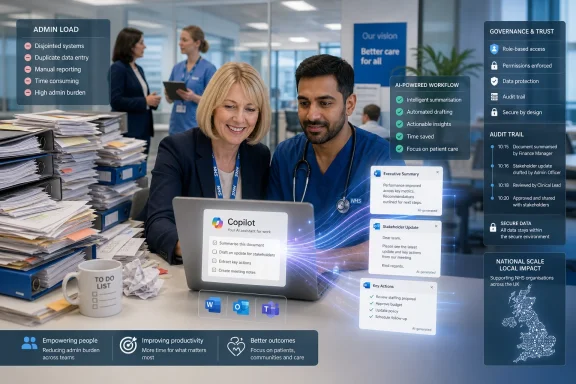
  3. Related coverage: england.nhs.uk
  4. Related coverage: htn.co.uk
  5. Related coverage: investing.com
  6. Related coverage: techmarketview.com
  1. Related coverage: resultsense.com
  2. Related coverage: theagenttimes.com
  3. Official source: blogs.microsoft.com
  4. Official source: microsoft.com
  5. Official source: fpc.microsoft.com
 

NHS England said on June 8, 2026, that it will give Microsoft 365 Copilot to 505,000 clinicians and support staff across England by October 2026, after a 30,000-person pilot across 90 NHS organizations reported average administrative savings of 43 minutes per user per day. That is the kind of number that makes ministers, vendors, and exhausted managers lean forward at the same time. It is also the kind of number that should make IT leaders slow down, because a half-million-seat AI rollout is not just a productivity purchase. It is a bet that Microsoft’s assistant can be made safe, useful, governed, and boring enough for one of the world’s most complex health systems.

Healthcare professionals collaborate on connected devices with cloud security icons over a city skyline at dusk.Microsoft Wins the Paperwork War Before the Clinical War​

The NHS is not buying Copilot because it wants a chatbot to practice medicine. It is buying Copilot because modern healthcare has turned into an arms race between care delivery and documentation, and documentation has been winning for years.
That distinction matters. The immediate targets are not diagnoses, prescriptions, or surgical decisions, but the administrative sludge around them: discharge paperwork, bed management, rota planning, meeting notes, briefings, board papers, HR, finance, procurement, and data analysis. This is the low-glamour, high-volume layer where time disappears and where even modest automation looks seductive.
Microsoft’s pitch fits that world neatly. Copilot lives inside Outlook, Teams, Word, Excel, PowerPoint, and the wider Microsoft 365 estate that many large organizations already inhabit. For staff who spend their days in email threads, Teams meetings, Word documents, spreadsheets, and slide decks, the assistant is less a new destination than a layer over familiar tools.
That is precisely why the rollout is strategically important. The NHS is not being asked to rebuild its administrative workflows around a new standalone AI product; it is being asked to let Microsoft’s AI occupy the software it already depends on. For WindowsForum readers, that is the bigger Microsoft story: Copilot becomes harder to evaluate as a separate application once it is embedded into the daily plumbing of enterprise work.

The 43-Minute Claim Is Powerful Because It Is Plausible​

A claimed saving of 43 minutes per day sounds both huge and oddly believable. Anyone who has worked in a large regulated organization knows that 43 minutes can vanish into meeting summaries, duplicated reporting, inbox triage, spreadsheet cleanup, policy drafts, and the eternal ritual of turning one set of notes into another set of notes.
NHS England says the figure came from a pilot involving more than 30,000 staff across 90 organizations. That is large enough to be more than a toy experiment and broad enough to carry political weight. It gives the rollout a story that executives can repeat: this is not speculative AI futurism, but an observed administrative saving at NHS scale.
Still, “average time saved” is one of the slipperiest metrics in enterprise technology. It can mean measured workflow time, self-reported time, estimated time, or a blended model that captures enthusiasm as much as efficiency. The difference matters, because the NHS will now move from pilot conditions to routine use, where novelty fades and workarounds become institutionalized.
The hard test is not whether Copilot can help a motivated pilot user summarize meetings faster. The hard test is whether half a million busy people, under varying degrees of pressure and digital maturity, can turn the assistant into repeatable time savings without creating new review burdens, security headaches, or managerial illusions.

The NHS Is Buying a Layer, Not a Tool​

Copilot’s enterprise value is not just that it can generate text. Lots of AI systems can generate text. Microsoft’s advantage is that it can place generative AI inside identity, permissions, files, calendars, chats, meetings, and productivity apps that already define the workday.
That makes Copilot more useful than a generic chatbot for administrative work, but it also makes it more consequential. A system that can summarize Teams meetings, draft documents from organizational context, and reason over files is operating close to sensitive institutional knowledge. In healthcare, even “administrative” material can include patient information, staffing data, finance details, legal correspondence, or reputational risk.
This is where the usual AI debate becomes too simple. The question is not whether staff should use AI or whether the NHS should modernize paperwork. The question is whether the underlying information architecture is clean enough, permissioned enough, and audited enough for Copilot to safely expose what staff are technically allowed to see.
Many sysadmins already know the dirty secret of enterprise search: permissions are often accurate in the narrow technical sense but messy in the human one. A file share may contain documents inherited from old teams, forgotten projects, overbroad groups, or years of “temporary” access that became permanent. Add an AI assistant that can summarize across that sprawl, and latent governance problems become visible in a hurry.

The Real Deployment Begins Before the License Is Assigned​

NHS England says trusts will receive central license allocations based on headcount, often beginning with about 2,000 seats, with access expected to reach more than 500,000 staff by October 2026. That schedule is ambitious but not instantaneous, and the phased nature is important. Copilot rollouts tend to succeed or fail before users see the button.
The preparation work is familiar to enterprise administrators: identity hygiene, sensitivity labels, retention policies, data loss prevention rules, conditional access, audit logging, endpoint management, Teams governance, SharePoint permissions, and training. None of that is exciting, and all of it determines whether the AI assistant is a controlled productivity layer or a very expensive way to surface old chaos.
Microsoft has spent years arguing that its security and compliance stack makes Copilot suitable for regulated industries. That argument is credible in the sense that Microsoft has the infrastructure, certifications, and administrative controls needed to serve large public-sector customers. But “available controls” and “correctly implemented controls” are different things, especially across an organization as decentralized and operationally stretched as the NHS.
The NHS rollout will therefore be a governance exercise disguised as a software deployment. Every trust will have to decide who gets access first, which use cases are encouraged, which are restricted, how outputs are checked, and how staff are trained not to confuse fluent text with verified fact. The license count is the easy headline; the operating model is the real project.

Microsoft’s Public-Sector AI Strategy Just Found Its Best Case Study​

For Microsoft, the NHS deal is more than another large customer win. It is a public-sector proof point at a moment when the company wants Copilot to look less like an optional productivity add-on and more like the default interface for work.
The company has been pushing enterprises toward an “agentic” future in which software does not merely answer questions but carries out tasks across systems. NHS England’s plan includes Copilot Studio, Microsoft’s toolset for creating custom agents, with examples such as handling Freedom of Information requests, processing complaints, reducing helpdesk workloads, and assisting with financial analysis. That is a wider ambition than drafting emails.
The phrase AI agent has become elastic enough to cover everything from a glorified workflow script to an autonomous system with access to multiple tools. In a health service, that ambiguity matters. A custom agent that helps classify FOI requests is one thing; an agent that touches complaint workflows, financial analysis, or service operations requires much clearer boundaries.
NHS England’s reference to an Agent 365 governance framework is therefore not a footnote. It is an admission that once organizations start building AI agents internally, the problem becomes less about the base model and more about inventory, ownership, permissions, audit, lifecycle management, and failure modes. In plain English: someone has to know what the bots are doing, who approved them, and how to shut them down.

The Cost Is the Missing Number Everyone Will Calculate Anyway​

The most conspicuous absence in the announcement is the price. NHS England has not disclosed the cost of the deal, and that omission will do more to fuel skepticism than almost any technical concern.
Public list pricing for Microsoft 365 Copilot has typically sat in the tens of pounds per user per month, depending on plan, market, and billing terms. At half a million seats, even a heavily discounted public-sector agreement can become a very large recurring commitment. The NHS almost certainly is not paying retail, but “not retail” is not the same as “cheap.”
This matters because Copilot’s return on investment is inseparable from adoption quality. A theoretical 43-minute daily saving multiplied by 505,000 staff produces a staggering productivity story. But if only a fraction of users adopt it deeply, if savings are concentrated among office-heavy roles, or if time saved is absorbed by additional demand rather than released capacity, the economics become harder to defend.
There is also a political dimension. The NHS is under constant pressure over waiting lists, staffing, infrastructure, and frontline capacity. A nine-figure-feeling software initiative, even if discounted below that, will be judged not by licensing theory but by whether staff and patients experience visible relief. Microsoft and NHS England are now tied to a promise that paperwork can be materially reduced, not merely rearranged.

The Administrative Burden Was Never Just a Technology Problem​

The danger in any AI productivity story is that it treats bureaucracy as a pile of text waiting to be summarized. Some of it is. Much of it is not.
Healthcare administration exists because hospitals and clinics need continuity, accountability, safety, funding, compliance, resource planning, workforce management, legal defensibility, and public transparency. Documents are often the visible residue of deeper process requirements. If Copilot drafts them faster, that may help enormously, but it does not automatically remove the underlying obligation to produce, review, approve, and store them.
That is why the NHS must avoid measuring success only by documents generated or minutes claimed. A discharge summary drafted faster still has to be clinically accurate. A meeting transcript summarized instantly still has to reflect decisions correctly. A rota plan assembled by AI still has to survive human constraints, union rules, sickness, specialties, fatigue, and local reality.
The most successful uses will likely be those where AI accelerates the first draft, organizes messy inputs, or reduces blank-page work. The risky uses will be those where speed creates a false sense of completion. In healthcare, the final 10 percent of verification is often the part that matters most.

Windows Admins Will Recognize the Shape of the Problem​

For IT professionals, this rollout has a familiar rhythm. A senior organization buys a strategic platform, a vendor wraps it in transformation language, and administrators are left to turn vision into policy, controls, and support tickets.
Copilot adds new pressure because its failures can look deceptively polished. Traditional software errors often announce themselves with crashes, missing fields, or broken workflows. AI errors can arrive as confident summaries, plausible drafts, and cleanly formatted nonsense. The user experience is smoother, which can make the operational risk harder to spot.
That shifts some burden from pure technical support to user education and governance. Staff need to understand when Copilot is drafting, when it is summarizing, when it is reasoning over accessible content, and when it may be filling gaps probabilistically. They also need clear rules on patient data, confidential material, and the difference between assistance and authority.
The administrative support model must also be ready for a new class of complaint: “Copilot found a document I did not know I could access,” “Copilot summarized a meeting incorrectly,” “Copilot used the wrong version,” or “Copilot generated something that looked official but was not.” Those are not ordinary helpdesk tickets. They sit at the intersection of permissions, training, records management, and professional responsibility.

The Pilot-to-Platform Leap Is Where AI Projects Get Interesting​

Pilots are good at proving that a tool can work. Rollouts prove whether an organization can absorb it.
The NHS pilot’s reported savings are meaningful, but pilots often benefit from motivated participants, clearer support, narrower use cases, and closer observation. Scaling to 505,000 staff introduces uneven digital skills, local process variation, inconsistent data hygiene, and competing operational priorities. A hospital trust facing winter pressure will experience Copilot differently from a central administrative team with time to redesign workflows.
That does not mean the rollout is doomed. It means the most important work will be local. A trust that treats Copilot as a magic button will likely get scattered usage and inflated expectations. A trust that identifies specific workflows, trains role-based cohorts, measures outcomes honestly, and tightens information governance first has a better chance of turning the license into actual capacity.
The October 2026 target gives NHS England a visible deadline, but not every useful transformation should be measured by whether every eligible user can click the Copilot icon by then. A smaller group using it well may create more value than a larger group using it casually. Adoption dashboards can be useful, but they can also tempt leaders into counting prompts instead of outcomes.
The best case is not half a million people asking Copilot random questions. The best case is thousands of repetitive administrative workflows becoming lighter, faster, and less soul-destroying because the assistant is applied where the work is structured enough to benefit and supervised enough to remain safe.

The Staff Experience Will Decide the Politics​

The NHS has a long memory for digital transformation schemes that promised simplification and delivered another login, another form, or another dashboard. Copilot will have to overcome that skepticism from the bottom up.
If clinicians and support staff experience it as a practical helper that reduces after-hours documentation, summarizes meetings accurately, and drafts routine material they can quickly correct, the rollout may build goodwill quickly. If they experience it as a management fad, a surveillance layer, or an unreliable writing machine that creates more checking work than it saves, the enthusiasm will curdle.
This is especially sensitive because administrative overload is not evenly distributed. Some staff spend most of their time in Microsoft 365 and may see immediate value. Others work in clinical systems, ward environments, patient-facing roles, or operational settings where the Copilot footprint is less direct. A single average saving can conceal a wide spread of benefits.
The NHS should be transparent about that spread. It would be more credible to say that some roles save hours while others save little than to imply uniform gains across a workforce of half a million. The promise of AI in public services will survive better if it is described with operational honesty rather than vendor-grade smoothness.

Patients May Never See Copilot, but They Will Feel the Trade-Offs​

The public-facing argument is simple: less admin means more time for patients. That is a powerful line because it connects a back-office software license to a human outcome. It is also difficult to prove.
Time saved in healthcare does not automatically become patient-facing time. It may reduce overtime, improve staff morale, accelerate internal processes, shorten delays, or simply let people keep up with existing demand. All of those are worthwhile, but they are not the same as adding clinical capacity.
Patients are more likely to feel Copilot indirectly. Discharge paperwork may move faster. Internal coordination may improve. Meeting actions may be clearer. Complaints and FOI requests may be processed more consistently. Back-office delays may shrink in ways that never appear in a headline but matter to the functioning of a health system.
The risk is that political messaging oversells the patient impact and creates a backlash if waiting rooms do not suddenly empty. AI can help with administrative drag, but it cannot conjure beds, nurses, scanners, social care packages, or spare hours where structural shortages dominate. The honest promise is narrower but still important: reduce the paperwork tax so scarce human attention is wasted less often.

The Security Story Is About Permission, Not Just Privacy​

Microsoft and NHS England will understandably emphasize enterprise security, compliance, and governance. Those assurances matter, but they can also flatten the issue into a generic privacy discussion. The harder problem is permission.
Copilot’s usefulness depends on access to organizational context. That means emails, documents, chats, calendar information, and files exposed through Microsoft Graph and governed by existing access controls. If those controls are well designed, Copilot can respect them. If they are messy, Copilot can make the mess more visible and more useful to the wrong person.
This is not a theoretical concern unique to the NHS. Every large Microsoft 365 tenant contains some degree of oversharing. Old SharePoint sites linger. Teams sprawl. Guest access accumulates. Sensitivity labels are inconsistently applied. Users move roles but retain access. Copilot does not invent those problems, but it can lower the effort required to exploit them accidentally.
The security preparation should therefore include aggressive permission review, not just AI policy documents. It should include audit readiness, clear escalation routes, and a culture in which discovering overexposed data is treated as a governance signal rather than a user misbehavior. In AI deployments, embarrassment is less useful than remediation.
There is also the question of output handling. A Copilot-generated draft can contain sensitive material even if the prompt looked harmless. Users need to understand that AI output inherits the risk profile of the data used to produce it. Copying a polished summary into the wrong email, document, or system can be just as damaging as mishandling the original source.

Agent 365 Is the Part to Watch After the Headlines Fade​

The initial news is about Microsoft 365 Copilot licenses, but the longer-term story may be Copilot Studio and agent governance. Once organizations begin building internal agents, the productivity promise moves from “help me write this” to “help me process this workflow.”
That is where the gains could become more concrete. FOI handling, complaints triage, helpdesk deflection, financial analysis, and procurement support are process-heavy areas where structured AI assistance could reduce repetitive effort. They are also areas with audit trails, deadlines, legal obligations, and reputational stakes.
An agent that drafts a response is manageable. An agent that routes a complaint, updates a case, interprets policy, or triggers downstream action needs much more discipline. It needs human ownership, testing, monitoring, versioning, and a sunset plan. It needs to fail safely.
Agent governance will be a major enterprise software category because every organization that lets departments build bots will eventually need a way to answer simple questions: which agents exist, what data can they access, who approved them, what actions can they take, how are they monitored, and what happens when a policy changes? The NHS rollout will be watched because it compresses those questions into a high-stakes public environment.

The NHS Has Made Microsoft the Default AI Interface for Work​

There is a broader market consequence here. By choosing Copilot at this scale, NHS England is effectively endorsing Microsoft 365 as the default surface for administrative AI in the health service.
That does not mean other AI systems will disappear from healthcare. Clinical AI, imaging AI, research models, local automation tools, and specialist applications will continue to develop. But for the daily office layer — the emails, meetings, documents, spreadsheets, and internal workflows — Microsoft now has a privileged position.
This is classic platform strategy. Microsoft does not need Copilot to be the best possible AI assistant for every task if it is the assistant already present where work happens. Convenience, identity integration, procurement simplicity, compliance posture, and user familiarity can outweigh raw model comparisons, especially in large organizations.
For competitors, the NHS deal shows the difficulty of attacking Microsoft in its enterprise stronghold. For customers, it raises the familiar platform-dependence question. The more workflows, agents, prompts, governance processes, and training programs are built around Copilot, the more expensive it becomes to change direction later.

The Fine Print Behind the Five-Week Promise​

The NHS rollout should not be dismissed as AI hype, because the administrative problem is real and the pilot was not trivial. But it should not be swallowed whole either, because the difference between a useful assistant and a costly dependency will be decided in implementation.
The concrete points are straightforward:
  • NHS England plans to provide Microsoft 365 Copilot access to 505,000 clinicians and support staff by October 2026.
  • The decision follows a pilot involving more than 30,000 staff across 90 NHS organizations, with reported average savings of 43 minutes per user per day.
  • The early use cases are administrative rather than clinical, including discharge paperwork, rota planning, meeting summaries, briefings, HR, finance, procurement, and data analysis.
  • Trusts are expected to receive centrally allocated licenses based on headcount, often starting with about 2,000 seats.
  • Copilot Studio and Agent 365 point to a second phase in which NHS organizations build and govern custom AI agents for internal workflows.
  • The undisclosed price, the quality of local governance, and the honesty of outcome measurement will determine whether the rollout looks visionary or merely expensive.
The NHS is right to attack paperwork with the same seriousness it applies to more visible operational pressures, because administrative drag is not a side issue when it consumes clinical and managerial attention at scale. But Copilot will not save the NHS by being clever; it will help only if the service does the slower work of governance, measurement, training, permission cleanup, and workflow redesign. The next year will show whether Microsoft’s AI can become a practical tool in public healthcare, or whether the paperwork headache simply migrates into a new generation of prompts, policies, and procurement debates.

References​

  1. Primary source: The Register
    Published: 2026-06-08T14:21:08.779088
  2. Official source: microsoft.com
  3. Related coverage: resultsense.com
  4. Related coverage: techmarketview.com
  5. Related coverage: epcgroup.net
  6. Related coverage: strategy365.co.uk
  1. Related coverage: techfinitive.com
  2. Related coverage: br.investing.com
  3. Related coverage: cloudswitched.com
  4. Official source: microsoftnegotiations.com
  5. Related coverage: windowscentral.com
  6. Related coverage: techradar.com
  7. Related coverage: hbs.net
  8. Official source: techcommunity.microsoft.com
  9. Related coverage: emea.ingrammicro.com
  10. Related coverage: everon.co.uk
 

NHS England and Microsoft announced on June 8, 2026, that Microsoft 365 Copilot will be rolled out to about 505,000 clinicians and support staff across NHS services in England by October 2026. The promise is disarmingly simple: give overstretched staff an AI assistant for the paperwork that surrounds care, and recover time for patients. The harder truth is that the NHS is not merely buying a productivity tool; it is testing whether one of the world’s largest public health systems can safely industrialize generative AI without turning clinical work into another software dependency. If the numbers hold, this could be one of the most consequential deployments of Microsoft’s AI stack yet.

Healthcare staff use an AI “Copilot” assistant in a hospital setting, promoting safe, human-in-the-loop support.Microsoft’s Biggest NHS Pitch Is Not Intelligence, but Time​

The headline figure is 43 minutes per staff member per day. That is the average administrative time reportedly saved during a large NHS trial of Microsoft 365 Copilot involving more than 30,000 workers across 90 NHS organizations. Scaled to half a million users, it becomes the sort of number that makes ministers, procurement teams, and hospital executives sit up: millions of hours returned each month, at least on paper.
That framing matters because the NHS has never lacked digital ambition. What it lacks is slack. Clinicians and support staff are often asked to absorb new systems while continuing to meet service targets, handle backlogs, and document everything with a level of precision that modern healthcare demands. A tool that drafts, summarizes, searches, formats, and analyzes within the Microsoft 365 environment is appealing precisely because it attacks the accreted administrative burden around care rather than attempting to replace clinical judgment outright.
Microsoft’s language is carefully pitched at that boundary. Copilot is presented as a personal assistant, not a diagnostician. It can help draft documents, summarize meetings, analyze data, and assist with routine knowledge work. In NHS terms, that means fewer minutes spent wrestling with correspondence, board papers, service documents, inbox triage, meeting notes, and internal reports.
The crucial distinction is that the NHS is not announcing a moonshot AI doctor. It is announcing AI for the boring work. That is why the announcement may prove more important than many flashier health-tech pilots: healthcare systems often bleed time not at the dramatic edge of medicine but in the mundane connective tissue of administration.

The 43-Minute Claim Will Carry the Whole Project​

Every big technology rollout needs a number simple enough to survive politics, procurement, and public skepticism. For this one, 43 minutes is that number. It implies roughly five weeks of administrative time per person annually, and NHS leaders have translated that into a more human metric: around two days of admin time back every month.
But average time-saved figures are tricky beasts. They compress different roles, habits, workloads, levels of training, and adoption patterns into a single productivity claim. A senior manager producing documents all day may find Copilot immediately useful; a ward-based clinician with little desk time may experience the tool quite differently. Some staff may use it daily, others only occasionally, and some may not trust it enough to let it meaningfully change their workflow.
That does not make the number useless. It makes it a hypothesis at national scale. The trial suggests there is real administrative friction Copilot can reduce, but national deployment will reveal whether those savings survive the messy realities of staff turnover, uneven digital maturity, local governance, clinical pressure, and the simple fact that a tool only saves time when people can actually use it in the flow of work.
This is where Microsoft has an unusually favorable starting position. The NHS already runs heavily on Microsoft 365, so Copilot enters through familiar applications rather than as a completely foreign platform. That reduces friction, but it also deepens lock-in. Once the productivity layer, AI assistant, document corpus, identity system, and collaboration workflows all point in the same direction, changing course becomes harder.

The NHS Is Buying an AI Layer for Its Existing Bureaucracy​

The most revealing part of the deal is not that staff will get Microsoft 365 Copilot. It is that the agreement also includes access to Copilot Studio and governance through Agent 365, positioning the NHS to build and deploy AI agents on top of existing processes. That moves the story beyond drafting emails and summarizing meetings.
An AI assistant helps a user complete a task. An AI agent starts to participate in a workflow. In a health system, that difference is enormous. Once organizations begin creating agents for HR, finance, procurement, operational analysis, reporting, scheduling, or internal service requests, the AI layer stops being a convenience feature and becomes part of the administrative architecture.
That is both the opportunity and the hazard. The NHS is full of repeatable processes that are slow, fragmented, and expensive because they rely on humans copying information between systems, generating documents from templates, and interpreting internal policies. AI tools can compress that work. They can also produce confident errors, obscure responsibility, and turn governance into a game of chasing automation after it has already entered practice.
The likely early wins will not be glamorous. Drafting internal updates, preparing summaries from meetings, turning notes into structured documents, analyzing spreadsheet data, and producing first-pass reports are exactly the tasks where generative AI tends to feel useful. These are also tasks where small errors are manageable if a human remains firmly in the loop.
The real stress test will come later, when local organizations want to connect agents to more sensitive workflows. The temptation will be obvious: if Copilot can summarize, why not triage? If it can analyze, why not recommend? If it can draft, why not complete? NHS England’s challenge will be to draw bright lines before the productivity story quietly becomes a decision-support story.

Healthcare AI Has Learned to Enter Through the Back Office​

For years, the public debate around AI in healthcare has focused on diagnosis, imaging, drug discovery, and clinical decision support. Those are important, but they are also heavily regulated, clinically sensitive, and difficult to scale. Administrative AI is a softer entrance. It promises immediate relief without asking patients to trust an algorithm with a diagnosis.
That is why this rollout is politically attractive. The NHS can tell staff that the tool exists to remove drudgery. It can tell patients that clinicians should have more time for care. It can tell taxpayers that the health service is using its purchasing power to improve productivity. Microsoft, meanwhile, gets a flagship deployment in one of the most visible public-sector environments in the world.
There is a strategic lesson here for the broader enterprise market. Generative AI may not first transform organizations by replacing expert work. It may transform them by attaching itself to the clerical shadow of expert work: the notes, forms, minutes, summaries, emails, policy documents, and analysis that professionals must produce to keep institutions moving.
In the NHS, that shadow is huge. Modern healthcare is documentation-heavy for good reasons: safety, accountability, funding, auditability, legal defensibility, continuity of care. But the cumulative effect is that highly trained staff can spend painful chunks of their day producing, reading, reformatting, and rediscovering information. If AI can reduce even a modest fraction of that load reliably, the operational case becomes powerful.
The risk is that recovered time is rarely recovered cleanly. An hour saved in one workflow can be swallowed by another demand before it ever reaches the patient. For Copilot to produce visible benefits, NHS organizations will need to measure not only whether staff generate documents faster, but whether clinical capacity, service responsiveness, or staff wellbeing actually improves.

The Windows and Microsoft 365 Angle Is Bigger Than a Health Story​

For WindowsForum readers, this is not just an NHS procurement item. It is a live case study in Microsoft’s broader strategy: make AI a default layer across work, identity, documents, security, collaboration, and process automation. The NHS rollout shows how that strategy lands when the customer is not a startup or a bank, but a national health service.
Microsoft 365 Copilot is not a standalone chatbot in the classic sense. Its value depends on proximity to organizational data: emails, calendars, Teams meetings, Word documents, PowerPoint decks, Excel workbooks, SharePoint sites, and permissions managed through Microsoft’s identity stack. The more an organization lives inside Microsoft 365, the more plausible Copilot becomes as a unifying assistant.
That architecture gives Microsoft an advantage competitors cannot easily match. A generic chatbot may be impressive, but an assistant embedded in the tools workers already use has a different adoption path. It appears where the work already happens. It inherits familiar permissions. It can summarize the meeting you just had and draft the document you already need.
But that same architecture raises the stakes for configuration and governance. If permissions are messy, Copilot can expose organizational mess at machine speed. If old files are over-shared, if SharePoint sites have become dumping grounds, if sensitive documents sit in locations with broad access, then an AI assistant grounded in enterprise data may surface information more effectively than the organization intended.
For sysadmins, this is the unglamorous but essential lesson. AI readiness is not just a training deck. It is identity hygiene, data classification, lifecycle management, retention policy, audit logging, endpoint security, conditional access, and a clear understanding of who can see what. The NHS rollout will depend as much on boring Microsoft 365 administration as on any model capability.

Staff Trust Will Decide Whether Copilot Becomes a Tool or Shelfware​

Technology vendors often describe adoption as if it were a rollout problem: assign licenses, train users, measure engagement, repeat. In healthcare, adoption is more intimate. Staff will use a tool if it helps under pressure, if it does not slow them down, if it does not create new risks, and if they believe leadership will not weaponize the data against them.
That last point deserves attention. AI productivity tools generate telemetry. They can show usage, activity, and patterns of engagement. In a strained public service, staff may reasonably worry that a tool marketed as relief could become a mechanism for monitoring or squeezing more output from already overburdened teams. The NHS will need to be explicit that time saved is not merely a way to raise the administrative treadmill.
There is also the question of confidence. Copilot can produce fluent text that still needs checking. In administrative work, that may be acceptable when the output is a first draft or a summary. But in healthcare-adjacent contexts, a subtly wrong summary, an omitted caveat, or a misread data point can matter. Staff must have enough training not only to use the tool, but to distrust it appropriately.
The best deployments will likely treat Copilot as a drafting and synthesis aid rather than a final authority. That sounds obvious, but enterprise AI failures often begin when convenience outruns review. The faster a tool makes work feel, the easier it is for verification to become perfunctory.
NHS England’s planned adoption and AI skilling program will therefore be more than a support function. It will be the difference between a productivity program and a reputational risk. Staff need examples rooted in their actual roles, not generic prompts. They need clear rules on patient-identifiable information, internal confidentiality, output checking, and escalation when the tool behaves unexpectedly.

The Patient Benefit Is Plausible, but Not Automatic​

The most emotionally compelling claim is that Copilot will give staff more time for patient care. It might. But the chain of causality is longer than the press release version suggests.
First, the tool must be available to the right staff. Then those staff must use it often enough for meaningful savings. Then those savings must occur in parts of the day where time can be reallocated rather than merely absorbed. Then management must resist the instinct to fill the newly available minutes with additional documentation, meetings, or targets. Only then does the patient experience improve in a way ordinary people can feel.
That does not mean the claim is hollow. Administrative overload is one of the great hidden enemies of care quality. It contributes to burnout, delays communication, reduces responsiveness, and forces clinicians to divide attention between people and systems. If Copilot can reduce the time spent producing low-value paperwork, even partially, the patient-facing upside is real.
But the NHS should be judged on outcomes, not just deployment scale. A half-million licenses is not a health outcome. Forty-three minutes saved in a trial is not the same as shorter waits, better communication, faster discharge letters, improved staff retention, or safer handovers. Those are the measures that will determine whether the rollout becomes a model or a cautionary tale.
The most honest version of the promise is not that AI will magically fix NHS capacity. It is that AI may remove some of the administrative drag that makes existing capacity feel smaller than it is. That is worth pursuing, but it is not a substitute for staffing, funding, estate modernization, interoperability, or reform of broken processes.

Microsoft Gets a Flagship, the NHS Gets a Dependency​

The commercial significance for Microsoft is obvious. A 505,000-user healthcare deployment gives Copilot credibility at a scale few case studies can match. It shows that Microsoft can sell AI not merely as a premium enterprise add-on, but as infrastructure for public services.
For the NHS, the trade-off is more complicated. Microsoft brings mature enterprise controls, procurement familiarity, integration with existing systems, and the sheer gravitational pull of a platform already embedded in daily work. Those are strong reasons to choose it. They are also the reasons dependency grows quietly.
Once staff build habits around Copilot, once local teams create agents in Copilot Studio, once workflows assume Microsoft’s AI layer is present, the cost of leaving increases. That does not make the deal wrong; lock-in is not automatically a scandal. But public-sector buyers should be candid about it. AI procurement is not like buying another office application. It can become a layer through which institutional knowledge is accessed and work is routed.
The NHS will also need to keep pressure on value for money. Microsoft 365 Copilot is typically positioned as a premium per-user product in the enterprise market, and even discounted public-sector terms can add up quickly at this scale. The return on investment depends on sustained usage, measurable time savings, and actual operational benefit. Licenses that sit idle are expensive; licenses that change workflows without improving care are worse.
This is where central purchasing power can help. The NHS can negotiate at a scale few organizations can match, and it can standardize governance, training, and measurement. But central scale can also hide local variation. A trust that gets transformative value and a trust that barely uses the tool may look identical in a national rollout dashboard unless measurement is designed carefully.

The Data Governance Story Will Not Stay in the Background​

Every major AI deployment eventually becomes a data governance story. In healthcare, it starts there. Even if Copilot is used primarily for administration, NHS workers operate in environments where sensitive personal, clinical, workforce, and financial information is everywhere.
Microsoft and NHS England will emphasize enterprise-grade controls, existing permissions, and governance tooling. Those controls matter. But the practical question is how well each organization has managed the data estate Copilot will be allowed to reason over. AI does not magically create a clean information architecture. It reveals the consequences of the one you already have.
The most immediate danger is not necessarily a cinematic breach. It is oversharing, misclassification, inappropriate summarization, accidental inclusion of sensitive content, and misplaced confidence in generated text. A staff member asking Copilot to summarize a document may not always know what source material has influenced the answer. A manager using it to analyze internal data may not understand the limitations of the dataset. A team building an agent may not anticipate every context in which it will be used.
That is why governance cannot be confined to IT or information governance teams. Line managers, clinical safety officers, Caldicott Guardians, security teams, records managers, and frontline staff all have a role. The NHS has institutional experience with confidentiality and information governance; the challenge is translating those principles into the faster, more fluid world of generative AI.
The rollout should also sharpen public debate about where patient data sits in AI-enabled productivity tools. Even when vendors provide contractual assurances and technical boundaries, public trust depends on clear communication. Patients do not need marketing language. They need to know whether their information is being used, for what purpose, under what controls, and with what human oversight.

The Five Checks That Will Decide Whether This Rollout Is More Than a Press Release​

The NHS and Microsoft have chosen a pragmatic version of healthcare AI: less robot doctor, more administrative exoskeleton. That makes the project easier to defend and potentially easier to scale. It also means success will be measured in dull but decisive operational details rather than dazzling demos.
  • The 43-minute saving must be tested continuously against real-world usage after the October 2026 rollout, not treated as a permanent benefit guaranteed by the trial.
  • NHS organizations must clean up permissions, document repositories, and data classification before Copilot makes old information-governance problems easier to discover.
  • Staff training must teach workers when not to trust AI output, because fluent drafting is not the same thing as accuracy.
  • Patient benefit should be measured through service outcomes such as faster communication, reduced administrative delays, and improved staff capacity, not merely by counting assigned licenses.
  • Copilot Studio and AI agents should be governed as workflow infrastructure, because automation that begins in the back office can quickly move toward higher-risk decisions.
  • The NHS should publish enough evidence over time for the public to distinguish genuine productivity gains from vendor optimism and political wish-casting.
The NHS Copilot rollout is therefore a bet on a restrained but powerful idea: that the first truly useful AI revolution in healthcare may come not from replacing doctors, nurses, or administrators, but from reducing the bureaucratic gravity that pulls them away from the work only humans can do. If Microsoft and NHS England can prove that at national scale, the announcement will look less like another AI press release and more like the beginning of a new operating model for public-sector work. If they cannot, it will become a familiar lesson in modern digital transformation: software can save time only when institutions are willing to change what they do with the time it saves.

References​

  1. Primary source: Pharmacy Business
    Published: 2026-06-08T15:02:07.265262
  2. Official source: news.microsoft.com
  3. Related coverage: resultsense.com
  4. Related coverage: gov.uk
  5. Related coverage: investing.com
  6. Related coverage: techmarketview.com
  1. Related coverage: htn.co.uk
  2. Related coverage: healthcare-management.uk
  3. Related coverage: theagenttimes.com
  4. Related coverage: england.nhs.uk
  5. Related coverage: openaccessgovernment.org
  6. Official source: ukstories.microsoft.com
  7. Related coverage: assets.publishing.service.gov.uk
  8. Official source: fpc.microsoft.com
 

NHS England said on June 8, 2026, that it will give Microsoft 365 Copilot access to 505,000 clinicians and support staff across England, following a 30,000-worker trial that reported average administrative savings of 43 minutes per user per day. The deal is not merely another AI licensing win for Microsoft; it is a test of whether generative AI can survive contact with the least forgiving productivity environment in the public sector. If the numbers hold, the NHS gets a rare lever against the administrative drag that consumes clinical time. If they do not, England will have staged one of the world’s largest experiments in mistaking inbox acceleration for healthcare reform.

Healthcare team collaborates in an office with a digital data clock and cloud security map overlay.Microsoft Wins the Healthcare Scale Argument Before the Hard Part Begins​

The headline number is designed to travel: 505,000 NHS workers, the largest healthcare implementation of its kind, a claimed five weeks of time saved per person each year. Microsoft and NHS England are framing Copilot not as a diagnostic tool, not as a clinical decision engine, and not as a moonshot medical AI system, but as an administrative pressure valve. That matters because the most credible near-term AI story in healthcare is not robotic doctors. It is fewer human hours lost to drafting, summarizing, formatting, searching, meeting notes, rota paperwork, procurement queries, and the endless internal choreography that keeps a vast health system moving.
The deployment follows a trial across more than 30,000 NHS workers in 90 organizations. The reported average saving of 43 minutes a day is the figure around which the whole announcement turns. Multiply that across hundreds of thousands of users and the promise becomes almost absurdly large: millions of staff hours returned to a system that has little spare capacity and no shortage of demand.
But this is also where the story becomes more interesting than a press release. Copilot’s most important job in the NHS is not to be impressive in a demo. It is to be consistently useful in the messy middle of public healthcare, where staff already work around aging systems, uneven data quality, procurement constraints, security rules, and the permanent reality that a saved minute in one workflow can easily become a new burden in another.

The NHS Is Buying Time, Not Magic​

NHS England’s pitch is deliberately grounded in office work. Ward clerks are expected to use Copilot for discharge processes, service data analysis, rota building, and bed management. Medical secretaries may use it for minutes, patient letters, and consistent templates. Management teams can draft papers, briefings, and organizational analysis. HR, finance, and procurement teams are in scope too.
That portfolio is revealing. These are document-heavy, repetitive, coordination-heavy tasks where generative AI has a plausible role and where the clinical risk is lower than if the system were directly recommending treatment. Microsoft 365 Copilot lives inside the productivity suite many organizations already use, which makes it less like a standalone health-tech application and more like an ambient layer over Word, Excel, Outlook, Teams, SharePoint, and the rest of the Microsoft estate.
The safer interpretation is that the NHS is trying to standardize assisted administration before it standardizes more ambitious AI. That is sensible. The health service does not need a chatbot that sounds authoritative about medicine; it needs tools that reduce the time it takes to turn meetings into actions, locate relevant policy, assemble routine correspondence, summarize long documents, and route internal work without demanding yet another portal login.
The unsentimental version is that Microsoft has found the perfect early enterprise AI beachhead. Every large organization has too many meetings, too much email, too many documents, and too little patience. The NHS has those problems at national scale, under public pressure, with a workforce whose time is both expensive and politically precious.

The 43-Minute Claim Will Define the Rollout​

The strongest number in the announcement is also the number administrators should interrogate hardest. An average saving of 43 minutes per person per day sounds transformative. Across a working year, NHS England says that equates to roughly five weeks of time per person annually, a figure that helps explain why ministers and executives are willing to move from pilot to national deployment.
The question is not whether some workers saved time. They almost certainly did. Anyone who has watched a capable user turn a meeting transcript into minutes, a policy document into a briefing, or a bloated email thread into an action list understands why Copilot can be useful. The question is whether those savings are repeatable, measurable, and transferable across job roles, trusts, specialties, and local working cultures.
Time-savings studies around AI tools often depend on self-reporting, task selection, and user enthusiasm. Early adopters are not the average workforce. Pilot participants may use the tool on tasks where it is naturally strong. The value can fade when the product moves from motivated testers to busy staff who have limited time for prompt-craft, verification, and workflow redesign.
That does not invalidate the pilot. It simply means the rollout’s success will depend less on Microsoft’s model quality than on operational discipline. If a ward clerk saves ten minutes drafting a discharge-related note but loses those minutes checking whether the output matches local requirements, the productivity story changes. If a medical secretary gets a usable first draft but must still reconcile ambiguous source material, the saving is real but bounded. If managers generate more reports because reports are now easier to generate, the NHS may not reduce admin so much as make bureaucracy more fluent.

Copilot Studio Turns This From Office AI Into Workflow AI​

The bigger strategic element is not just Microsoft 365 Copilot. The agreement also includes Copilot Studio, allowing NHS England and individual trusts to build AI agents for specific processes. This is where the deployment shifts from “help me draft this document” to “help this organization automate a workflow.”
NHS England says central teams will be able to build and deploy agents nationally, while trusts can create custom agents for local problems. The examples are familiar to anyone who has worked in public-sector IT: help desk triage, complaints handling, freedom of information requests, financial analysis, research support, meeting facilitation, HR enquiries, and process bottlenecks that are important enough to waste thousands of hours but not glamorous enough to attract a bespoke software project.
This is potentially more valuable than generic document drafting. The NHS is not a single office. It is an interconnected federation of trusts, services, specialties, local practices, regional processes, and national rules. A general-purpose AI assistant can help individuals, but agents tied to defined workflows could help teams and departments, provided they are governed tightly and integrated with the systems staff actually use.
The risk is that “agent” becomes the new “app,” with every department building small automations that look useful in isolation but create a governance estate no one fully understands. Microsoft’s Agent 365 governance pitch is meant to answer that fear, promising oversight so agents follow organizational policies and rules. In a healthcare environment, that oversight cannot be a decorative compliance layer. It has to become a living inventory of what agents can access, what they can change, what they log, who owns them, and how they fail.

The NHS Is Right to Aim AI at Admin First​

Healthcare AI attracts attention when it promises diagnosis, triage, radiology assistance, drug discovery, or personalized medicine. Those areas matter, but they also bring high-stakes safety questions and regulatory complexity. By contrast, administrative AI can be mundane and still transformative.
The NHS’s productivity problem is not only a shortage of clinicians or beds. It is also the accumulated drag of systems that require skilled humans to spend part of their working day as translators between forms, meetings, emails, spreadsheets, and service rules. A nurse does not need an AI assistant to tell them what care is; they may need one to reduce the paperwork orbiting that care. A manager does not need another dashboard if they already lack time to interpret the ones they have; they may need faster synthesis of the documents those dashboards produce.
This is why the rollout deserves to be taken seriously even by AI skeptics. The best use of generative AI in the enterprise is often not replacing expertise. It is compressing the low-value work that surrounds expertise. In the NHS, even modest improvements in document handling and internal coordination could matter if they compound across enough people.
Still, “admin first” does not mean “risk free.” Healthcare administration contains sensitive patient information, employment data, financial decisions, and operational details that affect care. A badly summarized complaint, a hallucinated policy reference, or an overconfident draft letter can create real downstream harm. The fact that Copilot is not diagnosing patients does not remove the need for strict human review.

Microsoft’s Advantage Is the Stack, Not Just the Model​

For WindowsForum readers, the most important platform story is that Microsoft is selling the NHS an AI layer because Microsoft already owns much of the work surface. Copilot is compelling to big organizations not merely because it can generate text, but because it sits inside tools their staff already open every day. That is the advantage challengers struggle to match.
A standalone AI product has to earn attention. A Microsoft 365 feature appears in the place where the work already happens. In enterprise IT, distribution often beats elegance. If staff live in Outlook, Teams, Word, Excel, and SharePoint, then an AI assistant that can summarize a meeting, draft a reply, reason over a document, or produce a first-pass analysis has an adoption path that an external tool does not.
This is also why the NHS deal has implications beyond healthcare. Microsoft is trying to normalize the idea that productivity suites are no longer static office software but AI-mediated work environments. The subscription is not just for storage, editing, messaging, and identity. It is for a layer that claims to understand the user’s organizational context and act across it.
That contextual promise is powerful and uncomfortable. The better Copilot becomes, the more it depends on access to organizational data. The more data it can reach, the more important permissions, retention, classification, and oversharing controls become. Many Microsoft 365 administrators already know the uncomfortable truth: Copilot does not create a permissions problem so much as reveal the one that was already there.

Governance Is the Real Deployment Work​

The announcement’s references to security, organizational policies, and Agent 365 governance are not boilerplate. They are the center of the operating model. In a healthcare system, the question is not simply whether Copilot can draft a document. It is whether it can do so without exposing data to the wrong person, preserving auditability, respecting retention rules, and fitting into local information governance procedures.
The hard part begins before the first user types a prompt. NHS organizations will need to know which SharePoint sites are too broadly accessible, which Teams contain sensitive material, which document libraries are poorly classified, which historical files should not be available to general search, and which workflows require explicit human sign-off. Copilot amplifies the value of clean information architecture and the danger of neglected access control.
That is an IT lesson as much as a healthcare lesson. Generative AI turns enterprise content sprawl from an annoyance into an operational risk. A human might never find the forgotten file with sensitive content in a misconfigured site. An AI assistant designed to retrieve and synthesize organizational information might surface it in seconds.
The 12-month onboarding and skilling plan is therefore not a soft change-management accessory. It is part of the control surface. Training must cover not only how to write better prompts, but when not to use the tool, how to verify outputs, how to handle patient-identifiable information, how to distinguish drafts from records, and how to report questionable behavior. In a rollout of this size, the difference between productivity and chaos is usually not the feature list. It is the operating discipline around it.

The Public Sector Is Becoming Microsoft’s AI Proving Ground​

There is a symmetry to this deal that Microsoft will not mind at all. The company needs evidence that Copilot can deliver measurable enterprise value at scale. NHS England needs evidence that AI can help a strained public service without turning into another technology procurement cautionary tale. Each side gets a narrative it can use.
For Microsoft, the NHS is a trophy case. If Copilot can show credible productivity gains in healthcare, the company can point to one of the world’s most visible public health systems and tell other governments, hospitals, universities, and regulated industries that the product is ready for serious work. The sale is not just 505,000 seats. It is a reference architecture for AI adoption in complex institutions.
For NHS England, the deal fits a broader political and operational push to show that digital reform can release capacity. Ministers can talk about freeing clinicians from paperwork. Executives can talk about value for taxpayers. Trusts can talk about modernizing workflows without waiting years for custom software.
The danger is that everyone involved has an incentive to celebrate the rollout before the results are proven. Procurement is not transformation. Licensing is not adoption. Adoption is not productivity. Productivity is not automatically better care. The chain can hold, but every link has to be tested.

Staff Acceptance Will Decide Whether This Becomes Infrastructure or Shelfware​

The NHS is not short of digital systems that were rational on paper and resented in practice. Any technology that enters clinical and support workflows must compete with exhaustion, skepticism, local habit, time pressure, and the memory of previous tools that promised simplicity while adding clicks. Copilot will be judged less by its keynote capabilities than by whether it makes a bad Tuesday easier.
The rollout’s early scale-up plan is ambitious, with 200,000 users expected within the first six months. That pace may help create momentum, but it also raises the stakes for support. Staff need practical examples tied to their jobs, not abstract AI evangelism. A ward clerk needs to know which discharge-adjacent tasks are safe and useful. A finance officer needs templates that match real reporting cycles. A medical secretary needs clear rules for drafts, review, and patient correspondence.
The best adoption programs will probably look local, even when the licensing is national. Trusts differ. Departments differ. A useful Copilot workflow in one setting may be irrelevant elsewhere. If training becomes generic, the rollout risks becoming another “here is your new tool” exercise in which enthusiasts move quickly and everyone else quietly returns to old habits.
There is also a cultural tension. The NHS announcement says technology should support staff, not slow them down. That is the right framing, but staff will notice whether AI becomes a way to reduce burden or a way to increase expectations. If managers use Copilot-enabled speed to demand more paperwork, faster responses, and more frequent reporting, the technology may become a productivity treadmill rather than relief.

The Cost Question Is Bigger Than the License​

The announcement emphasizes reduced costs and better value for taxpayers, but the economics of enterprise AI are still unsettled. Microsoft 365 Copilot is not a lightweight add-on in the way older Office features were. It is a premium AI service supported by substantial compute, integration, governance, and training requirements. At NHS scale, even favorable public-sector terms imply serious money.
The business case rests on time. If staff save meaningful hours and those hours translate into better capacity, faster processes, lower overtime, fewer delays, or improved service delivery, the deal can justify itself. But if savings remain notional, the math becomes harder. A saved minute is only valuable if the organization can use it.
This is the trap in many productivity claims. Knowledge work does not always convert saved time into measurable output. A doctor who gets 43 minutes back may spend it on patients, documentation catch-up, clinical coordination, or simply surviving a workload that was already too high. All of those may be good outcomes, but they are not the same kind of financial return.
For the NHS, the most honest measure may not be cash savings alone. Better timeliness, less staff burnout, fewer administrative bottlenecks, faster correspondence, more consistent internal documents, and improved responsiveness all have value. The challenge is to measure enough of that value without creating a new administrative industry dedicated to proving that AI reduced administration.

Windows and Microsoft 365 Admins Should Read This as a Warning Shot​

Outside the UK health system, the NHS rollout is a preview of what many Microsoft 365 environments are about to face. Copilot adoption is no longer a speculative future project for large tenants. It is becoming a board-level productivity initiative, and administrators will be expected to make it safe after executives have already decided it is strategic.
That changes the priority list. Identity hygiene, sensitivity labels, retention policies, SharePoint permissions, Teams lifecycle management, audit logging, data loss prevention, and user training are no longer background governance work. They are prerequisites for AI readiness. The old tolerance for messy collaboration spaces does not survive well when AI can synthesize across them.
The NHS case also shows why “block it until it is perfect” will be a difficult position to maintain. Organizations under pressure will chase productivity gains. If sanctioned tools are delayed too long, users may experiment with unsanctioned ones. For IT leaders, the practical choice is often not AI or no AI. It is governed AI inside the tenant or shadow AI outside it.
Microsoft benefits from that framing, of course. The company can argue that Copilot is safer because it works within the Microsoft 365 security model, respects existing permissions, and can be governed centrally. That argument is credible only if the underlying tenant governance is credible. Otherwise, Copilot may faithfully respect permissions that should never have existed.

The NHS Bet Will Be Won in the Boring Work​

The most important next year of this project will not be glamorous. It will involve license allocation, onboarding cohorts, training sessions, support tickets, policy clarifications, information governance reviews, agent inventories, local workflow mapping, and endless decisions about what Copilot should and should not do. This is where major public technology programs usually succeed or decay.
The announcement’s promise of a 12-month onboarding plan is encouraging because it acknowledges that deployment is not a switch flip. But the timeline is still aggressive. Scaling 200,000 users within six months requires more than enthusiasm. It requires help desks ready for AI questions, local champions who understand real workflows, and leaders willing to remove low-value administrative tasks rather than simply accelerate them.
Copilot Studio will be a particular test. A national library of well-governed agents could become a powerful asset if NHS England can reuse patterns across trusts while allowing local adaptation. But if each trust builds bespoke agents without enough shared standards, the estate could fragment quickly. The NHS has spent years wrestling with interoperability in conventional systems; it should not recreate the same problem in miniature with AI agents.
The most successful version of this rollout will feel almost anticlimactic. Staff will not talk about “using AI.” They will talk about meetings becoming easier to process, letters taking less time to draft, HR queries getting answered faster, financial analysis starting from a better first pass, and managers spending less of their week assembling documents. Enterprise AI becomes real when it stops being a novelty and starts being plumbing.

The Numbers That Will Decide Whether the Copilot Prescription Works​

The deal is large enough that vague success stories will not be enough. NHS England and Microsoft have put a concrete number into the public domain, and that number creates an obligation to report concrete outcomes later. The rollout should be judged by whether it improves work, not whether it increases AI usage.
  • NHS England is giving Microsoft 365 Copilot access to 505,000 clinicians and support staff after a 30,000-person trial across 90 NHS organizations.
  • The central productivity claim is an average saving of 43 minutes per user per day on administrative work, equivalent to about five weeks per person annually.
  • The first wave is expected to move quickly, with 200,000 users planned within the first six months of the 12-month onboarding program.
  • Copilot Studio makes the deal more than a writing-assistant rollout because NHS England and individual trusts will be able to build AI agents for specific workflows.
  • The biggest technical risk is not the chatbot interface, but whether Microsoft 365 permissions, data governance, audit controls, and staff training are mature enough for AI-mediated work.
  • The most meaningful test will be whether saved administrative time becomes better patient-facing capacity, faster service operations, and lower staff burden rather than simply more paperwork at higher speed.
The NHS has chosen the most defensible place to start with generative AI: the administrative fog that surrounds care rather than care itself. That makes the project less dramatic than the AI fantasies that dominate conference stages, but potentially more useful if it is executed with discipline. Microsoft now has a vast public-sector proof point, NHS England has a politically attractive productivity bet, and staff have been promised time back in a system that rarely gives any. The next phase will show whether Copilot can become a quiet tool for relief, or whether one of healthcare’s largest AI rollouts simply teaches everyone that bureaucracy, once automated, still has to be governed.

References​

  1. Primary source: Microsoft Source
    Published: 2026-06-08T12:42:12.282717
  2. Related coverage: england.nhs.uk
  3. Related coverage: htn.co.uk
  4. Related coverage: techmarketview.com
  5. Related coverage: resultsense.com
  6. Related coverage: investing.com
  1. Related coverage: theagenttimes.com
  2. Related coverage: healthcare-management.uk
  3. Related coverage: in.marketscreener.com
  4. Related coverage: windowsforum.com
  5. Official source: microsoft.com
  6. Official source: fpc.microsoft.com
  7. Related coverage: assets.publishing.service.gov.uk
 

NHS England said on June 8, 2026, that it will give Microsoft 365 Copilot access to 505,000 clinicians and support staff across England by October 2026, following a large trial that reported average administrative savings of 43 minutes per user per day. The deal is being sold as a productivity intervention in a health service where time is the scarcest resource. It is also a major test of whether generative AI can move from boardroom demo to public-sector infrastructure without collapsing under governance, trust, and adoption problems. For Microsoft, this is a marquee healthcare deployment; for the NHS, it is a bet that bureaucracy can be attacked at the keyboard before it overwhelms the ward.

Office workers manage digital productivity tools, with a glowing map of the UK and security icons.The NHS Is Not Buying a Chatbot, It Is Buying Time​

The headline number is enormous because the NHS is enormous: 505,000 staff, spread across trusts, services, roles, and local workflows that do not behave like a single tidy enterprise tenant. Microsoft 365 Copilot will be used by clinicians and support staff to draft documents, analyze data, summarize meetings, create templates, help with administrative workflows, and move routine office work faster through the system.
That sounds mundane, and that is precisely the point. The most plausible use for AI in healthcare is not a dramatic diagnostic oracle replacing doctors. It is the less cinematic work of turning meeting notes into actions, cutting the time spent drafting letters, helping ward clerks wrangle bed-management information, and reducing the friction around HR, finance, procurement, and complaints handling.
This is why the announcement matters to WindowsForum readers as much as to health policy watchers. Microsoft has spent the past few years pushing Copilot as the new interface layer for work. The NHS deployment is one of the clearest examples yet of that strategy landing inside a complex, high-stakes, heavily regulated institution where Office documents, Outlook inboxes, Teams meetings, SharePoint libraries, and identity controls already form the operating system of daily work.
The sales pitch is not that AI will make public healthcare magical. It is that a half-hour here and an hour there, multiplied across hundreds of thousands of employees, becomes a staffing story.

The Trial Gave Microsoft and the NHS the Number They Needed​

The rollout follows a trial involving more than 30,000 NHS workers across 90 NHS organizations. According to the reported findings, users saved an average of 43 minutes per day on administrative work, which NHS and government messaging translate into roughly five weeks per person per year.
That figure will do a lot of political work. It gives ministers a clean claim, gives Microsoft a global proof point, and gives NHS leaders a way to frame AI as capacity rather than novelty. In a health system under chronic pressure, “43 minutes per day” is more persuasive than “large language model” or “agentic workflow.”
But averages are dangerous creatures in enterprise software. They hide differences between enthusiastic early adopters and reluctant users, between roles with obvious document-heavy tasks and roles where the work is fragmented, urgent, or patient-facing. A medical secretary drafting correspondence may see immediate benefit; a junior doctor fighting a messy rota, a locked-down clinical system, and a queue of patients may experience Copilot as just another pane in an already crowded digital workspace.
That does not make the trial meaningless. It means the real question is no longer whether some NHS workers can save time with Microsoft 365 Copilot. The question is whether those savings survive national rollout, uneven training, local governance, overloaded IT teams, and the brutal reality that saved time often disappears into the next unfilled task.

Microsoft’s Best AI Use Case Is Still Microsoft Office​

This deployment is a reminder that Microsoft’s strongest AI position is not necessarily in standalone chatbots. It is in the software estate it already owns. Word, Excel, PowerPoint, Outlook, Teams, SharePoint, Entra ID, Purview, Defender, and the rest of the Microsoft 365 stack are already embedded in the administrative tissue of large organizations.
That matters because enterprise AI adoption is rarely blocked by the absence of a clever model. It is blocked by identity, permissions, audit trails, compliance, training, procurement, and the question every CIO dreads: “What exactly can this thing see?” Microsoft’s advantage is that Copilot can be sold as an extension of existing controls rather than as an alien system bolted onto the side.
For NHS England, that makes the move less radical than it looks. The health service is not suddenly handing half a million workers an ungoverned consumer AI tool and hoping for the best. It is expanding access to a paid assistant inside a Microsoft environment where administrators can at least attempt to enforce policies, manage identity, and constrain data access.
Still, this is also why the deployment deserves scrutiny. When AI becomes another layer inside the productivity suite, it becomes harder to separate software convenience from vendor dependency. The NHS is not merely adopting a tool; it is deepening the role of Microsoft as a core operational platform for public healthcare administration.

The October 2026 Deadline Turns Adoption Into an Operational Problem​

The plan is to reach more than half a million users by October 2026. That timeline is aggressive, but not impossible, because the underlying Microsoft 365 estate already exists across the NHS. The hard part is not provisioning licenses. The hard part is making those licenses useful.
Large software rollouts often confuse availability with adoption. A Copilot icon in an app launcher does not mean a ward clerk has been trained on safe prompting, a trust has documented acceptable use, or a manager knows how to measure whether the tool is helping rather than merely generating more polished paperwork. If the rollout becomes a license distribution exercise, the NHS could end up with one of the largest AI shelfware experiments in public-sector history.
NHS organizations are expected to receive central allocations based on headcount, with reports suggesting typical starting allocations around 2,000 licenses per trust. That model makes sense administratively, but local reality will decide impact. Some trusts will already have digital teams capable of building training programs and workflow templates; others will be juggling legacy systems, cybersecurity demands, and staffing gaps that make AI enablement feel like one more unfunded transformation mandate.
The most successful deployments will likely be the least glamorous. They will identify repeatable tasks, assign ownership, monitor usage, gather feedback, and remove bad use cases quickly. The least successful will treat Copilot as a general productivity mist and hope the benefits materialize.

The Real Prize Is Not Drafting, It Is Workflow​

The announcement includes access to Copilot Studio, which is more consequential than the phrase may suggest. Microsoft 365 Copilot helps individual users work faster inside familiar apps. Copilot Studio lets organizations build agents that automate or orchestrate specific processes.
That is where the NHS deployment could become more than a productivity story. Centrally built agents could support national processes, while individual trusts could create local tools for help desk queries, complaints handling, freedom of information requests, research assistance, financial analysis, and meeting support. In theory, this shifts AI from “write this email for me” to “help move this process through a governed workflow.”
The risk is that agent becomes the next enterprise buzzword smeared over ordinary automation. Healthcare administration is full of exceptions, accountability requirements, sensitive data, and handoffs between systems that were never designed to cooperate. An agent that summarizes a meeting is one thing; an agent that influences discharge processes, complaints responses, or financial decisions enters a more serious zone.
That is why governance will matter more than model quality. The NHS will need clear rules on where Copilot can assist, where human review is mandatory, and where automation is inappropriate. The system’s credibility will depend less on dazzling demos than on whether staff can trust that the assistant is using the right information, respecting permissions, and leaving a trail when something goes wrong.

The Patient Benefit Is Indirect, and That Is Fine​

The announcement is framed around freeing clinicians to spend more time caring for patients. That framing is politically necessary, but it should be understood carefully. Microsoft 365 Copilot is not being deployed as a clinical decision system. It is an administrative assistant for a workforce drowning in documentation, coordination, and internal communication.
The patient benefit, if it arrives, will be indirect. Faster discharge paperwork may help patient flow. Better meeting notes may speed decisions. More consistent templates may reduce rework. Quicker data analysis may help managers spot problems earlier. Less time spent wrestling with documents may mean more time for direct care, supervision, or recovery from the daily overload that drives burnout.
Indirect does not mean trivial. Healthcare systems are full of bottlenecks that look clerical until they delay a bed, a referral, a response, or a decision. The NHS does not need AI to perform miracles to justify experimenting with administrative relief at scale.
But the public should resist the idea that “saved time” automatically becomes “more patient care.” In strained systems, saved time is often consumed by backlogs. A doctor who gets 43 minutes back may not spend it in a calm bedside conversation; they may use it to answer the next 12 messages, sign off pending notes, or catch up on mandatory training. That may still be valuable, but it is not the same as the glossy version of AI-enabled healthcare.

Cost Savings Are the Claim That Needs the Most Patience​

NHS England and Microsoft both emphasize reduced costs. The arithmetic is tempting: multiply minutes saved by hundreds of thousands of staff, convert time into labor value, and the result looks enormous. This is how productivity software has always justified itself, and AI makes the spreadsheet more seductive.
The harder question is cash. Saving staff time is not the same as reducing expenditure. If the NHS avoids hiring additional administrative staff, reduces overtime, speeds processes, or improves throughput, then the savings may become tangible. If Copilot simply helps existing staff survive impossible workloads slightly better, the benefit may be real but difficult to book as a financial return.
There is also the cost side of the ledger. The public announcements focus heavily on scale and expected benefit, but not on the full commercial terms. For IT professionals, that omission is not a footnote. Licensing, training, support, data governance, integration work, and change management all determine whether an AI deployment becomes a net productivity gain or another expensive layer on top of existing complexity.
The NHS has collective buying power, and Microsoft has every incentive to make a flagship deployment work. That does not remove the need for transparent evaluation. A rollout of this size should be judged not by launch-day promises, but by usage data, measured outcomes, error reporting, staff sentiment, and whether benefits persist after the first wave of enthusiasm.

Security and Privacy Are Not Side Issues in a Health Service Rollout​

Any large AI deployment in healthcare immediately raises questions about data access, confidentiality, and auditability. Microsoft’s enterprise pitch is built around the idea that Copilot respects existing Microsoft 365 permissions and governance boundaries. In practice, that makes good information architecture more important, not less.
If a user has access to too much data, Copilot may make that overexposure more visible. If SharePoint permissions are messy, old documents are poorly classified, or Teams sprawl has gone unmanaged, AI can surface the consequences at conversational speed. This is not a unique Copilot flaw; it is the classic enterprise search problem made more fluent and therefore more dangerous.
For NHS trusts, the rollout should trigger a permissions reckoning. Who can see what? Which documents are labelled correctly? Which teams contain sensitive information that no longer belongs there? Which retention policies are enforced, and which exist only in a governance document nobody has read since procurement?
There is also the human problem of overtrust. AI-generated text can sound confident when it is wrong, incomplete, or based on misunderstood context. In healthcare administration, a polished error can travel further than a messy one. Staff training needs to emphasize that Copilot output is assistance, not authority, especially when information may affect patients, employment, finance, or public accountability.

This Is a Windows and Microsoft 365 Story Hiding Inside a Healthcare Story​

For WindowsForum readers, the deployment is a signal about where Microsoft thinks workplace computing is going. The center of gravity is no longer just the operating system or the Office app. It is the AI layer that sits across identity, documents, meetings, search, security, and workflow automation.
That changes the role of administrators. The sysadmin’s job is not merely to deploy software and patch endpoints. It increasingly involves controlling AI access, auditing data exposure, managing prompt and agent governance, understanding licensing tiers, and translating executive productivity claims into defensible technical policies.
It also changes the user-support burden. Employees will ask why Copilot cannot find a file, why it summarized the wrong meeting, why it exposed an old document, why an agent failed, or why one colleague has features another does not. Help desks will become the first line of AI governance whether or not anyone formally gives them that title.
Microsoft’s product strategy is to make Copilot feel inevitable. The NHS rollout helps that strategy because it tells every other public-sector CIO that generative AI is no longer a lab experiment. But inevitability is not the same as readiness. The organizations that benefit most will be those that treat Copilot as a managed platform, not a magical productivity button.

The Politics of AI in the NHS Will Be Won or Lost Locally​

The political language around the rollout is deliberately reassuring. Technology should support NHS staff, not slow them down. AI should reduce paperwork and let clinicians focus on care. Those are safe claims because almost nobody wants more bureaucracy.
The local experience may be messier. Staff who have lived through failed IT projects will not be persuaded by ministerial quotes or vendor videos. They will judge Copilot by whether it helps with the work in front of them, whether it respects clinical and administrative reality, and whether it creates new obligations disguised as time savings.
There is a danger that managers see AI-generated productivity as permission to raise expectations. If a tool saves time, the institution may simply demand more output. That is not a technology problem, but it is a deployment problem. Workers will sour quickly if Copilot becomes a mechanism for squeezing more administrative throughput from already exhausted teams.
The better path is to let staff shape the use cases. The people who know which forms are duplicative, which meetings are wasteful, which letters consume unnecessary time, and which internal processes are broken are often not the people who approve the software. A national rollout that listens locally has a chance. A national rollout that dictates locally will produce compliance, not transformation.

The 43-Minute Promise Now Has to Survive the Real NHS​

The most important number in this story is not 505,000. It is 43. That number is the bridge between the trial and the national rollout, between Microsoft’s AI ambitions and the NHS’s operational need, between a procurement decision and a public promise.
It will also be the number critics return to if the rollout disappoints. If staff do not feel the savings, if licenses go unused, if governance slows deployment, or if benefits cluster in back-office roles while clinicians remain buried, the 43-minute claim will look like a launch statistic rather than an operating reality.
That is why measurement needs to be honest. The NHS should distinguish between time saved in drafting, time saved in meetings, time saved in analysis, and time that actually translates into better service delivery. It should report where Copilot works poorly as well as where it works well. And it should avoid pretending that an average saving across selected users is a universal law of workplace physics.
The trial gave NHS England permission to scale. The rollout will determine whether that permission was earned.

The Copilot Deal Gives the NHS a Test It Cannot Grade on Hype​

The practical implications are already clear enough for IT leaders, clinicians, and Microsoft 365 administrators to start planning around them. This is not a distant pilot or a speculative AI strategy document. It is a large deployment with a defined target date and a public productivity claim attached.
  • NHS England plans to provide Microsoft 365 Copilot access to 505,000 clinicians and support staff by October 2026.
  • The rollout follows a trial across more than 30,000 NHS workers in 90 organizations that reported average administrative savings of 43 minutes per user per day.
  • Copilot’s most credible early uses are administrative tasks such as drafting documents, summarizing meetings, analyzing data, creating templates, and supporting operational workflows.
  • Copilot Studio and agent-building capabilities may become more important than individual document drafting if trusts use them to streamline repeatable local processes.
  • The biggest implementation risks are uneven adoption, unclear governance, messy permissions, overtrust in AI output, and the gap between time saved on paper and capacity gained in practice.
  • The deployment strengthens Microsoft’s position as the default productivity and AI platform for large public-sector organizations.
The NHS is right to attack administrative burden, and Microsoft 365 Copilot is a plausible weapon because it lives where much of that burden already happens. But the success of this rollout will not be measured by the size of the license count or the elegance of the launch announcement. It will be measured in whether staff trust it, whether managers deploy it wisely, whether administrators govern it rigorously, and whether the promised minutes become visible capacity rather than another optimistic line in a transformation plan. If the NHS can turn Copilot from a productivity slogan into a disciplined operating tool, this rollout may become the template for public-sector AI; if it cannot, it will stand as a reminder that even the best-funded assistant cannot fix a system that asks technology to substitute for operational clarity.

References​

  1. Primary source: Healthcare Digital
    Published: 2026-06-08T15:58:15.500852
  2. Independent coverage: Technology Magazine
    Published: 2026-06-08T15:50:15.499146
  3. Independent coverage: Healthcare Management Magazine
    Published: 2026-06-08T09:50:15.506778
  4. Official source: news.microsoft.com
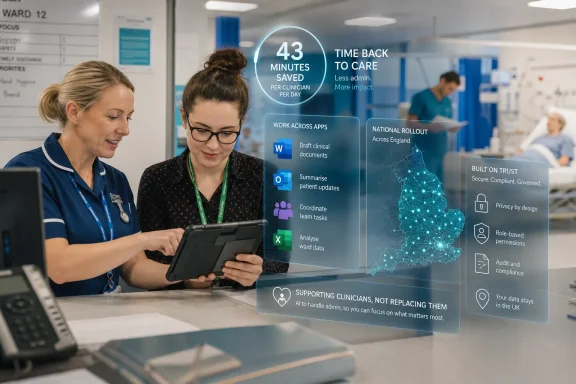
  5. Official source: ukstories.microsoft.com
  6. Related coverage: investing.com
  1. Related coverage: htn.co.uk
  2. Related coverage: resultsense.com
  3. Related coverage: england.nhs.uk
  4. Related coverage: techmarketview.com
  5. Related coverage: theagenttimes.com
  6. Related coverage: windowsforum.com
  7. Official source: microsoft.com
  8. Related coverage: assets.publishing.service.gov.uk
  9. Official source: fpc.microsoft.com
 

NHS England said on June 8, 2026, that it will give Microsoft 365 Copilot access to 505,000 clinicians and support staff across England by October 2026, after a 30,000-person trial across 90 NHS organisations reported average administrative savings of 43 minutes per worker per day. The announcement is not merely another “AI in healthcare” pilot dressed up for a press cycle; it is the moment generative AI moves from the innovation lab into the bureaucratic bloodstream of one of the world’s largest public health systems. Microsoft gets a marquee public-sector deployment, the NHS gets a productivity story at national scale, and staff get a tool that may either reduce the paperwork burden or add a new layer of managed optimism to already strained working lives.

NHS staff in an office view Microsoft 365 Copilot rollout across England with AI productivity stats.Microsoft Wins the NHS Productivity Argument Before the Rollout Begins​

The most important number in the NHS announcement is not 505,000. It is 43 minutes.
That figure gives the deal its political and commercial force. Forty-three minutes per day sounds modest enough to be believable, large enough to be meaningful, and clean enough to be repeated by ministers, executives, and vendors. In annualised form, it becomes five weeks per person. In organisational form, it becomes millions of hours. In Whitehall language, it becomes productivity.
That matters because the NHS is not buying a futuristic diagnostic engine here. It is buying relief from the everyday sludge of modern healthcare administration: letters, minutes, email chains, rota work, board papers, discharge documents, training material, service analysis, finance queries, HR workflows, and procurement paperwork. These are not glamorous use cases, but they are where much of the operational drag lives.
Microsoft has been trying to make precisely this argument for Microsoft 365 Copilot since the product first became a serious enterprise bet: the killer app for generative AI at work is not necessarily replacing a specialist job, but compressing the time spent navigating the documents, meetings, messages, and spreadsheets that already define office life. The NHS rollout gives that argument a public-sector test case of unusual scale.
The framing is also politically convenient. The NHS can talk about freeing staff to care for patients without promising that AI will make clinical decisions. Microsoft can talk about “AI safely in the flow of healthcare” without needing to claim that Copilot is reading scans or prescribing medicine. Everyone gets to stand on the safer side of the healthcare AI line: administration, not diagnosis.
That does not make the rollout low-stakes. In a health service where workflow, record-keeping, staffing, correspondence, and escalation all shape patient experience, administrative AI is still healthcare infrastructure. A badly drafted discharge summary, a missed nuance in a complaint response, or a misunderstood rota constraint can matter. The boring use cases are boring only until they fail.

The Trial Gave the NHS a Number It Could Govern By​

The rollout follows a trial involving more than 30,000 NHS workers across 90 organisations, described by NHS England and the government as the largest AI trial of its kind in global healthcare. The trial reported average savings of 43 minutes per staff member per day, with earlier government material estimating up to 400,000 hours saved per month at 100,000 users.
Those figures explain why the trial became policy so quickly. Public services rarely get clean technology wins. Digital transformation projects often arrive with long procurement cycles, integration pain, training gaps, and benefits that materialise slowly or not at all. A tool that appears inside software staff already use — Teams, Outlook, Word, Excel, PowerPoint — is easier to sell than a new platform that demands a new workflow from scratch.
The NHS is also under relentless pressure to show productivity gains that do not depend solely on more hiring, more buildings, or more money. Copilot fits the moment because it promises to recover time from the existing system. In theory, that is the most politically attractive form of efficiency: not cuts, not headcount reduction, but giving staff back the hours currently lost to administrative friction.
Still, the trial number needs careful handling. Time saved in a trial does not automatically become capacity released in a live national rollout. A clinician who saves 20 minutes drafting correspondence may spend that time on patient care, or may use it to catch up on another overdue task, or may lose some of the gain reviewing AI output for accuracy. The distinction between time theoretically saved and service capacity measurably increased will be the real evaluation challenge.
This is where the NHS announcement walks a fine line. It is reasonable to treat the pilot results as promising. It would be reckless to treat them as guaranteed system-wide productivity already banked. A 505,000-seat deployment does not multiply the trial result by headcount as if healthcare work were a spreadsheet formula.

Copilot Is Being Sold as a Paperwork Tool, Not a Doctor​

The announced use cases are deliberately administrative. Clinicians may use Copilot to draft letters and assist with registrar training. Ward clerks may use it for patient discharge processes, service data analysis, rota building, and bed management. Medical secretaries may use it for patient letters, meeting minutes, and document templates. Management teams may use it for board papers, briefings, and organisational analysis.
That list is revealing. The NHS is not presenting Copilot as an autonomous clinical assistant. It is presenting it as an accelerator for the document-heavy machinery surrounding clinical care. This is the part of healthcare that patients rarely see directly, but feel when letters are delayed, discharges stall, referrals crawl, or managers lack timely information.
For WindowsForum readers, the technical significance is equally plain: Microsoft 365 Copilot is becoming a default enterprise interface for AI, not a bolt-on chatbot. Its advantage is not that it is always the most capable model in isolation. Its advantage is that it sits where the work already happens, with access to Microsoft Graph context, tenant permissions, collaboration history, and Office document formats.
That is why this deal is such a strong validation of Microsoft’s strategy. The NHS is not rolling out a standalone experimental assistant to half a million workers. It is extending the Microsoft 365 estate it already depends on. The AI layer rides on the same productivity stack that already holds email, calendars, Teams meetings, SharePoint documents, and Excel analysis.
The risk follows the same path. If Copilot inherits the strengths of Microsoft 365 integration, it also inherits the consequences of messy permissions, sprawling document stores, inconsistent labelling, and uneven information governance. In a giant organisation, the quality of AI output is inseparable from the quality of the underlying data estate.

The Real Deployment Is Governance, Not Licences​

The headline says 505,000 staff will get access. The work is making sure 505,000 staff use it appropriately.
Microsoft says the agreement includes Copilot Studio, allowing NHS England and individual trusts to build AI agents for workflow automation. That widens the project beyond prompt-assisted drafting. Agents could streamline HR enquiries, meeting facilitation, complaints handling, freedom of information requests, help desk work, financial processing, or local trust-specific workflows.
This is where the rollout becomes more interesting and more dangerous. A licensed assistant can help an individual draft, summarise, or analyse. An agent can become part of a process. Once AI is embedded in a process, mistakes become less visible, harder to attribute, and potentially more scalable.
Microsoft’s pitch includes governance through Agent 365, with agents adhering to organisational policies and rules. That is necessary language, and in a system like the NHS it is not optional. But governance is not achieved by product branding. It requires data classification, access controls, auditability, retention policies, user training, prompt hygiene, incident response, and a clear understanding of where human review is mandatory.
The NHS already operates under stringent expectations around patient confidentiality, operational resilience, clinical safety, and public accountability. Copilot may be working on administrative material, but administrative material can still include sensitive health information, staff data, complaints, safeguarding concerns, workforce planning, financial details, and internal risk assessments. The compliance boundary is wide.
The hard question is not whether Microsoft offers enterprise controls. It does. The hard question is whether every trust receiving a central licence allocation can configure, monitor, and enforce those controls consistently while also training staff to understand the tool’s limits. A national rollout can procure centrally, but risk still lands locally.

The Licence Allocation Model Hints at Both Speed and Scarcity​

Each trust is expected to receive a central allocation of licences based on organisational headcount, typically starting around 2,000 Microsoft 365 Copilot licences. Full deployment to more than 500,000 staff is expected by October 2026, with Microsoft describing a 12-month onboarding plan and a rapid scale-up of 200,000 users within the first six months.
That structure suggests a rollout designed to move fast without giving every worker immediate access at once. Licence allocation becomes a management decision. Trusts will need to decide which roles get priority, which departments can prove immediate value, and which workflows are mature enough to benefit from AI assistance.
This is where the internal politics of productivity software become real. If Copilot licences are scarce at first, they will go where leaders believe the savings are highest or easiest to demonstrate. Clinicians drafting letters may outrank back-office staff. Management teams preparing board papers may be early adopters because their work is visible to executives. Medical secretaries and ward clerks may prove the strongest case if the tool genuinely reduces repeatable paperwork.
The danger is that benefits skew toward roles already closest to Microsoft 365 workflows, while staff in more fragmented or operationally constrained environments see less impact. Copilot is strongest where information is already digitised, permissioned, and available inside the Microsoft ecosystem. The NHS contains plenty of that, but it also contains legacy systems, local variation, and workflows that are only partly captured in Office documents.
That means the rollout will test not just AI adoption, but the uneven digital maturity of NHS organisations. A trust with clean document repositories, mature Teams practices, and well-governed SharePoint sites will have a different Copilot experience from one with chaotic file structures and inconsistent data discipline.

The NHS Is Trying to Buy Time, Not Magic​

The productivity promise is attractive because the NHS has an administrative problem that everyone recognises. Clinicians complain about documentation. Patients complain about delays. Managers complain about reporting burden. Secretaries, clerks, and back-office teams often absorb the invisible load that keeps care pathways moving.
Generative AI is well suited to some of that work. It can summarise long email chains. It can turn rough notes into a structured draft. It can create first-pass minutes from meetings. It can reformat text for different audiences. It can help users interrogate spreadsheets and documents without building everything manually from scratch.
But these are assistance tasks, not accountability transfers. The person sending the letter remains responsible for the letter. The team using a meeting summary remains responsible for what was agreed. The manager relying on an analysis remains responsible for checking whether the analysis is sound. Copilot can accelerate the first draft; it cannot absorb institutional responsibility.
That distinction will matter as adoption spreads. Staff who are already overloaded may be tempted to trust outputs too quickly. Managers under pressure to report productivity gains may encourage heavier use before local guardrails are mature. Conversely, sceptical staff may avoid the tool entirely if early outputs are inaccurate, awkward, or require too much correction.
The most successful use cases will be those where Copilot is treated as a junior drafter, summariser, or assistant — fast, useful, and fallible. The least successful will be those where AI is treated as an oracle or as a way to avoid fixing broken upstream processes. If a discharge workflow is badly designed, Copilot may make parts of it faster, but it will not make the underlying process coherent.

Microsoft Gets a Public-Sector Showcase at Exactly the Right Time​

For Microsoft, the NHS rollout arrives at a useful moment. The company has spent years embedding Copilot branding across Windows, Microsoft 365, GitHub, Security, Dynamics, and the broader enterprise stack. The challenge has been turning AI enthusiasm into paid, durable, high-volume deployment.
A half-million-seat healthcare rollout gives Microsoft a reference case with institutional weight. The NHS is not a boutique tech company or a consultancy with a workforce trained to live in slide decks. It is a complex public service, full of regulated data, unionised labour, operational pressure, political scrutiny, and legacy IT. If Copilot can show measurable value there, Microsoft can use that proof in conversations with governments, health systems, universities, banks, and large enterprises around the world.
The deal also reinforces Microsoft’s biggest AI advantage over many rivals: distribution. OpenAI, Anthropic, Google, and others can compete on model quality and developer ecosystems, but Microsoft can sell AI as an extension of software already deployed at enormous scale. For IT departments, that often matters more than benchmark wins.
There is a Windows angle here, even if the announcement is formally about Microsoft 365. Microsoft’s AI strategy is not confined to the operating system. The company is building an environment in which Windows PCs, cloud identity, Office documents, Teams meetings, SharePoint content, Entra controls, Purview governance, and Copilot agents become parts of the same enterprise AI fabric. The NHS deal is a Microsoft 365 story, but it is also a story about how deeply Microsoft wants AI to sit inside everyday institutional computing.
That ambition will appeal to administrators who prefer integrated governance and procurement. It will worry those who see concentration risk, vendor lock-in, and public-sector dependence on a single commercial platform. Both readings are fair.

Public Healthcare Is a Hard Place to Learn AI at Scale​

Healthcare is not a normal enterprise environment. A missed email in a consultancy is inconvenient. A missed update in a care pathway can be serious. A poor summary in a board pack can distort operational oversight. A badly handled complaint response can damage public trust.
That does not mean the NHS should avoid AI. It means the NHS has to learn in public, under pressure, with little room for failure. The administrative burden is real, and refusing useful automation would also have consequences. Burned-out staff, delayed correspondence, inefficient meetings, and slow discharge processes are not neutral conditions.
The challenge is that generative AI produces fluent output before it produces reliable institutional confidence. Staff may see an answer that looks polished and assume it is correct. They may not know what source material was emphasised, omitted, or misunderstood. They may not have time to interrogate the output when the whole point of the tool is to save time.
Training therefore cannot be a perfunctory webinar. It needs to teach staff when Copilot is useful, when it is risky, how to verify outputs, what data should not be entered, how permissions affect responses, and how to escalate incidents. The 12-month onboarding plan matters because adoption is not just a software deployment. It is a change to how half a million people interact with institutional knowledge.
The NHS also needs measurement beyond self-reported time savings. It will need to know whether letters are completed faster, whether discharge bottlenecks improve, whether meeting documentation becomes more accurate, whether complaints handling is accelerated without becoming impersonal, and whether staff experience improves. A productivity tool that saves time while creating downstream errors is not a productivity tool.

The Admin Burden Is the Soft Underbelly of Digital Transformation​

There is a reason the initial use cases focus on letters, minutes, templates, and summaries. These are the places where AI can produce visible relief without requiring deep integration into clinical systems. They are also the places where knowledge work has quietly become intolerable.
The modern workplace has buried professionals under communication. Every meeting creates notes. Every decision creates follow-up. Every care pathway creates documents. Every operational problem creates reporting. The NHS is especially exposed because it combines clinical complexity, public accountability, central targets, local variation, and high patient volume.
Microsoft 365 Copilot attacks that layer. It does not need to understand medicine like a consultant to make a meeting transcript useful. It does not need to diagnose a patient to help structure a draft letter. It does not need to manage a ward to help analyse a service spreadsheet. That is precisely why the rollout is plausible.
But the same practicality creates a strategic tension. If Copilot makes administrative work easier, organisations may ask for more administration. Faster board papers can become more board papers. Easier summaries can become more requests for summaries. More efficient reporting can become more reporting. Productivity tools sometimes reduce burden; sometimes they increase the expected volume of work.
The NHS will have to guard against that failure mode. The point should be to return time to care, rest, training, supervision, and operational problem-solving — not simply to increase the throughput of bureaucracy. If AI becomes a way to make staff produce more paperwork faster, the programme will miss its own moral argument.

The Data Estate Will Decide Whether Copilot Feels Brilliant or Brittle​

Copilot’s usefulness depends heavily on the information it can access and the permission model controlling that access. In a clean environment, it can locate relevant documents, summarise the right material, and generate drafts grounded in organisational context. In a messy environment, it can surface stale documents, miss crucial context, or expose uncomfortable truths about overbroad access permissions.
This is not a hypothetical problem. Large Microsoft 365 tenants often accumulate years of SharePoint sites, Teams channels, OneDrive folders, legacy groups, duplicated documents, inconsistent naming, and poorly maintained access controls. Copilot does not create those governance problems, but it can make them more visible and more consequential.
Before generative AI, a user with excessive access might never know what they could see because finding it required effort. With AI, discovery becomes conversational. That changes the risk profile. Information governance that was “good enough” for manual search may not be good enough for AI-assisted retrieval.
For NHS trusts, this should make pre-rollout hygiene a priority. Sensitive documents need appropriate classification. Old permissions need review. Retention policies need enforcement. Staff need clarity on which data categories can be used with Copilot and which require special handling. Local agents built through Copilot Studio need lifecycle management, ownership, testing, and audit trails.
The unglamorous work of identity, access, compliance, and records management will decide whether the rollout is a success. The AI demo may win the boardroom, but the permissions audit will protect the organisation.

Staff Trust Will Be Won in Drafts, Not Speeches​

The announcement quotes senior leaders promising that AI will free staff from admin so they can focus on patients. That is the right aspiration, but staff trust will not be won by aspiration. It will be won when the tool makes Tuesday afternoon less miserable.
A ward clerk will judge Copilot by whether it helps with discharge coordination without creating extra checking. A medical secretary will judge it by whether draft letters are usable rather than merely grammatical. A clinician will judge it by whether summarising a long email chain actually captures the clinical and operational nuance. A manager will judge it by whether board paper drafting becomes faster without becoming blander.
The NHS workforce has seen many technology programmes arrive with big promises and uneven delivery. Some have helped. Some have made work harder. The bar for trust is therefore practical and local. Does the tool work in my workflow, with my documents, under my time pressure, with acceptable risk?
There is also a labour dimension that should not be ignored. When technology is presented as freeing time, staff may hear a promise of relief. They may also hear a warning that management expects more output with the same or fewer people. NHS England and trusts will need to be clear that the goal is reducing burden and improving care, not quietly converting time savings into intensified work.
That clarity matters because AI adoption is cultural as much as technical. Staff who believe the tool is being imposed to monitor, deskill, or squeeze them will resist it, misuse it, or perform compliance without real adoption. Staff who see genuine relief in their own work are more likely to become the internal champions every rollout needs.

The Patient Benefit Is Plausible, but Not Automatic​

The announcement’s patient-care argument is straightforward: reduce administrative time, free staff capacity, improve productivity, and help patients get treatment sooner. It is plausible. It is not proven by the rollout itself.
Patients may benefit if discharge paperwork moves faster, if referral letters are drafted sooner, if clinicians spend less time in inboxes, if managers can identify operational bottlenecks more quickly, and if support functions respond more efficiently. These are meaningful improvements. They are also indirect.
The NHS should resist the temptation to overclaim. Copilot will not fix waiting lists by itself. It will not solve workforce shortages. It will not repair underfunded estates, fragmented care pathways, or every legacy IT dependency. It may, however, remove enough administrative drag to matter at the margins — and in a system as large as the NHS, marginal gains can become substantial.
The key is whether saved time is captured and redirected. If a clinic letter takes less time to draft, does the clinician see more patients, leave on time, supervise trainees, or complete other overdue work? If meeting minutes are automated, does the team spend more time acting on decisions? If HR and finance queries are handled faster, do frontline teams feel the difference?
Those are operational questions, not AI questions. Microsoft can supply the tool. NHS England can procure the licences. The trusts must convert capability into better workflows. That is where the patient benefit will either appear or vanish.

The NHS Is Becoming a Test Case for Public-Sector AI Normalisation​

The significance of this rollout extends beyond England. Governments everywhere are trying to decide how generative AI fits into public services. The early phase was dominated by experimentation, guidelines, bans, pilots, and procurement anxiety. The NHS announcement marks a move into normalisation: AI as a standard productivity layer for public employees.
That shift will shape expectations. If half a million NHS staff can use Copilot, other public bodies will be asked why they are not doing something similar. Councils, departments, regulators, universities, and public agencies will face pressure to show their own AI productivity plans. Microsoft will be ready with the case study.
Public-sector normalisation also raises democratic questions. Citizens may be comfortable with AI helping draft internal documents. They may be less comfortable if AI-generated language appears in patient letters, complaint responses, or policy briefings without transparency. The boundary between assistance and authorship will become harder to police as tools become embedded in everyday software.
The NHS does not need to label every sentence touched by AI. But it does need standards for accountability. Patients and staff should know that human professionals remain responsible for communications and decisions. Internal policies should define where AI assistance is acceptable, where disclosure is needed, and where use is prohibited.
This is the quiet governance frontier. The public may not object to AI helping staff work faster. It will object if AI becomes a convenient way to obscure responsibility.

The Copilot Rollout Will Succeed or Fail in the Boring Middle​

The eye-catching numbers are now fixed: 505,000 staff, 30,000 trial users, 90 organisations, 43 minutes per day, full rollout expected by October 2026. But the fate of the programme lies in the boring middle between announcement and outcome.
That middle includes licence assignment, tenant configuration, data governance, staff training, local workflow redesign, agent approval, risk assessment, audit logging, union engagement, clinical safety review, procurement oversight, and benefit measurement. None of this will trend on social media. All of it matters more than the launch quote.
The NHS is right to target administration first. It is the area where generative AI is most likely to deliver fast, visible gains without crossing into unsafe clinical autonomy. Microsoft is right to emphasise integration, adoption, and governance. The question is whether the deployment machinery can keep pace with the ambition.
For IT pros, the lesson is familiar: the product is the easy part. The operating model is the hard part. Copilot can be switched on; value has to be engineered.

The Numbers NHS Trusts Cannot Afford to Treat as Marketing​

The rollout gives NHS leaders, Microsoft administrators, and frontline managers a concrete set of claims to test. The next year should be judged less by how many licences are assigned than by whether the time savings survive contact with real departments.
  • NHS England is moving Microsoft 365 Copilot from a large pilot to a national deployment for 505,000 clinical and support staff by October 2026.
  • The business case rests heavily on a trial-reported average saving of 43 minutes per staff member per day across administrative tasks.
  • The strongest early use cases are drafting, summarising, meeting support, rota assistance, discharge administration, service analysis, and management paperwork.
  • Copilot Studio and AI agents could extend the programme from personal productivity into workflow automation, which raises the importance of governance and auditability.
  • The rollout’s practical success will depend on data hygiene, permissions, staff training, local adoption, and whether saved time is genuinely redirected toward patient care.
  • The biggest risk is not that Copilot fails spectacularly, but that it produces enough plausible output to be overtrusted, overextended, or used to accelerate bureaucracy rather than reduce it.
The NHS has chosen the most defensible path into generative AI: start with the paperwork, keep humans accountable, and use the Microsoft tools staff already know. That makes the rollout sensible, but not self-validating. By October 2026, the question should not be whether half a million workers have access to Copilot; it should be whether the NHS can prove that AI has made the daily work of care less encumbered, not merely more automated.

References​

  1. Primary source: Technology Record
    Published: Mon, 08 Jun 2026 17:26:15 GMT
  2. Official source: news.microsoft.com
  3. Related coverage: resultsense.com
  4. Related coverage: htn.co.uk
  5. Official source: ukstories.microsoft.com
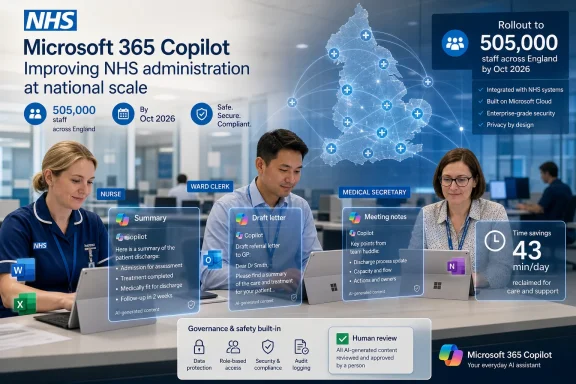
  6. Related coverage: theagenttimes.com
  1. Related coverage: windowsforum.com
  2. Related coverage: england.nhs.uk
  3. Related coverage: investing.com
  4. Related coverage: pharmacy.biz
  5. Related coverage: itpro.com
  6. Official source: microsoft.com

 

Back
Top