

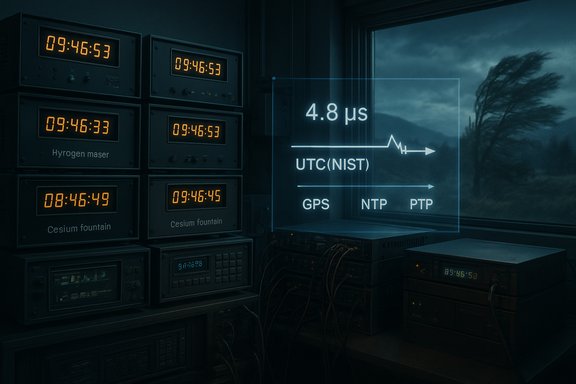
Last week’s windstorm and a cascading backup-power failure at the National Institute of Standards and Technology (NIST) in Boulder briefly nudged the United States’ official time off by about 4.8 microseconds, a tiny interval measured in millionths of a second but one that exposes real operational and systemic risks in modern timekeeping and the critical infrastructure that depends on it.
Time at the national and international level is not a single clock on a wall but an engineered ensemble: NIST synthesizes a national time scale called UTC(NIST) from an ensemble of atomic clocks (hydrogen masers, cesium beam clocks and cesium fountain standards) and then distributes that signal via radio and internet services. A weighted‑average algorithm gives more influence to the most stable clocks, and multiple redundant systems — primary, alternate, contingency and emergency — are designed to keep the signals running even when parts of the lab go offline. That architecture generally works. But on December 17 a severe windstorm knocked out utility power at NIST’s Boulder campus and, crucially, a downstream standby generator in the signal distribution chain failed during the switchover. The result: some of NIST’s distribution systems lost a reliable reference for a short interval and UTC(NIST) ended up 4.8 microseconds slower than it should have been until operators restored redundancy and corrected the time. NIST notified high‑precision users and worked to restore services.
But in a modern, highly interconnected technical landscape, microseconds can matter:
Two policy points emerge:
For IT leaders and infrastructure operators the practical lesson is straightforward and actionable: treat time as an engineered service, not a passive utility. Use multiple, authenticated sources; invest in local holdover and monitoring; test and harden generators and power paths; and presume that rare events — storms, access limitations, human errors — will occur. Those measures will keep systems resilient when the weather, or the grid, tests them.
The NIST teams have restored service and are correcting the documented drift; their public guidance emphasizes that users requiring microsecond accuracy should consult NIST advisories and use geographically diverse, secure time sources while the lab completes post‑event validation.
Source: Newswav US official time slowed down by a few microseconds last week due to power outage, watchdog says
 Background
Time at the national and international level is not a single clock on a wall but an engineered ensemble: NIST synthesizes a national time scale called UTC(NIST) from an ensemble of atomic clocks (hydrogen masers, cesium beam clocks and cesium fountain standards) and then distributes that signal via radio and internet services. A weighted‑average algorithm gives more influence to the most stable clocks, and multiple redundant systems — primary, alternate, contingency and emergency — are designed to keep the signals running even when parts of the lab go offline. That architecture generally works. But on December 17 a severe windstorm knocked out utility power at NIST’s Boulder campus and, crucially, a downstream standby generator in the signal distribution chain failed during the switchover. The result: some of NIST’s distribution systems lost a reliable reference for a short interval and UTC(NIST) ended up 4.8 microseconds slower than it should have been until operators restored redundancy and corrected the time. NIST notified high‑precision users and worked to restore services. What happened — concise timeline and mechanics
The weather and the outage
- A powerful windstorm damaged local infrastructure and led to a utility power loss at the Boulder facility.
- NIST’s normal protections include UPS and standby generators for critical systems; during the event a backup generator in the downstream distribution path failed to carry the needed load at the exact point where the timing signals are routed outward.
Immediate technical effect
- The atomic clocks themselves continued running on internal battery backups, but the network of measurement and distribution systems that reads, processes and broadcasts the ensemble output was disrupted.
- Because UTC(NIST) is computed from a weighted average of ensemble clock readings, the interruption in the measurement and distribution chain produced a measurable offset: UTC(NIST) ran about 4.8 microseconds slow during the fault window. NIST staff later corrected the drift and informed users.
Which services were at risk
- NIST operates both radio broadcasts (WWVB, WWV/WWVH) and an Internet Time Service with named hosts (for example the Boulder hosts time‑a‑b.nist.gov through time‑e‑b.nist.gov and an authenticated server ntp‑b.nist.gov). Some of those Boulder‑hosted servers were called out as potentially unreliable during the outage; geographically distributed endpoints (for example the round‑robin time.nist.gov name) were designed to fail over automatically and were less affected.
Why a few microseconds matter (and when they do not)
For most people and ordinary IT systems, a 4.8 microsecond error is invisible. Human perception and standard client systems operate at millisecond or greater resolutions, and everyday timestamps and logs will not be affected.But in a modern, highly interconnected technical landscape, microseconds can matter:
- Telecommunications, cellular handoffs and some network measurements rely on sub‑microsecond or microsecond accuracy for proper phase alignment and scheduling.
- Power‑grid synchrophasors (PMUs) and certain protection schemes require tightly synchronized timestamps; incorrect timing can complicate event reconstruction or automated responses.
- High‑frequency trading and timestamp compliance regimes demand traceable, auditable time at microsecond (or better) resolution.
- GNSS receivers and devices that use PTP (Precision Time Protocol) for sub‑microsecond synchronization expect robust, authenticated references and can be sensitive to transient drifts if holdover behavior is not engineered correctly.
Verification and what the public record shows
Multiple independent outlets reported NIST’s statement that UTC(NIST) drifted about 4.8 microseconds after the Boulder power interruption; the initial, widely‑distributed coverage was based on NIST spokesperson comments and posts from NIST time‑operations staff. Tom’s Hardware and public radio/NPR affiliates reproduced the technical description that the downstream generator failure — not the atomic clocks themselves — was the proximate cause of the distribution problem. NIST’s own documentation explains the ensemble model and redundancy philosophy that underpins how UTC(NIST) is realized and distributed. Two important verification notes:- NIST’s public technical pages describe the ensemble and the redundancy hierarchy (primary/alternate/contingency/emergency) in detail and therefore corroborate the mechanism described by reporters.
- Several outlets repeated a specific numeric claim — that NIST calculates UTC(NIST) from a weighted average of 16 atomic clocks. That precise count appears in some news stories, but NIST’s publicly available material describes “a dozen or so” hydrogen masers plus several cesium beam clocks and two fountain primary standards; lab staffing, which clocks are in active weighting and exact ensemble membership can vary over time, so the single figure of “16” should be treated as a useful shorthand reported by the press rather than a fixed technical constant. Where a specific number matters, it should be verified directly with NIST operations or an up‑to‑date internal inventory.
Critical analysis — strengths, fragilities, and risk vectors
Strengths (what worked)
- Atomic‑level timekeeping remained intact. The clocks themselves kept running on battery backup; the core metrology assets did not stop. That’s a testament to proper clock-level protections and the physical resilience of the instrumentation.
- Redundancy and notification. NIST’s design philosophy (Primary/Alternate/Contingency/Emergency) and its operational practices — monitoring, on‑call staff and multiple distribution channels — limited the scope and allowed targeted notification of high‑precision users.
- Public transparency. NIST and operations staff communicated the problem and the measured offset, which is important when critical sectors rely on a nationally‑trusted time source.
Fragilities and exposed risks
- Single points in distribution paths. The proximate generator failure was downstream in a signal distribution chain; redundancy there was either insufficient or had a common‑mode vulnerability. A generator downstream of the distribution chain can be an Achilles’ heel if it sits on a critical routing path without equally isolated failovers.
- Operational complexity and human dependency. Highly automated control planes still require human monitoring and physical intervention (e.g., to switch contingency hardware), and severe weather can delay safe access. The incident underscores how physical infrastructure (power and site access) remains a core dependency for even the most precise cyber‑physical systems.
- User practices amplify exposure. Many networked devices and services hard‑code single time‑server hostnames or rely on a limited set of geographically co‑located time sources; systems that don’t implement multi‑source configurations, resilient fallover or authenticated NTP/PTP can be exposed to localized errors and cascading failures. NIST warned that particular Boulder‑hosted servers might not be reliable and advised using geographically distributed endpoints.
Practical recommendations — what organizations and system administrators should do now
For most readers this was an academic curiosity. For IT operations, industrial control, financial services and telecoms, the incident is a reminder to enforce sound timing disciplines. Key measures:- Ensure time clients use multiple, geographically distributed time sources.
- Configure NTP/PTP clients to use at least three independent servers (mix of GPS/GNSS receivers, NIST/USNO servers, vendor or pool services) and avoid hard‑coding a single host. Use DNS round‑robin names like time.nist.gov rather than single hostnames where appropriate.
- For sub‑microsecond needs, use PTP (IEEE 1588) with hardware timestamping and authenticated profiles; implement fallback to NTP with clear holdover behavior.
- PTP is the appropriate tool for sub‑microsecond synchronization in LANs and industrial networks; RFC/IEEE guidance and NIST/industry guidance recommend authenticated PTP in hostile or high‑risk environments and failover policies to prevent silent degradation.
- Deploy local, GPS‑disciplined oscillators or holdover oscillators for critical installations.
- A disciplined rubidium or oven‑controlled crystal oscillator (OCXO) combined with GNSS input provides robust holdover for minutes to hours if external references fail. For the most demanding sites, consider on‑site cesium or rubidium standards.
- Harden physical and power resilience for timing infrastructure.
- Critical timing distribution hardware should be on redundant UPS and independent generators with separate distribution paths; generators must be exercised and tested under load regularly. In other words, “generator of generator” redundancy is unglamorous but necessary where timing is critical.
- Monitor time offsets and alert aggressively.
- Instrumentation and logging should monitor stratum, round‑trip delay and offset and generate high‑priority alerts when offsets exceed policy thresholds. Correlate time anomalies with environmental and power alarms.
- Use authenticated time protocols where security matters.
- For systems where spoofed or manipulated time is a risk, use authenticated NTP (NTS), authenticated PTP profiles or isolated timing enclaves behind hardened perimeters. NIST guidance for operational technology explicitly recommends authenticated NTP or secure PTP where malicious modification is a concern.
- Plan for business and regulatory compliance.
- Financial and regulated sectors should review timestamping compliance with regulators and ensure documented fallbacks and controls for timing integrity and traceability.
Wider implications — national resilience, trust and investment
This incident is small in absolute magnitude but revealing in systems terms. National timekeeping is a public good that undergirds telecommunication, navigation, power systems and financial markets. The operational model depends on tightly engineered laboratories and physical infrastructure that must be maintained and modernized.Two policy points emerge:
- Invest in distributed redundancy. Running multiple, geographically dispersed, fully independent realizations of national time with independent power, distribution chains and monitoring reduces the chance that a single weather event will create a measurable national offset.
- Encourage resilient user practices. Regulators and industry groups should continue to push best practices: multi‑source time configuration, authenticated protocols for threat environments, and clear operational standards for critical sectors.
Caveats and unverifiable details
- Some press reports repeated an exact figure — 16 atomic clocks — as the basis for UTC(NIST). NIST documentation strongly describes an ensemble composed of about a dozen hydrogen masers plus several cesium beam clocks and two fountain standards; ensemble membership and which clocks carry weight can change over time. The exact operational number in the weighted average at any given moment is not a fixed constant in public documents and should be treated as variable unless confirmed directly by NIST operations. Where precision matters, contact NIST for the current ensemble composition.
- The measured 4.8 microseconds figure is the operational offset NIST reported; independent verification by other national timing labs or by cross‑checks (e.g., compared to UTC as computed by BIPM or USNO) is the standard practice and will be reflected in formal bulletins and Circular T adjustments over the coming weeks. NIST’s public messages and the community’s telemetry converge on the same general account: a brief, small‑magnitude drift that has since been corrected.
Bottom line
This week’s incident at NIST underscores a critical truth of modern infrastructure: even the most precise laboratory instruments require dependable physical and operational ecosystems to perform reliably for the wider world. The atomic clocks themselves did what they are designed to do — tick with extraordinary fidelity — but a downstream distribution and power failure produced a measurable national time offset of roughly 4.8 microseconds that could have mattered to a narrow set of high‑precision users.For IT leaders and infrastructure operators the practical lesson is straightforward and actionable: treat time as an engineered service, not a passive utility. Use multiple, authenticated sources; invest in local holdover and monitoring; test and harden generators and power paths; and presume that rare events — storms, access limitations, human errors — will occur. Those measures will keep systems resilient when the weather, or the grid, tests them.
The NIST teams have restored service and are correcting the documented drift; their public guidance emphasizes that users requiring microsecond accuracy should consult NIST advisories and use geographically diverse, secure time sources while the lab completes post‑event validation.
Source: Newswav US official time slowed down by a few microseconds last week due to power outage, watchdog says
