

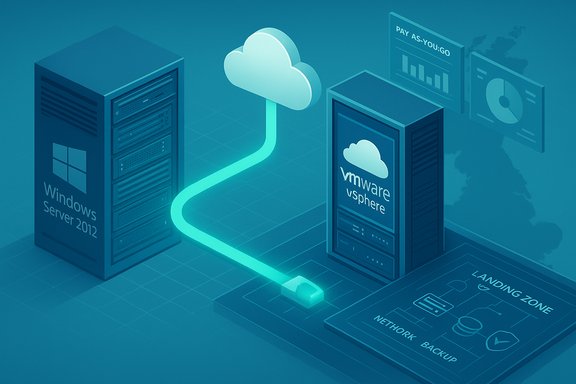
Node4’s delivery of a Virtual Data Centre (VDC) to Stratas is a compact case study in how small, specialist technology firms can migrate away from aging on-premises infrastructure to a managed, consumption-based cloud model without surrendering control or compliance. The move replaced a precarious setup of legacy Windows Server 2012 hosts with a bespoke Node4 landing zone, secure high‑speed VPN access, and a VMware‑compatible Virtual Data Centre that preserves the operational patterns and specialised workflows Stratas depends on — while adding modern backup, resiliency and integrated security. The result is predictable costs, rapid scalability and the managed support a lean business demands, but the approach also raises familiar channel and architectural trade‑offs: vendor dependency, network reliance, exit planning and the long tail of migration governance that every IT leader must manage.
Stratas is a UK specialist in document automation, finance automation and intelligent document processing (IDP). Its business model depends on highly reliable handling of document flows and tight uptime for invoicing and accounting services — workloads that are both latency‑sensitive and compliance‑sensitive. After their remote storage provider signalled an end to their service, Stratas found themselves running on older physical hardware and Windows Server 2012, a combination that posed reliability and security concerns. Rather than attempt another hardware refresh or a DIY public cloud migration, Stratas selected Node4’s managed Virtual Data Centre to provide a hosted, VMware‑friendly infrastructure-as-a-service platform with local operation and support. Node4’s Virtual Data Centre offering — and its newer “VDC Slide” migration tooling — is explicitly engineered to receive VMware workloads with minimal refactor, provide a self‑service portal, and offer no‑contract, pay‑as‑you‑go consumption options for compute, network and storage. Node4 also emphasises migration accelerators such as prebuilt landing zones, live replication appliances and managed project delivery to reduce downtime during cutover. This blend of compatibility with VMware operational models and managed migration support is core to why Stratas chose the VDC rather than a hyperscaler IaaS or a full replatform.
Industry reporting shows Node4 actively investing in VDC tooling and partner enablement to capture customers migrating from older estates or from third‑party white‑label VMware arrangements. Node4’s recent marketing and product communications emphasise migration ease (VDC Slide), compatibility and managed support as their primary differentiators in a crowded market. For many customers, that is the “best of both worlds” — cloud‑like elasticity with an operational model and managed support they trust.
Source: Comms Business Node4 delivers virtual data centre for Stratas - Comms Business
 Background / Overview
Stratas is a UK specialist in document automation, finance automation and intelligent document processing (IDP). Its business model depends on highly reliable handling of document flows and tight uptime for invoicing and accounting services — workloads that are both latency‑sensitive and compliance‑sensitive. After their remote storage provider signalled an end to their service, Stratas found themselves running on older physical hardware and Windows Server 2012, a combination that posed reliability and security concerns. Rather than attempt another hardware refresh or a DIY public cloud migration, Stratas selected Node4’s managed Virtual Data Centre to provide a hosted, VMware‑friendly infrastructure-as-a-service platform with local operation and support. Node4’s Virtual Data Centre offering — and its newer “VDC Slide” migration tooling — is explicitly engineered to receive VMware workloads with minimal refactor, provide a self‑service portal, and offer no‑contract, pay‑as‑you‑go consumption options for compute, network and storage. Node4 also emphasises migration accelerators such as prebuilt landing zones, live replication appliances and managed project delivery to reduce downtime during cutover. This blend of compatibility with VMware operational models and managed migration support is core to why Stratas chose the VDC rather than a hyperscaler IaaS or a full replatform. What Node4 delivered for Stratas
Bespoke landing zone and migration factory
Node4 set up a tailored landing zone — a preconfigured tenancy and network architecture — designed to accept the Stratas estate and to provide tooling for controlled migration. Landing zones encapsulate the environment’s identity, networking, security baseline, backup and monitoring policies, and are critical when moving many smaller production tenants into a managed platform. For Stratas, the landing zone allowed staged, testable migrations (one customer at a time) to minimise business disruption.Secure connectivity: high‑speed VPN and identity hygiene
Connectivity was established via a secure, high‑speed VPN to link Stratas’ remote operations to the Node4 VDC. Node4 also helped plan for multi‑factor authentication on VPN access — an important control for a fully remote workforce — and layered firewall and DDoS protections at the VDC edge. These are practical, immediate gains over unmanaged, aging servers that may lack consistent perimeter controls.Managed VMware‑compatible hosting and consumption pricing
Stratas retained its niche applications and VM‑centric workflows while gaining the operational benefits of a hosted platform: built‑in backup and disaster recovery, transparent consumption billing, and Node4’s managed support. The VDC’s pay‑for‑what‑you‑use model let Stratas scale capacity during server consolidation without incurring charges for idle infrastructure. That combination — operational familiarity, managed service and metered cost — is the explicit value proposition Node4 promotes for organisations leaving ageing on‑prem estates.Immediate business impact
For day‑to‑day operations Stratas reported improved login reliability, reduced forced reboots and general stability improvements. More broadly, Stratas gained a pathway to modernisation — a platform that can host future AI or automation workloads — without the immediate overhead or complexity of converting legacy workflow apps into cloud‑native services. The move also preserved UK data residency, a plus for GDPR and customer trust.Why this was the right choice for Stratas — and for similar SMBs
- Preservation of operational patterns: Many boutique and vertical ISVs run niche applications that have highly specific configuration and workflow requirements. A managed VDC that supports VMware VMs lets them keep those operational patterns while removing the need to manage physical hardware refresh cycles.
- Managed service for a lean team: Stratas is a lean organisation with no physical premises; outsourcing infrastructure operations reduces overhead and lets specialists at Node4 handle routine hardware and hypervisor maintenance.
- Consumption economics and transparent pricing: Pay‑as‑you‑go billing aligns costs with actual usage, reducing capital outlay and the risk of over‑provisioning during consolidation or growth. Transparent billing avoids “hidden” fixed data charges that can make other providers unexpectedly expensive.
- Local data residency and compliance: Hosting on UK infrastructure with a local operator simplified GDPR conversations and reassured clients that data would not cross into uncontrolled jurisdictions. For many regulated workloads, that is decisive.
The technical context: why Windows Server 2012 was a trigger
Windows Server 2012 reached the end of its extended support window in October 2023; while Extended Security Updates (ESUs) have been available for a fixed term and via Azure, running production services on an aging OS increases attack surface and operational risk. Organisations that continue to operate unsupported OS versions face amplified exposure to unpatched vulnerabilities and vendor discontinuity. Stratas’ stated lack of confidence in their provider’s maintenance of older hardware and an outdated OS is therefore a common and rational trigger for migration. Microsoft explicitly urged customers to modernise or migrate to Azure (or obtain ESUs) to remain protected.Critical analysis: strengths, trade‑offs and risks
Strengths (what Node4 + VDC did well)
- Managed migration and operational handoff significantly reduce execution risk for small teams; Node4’s landing zone and replication tooling let Stratas test migrations before cutover. This pattern lowers the odds of catastrophic downtime and supports incremental rollback.
- The VMware‑compatible hosting model minimises application refactor effort and preserves existing operational skill sets (vSphere, VM templates, snapshot patterns), a practical win when timelines or budgets don’t support replatforming.
- Consumption pricing and transparent billing mitigate the capital expense and lock‑in pressure of procuring new hardware or long‑term reserved cloud commitments during uncertain market conditions. Stratas’ observation that unused but reserved capacity isn’t charged is an effective FinOps control for a small business.
Risks and trade‑offs (what organisations must watch)
- Vendor concentration and exit planning: moving production VMs and operational dependencies to Node4’s managed platform raises the question of exit pathways. Organisations should document VM images, data egress mechanics, exportable backups, and migration playbooks to avoid being trapped if commercial terms change. This is the classic managed‑service trade‑off: convenience versus operational portability.
- Network dependency and performance SLAs: a hosted VDC model depends on resilient, well‑engineered connectivity. Meetings, invoicing and month‑end financial operations are latency‑sensitive — any network interruption directly affects revenue. Contracts should include realistic SLA terms, failover circuits (dual ISPs or ExpressRoute/Direct circuits where available), and measurable MTTR commitments.
- Cost posture over time: consumption models can be efficient for variable workloads but may become more expensive than reserved capacity for stable, high‑utilisation workloads. FinOps practices (tagging, rightsizing, scheduled power-down windows) are essential to sustain cost advantages.
- Security posture and shared responsibility: while the provider secures the underlying infrastructure, the customer remains responsible for guest OS hardening, patching, identity management and application‑level controls. Relying on managed services is not a substitute for a validated security lifecycle inside VMs and applications.
- Compliance nuance: local data residency is valuable, but contractual guarantees and audit evidence (SOC2, ISO27001 attestation, data location clauses) must be verified. Marketing claims of “UK‑based hosting” are necessary but not sufficient for regulated workloads without supporting audit artefacts.
Practical recommendations for organisations considering the same path
- Validate landing zone controls: ensure network segmentation, logging, encryption‑at‑rest, backup retention policies and role‑based access are implemented as code and can be audited.
- Confirm migration strategy and RTO/RPOs: pilot migrations, test restores and schedule rolling cutovers. Stratas’ pace — migrating five customers per week — is a conservative pattern that reduces blast radius.
- Insist on billing transparency: request sample invoices and a line-by-line mapping of consumption metrics to costs (compute hours, storage GiB/month, snapshot / egress charges).
- Require explicit exit/destruction mechanics: documented VM export options, standard backup exports and a timeline to deliver customer data in a rehostable format in case of termination.
- Harden guest OS and identity: ensure multi‑factor authentication, least‑privilege VPN and centralised patching are contractual responsibilities for the tenant, not assumed as provided by the host.
- Build network resiliency: implement redundant circuits, BGP failover, or private connectivity where appropriate (ExpressRoute/Direct alternatives) and validate latency/throughput under realistic loads.
- Enforce SLAs with penalties: align uptime, MTTR, and data durability SLAs to business impact and include audit rights for compliance checks.
- Adopt FinOps discipline: tag resources by customer and workload, schedule non‑business VMs to hibernate, and set budget alerts to avoid unexpected bills.
- Document software licensing: if VMs run licensed software (SQL Server, Windows), confirm how license mobility, Azure Hybrid Benefit or server migration affects rights and costs.
- Retain a migration testbed: keep a small, parallel environment for patch testing and upgrades to avoid last‑minute surprises during live operations.
Migration checklist (step‑by‑step)
- Discovery and inventory: map all VMs, dependencies, storage footprints and licensing entitlements.
- Define migration groups: cluster by business impact, interdependency and data gravity.
- Build landing zone: implement baseline security, monitoring, backup and network topology as code.
- Pilot migrate: choose a low‑risk tenant and validate performance, backups and restoration.
- Cutover window planning: schedule migrations around low‑activity windows and month‑end cycles.
- Validate backups and DR: test restores to an isolated environment.
- Harden and monitor: deploy endpoint hardening, MFA and central logging.
- Optimize: rightsise compute, tier cold storage, and apply lifecycle rules.
- Document and train: update runbooks, escalation matrices and staff training on managed service support channels.
- Post‑migration review: conduct a blameless retrospective and update the migration playbook.
Market context and what this means for the channel
Node4’s positioning — a managed VMware‑compatible VDC with migration accelerators and consumption billing — fits a clear market niche: organisations that want modern infrastructure without wholesale application rearchitecting. For channel partners and systems integrators, the key opportunity is to package migration, governance and vertical expertise around VDCs to capture customers who are technically between a forklift rehost and full cloud‑native replatform.Industry reporting shows Node4 actively investing in VDC tooling and partner enablement to capture customers migrating from older estates or from third‑party white‑label VMware arrangements. Node4’s recent marketing and product communications emphasise migration ease (VDC Slide), compatibility and managed support as their primary differentiators in a crowded market. For many customers, that is the “best of both worlds” — cloud‑like elasticity with an operational model and managed support they trust.
Balanced verdict
The Stratas–Node4 engagement is a pragmatic, well‑executed example of modern managed hosting: it addresses an urgent security and reliability problem (legacy Windows Server 2012 estate), preserves operational continuity for niche applications, and adds managed migration, backup and identity improvements. The technical execution — landing zone, staged migrations, VPN connectivity and consumption billing — is sensible and aligned with industry best practices for low‑risk lift‑and‑shift projects. However, the move is not a silver bullet. Organisations must guard against the hidden risks of long‑term managed hosting: governance drift, unclear exit paths, network dependency and the need for active application hardening inside the guest OS. For Stratas the trade‑offs appear to be well judged, but other firms should treat the Node4 VDC as an operational platform that still requires in‑house governance, FinOps, and tested backup/export plans to remain robust and resilient.Final takeaways for IT leaders
- When legacy servers are poorly maintained and the OS is unsupported, a managed Virtual Data Centre is a low‑risk and high‑value route to modernise infrastructure quickly. Confirm dates and ESU options for any legacy OS (e.g., Windows Server 2012 EOS and ESU windows) when you plan timelines.
- Preserve what matters: keep application compatibility by choosing VMware‑compatible hosting if refactoring is not feasible in the short term. Use landing zones to bake in governance and security from day one.
- Treat managed hosting as a shared responsibility: negotiate SLAs, require audit evidence for compliance claims, and own guest OS patching and identity hygiene.
- Build an explicit exit and portability plan: test export and restore before committing long‑term, and practice a migration‑out scenario to maintain leverage and avoid operational lock‑in.
- Apply FinOps and rightsizing early: consumption models can deliver savings but only with tagging, rightsizing and scheduled cost controls.
Source: Comms Business Node4 delivers virtual data centre for Stratas - Comms Business
