

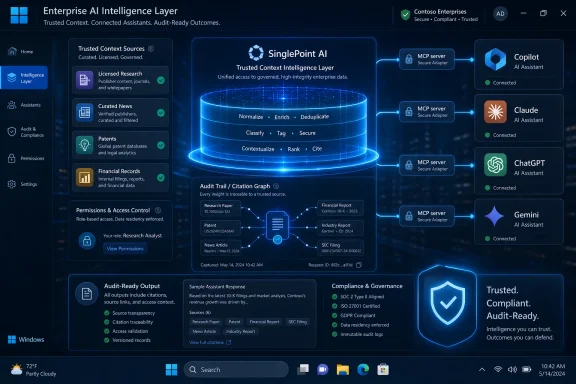
Northern Light Group spent the week ending June 6, 2026, positioning its SinglePoint AI platform as a governed enterprise intelligence layer that combines licensed research, curated news, patents, financial records, multi-agent research workflows, and MCP-based access from tools such as Copilot, Claude, ChatGPT, and Gemini. The pitch is not that Northern Light has invented a better chatbot. It is that the next fight in enterprise AI will be over trusted context, not model glamour. For WindowsForum readers, that distinction matters because the same forces reshaping market intelligence are also reshaping how enterprises will connect Copilot-class assistants to internal and licensed data.
The recap may read at first like another private-company AI update, complete with the now-familiar language of agents, orchestration, and productivity savings. But Northern Light’s message is more specific than the usual “AI will transform knowledge work” brochure copy. It is arguing that Fortune 500 strategy teams do not merely need a larger language model; they need a controlled information supply chain.
That is the heart of the SinglePoint AI positioning. Instead of asking a general-purpose assistant to reason from open-web material and whatever a user pastes into a prompt, Northern Light wants enterprises to start from licensed syndicated research, curated news, internal documents, patents, filings, and other managed sources. The platform’s value proposition depends less on model novelty than on provenance, entitlement, retrieval, and auditability.
This is a sober bet. In consumer AI, the assistant wins by feeling magically broad. In enterprise AI, the assistant loses when it cannot explain where an answer came from, whether a user was allowed to see the underlying material, or whether the output can survive review by legal, compliance, or a skeptical executive committee.
Northern Light’s strategy therefore belongs to a growing class of AI infrastructure plays: companies trying to become the connective tissue between large models and the controlled knowledge estates those models need to be useful inside real organizations. The company is not trying to out-ChatGPT ChatGPT. It is trying to become the layer ChatGPT has to call when the question matters.
That distinction is easy to miss because AI vendors have spent the last two years collapsing every kind of knowledge work into the same demo: ask a natural-language question, receive a polished answer. The demo works brilliantly until the answer must reflect a specific subscription report, respect internal access rights, cite a source an executive trusts, or distinguish a verified market signal from a plausible hallucination.
Northern Light’s answer is to treat content governance as the starting point rather than an afterthought. Its materials emphasize more than 150 licensed syndicated research providers, thousands of curated news sources, and millions of patent and financial records. Those numbers are marketing claims, but they also reveal the product philosophy: value comes from assembling and normalizing the corpus before the model ever begins to reason over it.
The practical implication is that Northern Light is selling a worldview as much as a platform. In that worldview, the enterprise AI winners are not the teams that let the most employees experiment with the most chatbots. They are the teams that turn approved knowledge into a shared operating layer, then let multiple AI interfaces draw from it without breaking governance.
This is where the company’s pitch has teeth. Every large organization already has a version of this problem: market research in one system, competitive intelligence in another, internal presentations in SharePoint, financial feeds in licensed portals, patents in specialist databases, and institutional memory scattered across email and file shares. A general assistant can summarize what it can reach. It cannot magically fix a fragmented knowledge architecture.
That split is important. The first mode says Northern Light still wants to own an application experience for strategic research. The second says the company understands that users increasingly want intelligence to appear inside the tools they already use. Enterprise software vendors are learning that the AI interface may not be their own.
The Deep Research angle is the more familiar one. A strategy user asks for a competitive landscape, a market entry assessment, a technology trend scan, or a patent-and-financials-backed view of a sector. Behind the scenes, multiple agents can search, retrieve, compare, synthesize, and cite material. The finished product is positioned as audit-ready rather than merely convenient.
The MCP angle is the more strategically interesting one. Model Context Protocol began as a way to standardize how AI assistants connect to external systems, tools, and data sources. In enterprise terms, that makes MCP less a developer curiosity than an emerging integration pattern. If AI assistants are becoming the new front end, MCP servers are becoming the adapter layer through which governed systems make themselves usable.
For Northern Light, this is a defensive and offensive move at the same time. It defends against the risk that users abandon specialist portals for whatever assistant is embedded in their daily workflow. It also gives Northern Light a path to remain central even if the visible interaction happens inside Microsoft Copilot, Claude, ChatGPT, or another agentic interface.
That is the quiet power of middleware. If the user asks the question in Copilot but the governed answer is retrieved through Northern Light, the value still accrues to Northern Light’s data layer. The interface may get the applause, but the enterprise buyer pays for the source of truth.
Northern Light’s materials lean into that future. The company talks about unified content foundations, multi-agent orchestration, and autonomous workflows embedded into existing productivity tools. That language can sound grandiose, but the underlying shift is real. Enterprises are moving from “Can this chatbot summarize a document?” to “Can this agent repeatedly perform a knowledge workflow without creating risk?”
The risk part is where the sales cycle gets serious. An agent that only produces a bad paragraph is annoying. An agent that pulls from the wrong entitlement tier, cites an outdated research note, leaks restricted content into a broad workspace, or automates a competitive analysis from unreliable sources can create business and compliance exposure.
That is why governed content is becoming a prerequisite for agentic systems. The more autonomy an AI workflow has, the more important it becomes to constrain its inputs, define its permissions, log its actions, and make its reasoning trail reviewable. Enterprises do not want autonomous interns roaming across their data estates. They want controlled agents operating inside policy.
Northern Light’s positioning fits that demand neatly. By presenting SinglePoint as a managed intelligence backbone, the company is saying that agentic AI cannot be safely scaled on top of unmanaged content chaos. The claim is self-serving, of course, but it also matches what IT and security teams have been telling vendors for years: integration without governance is just a faster way to spread risk.
Microsoft’s enterprise AI strategy depends heavily on integration with business data, permissions, and workflows. But no horizontal assistant can natively contain every licensed research source, every industry-specific taxonomy, every internal intelligence archive, and every company’s content-entitlement rules. The more users expect Copilot-like interfaces to answer high-value questions, the more pressure there is to connect those interfaces to specialized knowledge systems.
That creates an opening for vendors that can present themselves as authoritative back ends rather than competing chat windows. Northern Light’s MCP server is best understood in that context. It is a way to say: let Microsoft, Anthropic, OpenAI, and Google fight over the assistant interface; Northern Light will supply the governed intelligence those assistants need for strategy work.
This is not unique to market intelligence. Analytics vendors, data catalog companies, developer-tool platforms, and cloud providers are all racing to expose their systems to agents through standardized interfaces. The direction of travel is clear. Enterprise AI is becoming less about one monolithic app and more about a mesh of assistants, tools, connectors, policies, and specialized servers.
For Windows-centric organizations, the relevance is obvious. Copilot may become the user-facing default for many employees, but the quality of its answers will depend on what the enterprise connects behind it. A governed research system that plugs into Copilot could be more useful than yet another standalone AI dashboard, especially if it respects licensing and access controls.
Northern Light’s challenge is to make that back-end role feel strategic rather than invisible. Middleware can be lucrative, but it can also be commoditized if buyers conclude that any connector can provide similar access. The company’s defense is its combination of licensed content relationships, domain-specific indexing, taxonomies, and research workflow expertise. The integration matters, but the corpus and governance model are the moat.
Still, the claim is useful because it shows where Northern Light wants buyers to see the economic value. The company is not only selling faster search. It is selling the possibility that better reuse of licensed and internal intelligence can prevent teams from commissioning redundant work, repeating analysis, or burning analyst hours on manual collection.
That is a believable pain point. Large companies routinely pay for research they cannot fully find, reuse, or connect to decisions. Strategy teams may know that a relevant report exists somewhere, but not where it lives, whether it is current, who can access it, or how it relates to newer signals. When information is fragmented, the organization behaves as if it knows less than it actually does.
AI can help, but only if it has access to the right material and can produce outputs people trust. A generic chatbot may reduce the time needed to draft a market overview, but it may also miss the expensive report the company already licensed. A governed intelligence platform can plausibly reduce the “DIY burden” by making existing knowledge reusable at the moment of decision.
The more compelling savings argument is therefore not a single dollar figure. It is the cumulative waste created when smart teams repeatedly reconstruct context from scratch. If SinglePoint can shorten that loop, its value is not just cheaper research. It is faster organizational memory.
Northern Light’s emphasis on licensed syndicated research puts it squarely in that battleground. Licensed content is valuable precisely because it is not simply floating around the open web. It is structured, expensive, restricted, and often bound by usage terms. Making that content available to AI workflows requires more than a search box; it requires entitlement management, logging, and vendor relationships that survive procurement scrutiny.
That is why the company’s positioning may resonate in sectors such as life sciences and financial services. These are industries where market intelligence is expensive, decisions are high-stakes, and compliance concerns are not theoretical. A pharmaceutical strategy team evaluating a therapeutic area or a financial services team monitoring competitors cannot rely solely on whatever a general model happens to know.
The flip side is that licensed content also complicates the AI user experience. Users want frictionless answers. Rights holders want controlled access. IT wants security. Legal wants auditability. Vendors want monetization. A platform such as SinglePoint has to reconcile those demands without making the AI workflow feel like a trip through a contract-management office.
That tension will define much of the enterprise AI market over the next few years. The best systems will make governance feel invisible to users while keeping it explicit to administrators. The worst systems will either lock content down so tightly that AI becomes useless or expose it so casually that organizations recoil.
That does not make integration easy. Authentication, authorization, rate limits, transport choices, data filtering, logging, prompt-injection defenses, and output controls remain hard problems. But MCP gives the market a common vocabulary. It lets a vendor say, “Our intelligence system can be called by your agent,” without building a separate integration for every assistant on the market.
For Northern Light, that is a practical route into the user’s existing workspace. A strategy analyst may prefer Claude for long-form synthesis, Copilot because it sits inside Microsoft 365, or ChatGPT because it has become familiar through daily use. Northern Light does not need to win that preference battle if it can provide governed content to all of them.
The risk is that MCP becomes table stakes. Once every serious data, analytics, and knowledge-management vendor offers an MCP server, the mere existence of one will not differentiate Northern Light. Buyers will ask harder questions: what sources are available, how are permissions enforced, how strong is retrieval quality, how transparent are citations, how well does the platform handle conflicting evidence, and how deeply can it model industry-specific concepts?
That is where Northern Light’s older identity matters. The company has long been associated with enterprise search, text analytics, and strategic research portals. In the current AI cycle, that history can be reframed as readiness. What looked like an old-fashioned research portal business can be recast as the governed content foundation agentic AI suddenly needs.
The company’s task is to prove that this is more than rebranding. Multi-agent workflows and MCP access are credible additions only if they improve the hard parts of enterprise research: source coverage, relevance, traceability, timeliness, and decision support. The market has plenty of AI wrappers. It has fewer systems that can make a research director confident enough to send an AI-generated brief upstream.
On the other side are specialist data and intelligence providers that may decide to expose their own corpora directly to agents. Research vendors, analytics platforms, patent databases, financial-data providers, and data catalogs all have incentives to become AI-ready. If every source builds its own MCP endpoint and every assistant can call them, the aggregation layer becomes harder to defend.
Northern Light’s answer is consolidation. The company is arguing that enterprises do not want dozens of disconnected source-level AI integrations. They want a unified, governed intelligence layer that normalizes access across many content types. That is a plausible argument because fragmentation is exactly the problem most enterprise knowledge teams already face.
But consolidation is hard to sell when every department has its preferred tool and every vendor wants to protect its direct customer relationship. A central intelligence platform must deliver enough convenience and governance value to overcome local habits. It must also avoid becoming yet another silo in the name of eliminating silos.
The company’s best opportunity is with organizations that already recognize market and competitive intelligence as a formal function. In those environments, the pain of fragmented research is visible, budgets exist, and the value of auditable output is easier to explain. In less mature organizations, SinglePoint may look like an expensive answer to a problem users still think they can solve with a chatbot and a browser tab.
An impressive AI answer is fluent, concise, and plausible. An audit-ready AI answer is traceable, permission-aware, current, and tied to sources the organization is entitled to use. The former wins demos. The latter survives deployment.
This distinction is especially important for agentic research workflows. When multiple agents divide a task, retrieve documents, summarize evidence, and assemble a report, the system must preserve the chain of custody. A user should be able to inspect where a claim came from, whether the source was authoritative, and how conflicting information was handled.
Northern Light’s focus on citation transparency and governed content is therefore not decorative. It is central to whether AI research can move from experimentation to routine executive use. Senior leaders may enjoy polished summaries, but they make decisions under uncertainty and accountability. They need to know what the machine read.
The harder challenge is making auditability usable. If every AI answer becomes a dense evidence packet, users will revert to shortcuts. If citations are too shallow, trust erodes. The winners will balance readable synthesis with accessible proof. That balance is much harder than adding a footnote generator to a chatbot.
A tool solves a task. An operating model changes how work is organized. In market intelligence, that could mean continuous monitoring rather than episodic research, shared taxonomies rather than personal folders, reusable source collections rather than ad hoc searches, and AI-generated updates that analysts review instead of blank-page reporting cycles.
This is where agentic AI has genuine potential. The best use of agents may not be replacing analysts with autonomous report writers. It may be turning intelligence work into a more continuous system: scanning, flagging, clustering, summarizing, and routing developments so human experts spend more time interpreting and less time gathering.
Northern Light’s positioning around always-on intelligence and multi-agent research fits this model. The company is effectively saying that strategy teams should stop treating AI as a clever assistant at the edge of their workflow and start treating it as a managed layer inside the workflow. That is a much bigger organizational change than buying licenses.
It also raises adoption questions. Strategy and research teams often value judgment, nuance, and source familiarity. They may resist black-box automation, especially if it threatens to flatten expert interpretation into generic summaries. Northern Light will need to show that its agents augment the craft of intelligence rather than industrialize it into mediocrity.
The strongest version of the product is not “press a button, get a strategy.” It is “maintain a governed intelligence system that keeps analysts closer to the signals that matter.” That is less magical, but much more credible.
Many organizations are already wrestling with Microsoft 365 permissions, SharePoint sprawl, Teams data, file governance, retention policies, and sensitivity labels. Add external licensed research and third-party intelligence archives, and the problem becomes more complex. The assistant interface may be simple; the back-end governance is not.
Northern Light’s MCP strategy should be read as part of the broader shift toward AI-accessible enterprise systems. If Copilot becomes the place employees ask business questions, then systems such as SinglePoint must decide whether to integrate with it or risk being bypassed. The same logic applies to service desks, CRM systems, data warehouses, BI tools, and security platforms.
For IT admins, this creates a new class of governance work. It is not enough to ask whether a vendor has AI features. The better questions are whether those features respect existing permissions, expose logs, support least-privilege access, isolate licensed content, and provide controls over what agents can retrieve or do.
That is where the marketing term “agentic” becomes a checklist. What tools can the agent call? What data can it see? Who approved the connector? How are outputs retained? Can administrators disable risky actions? Can the system distinguish between a user who may know a report exists and a user who may read it?
Northern Light’s pitch lands because those questions are becoming unavoidable. The enterprise AI stack is moving from novelty to plumbing, and plumbing is where Windows admins, identity teams, compliance officers, and knowledge managers all eventually meet.
Northern Light is sharpening three claims at once. First, open-web AI is insufficient for high-stakes enterprise intelligence. Second, governed licensed content is a strategic asset when connected to AI workflows. Third, MCP and agentic architectures allow that asset to show up inside the AI tools users already prefer.
Those claims align with a wider market correction. The first wave of generative AI adoption rewarded experimentation, demos, and broad access. The next wave is rewarding systems that can answer the procurement officer’s question: how does this work safely with our data, our licenses, our controls, and our workflows?
That does not guarantee Northern Light’s success. The company must compete against larger platforms, prove the quality of its agentic workflows, and persuade buyers that a governed intelligence layer deserves budget in a crowded AI market. It also must avoid drowning a clear governance story in the same buzzwords every vendor now uses.
Still, the company’s direction is coherent. It is not trying to be the model, the office suite, or the universal assistant. It is trying to be the trusted research substrate beneath them. In a market obsessed with front ends, that is a contrarian but sensible place to stand.
 Northern Light Is Selling the Boring Part of AI That Enterprises Actually Need
The recap may read at first like another private-company AI update, complete with the now-familiar language of agents, orchestration, and productivity savings. But Northern Light’s message is more specific than the usual “AI will transform knowledge work” brochure copy. It is arguing that Fortune 500 strategy teams do not merely need a larger language model; they need a controlled information supply chain.That is the heart of the SinglePoint AI positioning. Instead of asking a general-purpose assistant to reason from open-web material and whatever a user pastes into a prompt, Northern Light wants enterprises to start from licensed syndicated research, curated news, internal documents, patents, filings, and other managed sources. The platform’s value proposition depends less on model novelty than on provenance, entitlement, retrieval, and auditability.
This is a sober bet. In consumer AI, the assistant wins by feeling magically broad. In enterprise AI, the assistant loses when it cannot explain where an answer came from, whether a user was allowed to see the underlying material, or whether the output can survive review by legal, compliance, or a skeptical executive committee.
Northern Light’s strategy therefore belongs to a growing class of AI infrastructure plays: companies trying to become the connective tissue between large models and the controlled knowledge estates those models need to be useful inside real organizations. The company is not trying to out-ChatGPT ChatGPT. It is trying to become the layer ChatGPT has to call when the question matters.
The Open Web Was Never Enough for Corporate Strategy
The contrast Northern Light draws with mainstream assistants is not subtle. ChatGPT, Microsoft Copilot, Claude, and Gemini are enormously capable general interfaces, but their default strengths are not the same as enterprise market intelligence. They are fluent, flexible, and increasingly integrated into productivity workflows, but they are not automatically grounded in the expensive research subscriptions, proprietary studies, and curated intelligence collections that strategy teams already rely on.That distinction is easy to miss because AI vendors have spent the last two years collapsing every kind of knowledge work into the same demo: ask a natural-language question, receive a polished answer. The demo works brilliantly until the answer must reflect a specific subscription report, respect internal access rights, cite a source an executive trusts, or distinguish a verified market signal from a plausible hallucination.
Northern Light’s answer is to treat content governance as the starting point rather than an afterthought. Its materials emphasize more than 150 licensed syndicated research providers, thousands of curated news sources, and millions of patent and financial records. Those numbers are marketing claims, but they also reveal the product philosophy: value comes from assembling and normalizing the corpus before the model ever begins to reason over it.
The practical implication is that Northern Light is selling a worldview as much as a platform. In that worldview, the enterprise AI winners are not the teams that let the most employees experiment with the most chatbots. They are the teams that turn approved knowledge into a shared operating layer, then let multiple AI interfaces draw from it without breaking governance.
This is where the company’s pitch has teeth. Every large organization already has a version of this problem: market research in one system, competitive intelligence in another, internal presentations in SharePoint, financial feeds in licensed portals, patents in specialist databases, and institutional memory scattered across email and file shares. A general assistant can summarize what it can reach. It cannot magically fix a fragmented knowledge architecture.
SinglePoint’s Two-Door Strategy Shows Where Enterprise AI Is Going
Northern Light is presenting SinglePoint AI through two usage modes that reveal a broader shift in enterprise software. One door is a Deep Research application that runs multi-agent workflows to produce detailed, source-backed reports. The other is an MCP server that exposes the same governed content to third-party AI front ends such as Copilot, Claude, and ChatGPT.That split is important. The first mode says Northern Light still wants to own an application experience for strategic research. The second says the company understands that users increasingly want intelligence to appear inside the tools they already use. Enterprise software vendors are learning that the AI interface may not be their own.
The Deep Research angle is the more familiar one. A strategy user asks for a competitive landscape, a market entry assessment, a technology trend scan, or a patent-and-financials-backed view of a sector. Behind the scenes, multiple agents can search, retrieve, compare, synthesize, and cite material. The finished product is positioned as audit-ready rather than merely convenient.
The MCP angle is the more strategically interesting one. Model Context Protocol began as a way to standardize how AI assistants connect to external systems, tools, and data sources. In enterprise terms, that makes MCP less a developer curiosity than an emerging integration pattern. If AI assistants are becoming the new front end, MCP servers are becoming the adapter layer through which governed systems make themselves usable.
For Northern Light, this is a defensive and offensive move at the same time. It defends against the risk that users abandon specialist portals for whatever assistant is embedded in their daily workflow. It also gives Northern Light a path to remain central even if the visible interaction happens inside Microsoft Copilot, Claude, ChatGPT, or another agentic interface.
That is the quiet power of middleware. If the user asks the question in Copilot but the governed answer is retrieved through Northern Light, the value still accrues to Northern Light’s data layer. The interface may get the applause, but the enterprise buyer pays for the source of truth.
Agentic AI Is Becoming a Governance Problem Before It Becomes a Productivity Miracle
The phrase agentic AI is already in danger of being sanded down into another vendor slogan. In its most useful sense, it describes systems that do more than answer a single prompt: they plan, call tools, retrieve information, perform subtasks, check outputs, and sometimes act across systems. For market intelligence, that could mean monitoring competitors, updating dashboards, detecting anomalies in filings, and drafting periodic executive briefs with source trails.Northern Light’s materials lean into that future. The company talks about unified content foundations, multi-agent orchestration, and autonomous workflows embedded into existing productivity tools. That language can sound grandiose, but the underlying shift is real. Enterprises are moving from “Can this chatbot summarize a document?” to “Can this agent repeatedly perform a knowledge workflow without creating risk?”
The risk part is where the sales cycle gets serious. An agent that only produces a bad paragraph is annoying. An agent that pulls from the wrong entitlement tier, cites an outdated research note, leaks restricted content into a broad workspace, or automates a competitive analysis from unreliable sources can create business and compliance exposure.
That is why governed content is becoming a prerequisite for agentic systems. The more autonomy an AI workflow has, the more important it becomes to constrain its inputs, define its permissions, log its actions, and make its reasoning trail reviewable. Enterprises do not want autonomous interns roaming across their data estates. They want controlled agents operating inside policy.
Northern Light’s positioning fits that demand neatly. By presenting SinglePoint as a managed intelligence backbone, the company is saying that agentic AI cannot be safely scaled on top of unmanaged content chaos. The claim is self-serving, of course, but it also matches what IT and security teams have been telling vendors for years: integration without governance is just a faster way to spread risk.
The Copilot Era Makes Specialist Knowledge Platforms More Valuable, Not Less
At first glance, Microsoft Copilot and similar assistants might seem like a threat to companies such as Northern Light. If every employee has a natural-language AI pane inside Office, Teams, Windows, or a browser, why would anyone visit a dedicated research portal? The answer is that Copilot is not a substitute for every specialized corpus. It is a demand generator for better-connected corpora.Microsoft’s enterprise AI strategy depends heavily on integration with business data, permissions, and workflows. But no horizontal assistant can natively contain every licensed research source, every industry-specific taxonomy, every internal intelligence archive, and every company’s content-entitlement rules. The more users expect Copilot-like interfaces to answer high-value questions, the more pressure there is to connect those interfaces to specialized knowledge systems.
That creates an opening for vendors that can present themselves as authoritative back ends rather than competing chat windows. Northern Light’s MCP server is best understood in that context. It is a way to say: let Microsoft, Anthropic, OpenAI, and Google fight over the assistant interface; Northern Light will supply the governed intelligence those assistants need for strategy work.
This is not unique to market intelligence. Analytics vendors, data catalog companies, developer-tool platforms, and cloud providers are all racing to expose their systems to agents through standardized interfaces. The direction of travel is clear. Enterprise AI is becoming less about one monolithic app and more about a mesh of assistants, tools, connectors, policies, and specialized servers.
For Windows-centric organizations, the relevance is obvious. Copilot may become the user-facing default for many employees, but the quality of its answers will depend on what the enterprise connects behind it. A governed research system that plugs into Copilot could be more useful than yet another standalone AI dashboard, especially if it respects licensing and access controls.
Northern Light’s challenge is to make that back-end role feel strategic rather than invisible. Middleware can be lucrative, but it can also be commoditized if buyers conclude that any connector can provide similar access. The company’s defense is its combination of licensed content relationships, domain-specific indexing, taxonomies, and research workflow expertise. The integration matters, but the corpus and governance model are the moat.
The $250,000 Savings Claim Is Less Important Than the Behavior It Implies
The weekly recap references marketing materials citing $250,000 in research cost savings from reduced primary research needs. That figure should be treated carefully. It is anecdotal, likely context-dependent, and not the same as an independently verified benchmark across customers.Still, the claim is useful because it shows where Northern Light wants buyers to see the economic value. The company is not only selling faster search. It is selling the possibility that better reuse of licensed and internal intelligence can prevent teams from commissioning redundant work, repeating analysis, or burning analyst hours on manual collection.
That is a believable pain point. Large companies routinely pay for research they cannot fully find, reuse, or connect to decisions. Strategy teams may know that a relevant report exists somewhere, but not where it lives, whether it is current, who can access it, or how it relates to newer signals. When information is fragmented, the organization behaves as if it knows less than it actually does.
AI can help, but only if it has access to the right material and can produce outputs people trust. A generic chatbot may reduce the time needed to draft a market overview, but it may also miss the expensive report the company already licensed. A governed intelligence platform can plausibly reduce the “DIY burden” by making existing knowledge reusable at the moment of decision.
The more compelling savings argument is therefore not a single dollar figure. It is the cumulative waste created when smart teams repeatedly reconstruct context from scratch. If SinglePoint can shorten that loop, its value is not just cheaper research. It is faster organizational memory.
Licensed Data Is Becoming the New Enterprise AI Battleground
For much of the generative AI boom, the public debate over data focused on training: what models were trained on, whether publishers were compensated, and whether copyrighted material was used fairly. Enterprise AI shifts the emphasis from training data to operational data. The question becomes: what information can the model retrieve and use right now to answer a business question?Northern Light’s emphasis on licensed syndicated research puts it squarely in that battleground. Licensed content is valuable precisely because it is not simply floating around the open web. It is structured, expensive, restricted, and often bound by usage terms. Making that content available to AI workflows requires more than a search box; it requires entitlement management, logging, and vendor relationships that survive procurement scrutiny.
That is why the company’s positioning may resonate in sectors such as life sciences and financial services. These are industries where market intelligence is expensive, decisions are high-stakes, and compliance concerns are not theoretical. A pharmaceutical strategy team evaluating a therapeutic area or a financial services team monitoring competitors cannot rely solely on whatever a general model happens to know.
The flip side is that licensed content also complicates the AI user experience. Users want frictionless answers. Rights holders want controlled access. IT wants security. Legal wants auditability. Vendors want monetization. A platform such as SinglePoint has to reconcile those demands without making the AI workflow feel like a trip through a contract-management office.
That tension will define much of the enterprise AI market over the next few years. The best systems will make governance feel invisible to users while keeping it explicit to administrators. The worst systems will either lock content down so tightly that AI becomes useless or expose it so casually that organizations recoil.
MCP Gives the Data Layer a Shot at Surviving the Interface War
MCP’s rise matters because it changes the integration politics of enterprise AI. Before a standard connector model, each assistant-to-system integration risked becoming a bespoke project. With MCP, vendors can increasingly expose tools and data in a way that multiple AI clients can call, at least in principle.That does not make integration easy. Authentication, authorization, rate limits, transport choices, data filtering, logging, prompt-injection defenses, and output controls remain hard problems. But MCP gives the market a common vocabulary. It lets a vendor say, “Our intelligence system can be called by your agent,” without building a separate integration for every assistant on the market.
For Northern Light, that is a practical route into the user’s existing workspace. A strategy analyst may prefer Claude for long-form synthesis, Copilot because it sits inside Microsoft 365, or ChatGPT because it has become familiar through daily use. Northern Light does not need to win that preference battle if it can provide governed content to all of them.
The risk is that MCP becomes table stakes. Once every serious data, analytics, and knowledge-management vendor offers an MCP server, the mere existence of one will not differentiate Northern Light. Buyers will ask harder questions: what sources are available, how are permissions enforced, how strong is retrieval quality, how transparent are citations, how well does the platform handle conflicting evidence, and how deeply can it model industry-specific concepts?
That is where Northern Light’s older identity matters. The company has long been associated with enterprise search, text analytics, and strategic research portals. In the current AI cycle, that history can be reframed as readiness. What looked like an old-fashioned research portal business can be recast as the governed content foundation agentic AI suddenly needs.
The company’s task is to prove that this is more than rebranding. Multi-agent workflows and MCP access are credible additions only if they improve the hard parts of enterprise research: source coverage, relevance, traceability, timeliness, and decision support. The market has plenty of AI wrappers. It has fewer systems that can make a research director confident enough to send an AI-generated brief upstream.
The Competitive Threat Comes From Platforms on Both Sides
Northern Light is not competing in a vacuum. On one side are the horizontal AI platforms: Microsoft, OpenAI, Anthropic, Google, and the cloud ecosystems around them. These companies own user attention, model access, developer mindshare, and increasingly the enterprise AI procurement conversation.On the other side are specialist data and intelligence providers that may decide to expose their own corpora directly to agents. Research vendors, analytics platforms, patent databases, financial-data providers, and data catalogs all have incentives to become AI-ready. If every source builds its own MCP endpoint and every assistant can call them, the aggregation layer becomes harder to defend.
Northern Light’s answer is consolidation. The company is arguing that enterprises do not want dozens of disconnected source-level AI integrations. They want a unified, governed intelligence layer that normalizes access across many content types. That is a plausible argument because fragmentation is exactly the problem most enterprise knowledge teams already face.
But consolidation is hard to sell when every department has its preferred tool and every vendor wants to protect its direct customer relationship. A central intelligence platform must deliver enough convenience and governance value to overcome local habits. It must also avoid becoming yet another silo in the name of eliminating silos.
The company’s best opportunity is with organizations that already recognize market and competitive intelligence as a formal function. In those environments, the pain of fragmented research is visible, budgets exist, and the value of auditable output is easier to explain. In less mature organizations, SinglePoint may look like an expensive answer to a problem users still think they can solve with a chatbot and a browser tab.
Audit-Ready AI Is a Different Product From Impressive AI
The phrase “audit-ready” may not excite casual users, but it is one of the most important words in Northern Light’s positioning. Enterprise AI outputs are increasingly being judged not only by whether they sound right, but by whether they can be checked. That changes the product requirements.An impressive AI answer is fluent, concise, and plausible. An audit-ready AI answer is traceable, permission-aware, current, and tied to sources the organization is entitled to use. The former wins demos. The latter survives deployment.
This distinction is especially important for agentic research workflows. When multiple agents divide a task, retrieve documents, summarize evidence, and assemble a report, the system must preserve the chain of custody. A user should be able to inspect where a claim came from, whether the source was authoritative, and how conflicting information was handled.
Northern Light’s focus on citation transparency and governed content is therefore not decorative. It is central to whether AI research can move from experimentation to routine executive use. Senior leaders may enjoy polished summaries, but they make decisions under uncertainty and accountability. They need to know what the machine read.
The harder challenge is making auditability usable. If every AI answer becomes a dense evidence packet, users will revert to shortcuts. If citations are too shallow, trust erodes. The winners will balance readable synthesis with accessible proof. That balance is much harder than adding a footnote generator to a chatbot.
The Real Product Is an Intelligence Operating Model
Northern Light’s recent language about enterprise priorities shifting from generic AI adoption to agentic operating models is telling. The company is trying to move the conversation from tools to operating architecture. That is a more ambitious sale, and probably the right one.A tool solves a task. An operating model changes how work is organized. In market intelligence, that could mean continuous monitoring rather than episodic research, shared taxonomies rather than personal folders, reusable source collections rather than ad hoc searches, and AI-generated updates that analysts review instead of blank-page reporting cycles.
This is where agentic AI has genuine potential. The best use of agents may not be replacing analysts with autonomous report writers. It may be turning intelligence work into a more continuous system: scanning, flagging, clustering, summarizing, and routing developments so human experts spend more time interpreting and less time gathering.
Northern Light’s positioning around always-on intelligence and multi-agent research fits this model. The company is effectively saying that strategy teams should stop treating AI as a clever assistant at the edge of their workflow and start treating it as a managed layer inside the workflow. That is a much bigger organizational change than buying licenses.
It also raises adoption questions. Strategy and research teams often value judgment, nuance, and source familiarity. They may resist black-box automation, especially if it threatens to flatten expert interpretation into generic summaries. Northern Light will need to show that its agents augment the craft of intelligence rather than industrialize it into mediocrity.
The strongest version of the product is not “press a button, get a strategy.” It is “maintain a governed intelligence system that keeps analysts closer to the signals that matter.” That is less magical, but much more credible.
Windows Shops Should Read This as a Copilot Integration Story
WindowsForum readers may reasonably ask why a private market-intelligence vendor belongs in the same conversation as Windows, Copilot, and enterprise IT. The answer is that this is exactly where the Copilot ecosystem is heading. The AI assistant in the productivity suite is only as useful as the systems it can safely reach.Many organizations are already wrestling with Microsoft 365 permissions, SharePoint sprawl, Teams data, file governance, retention policies, and sensitivity labels. Add external licensed research and third-party intelligence archives, and the problem becomes more complex. The assistant interface may be simple; the back-end governance is not.
Northern Light’s MCP strategy should be read as part of the broader shift toward AI-accessible enterprise systems. If Copilot becomes the place employees ask business questions, then systems such as SinglePoint must decide whether to integrate with it or risk being bypassed. The same logic applies to service desks, CRM systems, data warehouses, BI tools, and security platforms.
For IT admins, this creates a new class of governance work. It is not enough to ask whether a vendor has AI features. The better questions are whether those features respect existing permissions, expose logs, support least-privilege access, isolate licensed content, and provide controls over what agents can retrieve or do.
That is where the marketing term “agentic” becomes a checklist. What tools can the agent call? What data can it see? Who approved the connector? How are outputs retained? Can administrators disable risky actions? Can the system distinguish between a user who may know a report exists and a user who may read it?
Northern Light’s pitch lands because those questions are becoming unavoidable. The enterprise AI stack is moving from novelty to plumbing, and plumbing is where Windows admins, identity teams, compliance officers, and knowledge managers all eventually meet.
Northern Light’s Week Was Small News With a Large Signal
Nothing in the recap suggests a dramatic acquisition, funding round, or public-market milestone. This is a positioning week, not a rupture. But in enterprise software, positioning often reveals where the budget conversation is moving before the deal announcements arrive.Northern Light is sharpening three claims at once. First, open-web AI is insufficient for high-stakes enterprise intelligence. Second, governed licensed content is a strategic asset when connected to AI workflows. Third, MCP and agentic architectures allow that asset to show up inside the AI tools users already prefer.
Those claims align with a wider market correction. The first wave of generative AI adoption rewarded experimentation, demos, and broad access. The next wave is rewarding systems that can answer the procurement officer’s question: how does this work safely with our data, our licenses, our controls, and our workflows?
That does not guarantee Northern Light’s success. The company must compete against larger platforms, prove the quality of its agentic workflows, and persuade buyers that a governed intelligence layer deserves budget in a crowded AI market. It also must avoid drowning a clear governance story in the same buzzwords every vendor now uses.
Still, the company’s direction is coherent. It is not trying to be the model, the office suite, or the universal assistant. It is trying to be the trusted research substrate beneath them. In a market obsessed with front ends, that is a contrarian but sensible place to stand.
The Week’s Signal Is That SinglePoint Wants to Be the Memory, Not the Chatbot
Northern Light’s latest messaging is best understood as a bid for durable relevance in an AI market where interfaces are unstable but trusted data remains scarce. The company’s opportunity lies in making licensed and internal intelligence usable by agents without surrendering governance. The practical lessons are concrete:- Northern Light is positioning SinglePoint AI as a governed intelligence layer rather than a general-purpose chatbot competitor.
- The company’s Deep Research application is aimed at audit-ready strategic reports built from licensed, curated, and enterprise-controlled sources.
- Its MCP server strategy is designed to make Northern Light content available inside AI front ends such as Copilot, Claude, ChatGPT, and Gemini.
- The business case depends on reducing duplicated research, accelerating decision cycles, and making existing intelligence easier to reuse.
- The biggest competitive test will be whether Northern Light’s source coverage, permission controls, and research workflows remain differentiated as MCP support becomes common.
- For enterprise IT, the story is another reminder that AI adoption is becoming a data-governance and connector-management problem as much as a model-selection problem.
References
- Primary source: TipRanks
Published: 2026-06-06T13:50:49.426009
Northern Light Group – Weekly Recap - TipRanks.com
Northern Light Group is a private provider of AI-driven market and competitive intelligence platforms, and this weekly recap summarizes key developments in its stra...www.tipranks.com
- Related coverage: tmcnet.com
Northern Light Announces Aurora, Advancing the SinglePoint Intelligence Platform with Multi-Agent Deep Research
Northern Light Announces Aurora, Advancing the SinglePoint Intelligence Platform with Multi-Agent Deep Researchwww.tmcnet.com - Related coverage: cabinetm.com
Landing page
 www.cabinetm.com
- Related coverage: northernlight.com
