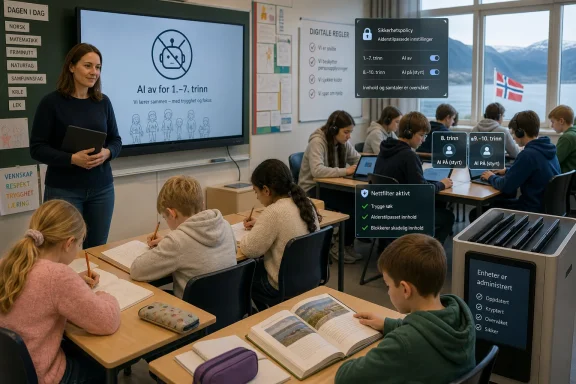
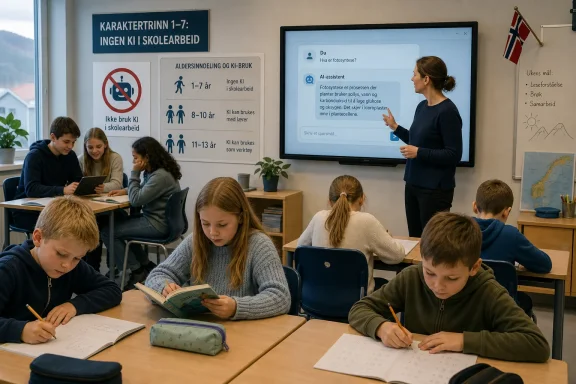
Norway said on June 19, 2026, that pupils aged roughly six to 13 should generally not use generative AI in school, while older students will face supervised or age-tiered access when the new school year begins in late August. The decision is not a theatrical rejection of technology so much as a declaration that childhood is not another productivity workflow waiting to be optimized. It is also a warning shot to the edtech industry, Microsoft included: the classroom is becoming the first serious arena where governments are willing to say that AI capability and educational value are not the same thing.
The Norwegian move matters because it cuts against the prevailing sales pitch around generative AI. Since ChatGPT made AI legible to ordinary users, the industry has treated schools as both a moral showcase and a future customer pipeline: tutors that never tire, feedback that arrives instantly, lesson plans that write themselves, accessibility tools that flatten barriers. Norway is not denying those possibilities. It is arguing that, for younger children, the tool may be too good at doing the very work the child is supposed to learn how to do.
Prime Minister Jonas Gahr Støre’s message was blunt: children need to learn to read, write, and do mathematics. That sounds almost quaint in a technology cycle obsessed with agents, copilots, and automated reasoning, but the plainness is the point. Norway is saying that early schooling is not mainly about output quality; it is about the slow construction of mental machinery.
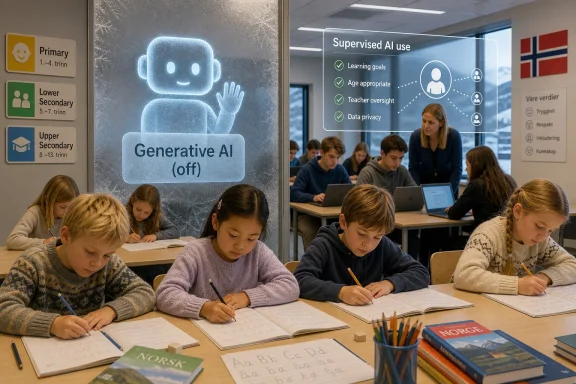
The policy is tiered rather than absolutist. Primary school pupils, generally first through seventh grade, are to be kept away from generative AI in ordinary classroom use. Lower secondary students, roughly ages 14 to 16, may use AI cautiously under teacher supervision. Upper secondary students, roughly ages 17 to 19, are expected to learn appropriate AI use because higher education and the workplace will demand it.
That age gradient is the intellectually interesting part. It rejects both sides of the laziest AI-in-schools debate: neither “ban it all” nor “teach it from kindergarten.” Norway’s premise is developmental. A child who has not yet internalized reading, sentence formation, arithmetic, or independent problem solving is in a different position from a teenager learning to critique, prompt, verify, and use a machine-generated draft without surrendering judgment.
For WindowsForum readers, the policy lands close to home because generative AI is no longer a separate destination called ChatGPT. It is being baked into operating systems, browsers, productivity suites, search boxes, classroom platforms, and administrative dashboards. In a Microsoft-centered school environment, AI is not merely an app a teacher can decline to install. It is increasingly a layer of the computing experience.
That makes Norway’s rule more than a curriculum policy. It is a governance test for the AI-enabled PC era.
A calculator can short-circuit arithmetic practice if introduced too early. Spellcheck can hide weak spelling if it becomes a crutch before phonics and writing patterns are secure. Generative AI is more powerful because it does not merely complete a narrow operation. It can summarize, reason, draft, translate, explain, solve, embellish, and simulate confidence all at once.
That breadth makes it difficult for teachers to see what a child actually knows. A polished paragraph from a nine-year-old is no longer reliable evidence of vocabulary, syntax, or comprehension. A completed math explanation may show that the pupil can paste a prompt, not that the pupil can move through the logic of the problem. The classroom artifact becomes less informative just as accountability systems continue to demand measurable outputs.
This is where the AI industry’s “personal tutor” pitch becomes slippery. A good tutor does not merely give answers; it diagnoses misconceptions, withholds help at the right moment, and lets productive struggle happen. Most general-purpose generative AI tools are not built around that pedagogical discipline. They are built around responsiveness, fluency, and user satisfaction.
For adults, that responsiveness is useful. For children, it may be pedagogically corrosive. The machine’s instinct is to remove friction; early education often depends on carefully managed friction.
Norway was not alone in rethinking phones, but the Norwegian case became prominent because research associated school phone bans with reduced bullying, improved outcomes for some students, and fewer health-care visits for psychological symptoms among girls. The findings have been debated, as all social-policy evidence should be, but the political effect was unmistakable. The phone went from being a symbol of modern learning to a symbol of a classroom that had lost control of attention.
Generative AI arrives with a different interface but a similar institutional pattern. First it appears as a tool of empowerment. Then teachers discover that it reshapes assignments, expectations, discipline, assessment, and the meaning of independent work. Finally policymakers are asked to regulate a system that was already informally adopted.
The government’s planned return to more physical books fits the same arc. Norway spent decades digitizing classrooms, beginning with computers in the 1990s and accelerating with tablets after the iPad era began in 2010. Now it is trying to restore books and handwriting not out of nostalgia, but because a fully digitized classroom proved less neutral than advertised.
The lesson is not that screens are bad and paper is good. The lesson is that medium shapes behavior. A textbook does not notify, autocomplete, recommend, chat, remix, or quietly collect interaction data. A tablet can be a library, a tutor, a game console, a distraction engine, and a surveillance surface in the same school day.
That creates a problem for education customers. Many schools already live inside Microsoft 365, Teams, Edge, Windows devices, Entra identity, Intune management, and cloud-based filtering. If AI features are woven through those systems, administrators need controls that are more granular than “turn the computer on” or “turn the computer off.”
A Norwegian-style regime requires age-aware policy enforcement. Primary students may need AI disabled across browsers, productivity apps, search, writing assistants, and third-party web services. Lower secondary students may need supervised access only in defined contexts. Upper secondary students may need enabled access with logging, guardrails, and instruction in verification.
That is a serious systems-management challenge. It is not enough for a vendor to publish responsible-AI principles or add a school-friendly toggle. Districts need enforceable defaults, auditable settings, identity-based restrictions, data-protection clarity, and assurance that consumer AI features will not leak into managed learning environments through side doors.
Microsoft has the technical pieces to support that kind of governance: device management, tenant policy, age-grouping, browser controls, app restrictions, and enterprise compliance tooling. The hard part is product philosophy. AI companies want broad usage because broad usage generates data, dependency, and subscription logic. Schools increasingly want selective usage because children are not enterprise employees in miniature.
The more AI becomes ambient, the more credible education customers will demand a “not for this age, not in this context” architecture. Norway’s policy turns that from a theoretical feature request into a public-sector requirement.
That question does not fit neatly into the usual enterprise risk matrix. A hallucinated answer can be corrected. A leaked document can trigger incident response. A biased model can be audited, at least in theory. But a generation of pupils learning to bypass mental effort is harder to measure and harder to remediate.
This is why the Norwegian policy should not be dismissed as Luddite. It is a precautionary intervention in a domain where the harms may be cumulative and delayed. If the government is wrong, older pupils still learn AI use later. If the government is right and does nothing, foundational learning may erode in ways that only appear in test scores, attention patterns, writing quality, and teacher burnout years later.
There is also a social-equity angle. Wealthier families can often compensate for weak school design with tutors, structured home routines, and parental oversight. Lower-income students are more exposed to whatever defaults the school system adopts. If generative AI helps strong students accelerate but allows weaker students to avoid practice, the technology could widen gaps under the banner of personalization.
That does not mean AI has no place in education. It means the burden of proof should be higher when the user is a child and the task is foundational. The classroom is not a beta channel.
A genuinely school-ready AI tutor for young learners would need to behave less like a chatbot and more like a disciplined teacher. It would ask the child to try first. It would reveal hints gradually. It would make the student explain reasoning. It would distinguish between a child stuck at the edge of understanding and a child trying to outsource the assignment.
That is possible in principle, but it is not what most pupils encounter when they open a general-purpose AI tool. The default chatbot is optimized for helpfulness as the user defines it in the moment. A child’s immediate preference may be to finish quickly. A teacher’s goal may be to make the child wrestle with the concept.
The difference matters. AI can produce a perfect book report on a text the child did not read. It can generate a persuasive essay before the student has learned how to form a paragraph. It can solve a word problem without the learner mapping language to arithmetic. Each output looks like schoolwork. Each may conceal the absence of learning.
Norway’s tiered policy implicitly recognizes that students must earn the right to use a tool that collapses steps. Once a learner has built enough internal structure, AI can become a sparring partner, editor, translator, accessibility aid, or research assistant. Before that, it risks becoming scaffolding that never comes down.
Unlike phones, AI is not always physically visible. A phone in a desk is a phone in a desk. AI can appear through a browser tab, a document assistant, a translation tool, a search engine, a keyboard, a homework platform, or a parent’s device at home. The enforcement problem is not just classroom discipline; it is ecosystem control.
This is where school IT departments become policy actors. A rule announced by a prime minister becomes real only when networks, devices, identities, filters, app catalogs, and classroom workflows align. If a pupil can bypass restrictions through a personal account, a browser extension, a web proxy, or an unmanaged device, the policy becomes symbolic.
Administrators will need to think in layers. Managed devices should enforce age-specific restrictions. School accounts should limit AI features according to grade. Network controls should block unsanctioned tools where appropriate. Teachers should have approved pathways for supervised AI activities rather than improvising with whatever chatbot happens to be popular that month.
The danger is that poorly implemented bans create two classes of students: those who follow the rules and those who learn circumvention. That is not a reason to give up. It is a reason to design policies that are technically enforceable and educationally coherent.
Norway’s answer is one of the clearest so far. Young pupils should generally not use generative AI. Early teenagers may use it carefully with teacher oversight. Older teenagers should learn appropriate use because AI literacy is becoming part of adult life. The structure is easy to understand, which is one reason it may travel.
Other countries are already wrestling with adjacent restrictions. Australia has moved on social media age limits. In the United States, lawmakers have discussed age verification and restrictions around AI companions for minors. European governments are implementing broader AI rules while also debating children’s screen exposure, platform accountability, and digital well-being.
The politics cut across familiar ideological lines. Conservatives may see AI limits as a defense of discipline, books, and traditional schooling. Progressives may see them as child protection, equity, and anti-surveillance policy. Teachers may see them as a chance to reclaim attention. Parents may simply be tired of watching schools adopt tools first and ask developmental questions later.
That coalition is powerful because it is not anti-technology in the abstract. It is anti-default. It challenges the assumption that every new digital capability deserves immediate classroom presence unless proven harmful. Norway is flipping that burden: for younger children, prove the tool belongs.
But the history of classroom technology is full of tools that improved administration more clearly than learning. Schools digitized assignments, communication, testing, content delivery, and behavior systems. Some of it helped. Some of it made teachers’ lives more complicated. Much of it was adopted before anyone could confidently say what it did to attention, memory, comprehension, or social development.
Generative AI intensifies that pattern because its benefits are obvious and its costs are subtle. A teacher can instantly see that AI drafts a worksheet. A student can instantly see that it explains a concept. A parent can instantly see that homework gets done faster. The missing question is whether the learner’s internal capacity is growing or merely being bypassed.
Norway is demanding a slower accounting. That is uncomfortable for vendors because the AI business model rewards speed, scale, and normalization. The more quickly AI becomes routine, the harder it is for institutions to restrict it later. The smartphone experience showed that once a device becomes socially embedded, removing it feels punitive even when the evidence supports limits.
The edtech industry will adapt its language. Expect more “age-appropriate AI,” “teacher-in-the-loop experiences,” “guided prompting,” “safe tutors,” and “curriculum-aligned copilots.” Some of those products may be useful. But Norway’s decision suggests governments will no longer accept the mere presence of guardrails as proof of educational value.
AI restrictions in schools will suffer from the same disease: policy drift. A district may block one chatbot while another appears. A productivity suite may add a summarization feature. A browser may integrate an assistant. A search engine may return generated answers. A third-party learning platform may quietly introduce AI feedback.
This is not hypothetical. The AI layer is spreading precisely because vendors want it to feel seamless. But seamlessness is the enemy of school governance when different ages require different levels of access. A feature that is harmless for a 17-year-old research project may be unacceptable for a seven-year-old learning sentence structure.
The Windows ecosystem therefore needs clearer administrative separation between AI-enabled and AI-disabled modes. Schools should not have to hunt through scattered settings to suppress generative features for younger pupils. Nor should they have to choose between giving up modern management tools and accepting AI everywhere.
The most useful vendor response would be boring: tenant-level AI controls, grade-band policy templates, logs that show when AI features were invoked, reliable child-account behavior, and documentation written for school administrators rather than marketing departments. The future of AI in education may depend less on model benchmarks than on whether IT staff can make the policy stick on Tuesday morning.
That is a humbling thought for an industry that prefers visionary demos. But institutions run on defaults, permissions, and support tickets.
That distinction matters because AI literacy is real. Students will need to understand how generative systems work, where they fail, how they fabricate, how they encode bias, how prompts shape outputs, how data is used, and how to verify machine-generated material. A school system that bans AI forever would fail students just as surely as one that hands it to six-year-olds without restraint.
The better analogy is not prohibition but driver education. Children are not given car keys in primary school because mobility is important. They are taught road safety first, then allowed supervised practice, then licensed when their development and competence justify the risk. AI may need a similar staged model.
Norway’s approach is therefore more sophisticated than the headline “AI ban” suggests. It acknowledges that older students should learn appropriate use. It gives teachers a supervised role in the middle years. It reserves the strongest protection for the years when foundational skills are being formed.
The open question is implementation. If the policy becomes a clear national framework with practical tools, it could become a model. If it becomes vague guidance placed on already overburdened teachers, it will become another well-intentioned rule eroded by classroom reality.
The Norwegian move matters because it cuts against the prevailing sales pitch around generative AI. Since ChatGPT made AI legible to ordinary users, the industry has treated schools as both a moral showcase and a future customer pipeline: tutors that never tire, feedback that arrives instantly, lesson plans that write themselves, accessibility tools that flatten barriers. Norway is not denying those possibilities. It is arguing that, for younger children, the tool may be too good at doing the very work the child is supposed to learn how to do.
 Norway Draws a Line Where the AI Industry Wanted a Ramp
Prime Minister Jonas Gahr Støre’s message was blunt: children need to learn to read, write, and do mathematics. That sounds almost quaint in a technology cycle obsessed with agents, copilots, and automated reasoning, but the plainness is the point. Norway is saying that early schooling is not mainly about output quality; it is about the slow construction of mental machinery.The policy is tiered rather than absolutist. Primary school pupils, generally first through seventh grade, are to be kept away from generative AI in ordinary classroom use. Lower secondary students, roughly ages 14 to 16, may use AI cautiously under teacher supervision. Upper secondary students, roughly ages 17 to 19, are expected to learn appropriate AI use because higher education and the workplace will demand it.
That age gradient is the intellectually interesting part. It rejects both sides of the laziest AI-in-schools debate: neither “ban it all” nor “teach it from kindergarten.” Norway’s premise is developmental. A child who has not yet internalized reading, sentence formation, arithmetic, or independent problem solving is in a different position from a teenager learning to critique, prompt, verify, and use a machine-generated draft without surrendering judgment.
For WindowsForum readers, the policy lands close to home because generative AI is no longer a separate destination called ChatGPT. It is being baked into operating systems, browsers, productivity suites, search boxes, classroom platforms, and administrative dashboards. In a Microsoft-centered school environment, AI is not merely an app a teacher can decline to install. It is increasingly a layer of the computing experience.
That makes Norway’s rule more than a curriculum policy. It is a governance test for the AI-enabled PC era.
The Ban Is Really About Cognitive Offloading
The phrase that should follow this story is not “AI cheating.” Cheating is the old frame, borrowed from plagiarism detectors and take-home essays. Norway’s concern is deeper: cognitive offloading, the transfer of mental work from the learner to the machine before the learner has built the capacity to perform that work independently.A calculator can short-circuit arithmetic practice if introduced too early. Spellcheck can hide weak spelling if it becomes a crutch before phonics and writing patterns are secure. Generative AI is more powerful because it does not merely complete a narrow operation. It can summarize, reason, draft, translate, explain, solve, embellish, and simulate confidence all at once.
That breadth makes it difficult for teachers to see what a child actually knows. A polished paragraph from a nine-year-old is no longer reliable evidence of vocabulary, syntax, or comprehension. A completed math explanation may show that the pupil can paste a prompt, not that the pupil can move through the logic of the problem. The classroom artifact becomes less informative just as accountability systems continue to demand measurable outputs.
This is where the AI industry’s “personal tutor” pitch becomes slippery. A good tutor does not merely give answers; it diagnoses misconceptions, withholds help at the right moment, and lets productive struggle happen. Most general-purpose generative AI tools are not built around that pedagogical discipline. They are built around responsiveness, fluency, and user satisfaction.
For adults, that responsiveness is useful. For children, it may be pedagogically corrosive. The machine’s instinct is to remove friction; early education often depends on carefully managed friction.
Norway’s Smartphone Retreat Set the Stage
The AI decision follows Norway’s earlier move to restrict smartphones in schools, a policy backed by concern over falling performance, distraction, screen exposure, bullying, and mental health. The smartphone experience matters because it taught governments a hard lesson about educational technology: adoption is easy, reversal is politically harder, and evidence often arrives after habits have already formed.Norway was not alone in rethinking phones, but the Norwegian case became prominent because research associated school phone bans with reduced bullying, improved outcomes for some students, and fewer health-care visits for psychological symptoms among girls. The findings have been debated, as all social-policy evidence should be, but the political effect was unmistakable. The phone went from being a symbol of modern learning to a symbol of a classroom that had lost control of attention.
Generative AI arrives with a different interface but a similar institutional pattern. First it appears as a tool of empowerment. Then teachers discover that it reshapes assignments, expectations, discipline, assessment, and the meaning of independent work. Finally policymakers are asked to regulate a system that was already informally adopted.
The government’s planned return to more physical books fits the same arc. Norway spent decades digitizing classrooms, beginning with computers in the 1990s and accelerating with tablets after the iPad era began in 2010. Now it is trying to restore books and handwriting not out of nostalgia, but because a fully digitized classroom proved less neutral than advertised.
The lesson is not that screens are bad and paper is good. The lesson is that medium shapes behavior. A textbook does not notify, autocomplete, recommend, chat, remix, or quietly collect interaction data. A tablet can be a library, a tutor, a game console, a distraction engine, and a surveillance surface in the same school day.
Microsoft’s School Pitch Just Got More Complicated
The Norwegian policy is not aimed specifically at Microsoft, OpenAI, Google, Apple, or any single vendor. But Microsoft is deeply implicated because it has made AI integration the center of its Windows and productivity strategy. Copilot is not an optional science project in Redmond’s messaging; it is the organizing metaphor for the next generation of work.That creates a problem for education customers. Many schools already live inside Microsoft 365, Teams, Edge, Windows devices, Entra identity, Intune management, and cloud-based filtering. If AI features are woven through those systems, administrators need controls that are more granular than “turn the computer on” or “turn the computer off.”
A Norwegian-style regime requires age-aware policy enforcement. Primary students may need AI disabled across browsers, productivity apps, search, writing assistants, and third-party web services. Lower secondary students may need supervised access only in defined contexts. Upper secondary students may need enabled access with logging, guardrails, and instruction in verification.
That is a serious systems-management challenge. It is not enough for a vendor to publish responsible-AI principles or add a school-friendly toggle. Districts need enforceable defaults, auditable settings, identity-based restrictions, data-protection clarity, and assurance that consumer AI features will not leak into managed learning environments through side doors.
Microsoft has the technical pieces to support that kind of governance: device management, tenant policy, age-grouping, browser controls, app restrictions, and enterprise compliance tooling. The hard part is product philosophy. AI companies want broad usage because broad usage generates data, dependency, and subscription logic. Schools increasingly want selective usage because children are not enterprise employees in miniature.
The more AI becomes ambient, the more credible education customers will demand a “not for this age, not in this context” architecture. Norway’s policy turns that from a theoretical feature request into a public-sector requirement.
The Classroom Is Becoming an AI Safety Frontier
Most AI regulation focuses on privacy, discrimination, copyright, cybersecurity, market concentration, and high-risk automated decision-making. Schools add a different question: what happens when a developing mind uses a fluent machine before it has learned the underlying skill?That question does not fit neatly into the usual enterprise risk matrix. A hallucinated answer can be corrected. A leaked document can trigger incident response. A biased model can be audited, at least in theory. But a generation of pupils learning to bypass mental effort is harder to measure and harder to remediate.
This is why the Norwegian policy should not be dismissed as Luddite. It is a precautionary intervention in a domain where the harms may be cumulative and delayed. If the government is wrong, older pupils still learn AI use later. If the government is right and does nothing, foundational learning may erode in ways that only appear in test scores, attention patterns, writing quality, and teacher burnout years later.
There is also a social-equity angle. Wealthier families can often compensate for weak school design with tutors, structured home routines, and parental oversight. Lower-income students are more exposed to whatever defaults the school system adopts. If generative AI helps strong students accelerate but allows weaker students to avoid practice, the technology could widen gaps under the banner of personalization.
That does not mean AI has no place in education. It means the burden of proof should be higher when the user is a child and the task is foundational. The classroom is not a beta channel.
The Useful AI Is the One That Knows When to Stay Silent
The most defensible educational AI will not be the model that answers fastest. It will be the one that can refuse to do the learner’s work at the wrong moment. That is an awkward incentive problem for consumer AI, where user satisfaction is often tied to completion, convenience, and conversational smoothness.A genuinely school-ready AI tutor for young learners would need to behave less like a chatbot and more like a disciplined teacher. It would ask the child to try first. It would reveal hints gradually. It would make the student explain reasoning. It would distinguish between a child stuck at the edge of understanding and a child trying to outsource the assignment.
That is possible in principle, but it is not what most pupils encounter when they open a general-purpose AI tool. The default chatbot is optimized for helpfulness as the user defines it in the moment. A child’s immediate preference may be to finish quickly. A teacher’s goal may be to make the child wrestle with the concept.
The difference matters. AI can produce a perfect book report on a text the child did not read. It can generate a persuasive essay before the student has learned how to form a paragraph. It can solve a word problem without the learner mapping language to arithmetic. Each output looks like schoolwork. Each may conceal the absence of learning.
Norway’s tiered policy implicitly recognizes that students must earn the right to use a tool that collapses steps. Once a learner has built enough internal structure, AI can become a sparring partner, editor, translator, accessibility aid, or research assistant. Before that, it risks becoming scaffolding that never comes down.
Teachers Are Being Asked to Police a Moving Target
The policy gives teachers a central role in supervised use, especially for lower secondary students. That is both necessary and unfair. Teachers are already expected to manage devices, curriculum, behavior, assessment, mental health spillover, parental expectations, and administrative reporting. AI adds a new layer of invisible assistance that can be hard to detect and harder to interpret.Unlike phones, AI is not always physically visible. A phone in a desk is a phone in a desk. AI can appear through a browser tab, a document assistant, a translation tool, a search engine, a keyboard, a homework platform, or a parent’s device at home. The enforcement problem is not just classroom discipline; it is ecosystem control.
This is where school IT departments become policy actors. A rule announced by a prime minister becomes real only when networks, devices, identities, filters, app catalogs, and classroom workflows align. If a pupil can bypass restrictions through a personal account, a browser extension, a web proxy, or an unmanaged device, the policy becomes symbolic.
Administrators will need to think in layers. Managed devices should enforce age-specific restrictions. School accounts should limit AI features according to grade. Network controls should block unsanctioned tools where appropriate. Teachers should have approved pathways for supervised AI activities rather than improvising with whatever chatbot happens to be popular that month.
The danger is that poorly implemented bans create two classes of students: those who follow the rules and those who learn circumvention. That is not a reason to give up. It is a reason to design policies that are technically enforceable and educationally coherent.
The Global Debate Is Moving From Access to Timing
The early AI-in-education debate was framed around access. Should students be allowed to use ChatGPT? Should schools detect AI-written essays? Should teachers use AI to grade? Should every child have an AI tutor? Those questions are giving way to a more mature one: at what age, for what task, under whose supervision, and with what evidence of benefit?Norway’s answer is one of the clearest so far. Young pupils should generally not use generative AI. Early teenagers may use it carefully with teacher oversight. Older teenagers should learn appropriate use because AI literacy is becoming part of adult life. The structure is easy to understand, which is one reason it may travel.
Other countries are already wrestling with adjacent restrictions. Australia has moved on social media age limits. In the United States, lawmakers have discussed age verification and restrictions around AI companions for minors. European governments are implementing broader AI rules while also debating children’s screen exposure, platform accountability, and digital well-being.
The politics cut across familiar ideological lines. Conservatives may see AI limits as a defense of discipline, books, and traditional schooling. Progressives may see them as child protection, equity, and anti-surveillance policy. Teachers may see them as a chance to reclaim attention. Parents may simply be tired of watching schools adopt tools first and ask developmental questions later.
That coalition is powerful because it is not anti-technology in the abstract. It is anti-default. It challenges the assumption that every new digital capability deserves immediate classroom presence unless proven harmful. Norway is flipping that burden: for younger children, prove the tool belongs.
Edtech’s Favorite Word Meets a Government That Wants Evidence
The word “personalization” has carried edtech through two decades of procurement cycles. Adaptive software promised to meet every student where they were. Tablets promised engagement. Learning analytics promised insight. AI now promises all of that with better language and more convincing demos.But the history of classroom technology is full of tools that improved administration more clearly than learning. Schools digitized assignments, communication, testing, content delivery, and behavior systems. Some of it helped. Some of it made teachers’ lives more complicated. Much of it was adopted before anyone could confidently say what it did to attention, memory, comprehension, or social development.
Generative AI intensifies that pattern because its benefits are obvious and its costs are subtle. A teacher can instantly see that AI drafts a worksheet. A student can instantly see that it explains a concept. A parent can instantly see that homework gets done faster. The missing question is whether the learner’s internal capacity is growing or merely being bypassed.
Norway is demanding a slower accounting. That is uncomfortable for vendors because the AI business model rewards speed, scale, and normalization. The more quickly AI becomes routine, the harder it is for institutions to restrict it later. The smartphone experience showed that once a device becomes socially embedded, removing it feels punitive even when the evidence supports limits.
The edtech industry will adapt its language. Expect more “age-appropriate AI,” “teacher-in-the-loop experiences,” “guided prompting,” “safe tutors,” and “curriculum-aligned copilots.” Some of those products may be useful. But Norway’s decision suggests governments will no longer accept the mere presence of guardrails as proof of educational value.
Windows Admins Will Recognize the Real Problem: Policy Drift
The technical challenge resembles every endpoint-management problem Windows administrators already know. A central policy exists. Users have incentives to route around it. Vendors change features. Defaults shift after updates. Consumer services bleed into enterprise environments. Documentation lags reality.AI restrictions in schools will suffer from the same disease: policy drift. A district may block one chatbot while another appears. A productivity suite may add a summarization feature. A browser may integrate an assistant. A search engine may return generated answers. A third-party learning platform may quietly introduce AI feedback.
This is not hypothetical. The AI layer is spreading precisely because vendors want it to feel seamless. But seamlessness is the enemy of school governance when different ages require different levels of access. A feature that is harmless for a 17-year-old research project may be unacceptable for a seven-year-old learning sentence structure.
The Windows ecosystem therefore needs clearer administrative separation between AI-enabled and AI-disabled modes. Schools should not have to hunt through scattered settings to suppress generative features for younger pupils. Nor should they have to choose between giving up modern management tools and accepting AI everywhere.
The most useful vendor response would be boring: tenant-level AI controls, grade-band policy templates, logs that show when AI features were invoked, reliable child-account behavior, and documentation written for school administrators rather than marketing departments. The future of AI in education may depend less on model benchmarks than on whether IT staff can make the policy stick on Tuesday morning.
That is a humbling thought for an industry that prefers visionary demos. But institutions run on defaults, permissions, and support tickets.
The Case Against Panic Is Still Worth Making
There is a risk that Norway’s policy will be flattened into a culture-war slogan: books versus bots, children versus machines, teachers versus tech companies. That would miss the nuance. The government is not saying that AI is useless, nor that teenagers should be shielded from the tools shaping universities and workplaces. It is saying that timing matters.That distinction matters because AI literacy is real. Students will need to understand how generative systems work, where they fail, how they fabricate, how they encode bias, how prompts shape outputs, how data is used, and how to verify machine-generated material. A school system that bans AI forever would fail students just as surely as one that hands it to six-year-olds without restraint.
The better analogy is not prohibition but driver education. Children are not given car keys in primary school because mobility is important. They are taught road safety first, then allowed supervised practice, then licensed when their development and competence justify the risk. AI may need a similar staged model.
Norway’s approach is therefore more sophisticated than the headline “AI ban” suggests. It acknowledges that older students should learn appropriate use. It gives teachers a supervised role in the middle years. It reserves the strongest protection for the years when foundational skills are being formed.
The open question is implementation. If the policy becomes a clear national framework with practical tools, it could become a model. If it becomes vague guidance placed on already overburdened teachers, it will become another well-intentioned rule eroded by classroom reality.
The Lesson From Norway Is That Childhood Is Not a Productivity Stack
Norway’s decision offers a handful of concrete signals for anyone managing classrooms, devices, or AI policy. The details will evolve, but the direction is already visible: governments are beginning to treat generative AI in schools as a developmental question, not merely a software-access question.- Norway’s new framework generally keeps generative AI away from primary pupils aged about six to 13 while allowing more supervised use as students get older.
- The policy is tied to concerns that young children may skip essential learning steps in reading, writing, mathematics, and independent reasoning.
- The move follows Norway’s earlier school smartphone restrictions and a broader turn back toward books, handwriting, and lower screen exposure.
- The practical burden will fall heavily on teachers and IT administrators, who must translate national rules into enforceable device, account, browser, and classroom policies.
- Microsoft, Google, Apple, and edtech vendors will face growing pressure to provide age-aware AI controls rather than assuming that AI features should be available by default.
- The broader policy lesson is that AI literacy may be essential for older students while still being inappropriate for younger children who have not yet built foundational skills.
References
- Primary source: The Indian Express
Published: 2026-06-20T11:30:18.567556
Norway wants children to spend less time on AI and more time with books
Norway is imposing a near-ban on generative AI in elementary and middle schools to protect cognitive development.indianexpress.com - Independent coverage: technology.org
Published: Sat, 20 Jun 2026 05:57:00 GMT
- Independent coverage: t2ONLINE
Published: 2026-06-20T04:30:18.598019
Norway imposes near-total ban on AI use in primary schools | t2ONLINE
Norway imposes near-total ban on AI use in primary schools t2online.in
- Independent coverage: South China Morning Post
Published: Sat, 20 Jun 2026 01:17:36 GMT
Norway imposes near AI ban for junior school pupils, curbs use for older children | South China Morning Post
The move follows a 2024 ban on smartphones after Norway recorded a broad decline in education test scores.www.scmp.com - Independent coverage: Gizmodo
Published: Fri, 19 Jun 2026 20:05:31 GMT
Norway Says AI Ain't for Education
The country is cutting back on tech in classrooms. gizmodo.com
- Independent coverage: The Express Tribune
Published: 2026-06-19T19:30:18.592982
Norway imposes near ban on AI in elementary school
Prime Minister Jonas Gahr Støre said using AI risks young children skipping important steps in their education tribune.com.pk
- Independent coverage: The Decoder
Published: Fri, 19 Jun 2026 18:47:36 GMT
Norway bans generative AI tools in elementary schools to protect kids' basic learning skills
Norway is banning generative AI tools in elementary schools starting in late August. Students in grades 1 through 7 won't be allowed to use AI at all; secondary schools will permit it only under supervision. Prime Minister Stoere says children must first "learn to read, write, and do...the-decoder.com - Related coverage: startupfortune.com
Norway bans AI from primary classrooms and the rest of Europe may not be far behind - Startup Fortune
Norway's Prime Minister Jonas Gahr Stoere announced a near-total ban on generative AI in elementary schools on June 19, 2026, with tiered restrictionsstartupfortune.com - Related coverage: nhh.no
Smartphones should be out of the classrooms | NHH
A doctoral thesis from NHH sparked the debate on smartphone bans in schools: Sara Abrahamsson's research showed that banning phones led to bwww.nhh.no - Related coverage: marginalrevolution.com
Did Norwegian schools actually ban cell phones? - Marginal REVOLUTION
Some commentators are suggesting no real ban was in effect. I went back to the Sara Abrahamsson paper to confirm the following: Schools where students are required to hand in their phones in the morning, and therefore cannot access them during breaks, are considered to have a strict policy...marginalrevolution.com - Related coverage: media.eppc.org
- Related coverage: phys.org
- Related coverage: publications.iadb.org
Mobile Devices and Childrens Development The Case for School Restrictions
PDF documentpublications.iadb.org