

Notepad++ creator Don Ho publicly denounced an unauthorized macOS port in early May 2026 after developer Andrey Letov launched it as “Notepad++ for Mac,” using the project’s name, chameleon branding, Ho’s identity, and a similarly named website despite lacking official approval. The fight is not really about whether open-source code may be forked. It is about whether a fork can borrow twenty years of trust and then ask users to read the fine print. For Windows users, sysadmins, and anyone who has ever had to clean up after a fake download button, Ho’s anger is less surprising than inevitable.
For years, “Notepad++ for Mac” has been one of those search phrases that produces workarounds, Wine instructions, sketchy download pages, and wishful thinking. Notepad++ is a Windows-native editor with a long history, a loyal user base, and a name that has become shorthand for “the first thing I install after Windows.” That makes a native macOS port newsworthy by default.
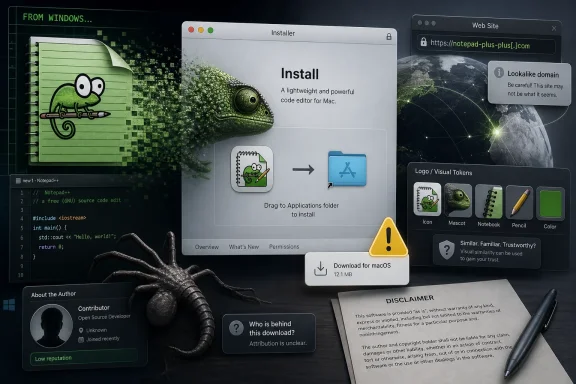
But the new app did not arrive merely as a fork with a clear new identity. It reportedly appeared with the Notepad++ name, a chameleon-like logo, a domain built around the original project’s name, and an author page that included Ho himself. Even if the site also described the project as independent, the overall presentation did the opposite of what careful open-source stewardship demands: it made users squint to discover what should have been obvious.
That is why Ho’s response landed so forcefully. His objection was not that someone had studied, adapted, or reused code under the GNU General Public License. His objection was that users, Reddit posters, and even tech media were already treating the Mac version as if it were the long-awaited official release.
The distinction matters because open-source licensing and brand trust solve different problems. The GPL tells developers what they may do with code. It does not grant them the right to wear another project’s face.
Open-source projects survive because code, community, and reputation reinforce one another. A fork is legitimate when it respects that triangle. It can borrow code under the license, acknowledge lineage, and chart its own path. What it cannot do, at least not without consequences, is blur the boundary between “derived from” and “delivered by.”
Ho’s own comments reflected that line. He reportedly told Letov that he was happy for Mac users to benefit from the Notepad++ code base, but that using the Notepad++ name and logo created confusion. That is the heart of the dispute, and it is a stronger claim than a blanket anti-fork complaint would have been.
The irony is that a clean rebrand from day one would likely have produced a very different story. A “Mac editor inspired by Notepad++” might have drawn curiosity, criticism, bug reports, and perhaps contributors. “Notepad++ for Mac,” by contrast, implied a succession that did not exist.
In this case, those impressions reportedly said “official” loudly enough that multiple online discussions framed the app as the Mac arrival of Notepad++ after a two-decade wait. That was not a minor branding quibble. That was the market, or at least the attention economy, doing exactly what Ho feared.
This is where developers often underestimate the power of presentation. The difference between a clone, a port, a fork, a tribute, and an impersonation may be obvious to the person compiling the code. It is not obvious to a user who types a familiar product name into a search engine and sees a plausible download page.
The chameleon logo was especially loaded. Logos are not decorative afterthoughts in software; they are trust tokens. They sit in installers, taskbars, package managers, GitHub avatars, and screenshots. Reusing one tells users, at a glance, that continuity exists.
Intent matters morally, but effect matters operationally. If a project credits an original author in a way that makes casual readers believe he is part of the new release, the credit becomes a liability. If the image is jokey or stylized, it may be harmless inside a fan forum, but it reads differently on a software download site.
Ho called the presentation misleading and disrespectful. That reaction is understandable even if one grants Letov every charitable assumption. Open-source maintainers already fight burnout, impersonation, malicious mirrors, poisoned ads, and dependency confusion. They do not have endless patience for ambiguity around their names.
There is also a human dimension here that legal language tends to flatten. For many users, Notepad++ is Don Ho. It is not a faceless corporate product with a trademark department and a crisis-communications team. Putting Ho’s identity on an unaffiliated port was always going to be perceived as more than a metadata issue.
The official Notepad++ community has repeatedly warned users that there is no native macOS release and that downloads should come from the project’s official channels. That warning is not mere territoriality. Popular free Windows utilities are magnets for malware distributors precisely because users search for them by name and often click the first plausible result.
In recent years, the project has also had to navigate code-signing complications, false positives from antivirus tools, and hardening around update integrity. Those are not abstract infrastructure chores. They are the fragile plumbing that lets a volunteer-driven project continue to be trusted at scale.
Against that backdrop, a macOS site using the Notepad++ name was not just annoying. It threatened to widen the trust surface. If something went wrong with the Mac port, many users would blame Notepad++ first and sort out attribution later, if at all.
Software supply-chain attacks increasingly rely on users, developers, or automated systems making a reasonable but wrong assumption. A package name looks familiar. A domain looks official. A logo matches memory. A blog post headline compresses nuance into “finally available.” At that point, the attacker does not need a zero-day; the attacker needs a believable costume.
That is why trademark enforcement can feel like security work in the open-source world. It is not just about protecting commercial value. It is about preserving a clear chain of custody between maintainer, source, binary, and user expectation.
For sysadmins, this is the part that should ring loudest. A help desk ticket rarely begins with a philosophical discussion of the GPL. It begins with “I installed Notepad++ for Mac from a website I found,” followed by an endpoint alert, a policy exception, or a user asking why the app behaves differently from the Windows version.
This is not simply a matter of reporters failing to read a disclaimer. Modern software news often moves through Reddit posts, GitHub threads, landing pages, and screenshots before anyone calls the original maintainer. When the presentation of a project already leans official, the reporting pipeline tends to harden that impression.
PCMag UK’s account makes clear that the distinction was lost in public discussion. Ars Technica and Tom’s Hardware also covered the backlash, emphasizing that Ho objected to the branding and that the app was being renamed. By then, the correction had become the story.
The lesson for maintainers and fork authors is brutal: if your project can be misunderstood, it will be misunderstood at platform speed. A disclaimer buried below official-looking signals is not a safety rail. It is a legal fig leaf.
That rebrand does not erase the initial mistake, but it does point toward a viable future. A Mac-native editor inspired by Notepad++ could be valuable, especially for users who move between Windows and macOS and miss familiar workflows. The demand is real. The problem was never that Mac users wanted a Notepad++-like tool.
The remaining domain issue matters because names do not live only inside app bundles. Domains are part of the trust perimeter. A site still using a Notepad++-centered address while displaying a new product name continues to send mixed signals, especially to search engines and casual visitors.
If the project fully moves to its own domain and identity, it can compete on its own merits. That is the healthy open-source path: inherit code where the license permits, credit the origin clearly, and build a reputation that does not require borrowed confusion.
Still, AI does make the broader ecosystem more combustible. If one developer can quickly produce a plausible port, wrapper, or clone of a well-known tool, then recognizable names become even more tempting. The bottleneck shifts from implementation to distribution and trust.
This is where the industry is heading. We will see more unofficial versions of beloved apps, more fast-moving ports, more “community editions,” and more projects that are technically impressive but socially careless. Maintainers will not only have to review code; they will have to police identity.
That is an exhausting prospect for volunteer projects. It also means users will need better instincts. A slick landing page and familiar name are no longer enough evidence that a download is what it appears to be.
Notepad++ itself became popular partly because it felt like the opposite of that mess: small, fast, practical, and dependable. It was the sort of tool administrators could recommend without turning every install into a procurement meeting. That reputation is precisely why a confusing Mac port had value in the first place.
The broader Windows angle is also cultural. Notepad++ is not just another editor; it is a piece of Windows muscle memory. Many people who use Visual Studio Code, Sublime Text, Vim, or JetBrains IDEs still keep Notepad++ around because it opens instantly and does the thing. A “Mac version” of that experience carries emotional weight.
That emotional weight is exploitable. It makes users more likely to suspend skepticism because they want the story to be true. After twenty years, who would not want the chameleon to show up on a MacBook?
Linux distributions understand this. Browser projects understand this. Security tools understand this. The code may be free, but the name tells users which builds, policies, maintainers, update channels, and security promises they are dealing with.
Notepad++ is unusually exposed because it is both famous and relatively lean. It does not have the institutional armor of a foundation-backed project. Ho’s public complaint, Cloudflare report, and threat of legal escalation were therefore not just defensive moves. They were governance by necessity.
That should make other small projects uncomfortable. If a utility becomes beloved enough, someone will eventually try to capture search traffic around its name. If the project has not thought about trademarks, domains, mirrors, and user messaging before that happens, it will be forced to improvise in public.
But technical effort does not cancel the obligation to be clear. In fact, the more impressive the fork, the more important the boundary becomes. Users need to know who maintains it, who signs it, who updates it, who receives vulnerability reports, and who is accountable when it breaks.
The safest pattern is simple: choose a distinct name, use distinct artwork, state the upstream relationship plainly, and never make the original maintainer’s identity part of your product presentation unless that maintainer has agreed. That is not bureaucratic fussiness. It is how trust survives reuse.
If a fork cannot attract users without the original name in the product title, then it has not yet earned the trust it is trying to spend.
For enterprise IT, the rule is harsher. Unofficial ports should be treated as new software, not as extensions of an approved package. That means separate evaluation, separate inventory, separate update tracking, and separate risk assessment. The name similarity is not a shortcut; it is a warning.
For home users, the practical advice is old but still correct: start from the original project’s official site or repository, not from search ads, reposted download links, or social-media excitement. If the original project says a platform is unsupported, believe it until the original project says otherwise.
This is especially important for utilities that run locally and touch arbitrary files. Text editors may seem harmless, but they open scripts, configs, credentials, logs, registry exports, and source code. A compromised or misleading editor sits closer to sensitive work than many users realize.
Source: PCMag UK NotePad++ Creator Slams Mac Version As 'Disrespectful' Trademark Violation
 The Mac Port Crossed the Line Before Users Read the Disclaimer
For years, “Notepad++ for Mac” has been one of those search phrases that produces workarounds, Wine instructions, sketchy download pages, and wishful thinking. Notepad++ is a Windows-native editor with a long history, a loyal user base, and a name that has become shorthand for “the first thing I install after Windows.” That makes a native macOS port newsworthy by default.But the new app did not arrive merely as a fork with a clear new identity. It reportedly appeared with the Notepad++ name, a chameleon-like logo, a domain built around the original project’s name, and an author page that included Ho himself. Even if the site also described the project as independent, the overall presentation did the opposite of what careful open-source stewardship demands: it made users squint to discover what should have been obvious.
That is why Ho’s response landed so forcefully. His objection was not that someone had studied, adapted, or reused code under the GNU General Public License. His objection was that users, Reddit posters, and even tech media were already treating the Mac version as if it were the long-awaited official release.
The distinction matters because open-source licensing and brand trust solve different problems. The GPL tells developers what they may do with code. It does not grant them the right to wear another project’s face.
Open Source Lets You Fork Code, Not Reputation
The most predictable defense of Letov’s project is also the least complete: Notepad++ is free and open source, so why complain when someone ports it? That argument sounds principled until it meets the practical world of software distribution, where users rarely audit licenses before clicking download.Open-source projects survive because code, community, and reputation reinforce one another. A fork is legitimate when it respects that triangle. It can borrow code under the license, acknowledge lineage, and chart its own path. What it cannot do, at least not without consequences, is blur the boundary between “derived from” and “delivered by.”
Ho’s own comments reflected that line. He reportedly told Letov that he was happy for Mac users to benefit from the Notepad++ code base, but that using the Notepad++ name and logo created confusion. That is the heart of the dispute, and it is a stronger claim than a blanket anti-fork complaint would have been.
The irony is that a clean rebrand from day one would likely have produced a very different story. A “Mac editor inspired by Notepad++” might have drawn curiosity, criticism, bug reports, and perhaps contributors. “Notepad++ for Mac,” by contrast, implied a succession that did not exist.
The Chameleon Was Doing More Work Than the Disclaimer
Disclaimers are useful when the surrounding design is honest. They are weak medicine when the name, logo, biography, and domain all point in a more official direction. A user does not experience a website as a courtroom exhibit; a user experiences it as a sequence of impressions.In this case, those impressions reportedly said “official” loudly enough that multiple online discussions framed the app as the Mac arrival of Notepad++ after a two-decade wait. That was not a minor branding quibble. That was the market, or at least the attention economy, doing exactly what Ho feared.
This is where developers often underestimate the power of presentation. The difference between a clone, a port, a fork, a tribute, and an impersonation may be obvious to the person compiling the code. It is not obvious to a user who types a familiar product name into a search engine and sees a plausible download page.
The chameleon logo was especially loaded. Logos are not decorative afterthoughts in software; they are trust tokens. They sit in installers, taskbars, package managers, GitHub avatars, and screenshots. Reusing one tells users, at a glance, that continuity exists.
The Facehugger Image Turned a Trademark Fight Into a Trust Fight
The inclusion of Ho on the Mac project’s author page made the controversy stranger and more combustible. According to reports, the page not only referenced him but used an altered image in which he appeared with an alien facehugger. Letov later said he intended to credit Ho for creating the original software, not imply involvement.Intent matters morally, but effect matters operationally. If a project credits an original author in a way that makes casual readers believe he is part of the new release, the credit becomes a liability. If the image is jokey or stylized, it may be harmless inside a fan forum, but it reads differently on a software download site.
Ho called the presentation misleading and disrespectful. That reaction is understandable even if one grants Letov every charitable assumption. Open-source maintainers already fight burnout, impersonation, malicious mirrors, poisoned ads, and dependency confusion. They do not have endless patience for ambiguity around their names.
There is also a human dimension here that legal language tends to flatten. For many users, Notepad++ is Don Ho. It is not a faceless corporate product with a trademark department and a crisis-communications team. Putting Ho’s identity on an unaffiliated port was always going to be perceived as more than a metadata issue.
Notepad++ Has Been Fighting Fake Distribution for Years
The Mac incident did not happen in a vacuum. Notepad++ has a long history of dealing with lookalike sites, malicious ads, confusing download pages, and user reports about installers obtained from unofficial sources. That history makes Ho’s zero-tolerance posture easier to understand.The official Notepad++ community has repeatedly warned users that there is no native macOS release and that downloads should come from the project’s official channels. That warning is not mere territoriality. Popular free Windows utilities are magnets for malware distributors precisely because users search for them by name and often click the first plausible result.
In recent years, the project has also had to navigate code-signing complications, false positives from antivirus tools, and hardening around update integrity. Those are not abstract infrastructure chores. They are the fragile plumbing that lets a volunteer-driven project continue to be trusted at scale.
Against that backdrop, a macOS site using the Notepad++ name was not just annoying. It threatened to widen the trust surface. If something went wrong with the Mac port, many users would blame Notepad++ first and sort out attribution later, if at all.
The Security Risk Is Confusion Itself
There is no need to claim that Letov’s app was malicious to see the security problem. The risk is not only what this specific binary does. The risk is that a famous project name becomes a template for distribution confusion.Software supply-chain attacks increasingly rely on users, developers, or automated systems making a reasonable but wrong assumption. A package name looks familiar. A domain looks official. A logo matches memory. A blog post headline compresses nuance into “finally available.” At that point, the attacker does not need a zero-day; the attacker needs a believable costume.
That is why trademark enforcement can feel like security work in the open-source world. It is not just about protecting commercial value. It is about preserving a clear chain of custody between maintainer, source, binary, and user expectation.
For sysadmins, this is the part that should ring loudest. A help desk ticket rarely begins with a philosophical discussion of the GPL. It begins with “I installed Notepad++ for Mac from a website I found,” followed by an endpoint alert, a policy exception, or a user asking why the app behaves differently from the Windows version.
The Media Helped Flatten the Distinction
Tech media and social platforms amplified the confusion because the story was irresistible: beloved Windows editor finally comes to Mac after twenty years. It is a great headline. It is also exactly the kind of headline that turns a fork into an apparent official release.This is not simply a matter of reporters failing to read a disclaimer. Modern software news often moves through Reddit posts, GitHub threads, landing pages, and screenshots before anyone calls the original maintainer. When the presentation of a project already leans official, the reporting pipeline tends to harden that impression.
PCMag UK’s account makes clear that the distinction was lost in public discussion. Ars Technica and Tom’s Hardware also covered the backlash, emphasizing that Ho objected to the branding and that the app was being renamed. By then, the correction had become the story.
The lesson for maintainers and fork authors is brutal: if your project can be misunderstood, it will be misunderstood at platform speed. A disclaimer buried below official-looking signals is not a safety rail. It is a legal fig leaf.
Nextpad++ Is the Name That Should Have Existed First
Letov’s eventual move to rename the project Nextpad++ was the obvious repair. The new name keeps the wink to heritage while creating distance from the original. The reported frog logo does similar work, replacing the chameleon association with something adjacent but distinct.That rebrand does not erase the initial mistake, but it does point toward a viable future. A Mac-native editor inspired by Notepad++ could be valuable, especially for users who move between Windows and macOS and miss familiar workflows. The demand is real. The problem was never that Mac users wanted a Notepad++-like tool.
The remaining domain issue matters because names do not live only inside app bundles. Domains are part of the trust perimeter. A site still using a Notepad++-centered address while displaying a new product name continues to send mixed signals, especially to search engines and casual visitors.
If the project fully moves to its own domain and identity, it can compete on its own merits. That is the healthy open-source path: inherit code where the license permits, credit the origin clearly, and build a reputation that does not require borrowed confusion.
AI-Assisted Development Raises the Temperature, But Not the Core Issue
Some coverage has noted that the Mac port was built with heavy AI-assisted development workflows. That detail adds a modern twist, but it should not distract from the central question. Whether code is written by hand, generated with AI help, or assembled through a multi-agent workflow, the branding obligations remain the same.Still, AI does make the broader ecosystem more combustible. If one developer can quickly produce a plausible port, wrapper, or clone of a well-known tool, then recognizable names become even more tempting. The bottleneck shifts from implementation to distribution and trust.
This is where the industry is heading. We will see more unofficial versions of beloved apps, more fast-moving ports, more “community editions,” and more projects that are technically impressive but socially careless. Maintainers will not only have to review code; they will have to police identity.
That is an exhausting prospect for volunteer projects. It also means users will need better instincts. A slick landing page and familiar name are no longer enough evidence that a download is what it appears to be.
Windows Users Know This Movie Too Well
The Notepad++ controversy may be centered on macOS, but Windows users should feel right at home. The Windows ecosystem has spent decades training users to dodge fake download buttons, bundled installers, driver-update scams, and search ads impersonating legitimate utilities.Notepad++ itself became popular partly because it felt like the opposite of that mess: small, fast, practical, and dependable. It was the sort of tool administrators could recommend without turning every install into a procurement meeting. That reputation is precisely why a confusing Mac port had value in the first place.
The broader Windows angle is also cultural. Notepad++ is not just another editor; it is a piece of Windows muscle memory. Many people who use Visual Studio Code, Sublime Text, Vim, or JetBrains IDEs still keep Notepad++ around because it opens instantly and does the thing. A “Mac version” of that experience carries emotional weight.
That emotional weight is exploitable. It makes users more likely to suspend skepticism because they want the story to be true. After twenty years, who would not want the chameleon to show up on a MacBook?
The Trademark Lesson Is Bigger Than Notepad++
Open-source communities sometimes talk about trademarks as if they are corporate weapons imported from a proprietary world. That suspicion is not baseless; trademarks can be abused. But for community software, a mark can also be the thin line between an authentic project and a parasite.Linux distributions understand this. Browser projects understand this. Security tools understand this. The code may be free, but the name tells users which builds, policies, maintainers, update channels, and security promises they are dealing with.
Notepad++ is unusually exposed because it is both famous and relatively lean. It does not have the institutional armor of a foundation-backed project. Ho’s public complaint, Cloudflare report, and threat of legal escalation were therefore not just defensive moves. They were governance by necessity.
That should make other small projects uncomfortable. If a utility becomes beloved enough, someone will eventually try to capture search traffic around its name. If the project has not thought about trademarks, domains, mirrors, and user messaging before that happens, it will be forced to improvise in public.
The Fork Author’s Burden Is Clarity
Fork authors deserve credit when they do hard technical work. Porting a Windows-centric application to macOS is not trivial, especially when a project leans heavily on platform-specific APIs and long-standing UI assumptions. Letov may well have done real engineering.But technical effort does not cancel the obligation to be clear. In fact, the more impressive the fork, the more important the boundary becomes. Users need to know who maintains it, who signs it, who updates it, who receives vulnerability reports, and who is accountable when it breaks.
The safest pattern is simple: choose a distinct name, use distinct artwork, state the upstream relationship plainly, and never make the original maintainer’s identity part of your product presentation unless that maintainer has agreed. That is not bureaucratic fussiness. It is how trust survives reuse.
If a fork cannot attract users without the original name in the product title, then it has not yet earned the trust it is trying to spend.
The User’s Burden Is Skepticism
Users are not lawyers, and they should not need to parse open-source licensing to download a text editor. But they do need to practice a basic form of software hygiene. If a famous app suddenly appears on a new platform after decades of absence, that is a reason to verify, not a reason to rush.For enterprise IT, the rule is harsher. Unofficial ports should be treated as new software, not as extensions of an approved package. That means separate evaluation, separate inventory, separate update tracking, and separate risk assessment. The name similarity is not a shortcut; it is a warning.
For home users, the practical advice is old but still correct: start from the original project’s official site or repository, not from search ads, reposted download links, or social-media excitement. If the original project says a platform is unsupported, believe it until the original project says otherwise.
This is especially important for utilities that run locally and touch arbitrary files. Text editors may seem harmless, but they open scripts, configs, credentials, logs, registry exports, and source code. A compromised or misleading editor sits closer to sensitive work than many users realize.
The Chameleon’s Mac Detour Leaves a Clear Trail
The Notepad++ Mac fight is messy, but its practical lessons are unusually concrete. It is a branding dispute, a user-trust dispute, and a supply-chain cautionary tale wrapped inside one nostalgic headline.- Notepad++ has not released an official native macOS version, and users should treat any Mac app claiming that lineage as a separate project unless Ho’s project says otherwise.
- The GPL permits forks and ports, but it does not give a developer permission to reuse the Notepad++ name, logo, or maintainer identity in a way that implies endorsement.
- Letov’s project reportedly began under “Notepad++ for Mac” branding and later moved toward the name Nextpad++ with different artwork after Ho objected.
- The controversy shows why disclaimers are not enough when the rest of a product’s presentation tells users a different story.
- Sysadmins should evaluate unofficial ports as independent software, even when they are based on familiar open-source code.
- Smaller open-source projects need to treat trademarks, domains, signing, and download-channel clarity as security infrastructure, not vanity work.
Source: PCMag UK NotePad++ Creator Slams Mac Version As 'Disrespectful' Trademark Violation
