

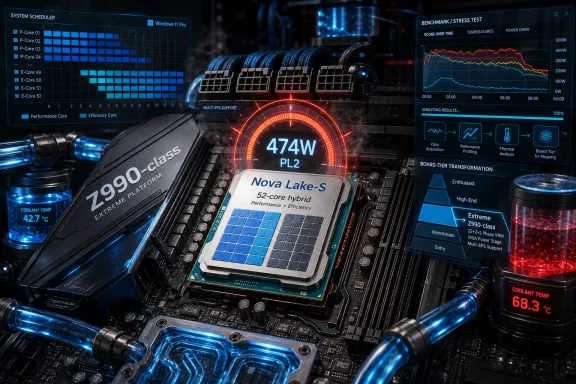
Intel’s rumored Nova Lake-S flagship is now being described as a 52-core desktop part with a 474 W PL2 boost target for high-end Z990-class boards, according to recent reporting on leaked platform power guidance. That number is not a launch specification, and it should be treated as pre-release silicon gossip until Intel says otherwise. But the rumor lands because it fits the shape of the modern desktop CPU fight: Intel trying to claw back enthusiast mindshare with brute-force scale, while AMD sells platform longevity and cache-heavy gaming parts. The real story is not whether one unreleased chip can briefly pull nearly 500 W; it is whether the next desktop generation turns motherboard choice, cooling budget, and socket strategy into the new performance tiers.
A 474 W PL2 figure sounds absurd if you treat it like the everyday power draw of a normal gaming CPU. It makes more sense as a short-term boost allowance for a high-end, possibly overclocking-focused SKU on motherboards built to feed it. Even then, it is a revealing number: Intel appears willing to let its top desktop platform look more like a workstation-adjacent showcase than a restrained consumer socket.
Nova Lake-S has been rumored for months as Intel’s big architectural reset after Arrow Lake, with configurations reaching as high as 52 cores. The expected layout is not 52 identical high-performance cores; it is a hybrid design built from performance cores, efficiency cores, and low-power efficiency cores. That distinction matters, because Intel’s headline core counts now describe a scheduling and power-management puzzle as much as a raw throughput machine.
The leak also points to a platform story. If top Z990 boards are being designed around aggressive power delivery tiers and multiple EPS connectors, Intel is not merely selling a CPU. It is selling a class of system where the motherboard, BIOS policy, cooling loop, and power supply become part of the product.
That is not new in spirit. Enthusiast Intel platforms have long blurred the line between stock behavior and board-vendor opportunism. What is different is the scale: once a client CPU’s boost envelope approaches 500 W, “default” stops feeling like a neutral word.
That history is why the 474 W rumor should not be read as “your gaming PC will constantly burn 474 W at the CPU socket.” It should be read as “Intel and its partners may be preparing a desktop platform where the ceiling is high enough that cooling and board design will decide how much performance the buyer actually sees.” The former is panic bait; the latter is a genuine platform concern.
This matters because modern CPUs no longer have one obvious behavior. The same silicon can behave like a sane desktop processor, a benchmark chaser, or a furnace depending on firmware defaults and user settings. Enthusiasts know this, but normal buyers usually learn it only after their cooler screams under a rendering load.
Intel has already been forced into a more disciplined conversation about power limits after the instability saga around high-end 13th- and 14th-generation Core chips. The lesson from that period was not simply “too much voltage is bad.” It was that motherboard defaults, vendor competition, and vague expectations about unlocked CPUs can create a gray zone where nobody owns the user experience until something breaks.
That is the CPU market in miniature. On one side is the appeal of the best chip for the current workload, even if it means buying into a newer platform. On the other is the economic gravity of a socket that has been around since 2022 and is still being extended.
AMD’s desktop advantage is not merely that Ryzen 9 X3D parts are fast in games or that Ryzen 9 chips are strong in productivity. It is that AM5 has become a trust product. A buyer who purchased a decent AM5 board early in the cycle can plausibly view the next CPU purchase as an upgrade rather than a rebuild.
Intel has rarely competed that way on mainstream desktop. Its cadence has more often pushed buyers toward new boards, new sockets, or at least new chipset assumptions. If Nova Lake-S arrives with LGA 1954 and Z990 as expected, Intel’s pitch will have to be stronger than “new board required, but this time the flagship is enormous.”
This is where Intel still has room to be dangerous. If Intel can deliver strong midrange parts with good memory support, predictable scheduling, and aggressive OEM pricing, it does not need every enthusiast to buy a 52-core monster. It needs the halo part to make the platform exciting while the volume parts win the practical builds.
AMD’s chiplet approach also has tradeoffs that enthusiasts notice. Multi-CCD Ryzen chips can introduce latency asymmetry, cache placement concerns, and workload behavior that depends on whether threads land on the “right” die. AMD has improved this substantially, especially with X3D scheduling and chipset-driver coordination, but the underlying topology is still different from a more monolithic or differently tiled Intel approach.
The irony is that Intel may now be moving toward its own version of that complexity. A dual-compute-tile Nova Lake flagship is not a return to the simple old days of one big client die. It is Intel trying to scale desktop through packaging, tiling, and heterogeneous cores — the same broad industry logic that made AMD’s chiplets successful, only filtered through Intel’s design priorities.
But the same commenter also notes that Intel has cut deeply and that its profits have not returned to the old shape. That matters because desktop enthusiast CPUs are not just products; they are brand signals. When Intel was unquestionably dominant, the halo chip confirmed the market’s default assumption. Now the halo chip has to help rebuild confidence.
Intel’s problem is not that it lacks customers. It is that it has too many strategic battles at once: process recovery, foundry ambitions, AI accelerator relevance, server competitiveness, client platform execution, and cost restructuring. Nova Lake-S is only one piece of that recovery story, but it is a visible one for the Windows enthusiast audience.
For IT pros, the business-client angle cuts both ways. Intel’s platform manageability, validation ecosystem, and OEM depth remain valuable in fleets. Yet power behavior, firmware defaults, and long-term platform support increasingly matter outside gaming forums, because thermals affect acoustics, reliability perception, and support tickets in real deployments.
For a typical gamer, the question is not whether Windows can see 52 cores. It is whether foreground responsiveness, background work, anti-cheat services, launchers, browser tabs, capture software, and game engines all behave sensibly when the CPU is a small city of unequal cores. Enthusiasts can tune; normal users expect the machine to feel fast without a scheduling seminar.
For creators and developers, the appeal is clearer. Compilers, renderers, encoders, virtual machines, and local AI tooling can all benefit from more parallel resources, assuming memory bandwidth and cache behavior do not become the limiting factor. A 52-core desktop part could be compelling for people who want workstation-like throughput without stepping into Xeon or Threadripper pricing and platform costs.
But there is a danger in assuming core count solves every desktop workload. Dual-channel memory has limits. Cache topology has limits. Software licensing sometimes has limits. The machine that wins Cinebench may not be the machine that feels cleanest in a DAW, a low-latency development environment, or a competitive game.
This is where Intel and its partners need to avoid repeating old mistakes. If a CPU’s official behavior depends heavily on board tier, then the buyer deserves plain language about what is guaranteed and what is opportunistic. “Supports Core Ultra 9” is not the same as “sustains the flagship’s advertised boost behavior under heavy all-core loads.”
The enthusiast motherboard market loves oversized VRMs, armored heatsinks, and power-stage numerology. Sometimes those features are useful; sometimes they are expensive theater. A CPU generation that can genuinely stress the platform gives board vendors a better reason to upsell, but it also gives reviewers a better reason to punish vague marketing.
The practical build advice almost writes itself. If someone buys a top Nova Lake-S part, they should budget for the board and cooler as part of the CPU purchase. Treating a near-500 W boost envelope as something a bargain board and a midrange tower cooler will casually absorb is how buyers end up disappointed even when the silicon is doing exactly what it was allowed to do.
A 474 W PL2 target makes cooling part of the performance equation in a brutally direct way. The CPU can only spend time near its upper boost limits if heat can be moved away quickly enough and if the motherboard is willing to keep feeding it. Otherwise, the headline power limit becomes a theoretical ceiling that exists mainly in lab conditions, short bursts, or extreme enthusiast builds.
This is not necessarily a scandal. Modern boost algorithms are designed to exploit available headroom. A chip that opportunistically boosts high and then settles down can be efficient enough in normal mixed use while still looking outrageous in worst-case measurements.
The trouble is messaging. If Intel wants to frame Nova Lake-S as a return to desktop dominance, it cannot let the story become “buy a bigger AIO and hope your board vendor guessed correctly.” The company needs a credible default profile, clear enthusiast profiles, and less ambiguity about what reviewers should test.
The forum comment about already owning three AM5 boards is exactly the kind of thing Intel has to overcome. Once a user has memory, boards, coolers, and known-good BIOS habits, switching platforms becomes less attractive unless the performance delta is obvious. Enthusiasts like novelty, but they also like not wasting money.
AMD’s upgradability story is especially powerful in the midrange, where buyers are more price-sensitive. A user who starts with a Ryzen 5 can later move to a Ryzen 7 X3D or Ryzen 9 without rebuilding the entire system, assuming the board’s firmware and power delivery are up to the task. Intel can win benchmarks and still lose that household-budget argument.
At the same time, AMD should not assume socket longevity excuses weak segmentation. If users feel boxed into expensive 6-core and 8-core options, or if the most attractive gaming chips remain priced like luxury parts, Intel has an opening. Platform loyalty is earned, but it is not unconditional.
The differences matter most at the edges. AMD’s X3D chips can be spectacular in certain games. Intel can be strong in lightly threaded responsiveness, memory tuning, and workloads that like its architecture. AMD’s platform story is better. Intel’s OEM and business ecosystem remains deeper.
That is why a 52-core Nova Lake-S flagship should be judged less as a universal recommendation and more as a statement of intent. Intel wants the desktop conversation to move away from Arrow Lake’s mixed reception and toward a future where it can claim architectural ambition again. A big, hot, expensive flagship can do that, but only if the rest of the stack is coherent.
The danger for Intel is that enthusiasts now have a low tolerance for paper victories. A CPU that wins under exotic cooling, expensive boards, and permissive power limits will impress overclockers but not necessarily persuade mainstream builders. The old “more watts, more frames” bargain is harder to sell when efficiency, acoustics, and platform cost are part of the review conversation.
That means 8-core, 12-core, 16-core, and perhaps 24-core configurations with sane power behavior, fair pricing, and enough platform features to make the Z990 and lower-tier boards feel modern. It also means Intel cannot rely solely on the flagship’s core count to define the generation. A 52-core SKU is exciting, but most buyers will never own it.
The Windows desktop market is full of users sitting on older Intel systems who are ready to upgrade but not desperate. Many are still on 10th-, 11th-, 12th-, or 13th-generation systems that remain usable. Others moved to AM5 and now have a credible upgrade path without leaving AMD.
Intel’s opportunity is to make those users feel that a new platform buys them something durable: better performance, better efficiency, better I/O, better memory support, and fewer BIOS games. If Nova Lake-S instead arrives as another round of “the expensive boards are great and the rest are complicated,” AMD’s socket story gets even stronger.
For WindowsForum readers, the sensible position is neither Intel doomposting nor AMD triumphalism. The right posture is skepticism with a spreadsheet. Wait for launch silicon, independent testing, and firmware maturity before treating any leaked PL2 figure as destiny.
 Intel Is Rebuilding the Halo Chip Around the Wall Socket
A 474 W PL2 figure sounds absurd if you treat it like the everyday power draw of a normal gaming CPU. It makes more sense as a short-term boost allowance for a high-end, possibly overclocking-focused SKU on motherboards built to feed it. Even then, it is a revealing number: Intel appears willing to let its top desktop platform look more like a workstation-adjacent showcase than a restrained consumer socket.Nova Lake-S has been rumored for months as Intel’s big architectural reset after Arrow Lake, with configurations reaching as high as 52 cores. The expected layout is not 52 identical high-performance cores; it is a hybrid design built from performance cores, efficiency cores, and low-power efficiency cores. That distinction matters, because Intel’s headline core counts now describe a scheduling and power-management puzzle as much as a raw throughput machine.
The leak also points to a platform story. If top Z990 boards are being designed around aggressive power delivery tiers and multiple EPS connectors, Intel is not merely selling a CPU. It is selling a class of system where the motherboard, BIOS policy, cooling loop, and power supply become part of the product.
That is not new in spirit. Enthusiast Intel platforms have long blurred the line between stock behavior and board-vendor opportunism. What is different is the scale: once a client CPU’s boost envelope approaches 500 W, “default” stops feeling like a neutral word.
PL2 Was Always a Marketing Number Wearing an Engineering Badge
The power-limit vocabulary around Intel desktop CPUs has been misunderstood for years. PL1 is typically the sustained power level associated with longer-running workloads, while PL2 is the higher short-duration boost level that lets the chip sprint when thermal and electrical conditions allow. Board vendors, reviewers, and users have often complicated that distinction by letting “stock” mean whatever the motherboard enables out of the box.That history is why the 474 W rumor should not be read as “your gaming PC will constantly burn 474 W at the CPU socket.” It should be read as “Intel and its partners may be preparing a desktop platform where the ceiling is high enough that cooling and board design will decide how much performance the buyer actually sees.” The former is panic bait; the latter is a genuine platform concern.
This matters because modern CPUs no longer have one obvious behavior. The same silicon can behave like a sane desktop processor, a benchmark chaser, or a furnace depending on firmware defaults and user settings. Enthusiasts know this, but normal buyers usually learn it only after their cooler screams under a rendering load.
Intel has already been forced into a more disciplined conversation about power limits after the instability saga around high-end 13th- and 14th-generation Core chips. The lesson from that period was not simply “too much voltage is bad.” It was that motherboard defaults, vendor competition, and vague expectations about unlocked CPUs can create a gray zone where nobody owns the user experience until something breaks.
The Forum Argument Gets the Market Right
The WindowsForum thread around the TechPowerUp item is more interesting than the leak itself because it captures the enthusiast market’s actual decision tree. One user argues that AMD’s high-end Ryzen parts and Intel’s modern Core chips are all excellent, but that AMD’s multi-CCD and I/O-die design can still create quirks Intel avoids. Another counters that AMD’s AM5 installed base is now a strategic advantage because many buyers already own boards they can upgrade.That is the CPU market in miniature. On one side is the appeal of the best chip for the current workload, even if it means buying into a newer platform. On the other is the economic gravity of a socket that has been around since 2022 and is still being extended.
AMD’s desktop advantage is not merely that Ryzen 9 X3D parts are fast in games or that Ryzen 9 chips are strong in productivity. It is that AM5 has become a trust product. A buyer who purchased a decent AM5 board early in the cycle can plausibly view the next CPU purchase as an upgrade rather than a rebuild.
Intel has rarely competed that way on mainstream desktop. Its cadence has more often pushed buyers toward new boards, new sockets, or at least new chipset assumptions. If Nova Lake-S arrives with LGA 1954 and Z990 as expected, Intel’s pitch will have to be stronger than “new board required, but this time the flagship is enormous.”
AMD’s Weakness Is Not at the Top
The user comment that AMD has “lost the plot” in the midrange is blunt, but it points at a real tension. AMD’s halo products are easy to defend: 16-core Ryzen 9 chips for heavy multitasking, X3D models for gaming, and a long-lived platform for upgraders. The awkwardness shows up lower in the stack, where 6-core and 8-core parts can feel expensive against years of rising baseline expectations.This is where Intel still has room to be dangerous. If Intel can deliver strong midrange parts with good memory support, predictable scheduling, and aggressive OEM pricing, it does not need every enthusiast to buy a 52-core monster. It needs the halo part to make the platform exciting while the volume parts win the practical builds.
AMD’s chiplet approach also has tradeoffs that enthusiasts notice. Multi-CCD Ryzen chips can introduce latency asymmetry, cache placement concerns, and workload behavior that depends on whether threads land on the “right” die. AMD has improved this substantially, especially with X3D scheduling and chipset-driver coordination, but the underlying topology is still different from a more monolithic or differently tiled Intel approach.
The irony is that Intel may now be moving toward its own version of that complexity. A dual-compute-tile Nova Lake flagship is not a return to the simple old days of one big client die. It is Intel trying to scale desktop through packaging, tiling, and heterogeneous cores — the same broad industry logic that made AMD’s chiplets successful, only filtered through Intel’s design priorities.
Business PCs Keep Intel Alive While Enthusiasts Argue Thermals
One forum participant says Intel is not in trouble as long as it serves “a bazillion business customers.” That is directionally right, but incomplete. Intel’s client business, OEM relationships, vPro footprint, and enterprise inertia remain formidable. Corporate fleets do not turn over because a gaming benchmark chart changed hands.But the same commenter also notes that Intel has cut deeply and that its profits have not returned to the old shape. That matters because desktop enthusiast CPUs are not just products; they are brand signals. When Intel was unquestionably dominant, the halo chip confirmed the market’s default assumption. Now the halo chip has to help rebuild confidence.
Intel’s problem is not that it lacks customers. It is that it has too many strategic battles at once: process recovery, foundry ambitions, AI accelerator relevance, server competitiveness, client platform execution, and cost restructuring. Nova Lake-S is only one piece of that recovery story, but it is a visible one for the Windows enthusiast audience.
For IT pros, the business-client angle cuts both ways. Intel’s platform manageability, validation ecosystem, and OEM depth remain valuable in fleets. Yet power behavior, firmware defaults, and long-term platform support increasingly matter outside gaming forums, because thermals affect acoustics, reliability perception, and support tickets in real deployments.
A 52-Core Desktop CPU Is Also a Windows Scheduler Story
The hardware rumor naturally invites a hardware argument, but a 52-core hybrid desktop processor is also a software-platform test. Windows has improved its handling of Intel’s hybrid architectures since Alder Lake, and Intel’s Thread Director model helped the operating system understand which cores should receive which work. Still, every new core mix adds edge cases.For a typical gamer, the question is not whether Windows can see 52 cores. It is whether foreground responsiveness, background work, anti-cheat services, launchers, browser tabs, capture software, and game engines all behave sensibly when the CPU is a small city of unequal cores. Enthusiasts can tune; normal users expect the machine to feel fast without a scheduling seminar.
For creators and developers, the appeal is clearer. Compilers, renderers, encoders, virtual machines, and local AI tooling can all benefit from more parallel resources, assuming memory bandwidth and cache behavior do not become the limiting factor. A 52-core desktop part could be compelling for people who want workstation-like throughput without stepping into Xeon or Threadripper pricing and platform costs.
But there is a danger in assuming core count solves every desktop workload. Dual-channel memory has limits. Cache topology has limits. Software licensing sometimes has limits. The machine that wins Cinebench may not be the machine that feels cleanest in a DAW, a low-latency development environment, or a competitive game.
The Motherboard Becomes the Performance Contract
If the leaked power guidance is accurate, Nova Lake-S will make motherboard segmentation more visible than ever. A top SKU that can boost toward 474 W on certain boards will inevitably raise the question of what happens on cheaper boards, compact boards, and prebuilts with less ambitious cooling. The answer may be perfectly reasonable, but it must be clearly communicated.This is where Intel and its partners need to avoid repeating old mistakes. If a CPU’s official behavior depends heavily on board tier, then the buyer deserves plain language about what is guaranteed and what is opportunistic. “Supports Core Ultra 9” is not the same as “sustains the flagship’s advertised boost behavior under heavy all-core loads.”
The enthusiast motherboard market loves oversized VRMs, armored heatsinks, and power-stage numerology. Sometimes those features are useful; sometimes they are expensive theater. A CPU generation that can genuinely stress the platform gives board vendors a better reason to upsell, but it also gives reviewers a better reason to punish vague marketing.
The practical build advice almost writes itself. If someone buys a top Nova Lake-S part, they should budget for the board and cooler as part of the CPU purchase. Treating a near-500 W boost envelope as something a bargain board and a midrange tower cooler will casually absorb is how buyers end up disappointed even when the silicon is doing exactly what it was allowed to do.
Cooling Is No Longer an Accessory
The desktop CPU market used to let many users think of cooling as an afterthought. Buy a decent tower, apply paste, move on. That era is not completely gone, but it is shrinking at the top of the stack.A 474 W PL2 target makes cooling part of the performance equation in a brutally direct way. The CPU can only spend time near its upper boost limits if heat can be moved away quickly enough and if the motherboard is willing to keep feeding it. Otherwise, the headline power limit becomes a theoretical ceiling that exists mainly in lab conditions, short bursts, or extreme enthusiast builds.
This is not necessarily a scandal. Modern boost algorithms are designed to exploit available headroom. A chip that opportunistically boosts high and then settles down can be efficient enough in normal mixed use while still looking outrageous in worst-case measurements.
The trouble is messaging. If Intel wants to frame Nova Lake-S as a return to desktop dominance, it cannot let the story become “buy a bigger AIO and hope your board vendor guessed correctly.” The company needs a credible default profile, clear enthusiast profiles, and less ambiguity about what reviewers should test.
AMD’s Platform Promise Is the Quiet Counterattack
AMD’s strongest response to a giant Intel flagship may not be a larger core count. It may be AM5 itself. The socket arrived with Ryzen 7000 in 2022, carried Ryzen 9000, and AMD has now extended its public commitment further into the decade. For many buyers, that is not a footnote; it is the product.The forum comment about already owning three AM5 boards is exactly the kind of thing Intel has to overcome. Once a user has memory, boards, coolers, and known-good BIOS habits, switching platforms becomes less attractive unless the performance delta is obvious. Enthusiasts like novelty, but they also like not wasting money.
AMD’s upgradability story is especially powerful in the midrange, where buyers are more price-sensitive. A user who starts with a Ryzen 5 can later move to a Ryzen 7 X3D or Ryzen 9 without rebuilding the entire system, assuming the board’s firmware and power delivery are up to the task. Intel can win benchmarks and still lose that household-budget argument.
At the same time, AMD should not assume socket longevity excuses weak segmentation. If users feel boxed into expensive 6-core and 8-core options, or if the most attractive gaming chips remain priced like luxury parts, Intel has an opening. Platform loyalty is earned, but it is not unconditional.
The High End Is Competitive Because Both Sides Are Flawed
The most sensible part of the forum discussion is also the least tribal: both AMD and Intel make excellent high-end CPUs, and many users would not notice the difference in blind everyday use. That statement enrages benchmark absolutists, but it is true for a large portion of the market. A modern Ryzen 9, Core i9, or Core Ultra 9-class desktop chip is rarely the bottleneck in browsing, office work, media, and most gaming scenarios.The differences matter most at the edges. AMD’s X3D chips can be spectacular in certain games. Intel can be strong in lightly threaded responsiveness, memory tuning, and workloads that like its architecture. AMD’s platform story is better. Intel’s OEM and business ecosystem remains deeper.
That is why a 52-core Nova Lake-S flagship should be judged less as a universal recommendation and more as a statement of intent. Intel wants the desktop conversation to move away from Arrow Lake’s mixed reception and toward a future where it can claim architectural ambition again. A big, hot, expensive flagship can do that, but only if the rest of the stack is coherent.
The danger for Intel is that enthusiasts now have a low tolerance for paper victories. A CPU that wins under exotic cooling, expensive boards, and permissive power limits will impress overclockers but not necessarily persuade mainstream builders. The old “more watts, more frames” bargain is harder to sell when efficiency, acoustics, and platform cost are part of the review conversation.
The Midrange Will Decide Whether Nova Lake Matters
Halo chips create headlines. Midrange chips create installed bases. If Nova Lake-S is to matter beyond benchmark leaderboards, Intel needs compelling parts below the 52-core flagship.That means 8-core, 12-core, 16-core, and perhaps 24-core configurations with sane power behavior, fair pricing, and enough platform features to make the Z990 and lower-tier boards feel modern. It also means Intel cannot rely solely on the flagship’s core count to define the generation. A 52-core SKU is exciting, but most buyers will never own it.
The Windows desktop market is full of users sitting on older Intel systems who are ready to upgrade but not desperate. Many are still on 10th-, 11th-, 12th-, or 13th-generation systems that remain usable. Others moved to AM5 and now have a credible upgrade path without leaving AMD.
Intel’s opportunity is to make those users feel that a new platform buys them something durable: better performance, better efficiency, better I/O, better memory support, and fewer BIOS games. If Nova Lake-S instead arrives as another round of “the expensive boards are great and the rest are complicated,” AMD’s socket story gets even stronger.
The Windows Enthusiast’s Real Buying Checklist Just Got Longer
The practical takeaway from the 474 W rumor is not that everyone should panic about power supplies. It is that the CPU purchase can no longer be separated from the platform purchase at the high end. The chip, board, BIOS, cooler, case airflow, and workload all determine whether the advertised experience shows up on the desk.For WindowsForum readers, the sensible position is neither Intel doomposting nor AMD triumphalism. The right posture is skepticism with a spreadsheet. Wait for launch silicon, independent testing, and firmware maturity before treating any leaked PL2 figure as destiny.
- The 474 W figure is best understood as a rumored boost limit for high-end dual-tile Nova Lake-S configurations, not as a guaranteed constant power draw in normal use.
- The rumored 52-core design would likely serve as a halo product whose value depends heavily on workload scaling, Windows scheduling, memory behavior, and cooling capacity.
- Motherboard tiering may become a more important part of Intel desktop performance if only premium Z990-class boards are designed to sustain the most aggressive power profiles.
- AMD’s AM5 advantage remains platform trust, because existing owners can weigh future CPU upgrades against the cost of a full Intel platform switch.
- Intel’s real test is the midrange, where pricing, efficiency, and board costs will matter more to most buyers than a near-500 W flagship boost envelope.
- Reviewers should separate Intel baseline behavior from motherboard-enhanced behavior, because “stock” settings have become too slippery to carry the whole argument.
References
- Primary source: TechPowerUp
Published: 2026-06-26T17:30:20.712125
Intel "Nova Lake-S" 52-Core OC SKU to Draw 474 W in PL2 Mode | TechPowerUp
Intel's next-generation "Nova Lake" CPU microarchitecture is shaping up to be quite power-hungry. According to the latest leak, confirmed by well-known Intel leaker Jaykihn, Intel's top-end, overclocking-focused, dual compute die "Nova Lake-S" CPU with 52 cores will feature a PL2 mode with a...www.techpowerup.com - Related coverage: tweaktown.com
Intel's dual-tile Nova Lake-S CPUs reportedly carry a 474W PL2 target, according to leaked Z990 power guidance
The 474W PL2 applies to dual tile Nova Lake-S chips with up to 52 cores, with Z990 boards segmented into power tiers to manage performance profiles. www.tweaktown.com
- Related coverage: tomshardware.com
Intel's Nova Lake CPU reportedly has up to 52 cores — Coyote Cove P-cores and Arctic Wolf E-cores onboard | Tom's Hardware
More than twice the core count of the 285K.www.tomshardware.com - Related coverage: pcgamesn.com
A new Intel gaming CPU with a whopping 52 cores has just been spotted - PCGamesN
A shipping manifest has hinted at the possibility of a future Intel Nova Lake gaming CPU with 52 cores, alongside a 28-core option.www.pcgamesn.com - Related coverage: gazlog.jp
Intel Nova Lake-S 52コア最上位の定格PL2は474W判明。Z990は8-pin×3対応へ
Intel Nova Lake-Sの最上位52コアモデルにおける定格PL2が474Wに設定される見通しであることが、リーカーのLC Tech Leaks氏(@laurentschoice)の投稿で明らかになりました。あわせてZ990プラットフォームでは、8-pingazlog.jp - Related coverage: notebookcheck.net
Rumor: Intel Nova Lake desktop CPUs will have up to 52 cores, more than previously expected - Notebookcheck News
Intel’s CPU roadmap for the next few years is said to include its Nova Lake CPUs, Arrow Lake Refresh, and Panther Lake chips. The Nova Lake chips may bring more than double the core count, if the latest rumors are to be believed. www.notebookcheck.net
- Related coverage: wccftech.com
Intel Nova Lake Dual-Tile CPUs Reportedly Feature Up To 474W PL2 Power Limit
Intel's Nova Lake flagship may push PL2 power to 474W with a 52-core setup, featuring a revised Z990 design and three 8-pin connectors.wccftech.com - Related coverage: pcgamer.com
Nova Lake shipping manifest confirms rumours that Intel's flagship CPU will be packing up to 52 cores, but more cores aren't all Intel needs | PC Gamer
Catching up to AMD will take a big effort.www.pcgamer.com - Related coverage: tweakers.net
Gerucht: Intel Nova Lake-topmodellen verstoken tijdens boosten maximaal 474W
Intels volgende cpu-serie, Nova Lake, heeft mogelijk een fors hogere PL2-limiet. Dat wil zeggen dat bepaalde processors in die serie heel even 474W mogen verstoken. Bij de huidige Arrow Lake-generatie lag die limiet standaard op maximaal 250W.tweakers.net
- Related coverage: ashgabattimes.com
- Related coverage: macrotrends.net

Intel Financial Statements 2011-2026 | INTC | MacroTrends
Ten years of annual and quarterly financial statements and annual report data for Intel (INTC). Income statements, balance sheets, cash flow statements and key ratios.
www.macrotrends.net
- Related coverage: techradar.com
Intel slashes even more workers to help meet 20% workforce cut goal | TechRadar
Intel is laying off even more workerswww.techradar.com - Related coverage: download.intel.com
