

NVIDIA has introduced its Agent Toolkit for DGX Station, bundling local AI-agent software, a large Nemotron model, Omniverse libraries and a sandboxed runtime for the company’s GB300-based deskside system. Wccftech reported the rollout on July 20, while NVIDIA detailed the stack as part of its SIGGRAPH announcements.
The important qualification for Windows users and IT administrators is that this is not a new Windows AI feature or a toolkit for conventional workstation PCs. DGX Station GB300 is an ARM-based Linux appliance-class workstation, and NVIDIA’s current NemoClaw onboarding documentation targets DGX OS and qualified Ubuntu 24.04 ARM64 hosts. Windows systems may remain part of a wider networked workflow, but they are not the host platform for this local deployment.
NVIDIA Agent Toolkit combines four pieces:
That distinction matters. NVIDIA is selling a tightly controlled hardware-and-software combination, not a general-purpose installer that turns an existing Windows AI PC into a local 550B-model agent server.
The DGX Station hardware is designed for this scale: NVIDIA quotes up to 20 petaflops of FP4 AI performance and 748GB of coherent memory for the GB300 Grace Blackwell Ultra Desktop Superchip. That is far beyond the GPU and memory budgets of typical Windows workstations, including high-end systems built around a single consumer or professional GPU.
For creative and engineering shops, Omniverse is the differentiator. An agent can be connected to simulation and 3D-asset workflows rather than being limited to text, code and document retrieval. NVIDIA also says it is working with software partners on Model Context Protocol connections, which could let agents interact with tools used for scenes, timelines, assets and edits.
Windows admins do not need to change anything for existing PCs; the immediate next step is for prospective DGX Station buyers to validate the still-maturing deployment path against their Linux, networking and security standards.
The important qualification for Windows users and IT administrators is that this is not a new Windows AI feature or a toolkit for conventional workstation PCs. DGX Station GB300 is an ARM-based Linux appliance-class workstation, and NVIDIA’s current NemoClaw onboarding documentation targets DGX OS and qualified Ubuntu 24.04 ARM64 hosts. Windows systems may remain part of a wider networked workflow, but they are not the host platform for this local deployment.
 A local agent stack for a very specific machine
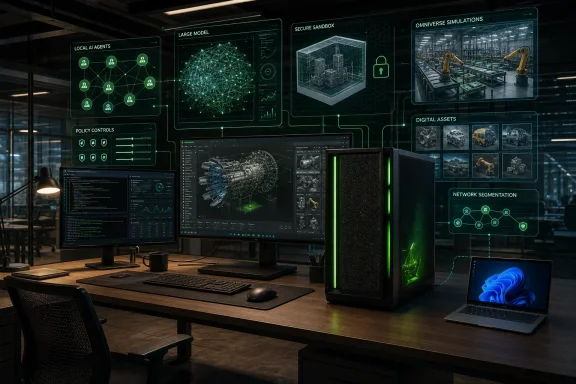
NVIDIA Agent Toolkit combines four pieces:- NemoClaw, NVIDIA’s agent blueprints and deployment tooling.
- Nemotron 3 Ultra, a 550-billion-parameter open model optimized for DGX Station.
- Omniverse libraries, exposed as tools for 3D, simulation and physical-AI workflows.
- OpenShell, an open-source runtime intended to sandbox agents and apply policies to their access to tools, systems and data.
That distinction matters. NVIDIA is selling a tightly controlled hardware-and-software combination, not a general-purpose installer that turns an existing Windows AI PC into a local 550B-model agent server.
Why NVIDIA is pushing it
The pitch is privacy, predictable cost and access to very large local models. Rather than sending prompts, internal documents or 3D assets to a hosted API, teams can run the model, agent runtime and associated tools on equipment they control. NVIDIA says the platform can also link up to two DGX Station systems for larger models, more concurrent users or additional agents.The DGX Station hardware is designed for this scale: NVIDIA quotes up to 20 petaflops of FP4 AI performance and 748GB of coherent memory for the GB300 Grace Blackwell Ultra Desktop Superchip. That is far beyond the GPU and memory budgets of typical Windows workstations, including high-end systems built around a single consumer or professional GPU.
For creative and engineering shops, Omniverse is the differentiator. An agent can be connected to simulation and 3D-asset workflows rather than being limited to text, code and document retrieval. NVIDIA also says it is working with software partners on Model Context Protocol connections, which could let agents interact with tools used for scenes, timelines, assets and edits.
What admins should do
Organizations evaluating the stack should treat it as an early, Linux-based AI infrastructure deployment. Review the supported DGX OS or Ubuntu configuration, GPU-container requirements, model-storage needs and OpenShell policy model before exposing it to internal data or production tools.Windows admins do not need to change anything for existing PCs; the immediate next step is for prospective DGX Station buyers to validate the still-maturing deployment path against their Linux, networking and security standards.
References
- Primary source: Wccftech
Published: 2026-07-20T15:00:13+00:00
NVIDIA Brings Local AI Agents To Its Most Powerful Workstation PC, The DGX Station, With The NVIDIA Agent Toolkit & Omniverse
NVIDIA enables DGX Station users to run personal AI agents locally through its NVIDIA Agent Toolkit, which can be set up in just three steps.wccftech.com
- Related coverage: developer.nvidia.com
Building an Analysis AI Agent for Industrial Alarm Management with NVIDIA Nemotron | NVIDIA Technical Blog
Industrial machinery generates more alarms than technicians can triage. For each important alarm requiring follow-up, the technician pulls historical context…developer.nvidia.com
- Related coverage: nvidia.com
Events
Learn how to leverage NVIDIA Nemotron to build smarter and more secure AI agents in the OpenClaw era.www.nvidia.com
