

Nvidia is expected to unveil new Arm-based chipsets for Windows 11 PCs on Monday, June 1, 2026, at Computex in Taipei, with Microsoft, Dell, and possibly Surface hardware reportedly attached to the launch. The real story is not simply that another silicon vendor wants into laptops. It is that Windows on Arm may finally be moving from a Qualcomm-led experiment into a competitive PC platform. If the leaks are directionally right, Microsoft is about to test whether Windows can absorb a second Arm supplier without repeating the fragmentation, app-compatibility anxiety, and overpromising that have haunted this effort since Surface RT.
The leaked Nvidia PC push sounds, at first, like a familiar Computex ritual: a major silicon vendor teases a keynote, OEM names begin to circulate, and the hardware press starts reconstructing a product stack from scraps. But this one lands differently because Nvidia has not been just another PC component supplier for years. It has become the company defining the economics and vocabulary of modern AI infrastructure, while the Windows PC has spent two years trying to make “AI PC” mean something more concrete than a sticker.
That tension is why the phrase “A new era of PC” matters even if it is marketing vapor in its purest form. Nvidia, Microsoft, and Arm all teasing the same message ahead of Computex is not subtle. The coordinates reportedly point to Taipei, and the timing lines up with Jensen Huang’s annual talent for turning a hardware show into a statement of industry direction.
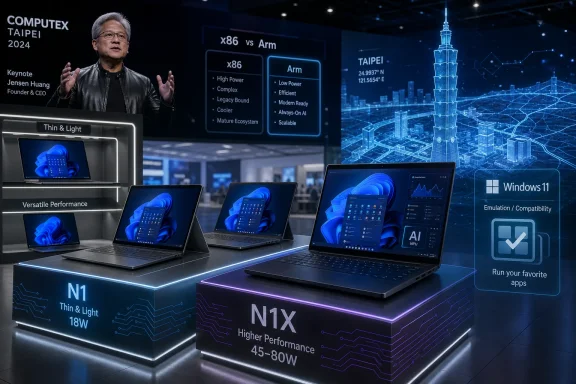
The leaks describe two broad families, N1 and N1X, with different CPU and CUDA configurations, memory ranges, and power envelopes. The lower-power N1 parts allegedly sit in the same thin-and-light territory that Qualcomm’s Snapdragon X chips have occupied. The higher-power N1X parts, if the reported 45-to-80-watt range is accurate, suggest a more aggressive play: laptops and desktops where Windows on Arm has never been credible because the GPU side, gaming story, and professional workloads were too compromised.
That is the crux. Qualcomm proved that Windows on Arm could ship in premium laptops without feeling like a science project. Nvidia’s rumored entrance would ask a harder question: can Windows on Arm become broad enough to support different classes of PCs, from battery-first ultraportables to machines that unapologetically trade watts for graphics and AI performance?
That was always going to be a strategic problem. If Windows on Arm is the future of the Windows laptop, it cannot depend on Qualcomm alone. OEMs want leverage, users want choice, developers want a stable target, and enterprises want assurances that the platform will not become another niche branch of Windows whose roadmap is effectively negotiated by two companies behind closed doors.
The long-rumored Microsoft-Qualcomm exclusivity arrangement has never been publicly confirmed in the way forum warriors would like. Still, the market behaved for years as if Qualcomm had the run of the place. Other Arm PC efforts failed to materialize, Nvidia rumors came and went, and Windows on Arm remained more of a Qualcomm category than a Windows category.
That is why a Microsoft-backed Nvidia launch would be more important than the first benchmarks. It would signal that Microsoft is trying to turn Windows on Arm into an ecosystem rather than a product line. In the PC business, ecosystems are built by allowing rivals to compete on the same platform, not by asking customers to believe that one vendor’s roadmap is destiny.
There is also a defensive angle. Apple’s transition to its own Arm-based Mac chips showed what happens when hardware, operating system, and developer incentives line up. Microsoft cannot replicate Apple’s vertical model without destroying the Windows value proposition. Its alternative is messier but potentially stronger: make Arm just another competitive lane inside the Windows hardware market.
Surface RT’s problem was not that Arm was inherently wrong for Windows. It was that the surrounding ecosystem was not ready. Desktop Windows software did not run in the way users expected, the Windows Store did not fill the gap, and the Metro app model arrived with more ideology than developer momentum. Microsoft had a plausible technical argument but a weak customer argument.
The 2026 version is different in several important ways. Windows 11 on Arm can run many existing Windows apps through emulation, developers have had years of pressure to produce Arm64 builds, and the market has already accepted that premium laptops can use Arm without being toys. The question is no longer whether Windows on Arm can function at all. The question is whether it can function invisibly enough that customers stop caring what instruction set is under the keyboard.
That is a higher bar than it sounds. PC buyers do not reward architectural progress if it creates new compatibility chores. They reward quieter machines, longer battery life, better performance, and fewer unpleasant surprises. Every Arm Windows launch has to fight the same old customer suspicion: “Will my stuff work?”
Nvidia’s reputation cuts both ways here. On one hand, it brings instant credibility in graphics, AI acceleration, and developer tooling. On the other hand, Nvidia entering the Windows CPU market will raise expectations for gaming and creative workloads far beyond what Qualcomm’s first Copilot+ PC wave had to answer. If an N1X machine carries the aura of GeForce and CUDA, users will not grade it like a polite office laptop.
The N1X tier is where the story becomes more disruptive. A Windows on Arm chip that allegedly scales to much higher power envelopes and up to far larger memory configurations would imply that Nvidia is not only chasing the MacBook Air comparison. It may be aiming at devices closer to gaming laptops, mobile workstations, creator machines, or compact desktops.
That would be a meaningful departure from the first wave of Copilot+ PCs. Microsoft’s 40-TOPS NPU requirement framed AI PCs around local neural processing, but the early devices were still laptop-first, battery-first, and mostly productivity-first. Nvidia’s natural advantage is not just an NPU block that clears a Microsoft spec. It is the broader GPU and AI software stack that developers already associate with acceleration.
If Nvidia can bring CUDA-like gravity to Windows on Arm PCs, the platform conversation changes. Suddenly, the value proposition is not just “an Arm laptop that runs Windows well enough.” It becomes “a Windows machine where local AI, graphics, and battery-conscious CPU performance are designed together.” That is the sort of pitch Microsoft has wanted for Copilot+ PCs but has not fully delivered in a way ordinary users can feel.
There is a catch, of course. The PC market is littered with ambitious segmentation charts that never translate into clean products. Higher-power Arm laptops will still need drivers, game compatibility, anti-cheat support, creative app optimization, peripheral reliability, and firmware maturity. Nvidia can solve some of those problems, Microsoft can solve others, and OEMs can still ruin the experience with thermals, pricing, and confusing SKUs.
But the arrival of Nvidia would change Qualcomm’s position from category owner to category incumbent. That is a very different role. Qualcomm would have to compete not just against Intel and AMD in the broader laptop market, but against Nvidia inside the Arm Windows lane it helped create.
That competition could be healthy for Windows users. Qualcomm’s strengths are efficiency, integration, modem heritage, and increasingly respectable CPU performance. Nvidia’s likely strengths are GPU compute, AI software, gaming mindshare, and high-performance system design. Those are not identical value propositions, which means Windows on Arm could finally stop being a single flavor of machine.
The risk is that Microsoft’s messaging gets even muddier. The company already asks consumers to distinguish between Windows 11 PCs, AI PCs, Copilot+ PCs, Arm PCs, and traditional x86 machines with NPUs. Add Nvidia Arm PCs with different GPU capabilities and possibly different feature availability, and the retail shelf could become a taxonomy exam.
For enthusiasts and IT pros, that complexity is manageable. For everyone else, it is where Windows has historically struggled. Apple sells a simple promise: the Mac runs macOS on Apple silicon. Microsoft sells a marketplace. That marketplace is powerful, but only if the differences create choice rather than confusion.
That does not mean users are buying the premise yet. The AI PC pitch has been ahead of the daily value for many customers. Live captions, image generation, background effects, Recall-style search, and local assistants may be useful, but they have not produced the same obvious pull as better battery life or a sharper display. For admins, local AI is often less exciting than the governance, privacy, patching, and support questions it creates.
Nvidia gives Microsoft a better chance to make local AI feel real because Nvidia’s brand is already tied to accelerated compute. Developers know its tools. Enthusiasts understand its GPUs. Enterprises deploying AI workloads already see Nvidia as the default supplier. If that halo reaches Windows PCs, Microsoft’s “AI runs locally” pitch may become more credible.
Still, the first practical question will be boring: does the machine run the software people use? That includes browsers, Office, Teams, VPN clients, endpoint security agents, printer utilities, CAD tools, games, launchers, plug-ins, audio software, and strange legacy line-of-business apps written by a contractor nobody can find. Windows on Arm succeeds when the answer is yes often enough that the architecture disappears.
This is where Nvidia cannot rely on brand alone. A high-performance Arm SoC with a strong GPU will not matter if users hit emulation cliffs, driver gaps, or unsupported kernel-level components. The Windows ecosystem’s strength is also its burden: it includes decades of assumptions made by software that expected x86 Windows forever.
Surface would matter in a different way. Microsoft’s own hardware division is where Windows bets become visible. Surface RT made Windows on Arm infamous; Surface Pro X kept the idea alive but did not fully erase skepticism; Surface Laptop with Snapdragon X helped normalize the modern Copilot+ wave. A Surface device with Nvidia silicon would be Microsoft saying the platform is ready for another public test.
OEM breadth will be crucial. If Nvidia-powered Windows PCs appear only in halo designs, the launch will be interesting but limited. If Dell, Microsoft, Lenovo, ASUS, HP, and others begin spacing Nvidia Arm systems across categories, then Windows on Arm becomes a roadmap rather than an event.
There is also a pricing question that leaks rarely answer well. Windows on Arm cannot live only at the premium end if its argument is efficiency and modern architecture. But Nvidia silicon is unlikely to be positioned as bargain-bin hardware, especially if the N1X tier leans into gaming, workstation, or AI-heavy use cases. The danger is a platform that wants mainstream relevance but launches in configurations priced for early adopters.
That danger is familiar. The PC industry often introduces architectural transitions through expensive machines and then wonders why adoption looks slow. If Microsoft and Nvidia want this to be more than a Computex headline, they need products that make sense to people who are not buying the future as a hobby.
For Intel, the threat is symbolic as much as technical. The Windows PC was effectively built around Intel compatibility for decades. Even when AMD competed fiercely, the architecture itself remained stable. Windows on Arm challenges that foundation by telling customers that Windows compatibility no longer has to mean x86 hardware.
For AMD, the threat is more tactical. AMD has gained credibility in laptops and desktops by offering strong CPU and GPU combinations, but Nvidia entering the SoC market could pressure exactly that integrated-performance story. If Nvidia can offer credible CPU performance with far stronger graphics and AI acceleration, some OEM design wins become harder fights.
The counterargument is obvious: x86 still owns compatibility. For many buyers, especially enterprises and gamers, that is not a small advantage. Intel and AMD systems run the widest range of Windows software with the fewest caveats, and that remains decisive in many environments.
But platform transitions do not happen all at once. They happen when the new thing becomes good enough in enough categories, then superior in a few visible ones. Apple did not need Arm Macs to win every workload immediately. It needed them to be unmistakably better for enough users that developer momentum followed. Microsoft is trying to create a messier, multi-vendor version of that shift.
Nvidia has the best possible brand to attempt the move. GeForce is the default mental model for PC gaming performance, and Nvidia’s software stack, upscaling technologies, and driver cadence are part of that identity. A Windows on Arm gaming laptop with Nvidia graphics would be far easier to market than one from a company without that history.
But the Arm layer complicates everything. Modern PC gaming is not just DirectX rendering. It is launchers, overlays, kernel anti-cheat systems, mod loaders, controller utilities, capture tools, and years of assumptions embedded in game engines and middleware. Even if raw GPU performance is excellent, compatibility can become the story overnight.
That is why the first N1X gaming claims, if they arrive, should be read carefully. The right launch strategy would show specific games, specific performance numbers, and specific compatibility commitments. The wrong strategy would wave at “AI gaming” and “RTX-class experiences” while avoiding the messy list of what actually runs.
For WindowsForum readers, this is where skepticism is not cynicism. Windows on Arm does not get to inherit the PC gaming library by association. It has to earn it title by title, driver by driver, and update by update.
The first question for admins will be lifecycle confidence. How long will these devices receive firmware updates? How quickly will Nvidia, Microsoft, and OEMs patch platform-level vulnerabilities? Will drivers arrive through predictable channels? Will existing endpoint protection behave correctly on Arm? Will hardware attestation, virtualization-based security, and management tooling work without special-case documentation?
The second question is app estate risk. Many organizations still depend on Win32 applications that are poorly documented, rarely updated, or tied to drivers and plug-ins that nobody wants to touch. Emulation can be impressive and still fail the one application a department considers mission-critical. That makes pilot programs likely, mass deployments slower.
The third question is AI governance. Local agents sound appealing, but enterprises will want to know what data they can access, where logs are stored, how policies constrain them, and whether local models become another surface for data leakage. Microsoft’s recent history with AI features has made IT departments more sensitive, not less, to rollout details.
Nvidia’s presence could reassure some enterprise buyers because the company is deeply embedded in AI infrastructure. But laptop fleet management is not data-center acceleration. The boring work of enterprise readiness will determine whether these machines become executive toys or standard-issue hardware.
Yet the Windows ecosystem is not a curated garden. It is a sprawling city with old wiring, illegal additions, brilliant architecture, and a surprising number of doors that only open if a 2009 driver is installed. That is why compatibility debates around Windows on Arm never fully go away.
Developers will respond to market size. If Nvidia-powered devices sell in meaningful numbers, more native Arm64 builds will follow. If Microsoft and OEMs seed the market with compelling hardware but weak volume, developers will prioritize other work. The platform has to create its own inevitability.
Nvidia may help by bringing developers who care about AI and GPU compute. A local AI workstation running Windows on Arm could attract experimentation from people who would not have bothered with a Snapdragon ultrabook. But that does not automatically solve consumer software gaps or enterprise legacy needs.
The most important thing Microsoft can do is make Arm a normal Windows target. Not exotic, not “coming soon,” not “works except when it doesn’t,” but normal. Nvidia’s entry could accelerate that normalization, provided the launch does not create a second compatibility matrix inside the first.
The leak’s power figures, if accurate, imply a range of devices that should not be judged by one standard. An 18-watt thin-and-light N1 laptop should be measured against Snapdragon X, Intel Lunar Lake-class systems, AMD ultraportables, and MacBook Air-like expectations. A 45-to-80-watt N1X machine should be judged against gaming laptops, mobile workstations, and creator systems where performance consistency matters more than idle efficiency.
That distinction matters because Windows on Arm discourse tends to collapse into a single verdict. Either it is “finally ready” or “still not ready.” Real platforms are messier. The lower-power devices might be excellent travel laptops while the higher-power devices struggle with gaming compatibility. Or the N1X machines might demonstrate why Nvidia entered the market while the lower-tier devices look redundant next to Qualcomm.
Microsoft will need discipline in how it positions these machines. If every device is sold as an AI revolution, users will grade them against an abstract promise. If each device is sold for a specific job, the market can decide where Nvidia silicon actually makes sense.
The early review cycle will also reveal how much of this is Nvidia silicon and how much is Microsoft platform work. Good hardware can be undermined by Windows quirks. Good Windows work can be wasted by poor OEM execution. The PC ecosystem is a team sport in which every participant can still fumble at the goal line.
The more realistic shift is that the PC stops being architecturally monolithic. Windows may increasingly span x86 laptops, Arm ultraportables, Arm AI workstations, handhelds, cloud-connected devices, and desktops where the processor architecture matters less than the experience layer above it. That is not as clean as Apple’s transition, but it is more consistent with Windows history.
The PC has always been a negotiated standard. IBM created the template, clones expanded it, Intel and Microsoft profited from it, AMD competed inside it, and OEMs differentiated around it. Nvidia entering the Windows CPU market would be another renegotiation of who gets to define performance, compatibility, and value.
The AI wave adds urgency because local compute is becoming a selling point again. For years, the industry pushed workloads to the cloud and treated the client as a relatively thin endpoint. Now vendors want PCs to run models locally, preserve privacy, reduce latency, and provide agent-like features without round-tripping every action to a data center. That makes silicon strategy matter again in a way ordinary buyers can eventually feel.
Still, the PC’s identity is not the chip. It is the expectation that users can buy hardware from many vendors, run the software they need, attach the peripherals they own, and keep control of the machine. Nvidia’s challenge is to strengthen that promise, not replace it with another locked-down vision wearing Windows clothes.
If Monday’s reveal delivers what the leaks suggest, it will not instantly remake the PC market. It will instead start a more consequential test: whether Microsoft can coordinate silicon vendors, OEMs, developers, and its own Windows roadmap well enough to make Arm feel like a normal part of the PC rather than a recurring side quest. That is the real “new era” to watch—not the slogan on a teaser, but the possibility that Windows finally becomes architecture-flexible without asking users to notice.
 Nvidia’s Return Is a Platform Story Disguised as a Chip Leak
The leaked Nvidia PC push sounds, at first, like a familiar Computex ritual: a major silicon vendor teases a keynote, OEM names begin to circulate, and the hardware press starts reconstructing a product stack from scraps. But this one lands differently because Nvidia has not been just another PC component supplier for years. It has become the company defining the economics and vocabulary of modern AI infrastructure, while the Windows PC has spent two years trying to make “AI PC” mean something more concrete than a sticker.That tension is why the phrase “A new era of PC” matters even if it is marketing vapor in its purest form. Nvidia, Microsoft, and Arm all teasing the same message ahead of Computex is not subtle. The coordinates reportedly point to Taipei, and the timing lines up with Jensen Huang’s annual talent for turning a hardware show into a statement of industry direction.
The leaks describe two broad families, N1 and N1X, with different CPU and CUDA configurations, memory ranges, and power envelopes. The lower-power N1 parts allegedly sit in the same thin-and-light territory that Qualcomm’s Snapdragon X chips have occupied. The higher-power N1X parts, if the reported 45-to-80-watt range is accurate, suggest a more aggressive play: laptops and desktops where Windows on Arm has never been credible because the GPU side, gaming story, and professional workloads were too compromised.
That is the crux. Qualcomm proved that Windows on Arm could ship in premium laptops without feeling like a science project. Nvidia’s rumored entrance would ask a harder question: can Windows on Arm become broad enough to support different classes of PCs, from battery-first ultraportables to machines that unapologetically trade watts for graphics and AI performance?
Microsoft Needed a Second Arm Champion More Than Nvidia Needed a Laptop Chip
For Microsoft, this is less about Nvidia specifically than about escaping a single-supplier narrative. The Snapdragon X launch gave Windows on Arm a far more serious foundation than the platform had enjoyed in its earlier lives, helped by better performance, better battery life, and Microsoft’s Prism emulation layer. But the optics remained awkward. Windows is supposed to be the horizontal ecosystem, yet its most visible Arm revival was tightly associated with one silicon vendor.That was always going to be a strategic problem. If Windows on Arm is the future of the Windows laptop, it cannot depend on Qualcomm alone. OEMs want leverage, users want choice, developers want a stable target, and enterprises want assurances that the platform will not become another niche branch of Windows whose roadmap is effectively negotiated by two companies behind closed doors.
The long-rumored Microsoft-Qualcomm exclusivity arrangement has never been publicly confirmed in the way forum warriors would like. Still, the market behaved for years as if Qualcomm had the run of the place. Other Arm PC efforts failed to materialize, Nvidia rumors came and went, and Windows on Arm remained more of a Qualcomm category than a Windows category.
That is why a Microsoft-backed Nvidia launch would be more important than the first benchmarks. It would signal that Microsoft is trying to turn Windows on Arm into an ecosystem rather than a product line. In the PC business, ecosystems are built by allowing rivals to compete on the same platform, not by asking customers to believe that one vendor’s roadmap is destiny.
There is also a defensive angle. Apple’s transition to its own Arm-based Mac chips showed what happens when hardware, operating system, and developer incentives line up. Microsoft cannot replicate Apple’s vertical model without destroying the Windows value proposition. Its alternative is messier but potentially stronger: make Arm just another competitive lane inside the Windows hardware market.
The Ghost of Surface RT Still Haunts This Announcement
Nvidia has been here before, and Microsoft remembers the scars. The original Surface RT launched in October 2012 with Nvidia’s Tegra 3, a premium-feeling Windows tablet that looked enough like a PC to confuse buyers and ran too little traditional Windows software to satisfy them. It was not merely a bad product-market fit. It was a lesson in how dangerous it is to borrow the Windows brand while quietly changing the rules.Surface RT’s problem was not that Arm was inherently wrong for Windows. It was that the surrounding ecosystem was not ready. Desktop Windows software did not run in the way users expected, the Windows Store did not fill the gap, and the Metro app model arrived with more ideology than developer momentum. Microsoft had a plausible technical argument but a weak customer argument.
The 2026 version is different in several important ways. Windows 11 on Arm can run many existing Windows apps through emulation, developers have had years of pressure to produce Arm64 builds, and the market has already accepted that premium laptops can use Arm without being toys. The question is no longer whether Windows on Arm can function at all. The question is whether it can function invisibly enough that customers stop caring what instruction set is under the keyboard.
That is a higher bar than it sounds. PC buyers do not reward architectural progress if it creates new compatibility chores. They reward quieter machines, longer battery life, better performance, and fewer unpleasant surprises. Every Arm Windows launch has to fight the same old customer suspicion: “Will my stuff work?”
Nvidia’s reputation cuts both ways here. On one hand, it brings instant credibility in graphics, AI acceleration, and developer tooling. On the other hand, Nvidia entering the Windows CPU market will raise expectations for gaming and creative workloads far beyond what Qualcomm’s first Copilot+ PC wave had to answer. If an N1X machine carries the aura of GeForce and CUDA, users will not grade it like a polite office laptop.
The N1 and N1X Split Hints at a More Ambitious Windows on Arm Map
The most interesting part of the leak is the alleged product segmentation. A basic N1 tier with lower power draw and smaller memory configurations sounds like a conventional Arm PC play: efficient laptops, long standby, thin designs, and mainstream productivity. That is the market Qualcomm has spent years trying to normalize.The N1X tier is where the story becomes more disruptive. A Windows on Arm chip that allegedly scales to much higher power envelopes and up to far larger memory configurations would imply that Nvidia is not only chasing the MacBook Air comparison. It may be aiming at devices closer to gaming laptops, mobile workstations, creator machines, or compact desktops.
That would be a meaningful departure from the first wave of Copilot+ PCs. Microsoft’s 40-TOPS NPU requirement framed AI PCs around local neural processing, but the early devices were still laptop-first, battery-first, and mostly productivity-first. Nvidia’s natural advantage is not just an NPU block that clears a Microsoft spec. It is the broader GPU and AI software stack that developers already associate with acceleration.
If Nvidia can bring CUDA-like gravity to Windows on Arm PCs, the platform conversation changes. Suddenly, the value proposition is not just “an Arm laptop that runs Windows well enough.” It becomes “a Windows machine where local AI, graphics, and battery-conscious CPU performance are designed together.” That is the sort of pitch Microsoft has wanted for Copilot+ PCs but has not fully delivered in a way ordinary users can feel.
There is a catch, of course. The PC market is littered with ambitious segmentation charts that never translate into clean products. Higher-power Arm laptops will still need drivers, game compatibility, anti-cheat support, creative app optimization, peripheral reliability, and firmware maturity. Nvidia can solve some of those problems, Microsoft can solve others, and OEMs can still ruin the experience with thermals, pricing, and confusing SKUs.
Qualcomm Is No Longer the Whole Windows on Arm Story
Qualcomm should not be written out of the story. Snapdragon X did the hard work of making Windows on Arm feel plausible to mainstream reviewers and buyers. The company pushed battery life, integrated NPUs, and Arm-native app momentum into the Windows conversation at a time when Intel and AMD were still adjusting their AI PC messaging.But the arrival of Nvidia would change Qualcomm’s position from category owner to category incumbent. That is a very different role. Qualcomm would have to compete not just against Intel and AMD in the broader laptop market, but against Nvidia inside the Arm Windows lane it helped create.
That competition could be healthy for Windows users. Qualcomm’s strengths are efficiency, integration, modem heritage, and increasingly respectable CPU performance. Nvidia’s likely strengths are GPU compute, AI software, gaming mindshare, and high-performance system design. Those are not identical value propositions, which means Windows on Arm could finally stop being a single flavor of machine.
The risk is that Microsoft’s messaging gets even muddier. The company already asks consumers to distinguish between Windows 11 PCs, AI PCs, Copilot+ PCs, Arm PCs, and traditional x86 machines with NPUs. Add Nvidia Arm PCs with different GPU capabilities and possibly different feature availability, and the retail shelf could become a taxonomy exam.
For enthusiasts and IT pros, that complexity is manageable. For everyone else, it is where Windows has historically struggled. Apple sells a simple promise: the Mac runs macOS on Apple silicon. Microsoft sells a marketplace. That marketplace is powerful, but only if the differences create choice rather than confusion.
Local AI Is the Sales Pitch, but Compatibility Is the Purchase Decision
Microsoft will almost certainly wrap the Nvidia news in local AI. The company has spent the Copilot+ era arguing that more AI work should happen on-device, enabled by NPUs and increasingly capable local models. Reports that Microsoft will discuss AI agents running locally on these PCs fit the pattern.That does not mean users are buying the premise yet. The AI PC pitch has been ahead of the daily value for many customers. Live captions, image generation, background effects, Recall-style search, and local assistants may be useful, but they have not produced the same obvious pull as better battery life or a sharper display. For admins, local AI is often less exciting than the governance, privacy, patching, and support questions it creates.
Nvidia gives Microsoft a better chance to make local AI feel real because Nvidia’s brand is already tied to accelerated compute. Developers know its tools. Enthusiasts understand its GPUs. Enterprises deploying AI workloads already see Nvidia as the default supplier. If that halo reaches Windows PCs, Microsoft’s “AI runs locally” pitch may become more credible.
Still, the first practical question will be boring: does the machine run the software people use? That includes browsers, Office, Teams, VPN clients, endpoint security agents, printer utilities, CAD tools, games, launchers, plug-ins, audio software, and strange legacy line-of-business apps written by a contractor nobody can find. Windows on Arm succeeds when the answer is yes often enough that the architecture disappears.
This is where Nvidia cannot rely on brand alone. A high-performance Arm SoC with a strong GPU will not matter if users hit emulation cliffs, driver gaps, or unsupported kernel-level components. The Windows ecosystem’s strength is also its burden: it includes decades of assumptions made by software that expected x86 Windows forever.
Dell and Surface Would Turn a Leak Into a Market Signal
The reported involvement of Dell matters because Dell is not a boutique validator. When Dell attaches a major PC line to a new platform, enterprise buyers pay attention even if they do not buy the first generation. Dell’s presence would imply that Nvidia’s PC silicon is not being treated as a curiosity or developer kit.Surface would matter in a different way. Microsoft’s own hardware division is where Windows bets become visible. Surface RT made Windows on Arm infamous; Surface Pro X kept the idea alive but did not fully erase skepticism; Surface Laptop with Snapdragon X helped normalize the modern Copilot+ wave. A Surface device with Nvidia silicon would be Microsoft saying the platform is ready for another public test.
OEM breadth will be crucial. If Nvidia-powered Windows PCs appear only in halo designs, the launch will be interesting but limited. If Dell, Microsoft, Lenovo, ASUS, HP, and others begin spacing Nvidia Arm systems across categories, then Windows on Arm becomes a roadmap rather than an event.
There is also a pricing question that leaks rarely answer well. Windows on Arm cannot live only at the premium end if its argument is efficiency and modern architecture. But Nvidia silicon is unlikely to be positioned as bargain-bin hardware, especially if the N1X tier leans into gaming, workstation, or AI-heavy use cases. The danger is a platform that wants mainstream relevance but launches in configurations priced for early adopters.
That danger is familiar. The PC industry often introduces architectural transitions through expensive machines and then wonders why adoption looks slow. If Microsoft and Nvidia want this to be more than a Computex headline, they need products that make sense to people who are not buying the future as a hobby.
Intel and AMD Are Being Pressured From an Uncomfortable Direction
The Nvidia leak also lands at a delicate time for x86. Intel and AMD are not standing still; both have been pushing NPUs, efficiency improvements, and hybrid designs into their Windows laptop platforms. But neither company can ignore a world in which Microsoft is actively courting Arm suppliers while Nvidia becomes a potential CPU competitor.For Intel, the threat is symbolic as much as technical. The Windows PC was effectively built around Intel compatibility for decades. Even when AMD competed fiercely, the architecture itself remained stable. Windows on Arm challenges that foundation by telling customers that Windows compatibility no longer has to mean x86 hardware.
For AMD, the threat is more tactical. AMD has gained credibility in laptops and desktops by offering strong CPU and GPU combinations, but Nvidia entering the SoC market could pressure exactly that integrated-performance story. If Nvidia can offer credible CPU performance with far stronger graphics and AI acceleration, some OEM design wins become harder fights.
The counterargument is obvious: x86 still owns compatibility. For many buyers, especially enterprises and gamers, that is not a small advantage. Intel and AMD systems run the widest range of Windows software with the fewest caveats, and that remains decisive in many environments.
But platform transitions do not happen all at once. They happen when the new thing becomes good enough in enough categories, then superior in a few visible ones. Apple did not need Arm Macs to win every workload immediately. It needed them to be unmistakably better for enough users that developer momentum followed. Microsoft is trying to create a messier, multi-vendor version of that shift.
Gaming Could Be Nvidia’s Advantage and Its Trap
If the N1X rumors point toward gaming laptops, Nvidia is walking into the most demanding audience in Windows computing. Gamers are unusually tolerant of tinkering and unusually intolerant of excuses. They will forgive heat, noise, and heavy power bricks; they will not forgive broken anti-cheat, driver weirdness, inconsistent frame pacing, or a favorite title that refuses to launch.Nvidia has the best possible brand to attempt the move. GeForce is the default mental model for PC gaming performance, and Nvidia’s software stack, upscaling technologies, and driver cadence are part of that identity. A Windows on Arm gaming laptop with Nvidia graphics would be far easier to market than one from a company without that history.
But the Arm layer complicates everything. Modern PC gaming is not just DirectX rendering. It is launchers, overlays, kernel anti-cheat systems, mod loaders, controller utilities, capture tools, and years of assumptions embedded in game engines and middleware. Even if raw GPU performance is excellent, compatibility can become the story overnight.
That is why the first N1X gaming claims, if they arrive, should be read carefully. The right launch strategy would show specific games, specific performance numbers, and specific compatibility commitments. The wrong strategy would wave at “AI gaming” and “RTX-class experiences” while avoiding the messy list of what actually runs.
For WindowsForum readers, this is where skepticism is not cynicism. Windows on Arm does not get to inherit the PC gaming library by association. It has to earn it title by title, driver by driver, and update by update.
The Enterprise Case Will Be Won in Management Consoles, Not Keynotes
Enterprise IT will watch this launch with curiosity and restraint. A new class of efficient, AI-capable Windows laptops is attractive in theory, especially if battery life improves and local processing reduces some cloud dependency. But enterprises do not deploy theories. They deploy images, policies, security agents, VPN stacks, device management profiles, and support scripts.The first question for admins will be lifecycle confidence. How long will these devices receive firmware updates? How quickly will Nvidia, Microsoft, and OEMs patch platform-level vulnerabilities? Will drivers arrive through predictable channels? Will existing endpoint protection behave correctly on Arm? Will hardware attestation, virtualization-based security, and management tooling work without special-case documentation?
The second question is app estate risk. Many organizations still depend on Win32 applications that are poorly documented, rarely updated, or tied to drivers and plug-ins that nobody wants to touch. Emulation can be impressive and still fail the one application a department considers mission-critical. That makes pilot programs likely, mass deployments slower.
The third question is AI governance. Local agents sound appealing, but enterprises will want to know what data they can access, where logs are stored, how policies constrain them, and whether local models become another surface for data leakage. Microsoft’s recent history with AI features has made IT departments more sensitive, not less, to rollout details.
Nvidia’s presence could reassure some enterprise buyers because the company is deeply embedded in AI infrastructure. But laptop fleet management is not data-center acceleration. The boring work of enterprise readiness will determine whether these machines become executive toys or standard-issue hardware.
The App Ecosystem Is Better, but Better Is Not the Same as Done
Windows on Arm has benefited from a long slow grind of native app support. Major browsers are better positioned. Microsoft’s own apps are stronger. Creative and productivity software has moved in the right direction. Prism improved the story for apps that still need emulation.Yet the Windows ecosystem is not a curated garden. It is a sprawling city with old wiring, illegal additions, brilliant architecture, and a surprising number of doors that only open if a 2009 driver is installed. That is why compatibility debates around Windows on Arm never fully go away.
Developers will respond to market size. If Nvidia-powered devices sell in meaningful numbers, more native Arm64 builds will follow. If Microsoft and OEMs seed the market with compelling hardware but weak volume, developers will prioritize other work. The platform has to create its own inevitability.
Nvidia may help by bringing developers who care about AI and GPU compute. A local AI workstation running Windows on Arm could attract experimentation from people who would not have bothered with a Snapdragon ultrabook. But that does not automatically solve consumer software gaps or enterprise legacy needs.
The most important thing Microsoft can do is make Arm a normal Windows target. Not exotic, not “coming soon,” not “works except when it doesn’t,” but normal. Nvidia’s entry could accelerate that normalization, provided the launch does not create a second compatibility matrix inside the first.
Computex Is the Reveal; the Review Cycle Is the Trial
The next few days will likely produce polished demos, OEM beauty shots, and confident language about a new generation of PCs. That is the easy part. Computex is designed for momentum. The hard part begins when reviewers test battery life, fan noise, app compatibility, game support, AI features, resume behavior, thermals, and price.The leak’s power figures, if accurate, imply a range of devices that should not be judged by one standard. An 18-watt thin-and-light N1 laptop should be measured against Snapdragon X, Intel Lunar Lake-class systems, AMD ultraportables, and MacBook Air-like expectations. A 45-to-80-watt N1X machine should be judged against gaming laptops, mobile workstations, and creator systems where performance consistency matters more than idle efficiency.
That distinction matters because Windows on Arm discourse tends to collapse into a single verdict. Either it is “finally ready” or “still not ready.” Real platforms are messier. The lower-power devices might be excellent travel laptops while the higher-power devices struggle with gaming compatibility. Or the N1X machines might demonstrate why Nvidia entered the market while the lower-tier devices look redundant next to Qualcomm.
Microsoft will need discipline in how it positions these machines. If every device is sold as an AI revolution, users will grade them against an abstract promise. If each device is sold for a specific job, the market can decide where Nvidia silicon actually makes sense.
The early review cycle will also reveal how much of this is Nvidia silicon and how much is Microsoft platform work. Good hardware can be undermined by Windows quirks. Good Windows work can be wasted by poor OEM execution. The PC ecosystem is a team sport in which every participant can still fumble at the goal line.
The Old PC Model Is Changing, but Not Disappearing
It would be easy to frame Nvidia’s rumored launch as the end of the x86 PC era. That would be premature. Intel and AMD are not going away, and most Windows users will continue buying x86 systems for years because they are familiar, compatible, and available at every price point.The more realistic shift is that the PC stops being architecturally monolithic. Windows may increasingly span x86 laptops, Arm ultraportables, Arm AI workstations, handhelds, cloud-connected devices, and desktops where the processor architecture matters less than the experience layer above it. That is not as clean as Apple’s transition, but it is more consistent with Windows history.
The PC has always been a negotiated standard. IBM created the template, clones expanded it, Intel and Microsoft profited from it, AMD competed inside it, and OEMs differentiated around it. Nvidia entering the Windows CPU market would be another renegotiation of who gets to define performance, compatibility, and value.
The AI wave adds urgency because local compute is becoming a selling point again. For years, the industry pushed workloads to the cloud and treated the client as a relatively thin endpoint. Now vendors want PCs to run models locally, preserve privacy, reduce latency, and provide agent-like features without round-tripping every action to a data center. That makes silicon strategy matter again in a way ordinary buyers can eventually feel.
Still, the PC’s identity is not the chip. It is the expectation that users can buy hardware from many vendors, run the software they need, attach the peripherals they own, and keep control of the machine. Nvidia’s challenge is to strengthen that promise, not replace it with another locked-down vision wearing Windows clothes.
The Nvidia Windows PC Bet Comes Down to Five Unromantic Details
The announcement, if it lands as leaked, will be one of the most important Windows hardware stories of the year. But the durable impact will depend on details that do not fit neatly into a keynote slide.- Nvidia-powered Windows 11 PCs would mark the first serious expansion of the modern Windows on Arm ecosystem beyond Qualcomm’s Snapdragon-centered launch wave.
- The rumored N1 and N1X split suggests Nvidia may be targeting both thin-and-light laptops and higher-performance machines that Windows on Arm has historically failed to serve.
- Microsoft’s involvement matters because Windows on Arm needs to become a multi-vendor platform, not a special arrangement wrapped around one chip supplier.
- Surface RT remains the cautionary tale because customers punish Windows devices that look familiar but behave incompatibly at the worst possible moment.
- The success of these PCs will depend less on AI slogans than on native apps, emulation reliability, drivers, games, enterprise management, battery life, and pricing.
If Monday’s reveal delivers what the leaks suggest, it will not instantly remake the PC market. It will instead start a more consequential test: whether Microsoft can coordinate silicon vendors, OEMs, developers, and its own Windows roadmap well enough to make Arm feel like a normal part of the PC rather than a recurring side quest. That is the real “new era” to watch—not the slogan on a teaser, but the possibility that Windows finally becomes architecture-flexible without asking users to notice.
References
- Primary source: thurrott.com
Published: Sun, 31 May 2026 15:07:04 GMT
Leaks: Nvidia-Powered Windows 11 PCs Set to Debut - Thurrott.com
Multiple leaks point to a Monday reveal of new Nvidia chipsets that will power Windows 11 on Arm-based PCs this year.www.thurrott.com - Related coverage: tomsguide.com
Nvidia N1X and N1 CPU: Everything we know so far | Tom's Guide
Nvidia has confirmed it's releasing its own CPU in collaboration with MediaTek, including a desktop-level N1X Arm chip and the N1 for gaming laptops, and now a surprise Intel x86 RTX silicon from an Nvidia and Intel partnership means another chip will be on the way. Find out everything we know...www.tomsguide.com - Related coverage: windowscentral.com
"A new era of PC": Microsoft and NVIDIA tease major announcement experts predict to be the fabled N1X chip | Windows Central
Microsoft and NVIDIA just hinted at major announcements at Computex and Build 2026.www.windowscentral.com - Related coverage: pcgamer.com
- Related coverage: techspot.com
Nvidia's first consumer CPU in over a decade is coming – and it has RTX cores built in | TechSpot
Update (Jun 1): Nvidia RTX Spark CPU is now official: "superchip" will power Windows laptops and desktops. Read the full story here or watch the keynote above (RTX...www.techspot.com - Related coverage: axios.com
Microsoft, Dell to debut Nvidia-powered laptops
The chips will appear in Microsoft Surface computers and PCs from other manufacturers.www.axios.com
- Related coverage: nationpress.com
Nvidia Declares 'A New Era of PC' at Computex 2026 | Nation Press
Nvidia posted 'A new era of PC' on X on 29 May 2026, geotagged to Taipei during Computex 2026. The four-word declaration signals a major new PC platform, continuing Nvidia's pattern of using the Taipei trade show to announce GPU and AI-PC inflection points. OEM and foundry partners...www.nationpress.com - Related coverage: tomshardware.com
Nvidia and Microsoft tease "a new era of PC" ahead of Computex 2026 — coordinated social media posts could indicate that rumored N1X laptops will be Windows on Arm systems | Tom's Hardware
An Nvidia-powered Arm PC running Windows could inspire new local AI experiences beyond Copilot+.www.tomshardware.com - Related coverage: notebookcheck.net
Nvidia announces new PC era - Notebookcheck News
Nothing less than a new PC era is literally just around the corner, if Nvidia and Microsoft are to be believed. Both companies posted tweets over the weekend before Computex 2026 teasing major upcoming news. Here we clarify what is behind it and why it does not refer to Windows 12. www.notebookcheck.net
- Related coverage: notebookcheck.info
Nvidia anuncia nova era do PC - NotebookCheck.info News
Nada menos que uma nova era de PCs está literalmente chegando, se acreditarmos na Nvidia e na Microsoft. Ambas as empresas publicaram tweets no fim de semana anterior à Computex 2026, provocando grandes novidades. Aqui esclarecemos o que está por trás disso e por que não se refere ao Windows 12. www.notebookcheck.info
- Related coverage: windowslatest.com
Report: Nvidia prepares multiple Arm-based chips for 2026 and 2027, first-gen could debut with Windows 11 26H1
NVIDIA is still planning a Windows on Arm chip, with N1X-based laptops expected as early as Q1 2026. More CPUs are planned. www.windowslatest.com
- Related coverage: notebookcheck.biz
Nvidia annonce une nouvelle ère pour les PC - NotebookCheck.biz News
Si l'on en croit Nvidia et Microsoft, rien de moins qu'une nouvelle ère du PC est littéralement sur le point de s'ouvrir. Les deux entreprises ont posté des tweets au cours du week-end précédant Computex 2026, annonçant d'importantes nouveautés à venir. Nous vous expliquons... www.notebookcheck.biz
- Related coverage: notebookcheck.it
Nvidia annuncia la nuova era dei PC - NotebookCheck.it News
Niente di meno che una nuova era del PC è letteralmente dietro l'angolo, se dobbiamo credere a Nvidia e Microsoft. Entrambe le aziende hanno pubblicato dei tweet durante il fine settimana prima del Computex 2026 che annunciavano importanti novità in arrivo. Qui chiariamo che cosa c'è... www.notebookcheck.it
- Related coverage: lowyat.net
- Related coverage: notebookcheck.nl
Nvidia kondigt nieuw PC-tijdperk aan - Notebookcheck.nl Nieuws
Niets minder dan een nieuw PC-tijdperk staat letterlijk voor de deur, als we Nvidia en Microsoft mogen geloven. Beide bedrijven hebben in het weekend voor Computex 2026 tweets geplaatst waarin ze groot nieuws teasen. Hier leggen we uit wat erachter zit en waarom het niet naar Windows 12 verwijst. www.notebookcheck.nl
- Related coverage: nvidianews.nvidia.com
- Official source: learn.microsoft.com
Copilot+ PCs developer guide | Microsoft Learn
Developer guide for Windows Copilot+ PCs.learn.microsoft.com - Official source: microsoft.com
Shop High-Performance Laptops, Computers, PCs, and Tablets | Microsoft Windows
Shop high-performance laptops, PCs, and tablets built for multitasking, advanced AI capabilities, powerful graphics, and all-day performance. Explore premium, high-spec Windows devices.www.microsoft.com - Official source: support.microsoft.com
Learn more about Copilot+ PCs and Windows 11 PCs from Surface | Microsoft Support
Learn more about Copilot + PCs with powerful neural processing units and AI experiences like Recall and Cocreator, as well as Windows 11 PCs from Surface.support.microsoft.com - Related coverage: qualcomm.com
What on Earth is a Copilot+ PC? | Qualcomm
Everything you need to know about this new class of Windows PCs powered by Snapdragon X Series processorswww.qualcomm.com - Related coverage: howtogeek.com
- Related coverage: makeuseof.com
Microsoft's Copilot+ Laptops Are Here, but What Does That Actually Mean?
They look sublime and have excellent battery life, but what does Microsoft's new AI-focused branding actually mean? www.makeuseof.com

