
 Nvidia’s Taipei Stage Has Become a Windows Story
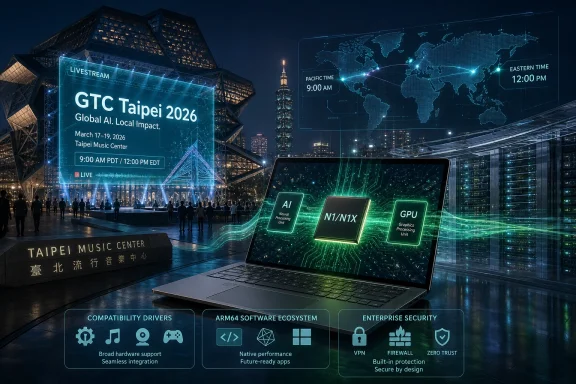
Computex has always been where the PC industry rehearses its next year in public. Motherboard vendors, laptop makers, chip designers, and component suppliers converge in Taipei because the PC is still a supply-chain business before it is a marketing category. That makes Jensen Huang’s GTC Taipei appearance more than a livestream slot on a Sunday night in the United States.
Nvidia could easily spend the keynote doing what Nvidia now does best: selling the world on accelerated computing, AI factories, robotics, networking, and the next generation of GPU-heavy infrastructure. That would be the safe bet, and in many ways still is. The company’s center of gravity is the datacenter, not the consumer laptop aisle.
Yet the pre-keynote chatter has taken a distinctly Windows-shaped turn. Microsoft and Nvidia have both leaned into “new era of PC” language, and that phrase does not sound like a routine GeForce refresh. It sounds like a platform pitch.
That is why a how-to-watch post from The Verge is functioning as a flare for a much larger industry question. If the rumored Nvidia N1 and N1X processors appear, the keynote becomes a possible inflection point for Windows on Arm: not because Arm is new to Windows, but because Nvidia would bring a different kind of gravitational pull to the ecosystem.
Microsoft Has Been Here Before, But Not With This Partner
Windows on Arm is not a new dream. It is a recurring Microsoft project that has moved through phases of optimism, compromise, embarrassment, and cautious revival. Windows RT was the cautionary tale, Surface Pro X was the elegant machine with the compatibility asterisk, and the first wave of Qualcomm-powered Copilot+ PCs showed that the idea could finally be competent without being complete.
The problem has never been whether Windows can technically run on Arm. It can. The problem has been whether enough of the Windows universe can run well enough, long enough, and predictably enough that buyers stop thinking about the processor architecture at all.
That is the test Apple passed with Apple Silicon. Apple did not merely ship Arm chips; it shipped a controlled platform transition with hardware, operating system, developer tools, translation technology, and retail messaging all moving in the same direction. Microsoft has never had that kind of control over the PC market, because the PC’s greatest strength is also its greatest complication: everybody gets a vote.
Nvidia changes the psychology of that vote. Qualcomm gave Windows on Arm credibility in battery life and mobile-style integration. Nvidia would give it an entirely different kind of credibility: graphics, AI acceleration, developer mindshare, gaming adjacency, and OEM attention.
That does not mean the transition suddenly becomes easy. It means the conversation changes from “Can Windows on Arm survive?” to “Which companies are now willing to build around it?”
The N1 and N1X Rumor Matters Because Nvidia Rarely Enters Quietly
The rumored N1 and N1X chips have been discussed for months as Arm-based processors aimed at Windows PCs, with N1 generally described in reports as the more mainstream part and N1X as the higher-performance variant. None of the important details are official until Nvidia says them on stage. Clock speeds, core counts, GPU configurations, power envelopes, OEM partners, and launch windows should all be treated as reported information rather than product fact.
Still, the persistence of the rumor is the story. References to N1X have appeared in industry reporting, leaks, and partner-adjacent breadcrumbs often enough that the idea no longer feels like idle fantasy. The coordinated “new era of PC” teasing from Microsoft and Nvidia has only raised expectations.
For Nvidia, an Arm Windows processor would be a strategic expansion beyond the GPU socket. The company already dominates the accelerator discussion in datacenters, has a strong brand in gaming, and has spent years arguing that the future of computing is heterogeneous. A PC system-on-chip would let Nvidia put that thesis into a consumer and enterprise device category that it has historically influenced but not controlled.
For Microsoft, the attraction is obvious. Windows on Arm cannot remain a Qualcomm-only story if Microsoft wants it to become a mainstream Windows story. A platform with one major silicon supplier looks like a special case. A platform with Qualcomm, Nvidia, and potentially others begins to look like an ecosystem.
The Surface Angle Is the Tell
The Surface rumor is what gives this keynote its WindowsForum relevance. Microsoft has been teasing a “new era of PC” for Surface, and expectations have formed around the possibility that Nvidia silicon could power yet-to-be-announced devices. That may prove true, partially true, or premature, but the framing is revealing either way.
Surface has long been Microsoft’s argument with the rest of the PC industry. It is where Microsoft demonstrates the hardware it wishes OEMs would build, the Windows features it wants buyers to notice, and the trade-offs it is willing to make visible. A Surface device with Nvidia Arm silicon would be more than another SKU; it would be Microsoft using its own hardware brand to bless a new class of Windows machine.
That would also be a pointed message to Intel and AMD. Microsoft does not want to abandon x86, and it could not even if it wanted to. The enterprise estate, gaming libraries, drivers, peripherals, management tooling, and decades of software assumptions all keep x86 central to Windows.
But Microsoft does want leverage. The PC market stagnated for too long around incremental CPU gains, thin-and-light refreshes, and OEM differentiation measured in millimeters. Apple’s M-series Macs embarrassed the Windows ecosystem on performance per watt, idle behavior, instant-on responsiveness, and the basic feeling that the machine was designed as a whole. Qualcomm helped answer that. Nvidia could make the answer louder.
The PC Industry Is Really Arguing About Control
The phrase “new era of PC” sounds airy until you ask what era is supposedly ending. The old era was not simply x86. It was the modular bargain that defined the Windows PC: Microsoft supplied the operating system, Intel or AMD supplied the CPU, Nvidia or AMD often supplied the GPU, OEMs assembled the machine, and users tolerated the seams.
The new era, if Microsoft and Nvidia are serious, is more integrated. The chip is not just a CPU. It is a CPU, GPU, neural processor, media engine, memory architecture, power-management strategy, and software optimization target. The PC becomes less like a box of parts and more like a platform stack.
That is uncomfortable for some Windows traditionalists, and not without reason. The openness of the PC has protected users from single-vendor lock-in and allowed decades of weird, wonderful, repairable, upgradeable machines. Integration can deliver better battery life and smoother performance, but it can also narrow choice and make the system more opaque.
Nvidia’s involvement sharpens that tension. Nvidia is not known as a passive component supplier. It builds ecosystems, defends software moats, and ties hardware value to proprietary capabilities. CUDA in the datacenter and DLSS in gaming are not just features; they are strategic walls.
A Windows PC built around Nvidia Arm silicon would therefore raise an important question. Is this a more competitive Windows ecosystem, or simply a more vertically managed one?
Compatibility Is Still the Tax Collector
Every Windows-on-Arm story eventually arrives at the same toll booth: compatibility. Microsoft has improved emulation, developers have become more familiar with Arm64 builds, and the web-app-heavy reality of modern computing makes architecture less visible to many users. But Windows remains Windows because it runs old things, strange things, business-critical things, and badly maintained things that no one dares to touch.
That matters most in the places where PC purchasing is conservative. Enterprises do not buy architectures; they buy supportability. Schools buy fleet management. Small businesses buy the ability to run that one accounting tool and the label printer in the back office. Gamers buy the expectation that their libraries, launchers, anti-cheat systems, overlays, mods, and drivers will behave.
Nvidia can help with some of this and complicate other parts. Its graphics stack is mature, and its developer relationships are deep. If anyone can make an Arm Windows machine feel less like a compatibility science project for creative workloads, AI tools, and GPU-accelerated applications, Nvidia is on the short list.
Gaming is harder. Nvidia’s brand may lead buyers to assume a level of compatibility that Windows on Arm may not be ready to guarantee across the entire PC gaming back catalog. If N1X laptops are marketed too aggressively as gaming machines before the software stack is ready, the backlash will write itself.
AI Gives Microsoft a Better Excuse Than Battery Life Ever Did
The first great Windows-on-Arm pitch was battery life. That was sensible but insufficient. Long battery life is valuable, but users will not trade away compatibility, performance confidence, and purchasing clarity for a few extra hours unless the rest of the machine also feels obviously better.
AI gives Microsoft and Nvidia a broader story. Copilot+ PCs already moved the Windows marketing center toward neural processing, local models, recall-style workflows, image generation, translation, camera effects, and on-device assistance. Whether every one of those features deserves the hype is debatable, but the direction is not.
An Nvidia Arm PC could tie that AI story to a more powerful GPU identity. Instead of asking buyers to care about an NPU number in isolation, Nvidia can talk about local AI, creator acceleration, gaming-adjacent upscaling, model inference, and developer workflows as part of one hardware package. That is a more natural pitch for Nvidia than “this laptop sleeps nicely.”
For Microsoft, this also helps justify another push at changing Windows assumptions. The company needs a reason for users and developers to care about native Arm64 applications. AI workloads, if they become genuinely local and performance-sensitive, could provide that pressure.
The danger is that “AI PC” becomes the new “ultrabook”: a useful idea hollowed out by branding. If the keynote produces more slogans than shipping software, Windows users will have learned nothing except that every company has discovered the same adjectives.
Qualcomm Should Be Nervous, Intel Should Be Alert, AMD Should Not Smirk
The most immediate competitive pressure from an Nvidia Windows-on-Arm push lands on Qualcomm. Snapdragon X chips gave Microsoft its best Windows-on-Arm moment so far, and Qualcomm deserves credit for moving the category from curiosity to credible option. But exclusivity, whether contractual or practical, was never going to be enough to carry an entire Windows transition.
Nvidia would be a dangerous second entrant because it brings a brand that consumers already associate with performance. Qualcomm has had to teach many PC buyers why they should care about Snapdragon in a laptop. Nvidia would not start from zero.
Intel faces a different problem. It has improved efficiency and is fighting hard to protect its central role in PCs, but the strategic narrative has shifted. The question is no longer whether Intel can make better x86 laptop chips. It is whether the Windows ecosystem can deliver Apple-like efficiency, AI acceleration, and graphics performance through multiple silicon models while keeping compatibility intact.
AMD should not be complacent. Ryzen remains strong, and AMD’s integrated graphics story has often been better than Intel’s, but Nvidia entering the PC SoC field would put pressure on every vendor’s GPU-plus-AI roadmap. If Nvidia can package credible CPU performance with RTX-class branding and a strong software stack, AMD will have to defend more than benchmark charts.
The result could be good for buyers if it forces real competition. It could also produce a mess of overlapping badges, AI claims, compatibility disclaimers, and platform tiers. The Windows ecosystem has a gift for turning healthy competition into sticker confusion.
OEMs Want Differentiation, But They Fear Support Calls
Laptop makers have every reason to be interested in Nvidia silicon. An N1X-powered premium notebook would be easy to market, especially if it promises strong graphics, local AI capability, and MacBook-like efficiency. OEMs have spent years trying to build Windows laptops that feel less like commodity products.
But OEMs also know where the pain lands. When an application fails, a driver misbehaves, a VPN client refuses to cooperate, or a game launcher breaks, the customer does not blame the architecture. The customer blames the laptop.
That is why launch partners matter almost as much as chip specs. If Microsoft and Nvidia announce only vague intentions, the story remains speculative. If they show real devices from credible OEMs with clear availability windows, enterprise manageability claims, developer support, and honest compatibility guidance, the story becomes materially different.
Surface would be especially important because Microsoft would be volunteering to absorb some of that risk itself. It is one thing to urge partners into a new architecture. It is another to put the Surface logo on it.
The Keynote Could Still Be Mostly About Datacenters
There is a necessary caution here: Nvidia keynotes are Nvidia keynotes. The company’s financial engine is AI infrastructure, not Windows laptops. GTC Taipei is likely to spend substantial time on accelerated computing, GPUs, networking, robotics, physical AI, sovereign AI, and the industrial-scale systems that now define Nvidia’s market value.
A Windows PC announcement, if it happens, may be one segment inside a much larger presentation. It may be teased rather than fully launched. It may involve partner devices that arrive later. It may focus on developer kits or AI workstations rather than mass-market Surface hardware.
That would not make it irrelevant. Platform shifts rarely arrive as one clean moment. They arrive as staged commitments: a tease, a developer push, a partner reference design, a first wave of imperfect hardware, a second wave that fixes the obvious mistakes, and then a point at which the old skepticism starts to sound stale.
The question for this keynote is whether Nvidia and Microsoft are ready to move from implication to commitment. The difference matters.
The Watch Party Is Really a Platform Audit
For Windows enthusiasts and IT pros, the correct way to watch the keynote is with two tabs open in your head. One tab should track the announcements themselves: chips, devices, dates, partners, demos, and price classes. The other should track what remains unsaid.
If Nvidia discusses N1 or N1X without concrete OEM devices, that suggests the silicon story is ahead of the product story. If Microsoft appears but avoids Surface specifics, the companies may be coordinating a platform message before a separate hardware launch. If native Windows applications, drivers, and developer tooling get serious airtime, the announcement is more than a branding exercise.
The most important details may be boring. Enterprise deployment support matters. Driver models matter. VPN and security software compatibility matters. Firmware update channels matter. Recovery images and lifecycle commitments matter. The things that make a new Windows platform trustworthy are rarely the things that trend during a keynote.
That is why the Windows community should resist both reflexive hype and reflexive dismissal. Windows on Arm has failed to meet expectations before, but past disappointment is not proof of permanent failure. At the same time, Nvidia’s logo does not magically erase the platform work still required.
The Concrete Signals to Watch From Taipei
The safest prediction is that Nvidia will frame everything through AI. The useful question is whether the PC becomes a meaningful part of that frame or merely a cameo. If the rumored Microsoft partnership is real, the keynote should give observers enough evidence to separate a genuine Windows platform push from a Computex marketing flourish.
Here is the short version for anyone watching live:
- Nvidia’s keynote is scheduled for June 1 in Taipei, which corresponds to the evening of May 31 for viewers in U.S. Pacific and Eastern time zones.
- The rumored N1 and N1X chips remain unconfirmed until Nvidia announces them, so reported specifications should be treated as provisional.
- Microsoft’s “new era of PC” language matters because it suggests a Windows platform story rather than a normal component launch.
- A Surface device using Nvidia Arm silicon would be a stronger signal than a generic partner tease.
- Compatibility, drivers, enterprise support, and native Arm64 software will determine whether this becomes a real Windows transition or another interesting detour.
- The most credible announcement would pair silicon claims with named OEM systems, shipping windows, developer guidance, and clear software commitments.
The keynote may ultimately be remembered for datacenter systems rather than laptops, because that is the business Nvidia now leads and the market Wall Street cares about most. But if Jensen Huang uses the Taipei stage to bring Microsoft into a renewed Windows-on-Arm push, the PC industry will have to take the idea more seriously than it did when the burden sat mostly on Qualcomm. The future of Windows will not be decided by one Computex keynote, but this one could mark the moment when Arm PCs stopped looking like a side project and started looking like a contested battlefield.
