

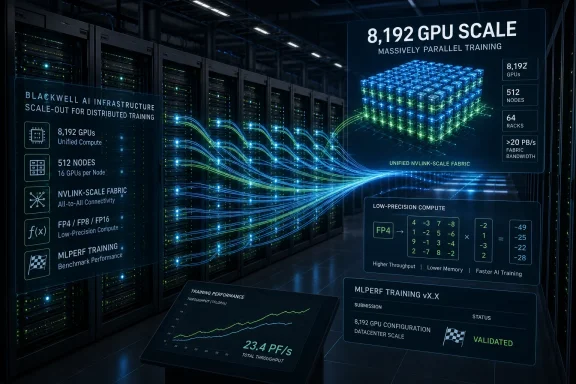
NVIDIA’s Blackwell platform swept the newly published MLPerf Training 6.0 results in June 2026, posting the fastest submitted training times across the benchmark suite and demonstrating scale-out runs that reportedly reached 8,192 GPUs in production cloud environments. The headline is not merely that NVIDIA won another benchmark round. It is that the company is using MLPerf to argue that modern AI performance is now a rack-scale, network-scale, software-stack problem rather than a chip-versus-chip contest. For enterprise buyers, cloud architects, and anyone watching the AI infrastructure market from the Windows ecosystem, that distinction matters.
The simplest reading of the MLPerf Training 6.0 news is that NVIDIA’s newest accelerator generation is very fast. That is true, but it is also the least interesting version of the story. The more consequential reading is that NVIDIA is framing Blackwell as a complete industrial platform: GPUs, NVLink, rack-scale design, low-precision math, optimized containers, cloud partners, and a software stack that gets better between benchmark rounds.
MLPerf Training does not measure how many theoretical FLOPS a vendor can print on a spec sheet. It measures time to train a model to a defined quality target under a standardized rule set. That makes it more useful than raw peak numbers, though not immune to benchmark politics or vendor optimization. In this round, NVIDIA’s claim is blunt: Blackwell led across the full suite, not merely in a handpicked test where its architecture had the cleanest advantage.
That breadth is important. AI infrastructure buyers do not run one model forever. They train and fine-tune transformers, recommender systems, vision models, graph workloads, and increasingly mixture-of-experts systems that stress memory, networking, scheduling, and software orchestration in different ways. A platform that performs well across multiple benchmark categories has a stronger claim to general usefulness than a part that shines only under narrow conditions.
NVIDIA has spent years turning that generality into a moat. CUDA is no longer just a programming model; it is procurement gravity. When a new architecture arrives, the chip is only one piece of the pitch. The other piece is that an existing ecosystem of frameworks, libraries, containers, drivers, profiling tools, and cloud images can be tuned rapidly enough to make the hardware look better every quarter.
That is why the Blackwell result should be read less like a lap time and more like a market signal. NVIDIA is telling buyers that the fastest AI clusters will be purchased as systems, consumed as managed capacity, and improved by software long after the purchase order clears.
Training modern frontier-class models is not just a matter of putting more accelerators in a room. The hard part is keeping them fed, synchronized, and useful. At thousands of GPUs, the enemy is not simply compute scarcity; it is communication overhead, memory pressure, job orchestration, failure recovery, and the brutal economics of idle silicon.
That is where NVIDIA’s benchmark story becomes more than a GPU story. Blackwell’s advantage depends on the surrounding fabric: NVLink, NVLink Switch, rack-scale integration, optimized collectives, and software that knows how to divide enormous workloads across thousands of devices. The larger the cluster, the more the interconnect and software scheduler determine whether extra GPUs reduce training time or merely increase the monthly bill.
The 8,192-GPU submission is therefore a statement about operational maturity. It suggests that NVIDIA and its partners can make Blackwell behave not as thousands of individual accelerators but as a coordinated training machine. That is exactly the message hyperscalers, sovereign AI projects, and the largest enterprise AI teams want to hear.
There is also a subtler point. At this level of scale, benchmarks become a form of proof that the supply chain, systems engineering, and cloud deployment model are all working. A vendor cannot casually produce credible large-scale training results if it cannot assemble the hardware, cool it, network it, provision it, and run the software stack without catastrophic inefficiency.
NVIDIA’s great advantage is that it optimizes at every layer. The company can adjust GPU architecture, tune libraries, refine kernels, improve data formats, update containers, and coordinate with system vendors and cloud providers. When performance improves between benchmark submissions, the improvement may not come from a new chip at all. It may come from better software exploiting the chip that was already installed.
That is an underappreciated part of NVIDIA’s dominance. Competitors often frame the contest as hardware parity: match memory capacity, match bandwidth, match low-precision throughput, and the market should open. But buyers do not purchase theoretical parity. They purchase an outcome that arrives through frameworks, drivers, documentation, support contracts, and reference deployments.
MLPerf’s time-to-train format rewards that outcome. It does not care whether a result came from cleaner kernels, better collective communication, stronger low-precision handling, improved memory scheduling, or raw silicon. It asks whether the system trained the model to the target faster.
This is why the benchmark sweep lands with force. NVIDIA is not only claiming that Blackwell is faster than Hopper or rival accelerators. It is claiming that its full-stack operating model compounds over time.
AI workloads can often tolerate lower numerical precision than traditional scientific computing, provided the hardware and software preserve enough accuracy for the model to converge. Lower precision can mean less memory traffic, higher throughput, and better energy efficiency. At data-center scale, those gains are not academic. They become fewer racks, lower power draw, faster experiments, and cheaper model iterations.
The catch is that low precision is not magic. If implemented carelessly, it can damage model quality or require compensating tricks that erase the performance gains. That is why vendors want benchmark validation: it gives them a public way to say that the faster math still reaches the required accuracy target.
Blackwell’s MLPerf showing reinforces the idea that future AI performance will be won by architectures that make aggressive precision reduction practical. This is no longer just about multiplying matrices faster in FP16 or BF16. The frontier is shifting toward formats and training recipes that squeeze more useful work out of every watt and every byte moved across the system.
For IT leaders, this has a procurement implication. The relevant question is not merely whether an accelerator supports a fashionable precision format. It is whether the vendor’s tools, frameworks, and model recipes make that precision usable without turning every training run into a research project.
NVIDIA still owns the center of gravity, but AMD’s presence changes the interpretation of each benchmark cycle. The question is no longer whether NVIDIA is alone on the field. It is whether rivals can turn isolated wins, competitive workloads, or cost advantages into a complete platform that large buyers trust at scale.
That is a harder task than building a fast chip. Enterprise AI teams need stable software, reliable framework support, predictable performance, and operational support when something breaks at 2 a.m. They also need confidence that today’s model stack will not require heroic porting work tomorrow. NVIDIA’s installed base gives it an enormous advantage in that kind of institutional trust.
Still, AMD’s improving MLPerf posture is good news for customers. Even if NVIDIA keeps winning the top-line training races, credible alternatives can pressure margins and force more open software pathways. The AI infrastructure market is too strategically important to become a single-vendor monoculture by default.
The Blackwell sweep therefore cuts both ways. It confirms NVIDIA’s lead, but it also gives competitors a concrete target. The industry now has to answer whether NVIDIA’s advantage is a temporary lead in a fast-moving race or a durable systems monopoly built around software gravity.
NVIDIA’s benchmark messaging leans heavily into production cloud environments for a reason. The largest AI jobs increasingly run on hyperscaler and specialized AI cloud infrastructure, not in a traditional enterprise server closet. Even companies with serious on-premises estates may burst to cloud for large experiments or use managed AI platforms for fine-tuning and inference pipelines.
This is where WindowsForum readers should pay attention. Microsoft’s ecosystem is deeply tied into the AI infrastructure race through Azure, Windows developer tooling, GitHub, Visual Studio Code, Microsoft 365 Copilot, and enterprise identity. Even when the GPUs sit in a Linux-heavy back end, the developers, administrators, and security teams consuming the resulting services are often operating in Microsoft-centered environments.
The training benchmark does not directly tell a Windows admin how fast Copilot will answer an email or how well a local workstation will run a small model. But it does influence the economics and cadence of the AI services that eventually land in Microsoft products, cloud APIs, developer tooling, and enterprise workflows. Faster training infrastructure means faster model iteration, more frequent fine-tuning, and potentially lower cost per experiment.
That does not guarantee lower customer prices. The AI market has repeatedly shown that efficiency gains can be absorbed into larger models, higher margins, or more ambitious product features rather than passed directly to customers. But infrastructure performance sets the ceiling for what vendors can build.
A benchmark result also does not answer the total-cost question by itself. The fastest system may not be the cheapest system for a given organization. Power, cooling, availability, software licensing, cloud discounts, staff expertise, and utilization rates can matter as much as benchmark time. A cluster that is 20 percent slower but much cheaper or easier to schedule may be the better business decision.
But dismissing MLPerf as mere theater goes too far. Standardized results are one of the few public windows into how systems behave under comparable rules. They provide a common vocabulary in a market otherwise dominated by bespoke claims, private demos, and marketing charts.
The right posture is neither blind belief nor reflexive cynicism. MLPerf Training 6.0 tells us that NVIDIA’s Blackwell platform is performing exceptionally well under a respected benchmark framework and that its scale-out story is mature enough to produce headline results. It does not tell every buyer that Blackwell is the right answer for every workload at every price.
That distinction is critical. Benchmarks are evidence, not verdicts.
Blackwell’s MLPerf results fit neatly into that framing. NVIDIA wants customers to think less about individual GPUs and more about throughput, utilization, and return on infrastructure. How quickly can a model be trained? How many experiments can a team run per month? How efficiently can capital expense become deployable AI capability?
This is why the AI infrastructure market increasingly resembles mainframe or high-end enterprise systems economics. The hardware is expensive, the vendor relationship is strategic, and the software ecosystem creates lock-in that buyers tolerate because the system is productive. Nobody loves lock-in in principle; many accept it in practice when the alternative is delay.
There is a risk here for the broader industry. If the best AI training performance depends on vertically integrated stacks available only to the richest companies, the gap between frontier labs and everyone else widens. Smaller firms may still innovate at the model, application, and data layers, but the frontier training race becomes increasingly capital-intensive.
That is not solely NVIDIA’s fault. The physics of training huge models are unforgiving. But every benchmark sweep by the dominant supplier reinforces the same strategic question: will AI infrastructure become a competitive cloud utility, or will it become a scarce industrial capability controlled by a handful of vendors and hyperscalers?
Microsoft’s AI strategy depends on a pipeline that begins in giant training clusters and ends in everyday software. Models are trained or fine-tuned at scale, distilled or optimized, deployed into cloud services, and sometimes compressed further for local inference. The performance and cost of the upstream training stage influence how quickly those downstream products evolve.
For developers on Windows, this affects the tools they use. Better training infrastructure can accelerate model releases, improve code assistants, expand multimodal features, and make specialized fine-tuned models more common in enterprise software. For administrators, it affects governance: more AI features arrive faster, often embedded inside products that were once simpler to audit.
For security teams, the pace is double-edged. Faster model development can improve defensive tools, automate analysis, and make threat detection more adaptive. It can also accelerate offensive experimentation, phishing automation, vulnerability research, and social engineering at scale. Infrastructure progress rarely stays on one side of the security ledger.
For PC enthusiasts, the lesson is that local AI and cloud AI are not separate worlds. The biggest models still need data-center training, while local devices increasingly serve as inference endpoints, privacy filters, latency reducers, or offline assistants. Blackwell’s benchmark victories live in the data center, but their effects will be felt in the software that lands on desktops.
The MLPerf coverage around Blackwell emphasizes not only hardware but repeated performance gains through updated software stacks. That matters because it changes the value proposition for buyers. A customer who deploys a Blackwell system is not just buying day-one performance; they are buying into a stream of optimizations that may improve throughput over months.
That is also a competitive weapon. If NVIDIA can make the same installed hardware faster through software, it can defend against rivals without immediately changing silicon. It can also make procurement decisions feel safer: customers expect the platform to mature rather than stagnate.
The downside is dependency. The more performance comes from vendor-controlled software layers, the more customers rely on the vendor’s roadmap, priorities, and support. Open frameworks still matter, but the deepest optimizations often live close to the hardware. That creates a practical tension between performance and portability.
Enterprises should be clear-eyed about this trade-off. NVIDIA’s stack may be the fastest and most mature option, but adopting it deeply can make future migration harder. In AI infrastructure, the cheapest time to think about exit costs is before the first large deployment, not after every pipeline depends on vendor-specific behavior.
Blackwell-class systems demand data centers built for dense accelerated computing. That means liquid cooling in many configurations, high-capacity networking, specialized racks, and electrical infrastructure that cannot be improvised late in a project. For many enterprises, the limiting factor is not appetite for AI but the physical reality of hosting it.
This is one reason cloud providers and specialized AI infrastructure firms have become so central. They absorb the facilities challenge and sell access to the result. But that merely moves the scarcity up the stack. If demand exceeds available capacity, customers face reservation games, regional constraints, and pricing pressure.
The benchmark result therefore has a hidden infrastructure message: the organizations that can access these systems will move faster than those that cannot. In the AI race, performance leadership is partly about silicon, partly about software, and partly about being near enough to the front of the allocation line.
That has consequences for enterprise planning. AI roadmaps built on assumptions of abundant top-tier GPU capacity may collide with procurement reality. Sensible teams will design for flexibility, including smaller models, fine-tuning strategies, retrieval-augmented generation, and hybrid inference architectures that reduce dependence on the largest training runs.
For organizations evaluating AI training or fine-tuning capacity, the practical lessons are concrete:
 Blackwell Turns MLPerf Into a Systems Argument
The simplest reading of the MLPerf Training 6.0 news is that NVIDIA’s newest accelerator generation is very fast. That is true, but it is also the least interesting version of the story. The more consequential reading is that NVIDIA is framing Blackwell as a complete industrial platform: GPUs, NVLink, rack-scale design, low-precision math, optimized containers, cloud partners, and a software stack that gets better between benchmark rounds.MLPerf Training does not measure how many theoretical FLOPS a vendor can print on a spec sheet. It measures time to train a model to a defined quality target under a standardized rule set. That makes it more useful than raw peak numbers, though not immune to benchmark politics or vendor optimization. In this round, NVIDIA’s claim is blunt: Blackwell led across the full suite, not merely in a handpicked test where its architecture had the cleanest advantage.
That breadth is important. AI infrastructure buyers do not run one model forever. They train and fine-tune transformers, recommender systems, vision models, graph workloads, and increasingly mixture-of-experts systems that stress memory, networking, scheduling, and software orchestration in different ways. A platform that performs well across multiple benchmark categories has a stronger claim to general usefulness than a part that shines only under narrow conditions.
NVIDIA has spent years turning that generality into a moat. CUDA is no longer just a programming model; it is procurement gravity. When a new architecture arrives, the chip is only one piece of the pitch. The other piece is that an existing ecosystem of frameworks, libraries, containers, drivers, profiling tools, and cloud images can be tuned rapidly enough to make the hardware look better every quarter.
That is why the Blackwell result should be read less like a lap time and more like a market signal. NVIDIA is telling buyers that the fastest AI clusters will be purchased as systems, consumed as managed capacity, and improved by software long after the purchase order clears.
The 8,192-GPU Number Is the Real Flex
The most eye-catching figure in the coverage is the reported 8,192-GPU training scale. In consumer technology, big numbers often blur into marketing decoration. In AI training infrastructure, scale is the product.Training modern frontier-class models is not just a matter of putting more accelerators in a room. The hard part is keeping them fed, synchronized, and useful. At thousands of GPUs, the enemy is not simply compute scarcity; it is communication overhead, memory pressure, job orchestration, failure recovery, and the brutal economics of idle silicon.
That is where NVIDIA’s benchmark story becomes more than a GPU story. Blackwell’s advantage depends on the surrounding fabric: NVLink, NVLink Switch, rack-scale integration, optimized collectives, and software that knows how to divide enormous workloads across thousands of devices. The larger the cluster, the more the interconnect and software scheduler determine whether extra GPUs reduce training time or merely increase the monthly bill.
The 8,192-GPU submission is therefore a statement about operational maturity. It suggests that NVIDIA and its partners can make Blackwell behave not as thousands of individual accelerators but as a coordinated training machine. That is exactly the message hyperscalers, sovereign AI projects, and the largest enterprise AI teams want to hear.
There is also a subtler point. At this level of scale, benchmarks become a form of proof that the supply chain, systems engineering, and cloud deployment model are all working. A vendor cannot casually produce credible large-scale training results if it cannot assemble the hardware, cool it, network it, provision it, and run the software stack without catastrophic inefficiency.
MLPerf Rewards the Boring Work NVIDIA Does Best
Every benchmark has a shadow game. Vendors optimize aggressively for the rules, and MLPerf is no exception. But that does not make the result meaningless; it reveals which companies can translate engineering discipline into measurable outcomes.NVIDIA’s great advantage is that it optimizes at every layer. The company can adjust GPU architecture, tune libraries, refine kernels, improve data formats, update containers, and coordinate with system vendors and cloud providers. When performance improves between benchmark submissions, the improvement may not come from a new chip at all. It may come from better software exploiting the chip that was already installed.
That is an underappreciated part of NVIDIA’s dominance. Competitors often frame the contest as hardware parity: match memory capacity, match bandwidth, match low-precision throughput, and the market should open. But buyers do not purchase theoretical parity. They purchase an outcome that arrives through frameworks, drivers, documentation, support contracts, and reference deployments.
MLPerf’s time-to-train format rewards that outcome. It does not care whether a result came from cleaner kernels, better collective communication, stronger low-precision handling, improved memory scheduling, or raw silicon. It asks whether the system trained the model to the target faster.
This is why the benchmark sweep lands with force. NVIDIA is not only claiming that Blackwell is faster than Hopper or rival accelerators. It is claiming that its full-stack operating model compounds over time.
Low Precision Is Becoming the New Performance Battlefield
The Blackwell generation is inseparable from NVIDIA’s push into lower-precision formats, particularly FP4-class approaches such as NVFP4. For the uninitiated, that sounds like numerical trivia. In practice, it is one of the central battlegrounds in AI infrastructure.AI workloads can often tolerate lower numerical precision than traditional scientific computing, provided the hardware and software preserve enough accuracy for the model to converge. Lower precision can mean less memory traffic, higher throughput, and better energy efficiency. At data-center scale, those gains are not academic. They become fewer racks, lower power draw, faster experiments, and cheaper model iterations.
The catch is that low precision is not magic. If implemented carelessly, it can damage model quality or require compensating tricks that erase the performance gains. That is why vendors want benchmark validation: it gives them a public way to say that the faster math still reaches the required accuracy target.
Blackwell’s MLPerf showing reinforces the idea that future AI performance will be won by architectures that make aggressive precision reduction practical. This is no longer just about multiplying matrices faster in FP16 or BF16. The frontier is shifting toward formats and training recipes that squeeze more useful work out of every watt and every byte moved across the system.
For IT leaders, this has a procurement implication. The relevant question is not merely whether an accelerator supports a fashionable precision format. It is whether the vendor’s tools, frameworks, and model recipes make that precision usable without turning every training run into a research project.
AMD’s Progress Makes the Sweep More Interesting, Not Less
A sweep is most impressive when the field is improving. AMD’s Instinct line has become more credible in AI training, and its recent MLPerf participation has emphasized generational gains, multi-node scaling, and stronger partner involvement. That matters because the accelerator market desperately needs competition that is real enough to influence pricing, availability, and architectural diversity.NVIDIA still owns the center of gravity, but AMD’s presence changes the interpretation of each benchmark cycle. The question is no longer whether NVIDIA is alone on the field. It is whether rivals can turn isolated wins, competitive workloads, or cost advantages into a complete platform that large buyers trust at scale.
That is a harder task than building a fast chip. Enterprise AI teams need stable software, reliable framework support, predictable performance, and operational support when something breaks at 2 a.m. They also need confidence that today’s model stack will not require heroic porting work tomorrow. NVIDIA’s installed base gives it an enormous advantage in that kind of institutional trust.
Still, AMD’s improving MLPerf posture is good news for customers. Even if NVIDIA keeps winning the top-line training races, credible alternatives can pressure margins and force more open software pathways. The AI infrastructure market is too strategically important to become a single-vendor monoculture by default.
The Blackwell sweep therefore cuts both ways. It confirms NVIDIA’s lead, but it also gives competitors a concrete target. The industry now has to answer whether NVIDIA’s advantage is a temporary lead in a fast-moving race or a durable systems monopoly built around software gravity.
The Cloud Is Where These Benchmarks Become Real
For most organizations, buying thousands of Blackwell GPUs is not a realistic plan. Renting them is. That shifts the practical meaning of MLPerf from “which box should I buy?” to “which cloud capacity can train or fine-tune my workload fastest, with the least waste?”NVIDIA’s benchmark messaging leans heavily into production cloud environments for a reason. The largest AI jobs increasingly run on hyperscaler and specialized AI cloud infrastructure, not in a traditional enterprise server closet. Even companies with serious on-premises estates may burst to cloud for large experiments or use managed AI platforms for fine-tuning and inference pipelines.
This is where WindowsForum readers should pay attention. Microsoft’s ecosystem is deeply tied into the AI infrastructure race through Azure, Windows developer tooling, GitHub, Visual Studio Code, Microsoft 365 Copilot, and enterprise identity. Even when the GPUs sit in a Linux-heavy back end, the developers, administrators, and security teams consuming the resulting services are often operating in Microsoft-centered environments.
The training benchmark does not directly tell a Windows admin how fast Copilot will answer an email or how well a local workstation will run a small model. But it does influence the economics and cadence of the AI services that eventually land in Microsoft products, cloud APIs, developer tooling, and enterprise workflows. Faster training infrastructure means faster model iteration, more frequent fine-tuning, and potentially lower cost per experiment.
That does not guarantee lower customer prices. The AI market has repeatedly shown that efficiency gains can be absorbed into larger models, higher margins, or more ambitious product features rather than passed directly to customers. But infrastructure performance sets the ceiling for what vendors can build.
The Benchmark Is Not the Workload, but It Is Not Theater
Skepticism about vendor benchmarks is healthy. MLPerf is standardized and peer-reviewed, but it is still a benchmark. Real-world AI training includes messy data pipelines, changing model architectures, compliance constraints, storage bottlenecks, flaky dependencies, and organizational delays that do not appear in a clean leaderboard.A benchmark result also does not answer the total-cost question by itself. The fastest system may not be the cheapest system for a given organization. Power, cooling, availability, software licensing, cloud discounts, staff expertise, and utilization rates can matter as much as benchmark time. A cluster that is 20 percent slower but much cheaper or easier to schedule may be the better business decision.
But dismissing MLPerf as mere theater goes too far. Standardized results are one of the few public windows into how systems behave under comparable rules. They provide a common vocabulary in a market otherwise dominated by bespoke claims, private demos, and marketing charts.
The right posture is neither blind belief nor reflexive cynicism. MLPerf Training 6.0 tells us that NVIDIA’s Blackwell platform is performing exceptionally well under a respected benchmark framework and that its scale-out story is mature enough to produce headline results. It does not tell every buyer that Blackwell is the right answer for every workload at every price.
That distinction is critical. Benchmarks are evidence, not verdicts.
AI Infrastructure Is Starting to Look Like Mainframe Economics
The phrase “AI factory” can sound like executive wallpaper, but it captures something real: AI compute is being industrialized. The biggest training systems are no longer clusters in the old enthusiast sense. They are purpose-built production plants for turning electricity, data, and engineering labor into model capability.Blackwell’s MLPerf results fit neatly into that framing. NVIDIA wants customers to think less about individual GPUs and more about throughput, utilization, and return on infrastructure. How quickly can a model be trained? How many experiments can a team run per month? How efficiently can capital expense become deployable AI capability?
This is why the AI infrastructure market increasingly resembles mainframe or high-end enterprise systems economics. The hardware is expensive, the vendor relationship is strategic, and the software ecosystem creates lock-in that buyers tolerate because the system is productive. Nobody loves lock-in in principle; many accept it in practice when the alternative is delay.
There is a risk here for the broader industry. If the best AI training performance depends on vertically integrated stacks available only to the richest companies, the gap between frontier labs and everyone else widens. Smaller firms may still innovate at the model, application, and data layers, but the frontier training race becomes increasingly capital-intensive.
That is not solely NVIDIA’s fault. The physics of training huge models are unforgiving. But every benchmark sweep by the dominant supplier reinforces the same strategic question: will AI infrastructure become a competitive cloud utility, or will it become a scarce industrial capability controlled by a handful of vendors and hyperscalers?
The Windows Angle Is Bigger Than Local AI
Windows users may wonder why a data-center training benchmark belongs on their radar. After all, Blackwell MLPerf results do not change the frame rate of a game, the responsiveness of File Explorer, or the battery life of a Copilot+ PC. The connection is indirect, but increasingly important.Microsoft’s AI strategy depends on a pipeline that begins in giant training clusters and ends in everyday software. Models are trained or fine-tuned at scale, distilled or optimized, deployed into cloud services, and sometimes compressed further for local inference. The performance and cost of the upstream training stage influence how quickly those downstream products evolve.
For developers on Windows, this affects the tools they use. Better training infrastructure can accelerate model releases, improve code assistants, expand multimodal features, and make specialized fine-tuned models more common in enterprise software. For administrators, it affects governance: more AI features arrive faster, often embedded inside products that were once simpler to audit.
For security teams, the pace is double-edged. Faster model development can improve defensive tools, automate analysis, and make threat detection more adaptive. It can also accelerate offensive experimentation, phishing automation, vulnerability research, and social engineering at scale. Infrastructure progress rarely stays on one side of the security ledger.
For PC enthusiasts, the lesson is that local AI and cloud AI are not separate worlds. The biggest models still need data-center training, while local devices increasingly serve as inference endpoints, privacy filters, latency reducers, or offline assistants. Blackwell’s benchmark victories live in the data center, but their effects will be felt in the software that lands on desktops.
NVIDIA’s Real Moat Is the Upgrade Cycle Around the Chip
The traditional chip industry narrative is generational: a new architecture arrives, performance jumps, and the market waits for the next node or design. NVIDIA has complicated that rhythm by making software improvement part of the architecture’s effective lifespan.The MLPerf coverage around Blackwell emphasizes not only hardware but repeated performance gains through updated software stacks. That matters because it changes the value proposition for buyers. A customer who deploys a Blackwell system is not just buying day-one performance; they are buying into a stream of optimizations that may improve throughput over months.
That is also a competitive weapon. If NVIDIA can make the same installed hardware faster through software, it can defend against rivals without immediately changing silicon. It can also make procurement decisions feel safer: customers expect the platform to mature rather than stagnate.
The downside is dependency. The more performance comes from vendor-controlled software layers, the more customers rely on the vendor’s roadmap, priorities, and support. Open frameworks still matter, but the deepest optimizations often live close to the hardware. That creates a practical tension between performance and portability.
Enterprises should be clear-eyed about this trade-off. NVIDIA’s stack may be the fastest and most mature option, but adopting it deeply can make future migration harder. In AI infrastructure, the cheapest time to think about exit costs is before the first large deployment, not after every pipeline depends on vendor-specific behavior.
Power, Cooling, and Scarcity Are the Unwritten Lines in the Leaderboard
A time-to-train record is clean. The facility required to produce it is not. Behind every large-scale AI benchmark are power delivery, thermal design, networking complexity, and supply constraints that do not fit neatly into a leaderboard row.Blackwell-class systems demand data centers built for dense accelerated computing. That means liquid cooling in many configurations, high-capacity networking, specialized racks, and electrical infrastructure that cannot be improvised late in a project. For many enterprises, the limiting factor is not appetite for AI but the physical reality of hosting it.
This is one reason cloud providers and specialized AI infrastructure firms have become so central. They absorb the facilities challenge and sell access to the result. But that merely moves the scarcity up the stack. If demand exceeds available capacity, customers face reservation games, regional constraints, and pricing pressure.
The benchmark result therefore has a hidden infrastructure message: the organizations that can access these systems will move faster than those that cannot. In the AI race, performance leadership is partly about silicon, partly about software, and partly about being near enough to the front of the allocation line.
That has consequences for enterprise planning. AI roadmaps built on assumptions of abundant top-tier GPU capacity may collide with procurement reality. Sensible teams will design for flexibility, including smaller models, fine-tuning strategies, retrieval-augmented generation, and hybrid inference architectures that reduce dependence on the largest training runs.
The Benchmark Sweep Leaves Buyers With a Shorter, Harder Checklist
The Blackwell MLPerf Training 6.0 results do not simplify AI infrastructure decisions. They sharpen them. NVIDIA has made the performance case; buyers now have to decide how much that performance is worth, how portable their workloads need to be, and where cloud convenience ends and strategic dependency begins.For organizations evaluating AI training or fine-tuning capacity, the practical lessons are concrete:
- NVIDIA’s Blackwell platform currently has the strongest public MLPerf Training 6.0 performance story across the benchmark suite.
- The reported 8,192-GPU scale-out result matters because modern AI training performance depends on networking, orchestration, and software as much as accelerator silicon.
- MLPerf results are useful evidence for comparing standardized training behavior, but they do not replace workload-specific testing or total-cost analysis.
- Low-precision training formats are becoming a core part of AI performance, and buyers should evaluate whether those formats are mature in the frameworks they actually use.
- Cloud access to Blackwell-class systems may be more realistic than on-premises deployment for most organizations, but it introduces its own questions about cost, availability, governance, and lock-in.
- Competition from AMD and others remains strategically important even when NVIDIA wins the headline benchmark, because credible alternatives shape pricing, openness, and long-term customer leverage.
References
- Primary source: HPCwire
Published: Wed, 17 Jun 2026 20:53:21 GMT
HPCwire - Since 1987 – Covering the Fastest Computers in the World and the People Who Run Them
June 17, 2026 — Every breakthrough AI model starts the same way: with a training run. The infrastructure running those training jobs shapes everything: how fast teams can iterate, what scale of model they can build and whether those jobs complete reliably. As models grow in size...www.hpcwire.com - Independent coverage: Quantum Zeitgeist
Published: Wed, 17 Jun 2026 16:31:15 GMT
NVIDIA Blackwell Achieves Record Training Scale With 8,192 GPUs
NVIDIA Blackwell led across every category in MLPerf Training 6.0, demonstrating fastest training times and the largest scale with 8,192 GPUs using NVIDIA Blackwell NVL72 systems. The platform’s performance, scale, and reliability are critical as AI models continue to grow in size and complexity.quantumzeitgeist.com - Independent coverage: Techgenyz
Published: Wed, 17 Jun 2026 14:25:37 GMT
NVIDIA Blackwell MLPerf 6.0 Training Sweep: Peerless Records
The NVIDIA Blackwell MLPerf 6.0 clean sweep sets a peerless standard for frontier AI. Explore CoreWeave's 2-minute DeepSeek-V3 record.techgenyz.com - Related coverage: mlcommons.org
MLCommons Releases New MLPerf Inference v6.0 Benchmark Results - MLCommons
MLCommons releases MLPerf Inference v6.0 results — the most significant benchmark update to date, with new tests for text-to-video, GPT-OSS 120B, DLRMv3, vision-language models, and YOLOv11 mlcommons.org
- Related coverage: developer.nvidia.com
NVIDIA Blackwell Tops MLPerf Training 6.0 with Industry-Leading Scale and Performance | NVIDIA Technical Blog
NVIDIA delivered a clean sweep in MLPerf Training v6.0, the latest edition of industry-standard AI training benchmarks developed by the MLCommons consortium.developer.nvidia.com
- Related coverage: blogs.nvidia.com
NVIDIA Blackwell Delivers Next-Level MLPerf Training Performance | NVIDIA Blog
In MLPerf Training 4.1 industry benchmarks, the NVIDIA Blackwell platform delivered impressive results on workloads across all tests.blogs.nvidia.com
- Related coverage: nvidia.com
NVIDIA: MLPerf AI Benchmarks
Our results for the leading industry benchmark for AI performance.www.nvidia.com - Related coverage: tomshardware.com
Nvidia claims software and hardware upgrades allow Blackwell Ultra GB300 to dominate MLPerf benchmarks — touts 45% DeepSeek R-1 inference throughput increase over GB200 | Tom's Hardware
Big increases in performance when running a range of popular open source models.www.tomshardware.com - Related coverage: nvidianews.nvidia.com
- Related coverage: download.intel.com
New MLCommons Results Highlight Impressive Competitive AI Gains for...
PDF documentdownload.intel.com
- Related coverage: documents.westerndigital.com
MLCommons MLPerf Storage v2.0: Western Digital OpenFlex Data24 4200 in Focus – Performance, Architecture, and the Necessity for True Comparison
PDF documentdocuments.westerndigital.com
