

Nvidia has ended Game Ready driver support for GeForce GPUs based on Maxwell, Pascal, and Volta after a final October 2025 release, shifting those cards to quarterly security updates through October 2028 while keeping Windows 10 Game Ready support for RTX GPUs only until October 2026. That is not the same as bricking a GTX 1080 Ti, but it is a clear line in the sand. The company is telling older GeForce owners that their hardware may still run, but the mainstream gaming ecosystem has moved on without them. For Windows gamers and PC builders, the real story is not just a driver branch; it is the slow conversion of “still fast enough” hardware into unsupported hardware.
The phrase “cutting gamers off” sounds dramatic, but in this case the drama is baked into the lifecycle. Maxwell, Pascal, and Volta GPUs are not suddenly useless. A GTX 970, GTX 1060, GTX 1080 Ti, or Titan V can still display a desktop, launch games, and keep doing the work it did yesterday.
What changes is the promise attached to the driver. Game Ready drivers are not merely a fresh control panel wrapped around an installer; they are where Nvidia ships day-one game optimizations, compatibility fixes, profile updates, performance tuning, and workarounds for the strange ways new games stress old assumptions. Once a GPU architecture leaves that stream, the card moves from being an actively supported gaming platform to being a maintained legacy device.
That distinction matters because modern PC gaming increasingly depends on the driver vendor as a silent co-developer. When a big title ships with shader compilation stutter, broken frame pacing, HDR weirdness, anti-cheat conflicts, or GPU-specific crashes, the fix often arrives through a driver update rather than a game patch. For older GeForce owners, Nvidia’s new posture means those fixes are no longer guaranteed to include them.
Nvidia’s defense is also not frivolous. Pascal launched in 2016, Maxwell before that, and Volta was never a mainstream GeForce gaming generation in the same way. Supporting architectures for close to a decade is not short by consumer hardware standards. But long support does not soften the landing for a market where the GTX 1060 became a folk hero precisely because it stayed useful for so long.
That is why this transition lands differently from a routine end-of-life notice. Nvidia is not just retiring obscure silicon from a bygone workstation niche. It is drawing down support for cards that still sit in hand-me-down towers, budget builds, dorm-room PCs, small-form-factor rigs, and living-room machines that never needed ray tracing to justify their existence.
The uneasy truth is that many of these GPUs remain adequate for the games their owners actually play. Esports titles, older AAA games, indie releases, emulators, Minecraft, Roblox, strategy games, and lightly modded classics do not care much about marketing cycles. For that audience, the limiting factor is less raw shader throughput than whether drivers, operating systems, launchers, and anti-cheat stacks continue to tolerate the machine.
This is where lifecycle policy becomes practical rather than philosophical. A card can be “fast enough” and still become increasingly awkward to own. The end of Game Ready support does not make performance vanish, but it removes the safety net that kept aging hardware feeling current.
That carve-out is revealing. If you own an RTX card on Windows 10, Nvidia is treating you as a customer worth carrying a little longer. If you own an older GTX card, the exit ramp is shorter and narrower. The signal is obvious: move to newer Nvidia hardware, move to Windows 11 where possible, or accept a more frozen PC gaming experience.
For WindowsForum readers, the Windows 10 angle is arguably the more consequential one. Many older gaming PCs are not merely old because the GPU is old; they are old because the whole platform is old. Unsupported CPUs, missing TPM 2.0 support, motherboard firmware quirks, and user resistance to Windows 11 all cluster around the same machines that still run Pascal and Maxwell cards.
That creates a compound support cliff. A user with a GTX 1060 in a Windows 10 system may face the end of Microsoft’s free OS updates, the end of Nvidia’s Game Ready optimizations, and eventually the creeping incompatibility of game launchers and anti-cheat software. None of these individually flips the off switch. Together, they make the machine feel less like a supported PC and more like a preserved exhibit.
But security maintenance is not gaming support. It means Nvidia will patch serious flaws; it does not mean the company will tune a new Unreal Engine blockbuster for a GTX 1080 Ti or investigate every visual glitch on Maxwell. Quarterly cadence also means the update rhythm slows dramatically compared with the Game Ready channel.
This is a familiar pattern across the tech industry. Vendors often describe a legacy phase in terms that sound reassuring, because “still receiving security updates” is better than abandonment. But users experience legacy support as a loss of responsiveness. The software continues to exist, but the product no longer has momentum.
The same distinction matters in enterprise IT. An admin responsible for lab machines, classrooms, or shared workstations may not care about day-one optimizations for a new shooter. They will care about whether a security driver exists, whether it installs cleanly, and whether the old driver branch remains compatible with Windows updates. In that world, Nvidia’s three-year security runway is useful. For gamers, it is a consolation prize.
That perception is sharpened by the broader GPU market. High-end gaming cards remain expensive, VRAM has become a sore point, and rumors about constrained gaming GPU supply now circulate in a climate where AI demand dominates memory and manufacturing conversations. Whether every rumor proves true is less important than the trust problem. Many gamers no longer believe the consumer graphics market is designed around them.
In that context, ending Game Ready support for beloved older GPUs feels like one more nudge toward an upgrade cycle that users did not choose. Nvidia can fairly argue that decade-old cards cannot be supported forever. Gamers can fairly reply that the replacement market has become more expensive, more segmented, and more entangled with features that older games do not need.
The company’s problem is not just policy; it is optics. When a vendor riding an AI gold rush tells budget gamers that their old cards are aging out, the technical argument may be sound while the emotional argument collapses. Nvidia is not obligated to support Pascal indefinitely. But it should not be surprised when users read the move through the lens of a company increasingly optimized for customers with far deeper pockets.
That bargain is weakening. Modern games often assume fast SSDs, large memory pools, new instruction sets, shader model features, hardware ray tracing paths, upscaling frameworks, and driver support for specific architectures. The floor is rising not just because graphics are prettier, but because the entire software stack is moving.
The result is a new kind of obsolescence. It is not that an older GPU cannot render polygons. It is that the game, driver, operating system, overlay, anti-cheat module, and upscaler are all evolving together. A card outside that loop becomes harder to recommend even if its benchmark numbers still look respectable.
This matters for secondhand buyers. The used GPU market has long been the relief valve for PC gaming affordability, and Pascal cards have been among its most attractive options. A cheap GTX 1070 may still be fine for a child’s first gaming PC or a Linux tinkering box, but buyers now need to price in a shorter support horizon. The bargain is not dead; it is conditional.
Rolling-release distributions are especially unforgiving. A driver that works today can become fragile after kernel, compiler, or display stack changes. Community packaging can keep old branches alive for a while, but that is not the same as vendor-backed support.
For Pascal and Maxwell owners, Linux may be a refuge from Windows 11 hardware requirements, but it is not a magic escape from Nvidia’s lifecycle. Users who want to keep old Nvidia hardware running on Linux may find themselves juggling older driver branches, manual packages, kernel pinning, or distribution choices that favor stability over novelty.
This is where AMD’s open driver architecture gains a reputational advantage, even when performance comparisons are more complicated. Open-source drivers do not guarantee eternal support, but they give communities more room to maneuver. Nvidia has made progress with open kernel modules for newer GPUs, yet that does not erase years of friction for users trying to stretch older cards.
This is not just about Nvidia. As consoles advance and PC minimum specs rise, studios will increasingly target hardware assumptions that leave pre-RTX cards behind. Ray tracing may be optional today in many games, but modern rendering pipelines, upscaling integrations, and shader-heavy effects are reshaping the baseline.
Older GPUs can still brute-force some of that, especially at 1080p with reduced settings. But without Game Ready drivers, problems that once might have been solved in Nvidia’s stack may instead sit unresolved unless the developer chooses to fix them. That shifts burden away from the GPU vendor and onto studios that may have little commercial incentive to spend time on legacy hardware.
The practical advice is blunt: if your old GeForce card already plays your library well, there is no immediate emergency. If your plan is to buy new releases for the next several years, the risk is rising. Not because every game will refuse to launch, but because the long tail of glitches, crashes, and missing optimizations will increasingly be yours to absorb.
A PC used for CAD instruction, media labs, esports clubs, or GPU-accelerated creative software has a different risk profile from a spare display machine. Some workloads may run unchanged for years. Others may become brittle the next time a major application updates its GPU requirements.
The security update window through October 2028 gives administrators time, but time is not a plan. Driver branches should be tested before broad deployment. Windows 10 systems need a separate OS lifecycle strategy. Machines exposed to untrusted content, browsers, game mods, and student accounts deserve more caution than offline workstations running fixed software.
The hidden cost is support labor. Keeping old hardware alive is only cheap when it does not consume staff time. Once technicians are spending hours troubleshooting driver conflicts on unsupported GPUs, the economics of “free” legacy hardware quickly become less attractive.
But the strategic message is unmistakable. The supported Nvidia gaming future is RTX, Windows 11, DLSS, Reflex, frame generation, neural rendering, and modern driver branches. GTX-era cards are now outside the main road. They may continue in the shoulder lane for a while, but the traffic has moved.
That is also why this moment feels bigger than a compatibility matrix. Nvidia’s software stack is increasingly a product in itself. DLSS versions, frame generation, RTX HDR, app overlays, Reflex integrations, and game-specific profiles all reinforce the value of being on current hardware. When older GPUs lose the driver stream, they lose access not just to fixes but to the living edge of Nvidia’s platform.
The upgrade pressure is therefore both technical and cultural. New games are marketed with Nvidia features that older cards cannot use. Driver releases increasingly celebrate capabilities tied to RTX generations. The older GeForce card becomes less a member of the family and more a tolerated ancestor.
Source: Fathom Journal Fathom - For a deeper understanding of Israel, the region, and global antisemitism
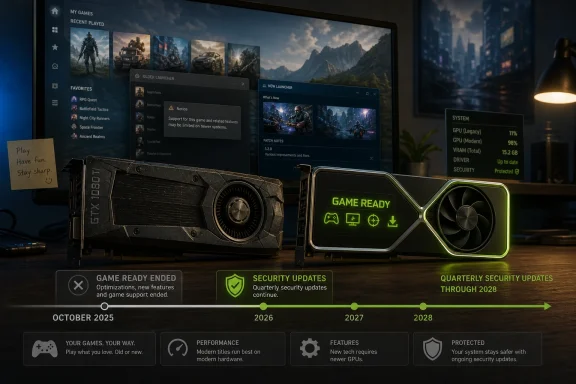 Nvidia Didn’t Brick the Cards; It Retired Their Future
The phrase “cutting gamers off” sounds dramatic, but in this case the drama is baked into the lifecycle. Maxwell, Pascal, and Volta GPUs are not suddenly useless. A GTX 970, GTX 1060, GTX 1080 Ti, or Titan V can still display a desktop, launch games, and keep doing the work it did yesterday.What changes is the promise attached to the driver. Game Ready drivers are not merely a fresh control panel wrapped around an installer; they are where Nvidia ships day-one game optimizations, compatibility fixes, profile updates, performance tuning, and workarounds for the strange ways new games stress old assumptions. Once a GPU architecture leaves that stream, the card moves from being an actively supported gaming platform to being a maintained legacy device.
That distinction matters because modern PC gaming increasingly depends on the driver vendor as a silent co-developer. When a big title ships with shader compilation stutter, broken frame pacing, HDR weirdness, anti-cheat conflicts, or GPU-specific crashes, the fix often arrives through a driver update rather than a game patch. For older GeForce owners, Nvidia’s new posture means those fixes are no longer guaranteed to include them.
Nvidia’s defense is also not frivolous. Pascal launched in 2016, Maxwell before that, and Volta was never a mainstream GeForce gaming generation in the same way. Supporting architectures for close to a decade is not short by consumer hardware standards. But long support does not soften the landing for a market where the GTX 1060 became a folk hero precisely because it stayed useful for so long.
Pascal Became the People’s GPU, and That Makes This Feel Personal
The Pascal generation occupies a special place in PC gaming memory. The GTX 1060 was not the fastest card of its era, but it was the kind of card that made Steam libraries feel democratic: affordable enough for mainstream builds, efficient enough for modest power supplies, and capable enough for years of 1080p gaming. The GTX 1070 and GTX 1080 Ti became their own kind of enthusiast lore.That is why this transition lands differently from a routine end-of-life notice. Nvidia is not just retiring obscure silicon from a bygone workstation niche. It is drawing down support for cards that still sit in hand-me-down towers, budget builds, dorm-room PCs, small-form-factor rigs, and living-room machines that never needed ray tracing to justify their existence.
The uneasy truth is that many of these GPUs remain adequate for the games their owners actually play. Esports titles, older AAA games, indie releases, emulators, Minecraft, Roblox, strategy games, and lightly modded classics do not care much about marketing cycles. For that audience, the limiting factor is less raw shader throughput than whether drivers, operating systems, launchers, and anti-cheat stacks continue to tolerate the machine.
This is where lifecycle policy becomes practical rather than philosophical. A card can be “fast enough” and still become increasingly awkward to own. The end of Game Ready support does not make performance vanish, but it removes the safety net that kept aging hardware feeling current.
Windows 10 Turns the Screw
Nvidia’s decision also intersects with the larger Windows 10 retirement story. Microsoft ended mainstream Windows 10 support in October 2025, though paid extended security options exist for users and organizations that need more time. Nvidia, for its part, gave RTX owners an extra year of Windows 10 Game Ready support, through October 2026.That carve-out is revealing. If you own an RTX card on Windows 10, Nvidia is treating you as a customer worth carrying a little longer. If you own an older GTX card, the exit ramp is shorter and narrower. The signal is obvious: move to newer Nvidia hardware, move to Windows 11 where possible, or accept a more frozen PC gaming experience.
For WindowsForum readers, the Windows 10 angle is arguably the more consequential one. Many older gaming PCs are not merely old because the GPU is old; they are old because the whole platform is old. Unsupported CPUs, missing TPM 2.0 support, motherboard firmware quirks, and user resistance to Windows 11 all cluster around the same machines that still run Pascal and Maxwell cards.
That creates a compound support cliff. A user with a GTX 1060 in a Windows 10 system may face the end of Microsoft’s free OS updates, the end of Nvidia’s Game Ready optimizations, and eventually the creeping incompatibility of game launchers and anti-cheat software. None of these individually flips the off switch. Together, they make the machine feel less like a supported PC and more like a preserved exhibit.
Security Updates Are Not the Same as Being Supported
Nvidia will continue quarterly security updates for affected architectures through October 2028. That is important, and it should not be dismissed. GPU drivers sit deep in the operating system, and vulnerabilities in graphics stacks can matter for browsers, game launchers, compute workloads, and local privilege escalation scenarios.But security maintenance is not gaming support. It means Nvidia will patch serious flaws; it does not mean the company will tune a new Unreal Engine blockbuster for a GTX 1080 Ti or investigate every visual glitch on Maxwell. Quarterly cadence also means the update rhythm slows dramatically compared with the Game Ready channel.
This is a familiar pattern across the tech industry. Vendors often describe a legacy phase in terms that sound reassuring, because “still receiving security updates” is better than abandonment. But users experience legacy support as a loss of responsiveness. The software continues to exist, but the product no longer has momentum.
The same distinction matters in enterprise IT. An admin responsible for lab machines, classrooms, or shared workstations may not care about day-one optimizations for a new shooter. They will care about whether a security driver exists, whether it installs cleanly, and whether the old driver branch remains compatible with Windows updates. In that world, Nvidia’s three-year security runway is useful. For gamers, it is a consolation prize.
The AI Boom Casts a Long Shadow Over GeForce
Nvidia’s driver lifecycle decision would be notable in any era, but it lands in a market where gamers already suspect they have slipped down the company’s priority list. Data center GPUs, AI accelerators, enterprise software, and cloud partnerships now define Nvidia’s valuation and strategic center of gravity. GeForce still matters, but it no longer feels like the company’s main character.That perception is sharpened by the broader GPU market. High-end gaming cards remain expensive, VRAM has become a sore point, and rumors about constrained gaming GPU supply now circulate in a climate where AI demand dominates memory and manufacturing conversations. Whether every rumor proves true is less important than the trust problem. Many gamers no longer believe the consumer graphics market is designed around them.
In that context, ending Game Ready support for beloved older GPUs feels like one more nudge toward an upgrade cycle that users did not choose. Nvidia can fairly argue that decade-old cards cannot be supported forever. Gamers can fairly reply that the replacement market has become more expensive, more segmented, and more entangled with features that older games do not need.
The company’s problem is not just policy; it is optics. When a vendor riding an AI gold rush tells budget gamers that their old cards are aging out, the technical argument may be sound while the emotional argument collapses. Nvidia is not obligated to support Pascal indefinitely. But it should not be surprised when users read the move through the lens of a company increasingly optimized for customers with far deeper pockets.
The Old PC Gaming Bargain Is Breaking
For years, one of the great advantages of PC gaming was graceful aging. A console generation ended abruptly; a PC could be upgraded in parts, patched around, repurposed, stretched, and kept alive. The GPU might age, but settings sliders, community fixes, and driver updates kept the machine relevant.That bargain is weakening. Modern games often assume fast SSDs, large memory pools, new instruction sets, shader model features, hardware ray tracing paths, upscaling frameworks, and driver support for specific architectures. The floor is rising not just because graphics are prettier, but because the entire software stack is moving.
The result is a new kind of obsolescence. It is not that an older GPU cannot render polygons. It is that the game, driver, operating system, overlay, anti-cheat module, and upscaler are all evolving together. A card outside that loop becomes harder to recommend even if its benchmark numbers still look respectable.
This matters for secondhand buyers. The used GPU market has long been the relief valve for PC gaming affordability, and Pascal cards have been among its most attractive options. A cheap GTX 1070 may still be fine for a child’s first gaming PC or a Linux tinkering box, but buyers now need to price in a shorter support horizon. The bargain is not dead; it is conditional.
Linux Users Get a Different Version of the Same Problem
The Linux gaming story complicates the picture. Valve’s Proton work, Mesa’s progress, and the Steam Deck effect have made Linux gaming far more realistic than it was a decade ago. But Nvidia’s proprietary driver stack remains a special case, and old GPUs on Linux can become troublesome when distributions move faster than legacy driver branches.Rolling-release distributions are especially unforgiving. A driver that works today can become fragile after kernel, compiler, or display stack changes. Community packaging can keep old branches alive for a while, but that is not the same as vendor-backed support.
For Pascal and Maxwell owners, Linux may be a refuge from Windows 11 hardware requirements, but it is not a magic escape from Nvidia’s lifecycle. Users who want to keep old Nvidia hardware running on Linux may find themselves juggling older driver branches, manual packages, kernel pinning, or distribution choices that favor stability over novelty.
This is where AMD’s open driver architecture gains a reputational advantage, even when performance comparisons are more complicated. Open-source drivers do not guarantee eternal support, but they give communities more room to maneuver. Nvidia has made progress with open kernel modules for newer GPUs, yet that does not erase years of friction for users trying to stretch older cards.
Game Developers Will Not Optimize for Yesterday Forever
Nvidia’s move also reflects a reality on the game development side. Developers have finite QA budgets. Every supported GPU architecture, driver branch, OS version, and feature path multiplies the test matrix. At some point, “works on old cards” becomes a best-effort outcome rather than a design requirement.This is not just about Nvidia. As consoles advance and PC minimum specs rise, studios will increasingly target hardware assumptions that leave pre-RTX cards behind. Ray tracing may be optional today in many games, but modern rendering pipelines, upscaling integrations, and shader-heavy effects are reshaping the baseline.
Older GPUs can still brute-force some of that, especially at 1080p with reduced settings. But without Game Ready drivers, problems that once might have been solved in Nvidia’s stack may instead sit unresolved unless the developer chooses to fix them. That shifts burden away from the GPU vendor and onto studios that may have little commercial incentive to spend time on legacy hardware.
The practical advice is blunt: if your old GeForce card already plays your library well, there is no immediate emergency. If your plan is to buy new releases for the next several years, the risk is rising. Not because every game will refuse to launch, but because the long tail of glitches, crashes, and missing optimizations will increasingly be yours to absorb.
IT Pros Should Treat Old GeForce Machines Like Legacy Endpoints
For sysadmins, schools, makerspaces, small studios, and community labs, the GeForce support shift should be handled like any other lifecycle event. Inventory matters. If machines rely on Maxwell, Pascal, or Volta GPUs, they should be identified, documented, and separated into use cases where legacy support is acceptable and use cases where it is not.A PC used for CAD instruction, media labs, esports clubs, or GPU-accelerated creative software has a different risk profile from a spare display machine. Some workloads may run unchanged for years. Others may become brittle the next time a major application updates its GPU requirements.
The security update window through October 2028 gives administrators time, but time is not a plan. Driver branches should be tested before broad deployment. Windows 10 systems need a separate OS lifecycle strategy. Machines exposed to untrusted content, browsers, game mods, and student accounts deserve more caution than offline workstations running fixed software.
The hidden cost is support labor. Keeping old hardware alive is only cheap when it does not consume staff time. Once technicians are spending hours troubleshooting driver conflicts on unsupported GPUs, the economics of “free” legacy hardware quickly become less attractive.
Nvidia’s Upgrade Message Is Clearer Than Its Marketing
Nvidia would rather frame this as a generous support lifecycle than as forced migration, and there is truth in that framing. Eleven years of support for some GPUs is substantial. Quarterly security updates through 2028 are better than a hard cutoff. RTX owners on Windows 10 get a one-year extension beyond Microsoft’s consumer support deadline.But the strategic message is unmistakable. The supported Nvidia gaming future is RTX, Windows 11, DLSS, Reflex, frame generation, neural rendering, and modern driver branches. GTX-era cards are now outside the main road. They may continue in the shoulder lane for a while, but the traffic has moved.
That is also why this moment feels bigger than a compatibility matrix. Nvidia’s software stack is increasingly a product in itself. DLSS versions, frame generation, RTX HDR, app overlays, Reflex integrations, and game-specific profiles all reinforce the value of being on current hardware. When older GPUs lose the driver stream, they lose access not just to fixes but to the living edge of Nvidia’s platform.
The upgrade pressure is therefore both technical and cultural. New games are marketed with Nvidia features that older cards cannot use. Driver releases increasingly celebrate capabilities tied to RTX generations. The older GeForce card becomes less a member of the family and more a tolerated ancestor.
The GTX Era Leaves Users With a Short Checklist
The smart response is not panic-buying a new GPU. It is matching the machine to the workload and being honest about where the support line now sits. For many users, an old card will remain perfectly serviceable. For others, the end of Game Ready support should move an upgrade from “eventually” to “before the next major game or OS transition.”- Owners of Maxwell, Pascal, and Volta cards should install and archive the final supported Game Ready driver branch that works well for their systems.
- Users who mainly play older or lightweight games can safely treat the cards as legacy hardware rather than e-waste.
- Gamers who buy new AAA titles at launch should expect more risk from crashes, visual bugs, and missing driver optimizations.
- Windows 10 users with RTX cards have only until October 2026 for Nvidia’s Game Ready support on that operating system.
- Administrators should inventory affected GPUs now and plan replacements around workload risk, not around a vague sense that the cards still feel fast.
Source: Fathom Journal Fathom - For a deeper understanding of Israel, the region, and global antisemitism
