

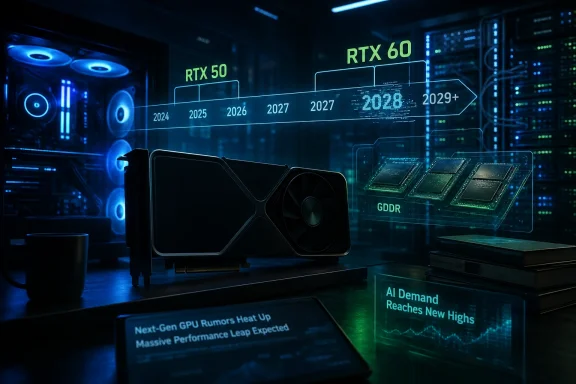
Reports that Nvidia has pushed its GeForce RTX 60-series gaming GPUs to 2028 remain unconfirmed, despite fresh claims from NoobFeed and other outlets that the company will ship no new consumer GPUs in 2026. Nvidia has not announced an RTX 60 roadmap, cancelled an RTX 50 Super refresh, or provided a launch date for either family.
NoobFeed’s July 13 report presents a 2028 RTX 60 launch as the likely outcome of memory constraints and Nvidia’s focus on AI hardware. That broad explanation is plausible: Nvidia’s own financial results show the data-center business dwarfs GeForce revenue. In its fiscal 2026 fourth quarter, Nvidia reported $62.3 billion in data-center revenue and $3.7 billion from gaming.
But the specific roadmap claims are still a moving target. Tom’s Hardware reported in February that Nvidia had reportedly delayed new RTX gaming products amid memory supply pressure. More recently, Seasonic briefly listed unannounced RTX 50 Super variants in its power-supply calculator before removing them, as reported by Tom’s Hardware and PC Gamer. That is not confirmation of a launch, but it does undercut claims that the refresh is definitively dead.
The reported RTX 5080 Super with 24GB of GDDR7, RTX 60-series branding, Rubin-based gaming parts, and a 2028 date should all be treated as leaks or speculation until Nvidia speaks publicly.
Nvidia’s RTX 50 series is still its current officially listed GeForce generation. The company continues to sell RTX 50-series desktop and laptop products, including the RTX 5060, rather than signalling an imminent wholesale replacement.
AMD faces many of the same component constraints. Claims that its next architecture will be called RDNA 5 or UDNA, and will arrive in late 2027 or early 2028, are likewise not official launch commitments. Intel’s future Arc desktop plans are also unclear, but there has been no formal cancellation notice for a next-generation consumer GPU line.
A 12GB card remains a sensible floor for many 1440p builds, while 16GB or more is more comfortable for 4K textures, creative applications, and local AI workloads. That is a purchasing guideline, not evidence that an RTX 60 launch has slipped.
Until Nvidia publishes a roadmap, the RTX 50 Super and RTX 60 timelines remain rumors, and current-generation cards are the only products builders can plan around.
The reported obstacle is pricing for 3GB GDDR7 memory chips. HotHardware says those parts are allegedly far more expensive than the 2GB chips used on existing models, potentially making higher-VRAM variants costly to produce and difficult to price competitively.
If accurate, this would explain a delay rather than a cancellation: board partners could be preparing RTX 5080 Super, RTX 5070 Ti Super, and RTX 5070 Super designs while Nvidia waits for memory economics to improve. It does not establish a release date, final specifications, or retail pricing.
For Windows PC builders, the practical takeaway remains unchanged: do not defer a needed purchase on the assumption that a Super refresh is imminent. Any additional VRAM models remain unannounced, and their eventual price may substantially reduce their value proposition.
 Rumors, not a product announcement
NoobFeed’s July 13 report presents a 2028 RTX 60 launch as the likely outcome of memory constraints and Nvidia’s focus on AI hardware. That broad explanation is plausible: Nvidia’s own financial results show the data-center business dwarfs GeForce revenue. In its fiscal 2026 fourth quarter, Nvidia reported $62.3 billion in data-center revenue and $3.7 billion from gaming.But the specific roadmap claims are still a moving target. Tom’s Hardware reported in February that Nvidia had reportedly delayed new RTX gaming products amid memory supply pressure. More recently, Seasonic briefly listed unannounced RTX 50 Super variants in its power-supply calculator before removing them, as reported by Tom’s Hardware and PC Gamer. That is not confirmation of a launch, but it does undercut claims that the refresh is definitively dead.
The reported RTX 5080 Super with 24GB of GDDR7, RTX 60-series branding, Rubin-based gaming parts, and a 2028 date should all be treated as leaks or speculation until Nvidia speaks publicly.
Memory pressure is the credible part
The larger market backdrop is real. AI infrastructure requires enormous volumes of HBM and other memory products, and memory suppliers have prioritized higher-margin data-center demand. That can affect the availability and cost of GDDR memory used in gaming cards, even where the GPU silicon itself is ready.Nvidia’s RTX 50 series is still its current officially listed GeForce generation. The company continues to sell RTX 50-series desktop and laptop products, including the RTX 5060, rather than signalling an imminent wholesale replacement.
AMD faces many of the same component constraints. Claims that its next architecture will be called RDNA 5 or UDNA, and will arrive in late 2027 or early 2028, are likewise not official launch commitments. Intel’s future Arc desktop plans are also unclear, but there has been no formal cancellation notice for a next-generation consumer GPU line.
What Windows PC builders should do
For buyers planning a Windows gaming PC or a local-AI workstation, the immediate advice is less dramatic than the rumor cycle suggests: buy on current price, performance, VRAM capacity, power requirements, and driver support—not on an assumed 2028 launch calendar.A 12GB card remains a sensible floor for many 1440p builds, while 16GB or more is more comfortable for 4K textures, creative applications, and local AI workloads. That is a purchasing guideline, not evidence that an RTX 60 launch has slipped.
Until Nvidia publishes a roadmap, the RTX 50 Super and RTX 60 timelines remain rumors, and current-generation cards are the only products builders can plan around.
Update: Report says RTX 50 Super cards have reached board partners (July 18, 2026)
HotHardware reports that Nvidia’s unannounced RTX 50 Super refresh may have progressed beyond internal prototypes, citing a VideoCardz source who says cards have been distributed to at least one add-in-board partner. Nvidia has not confirmed the claim or announced any RTX 50 Super product.The reported obstacle is pricing for 3GB GDDR7 memory chips. HotHardware says those parts are allegedly far more expensive than the 2GB chips used on existing models, potentially making higher-VRAM variants costly to produce and difficult to price competitively.
If accurate, this would explain a delay rather than a cancellation: board partners could be preparing RTX 5080 Super, RTX 5070 Ti Super, and RTX 5070 Super designs while Nvidia waits for memory economics to improve. It does not establish a release date, final specifications, or retail pricing.
For Windows PC builders, the practical takeaway remains unchanged: do not defer a needed purchase on the assumption that a Super refresh is imminent. Any additional VRAM models remain unannounced, and their eventual price may substantially reduce their value proposition.
References
- Primary source: NoobFeed
Published: 2026-07-13T00:00:00+00:00
RTX 60 Delayed to 2028: Nvidia's Gaming GPUs Are No Longer the Priority | NoobFeed
The arrival of the RTX 50 Super refresh now seems very, very uncertain and unlikely before CES 2027, and the RTX 60 series may not arrive until 2028.www.noobfeed.com - Independent coverage: tech-insider.org
Published: 2026-07-12T04:21:57+00:00
Nvidia Skips 2026 Gaming GPUs: 30-Year Streak Ends
Nvidia will not launch a new gaming GPU in 2026 as the AI memory shortage forces a 30-year streak to end. Here is what is cancelled and why.tech-insider.org - Related coverage: tomshardware.com
Unannounced Nvidia RTX 50 Super GPUs appear in Seasonic PSU calculator — unreleased graphics cards shown with 10-17% higher TGP over original models | Tom's Hardware
More memory, more performance, more power. Maybe.www.tomshardware.com - Related coverage: techradar.com
Nvidia’s next-generation RTX 60 series GPUs rumored to be on track to launch next year | TechRadar
I just hope the memory price crisis is over by thenwww.techradar.com - Related coverage: tomsguide.com
After missing CES, don't expect the Nvidia RTX 50 Super GPU series anytime soon | Tom's Guide
A new leak suggested that Nvidia has indefinitely delayed its GeForce RTX 50-series SUPER GPUs.www.tomsguide.com
Last edited:

