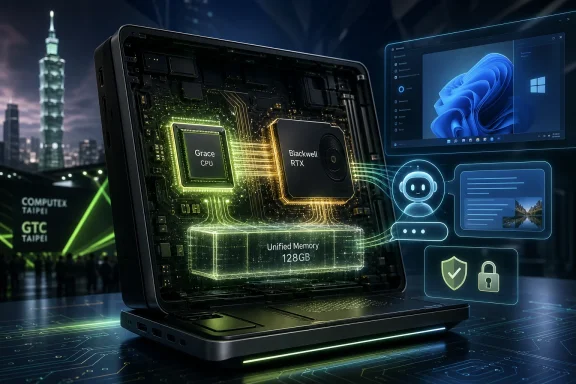
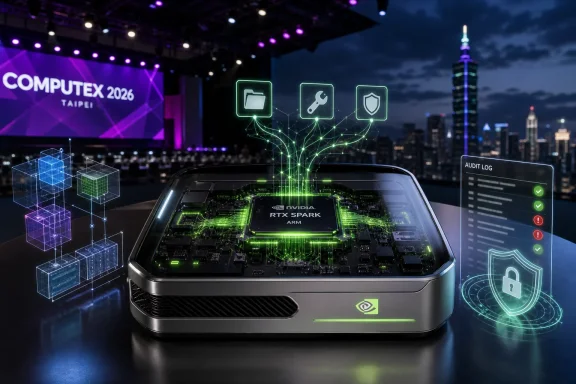
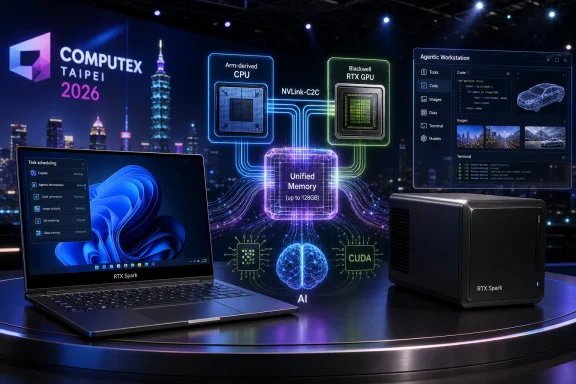
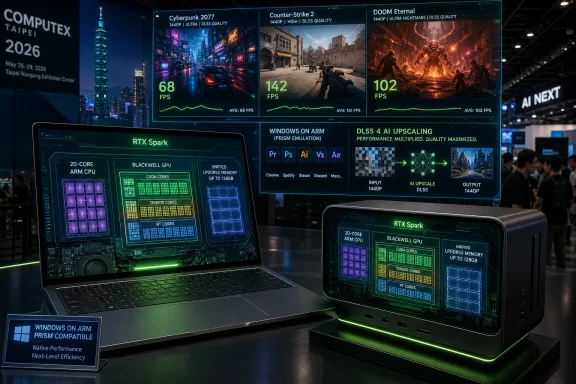
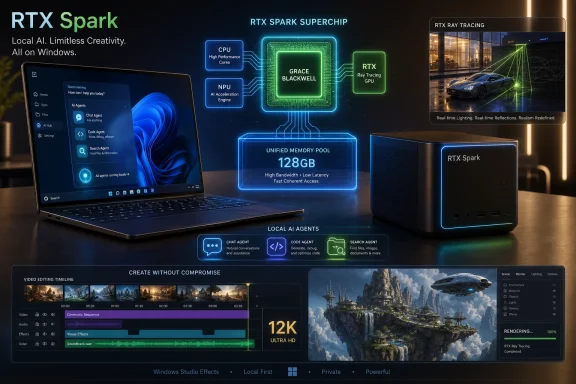
NVIDIA announced RTX Spark at GTC Taipei and Computex 2026 as a Grace Blackwell-based Windows PC superchip for thin laptops and compact desktops, pairing a 20-core Arm CPU, a Blackwell RTX GPU, up to 128GB of unified memory, and 1 petaflop of FP4 AI performance. The company is selling it as more than another fast mobile processor: this is NVIDIA’s bid to make the Windows PC a local AI workstation, creative rig, gaming machine, and personal agent host in one device. If the claims survive shipping hardware, RTX Spark could change the buying calculus for creators and AI developers who have been forced to choose between portability and memory capacity. But the real story is not simply 12K video on a laptop; it is NVIDIA trying to move the center of gravity in Windows computing away from the CPU and toward a CUDA-first, agent-ready platform.
For decades, NVIDIA’s place in the PC hierarchy was powerful but bounded. Intel and AMD owned the platform conversation, Microsoft owned the operating system, and NVIDIA supplied the GPU that made games, rendering, and compute workloads faster. RTX Spark is a more aggressive proposition: NVIDIA is not just accelerating the PC, it is trying to define what the next premium PC is.
That distinction matters. A discrete GPU can be optional, segmented, and thermally constrained by whatever chassis an OEM builds around it. A superchip with CPU, GPU, unified memory, and NVIDIA’s software stack woven together becomes the system architecture. It invites laptop makers to build around NVIDIA rather than merely slot NVIDIA into a design.
The company has been walking toward this for years. CUDA turned GPUs into developer infrastructure. RTX turned graphics silicon into a hybrid rendering and AI accelerator. DLSS turned game performance into a neural rendering problem. DGX systems turned NVIDIA hardware into the default appliance for AI labs. RTX Spark brings that strategy down from racks and workstations into the premium Windows PC.
That is why the branding matters. NVIDIA is not calling this another GeForce laptop part. It is calling it RTX Spark, tying consumer creative workflows, local AI inference, game rendering, and agentic computing into one platform story. The company wants buyers to see the machine less as a laptop with an NVIDIA GPU and more as a personal AI computer with Windows attached.
Unified memory is not magic, and it does not erase bandwidth, latency, or software optimization constraints. But for local AI models, large 3D scenes, complex timelines, and generative video workflows, memory capacity determines whether the job runs locally at all. NVIDIA’s pitch is that RTX Spark can keep more of the working set on the device without the dance of splitting models, proxying assets, or offloading work to the cloud.
That is the point behind the company’s claims around 120-billion-parameter large language models, million-token contexts, 90GB-plus 3D scenes, and 12K 4:2:2 video. These are not ordinary consumer benchmarks. They are workload boundary markers, chosen to say that a machine weighing around three pounds should be able to attempt jobs that previously implied a tower workstation, a cloud instance, or a very patient editor.
For Windows users, this is also a direct answer to Apple’s unified-memory advantage in creative laptops. Apple Silicon made the MacBook Pro a credible mobile workstation by giving CPU, GPU, and media engines access to a shared memory pool in a tightly controlled system. RTX Spark is NVIDIA’s version of that argument, but with CUDA, RTX, TensorRT, OptiX, DLSS, and the broader Windows software ecosystem as the counterweight.
The caveat is that “up to 128GB” will do a lot of work. OEM pricing, thermal envelopes, battery behavior, and lower-memory configurations will determine whether RTX Spark becomes a broad category or a halo spec for expensive creator laptops. The difference between a platform that can democratize local AI work and one that mostly decorates keynote slides is usually found in the configuration page.
NVIDIA says RTX Spark’s Blackwell decoder, unified memory, and software acceleration can support 12K 4:2:2 editing and more complex Premiere workflows. Adobe, for its part, is reportedly rearchitecting Premiere and Photoshop around the platform, with promised gains of up to 2x across AI, editing, coloring, and effects work. If that optimization reaches shipping builds, it could make RTX Spark one of the first Windows laptop platforms where the software story is as important as the silicon story.
The phrase 12K video editing also needs translation. Most users are not cutting 12K feature projects in coffee shops, and 12K support does not mean every effect, codec, and multicam timeline will run flawlessly on battery. What it means is that the ceiling for portable editorial work rises. More importantly, the amount of work that can happen before returning to a studio workstation expands.
That matters for documentary crews, solo creators, VFX supervisors, commercial editors, and photographers increasingly working across stills, video, 3D, and generative tools. A laptop that can ingest high-resolution footage, generate previews, apply AI-assisted edits, and continue working locally without cloud round trips is not merely faster. It changes when and where the creative decision-making can happen.
The bottleneck shifts from “Can I open this project?” to “How long can I sustain this workload, and how much does the machine cost?” That is still a hard problem. But it is a better problem than being locked out of the workflow entirely.
The claimed work goes beyond toggling on GPU acceleration. NVIDIA’s announcement describes a new Premiere video pipeline using unified memory, the Blackwell GPU, and TensorRT. Photoshop is described as getting a next-generation engine optimized for GPU compositing, live filters, HDR work, natural brushing, and AI-native operations. Substance 3D tools are also expected to run natively on the platform.
This is the correct direction. The old model of accelerating isolated filters is too small for modern creative software. The future is pipeline acceleration: decoding, effects, inference, compositing, color, preview, export, and generative edits all competing for the same memory and compute budget. RTX Spark’s promise is that these pieces can be orchestrated as a system rather than treated as separate islands.
Still, Adobe’s history gives users reason to wait for real-world tests. Creative professionals do not buy promises; they buy reliable timelines, predictable color, stable plug-ins, and export behavior that does not collapse under deadline pressure. “Up to 2x” is a marketing phrase until independent reviewers run messy projects, not canned demos.
The Windows ecosystem also has more variables than Apple’s. GPU drivers, Arm compatibility, plug-in support, codecs, third-party panels, storage speeds, and OEM thermal designs can all affect the experience. NVIDIA and Adobe may do the deep engineering work, but the final result still has to survive the chaos of real Windows production environments.
Qualcomm’s Windows on Arm story has centered on battery life, responsiveness, and neural processing units for everyday AI features. NVIDIA’s version starts at the top of the stack: CUDA compatibility, RTX graphics, huge memory configurations, and local frontier-model inference. It is less “thin laptop that happens to have AI” and more “portable workstation that happens to be Arm.”
For Microsoft, this is useful. Windows on Arm has needed more than efficiency; it has needed a reason for developers and professionals to tolerate transition friction. RTX Spark supplies a high-end reason. If the machine can run creative apps, AI frameworks, and games well enough, Arm stops being a compromise and becomes the price of admission to a new hardware class.
That said, compatibility will be the issue to watch. NVIDIA can bring the full CUDA and RTX ecosystem only if toolchains, drivers, runtimes, and applications behave as expected on Windows Arm systems. Gamers will care about anti-cheat, launchers, emulation, and driver maturity. Developers will care about Python environments, containers, native libraries, and whether their CUDA workflows behave like they do on x86 workstations.
This is where the “Windows-native” phrase must earn its keep. If RTX Spark feels like a special-purpose device that excels only inside curated demos, it will be admired but not trusted. If it behaves like a Windows PC that happens to have a radically stronger local AI and graphics substrate, it becomes much more dangerous to the existing laptop order.
The problem with agents is not merely intelligence. It is authority. An agent that can read your files, manipulate apps, send messages, summarize documents, and automate work is not just a chatbot. It is a process with privileges, memory, intent, and access to your digital life. Running that locally may improve privacy and latency, but it also raises the stakes for containment.
That is why NVIDIA and Microsoft are emphasizing Windows security primitives, identity, containment, policy, and NVIDIA OpenShell. The platform pitch is that agents need a governed runtime, not just a model window. Users and administrators should be able to decide what an agent can touch, what it can send to cloud models, when personal information should be disguised, and how local models are selected based on privacy policy.
For enterprise IT, this is the difference between useful automation and an ungovernable shadow workforce. A local agent that can operate across apps will need auditability, least-privilege controls, revocation, data-loss boundaries, and integration with existing management stacks. Otherwise, the first serious security incident will freeze deployment faster than any benchmark can revive it.
The consumer version of the risk is simpler: people will overtrust systems that look helpful. A personal agent that confidently changes settings, edits files, books travel, or sends messages needs visible consent moments and recoverable actions. If NVIDIA and Microsoft want the PC to become a teammate, they also need to make sure the teammate cannot quietly become an insider threat.
That is meaningful, but gaming is not where RTX Spark’s identity is most distinct. A traditional GeForce laptop can already be a strong gaming machine. RTX Spark’s more unusual value proposition is that it may combine competent high-refresh gaming with local model inference, creative acceleration, and a memory pool large enough for professional workflows.
In other words, gaming helps justify the purchase, but it probably does not define it. The buyer NVIDIA is courting is the creator who games, the developer who renders, the student training local models, the engineer who wants CUDA on the road, and the power user who wants one machine to do everything without renting a cloud GPU every time a workload gets interesting.
That hybrid audience is real. It is also hard to serve. Gaming laptops tend to optimize for wattage and frame rates; creator laptops optimize for displays, acoustics, memory, and storage; developer machines optimize for Linux compatibility, toolchains, and reliability. RTX Spark tries to collapse those categories into one premium Windows device. That is ambitious, and ambition in laptops often meets physics first.
The early design claims are eye-catching: laptops as thin as 14 millimeters, as light as three pounds, in 14- to 16-inch sizes, with premium tandem OLED displays and all-day battery life. Those specs sound like a direct challenge to the MacBook Pro, high-end Surface devices, and creator laptops that currently define the premium productivity segment. They also sound like the kind of claims that must be tested under sustained load.
Small desktop PCs may be the more immediately convincing form factor. A compact RTX Spark box with strong cooling, high memory capacity, and stable power could become a local AI and creative workstation for developers, labs, and studios that do not need a full tower. In that shape, NVIDIA’s DGX Spark lineage is easier to see, and thermal compromises are less severe.
Laptops, however, are where the cultural impact would be larger. If a thin Windows notebook can credibly run large local models, edit heavyweight video, render complex scenes, and game well, the premium laptop market gets a new reference point. If it throttles hard, costs too much, or ships with uneven software compatibility, RTX Spark becomes another impressive platform mostly purchased by people who already know why they need it.
Pricing will be decisive. NVIDIA’s adjacent DGX Spark systems have occupied expensive territory, and 128GB of high-speed memory is not cheap. OEMs may ship lower configurations that carry the RTX Spark badge but dilute the headline promise. Buyers should watch not only the chip name but the memory size, storage performance, display quality, cooling design, and whether the machine maintains performance on battery.
That shift matters because cloud AI is powerful but metered. Developers pay in tokens, GPU hours, latency, policy constraints, and data exposure. Creators pay in upload time, subscription tiers, and workflow interruption. Enterprises pay in compliance reviews and network dependence. A local AI workstation does not eliminate those costs, but it gives users another place to run the work.
The most plausible future is hybrid. A local agent handles private context, drafts, file search, code exploration, previews, smaller models, and immediate creative operations. Cloud models handle larger reasoning tasks, collaborative workloads, specialized services, and jobs that exceed local capacity. NVIDIA’s OpenShell pitch even acknowledges this by describing policy-based routing between local and cloud models.
That is a more mature vision than pretending everything will run locally. The practical question is whether users can understand and control the boundary. If the machine silently routes sensitive work to the cloud, trust erodes. If it keeps everything local but performs poorly, users abandon it. The platform has to make the trade-off legible.
For WindowsForum readers, this is where the operating system layer becomes just as interesting as the silicon. The PC has spent years becoming a client for cloud services. RTX Spark argues that the endpoint is about to become powerful again — not as a nostalgic return to offline computing, but as a negotiation point in an AI stack that spans device, cloud, and enterprise policy.
Thermals are the first test. A thin laptop can post dramatic peak numbers, but creators and developers care about sustained performance. Rendering, exporting, compiling, generating video, and running local models are not bursty web tasks. They produce heat, draw power, and expose weak cooling designs quickly.
Drivers are the second test. NVIDIA’s Windows driver reputation is strong in gaming and professional graphics, but RTX Spark adds a more complex platform layer: Arm CPU integration, unified memory, AI runtimes, agent security, media engines, and potentially new OEM-specific power states. Early adopters should expect some rough edges, especially in obscure creative plug-ins and developer workflows.
Developer trust is the third test. CUDA compatibility is NVIDIA’s biggest moat, but developers will want to know whether their existing libraries, containers, quantized models, and inference stacks work without days of configuration. The closer RTX Spark feels to “my CUDA workstation, but portable,” the faster it will spread. The more it feels like a new island, the slower adoption will be.
That is why independent benchmarks will matter less for peak scores than for messy workloads. Can it load the model users actually care about? Can it edit footage from the camera they actually own? Can it run Blender, DaVinci Resolve, Premiere, Photoshop, ComfyUI, llama.cpp, and game launchers without a compatibility scavenger hunt? Those answers will define RTX Spark more than the petaflop figure.
The concrete takeaways are sharper than the marketing:
 NVIDIA Is No Longer Content to Be the Card Inside the PC
For decades, NVIDIA’s place in the PC hierarchy was powerful but bounded. Intel and AMD owned the platform conversation, Microsoft owned the operating system, and NVIDIA supplied the GPU that made games, rendering, and compute workloads faster. RTX Spark is a more aggressive proposition: NVIDIA is not just accelerating the PC, it is trying to define what the next premium PC is.That distinction matters. A discrete GPU can be optional, segmented, and thermally constrained by whatever chassis an OEM builds around it. A superchip with CPU, GPU, unified memory, and NVIDIA’s software stack woven together becomes the system architecture. It invites laptop makers to build around NVIDIA rather than merely slot NVIDIA into a design.
The company has been walking toward this for years. CUDA turned GPUs into developer infrastructure. RTX turned graphics silicon into a hybrid rendering and AI accelerator. DLSS turned game performance into a neural rendering problem. DGX systems turned NVIDIA hardware into the default appliance for AI labs. RTX Spark brings that strategy down from racks and workstations into the premium Windows PC.
That is why the branding matters. NVIDIA is not calling this another GeForce laptop part. It is calling it RTX Spark, tying consumer creative workflows, local AI inference, game rendering, and agentic computing into one platform story. The company wants buyers to see the machine less as a laptop with an NVIDIA GPU and more as a personal AI computer with Windows attached.
The 128GB Number Is the Spec That Changes the Conversation
The headline number is 1 petaflop, but the more consequential figure may be 128GB of unified memory. AI developers and 3D artists have learned the hard way that raw compute is often less useful than memory that the accelerator can actually reach. A fast GPU starved by VRAM limits is a beautiful bottleneck.Unified memory is not magic, and it does not erase bandwidth, latency, or software optimization constraints. But for local AI models, large 3D scenes, complex timelines, and generative video workflows, memory capacity determines whether the job runs locally at all. NVIDIA’s pitch is that RTX Spark can keep more of the working set on the device without the dance of splitting models, proxying assets, or offloading work to the cloud.
That is the point behind the company’s claims around 120-billion-parameter large language models, million-token contexts, 90GB-plus 3D scenes, and 12K 4:2:2 video. These are not ordinary consumer benchmarks. They are workload boundary markers, chosen to say that a machine weighing around three pounds should be able to attempt jobs that previously implied a tower workstation, a cloud instance, or a very patient editor.
For Windows users, this is also a direct answer to Apple’s unified-memory advantage in creative laptops. Apple Silicon made the MacBook Pro a credible mobile workstation by giving CPU, GPU, and media engines access to a shared memory pool in a tightly controlled system. RTX Spark is NVIDIA’s version of that argument, but with CUDA, RTX, TensorRT, OptiX, DLSS, and the broader Windows software ecosystem as the counterweight.
The caveat is that “up to 128GB” will do a lot of work. OEM pricing, thermal envelopes, battery behavior, and lower-memory configurations will determine whether RTX Spark becomes a broad category or a halo spec for expensive creator laptops. The difference between a platform that can democratize local AI work and one that mostly decorates keynote slides is usually found in the configuration page.
The 12K Editing Claim Is Really About the End of Proxy-First Mobility
Video editors are right to be skeptical whenever a chip vendor promises workstation-class performance in a thin laptop. We have heard versions of this story before, often followed by fan noise, battery drain, dropped frames, and the quiet return of proxy workflows. Still, RTX Spark’s claimed video pipeline points at a real pain point: mobile editing has improved dramatically, but the highest-resolution professional formats remain awkward away from a plugged-in workstation.NVIDIA says RTX Spark’s Blackwell decoder, unified memory, and software acceleration can support 12K 4:2:2 editing and more complex Premiere workflows. Adobe, for its part, is reportedly rearchitecting Premiere and Photoshop around the platform, with promised gains of up to 2x across AI, editing, coloring, and effects work. If that optimization reaches shipping builds, it could make RTX Spark one of the first Windows laptop platforms where the software story is as important as the silicon story.
The phrase 12K video editing also needs translation. Most users are not cutting 12K feature projects in coffee shops, and 12K support does not mean every effect, codec, and multicam timeline will run flawlessly on battery. What it means is that the ceiling for portable editorial work rises. More importantly, the amount of work that can happen before returning to a studio workstation expands.
That matters for documentary crews, solo creators, VFX supervisors, commercial editors, and photographers increasingly working across stills, video, 3D, and generative tools. A laptop that can ingest high-resolution footage, generate previews, apply AI-assisted edits, and continue working locally without cloud round trips is not merely faster. It changes when and where the creative decision-making can happen.
The bottleneck shifts from “Can I open this project?” to “How long can I sustain this workload, and how much does the machine cost?” That is still a hard problem. But it is a better problem than being locked out of the workflow entirely.
Adobe’s Support Is the Difference Between a Demo and a Platform
NVIDIA’s best hardware announcements succeed when software vendors treat them as a new baseline rather than a niche accelerator. Adobe’s role in the RTX Spark story is therefore crucial. Photoshop and Premiere are not just popular creative applications; they are industry weather vanes. If Adobe rebuilds core pipelines around RTX Spark, other creative software vendors will have a reason to follow.The claimed work goes beyond toggling on GPU acceleration. NVIDIA’s announcement describes a new Premiere video pipeline using unified memory, the Blackwell GPU, and TensorRT. Photoshop is described as getting a next-generation engine optimized for GPU compositing, live filters, HDR work, natural brushing, and AI-native operations. Substance 3D tools are also expected to run natively on the platform.
This is the correct direction. The old model of accelerating isolated filters is too small for modern creative software. The future is pipeline acceleration: decoding, effects, inference, compositing, color, preview, export, and generative edits all competing for the same memory and compute budget. RTX Spark’s promise is that these pieces can be orchestrated as a system rather than treated as separate islands.
Still, Adobe’s history gives users reason to wait for real-world tests. Creative professionals do not buy promises; they buy reliable timelines, predictable color, stable plug-ins, and export behavior that does not collapse under deadline pressure. “Up to 2x” is a marketing phrase until independent reviewers run messy projects, not canned demos.
The Windows ecosystem also has more variables than Apple’s. GPU drivers, Arm compatibility, plug-in support, codecs, third-party panels, storage speeds, and OEM thermal designs can all affect the experience. NVIDIA and Adobe may do the deep engineering work, but the final result still has to survive the chaos of real Windows production environments.
Windows on Arm Gets the GPU Partner It Was Missing
RTX Spark is also a Windows on Arm moment, even if NVIDIA would rather lead with AI and creators. The chip pairs a Grace-class Arm CPU, developed with MediaTek involvement, with a Blackwell RTX GPU over NVLink-C2C. That makes it part of the same larger industry turn toward Arm-based personal computing, but with a different emphasis from Qualcomm’s Snapdragon X push.Qualcomm’s Windows on Arm story has centered on battery life, responsiveness, and neural processing units for everyday AI features. NVIDIA’s version starts at the top of the stack: CUDA compatibility, RTX graphics, huge memory configurations, and local frontier-model inference. It is less “thin laptop that happens to have AI” and more “portable workstation that happens to be Arm.”
For Microsoft, this is useful. Windows on Arm has needed more than efficiency; it has needed a reason for developers and professionals to tolerate transition friction. RTX Spark supplies a high-end reason. If the machine can run creative apps, AI frameworks, and games well enough, Arm stops being a compromise and becomes the price of admission to a new hardware class.
That said, compatibility will be the issue to watch. NVIDIA can bring the full CUDA and RTX ecosystem only if toolchains, drivers, runtimes, and applications behave as expected on Windows Arm systems. Gamers will care about anti-cheat, launchers, emulation, and driver maturity. Developers will care about Python environments, containers, native libraries, and whether their CUDA workflows behave like they do on x86 workstations.
This is where the “Windows-native” phrase must earn its keep. If RTX Spark feels like a special-purpose device that excels only inside curated demos, it will be admired but not trusted. If it behaves like a Windows PC that happens to have a radically stronger local AI and graphics substrate, it becomes much more dangerous to the existing laptop order.
Local Agents Are the Ambition, and the Security Model Is the Risk
NVIDIA’s most futuristic claim is not rendering or gaming. It is the idea that RTX Spark will power personal agents running locally on Windows, able to reason across applications, search local files, generate media, write code, and execute multi-step workflows under user control. This is the part of the announcement that sounds most like a keynote — and also the part that could matter most if Microsoft and NVIDIA get it right.The problem with agents is not merely intelligence. It is authority. An agent that can read your files, manipulate apps, send messages, summarize documents, and automate work is not just a chatbot. It is a process with privileges, memory, intent, and access to your digital life. Running that locally may improve privacy and latency, but it also raises the stakes for containment.
That is why NVIDIA and Microsoft are emphasizing Windows security primitives, identity, containment, policy, and NVIDIA OpenShell. The platform pitch is that agents need a governed runtime, not just a model window. Users and administrators should be able to decide what an agent can touch, what it can send to cloud models, when personal information should be disguised, and how local models are selected based on privacy policy.
For enterprise IT, this is the difference between useful automation and an ungovernable shadow workforce. A local agent that can operate across apps will need auditability, least-privilege controls, revocation, data-loss boundaries, and integration with existing management stacks. Otherwise, the first serious security incident will freeze deployment faster than any benchmark can revive it.
The consumer version of the risk is simpler: people will overtrust systems that look helpful. A personal agent that confidently changes settings, edits files, books travel, or sends messages needs visible consent moments and recoverable actions. If NVIDIA and Microsoft want the PC to become a teammate, they also need to make sure the teammate cannot quietly become an insider threat.
Gaming Is the Familiar Hook, Not the Main Event
NVIDIA included gaming claims because RTX is still a gaming brand, and because gamers remain the most reliable early adopters of expensive graphics hardware. The company says RTX Spark systems can play AAA games at 1440p and over 100 frames per second with ray tracing, DLSS, Reflex, and G-SYNC. It also points to DLSS 4.5 Ray Reconstruction, a second-generation transformer model, and broader RTX support across games and applications.That is meaningful, but gaming is not where RTX Spark’s identity is most distinct. A traditional GeForce laptop can already be a strong gaming machine. RTX Spark’s more unusual value proposition is that it may combine competent high-refresh gaming with local model inference, creative acceleration, and a memory pool large enough for professional workflows.
In other words, gaming helps justify the purchase, but it probably does not define it. The buyer NVIDIA is courting is the creator who games, the developer who renders, the student training local models, the engineer who wants CUDA on the road, and the power user who wants one machine to do everything without renting a cloud GPU every time a workload gets interesting.
That hybrid audience is real. It is also hard to serve. Gaming laptops tend to optimize for wattage and frame rates; creator laptops optimize for displays, acoustics, memory, and storage; developer machines optimize for Linux compatibility, toolchains, and reliability. RTX Spark tries to collapse those categories into one premium Windows device. That is ambitious, and ambition in laptops often meets physics first.
OEMs Will Decide Whether Spark Becomes a Category or a Trophy
NVIDIA says RTX Spark systems are expected from ASUS, Dell, HP, Lenovo, Microsoft Surface, and MSI, with Acer and GIGABYTE to follow. That breadth matters because platform shifts do not happen through one reference design. They happen when multiple OEMs decide the silicon deserves real chassis engineering, display quality, storage bandwidth, thermal tuning, and support.The early design claims are eye-catching: laptops as thin as 14 millimeters, as light as three pounds, in 14- to 16-inch sizes, with premium tandem OLED displays and all-day battery life. Those specs sound like a direct challenge to the MacBook Pro, high-end Surface devices, and creator laptops that currently define the premium productivity segment. They also sound like the kind of claims that must be tested under sustained load.
Small desktop PCs may be the more immediately convincing form factor. A compact RTX Spark box with strong cooling, high memory capacity, and stable power could become a local AI and creative workstation for developers, labs, and studios that do not need a full tower. In that shape, NVIDIA’s DGX Spark lineage is easier to see, and thermal compromises are less severe.
Laptops, however, are where the cultural impact would be larger. If a thin Windows notebook can credibly run large local models, edit heavyweight video, render complex scenes, and game well, the premium laptop market gets a new reference point. If it throttles hard, costs too much, or ships with uneven software compatibility, RTX Spark becomes another impressive platform mostly purchased by people who already know why they need it.
Pricing will be decisive. NVIDIA’s adjacent DGX Spark systems have occupied expensive territory, and 128GB of high-speed memory is not cheap. OEMs may ship lower configurations that carry the RTX Spark badge but dilute the headline promise. Buyers should watch not only the chip name but the memory size, storage performance, display quality, cooling design, and whether the machine maintains performance on battery.
The Cloud Does Not Disappear, but Its Job Changes
NVIDIA’s local-AI rhetoric could make it sound as if RTX Spark is an anti-cloud product. It is not. NVIDIA benefits from both sides of the AI infrastructure boom, and local devices will not replace large-scale training clusters or cloud inference for every workload. The better framing is that RTX Spark shifts more experimentation, iteration, and private inference onto the endpoint.That shift matters because cloud AI is powerful but metered. Developers pay in tokens, GPU hours, latency, policy constraints, and data exposure. Creators pay in upload time, subscription tiers, and workflow interruption. Enterprises pay in compliance reviews and network dependence. A local AI workstation does not eliminate those costs, but it gives users another place to run the work.
The most plausible future is hybrid. A local agent handles private context, drafts, file search, code exploration, previews, smaller models, and immediate creative operations. Cloud models handle larger reasoning tasks, collaborative workloads, specialized services, and jobs that exceed local capacity. NVIDIA’s OpenShell pitch even acknowledges this by describing policy-based routing between local and cloud models.
That is a more mature vision than pretending everything will run locally. The practical question is whether users can understand and control the boundary. If the machine silently routes sensitive work to the cloud, trust erodes. If it keeps everything local but performs poorly, users abandon it. The platform has to make the trade-off legible.
For WindowsForum readers, this is where the operating system layer becomes just as interesting as the silicon. The PC has spent years becoming a client for cloud services. RTX Spark argues that the endpoint is about to become powerful again — not as a nostalgic return to offline computing, but as a negotiation point in an AI stack that spans device, cloud, and enterprise policy.
The Fine Print Will Live in Thermals, Drivers, and Developer Trust
Every major PC platform announcement arrives with a gap between theoretical capability and daily experience. RTX Spark’s gap will be measured in thermals, drivers, native application support, battery behavior, and how well NVIDIA’s developer stack works on Windows Arm. The silicon may be impressive, but a platform is only as strong as the boring parts.Thermals are the first test. A thin laptop can post dramatic peak numbers, but creators and developers care about sustained performance. Rendering, exporting, compiling, generating video, and running local models are not bursty web tasks. They produce heat, draw power, and expose weak cooling designs quickly.
Drivers are the second test. NVIDIA’s Windows driver reputation is strong in gaming and professional graphics, but RTX Spark adds a more complex platform layer: Arm CPU integration, unified memory, AI runtimes, agent security, media engines, and potentially new OEM-specific power states. Early adopters should expect some rough edges, especially in obscure creative plug-ins and developer workflows.
Developer trust is the third test. CUDA compatibility is NVIDIA’s biggest moat, but developers will want to know whether their existing libraries, containers, quantized models, and inference stacks work without days of configuration. The closer RTX Spark feels to “my CUDA workstation, but portable,” the faster it will spread. The more it feels like a new island, the slower adoption will be.
That is why independent benchmarks will matter less for peak scores than for messy workloads. Can it load the model users actually care about? Can it edit footage from the camera they actually own? Can it run Blender, DaVinci Resolve, Premiere, Photoshop, ComfyUI, llama.cpp, and game launchers without a compatibility scavenger hunt? Those answers will define RTX Spark more than the petaflop figure.
The Spark Era Will Be Judged by Workflows, Not Keynotes
RTX Spark’s announcement gives Windows users something they have not had in a while: a genuinely new premium PC argument. It is not just thinner, faster, or more battery efficient. It says the next PC should be able to host local agents, run serious AI models, accelerate professional creative tools, render complex 3D scenes, and still behave like a high-end gaming machine.The concrete takeaways are sharper than the marketing:
- RTX Spark is NVIDIA’s attempt to turn the Windows PC into a CUDA-first local AI and creative platform, not merely another gaming laptop generation.
- The 128GB unified memory ceiling may matter more than the 1 petaflop AI figure because it determines which local models and creative projects can run at all.
- Adobe’s promised Premiere and Photoshop work is central to the platform’s credibility, because professional users need optimized workflows rather than isolated benchmark wins.
- Microsoft and NVIDIA’s agent security model will need to prove that local automation can be powerful without becoming reckless.
- OEM execution will decide whether RTX Spark becomes a mainstream premium category or an expensive halo for developers and creators.
- Buyers should wait for sustained-load tests, compatibility reports, and real application benchmarks before treating the keynote claims as purchasing guidance.
References
- Primary source: Canon Rumors
Published: 2026-06-08T11:23:09.836051
NVIDIA’s New RTX Spark Superchip Changes Everything for On-the-Go 12K Video Editing and 3D Rendering
With 128GB of unified memory and massive AI acceleration, NVIDIA’s lightweight RTX Spark laptops are a dream come true for creators working on massive files.www.canonrumors.com - Related coverage: tomshardware.com
Computex 2026 Day Zero Wrap-Up: Nvidia launches RTX Spark Superchip assault on laptop and desktop markets, Intel readies Xeon 6+ | Tom's Hardware
Computex 2026 is off to a strong startwww.tomshardware.com - Related coverage: itpro.com
‘This is the new PC. The personal AI computer’: Nvidia wants its RTX Spark ‘superchip’ to fuel the AI PC boom | IT Pro
The new RTX Spark chip is designed to keep AI inference local for security and safetywww.itpro.com - Related coverage: timesofindia.indiatimes.com
RTX Spark is Nvidia’s ‘superchip' for Windows PCs with 1 petaflop of AI, 128GB RAM, and RTX 5070-tier graphics - The Times of India
Tech News News: For thirty years, Nvidia made the GPU inside your PC. Now it makes the chip inside it too. At GTC Taipei and Computex 2026, Jensen Huang unveiled RTX .timesofindia.indiatimes.com - Related coverage: livemint.com
Nvidia launches RTX Spark chip to power Windows PCs with 128GB memory and AI agents | Mint
Nvidia's new RTX Spark chip will enable Windows laptops to run AI agents locally, allowing users to automate tasks and use natural language. The chip features a 20-core Grace CPU and Blackwell RTX GPU, offering up to 1 petaflop of AI performance and 128GB of memory. www.livemint.com
- Related coverage: gadgetbytenepal.com
NVIDIA RTX Spark announced with 1 PFLOP AI performance and local AI agents
NVIDIA has unveiled RTX Spark, a new ARM-based superchip for Windows PCs. It packs a Grace CPU, Blackwell RTX GPU, up to 128GB unified memory, and support for local AI agents. Here's everything you newww.gadgetbytenepal.com
- Related coverage: digitalapplied.com
NVIDIA RTX Spark: 1-Petaflop Local AI Agent Box Guide
NVIDIA's RTX Spark superchip runs 120B-parameter agents on-device with 128GB unified memory. Inside the silicon, the bandwidth math, and OpenShell security.www.digitalapplied.com - Related coverage: techspot.com
Nvidia RTX Spark CPU is now official: "superchip" will power Windows laptops and desktops | TechSpot
Ryan Shrout is a longtime technology analyst and industry veteran who has spent over two decades covering PC hardware, graphics, and semiconductors. He previously led technical marketing...www.techspot.com - Related coverage: gizbot.com
NVIDIA Unveils RTX Spark Platform With 1 Petaflop AI Performance and Up to 128GB Memory - Gizbot News
NVIDIA unveils RTX Spark, a new AI-focused Windows PC platform with local AI agents, RTX graphics, up to 128GB memory, and creator-focused features.www.gizbot.com - Related coverage: docs.nvidia.com
How OpenShell Works | NVIDIA OpenShell
Understand the OpenShell architecture, runtime boundaries, gateways, sandboxes, and ecosystem integration points.docs.nvidia.com
- Related coverage: pk-sharma.com
NVIDIA RTX Spark: The PC Reset : Full Breakdown
NVIDIA RTX Spark brings 128GB unified memory, 1 petaflop AI and full CUDA to 8 Windows laptops. Full specs, processor comparison vs Apple M5, and fall 2026 release.www.pk-sharma.com - Related coverage: phemex.com
NVIDIA RTX Spark Debuts with 1 Petaflop AI Power | Phemex News
NVIDIA's RTX Spark superchip, unveiled at GTC 2026, delivers 1 petaflop AI performance, redefining AI PCs. Major OEMs to launch devices this fall.phemex.com
- Related coverage: thesiliconreview.com
NVIDIA RTX Spark Brings 1 Petaflop AI Acceleration to Windows PCs
NVIDIA AI launched RTX Spark, a 1 petaflop AI superchip for Windows PCs, Microsoft optimizing Windows local AI agents The Silicon Review reports fall 2026 rollout thesiliconreview.com
- Related coverage: techvantage.blog
NVIDIA RTX Spark & Microsoft Reinvent the Windows PC for Personal AI Agents | TechVantage
NVIDIA and Microsoft unveil RTX Spark at GTC Taipei — a 1-petaflop superchip with 128GB unified memory, OpenShell agent security, Adobe 2x performance boost, 120B local LLMs, and 1440p gaming. Full fact-checked breakdown for US buyers.www.techvantage.blog - Related coverage: tdsynnex.com
- Related coverage: nvidianews.nvidia.com
- Related coverage: amax.com