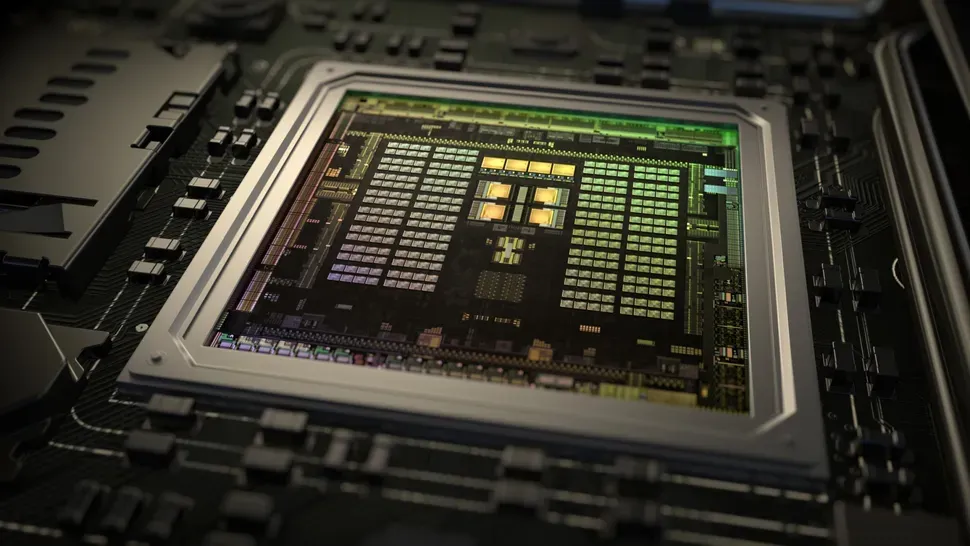
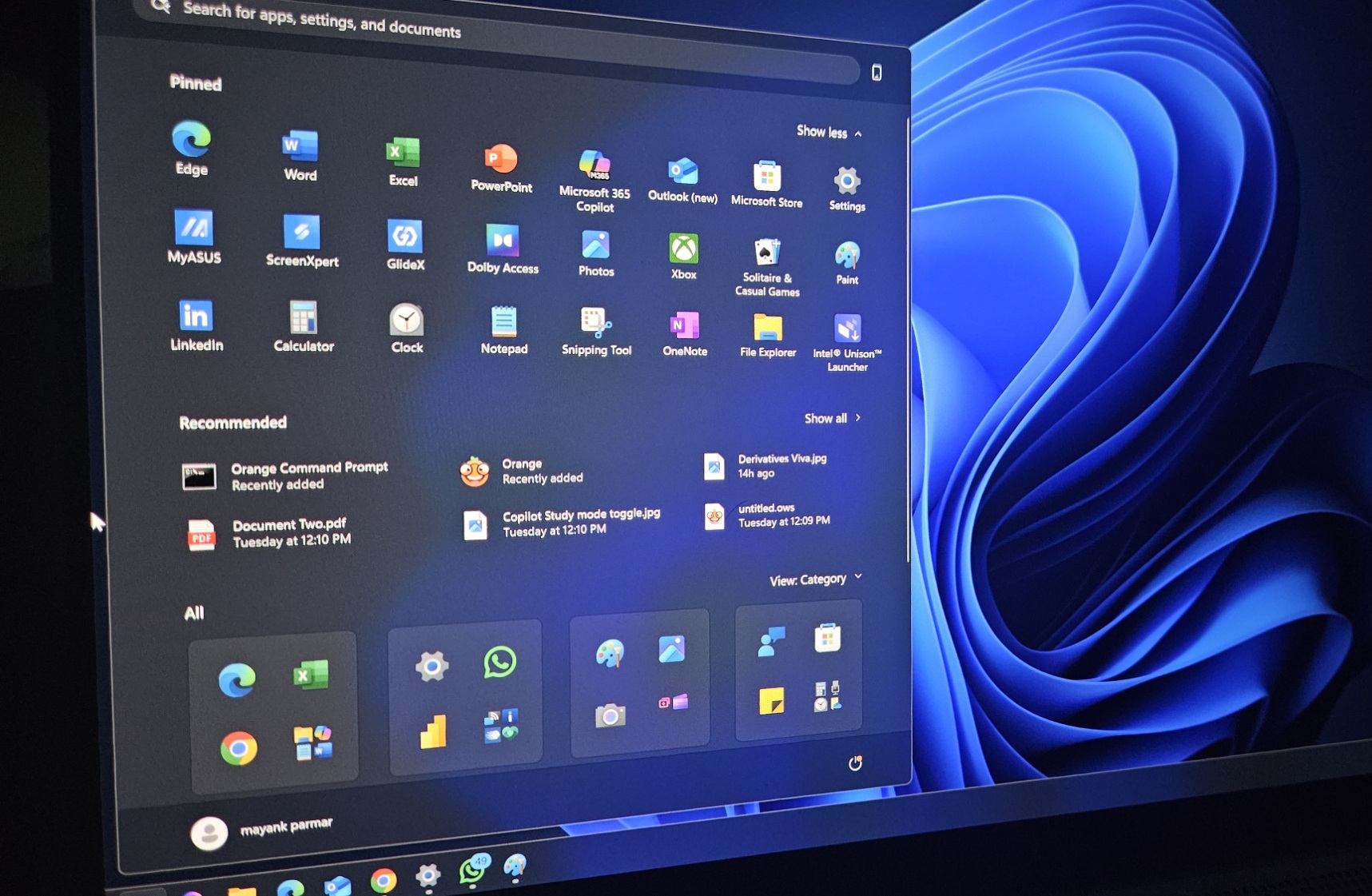
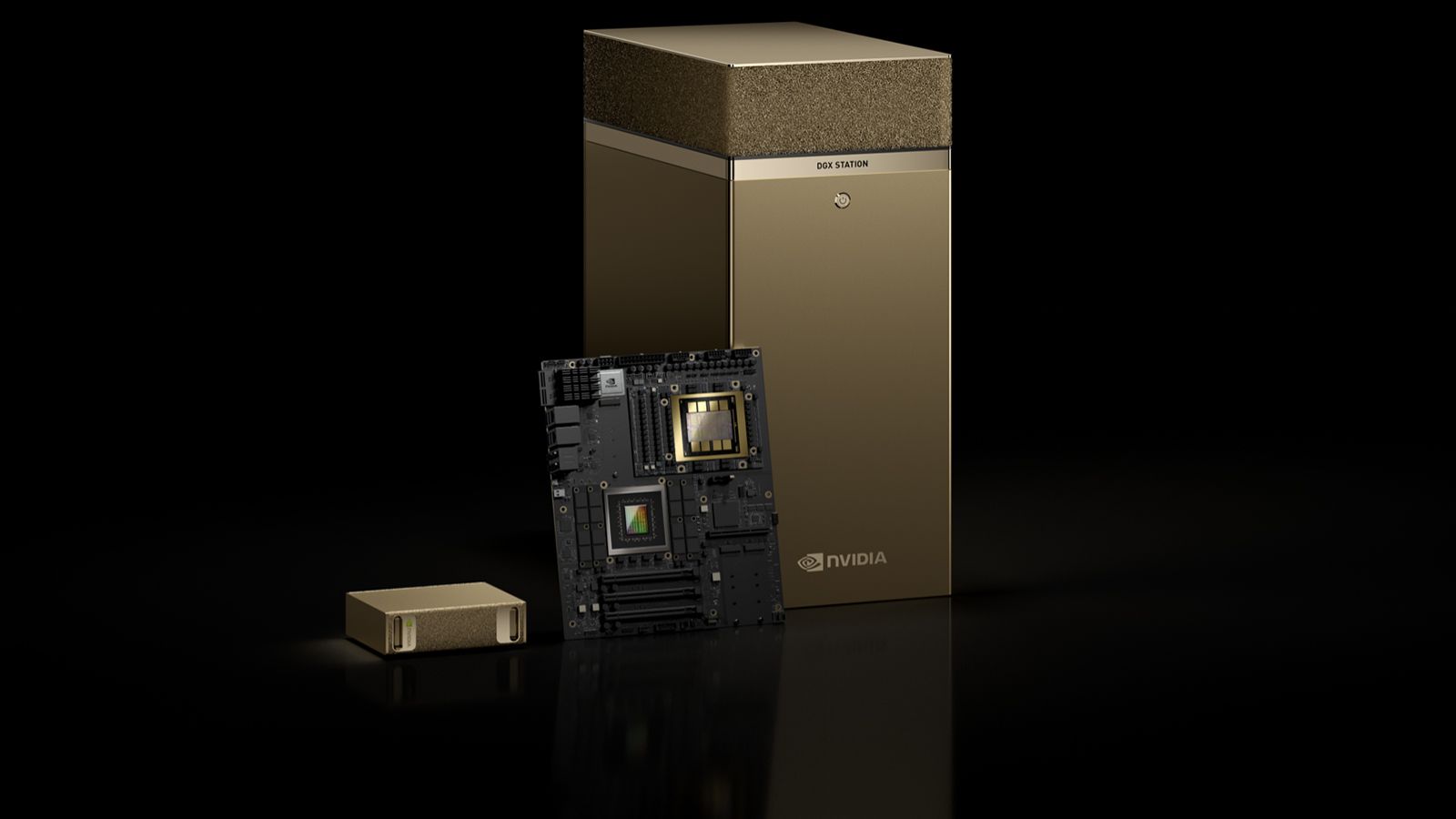
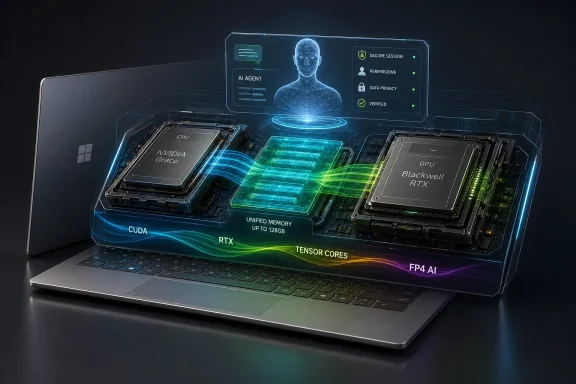
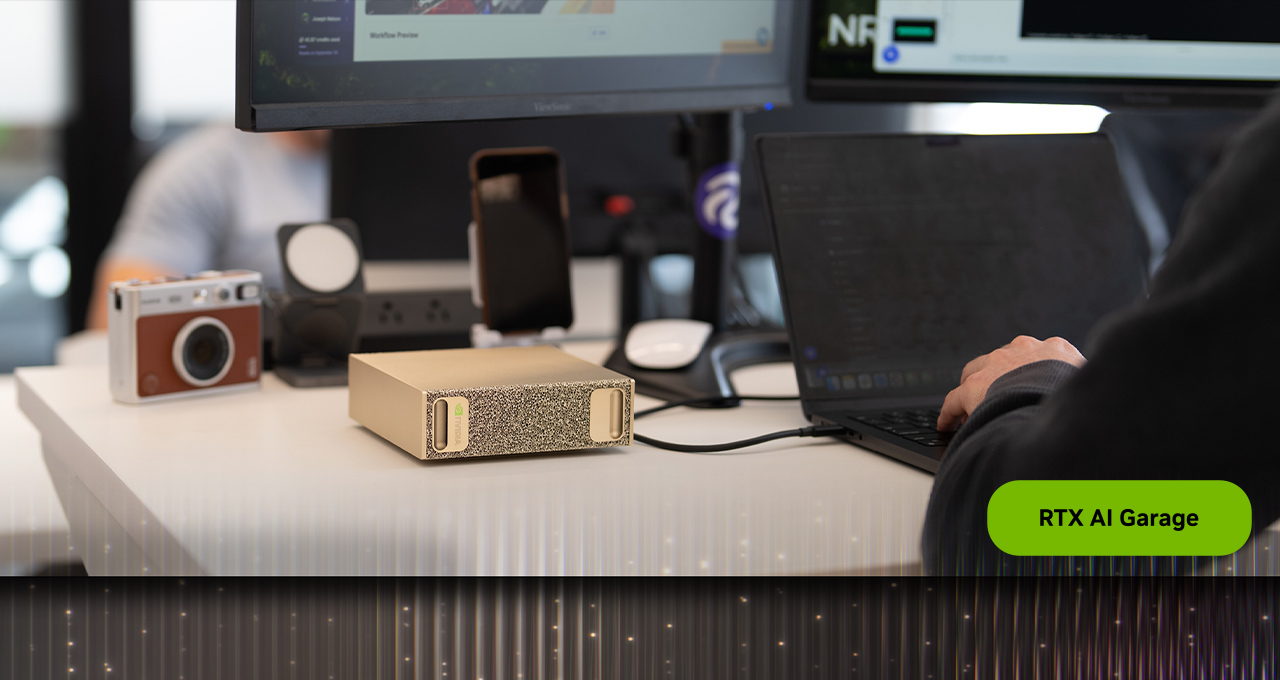
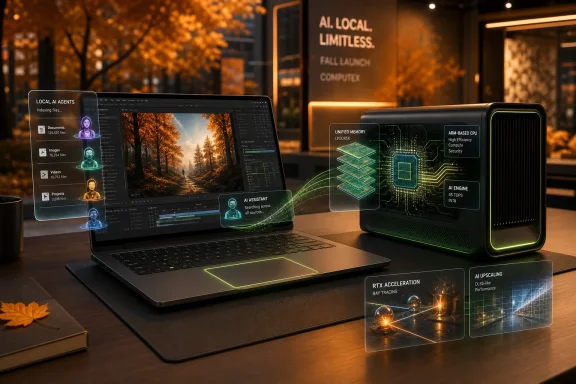
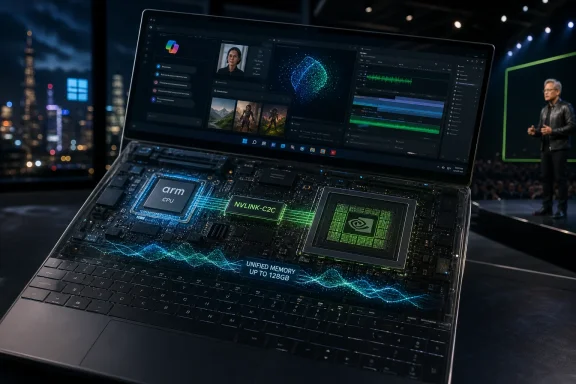
Microsoft and Nvidia announced on May 31, 2026, that a new class of thin-and-light Windows PCs will use Nvidia’s Arm-based RTX Spark platform, with Jensen Huang set to expand the pitch at GTC Taipei on June 1. That is the plain version of the news; the strategic version is much larger. Nvidia is no longer content to be the graphics company inside the PC. It wants to become one of the companies that defines what a Windows PC is.
That should make Intel, AMD, Qualcomm, and every Windows OEM sit up straight. For three decades, the PC’s center of gravity has been the x86 CPU, with the GPU treated as an accelerator, an add-in, or a gaming luxury. Nvidia is now trying to flip that hierarchy: the processor, GPU, NPU, developer stack, and AI runtime all become one vertically coordinated proposition, with Microsoft providing the Windows layer that makes the bet credible.
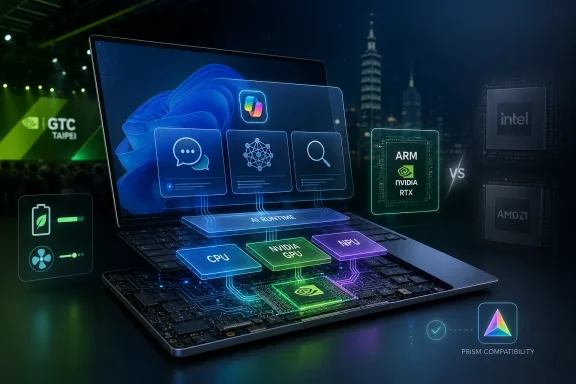
Futuristic laptop display shows AI runtime, CPU/GPU/NPU chips, and Intel vs ARM/NVIDIA in a city-tech scene.Nvidia Is Moving From Attachment to Architecture​

The modern PC industry has always had room for Nvidia, but mostly in a supporting role. The company’s GeForce and RTX GPUs shaped gaming laptops, creator workstations, and high-end desktops, but the main processor belonged to Intel or AMD. Even when Nvidia was the part people bragged about, Windows still booted around someone else’s CPU.
The RTX Spark announcement changes the posture. Nvidia is not merely accelerating a Windows machine; it is helping define the machine’s primary compute platform. That makes this a direct incursion into the territory that Intel built, AMD revived, and Qualcomm has been trying to enter through Windows on Arm.
The user-facing pitch is simple enough: powerful thin-and-light PCs with local AI performance, Copilot+ PC support, Arm efficiency, and Nvidia-class graphics. The industry-facing pitch is sharper. Nvidia wants the PC to become another endpoint in its AI platform strategy, not an isolated consumer hardware category.
That is why this is more than a chip story. The company is bringing its old superpower — the software ecosystem around CUDA, TensorRT, PyTorch acceleration, and developer tools — into a Windows client market that has historically been allergic to platform fragmentation. If Nvidia can make local AI development feel native on a laptop, it gains a new beachhead in the most familiar computing device in the world.

Microsoft Needs a Stronger Windows on Arm Story Than Battery Life​

Microsoft has spent years trying to make Windows on Arm feel inevitable. The problem is that inevitability has always arrived next year. Qualcomm’s Snapdragon X line finally gave the platform a serious consumer push, but the core challenge remains the same: Windows users do not buy architectures; they buy compatibility, performance, and confidence.
That is where Nvidia’s arrival matters. Microsoft can sell Windows on Arm as efficient and modern, but Nvidia can sell it as powerful. That distinction is not cosmetic. The PC market has repeatedly shown that battery life alone is not enough to break entrenched buying habits, especially among enthusiasts and professionals who remember the compromises of earlier Arm Windows devices.
The official language around Prism, Microsoft’s emulator for 32-bit and 64-bit x86 apps on Windows on Arm, is especially important. Compatibility is the tax every non-x86 Windows platform must pay. If Prism is fast enough, transparent enough, and broadly tested enough on Nvidia-powered machines, then the architecture becomes less of a warning label and more of an implementation detail.
But this is also where Microsoft’s risk is concentrated. A Windows PC that carries the Nvidia brand will be judged not only against other Arm laptops, but against the accumulated expectations of the Windows ecosystem: Steam libraries, Adobe workflows, Visual Studio workloads, old peripherals, corporate endpoint tools, VPN clients, printer drivers, accessibility utilities, and the long tail of software nobody remembers until it breaks.

The Three-Year Partnership Claim Deserves Caution​

Some early reporting has framed the Microsoft-Nvidia effort as a three-year partnership to reinvent the PC. The public record is more careful. Microsoft has described a multi-year, full-stack collaboration spanning gaming, AI, cloud, DirectX, RTX, Azure workloads, and now client PCs, but the precise commercial terms and duration have not been publicly nailed down in the way investors might prefer.
That matters because “three-year partnership” sounds like a product roadmap, while “multi-year collaboration” can mean a looser strategic alignment. Microsoft and Nvidia have been working together for years across cloud AI infrastructure, gaming APIs, and developer tooling. The new piece is not that the companies suddenly discovered each other; it is that their collaboration has moved from the data center and graphics stack into the heart of the Windows laptop.
The distinction is not pedantry. Windows history is littered with grand platform initiatives that were real, well-funded, and short-lived. Windows RT was real. Windows 10 on Arm was real. The first wave of always-connected PCs was real. What separates a durable platform from a keynote moment is not the adjective attached to the partnership, but the shipping cadence, OEM breadth, app compatibility, driver support, and user satisfaction after the first wave of reviews.
Nvidia and Microsoft can afford a long game. But Windows buyers have little patience for being early adopters of someone else’s strategic transition.

The PC Is Becoming an AI Endpoint, Not Just a Client Device​

The Copilot+ PC category already told us where Microsoft wants Windows to go. The operating system is being reimagined around local AI inference, background assistance, search, summarization, generation, and increasingly agent-like workflows. The missing piece has been a hardware story compelling enough to make users care.
Nvidia’s contribution is to make that local AI pitch feel less like a feature checklist and more like a compute platform. NPUs matter because they can run efficient on-device models, but Nvidia’s GPU software stack matters because developers already know it, trust it, and deploy around it. If RTX Spark laptops can bridge the NPU world of consumer AI features with the GPU world of serious AI development, they could occupy a useful middle ground.
That middle ground is strategically valuable. Data-center AI is expensive, capacity-constrained, and increasingly political. Local AI is cheaper to invoke, more private by design, and better suited to low-latency personal workflows. A Windows laptop that can run meaningful models locally does not replace the cloud, but it changes the default assumption that every useful AI task must round-trip through a remote service.
For sysadmins and security teams, that cuts both ways. Local AI creates opportunities for privacy-preserving workflows, but it also creates new governance questions. What data is processed locally? What telemetry leaves the device? How are models updated? How do endpoint protection tools inspect AI-assisted workflows? A more capable PC is not automatically a more manageable one.

Intel and AMD Are Being Challenged on Their Home Field​

Intel’s problem is not that Nvidia will instantly take the PC market. It will not. The problem is that Nvidia’s entrance attacks the story Intel has been trying to rebuild: that the AI PC era belongs to x86 incumbents with better NPUs, better power efficiency, and decades of Windows compatibility.
AMD faces a different version of the same threat. Ryzen AI has given AMD a credible position in premium laptops, and its integrated graphics have long been a strength. But Nvidia’s brand in AI acceleration is almost unfairly strong. If consumers start associating “AI PC” with Nvidia in the same way they associate “gaming PC” with Nvidia, AMD will have to fight on messaging as well as silicon.
Qualcomm may feel the pressure most immediately. Snapdragon X systems helped reset expectations for Windows on Arm, but Nvidia brings a GPU heritage and developer ecosystem Qualcomm cannot easily duplicate. Qualcomm’s advantage is that it arrived first in the current wave. Nvidia’s advantage is that the market already believes it can make difficult compute workloads fast.
This is the kind of competitive pressure Windows has needed. The PC industry became too comfortable describing incremental improvements as revolutions. A serious Nvidia Windows platform forces every chip vendor to answer a sharper question: not “how many TOPS does your NPU deliver,” but “what new work can this machine do that last year’s machine could not?”

OEMs Will Decide Whether This Is a Platform or a Showcase​

The reported involvement of Surface and Dell is significant because Windows hardware transitions need flagship systems. Microsoft can use Surface to define the ideal implementation, while Dell can test whether the platform works in the broader commercial and prosumer market. If HP, Lenovo, Asus, Acer, and others follow, RTX Spark becomes a category. If not, it risks becoming a boutique experiment.
OEM execution will matter more than keynote demos. Thermals, fan noise, battery life, display choices, docking reliability, firmware updates, and sleep behavior will define user perception. Windows users have seen too many “next-generation” laptops undermined by ordinary laptop problems.
Commercial buyers will be even more conservative. Enterprises do not merely ask whether a machine is fast. They ask whether it can be imaged, secured, serviced, audited, enrolled, remotely managed, and supported for years. They ask whether their endpoint agents run cleanly and whether line-of-business apps behave under emulation.
That is why Dell’s role, if confirmed in shipping systems, may be more important than Surface’s. Surface can set the aspiration. Dell can tell IT departments whether this platform belongs in procurement discussions.

The Software Stack Is the Real Moat​

Nvidia’s greatest asset is not just silicon. It is the layer cake of software that makes its silicon useful. CUDA’s dominance in AI and scientific computing has trained a generation of developers to treat Nvidia hardware as the default target for accelerated workloads.
Bringing that stack to Windows laptops changes the developer conversation. A student, researcher, indie developer, or enterprise prototyper could build locally on a portable machine that behaves more like the Nvidia environments they later deploy to in the cloud. That does not require the laptop to match a data-center GPU. It only requires the workflow to feel coherent.
Microsoft benefits from that coherence. Windows has often been the most widely used developer desktop while not always being the most loved AI development environment. If RTX Spark machines make CUDA-accelerated PyTorch, TensorRT, llama.cpp, Hugging Face tooling, and related frameworks easier to use locally, Microsoft gets a stronger answer to macOS and Linux workstations.
The danger is that Windows could become more stratified. A Copilot+ PC with Qualcomm silicon, an RTX Spark PC with Nvidia silicon, and an x86 AI PC from Intel or AMD may all carry similar stickers while behaving differently under real workloads. Microsoft will need to police the user experience carefully, or “AI PC” will become another marketing phrase that hides too many incompatibilities.

Gaming Is the Unspoken Stress Test​

Nvidia and Microsoft will understandably lead with AI, but Windows users will judge these machines through games whether the companies like it or not. Gaming is where Windows compatibility issues become visible, emotional, and brutally benchmarked. It is also where Nvidia’s brand promise is strongest.
The catch is that Windows gaming on Arm remains a complicated proposition. Some games will run well through emulation. Some will need native Arm builds. Some anti-cheat systems, launchers, overlays, mods, and drivers may become friction points. The GPU can be excellent and the experience can still be uneven if the surrounding ecosystem is not ready.
Microsoft has been making moves here, including improving Xbox app support on Arm-based Windows PCs. That matters, but the PC gaming universe is larger than Microsoft’s storefront. Steam, Epic, Battle.net, Riot, Ubisoft, EA, indie launchers, mod managers, and years of legacy DirectX behavior all become part of the practical test.
If Nvidia can make gaming feel ordinary on Arm Windows, the platform’s credibility jumps. If gaming feels like a compatibility lottery, RTX Spark risks being perceived as an AI workstation niche rather than a mainstream PC breakthrough.

Apple Is the Benchmark Nobody Wants to Name​

The obvious comparison is Apple Silicon. Apple proved that Arm-based personal computers could be fast, efficient, quiet, and desirable when hardware, operating system, developer tools, and app migration were coordinated tightly enough. Microsoft and Nvidia are trying to create a version of that story inside the messier, more open, more diverse Windows ecosystem.
That openness is both Windows’ weakness and its strength. Apple could force transitions in ways Microsoft cannot. Microsoft must carry decades of backward compatibility and OEM variation. Nvidia must fit into a platform where it does not own the operating system, the app store, the hardware brand, or the enterprise management stack.
But Windows has advantages Apple does not. It dominates many corporate environments, remains central to PC gaming, and supports a vast range of hardware configurations. If Nvidia can thrive inside that complexity, the payoff could be larger than a single polished product line.
The lesson from Apple is not simply “Arm is good.” The lesson is that architecture transitions work when users stop thinking about architecture. Nvidia and Microsoft’s job is to make an Arm-based Windows PC feel like a better Windows PC, not like a science project with impressive benchmarks.

Investors Should Separate PC Ambition From AI Euphoria​

For investors, the temptation is to treat any Nvidia expansion as another leg of the AI boom. That is understandable. Nvidia’s data-center business has become one of the defining financial stories in technology, and any new market with Microsoft attached will attract attention. But PCs are not data-center accelerators.
The PC market is lower margin, more seasonal, more fragmented, and more exposed to consumer replacement cycles. Winning laptops is not the same as selling constrained AI accelerators into hyperscale demand. Nvidia can build a meaningful business here without it becoming the next data-center-scale revenue engine.
The strategic value may be greater than the near-term revenue. A successful Windows PC platform gives Nvidia influence over developers earlier in the workflow, places its AI stack on more desks, and extends its brand into everyday computing. It also gives the company leverage against any future world in which cloud AI growth normalizes and investors ask where the next frontier lies.
Crypto investors should be especially careful not to overread the announcement. This is not a blockchain story, and there is no token angle. Nvidia’s GPUs remain relevant to parts of the crypto and AI infrastructure world, but RTX Spark is fundamentally about Windows PCs, local AI, and platform control.

The Compatibility Tax Has Not Been Repealed​

Every Windows architecture transition eventually meets the same villain: the old app that must work. It may be a 15-year-old accounting package, a device configuration utility, a scanner driver, a CAD plug-in, a game anti-cheat module, or a custom enterprise app maintained by someone who retired during the Windows 7 era. That is the real Windows ecosystem.
Prism is Microsoft’s answer, and it may be good enough for many users. But “many” is not “all,” and Windows buyers are famously unforgiving when a new platform fails at a task their old laptop handled without ceremony. The first reviews will obsess over benchmarks; the second wave of user reports will decide whether compatibility anxiety sticks.
This is why Microsoft must be disciplined with branding. If every AI-capable Windows PC is marketed as equivalent, users will be confused when software behaves differently across Arm and x86 systems. If the differences are explained too aggressively, Arm machines risk looking risky. The message must thread a narrow needle: modern and compatible, different but not troublesome.
Nvidia can help by making the upside obvious. If RTX Spark systems deliver genuinely better local AI workflows, strong graphics, and excellent battery life, users may tolerate some edge-case friction. If the upside is mostly theoretical, compatibility concerns will dominate the narrative.

The Windows PC Finally Has a Reason to Change​

The traditional PC upgrade cycle has been exhausted for years. Faster CPU, slightly better screen, thinner chassis, longer battery life — useful, but rarely transformative. AI gives the industry a new story, but only if the hardware enables new behavior rather than new stickers.
Nvidia’s entrance gives that story teeth. A Windows PC with serious local AI acceleration, Nvidia graphics, Arm efficiency, and a tuned Microsoft software layer is at least a plausible break from the past. It suggests a laptop that is not merely a browser-and-Office terminal, but a local inference device, development workstation, creative machine, and gaming system in one.
That promise is also why expectations should be high. Nvidia and Microsoft are not startups asking for patience. They are two of the most powerful companies in computing. If they are going to declare a new era of the PC, they should be judged by new-era standards.
The first generation does not need to be perfect. It does need to be coherent. Buyers can forgive rough edges; they are less forgiving of confused positioning, missing software, inconsistent performance, and vendor overpromising.

The Fine Print Behind the “New Era of PC” Slogan​

The announcement is best understood as a platform bet with practical consequences rather than a single product reveal. The details that matter most are not the slogan, but the shipping systems, developer support, and the way Windows handles the transition.
  • Nvidia is moving into the role of primary Windows PC processor supplier, not merely discrete GPU vendor.
  • Microsoft is using the partnership to strengthen Windows on Arm and the Copilot+ PC category.
  • The exact commercial duration and terms of the partnership remain less clear than some early framing suggests.
  • Surface and Dell systems would give the platform credibility with both consumers and enterprise buyers if they ship as expected.
  • Compatibility, gaming behavior, driver support, and enterprise manageability will determine whether RTX Spark becomes mainstream.
  • The strategic prize is not just laptop sales, but control over the local AI developer and user experience on Windows.
The PC has survived multiple attempted reinventions because it is stubbornly useful, not because it is elegant. Nvidia and Microsoft now have a chance to make the Windows PC feel genuinely new without asking users to abandon what made it valuable in the first place. If they can make Arm invisible, AI practical, and Nvidia’s acceleration feel native rather than bolted on, this will be more than a Computex headline; it will be the first serious redrawing of the Windows hardware map in years.

References​

  1. Primary source: Crypto Briefing
    Published: 2026-06-01T05:30:33.810646
  2. Related coverage: tomshardware.com
  3. Related coverage: windowscentral.com
  4. Related coverage: tomsguide.com
  5. Related coverage: axios.com
  6. Official source: blogs.windows.com
  1. Related coverage: windowslatest.com
  2. Related coverage: manifold.markets
  3. Related coverage: nvidia.com
  4. Related coverage: windowsforum.com
  5. Related coverage: gigazine.net
  6. Related coverage: pcgameshardware.de
  7. Related coverage: chatforest.com
  8. Related coverage: nvidianews.nvidia.com
  9. Related coverage: investor.nvidia.com

 

Microsoft and NVIDIA announced on June 1, 2026, at the Computex-adjacent NVIDIA GTC Taipei cycle, a new class of Windows PCs built around NVIDIA’s RTX Spark platform, with Surface, ASUS, Dell, HP, Lenovo, and MSI devices planned for fall availability. The pitch is simple enough to fit on a keynote slide: Windows laptops and compact desktops should run serious AI, graphics, and development workloads locally rather than treating the cloud as the only place where modern computing happens. The more interesting story is that Microsoft is once again trying to redraw the boundaries of the PC—this time by pairing Windows on Arm with NVIDIA’s CUDA-heavy developer gravity. If it works, RTX Spark could be the first Windows-on-Arm moment that feels less like a compromise and more like a power play.

Futuristic data-center scene with a laptop projecting “Unified Memory Pool” and neon AI/CPU visuals.Microsoft Finally Found a Windows-on-Arm Story That Is Not About Battery Life​

For years, Windows on Arm has been sold defensively. It was the platform of endurance, instant wake, fanless designs, and theoretical mobility. That was useful, but it also trained buyers to expect trade-offs: fewer native apps, weird driver gaps, occasional emulation penalties, and the quiet suspicion that a “real” Windows PC still meant x86.
RTX Spark changes the framing. Microsoft and NVIDIA are not leading with thinness, silence, or all-day battery life, even if energy efficiency is part of the package. They are leading with local AI performance, RTX graphics, unified memory, and developer workflows that have historically belonged to workstations or cloud instances.
That matters because Windows on Arm needed a reason to exist beyond being Microsoft’s answer to Apple silicon. Qualcomm’s Snapdragon X push helped establish that Windows laptops could compete on battery and responsiveness, but it did not fully settle the question that haunts professional buyers: can this machine run the demanding stuff I actually use? NVIDIA’s answer is to bring the demanding stuff with it.
The RTX Spark platform is being described as a superchip-class design with up to 6,144 Blackwell RTX cores, up to 20 power-efficient Arm CPU cores, and up to 128GB of unified memory. Those numbers are not ordinary laptop marketing. They are the language of model size, scene complexity, timeline resolution, and data locality.

The Real Product Is Not the Laptop, It Is the Local AI Workstation​

Microsoft’s announcement reads like a PC launch, but the strategic product is a new tier of personal compute. RTX Spark is meant to sit between today’s AI-capable laptops and the expensive deskside AI systems that NVIDIA sells to enterprises, labs, and developers who have outgrown consumer hardware. That middle layer is where a lot of practical AI work is likely to happen.
A developer building agent workflows does not always need a data-center cluster. A filmmaker testing an AI-assisted color, upscaling, or effects workflow does not always need to rent cloud GPU time for every iteration. A game developer, 3D artist, or robotics engineer often needs local responsiveness before scale-out infrastructure becomes useful.
This is where unified memory becomes more than a spec-sheet flourish. The difference between having a large memory pool available to CPU and GPU workloads and juggling limited discrete GPU VRAM can determine whether a model runs locally, whether a scene fits comfortably, or whether a workflow collapses into waiting, swapping, and compromise. NVIDIA has spent years training developers to think in CUDA, TensorRT, RTX, OptiX, DLSS, and related stacks; RTX Spark tries to shrink that world into a portable Windows machine.
Microsoft’s interest is equally obvious. If AI agents are to become part of everyday Windows computing, the company cannot rely entirely on remote inference. Cloud AI is powerful, but it has latency, cost, privacy, availability, and governance implications. Local AI lets Microsoft argue that Windows PCs remain the natural home for personal computing rather than merely terminals attached to hyperscale services.

Surface Laptop Ultra Is Microsoft’s Flag in the Ground​

The most symbolic machine in the first wave is Surface Laptop Ultra. Microsoft is positioning it as a high-performance laptop for creators, developers, engineers, and professionals who need more compute than the existing Surface lineup offers. That alone is a meaningful shift for Surface, a brand that has often been strongest as a design statement and weakest as a raw performance contender.
Surface has had powerful-ish machines before, including Laptop Studio models with discrete NVIDIA graphics. But Surface Laptop Ultra is different because Microsoft is not just bolting an NVIDIA GPU onto a familiar PC architecture. It is presenting the device as engineered around RTX Spark, Windows, and Arm from the start.
That gives Microsoft a cleaner answer to Apple’s MacBook Pro line than it has had in years. Apple’s advantage has not merely been performance-per-watt; it has been architectural coherence. CPU, GPU, media engines, memory, OS, and pro applications all tell one story. Microsoft and NVIDIA are now trying to tell an equivalent Windows story, but with NVIDIA’s graphics and AI ecosystem as the differentiator.
The risk is that Surface Laptop Ultra will be judged against several different expectations at once. Windows fans will want it to run legacy applications well. Creators will want Adobe, Blender, DaVinci Resolve, Cinema 4D, CapCut, Affinity, and other tools to behave like first-class citizens. Developers will want containers, toolchains, local models, package managers, and GPU acceleration to be boringly reliable. Gamers will want RTX branding to mean games, not just demos.
That is a lot for a first-generation platform to carry.

Native Apps Are the Difference Between Ambition and Adoption​

Microsoft’s claim that major creative applications already run natively on Arm-based Windows devices is central to the announcement. It is not enough for a platform to be technically impressive if the user spends the day inside emulated software, unsupported plug-ins, or drivers that lag behind their x86 counterparts. Creative professionals and developers are not buying an architecture; they are buying fewer interruptions.
The native-app list is stronger than it would have been a few years ago. Adobe Photoshop and Premiere Pro, Blender, DaVinci Resolve, Cinema 4D, CapCut, and Affinity represent a broad enough spread to make the platform plausible for many creators. The catch is that “runs natively” does not always mean “matches every workflow.”
Professional creative environments are messy. Plug-ins, codecs, capture hardware, color panels, audio interfaces, fonts, asset managers, scripting extensions, render farms, and old project dependencies can matter as much as the headline application. A native Premiere Pro build is good news; a specific third-party effect that fails on Arm can still stop a job.
Developers face a similar split. The modern software stack is more Arm-friendly than ever because cloud infrastructure, containers, Apple silicon, and Linux development have pushed the ecosystem in that direction. But Windows developers still live with a long tail of dependencies, SDKs, debuggers, drivers, virtualization layers, and enterprise tooling that may assume x86 in subtle ways.
This is why RTX Spark’s first year will be less about benchmark wins and more about friction. If the platform feels fast but occasionally strange, it will remain an enthusiast story. If it feels fast and predictable, Microsoft gets something it has chased for more than a decade: a credible high-end Windows-on-Arm workstation class.

Gaming Is the Platform’s Most Awkward Test​

The gaming claim is both necessary and dangerous. Microsoft says support from anti-cheat providers and game developers will help RTX Spark systems access a broad PC game catalog, with titles such as League of Legends and VALORANT called out. That is a direct acknowledgement of one of Windows on Arm’s most stubborn problems: PC gaming is not just rendering, it is compatibility.
NVIDIA’s involvement helps because gamers trust RTX in a way they do not yet trust Arm Windows gaming. DLSS, Reflex, RTX ray tracing, and NVIDIA’s driver reputation carry weight. But a platform can have excellent graphics hardware and still stumble if anti-cheat systems, launchers, kernel-level drivers, input utilities, overlays, mods, and game engines do not cooperate.
Riot’s titles matter because VALORANT in particular has been a difficult case for compatibility layers due to its anti-cheat architecture. If major anti-cheat vendors and game developers actively support Windows on Arm, the platform’s perceived ceiling rises. If support remains selective, RTX Spark laptops may be seen as creator/developer machines that can game, not gaming machines in the traditional PC sense.
That distinction may be acceptable. Microsoft does not need RTX Spark to replace every GeForce laptop. It needs the platform to avoid the embarrassment of an RTX-branded Windows PC that cannot run the games people expect to run on Windows. For a company that owns Xbox and Windows, gaming compatibility is not a side quest; it is part of the credibility test.

NVIDIA Is Walking Directly Into Intel, AMD, Qualcomm, and Apple’s Territory​

RTX Spark is not just a Microsoft story. It is NVIDIA signaling that the PC’s center of gravity is up for grabs. For decades, NVIDIA’s role in the Windows PC market was primarily as the graphics accelerator vendor. With RTX Spark, NVIDIA is moving closer to platform ownership.
That does not mean NVIDIA is suddenly becoming Intel overnight. But a superchip with Arm CPU cores, Blackwell RTX graphics, unified memory, and a full AI software stack is a very different proposition from a discrete GPU inside someone else’s laptop design. It gives NVIDIA more control over the performance story, the developer story, and the AI story.
Intel and AMD will not enjoy that framing. Both companies have been racing to add NPUs, improve integrated graphics, and position x86 PCs as AI-ready without abandoning the enormous compatibility base that made Windows dominant. Qualcomm, meanwhile, has worked hard to make Windows on Arm credible in the first place, only to see NVIDIA arrive with a platform that may instantly become more attractive to developers who care about CUDA.
Apple is the unavoidable comparison. The MacBook Pro became the professional laptop benchmark because Apple silicon delivered performance, thermals, battery life, and software integration in a package that made the old Intel Mac era look tired. Microsoft and NVIDIA are trying to exploit the one area where Apple is vulnerable: CUDA and the broader NVIDIA developer ecosystem.
For AI researchers, machine-learning engineers, 3D professionals, and certain technical creators, NVIDIA compatibility is not a nice-to-have. It is infrastructure. If Windows can offer that in a portable Arm system, Microsoft may finally have a professional laptop story that is not merely “like a Mac, but Windows.”

The Cloud Was Never Going Away, But It Needed a Counterweight​

The local-versus-cloud framing can become simplistic. Large-scale training, enterprise deployment, massive inference fleets, and collaboration-heavy workflows will still live in data centers. Nobody should mistake a thin-and-light RTX Spark laptop for an H100 cluster or a GB300 workstation built for trillion-parameter experiments.
But the pendulum had swung too far toward assuming that serious AI is always remote. That creates costs for users and administrators. Cloud GPU bills are unpredictable, data governance can be complicated, and latency-sensitive interactions feel different when every request leaves the device.
Local AI also changes experimentation. Developers can iterate privately, cheaply, and offline before deciding what needs to scale. Creators can use AI-assisted tools without turning every intermediate asset into a network transaction. Enterprises can test sensitive workflows in a more controlled environment, even if production eventually moves to managed infrastructure.
Microsoft has an additional reason to want this balance. If Windows becomes the place where AI agents observe user context, manipulate local files, automate workflows, and interact with installed applications, then local compute is not optional. The more personal the agent, the stronger the case for processing at least some of its work on the machine in front of the user.
That is why NVIDIA’s comment about agents being the future of personal computing is more than a slogan. The agentic PC is a hardware argument disguised as a software vision. If the PC is to become a collaborator rather than a launcher, it needs memory, acceleration, sensors, security boundaries, and platform APIs that can support that role.

DGX Station for Windows Shows the Stack Runs Upward​

The plan to extend Windows support to NVIDIA’s DGX Station platform later this year is easy to miss beside the laptop news, but it may be the more revealing move. DGX Station, powered by the GB300 Grace Blackwell Ultra Desktop Superchip, sits at the other end of the spectrum from thin laptops. It is deskside AI infrastructure, not a consumer PC.
Bringing Windows to that class of machine tells us how Microsoft and NVIDIA want the ladder to look. RTX Spark handles portable and compact local AI. DGX Station for Windows handles heavier models and enterprise-grade development. Azure remains the scale-out destination. The strategy is to make Windows feel present across the workflow rather than confined to the front-end laptop.
For enterprise IT, that could be compelling. Many organizations already have Windows-centric endpoint management, identity, security, and developer practices. If high-end AI workstations can slot into that world more naturally, Microsoft gains a way to keep AI development inside its ecosystem without forcing every workload immediately into Azure.
But this also raises practical questions. High-memory AI workstations are expensive, power-hungry, and operationally different from ordinary desktops. They need governance, scheduling, security policies, model management, and clear cost justification. The Windows logo does not magically make a deskside AI supercomputer easy to administer.
Still, the direction is clear. Microsoft does not want Windows to be perceived as the operating system for office productivity while Linux owns serious AI development. DGX Station for Windows is a statement that the company intends to contest that territory from the laptop to the workstation.

IT Departments Will See Opportunity Wrapped in Risk​

For administrators, RTX Spark PCs will be attractive and annoying in equal measure. The opportunity is obvious: more local capability, fewer cloud dependencies for some tasks, better support for AI developers and creators, and a potential way to standardize advanced Windows endpoints around a supported hardware platform. The annoyance is everything that comes with a new architecture, a new silicon vendor role, and a new class of workload.
Driver maturity will matter. Firmware updates will matter. Endpoint security tools will matter. VPN clients, EDR agents, disk encryption, privileged access systems, and device-management policies must all behave properly on Arm Windows. A beautiful AI laptop that breaks a corporate security agent is not a corporate laptop.
There is also procurement ambiguity. Is an RTX Spark device a developer workstation, a creator laptop, a gaming-capable premium PC, or an AI endpoint? Different departments budget those categories differently. The first wave may be expensive enough that organizations buy them selectively for high-value users rather than refresh fleets around them.
Support teams will also need to understand where local AI data goes. If agents can inspect files, summarize meetings, automate actions, or run models locally, governance does not disappear just because the workload avoids the cloud. Local processing may reduce some privacy risks while introducing others around logs, model artifacts, local caches, and user consent.
The best enterprise deployments will treat RTX Spark as a new endpoint class, not merely a faster laptop. That means pilot groups, app validation, security baselines, workload guidance, and clear rules for when local AI is preferred over cloud AI. The worst deployments will hand these devices to power users and discover the policy questions later.

Microsoft’s Bet Depends on Boring Execution​

The announcement is impressive because the ingredients are finally aligned. Windows on Arm is more mature. NVIDIA has the AI software stack developers actually use. Creators increasingly expect GPU acceleration everywhere. Local models have become useful enough that high-memory client machines make sense. The PC market, after years of incremental upgrades, badly needs a reason for buyers to care.
But the platform will live or die on boring things. Sleep and resume. Thermals under sustained load. External display behavior. Docking. Battery life during real AI and creative workloads. Plug-in compatibility. Driver updates. Windows Update reliability. Native installers. Game launchers. The quiet machinery of the PC experience will decide whether RTX Spark feels revolutionary or merely ambitious.
Microsoft has learned this lesson the hard way. Windows users are tolerant of complexity when the payoff is clear, but they are ruthless about broken promises. A machine advertised for creators cannot stumble on color workflows. A machine advertised for developers cannot make GPU setup feel like a scavenger hunt. A machine advertised for AI cannot require users to become infrastructure engineers.
NVIDIA faces its own challenge. Its developer ecosystem is a strength, but expectations around NVIDIA hardware are high. If RTX Spark performance falls into an awkward gap—too expensive for mainstream buyers, not powerful enough for serious local AI, and too compatibility-constrained for gamers—it could become a niche curiosity. If it lands well, it becomes a wedge into the future PC platform.
The fall launch window will therefore be unusually important. The first devices from Surface, ASUS, Dell, HP, Lenovo, and MSI will not just compete with one another. They will collectively define whether RTX Spark is perceived as a category or a campaign.

The RTX Spark Era Will Be Judged by the Work It Keeps Off the Cloud​

The practical test for RTX Spark is not whether it wins a keynote benchmark. It is whether users can point to real work that used to require a workstation, a cloud GPU, or a compromise and now happens on a Windows machine they can carry or keep on a small desk. That is the threshold that separates a platform shift from another premium-PC refresh.
The most concrete early signals are already visible:
  • Microsoft and NVIDIA are positioning RTX Spark as a local AI and graphics platform for Windows PCs, not merely as another laptop processor generation.
  • The first wave of systems is expected this fall from Surface, ASUS, Dell, HP, Lenovo, and MSI, with Surface Laptop Ultra serving as Microsoft’s flagship example.
  • The platform’s headline specifications include Blackwell RTX graphics, Arm CPU cores, and up to 128GB of unified memory, which directly targets local model and creator workflows.
  • Native Arm support in major creative applications is now central to Microsoft’s Windows-on-Arm argument, but plug-ins and professional peripherals remain the real-world compatibility test.
  • Gaming support will depend as much on anti-cheat vendors, launchers, and developer buy-in as on raw RTX graphics capability.
  • DGX Station for Windows shows that Microsoft and NVIDIA want Windows to span portable AI PCs, deskside AI workstations, and cloud-scale infrastructure.
The stakes are larger than one Surface model or one NVIDIA platform name. Microsoft is trying to make Windows feel like the natural operating system for personal AI, while NVIDIA is trying to move from component supplier to platform architect in the PC market. That alliance could pressure Intel, AMD, Qualcomm, and Apple in different ways, but it will only matter if the machines are as dependable as they are ambitious. The next phase of the Windows PC will not be won by whoever says “agent” the most; it will be won by whoever makes local intelligence feel ordinary, trustworthy, and fast enough that users stop thinking about where the compute is happening.

References​

  1. Primary source: dawan.africa
    Published: Mon, 01 Jun 2026 07:23:53 GMT
  2. Related coverage: nvidianews.nvidia.com
  3. Related coverage: gizmochina.com
  4. Related coverage: techspot.com
  5. Related coverage: windowscentral.com
  6. Official source: blogs.windows.com
  1. Related coverage: globenewswire.com
  2. Related coverage: nvidia.com
  3. Related coverage: tomshardware.com
  4. Related coverage: build.nvidia.com
  5. Related coverage: tomsguide.com
  6. Related coverage: techradar.com
  7. Related coverage: omni.se
  8. Related coverage: images.nvidia.com
  9. Related coverage: docs.nvidia.com
 

NVIDIA and Microsoft announced RTX Spark on May 31, 2026, as an Arm-based Windows 11 PC platform combining a 20-core NVIDIA Grace CPU, a Blackwell RTX GPU, up to 128GB of unified memory, and up to 1 petaflop of FP4 AI performance. The announcement is not merely another laptop chip reveal; it is NVIDIA’s most direct attempt yet to move from being the discrete GPU supplier inside Windows PCs to being the architectural center of the PC itself. For Microsoft, it is another swing at Windows on Arm, this time with the CUDA ecosystem and AI-agent narrative doing the work Qualcomm alone could not. For users and IT departments, the real question is less whether RTX Spark is fast, and more whether Windows is ready for a third great PC platform after x86 and Apple Silicon.

Futuristic laptop hardware diagram with glowing CPU/GPU chips and AI security interface.NVIDIA Is No Longer Content to Ride Shotgun in the PC​

The old PC bargain was simple: Intel or AMD supplied the CPU, NVIDIA supplied the GPU if the buyer needed graphics horsepower, and Microsoft made Windows abstract away the mess. RTX Spark rearranges that map. NVIDIA is pitching a complete compute substrate for Windows, with CPU, GPU, memory architecture, AI stack, developer tooling, graphics features, and agent runtime all presented as a single platform.
That matters because NVIDIA’s leverage in PCs has historically come from optionality. Gamers, creators, researchers, and workstation buyers selected an RTX GPU when the integrated graphics or standard CPU could not carry the workload. RTX Spark changes the posture from “add NVIDIA where needed” to “build the Windows PC around NVIDIA from the start.”
The company has been inching toward this for years. CUDA made NVIDIA indispensable in AI development, RTX made it central to modern graphics, DLSS gave it a software moat in gaming, and Grace Blackwell moved its CPU ambitions into credible territory. RTX Spark packages those threads into something much more provocative: a Windows system-on-chip that treats AI, graphics, memory, and CPU scheduling as one integrated problem.
Microsoft has every reason to entertain the idea. Windows PCs have spent the last few years absorbing pressure from Apple’s Arm-based Macs, which showed that thin laptops could be fast, quiet, long-lived, and architecturally coherent. Qualcomm’s Snapdragon X systems brought Windows closer to that model, but the remaining compatibility and performance gaps reminded everyone that Windows is not macOS and the PC ecosystem is not Apple’s walled garden. NVIDIA arrives with a different weapon: not merely Arm efficiency, but the developer gravity of CUDA and RTX.

The Spec Sheet Is Designed to Make Old Categories Look Small​

On paper, RTX Spark is easy to oversimplify: 20 Arm CPU cores, a Blackwell RTX GPU with 6,144 CUDA cores, fifth-generation Tensor Cores, FP4 support, NVLink-C2C between CPU and GPU, and up to 128GB of LPDDR5X unified memory. That reads like a workstation spec compressed into a laptop or compact desktop form factor. NVIDIA’s headline number, up to 1 petaflop of FP4 AI performance, is meant to make conventional TOPS comparisons feel quaint.
But the interesting number may be memory rather than raw compute. Unified memory is what lets NVIDIA talk about running local models with up to 120 billion parameters and context windows reaching one million tokens. In the AI PC race, memory capacity and bandwidth are often the difference between a flashy demo and a useful local workflow. A fast neural processing unit is not much help if the workload immediately spills into the cloud or collapses under model-size limits.
That is why RTX Spark feels closer in spirit to a miniaturized AI workstation than to a typical consumer laptop platform. The 128GB ceiling is not there so Outlook opens faster. It is there so developers can run larger local models, creators can keep enormous assets resident, and agent frameworks can operate across richer local contexts without treating the cloud as the default scratchpad.
NVIDIA is also careful to keep gaming and creative work in the pitch. The company says RTX Spark can drive AAA games at 1440p and over 100 frames per second with ray tracing, DLSS, Reflex, and the broader RTX stack. It also says creators can work with ultralarge 3D scenes, edit 12K 4:2:2 video, generate AI video, and use Adobe applications being reworked for the platform. This is not being sold as a developer board. It is being sold as a premium Windows PC class.
That is ambitious, and maybe deliberately so. If RTX Spark were framed only as an AI developer machine, it would sit in a profitable but narrow lane. By attaching it to gaming, creativity, Surface hardware, and mainstream OEMs including ASUS, Dell, HP, Lenovo, MSI, Acer, and GIGABYTE, NVIDIA and Microsoft are saying the platform belongs in the PC conversation, not just the lab.

Windows on Arm Gets Its Most Serious Hardware Partner Yet​

Windows on Arm has always had two problems: the one Microsoft can solve, and the one only the ecosystem can solve. Microsoft can improve emulation, scheduling, drivers, app compatibility layers, and developer tooling. It cannot, by itself, make every vendor care enough to optimize, test, and support a new architecture.
NVIDIA changes that incentive structure. The company has deep relationships with game studios, creative software vendors, AI developers, PC makers, and driver teams. If NVIDIA says RTX Spark matters, many companies that once treated Windows on Arm as a curiosity will at least have to evaluate it. That does not guarantee support, but it does make indifference more expensive.
Still, the compatibility question is not a footnote; it is the fault line under the whole announcement. Windows users have decades of expectations baked into the platform. They expect old applications, obscure utilities, anti-cheat systems, plug-ins, drivers, peripherals, and enterprise agents to keep working. Apple could break things during its Arm transition because it controlled the hardware stack, the operating system, and much of the customer expectation. Microsoft does not have that luxury.
NVIDIA reportedly says it is working with Microsoft, Adobe, and others to make applications run well, including games. That is necessary, but it is also the kind of claim Windows veterans know to treat cautiously. “Runs” can mean native Arm code, x86 or x64 emulation, cloud-assisted behavior, compatibility shims, vendor-specific patches, or simply a demo path that avoids the ugly cases.
The most important compatibility tests will not be staged keynote demos. They will be the ordinary annoyances that define whether people keep a machine: VPN clients, printer drivers, DAW plug-ins, game launchers, anti-cheat frameworks, capture tools, CAD extensions, browser plug-ins, old Win32 utilities, and line-of-business software with installers that assume an x86 world. RTX Spark may be the most capable Windows-on-Arm platform yet, but Windows compatibility is a sociology problem as much as a silicon problem.

The AI-Agent Pitch Is the Real Product​

NVIDIA and Microsoft are not presenting RTX Spark as a faster way to run today’s PC workloads. They are presenting it as hardware for personal agents, the latest attempt to define what comes after app-centric computing. The idea is that a Windows PC should not simply launch programs; it should host agents that reason across files, applications, workflows, images, video, code, and web contexts while remaining under user control.
That is why the announcement spends so much time on local execution, security primitives, containment, identity, manageability, and NVIDIA OpenShell. The companies know the agent pitch immediately raises alarm bells. An agent that can read files, act across apps, write code, manipulate documents, and route queries between local and cloud models is not just a productivity feature. It is a security boundary with a cheerful user interface.
Microsoft’s language around control is doing a lot of work here. The company wants users to believe they will choose when and how agents act, with visibility into what agents can access. NVIDIA’s OpenShell is positioned as a policy and runtime layer that helps define what agents may do, what data they may see, and whether sensitive queries stay local or move to the cloud.
That framing is smart because the industry’s first wave of AI PC marketing was too often satisfied with vague claims about TOPS and copilots. RTX Spark is more coherent. It says: local models require memory and GPU compute; local agents require OS-level containment and policy; and Windows needs a hardware platform that can make those experiences feel native instead of bolted on.
But coherent does not mean proven. Agents remain a bet on user behavior, developer adoption, trust, and reliability. Most people do not yet have a clear sense of what they want a personal agent to do every day, and many administrators have a very clear sense of what they do not want: autonomous software roaming through user data with insufficient guardrails. RTX Spark gives Microsoft and NVIDIA a stronger stage for that debate, not an escape from it.

The Surface Angle Turns a Chip Launch Into a Platform Signal​

The inclusion of Microsoft Surface in the first wave is more than a brand flourish. Surface has often served as Microsoft’s way of telling OEMs what kind of Windows PC it wants to exist. A Surface Laptop Ultra powered by RTX Spark signals that Microsoft is not treating this as an exotic NVIDIA workstation experiment. It is willing to put its own hardware credibility behind the platform.
That will make OEMs pay attention. ASUS, Dell, HP, Lenovo, MSI, Acer, and GIGABYTE do not need convincing that AI PCs are marketable; they need a reason to believe buyers will pay for differentiated AI hardware beyond today’s thin NPU story. RTX Spark offers a premium hook: CUDA, RTX, large unified memory, local agents, and high-end creative workloads in machines thinner and smaller than the old workstation stereotype.
The risk is that RTX Spark becomes a halo product rather than a category. If early systems cost workstation money, they may be beloved by developers and YouTubers while remaining irrelevant to mainstream PC refresh cycles. The source material’s warning about “tens of thousands of ringgit” is plausible in spirit even if exact pricing remains the missing piece. This is not likely to be the chip that powers the next cheap student laptop.
That may be acceptable. NVIDIA’s first job is not to replace every Intel or AMD notebook; it is to establish a new high-margin tier where local AI, RTX graphics, and Arm efficiency can coexist. Apple did not begin its Mac transition by winning every enterprise desktop. It began by making the integrated-platform argument feel inevitable. NVIDIA appears to be trying something similar inside the much messier Windows universe.

Intel, AMD, and Qualcomm Are Suddenly Fighting Different Battles​

It would be premature to say RTX Spark threatens Intel and AMD across the PC market. The overwhelming majority of Windows devices will still ship with x86 processors for the foreseeable future, and enterprises do not abandon validated platforms because a keynote looked impressive. But RTX Spark does attack the highest-visibility parts of the PC value chain: premium laptops, creator systems, developer workstations, compact desktops, and AI-focused machines.
Intel’s challenge is especially awkward. The company has spent years arguing that the PC is being reinvented around local AI, while trying to defend CPU relevance, integrated graphics progress, and manufacturing credibility all at once. NVIDIA is now saying the local AI PC should be built around a Blackwell-class GPU, CUDA, unified memory, and Arm CPU cores. That does not make Intel obsolete, but it does make the “AI PC” branding contest much harder.
AMD has a different problem. It has strong CPU and GPU IP, consoles, APUs, and increasingly serious AI ambitions. But it lacks NVIDIA’s CUDA moat and the same degree of developer default status in local AI tooling. RTX Spark’s appeal to developers is not just performance; it is the promise that the same NVIDIA software universe they already use in the cloud, workstation, or lab can now sit inside a Windows laptop.
Qualcomm may feel the most immediate pressure in Windows on Arm. Snapdragon X systems helped prove that Arm Windows laptops could be credible daily drivers, but they were never going to satisfy the high-end GPU and CUDA crowd. RTX Spark reframes Windows on Arm from a battery-life story into a performance-and-AI story. That does not erase Qualcomm’s advantages in thin, efficient client devices, but it narrows the space where Qualcomm can be seen as the default Arm answer for Windows.
This is why the platform politics matter as much as the silicon. NVIDIA is not merely entering the Windows PC market. It is forcing every other chip vendor to explain what kind of AI PC they are building and why developers should care.

The Petaflop Number Needs Context Before It Becomes a Sticker​

The phrase “1 petaflop” will sell machines, but WindowsForum readers should be careful with it. NVIDIA’s claim is tied to FP4 AI performance, a low-precision format useful for certain inference workloads when the software stack, model, quantization path, and hardware support line up. It is not a universal measure of how fast the PC will compile code, render every project, emulate every game, or run every local model.
That does not make the number meaningless. FP4 performance is relevant because the AI industry is aggressively chasing lower precision to make large models cheaper and faster to run. If RTX Spark can deliver useful local inference at large context sizes with good efficiency, that is genuinely important. The danger is consumer shorthand: petaflop equals supercomputer equals everything is instant.
Real-world AI performance will depend on model architecture, memory bandwidth, thermals, drivers, frameworks, and whether the workload is dense, sparse, quantized, supported, or awkwardly translated through immature tooling. Anyone who has followed early AI accelerator launches knows the pattern. The hardware arrives first, the demos look clean, and the community then spends months discovering which workloads are truly accelerated and which still need custom builds, patches, or patience.
NVIDIA has an advantage here because it controls much of the stack and has enormous developer mindshare. But RTX Spark systems will still be Windows PCs, not sealed appliances. Their success will depend on the boring layers: drivers, firmware updates, framework builds, package managers, app certification, thermal profiles, and OEM implementation quality.
That is where early reviews will matter. Battery life claims, plugged-in versus unplugged performance, fan noise, sustained GPU clocks, memory configurations, storage options, display choices, and dock behavior will decide whether RTX Spark feels like a breakthrough or a brilliant chip trapped in uneven first-generation machines.

Creators May Get the Clearest Immediate Payoff​

AI agents make the grandest story, but creators may see the simplest one. A Windows laptop or compact desktop with a large unified memory pool, Blackwell RTX graphics, hardware video acceleration, CUDA support, and Adobe optimization is easy to understand. It targets pain that already exists: giant timelines, heavy effects, AI masking, high-resolution footage, 3D scenes, and render queues that punish ordinary mobile hardware.
Adobe’s involvement is therefore significant. Creative apps have historically benefited from GPU acceleration, but the work is often uneven across features, plug-ins, codecs, and vendors. If Photoshop and Premiere are being deeply reworked for RTX Spark, NVIDIA gets a prestige software partner and Microsoft gets a practical reason for professionals to consider Arm Windows hardware despite compatibility anxiety.
The same logic applies to 3D artists and video creators. A 90GB scene or 12K 4:2:2 workflow is not mainstream, but those examples communicate a broader point: unified memory can let compact systems handle assets that would normally require bulkier workstations or cloud workflows. For freelancers, studios, and technical artists, local capability still matters when bandwidth, privacy, cost, or latency makes the cloud unattractive.
Gaming is more complicated. NVIDIA can bring DLSS, Reflex, G-SYNC, ray tracing, and Game Ready branding, but Windows on Arm gaming must pass through the compatibility minefield of launchers, anti-cheat systems, engines, drivers, overlays, and older APIs. Newer titles shown in controlled demos will not settle the issue. The gaming community will judge RTX Spark by the messy Steam library, not by the one game that looked great on stage.
Still, NVIDIA’s presence gives Windows on Arm gaming its best shot yet. Qualcomm could promise compatibility; NVIDIA can pressure the ecosystem that already depends on its GPUs. That difference may not guarantee success, but it raises the ceiling.

Enterprise IT Will See Both Promise and Blast Radius​

For IT departments, RTX Spark is attractive and unsettling for the same reason: it brings serious local AI capability onto primary user devices. If agents can operate locally with strong containment, identity, policy, and auditability, enterprises could reduce cloud exposure, improve latency, protect sensitive data, and give developers or analysts powerful tools without provisioning remote GPU instances for every task.
But the management burden is nontrivial. Enterprises will need to understand how OpenShell interacts with Windows security primitives, how agents are permissioned, how data is classified, how local models are updated, how telemetry is handled, and how cloud routing decisions are enforced. They will also need to validate endpoint protection, VPNs, DLP tools, EDR agents, device control, and compliance software on Arm-based NVIDIA Windows systems.
This is where Microsoft’s role is decisive. NVIDIA can build the compute platform, but enterprise trust lives in Windows management, Intune, Defender, Entra, Group Policy remnants, configuration baselines, and the accumulated habits of IT operations. If RTX Spark becomes yet another special-case device class, enterprises will slow-roll it. If it fits into familiar deployment and governance patterns, it has a real chance in developer, executive, design, and research fleets.
The security story also needs proof beyond architecture diagrams. Agents that act across applications need more than sandboxing. They need explainable permissions, revocation, logging, policy inheritance, safe failure modes, and user interfaces that do not train people to click through consent prompts. The history of Windows is full of powerful features that became attack surfaces because convenience outran containment.
That does not mean enterprises should reject the idea. It means RTX Spark should be evaluated less like a fancy laptop and more like a new endpoint category with local AI execution as a first-class risk domain.

The First Generation Will Be a Test of Discipline​

The biggest danger for NVIDIA and Microsoft is overclaiming. RTX Spark is impressive enough without pretending it immediately solves every Windows-on-Arm problem, every agent safety problem, and every AI PC use case. The companies should resist the temptation to market it as magic. Windows users are unusually good at finding the edge cases vendors would rather ignore.
Pricing will shape perception. If RTX Spark systems land at luxury workstation levels, buyers will forgive some first-generation rough edges if the machines deliver unique local AI and creative performance. If they are marketed as premium mainstream laptops, compatibility hiccups and app gaps will feel less acceptable. The higher the price, the more the device must behave like a professional instrument rather than a developer preview with a nice chassis.
OEM differentiation will also matter. A compact desktop with ample cooling, full-power behavior, and 128GB of unified memory may be a much better showcase than a thin laptop constrained by thermals and battery targets. Conversely, a genuinely portable RTX Spark laptop with strong battery life and consistent performance would be a far more powerful symbol of architectural change.
Microsoft’s timing is important, too. Build 2026 is expected to put more detail around Windows agent capabilities, security primitives, and developer pathways. If Microsoft can show real APIs, real management controls, and real applications, RTX Spark will feel like part of a platform transition. If the story remains mostly aspirational, it will look like another AI PC branding wave waiting for software to catch up.

The Spark That Matters Is the Ecosystem Reaction​

The practical read on RTX Spark is neither hype nor dismissal. It is a serious platform move with several concrete implications for Windows users, developers, and administrators.
  • RTX Spark is aimed first at premium AI, creator, developer, and gaming systems, not budget Windows laptops.
  • The platform’s most important technical feature may be up to 128GB of unified memory, because local AI workloads often fail on memory limits before they fail on raw compute.
  • Windows-on-Arm compatibility remains the central risk, especially for games, drivers, plug-ins, enterprise agents, and older Win32 software.
  • NVIDIA’s CUDA and RTX ecosystems give this Windows-on-Arm push more developer leverage than previous attempts built mainly around battery life.
  • Microsoft’s agent security primitives and NVIDIA OpenShell will need transparent controls, auditability, and enterprise manageability before IT departments treat local agents as safe defaults.
  • Early RTX Spark reviews should focus on sustained performance, thermals, battery behavior, app compatibility, driver maturity, and real local model workflows rather than headline petaflop claims.
RTX Spark is best understood as NVIDIA and Microsoft trying to redraw the Windows PC around local AI before someone else does it for them. It may not replace x86 laptops, discrete GPUs, or cloud AI any time soon, and it may arrive with all the first-generation compromises that Windows-on-Arm veterans have learned to expect. But if NVIDIA can make CUDA, RTX, unified memory, and Windows agents feel like one coherent machine rather than a bundle of promises, this announcement will be remembered less as a strange Arm detour and more as the moment the Windows PC stopped treating AI hardware as an accessory.

References​

  1. Primary source: TechNave
    Published: 2026-06-01T11:10:11.954098
  2. Related coverage: axios.com
  3. Related coverage: nvidianews.nvidia.com
  4. Related coverage: nvidia.com
  5. Related coverage: tomshardware.com
  6. Related coverage: phoronix.com
  1. Related coverage: business-standard.com
  2. Related coverage: blogs.nvidia.de
  3. Related coverage: developer.nvidia.com
  4. Related coverage: techspot.com
  5. Related coverage: signal65.com
  6. Related coverage: docs.nvidia.com
  7. Related coverage: ashgabattimes.com
  8. Related coverage: amax.com
  9. Related coverage: investor.nvidia.com
  10. Related coverage: blogs.nvidia.com
  11. Official source: blogs.windows.com
  12. Related coverage: msi.com
  13. Official source: news.microsoft.com
  14. Related coverage: thedailystar.net
  15. Related coverage: theenergymag.com
  16. Related coverage: investor.cisco.com
  17. Related coverage: s205.q4cdn.com
 

MediaTek and NVIDIA announced on May 31, 2026, that MediaTek collaborated on the custom CPU design inside NVIDIA RTX Spark, a new Arm-based Windows PC processor aimed at thin laptops, compact desktops, creators, gamers, and local AI agents. The announcement is less about one more chip than about a new coalition forming around the Windows PC. NVIDIA wants to bring its data-center AI advantage down to the desk; Microsoft wants Windows to look like the natural home for personal agents; MediaTek wants to be taken seriously in premium PCs. The result is the most interesting challenge yet to Intel, AMD, Qualcomm, and Apple’s model of vertically integrated silicon.

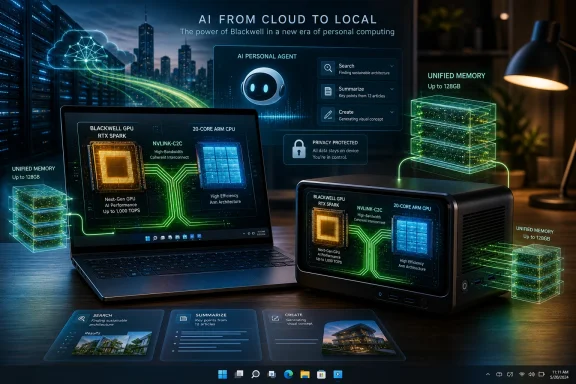
AI “cloud to local” personal agent concept with laptops, unified memory, and futuristic server visuals.NVIDIA Is No Longer Content to Be the GPU Inside Someone Else’s PC​

For most of the modern Windows era, NVIDIA’s role in the PC has been powerful but bounded. It supplied the graphics engine, the CUDA moat, the gaming brand, and the accelerator that made workstation buyers pay real money. The CPU, platform plumbing, modem story, and Windows system integration belonged to other companies.
RTX Spark changes that arrangement. NVIDIA is now presenting a full PC platform, not merely a component. The company describes RTX Spark as a “superchip” that combines a Blackwell RTX GPU, a 20-core Grace CPU, NVLink-C2C interconnect, fifth-generation Tensor Cores with FP4 support, and up to 128GB of unified memory.
That is not a normal laptop spec sheet. It is a workstation pitch compressed into the language of a consumer PC. NVIDIA is effectively saying that the next high-end Windows machine should look less like a traditional x86 laptop with a graphics option and more like a miniature AI workstation with an operating system attached.
MediaTek’s involvement matters because it gives NVIDIA something it has historically lacked in PCs: an experienced Arm SoC partner with a long record in power-managed consumer silicon. NVIDIA can build formidable GPUs and AI software stacks. MediaTek knows how to ship integrated platforms at scale, how to think about connectivity, and how to design around the thermal and battery limits that define mobile devices.
That is the real collaboration hiding under the announcement. NVIDIA brings the ambition; MediaTek helps make it behave like a PC chip rather than a lab demo.

MediaTek Gets Its Most Credible Shot at the Premium Windows PC​

MediaTek has spent years being familiar to consumers without being especially visible to them. Its chips power phones, tablets, Chromebooks, smart TVs, routers, and a broad swath of connected devices. In Windows PCs, though, MediaTek has often been peripheral: Wi-Fi modules, supporting silicon, and occasional platform experiments rather than a headline role.
RTX Spark gives MediaTek a different kind of entrance. Instead of trying to break into premium PCs alone, it arrives attached to NVIDIA’s brand, Microsoft’s Windows push, and OEMs that already know how to sell expensive laptops and small desktops. That is a much stronger position than asking enterprise buyers to take a chance on an unfamiliar PC CPU vendor.
The company’s contribution is described as the custom CPU design, with MediaTek contributing to efficiency, performance, and connectivity. That phrasing is careful. NVIDIA still wants the processor to carry the Grace and RTX identity, but the practical engineering challenge is very much in MediaTek’s wheelhouse: deliver Arm CPU performance and platform integration without blowing up thermals, battery life, or compatibility expectations.
For MediaTek, this is also a reputational play. The company is not merely providing low-cost silicon for commodity devices. It is participating in what NVIDIA and Microsoft are framing as the next chapter of Windows computing. If RTX Spark succeeds, MediaTek graduates from “that chip company in your accessory spec sheet” to a named participant in the premium AI PC race.
The risk is equally clear. PC buyers are unforgiving. A phone SoC can hide some complexity behind app-store rules and tightly controlled hardware. Windows is messy, old, extensible, driver-heavy, and full of software that assumes the world is x86. MediaTek is stepping into an ecosystem where performance-per-watt is only one column on the scorecard.

Windows on Arm Finally Gets the Partner It Always Needed​

Microsoft has been trying to make Windows on Arm happen for well over a decade. The story has moved from Windows RT to Qualcomm-powered always-connected PCs to the more credible Snapdragon X generation. Each attempt solved part of the problem while exposing another.
Battery life improved. Standby improved. Native Arm apps became more common. Emulation became less embarrassing. But the Windows on Arm proposition still carried a quiet caveat: it was good if your workflow fit the supported lane.
RTX Spark attacks that caveat from the other side. Instead of pitching Arm primarily as a battery-life architecture, NVIDIA is pitching it as the foundation for a high-performance AI and graphics machine. That flips the emotional framing. Windows on Arm is no longer just the efficient alternative to Intel; it becomes the architecture that can host a unified-memory AI workstation with RTX branding.
That does not magically erase compatibility concerns. Games with anti-cheat systems, specialized drivers, old enterprise utilities, niche creative plug-ins, and low-level tools remain the kinds of things that decide whether a Windows PC feels like a main machine or a beautiful compromise. Microsoft and NVIDIA are reportedly working with game developers and anti-cheat providers, but Windows enthusiasts know that “working with” is not the same as “works on day one.”
Still, the presence of NVIDIA changes the psychology of the platform. Developers who ignored earlier Arm Windows efforts may reconsider if the installed base includes high-end RTX machines with enormous local AI capability. Game studios may care more if the same platform promises 1440p gaming above 100 frames per second. Creative software vendors may care more if Adobe and Blender-style workloads become part of the launch narrative.
This is the opening Microsoft wanted years ago: not Windows on Arm as a concession to battery life, but Windows on Arm as the fastest route to something x86 machines cannot quite do in the same envelope.

The “Personal Agent” Pitch Is Both the Point and the Weakest Link​

NVIDIA and Microsoft are selling RTX Spark as hardware for the age of personal AI agents. The pitch is straightforward: instead of sending every complex request to the cloud, a Windows PC can run capable local models, automate tasks, process private data on-device, and coordinate workflows from the taskbar or native apps. In the marketing version, the PC shifts from tool to teammate.
The hardware claims are serious enough to deserve attention. NVIDIA says RTX Spark can offer up to 1 petaflop of AI performance and up to 128GB of unified memory. The company is talking about running 120-billion-parameter language models locally, handling very large context windows, generating 4K AI video, editing 12K 4:2:2 video, and rendering massive 3D scenes.
Those are not the same workloads as “summarize this email.” They are the kinds of tasks that have traditionally pushed users toward cloud GPUs, desktop workstations, or remote render farms. If RTX Spark can put a meaningful slice of that capability into a thin laptop or a compact desktop, it changes what developers and creators can expect from a Windows endpoint.
But the agent story remains the least proven part of the announcement. Chips do not create trustworthy agents. They create the performance budget in which agents might become useful. The hard problems are identity, permissions, auditability, app integration, user intent, rollback, data boundaries, and security when software is acting across applications on behalf of a human.
Microsoft knows this better than anyone. Windows is not a sandboxed phone OS; it is the messy center of work, gaming, files, credentials, legacy apps, browsers, and administrator privileges. A local agent that can “do the work” must be far more capable than a chatbot, but every added capability creates a new failure mode. If the agent can read private files, click buttons, write code, install packages, or move money, the security model becomes the product.
NVIDIA’s hardware may be ready before the software culture is. That is not a criticism of the silicon. It is a reminder that the personal-agent PC will live or die by trust, not TOPS.

Unified Memory Is the Quiet Workstation Story​

The most consequential RTX Spark spec may not be the AI performance figure. It may be the memory architecture. Up to 128GB of unified memory gives the CPU and GPU access to a shared pool, a design philosophy that Apple has used to great effect in its M-series Macs and that NVIDIA has long exploited in higher-end accelerated computing contexts.
For AI workloads, unified memory is not just elegant. It is practical. Large language models, video pipelines, 3D scenes, and multi-stage creative workflows are often constrained less by raw compute than by memory capacity and data movement. A machine that can keep more of the working set close to the accelerator can feel dramatically more capable than a system with similar headline compute but a more fragmented memory arrangement.
That matters for developers experimenting with local models. It matters for researchers who want to test agents without shipping sensitive data to a cloud provider. It matters for video editors and 3D artists who increasingly move between generative tools, rendering engines, and conventional creative suites. It also matters for IT departments that would rather buy one standardized high-end laptop than support a sprawl of cloud GPU accounts for every experimental team.
The question is how much of that potential survives the realities of product segmentation. “Up to 128GB” does not mean every RTX Spark laptop will ship that way. OEMs will build cheaper configurations, thermals will vary, and the machines that deliver the full workstation promise may land at prices that make them executive, creator, or developer devices rather than mainstream PCs.
That is still strategically important. Windows does not need every PC to become an RTX Spark machine for the platform to change. It needs enough high-end machines to establish a new software target. Once developers can assume some Windows PCs have local memory and GPU budgets closer to an AI workstation than an ultrabook, application design starts to shift.

Intel, AMD, and Qualcomm Now Face a Different Kind of Competitor​

RTX Spark does not merely add another processor vendor to the Windows market. It adds a vendor with a software ecosystem that many developers already treat as infrastructure. CUDA, TensorRT, RTX, DLSS, OptiX, Reflex, and NVIDIA’s AI tooling give the company a platform story that is unusually strong for a first major Windows CPU push.
Intel and AMD have decades of PC incumbency, deep OEM relationships, mature driver stacks, and x86 compatibility on their side. They are not going away because NVIDIA announced a high-end Arm chip. But they now face a competitor that can define the premium conversation around AI capability, not just CPU benchmarks or battery life.
Qualcomm may feel the pressure even more directly. Snapdragon X helped make Windows on Arm credible again, but NVIDIA brings a different kind of gravity. Qualcomm has the mobile heritage and efficiency story; NVIDIA has the graphics, gaming, creator, and AI developer ecosystem. If RTX Spark machines run the right apps well, Qualcomm’s Windows advantage becomes less about architecture and more about price, battery, and modem integration.
Apple is the unspoken comparison. The Mac’s M-series transition proved that Arm PCs could be fast, efficient, and coherent when hardware, software, and developer tooling align. NVIDIA and Microsoft are not copying Apple’s model exactly because Windows must support a broader hardware market and a much larger legacy software base. But RTX Spark is clearly an attempt to bring some of that vertical coherence to the Windows side without turning Windows into a single-vendor appliance.
The competitive threat is therefore not that RTX Spark instantly beats every Intel, AMD, Qualcomm, or Apple system. The threat is that it gives Windows a new premium reference point. If the best demos of local AI agents, creative acceleration, and high-efficiency gaming happen on RTX Spark machines, the rest of the market has to respond to NVIDIA’s framing.

OEMs Get a New Flagship Story, But Also a New Support Burden​

The announced OEM roster is broad enough to signal seriousness: ASUS, Dell, HP, Lenovo, Microsoft Surface, and MSI are expected in the first wave, with Acer and GIGABYTE following. That matters because Windows platform experiments often fail when they appear in one or two oddball devices that never get shelf space, enterprise validation, or driver attention.
A broad launch gives RTX Spark a fighting chance. It means business buyers may see familiar procurement channels. It means gamers may see MSI and ASUS machines rather than a developer kit. It means Microsoft can use Surface as a reference design while the rest of the ecosystem explores different sizes, cooling systems, and price points.
But the same breadth creates support complexity. Each OEM will need firmware updates, drivers, recovery images, management tooling, and clear messaging about what runs natively, what runs through emulation, and what does not run at all. IT administrators will ask whether their EDR agents, VPN clients, printer drivers, deployment tools, accessibility software, and line-of-business applications behave correctly on these machines.
This is where Windows enthusiasm often collides with enterprise reality. A gorgeous RTX Spark laptop that runs Blender, Adobe workflows, and local AI models beautifully can still be a poor fleet device if the company’s required security stack breaks. Conversely, if Microsoft, NVIDIA, MediaTek, and OEMs get the management story right, RTX Spark could become the first Windows on Arm platform that enterprise IT evaluates for performance rather than merely tolerates for battery life.
The Surface angle is especially important. Microsoft has spent years using Surface both as a hardware business and as a signal to OEMs. A Surface Laptop Ultra powered by RTX Spark would tell the market that Microsoft is willing to put its own brand behind NVIDIA’s Arm PC bet. That does not guarantee success, but it raises the cost of treating the platform as a niche experiment.

Gaming Is the Compatibility Test NVIDIA Cannot Dodge​

NVIDIA’s presence ensures that gaming will be part of the RTX Spark conversation whether Microsoft wants it or not. The company is promising RTX technologies, DLSS, Reflex, G-SYNC, and AAA gaming performance as part of the platform’s identity. That is smart marketing, but it also invites a brutally practical test: do the games people actually play work?
Windows on Arm has historically struggled here for reasons that go beyond raw GPU power. Some games depend on x86 assumptions, kernel-level anti-cheat systems, launchers, overlays, copy protection, or middleware that does not behave well in translation. Competitive multiplayer titles are especially sensitive because anti-cheat vendors must decide that the platform is worth supporting and safe enough to trust.
NVIDIA and Microsoft appear to understand this. Reports indicate work with Riot Games, Krafton, and anti-cheat technologies such as Easy Anti-Cheat, BattlEye, and Denuvo. That is exactly the kind of plumbing that matters more than a benchmark slide.
If RTX Spark can run major competitive titles cleanly, it could do something Snapdragon Windows PCs have not fully done: make Arm feel normal to gamers. If it cannot, the gaming promise will narrow to selected titles, streaming, creative workloads, and AI development. That would still leave a useful product, but not the “new PC” NVIDIA is trying to sell.
For WindowsForum readers, the gaming question is also a proxy for everything else. Games are complicated, performance-sensitive, DRM-heavy, driver-dependent software packages. If they work well on RTX Spark, confidence rises across the ecosystem. If they do not, users will wonder what other edge cases are waiting.

Local AI Is a Privacy Argument Only If Windows Earns It​

One of the most appealing parts of local AI is privacy. Running models on-device should mean fewer files sent to remote servers, less dependence on cloud subscriptions, and more control over sensitive workflows. For developers, journalists, lawyers, doctors, researchers, and administrators, that is not a marketing flourish. It is the difference between an experiment and a deployable tool.
RTX Spark gives Windows the hardware basis for that argument. A PC with enough local compute and memory can summarize, search, transcribe, generate, and reason over private material without needing a data-center round trip. That could make AI tools more acceptable in regulated environments, especially where cloud usage is constrained by policy.
But privacy is not created by locality alone. Windows telemetry, cloud sync defaults, Microsoft account integration, OneDrive behavior, app permissions, model provenance, logging, and enterprise policy controls all shape whether users believe the machine is working for them or observing them. A local agent that quietly routes tasks to cloud services when it hits a limit will be judged differently from one that clearly discloses where computation happens.
Security-minded users will want controls. Administrators will want group policy, Intune settings, audit logs, data-loss-prevention hooks, and a way to disable agent behaviors that do not fit a given environment. Developers will want APIs that do not require guessing whether an agent has access to a file, a credential, or a privileged action.
The promise is compelling: workstation-class local inference on Windows, inside mainstream OEM hardware. The burden is equally large: Microsoft and NVIDIA must make local AI feel verifiable, not merely convenient.

The Fall Launch Will Test Whether “AI PC” Means Anything​

The PC industry has spent the last two years spraying the phrase AI PC over products with wildly different capabilities. Some machines have NPUs useful for camera effects and light model acceleration. Some are conventional laptops with a Copilot key. Some are genuinely capable local inference machines. Consumers could be forgiven for treating the label as another sticker.
RTX Spark raises the stakes because it gives the term a more concrete shape. A Windows PC with a Blackwell GPU, a 20-core Arm CPU, fifth-generation Tensor Cores, FP4 support, NVLink-C2C, and up to 128GB of unified memory is not merely AI-branded. It is architected around the assumption that local AI workloads will matter.
That makes pricing and positioning crucial. If RTX Spark systems arrive only as ultra-premium devices for developers, creators, and wealthy enthusiasts, the platform can still influence software development but will not redefine everyday Windows computing overnight. If OEMs can offer a range of credible configurations without gutting the memory and thermal design, the impact could be broader.
Battery life claims will also deserve scrutiny. NVIDIA and Microsoft are talking about thin-and-light PCs and all-day use, but high-performance AI and graphics workloads are not gentle. The meaningful question is not whether a machine can idle efficiently. It is whether it can deliver its advertised local AI and creative performance without becoming loud, hot, or short-lived away from the wall.
That is where MediaTek’s contribution will be judged. A premium Windows Arm chip must not only post impressive peak numbers. It must switch gracefully between email, browser tabs, code builds, game sessions, model inference, and sleep states. The PC is a general-purpose machine; the platform that wins is the one that feels fast even when the user is not running the keynote demo.

The PC’s Next Platform War Will Be Fought Above the ISA​

It is tempting to frame RTX Spark as Arm versus x86. That is part of the story, but not the whole story. The more important fight is over the platform layer above the instruction set: software stacks, developer tools, model runtimes, graphics APIs, security primitives, app distribution, drivers, and the memory model exposed to creators and AI developers.
Intel and AMD can add bigger NPUs. Qualcomm can improve graphics and compatibility. Apple can keep refining its tightly integrated Mac platform. NVIDIA’s bet is that its accelerator ecosystem gives it leverage that raw CPU vendors do not have. If the future workload is a mixture of rendering, inference, code generation, simulation, video, and agent orchestration, NVIDIA wants the PC to be organized around the GPU and AI stack.
That is a profound shift for Windows. For decades, the CPU was the center of the PC and the GPU was the performance accessory. RTX Spark inverts that hierarchy. The CPU is important, but the platform’s identity comes from the accelerator, memory pool, and software stack wrapped around it.
Microsoft has an interest in encouraging that inversion. Windows needs a reason to remain the preferred platform for high-value local computing as cloud AI, browser apps, and Apple silicon all pull users in different directions. A Windows PC that can run serious local agents, accelerate creative work, and still play games gives Microsoft a stronger story than “Copilot, but on your existing laptop.”
The danger is fragmentation. If Windows becomes a patchwork of x86 PCs, Qualcomm Arm PCs, NVIDIA Arm PCs, NPU tiers, GPU tiers, and partially supported AI runtimes, developers may struggle to target the platform cleanly. Microsoft’s job is to prevent capability from turning into chaos.

The Spark That Matters Is the Ecosystem Reaction​

The first RTX Spark machines will be judged by reviewers on the usual metrics: performance, thermals, battery life, app compatibility, display quality, price, fan noise, and whether the marketing survives contact with real workloads. That is necessary, but it is not sufficient. The deeper measure will be ecosystem reaction.
If developers build native Windows Arm applications that assume RTX acceleration, RTX Spark becomes more than hardware. If major creative apps expose workflows that are materially better on unified-memory RTX systems, the platform gains gravity. If game publishers and anti-cheat vendors treat it as a first-class Windows target, consumers stop asking whether it is “really” a PC.
If those things do not happen, RTX Spark risks becoming a brilliant niche machine: exciting for local AI developers and creators, less relevant to mainstream buyers, and too expensive for casual curiosity. That would still be a meaningful product category, but not a reinvention of Windows.
The timeline is also unforgiving. Systems are expected in the fall of 2026, which means Microsoft, NVIDIA, MediaTek, OEMs, app developers, and driver teams have only a short runway to turn a platform announcement into shippable confidence. A weak first wave could poison perception. A strong one could make every other PC vendor explain why its AI machine is not merely AI-branded but AI-capable.
Windows users have seen enough platform promises to be skeptical. They should be. But skepticism should not obscure the fact that this is one of the rare PC announcements that actually changes the competitive map.

The New Windows Bet Comes Down to Five Concrete Tests​

RTX Spark deserves attention because it combines a real silicon shift with a real software ambition, but buyers should judge it by outcomes rather than keynote adjectives. The important questions are practical, measurable, and close to the ground.
  • RTX Spark systems are expected to arrive in fall 2026 from major PC makers, so the first serious verdict will come from shipping laptops and desktops rather than announcement-stage specifications.
  • MediaTek’s role in the custom CPU design gives NVIDIA a credible path into efficient Arm PCs, but the platform must prove itself in thermals, standby, drivers, and everyday responsiveness.
  • The headline AI claims depend heavily on configurations with large unified memory pools, so lower-end RTX Spark machines may not represent the full promise of the platform.
  • Windows on Arm compatibility remains the central risk, especially for games, anti-cheat systems, enterprise security agents, legacy utilities, and specialized hardware drivers.
  • Local AI could become RTX Spark’s strongest argument only if Microsoft provides transparent controls, enterprise policy hooks, and clear boundaries between on-device and cloud processing.
  • NVIDIA’s biggest advantage is not simply the chip but the CUDA, RTX, DLSS, TensorRT, and developer ecosystem that can turn a new processor into a new Windows software target.
RTX Spark is not proof that the Windows PC has been reinvented; it is proof that NVIDIA, Microsoft, and MediaTek now believe the old PC architecture is no longer enough for the workloads they want to sell next. The fall launch will show whether this is the beginning of a genuine high-end Windows on Arm ecosystem or another ambitious detour in the long search for the post-x86 PC. Either way, the center of gravity is moving: the next Windows flagship may be defined less by the CPU logo on the palm rest than by how much local intelligence it can run, how safely it can act, and whether users trust it to do more than open apps when asked.

References​

  1. Primary source: TechPowerUp
    Published: 2026-06-01T18:10:28.872216
  2. Related coverage: axios.com
  3. Related coverage: tomshardware.com
  4. Related coverage: nvidia.com
  5. Related coverage: techspot.com
  6. Related coverage: 91mobiles.com
  1. Related coverage: pcworld.com
  2. Related coverage: arstechnica.com
  3. Related coverage: techrepublic.com
  4. Related coverage: techgoondu.com
  5. Related coverage: notebookcheck.net
  6. Related coverage: business-standard.com
  7. Related coverage: pcgamer.com
  8. Related coverage: elpais.com
  9. Related coverage: signal65.com
  10. Related coverage: nvidianews.nvidia.com
  11. Official source: blogs.windows.com
  12. Related coverage: blogs.nvidia.com
  13. Related coverage: mediatek.com
  14. Related coverage: investor.nvidia.com
  15. Related coverage: shacknews.com
  16. Related coverage: blogs.nvidia.fr
  17. Related coverage: docs.nvidia.com
 

MediaTek and NVIDIA announced RTX Spark at Computex 2026 as an Arm-based Windows 11 PC platform combining a MediaTek-influenced CPU design, NVIDIA Blackwell-class RTX graphics, up to 128GB of unified memory, and local AI performance for laptops and compact desktops arriving this fall. The headline is not simply that NVIDIA wants into the PC processor business. It is that Windows is getting another serious attempt at a vertically optimized, AI-first hardware stack outside the Intel-and-AMD default. If Microsoft, NVIDIA, and MediaTek can make the software layer feel boringly reliable, RTX Spark could become the most consequential Windows-on-Arm test since Qualcomm’s Snapdragon X launch.

AI workstation setup with laptop, glowing data panels, and a computer GPU box for local limitless computing.NVIDIA Is No Longer Content to Ride Shotgun in the PC​

For decades, NVIDIA’s role in the Windows PC was glamorous but bounded. It sold the GPU, owned the gaming frame-rate conversation, powered professional visualization, and increasingly supplied the accelerator behind AI workloads. But the rest of the machine—the CPU, platform controller, memory hierarchy, and power behavior—belonged to someone else.
RTX Spark changes that power map. NVIDIA is now pitching a complete PC compute platform, not just a graphics option that an OEM bolts beside an Intel or AMD processor. The company’s language around “personal AI agents” is predictably grand, but the underlying move is concrete: bring NVIDIA’s AI and graphics stack closer to the CPU, closer to memory, and closer to Windows itself.
That matters because the AI PC story has been muddled. Intel, AMD, and Qualcomm have all described neural processing units as the next mandatory PC block, while most users still struggle to name the local AI workload they cannot live without. NVIDIA is making a different bet. Rather than treating AI acceleration as one small tile on a general-purpose client SoC, it is putting RTX-class graphics and AI horsepower at the center of the machine.
MediaTek’s role is equally important, even if NVIDIA will absorb most of the oxygen. MediaTek brings low-power SoC design experience, connectivity integration, and the kind of platform discipline required to make thin laptops behave like consumer electronics rather than portable space heaters. For Windows users, that is the part that separates a compelling demo from a daily driver.

The AI PC Needed a GPU Company to Make the Argument Legible​

The phrase AI PC has suffered from too much marketing and too little frictionless utility. Microsoft’s Copilot+ PC branding leaned heavily on NPUs and local inference, but the first wave of features did not obviously transform the workday for many buyers. The industry promised a new category, then shipped a familiar laptop with a new sticker.
RTX Spark reframes the category around a more understandable proposition: a Windows machine with enough local compute and memory to run heavier AI models, creator workflows, and games without always reaching for a cloud endpoint. That is a cleaner story than “this laptop has 45 TOPS,” because users already understand RTX as shorthand for acceleration they can feel. The question becomes whether NVIDIA can extend that trust from graphics into the whole PC.
The unified memory figure is central to the pitch. Up to 128GB of shared system memory gives AI developers and creative professionals room to run larger local workloads than the typical thin-and-light laptop can support. It also lets NVIDIA talk about the PC as a local inference box, not merely a client waiting for Azure, OpenAI, or another cloud service to do the hard work.
But the risk is obvious. Local AI remains an uneven experience across Windows applications. Some workloads benefit enormously from GPU acceleration, some are still glued to cloud APIs, and some are demos in search of a user habit. RTX Spark gives the ecosystem a much larger target to build against, but hardware cannot by itself create the killer workflow.

MediaTek Gets Its Premium Windows Opening​

MediaTek has long been formidable in phones, connectivity, TV silicon, Chromebooks, and embedded platforms, but the premium Windows PC market has been a harder door to open. Intel and AMD still dominate the mental model of what a serious Windows machine is. Qualcomm has spent years trying to prove that Arm-based Windows laptops can be fast, efficient, and compatible enough for mainstream buyers.
RTX Spark gives MediaTek a shortcut into the high end. Instead of trying to sell PC buyers on MediaTek as the main brand, the platform arrives under NVIDIA’s halo and Microsoft’s blessing. That is a strategically elegant arrangement: MediaTek supplies much of the platform craft, NVIDIA supplies the performance mythology, and OEMs get a new premium story to tell.
The collaboration also reflects a broader industry shift. PC silicon is moving away from interchangeable components and toward tightly coupled platforms where CPU, GPU, memory, firmware, power management, and AI software are designed as one experience. Apple proved the commercial power of that approach with Apple Silicon. Qualcomm adapted the playbook for Windows-on-Arm. NVIDIA and MediaTek are now attempting a version built around RTX identity and AI acceleration.
For MediaTek, the upside is bigger than one chip. If RTX Spark systems ship from major vendors and land credibly in reviews, MediaTek becomes part of the premium Windows conversation almost overnight. If the platform stumbles on compatibility, battery life, driver behavior, or pricing, the old hierarchy will reassert itself quickly.

Windows on Arm Gets a Second Front​

RTX Spark is also a Windows-on-Arm story, and that makes it more complicated than a normal chip launch. The modern Windows ecosystem still carries decades of x86 assumptions in applications, drivers, games, anti-cheat systems, enterprise tooling, and peripheral support. Microsoft has improved Arm support significantly, but every new platform has to prove that the invisible parts of Windows behave.
Qualcomm’s Snapdragon X machines helped move the conversation forward by making Arm laptops feel less like science projects. Battery life improved, performance became competitive in many everyday tasks, and native app support expanded. But gaming and high-end creator workflows remained difficult terrain, precisely the areas where NVIDIA has the strongest brand.
That is why RTX Spark is interesting. NVIDIA is not entering Windows-on-Arm from the productivity-notebook end of the pool. It is coming in through graphics, CUDA-adjacent developer mindshare, AI acceleration, and creator software. If it can make that stack work on Arm Windows with minimal caveats, it changes the perceived limits of the category.
The “if” is doing a lot of work. Windows gamers are a compatibility tribunal with little patience for architectural excuses. Creators are not kinder; they care whether plug-ins load, exports finish, color pipelines behave, and external hardware works. Sysadmins care whether deployment tools, endpoint security agents, VPN clients, and line-of-business software survive contact with a new platform. RTX Spark’s success will depend less on keynote claims than on this tedious, essential substrate.

The Gaming Pitch Is Powerful but Dangerous​

NVIDIA knows how to sell performance to gamers. RTX, DLSS, ray tracing, frame generation, Reflex, and Studio drivers have given the company a vocabulary that buyers understand. Bringing that language into thin-and-light Windows systems is a natural move, especially if RTX Spark can deliver respectable gaming without the acoustic and thermal compromises of traditional gaming laptops.
The danger is that gamers compare products brutally. A thin RTX Spark laptop will not be judged against an abstract AI future; it will be judged against current GeForce laptops, AMD Strix-class systems, Intel-based designs, handheld PCs, and desktops that cost less and run everything. If NVIDIA promises too much, the brand advantage becomes a liability.
There is also the question of what “RTX graphics” means in a fully integrated SoC context. A discrete GPU with its own memory and thermal budget is one thing. A unified-memory, power-constrained laptop platform is another. NVIDIA can do extraordinary things with efficiency, but physics still collects its tax.
The more credible gaming argument may be sustained performance per watt rather than absolute frame-rate dominance. If RTX Spark can make a 14mm laptop play modern titles smoothly at sane settings while also serving as a serious AI and creator machine, that is a real product category. If it is marketed as a no-compromise gaming monster, disappointment will arrive right on schedule.

Local AI Is the Feature and the Escape Hatch​

The industry’s local AI push is partly about user experience and partly about economics. Cloud inference is expensive, latency-sensitive, and dependent on network quality. Running more work locally can improve responsiveness, protect some data from leaving the device, and reduce recurring service costs for vendors. It also gives PC makers a reason to sell more expensive hardware after years of incremental upgrades.
RTX Spark fits that agenda neatly. NVIDIA can argue that personal agents should not always wait on a data center, Microsoft can argue that Windows is becoming more proactive and context-aware, and OEMs can argue that premium hardware now has a fresh purpose. Everyone gets a strategic story.
But local AI also creates new governance problems. A personal agent that can search files, automate applications, summarize private material, and act across a system is not just a faster chatbot. It is a new layer of authority inside the PC. For WindowsForum readers, that should trigger healthy skepticism about permissions, auditability, data retention, and the ability to disable features cleanly.
The best version of RTX Spark is not a machine that constantly guesses what the user wants. It is a machine with enough local intelligence to help when invited, stay quiet when not needed, and make its boundaries visible. Microsoft has learned the hard way that trust is easy to lose when AI features feel surveillant or irreversible.

Enterprise IT Will Ask the Boring Questions First​

Consumer launches thrive on aspiration. Enterprise adoption begins with a spreadsheet full of blockers. RTX Spark systems may look exciting to developers and executives, but IT departments will ask whether they can image them, manage them, secure them, repair them, and support them at scale.
Arm architecture remains the first checkpoint. Organizations with modern cloud-managed environments may be able to absorb another architecture more easily than those with legacy agents and bespoke desktop software. But even in progressive shops, endpoint protection, device management, print drivers, hardware tokens, VPNs, compliance tools, and accessibility software all need validation.
There is also lifecycle risk. Intel and AMD platforms benefit from deeply established enterprise support channels and predictable fleet behavior. NVIDIA and MediaTek will need to prove that firmware updates, drivers, Windows servicing, docking behavior, sleep states, and peripheral compatibility are not afterthoughts. In business computing, the best platform is often the one nobody notices.
Still, RTX Spark could appeal to specialized enterprise users quickly. AI developers, data scientists, media teams, simulation users, and software engineers who need local acceleration may see value before the average office worker does. The first commercial foothold may not be the whole fleet; it may be the high-end workstation replacement that happens to look like a laptop.

Microsoft Gets Another Chance to Make Windows Feel New​

Microsoft’s role in this launch should not be underestimated. Windows needs hardware ambition. For years, the PC market has been sustained by compatibility, enterprise inertia, gaming, and price competition. Those are powerful advantages, but they do not always make Windows feel like the future.
The AI PC is Microsoft’s attempt to change that story. Copilot, Recall-like memory concepts, local semantic search, agentic workflows, and developer-facing AI APIs all point toward a Windows experience where the operating system is more than a launcher for applications. RTX Spark gives Microsoft a hardware platform with enough headroom to make those ambitions less constrained.
The challenge is that Microsoft must thread a narrow needle. If AI features are too timid, the hardware looks excessive. If they are too invasive, users rebel. If they require subscriptions or cloud accounts for the best experience, the local AI pitch becomes muddled. If they work only on a subset of premium machines, developers hesitate to depend on them.
Windows has survived because it is broad, messy, and adaptable. AI-first hardware wants the opposite: a controlled, optimized path from silicon to application. RTX Spark will test whether Microsoft can support both instincts at once.

Intel, AMD, and Qualcomm Now Have a Different Rival​

RTX Spark does not instantly displace x86. Intel and AMD have enormous advantages in compatibility, OEM relationships, enterprise trust, gaming maturity, and platform breadth. Qualcomm has a head start in modern Windows-on-Arm laptops and a strong efficiency narrative. The PC market does not turn on one Computex announcement.
But NVIDIA changes the competitive conversation because it enters from strength. Intel and AMD are trying to convince the market that their integrated NPUs and GPUs can meet the AI moment. Qualcomm is trying to convince the market that Arm efficiency and improving compatibility are enough. NVIDIA can argue that the AI moment already belongs to its software and GPU ecosystem, and that the PC should be redesigned around that fact.
That is a more aggressive claim. It puts pressure on every rival to explain why their AI PC is not merely adequate, but preferable. It also pressures OEMs, which now have another premium platform to juggle in already crowded product lines.
The likely near-term result is segmentation. Intel and AMD will remain the default for mainstream and enterprise PCs. Qualcomm will continue pushing thin, efficient Windows-on-Arm systems. RTX Spark will chase high-margin creator, developer, AI, and premium gaming-adjacent devices. The fight is not for every laptop at first; it is for the machines that define what buyers think a modern PC can be.

The Spec Sheet Is Impressive, but the Software Bill Comes Due Later​

The early RTX Spark numbers are designed to impress: Blackwell-class GPU technology, a 20-core Arm CPU design associated with NVIDIA’s Grace lineage and MediaTek collaboration, up to 128GB of unified memory, and claims of very high local AI throughput. Those are serious ingredients for a compact Windows machine. They also raise serious expectations.
The software burden is larger than the silicon announcement. NVIDIA must deliver stable drivers across a new class of Windows systems. Microsoft must ensure Windows 11 behaves smoothly on the platform. OEMs must tune thermals, displays, batteries, keyboards, firmware, and sleep behavior. Developers must decide whether the installed base is worth optimizing for.
This is where many ambitious PC platforms become ordinary. The keynote shows the machine doing the one thing it was built to do. The review unit reveals whether it wakes from sleep, handles a conference call, drives two monitors, runs the weird accounting app, updates cleanly, and lasts through a travel day. Users experience platforms as accumulations of small failures or small successes.
NVIDIA has earned trust in graphics software over many years, but a whole PC platform is different. MediaTek has shipped vast quantities of efficient silicon, but premium Windows buyers will judge the result by a different standard. RTX Spark has the right ingredients; now it has to survive the daily indignities of Windows computing.

The Fall Launch Will Be a Platform Trial, Not a Victory Lap​

The first RTX Spark systems are expected from major PC makers, including Microsoft Surface and several large OEMs. That breadth is significant because it suggests the platform is not a boutique experiment. It also means the launch will be messy in the usual PC way: different chassis, different thermal envelopes, different price points, and different interpretations of what RTX Spark is for.
That variety can help. A compact desktop can lean into local AI development without pretending to be an all-day laptop. A premium creator notebook can focus on video, rendering, and generative tools. A thin gaming-capable laptop can test whether RTX branding carries into a new integrated form factor. Surface can try to turn the platform into a polished showcase.
But variety can also blur the message. If one OEM ships a loud machine, another ships an expensive one, and a third ships a gorgeous device with limited compatibility, the platform’s reputation will be set by the weakest early impressions. NVIDIA and Microsoft will need tight launch coordination, not just logos on stage.
Pricing may be the hidden determinant. If RTX Spark systems land as ultra-premium halo products, expectations will be unforgiving and adoption slower. If they arrive close enough to high-end Intel, AMD, and Qualcomm laptops, the platform has a chance to look like a genuine choice rather than a luxury experiment.

The Real Test Is Whether Agents Become Workflows​

The most ambitious claim around RTX Spark is not that it will make laptops faster. It is that it will help turn the PC from a tool into something closer to a collaborator. That language deserves scrutiny because the PC has always been a tool precisely because users can understand and control it.
Personal agents could be useful if they become workflows rather than mascots. A local agent that can index project files, summarize meetings, prepare edits, generate code scaffolding, automate repetitive desktop tasks, and hand work between applications without leaking data would be meaningful. A sidebar that produces generic prose and occasionally opens the wrong setting would not.
The hardware can enable the former, but it does not guarantee it. The industry has spent the last two years confusing chatbot availability with workflow transformation. RTX Spark gives developers more local power and memory; it does not automatically solve interface design, permissions, context management, or user trust.
For Windows enthusiasts, this is the most interesting part. The PC’s strength has always been that it lets users assemble their own workflows from disparate tools. If local AI agents can respect that modularity while reducing drudgery, the PC may feel newly powerful. If they try to replace user agency with opaque automation, they will become another feature people disable after setup.

The RTX Spark Era Begins With Practical Questions​

RTX Spark is a strategic announcement wrapped in a product launch. It signals NVIDIA’s intent to become a first-class PC platform company, MediaTek’s arrival in the premium Windows conversation, and Microsoft’s desire to make AI-native Windows hardware feel inevitable. The practical takeaways are sharper than the slogans.
  • RTX Spark is aimed at premium Windows 11 laptops and compact desktops, not low-cost commodity PCs.
  • The platform’s biggest technical promise is the combination of RTX-class acceleration, Arm efficiency, and up to 128GB of unified memory for local AI and creator workloads.
  • Gaming performance will matter, but the more defensible pitch is efficient sustained performance in thin systems rather than desktop replacement dominance.
  • Windows-on-Arm compatibility, driver maturity, enterprise tooling, and peripheral support will determine whether the platform feels mainstream or experimental.
  • MediaTek’s contribution gives NVIDIA a more credible low-power SoC foundation than a GPU-first company could easily build alone.
  • The first wave of systems this fall will be judged less by peak AI demos than by battery life, thermals, software reliability, price, and everyday Windows behavior.
RTX Spark is not the end of the x86 Windows PC, and it is not proof that local AI agents are about to transform every desktop overnight. It is something more interesting: a serious attempt to rebuild the premium Windows machine around the workloads NVIDIA believes will define the next decade. If the first devices can make that future feel useful rather than theatrical, Fall 2026 may be remembered as the moment the AI PC stopped being a sticker and started becoming a platform war.

References​

  1. Primary source: xiaomitoday.com
    Published: 2026-06-02T04:44:17.453065
  2. Related coverage: axios.com
  3. Related coverage: nvidianews.nvidia.com
  4. Related coverage: mediatek.com
  5. Related coverage: investor.nvidia.com
  6. Related coverage: tomshardware.com
  1. Official source: blogs.windows.com
  2. Related coverage: techcrunch.com
  3. Related coverage: business-standard.com
  4. Related coverage: techspot.com
  5. Related coverage: forbes.com
  6. Related coverage: pcworld.com
  7. Related coverage: windowscentral.com
  8. Related coverage: signal65.com
 

Nvidia entered the Windows PC processor market on June 1, 2026, at Computex in Taipei, where CEO Jensen Huang unveiled RTX Spark, an Arm-based Windows chip platform co-developed with Microsoft for premium laptops and compact desktops shipping this fall. The announcement is not just another silicon launch in a crowded AI PC season. It is Nvidia’s attempt to move CUDA from the workstation, cloud instance, and discrete GPU slot into the center of the Windows PC itself. If the bet works, the most important question in premium Windows laptops may shift from “Intel or AMD?” to “x86 compatibility or Nvidia’s software gravity?”

Close-up of a futuristic laptop on stage running editing software, with ARM and NLink/C2C hardware branding visible.Nvidia Is Not Selling a Faster Laptop So Much as a Different PC Contract​

For four decades, the Windows PC bargain has been simple: buy an x86 machine, expect the broadest compatibility, and add graphics or compute capability as the budget allows. Qualcomm tried to renegotiate that bargain with Windows on Arm, promising battery life and mobile-style efficiency, but the platform carried too much history on its back. Emulation improved, native apps arrived, and Copilot+ PCs gave Microsoft a cleaner marketing frame, yet the category still had to explain why a buyer should accept possible friction.
RTX Spark changes the pitch. Nvidia is not leading with “Arm is efficient.” It is leading with “CUDA is here.”
That distinction matters because CUDA is not a feature in the usual consumer-PC sense. It is infrastructure. Developers, researchers, renderers, simulation tools, AI frameworks, and increasingly creative applications have spent years treating Nvidia GPUs as the default acceleration target. By putting the CUDA stack inside a Windows laptop platform rather than beside it, Nvidia is trying to make the operating system’s old compatibility story compete against the modern AI developer’s workflow story.
The result is a machine category that sounds, on paper, like a contradiction: a thin Windows laptop with an Arm CPU, an RTX 5070-class Blackwell GPU, up to 128GB of unified memory, and enough local AI compute for workloads that previously belonged on a workstation, external GPU, or rented cloud box. Whether that combination becomes a mainstream premium PC or an expensive specialty tool will depend less on keynote numbers than on how cleanly Windows, developers, OEMs, and game publishers meet Nvidia halfway.

The Superchip Puts CUDA Where Windows on Arm Needed a Reason to Exist​

The RTX Spark platform is built around what had been expected as Nvidia’s N1X silicon: a 20-core Arm CPU paired with a Blackwell GPU carrying 6,144 CUDA cores, connected by Nvidia’s NVLink-C2C interconnect. Nvidia says the platform scales up to 128GB of unified memory and reaches up to 1 petaflop of AI compute, with systems coming from Microsoft Surface, Dell, HP, ASUS, Lenovo, and MSI in the first wave.
Those figures are the kind of numbers that invite bad comparisons. A laptop-class integrated GPU with the same CUDA core count as a desktop RTX 5070 is not automatically a desktop RTX 5070 in every real-world workload. Power limits, memory bandwidth, thermals, driver maturity, and sustained clocks matter. But the core count still tells us where Nvidia is aiming: not at the low-power edge of Windows on Arm, but at the place where “mobile workstation” and “AI development box” begin to overlap.
The more consequential number may be 128GB. Unified memory has been one of Apple Silicon’s strongest arguments because it lets CPU, GPU, and neural engines work from the same large pool without the traditional laptop split between system RAM and discrete VRAM. Nvidia is adapting that idea to the Windows world, but with a software stack that is already deeply entrenched in AI and graphics acceleration.
That is why RTX Spark is potentially more disruptive than a simple CPU entry from Nvidia would have been. Intel and AMD can answer CPU performance. Qualcomm can answer Arm efficiency. Apple can answer platform integration. But none of them can answer CUDA directly, because CUDA’s value comes from the accumulated habits of the industry. Nvidia is turning those habits into a PC platform.

Microsoft’s Real Endorsement Is Not the Logo on the Slide​

Microsoft’s support is central to this launch, and not merely because Windows has to run well on the chip. The company has been trying to reposition Windows around local AI, Copilot+ branding, NPUs, and agentic workflows, but it still needs hardware that makes the pitch feel more substantial than a new shortcut key and a few model demos. RTX Spark gives Microsoft a dramatic hardware story: a Windows PC that can run local models, accelerate AI frameworks, and keep the user inside the Windows ecosystem rather than sending them to a MacBook, a Linux workstation, or a browser tab connected to a cloud GPU.
The timing is important. Qualcomm’s long role as the effective standard-bearer for Windows on Arm gave Microsoft a way to push battery life and mobile-style architecture into the PC market, but it also narrowed the hardware story. With that exclusivity era over, Microsoft can treat Arm less like a Qualcomm category and more like a Windows architecture. Nvidia’s arrival makes Windows on Arm look less like a compatibility compromise and more like a competitive arena.
The promise that RTX Spark can run legacy Windows applications through a combination of native Arm software and Microsoft’s Prism emulation layer is necessary, but it is not sufficient. Every Windows on Arm pitch says compatibility is better this time. The difference here is that Nvidia and Microsoft are trying to reduce the importance of that defensive claim by giving buyers an affirmative reason to care: local AI workloads, CUDA frameworks, creator acceleration, and gaming features that map to Nvidia’s existing ecosystem.
That is the strategic inversion. Earlier Windows on Arm systems had to persuade users that they would not lose too much. RTX Spark asks whether a certain class of user might gain enough to tolerate what remains imperfect.

The Apple Comparison Is Obvious, but It Is Also Incomplete​

Apple’s M-series Macs are the unavoidable comparison because they made Arm laptops normal at the high end. Apple proved that a unified-memory Arm system could feel fast, quiet, and premium while escaping many of the assumptions that kept PC laptops tied to hot x86 chips and discrete-GPU compromises. Nvidia is clearly borrowing from that playbook.
But RTX Spark is not simply “Apple Silicon for Windows.” Apple’s advantage is vertical integration: macOS, the SoC, the hardware design, the media engines, the developer tools, and the retail configuration matrix all move as one. Nvidia’s advantage is ecosystem gravity of a different kind. CUDA, RTX, TensorRT, OptiX, DLSS, Reflex, and the broader AI software stack are not merely features of a single laptop line; they are standards of practice across gaming, rendering, AI research, and accelerated computing.
That makes the fight asymmetric. Apple can offer a refined, coherent laptop whose power is available through Apple’s frameworks and a growing set of native creative and developer apps. Nvidia can offer a Windows machine that speaks the language of existing CUDA workflows, potentially reducing the distance between local prototyping and deployment on Nvidia-powered servers or cloud instances.
For developers and AI researchers, that difference is not cosmetic. A laptop that can run CUDA-native PyTorch workflows, TensorRT-LLM, llama.cpp CUDA paths, and other GPU-accelerated tools locally is not just a faster PC. It is a portable development environment aligned with the dominant data-center AI hardware vendor. Apple Silicon has strong local AI capabilities, but it does not erase the operational convenience of using the same acceleration stack from laptop to workstation to cloud.

The Compatibility Question Moves From Office Apps to Everything Weird​

Microsoft Office, Teams, Edge, and many mainstream creative applications are no longer the hardest part of Windows on Arm. The harder question is the long tail: plug-ins, drivers, VPN clients, monitoring agents, endpoint security software, legacy line-of-business apps, niche engineering tools, game launchers, modding utilities, and DRM layers that assume x86 in ways users do not see until something breaks.
That is where enterprise IT will remain cautious. A premium RTX Spark laptop may be an obvious fit for an AI engineer, a creative technologist, or a developer working close to Nvidia’s stack. It is a harder sell as a default corporate fleet machine until IT departments know exactly how their device management, security, and compatibility baselines behave.
Gaming has its own version of the same problem. Nvidia’s confirmation that major anti-cheat and DRM systems are being supported natively on Windows on Arm is a real advance, because anti-cheat has historically been one of the sharpest barriers for Arm PCs. But native anti-cheat support does not mean every game is suddenly native Arm software, nor does it mean every publisher will prioritize the work at the same pace.
The most likely first year is therefore uneven. Some titles and creative tools will be showcased beautifully. Some CUDA-heavy workflows will make the platform look inevitable. Some older software will run acceptably through emulation. And some edge cases will remind everyone why x86 has survived so long: not because it is elegant, but because decades of assumptions are hard to uproot.

Dell, Surface, and the OEMs Are Being Asked to Sell a New Premium Tier​

The launch partner list matters because PC buyers trust form factors as much as chips. A Microsoft Surface Laptop Ultra gives the platform a flagship identity. Dell, HP, Lenovo, ASUS, and MSI give it reach across enterprise, creator, and gaming segments. Acer and Gigabyte following later suggests Nvidia wants RTX Spark to become a platform, not a one-off experiment.
Still, OEM execution will decide whether RTX Spark feels like a breakthrough or another expensive badge. Nvidia’s reference vision includes 14- and 16-inch designs, premium displays, thin aluminum chassis, all-day battery claims, and compact desktops that can run local AI agents continuously. Those are appealing ingredients, but the PC market is littered with impressive silicon that was undermined by loud fans, mediocre displays, poor standby behavior, bad firmware, or confusing configuration choices.
Pricing is the unanswered question. Nvidia has not confirmed prices, and the first systems are expected to target the premium tier. That almost certainly means RTX Spark will not begin life as a mass-market Windows laptop alternative. It will be judged against MacBook Pro configurations, high-end creator laptops, mobile workstations, and compact AI development systems.
That is a demanding peer group. If RTX Spark machines land above conventional premium laptops but below the cost and complexity of workstation-plus-cloud workflows, Nvidia has a plausible wedge. If they become ultra-expensive curiosities with limited native software, they risk being admired by reviewers and ignored by procurement departments.

DLSS 4.5 Shows Why Nvidia’s PC Story Is Bigger Than the CPU​

Nvidia’s Computex message was not confined to the new chip. DLSS 4.5 Ray Reconstruction, scheduled for August 2026 through the Nvidia App, extends the company’s graphics software advantage across existing RTX 20-, 30-, 40-, and 50-series GPUs. The update is framed around a second-generation transformer model, better temporal stability, improved lighting accuracy, and broader support across games and creative applications.
That matters because RTX Spark is not entering the PC market as a lonely CPU. It enters as part of a software machine that already reaches gamers, creators, developers, and AI researchers. Nvidia can tell a buyer that the same company building the laptop platform is also improving image reconstruction in games, accelerating Blender viewport work, supporting TensorRT, and feeding CUDA frameworks used far beyond the consumer PC.
This is the part competitors should find uncomfortable. Intel and AMD have strong road maps, deep OEM relationships, and x86 compatibility. Qualcomm has momentum in efficient Arm PCs. Apple has the most polished Arm laptop platform. But Nvidia is the company whose software updates can make a three-year-old GPU feel more valuable and whose developer ecosystem spans consumer laptops and AI data centers.
The CPU market is not used to that kind of leverage. Historically, a new laptop processor was judged by benchmarks, battery life, thermals, platform I/O, and price. RTX Spark will be judged by those things too, but Nvidia is also bringing an app-layer and framework-layer argument. The chip is the entry point; the moat is above it.

Intel and AMD Should Be Worried, but Not for the Simplest Reason​

It would be tempting to describe RTX Spark as Nvidia attacking Intel and AMD head-on. That is partly true, but it misses the more subtle threat. Nvidia does not need to replace every Core Ultra or Ryzen laptop to change the market. It only needs to capture the premium workflows that define what ambitious Windows PCs are supposed to become.
If AI developers, creators, and high-end gamers begin to see RTX Spark as the most interesting Windows laptop category, Intel and AMD face a perception problem even where their chips remain excellent. The halo moves. The “serious local AI” conversation starts with CUDA. The most exciting Windows machines become Nvidia-led designs, while x86 systems are forced to argue compatibility, cost, and incumbency.
That does not make x86 obsolete. Far from it. Enterprise fleets, gaming desktops, budget laptops, high-refresh gaming notebooks, CAD workstations, and countless specialized deployments will continue to reward the stability and breadth of x86. AMD and Intel also have their own AI accelerators, integrated GPUs, and platform improvements, and neither company is standing still.
But Nvidia is attacking the future margin pool. Premium laptops, creator systems, and local AI workstations are where PC makers can still charge for differentiation. If RTX Spark owns the story there, x86 vendors may find themselves defending the installed base while Nvidia defines the aspirational one.

The First Wave Will Reveal Whether “AI PC” Finally Means Something Specific​

The phrase AI PC has been stretched almost to uselessness. It has described laptops with NPUs, machines with Copilot keys, PCs capable of running small local models, and systems that mostly depend on cloud services while wearing an AI sticker. RTX Spark gives the term a sharper meaning: a personal computer with enough local GPU memory and software support to run serious AI workloads without treating the cloud as the default execution environment.
That is a healthier definition because it can be tested. Can developers run the models they care about locally? Can creators use AI tools without waiting on remote services? Can enterprises keep sensitive workflows on-device? Can local agents run continuously without destroying battery life, thermals, or user trust?
The answers will vary by workload, but at least the questions are concrete. Nvidia’s pitch moves the AI PC away from demo magic and toward resource allocation: memory, GPU compute, framework support, model size, security boundaries, and application integration. That is where serious buyers live.
It also exposes the gap between consumer excitement and professional adoption. Running a model locally is impressive. Running it reliably, securely, with manageable data controls and predictable performance is what makes it useful. Microsoft’s role in sandboxing, Windows integration, and enterprise controls may prove as important as Nvidia’s silicon.

The Buyers Who Should Pay Attention First Are Not the Average Laptop Shoppers​

RTX Spark is not likely to be the obvious recommendation for a student looking for a general-purpose laptop or a business user who lives in browser tabs and Office documents. Those buyers will care about price, battery life, weight, support, and whether their software works without surprises. Conventional Windows laptops and MacBooks will remain simpler choices for many of them.
The first natural audience is narrower and more valuable. AI developers who already depend on CUDA will want to know whether RTX Spark can replace a travel workstation or reduce cloud spend for prototyping. Creators using GPU-accelerated effects, rendering, denoising, or generative tools will want to see whether unified memory and Blackwell acceleration change their mobile workflows. Game developers and technical artists may find the platform attractive if Nvidia’s tools behave consistently across desktop and mobile environments.
IT departments should watch, but they should not rush. A pilot program makes more sense than a fleet refresh. The right test is not a synthetic benchmark; it is a week of real VPN clients, endpoint agents, Teams calls, browser tabs, line-of-business apps, developer containers, creative plug-ins, sleep-resume cycles, and conference-room docks.
That is the unglamorous reality of any new Windows platform. Keynotes sell the future. IT inherits the edge cases.

The Fall Launch Will Test Whether CUDA Can Carry Windows on Arm​

RTX Spark gives Windows on Arm something it has often lacked: a reason for demanding users to choose it rather than merely accept it. The first systems will not answer every question, but they will show whether Nvidia’s ecosystem can turn a risky architecture transition into a premium feature.
  • RTX Spark is Nvidia’s first major Windows PC processor platform, pairing an Arm CPU with a Blackwell GPU and the full CUDA stack for laptops and compact desktops.
  • Microsoft’s backing makes this more than an Nvidia experiment, because Windows compatibility, Prism emulation, Copilot+ positioning, and enterprise controls all have to mature together.
  • The platform’s strongest early appeal is likely to be AI development, creator workflows, local inference, and CUDA-dependent experimentation rather than ordinary office productivity.
  • Gaming support looks more credible than on earlier Windows on Arm machines, but native Arm game support and publisher adoption will still determine the real experience.
  • Pricing, thermals, battery life, and OEM execution will decide whether RTX Spark becomes a premium category or a fascinating niche.
  • Intel, AMD, Qualcomm, and Apple do not need to lose the whole market for Nvidia to reshape the part of the market that sets expectations.
The PC has survived many declarations of reinvention because compatibility, price, and habit are powerful forces. RTX Spark does not repeal those forces, and it will have to prove itself in the messy world of drivers, games, enterprise agents, docks, and old installers. But Nvidia has put a serious stake in the ground: the next premium Windows machine may be defined less by the instruction set that runs yesterday’s software than by the acceleration stack that runs tomorrow’s workloads. This fall, the industry will find out whether CUDA inside a Windows laptop is a niche luxury — or the beginning of a new center of gravity for the PC.

References​

  1. Primary source: Tech Times
    Published: Mon, 01 Jun 2026 14:13:26 GMT
  2. Related coverage: axios.com
  3. Related coverage: windowscentral.com
  4. Related coverage: pcgamer.com
  5. Related coverage: investor.nvidia.com
  6. Related coverage: tomshardware.com
  1. Related coverage: techspot.com
  2. Related coverage: techcrunch.com
  3. Official source: blogs.windows.com
  4. Related coverage: notebookcheck.net
  5. Related coverage: business-standard.com
  6. Related coverage: banklesstimes.com
  7. Related coverage: theguardian.com
  8. Related coverage: elpais.com
  9. Related coverage: nvidianews.nvidia.com
 

Back
Top