

Nvidia entered the Windows PC processor market on June 1, 2026, at Computex in Taipei, where CEO Jensen Huang unveiled RTX Spark, an Arm-based Windows chip platform co-developed with Microsoft for premium laptops and compact desktops shipping this fall. The announcement is not just another silicon launch in a crowded AI PC season. It is Nvidia’s attempt to move CUDA from the workstation, cloud instance, and discrete GPU slot into the center of the Windows PC itself. If the bet works, the most important question in premium Windows laptops may shift from “Intel or AMD?” to “x86 compatibility or Nvidia’s software gravity?”
For four decades, the Windows PC bargain has been simple: buy an x86 machine, expect the broadest compatibility, and add graphics or compute capability as the budget allows. Qualcomm tried to renegotiate that bargain with Windows on Arm, promising battery life and mobile-style efficiency, but the platform carried too much history on its back. Emulation improved, native apps arrived, and Copilot+ PCs gave Microsoft a cleaner marketing frame, yet the category still had to explain why a buyer should accept possible friction.
RTX Spark changes the pitch. Nvidia is not leading with “Arm is efficient.” It is leading with “CUDA is here.”
That distinction matters because CUDA is not a feature in the usual consumer-PC sense. It is infrastructure. Developers, researchers, renderers, simulation tools, AI frameworks, and increasingly creative applications have spent years treating Nvidia GPUs as the default acceleration target. By putting the CUDA stack inside a Windows laptop platform rather than beside it, Nvidia is trying to make the operating system’s old compatibility story compete against the modern AI developer’s workflow story.
The result is a machine category that sounds, on paper, like a contradiction: a thin Windows laptop with an Arm CPU, an RTX 5070-class Blackwell GPU, up to 128GB of unified memory, and enough local AI compute for workloads that previously belonged on a workstation, external GPU, or rented cloud box. Whether that combination becomes a mainstream premium PC or an expensive specialty tool will depend less on keynote numbers than on how cleanly Windows, developers, OEMs, and game publishers meet Nvidia halfway.
Those figures are the kind of numbers that invite bad comparisons. A laptop-class integrated GPU with the same CUDA core count as a desktop RTX 5070 is not automatically a desktop RTX 5070 in every real-world workload. Power limits, memory bandwidth, thermals, driver maturity, and sustained clocks matter. But the core count still tells us where Nvidia is aiming: not at the low-power edge of Windows on Arm, but at the place where “mobile workstation” and “AI development box” begin to overlap.
The more consequential number may be 128GB. Unified memory has been one of Apple Silicon’s strongest arguments because it lets CPU, GPU, and neural engines work from the same large pool without the traditional laptop split between system RAM and discrete VRAM. Nvidia is adapting that idea to the Windows world, but with a software stack that is already deeply entrenched in AI and graphics acceleration.
That is why RTX Spark is potentially more disruptive than a simple CPU entry from Nvidia would have been. Intel and AMD can answer CPU performance. Qualcomm can answer Arm efficiency. Apple can answer platform integration. But none of them can answer CUDA directly, because CUDA’s value comes from the accumulated habits of the industry. Nvidia is turning those habits into a PC platform.
The timing is important. Qualcomm’s long role as the effective standard-bearer for Windows on Arm gave Microsoft a way to push battery life and mobile-style architecture into the PC market, but it also narrowed the hardware story. With that exclusivity era over, Microsoft can treat Arm less like a Qualcomm category and more like a Windows architecture. Nvidia’s arrival makes Windows on Arm look less like a compatibility compromise and more like a competitive arena.
The promise that RTX Spark can run legacy Windows applications through a combination of native Arm software and Microsoft’s Prism emulation layer is necessary, but it is not sufficient. Every Windows on Arm pitch says compatibility is better this time. The difference here is that Nvidia and Microsoft are trying to reduce the importance of that defensive claim by giving buyers an affirmative reason to care: local AI workloads, CUDA frameworks, creator acceleration, and gaming features that map to Nvidia’s existing ecosystem.
That is the strategic inversion. Earlier Windows on Arm systems had to persuade users that they would not lose too much. RTX Spark asks whether a certain class of user might gain enough to tolerate what remains imperfect.
But RTX Spark is not simply “Apple Silicon for Windows.” Apple’s advantage is vertical integration: macOS, the SoC, the hardware design, the media engines, the developer tools, and the retail configuration matrix all move as one. Nvidia’s advantage is ecosystem gravity of a different kind. CUDA, RTX, TensorRT, OptiX, DLSS, Reflex, and the broader AI software stack are not merely features of a single laptop line; they are standards of practice across gaming, rendering, AI research, and accelerated computing.
That makes the fight asymmetric. Apple can offer a refined, coherent laptop whose power is available through Apple’s frameworks and a growing set of native creative and developer apps. Nvidia can offer a Windows machine that speaks the language of existing CUDA workflows, potentially reducing the distance between local prototyping and deployment on Nvidia-powered servers or cloud instances.
For developers and AI researchers, that difference is not cosmetic. A laptop that can run CUDA-native PyTorch workflows, TensorRT-LLM, llama.cpp CUDA paths, and other GPU-accelerated tools locally is not just a faster PC. It is a portable development environment aligned with the dominant data-center AI hardware vendor. Apple Silicon has strong local AI capabilities, but it does not erase the operational convenience of using the same acceleration stack from laptop to workstation to cloud.
That is where enterprise IT will remain cautious. A premium RTX Spark laptop may be an obvious fit for an AI engineer, a creative technologist, or a developer working close to Nvidia’s stack. It is a harder sell as a default corporate fleet machine until IT departments know exactly how their device management, security, and compatibility baselines behave.
Gaming has its own version of the same problem. Nvidia’s confirmation that major anti-cheat and DRM systems are being supported natively on Windows on Arm is a real advance, because anti-cheat has historically been one of the sharpest barriers for Arm PCs. But native anti-cheat support does not mean every game is suddenly native Arm software, nor does it mean every publisher will prioritize the work at the same pace.
The most likely first year is therefore uneven. Some titles and creative tools will be showcased beautifully. Some CUDA-heavy workflows will make the platform look inevitable. Some older software will run acceptably through emulation. And some edge cases will remind everyone why x86 has survived so long: not because it is elegant, but because decades of assumptions are hard to uproot.
Still, OEM execution will decide whether RTX Spark feels like a breakthrough or another expensive badge. Nvidia’s reference vision includes 14- and 16-inch designs, premium displays, thin aluminum chassis, all-day battery claims, and compact desktops that can run local AI agents continuously. Those are appealing ingredients, but the PC market is littered with impressive silicon that was undermined by loud fans, mediocre displays, poor standby behavior, bad firmware, or confusing configuration choices.
Pricing is the unanswered question. Nvidia has not confirmed prices, and the first systems are expected to target the premium tier. That almost certainly means RTX Spark will not begin life as a mass-market Windows laptop alternative. It will be judged against MacBook Pro configurations, high-end creator laptops, mobile workstations, and compact AI development systems.
That is a demanding peer group. If RTX Spark machines land above conventional premium laptops but below the cost and complexity of workstation-plus-cloud workflows, Nvidia has a plausible wedge. If they become ultra-expensive curiosities with limited native software, they risk being admired by reviewers and ignored by procurement departments.
That matters because RTX Spark is not entering the PC market as a lonely CPU. It enters as part of a software machine that already reaches gamers, creators, developers, and AI researchers. Nvidia can tell a buyer that the same company building the laptop platform is also improving image reconstruction in games, accelerating Blender viewport work, supporting TensorRT, and feeding CUDA frameworks used far beyond the consumer PC.
This is the part competitors should find uncomfortable. Intel and AMD have strong road maps, deep OEM relationships, and x86 compatibility. Qualcomm has momentum in efficient Arm PCs. Apple has the most polished Arm laptop platform. But Nvidia is the company whose software updates can make a three-year-old GPU feel more valuable and whose developer ecosystem spans consumer laptops and AI data centers.
The CPU market is not used to that kind of leverage. Historically, a new laptop processor was judged by benchmarks, battery life, thermals, platform I/O, and price. RTX Spark will be judged by those things too, but Nvidia is also bringing an app-layer and framework-layer argument. The chip is the entry point; the moat is above it.
If AI developers, creators, and high-end gamers begin to see RTX Spark as the most interesting Windows laptop category, Intel and AMD face a perception problem even where their chips remain excellent. The halo moves. The “serious local AI” conversation starts with CUDA. The most exciting Windows machines become Nvidia-led designs, while x86 systems are forced to argue compatibility, cost, and incumbency.
That does not make x86 obsolete. Far from it. Enterprise fleets, gaming desktops, budget laptops, high-refresh gaming notebooks, CAD workstations, and countless specialized deployments will continue to reward the stability and breadth of x86. AMD and Intel also have their own AI accelerators, integrated GPUs, and platform improvements, and neither company is standing still.
But Nvidia is attacking the future margin pool. Premium laptops, creator systems, and local AI workstations are where PC makers can still charge for differentiation. If RTX Spark owns the story there, x86 vendors may find themselves defending the installed base while Nvidia defines the aspirational one.
That is a healthier definition because it can be tested. Can developers run the models they care about locally? Can creators use AI tools without waiting on remote services? Can enterprises keep sensitive workflows on-device? Can local agents run continuously without destroying battery life, thermals, or user trust?
The answers will vary by workload, but at least the questions are concrete. Nvidia’s pitch moves the AI PC away from demo magic and toward resource allocation: memory, GPU compute, framework support, model size, security boundaries, and application integration. That is where serious buyers live.
It also exposes the gap between consumer excitement and professional adoption. Running a model locally is impressive. Running it reliably, securely, with manageable data controls and predictable performance is what makes it useful. Microsoft’s role in sandboxing, Windows integration, and enterprise controls may prove as important as Nvidia’s silicon.
The first natural audience is narrower and more valuable. AI developers who already depend on CUDA will want to know whether RTX Spark can replace a travel workstation or reduce cloud spend for prototyping. Creators using GPU-accelerated effects, rendering, denoising, or generative tools will want to see whether unified memory and Blackwell acceleration change their mobile workflows. Game developers and technical artists may find the platform attractive if Nvidia’s tools behave consistently across desktop and mobile environments.
IT departments should watch, but they should not rush. A pilot program makes more sense than a fleet refresh. The right test is not a synthetic benchmark; it is a week of real VPN clients, endpoint agents, Teams calls, browser tabs, line-of-business apps, developer containers, creative plug-ins, sleep-resume cycles, and conference-room docks.
That is the unglamorous reality of any new Windows platform. Keynotes sell the future. IT inherits the edge cases.
 Nvidia Is Not Selling a Faster Laptop So Much as a Different PC Contract
For four decades, the Windows PC bargain has been simple: buy an x86 machine, expect the broadest compatibility, and add graphics or compute capability as the budget allows. Qualcomm tried to renegotiate that bargain with Windows on Arm, promising battery life and mobile-style efficiency, but the platform carried too much history on its back. Emulation improved, native apps arrived, and Copilot+ PCs gave Microsoft a cleaner marketing frame, yet the category still had to explain why a buyer should accept possible friction.RTX Spark changes the pitch. Nvidia is not leading with “Arm is efficient.” It is leading with “CUDA is here.”
That distinction matters because CUDA is not a feature in the usual consumer-PC sense. It is infrastructure. Developers, researchers, renderers, simulation tools, AI frameworks, and increasingly creative applications have spent years treating Nvidia GPUs as the default acceleration target. By putting the CUDA stack inside a Windows laptop platform rather than beside it, Nvidia is trying to make the operating system’s old compatibility story compete against the modern AI developer’s workflow story.
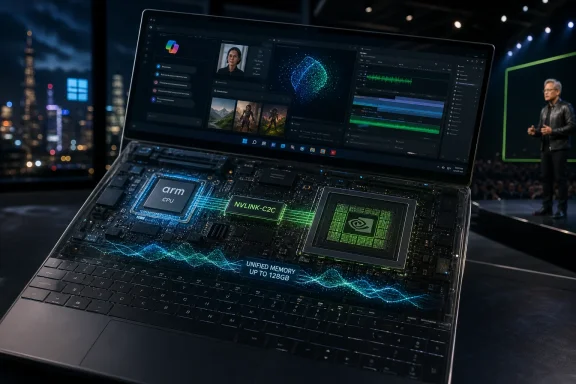
The result is a machine category that sounds, on paper, like a contradiction: a thin Windows laptop with an Arm CPU, an RTX 5070-class Blackwell GPU, up to 128GB of unified memory, and enough local AI compute for workloads that previously belonged on a workstation, external GPU, or rented cloud box. Whether that combination becomes a mainstream premium PC or an expensive specialty tool will depend less on keynote numbers than on how cleanly Windows, developers, OEMs, and game publishers meet Nvidia halfway.
The Superchip Puts CUDA Where Windows on Arm Needed a Reason to Exist
The RTX Spark platform is built around what had been expected as Nvidia’s N1X silicon: a 20-core Arm CPU paired with a Blackwell GPU carrying 6,144 CUDA cores, connected by Nvidia’s NVLink-C2C interconnect. Nvidia says the platform scales up to 128GB of unified memory and reaches up to 1 petaflop of AI compute, with systems coming from Microsoft Surface, Dell, HP, ASUS, Lenovo, and MSI in the first wave.Those figures are the kind of numbers that invite bad comparisons. A laptop-class integrated GPU with the same CUDA core count as a desktop RTX 5070 is not automatically a desktop RTX 5070 in every real-world workload. Power limits, memory bandwidth, thermals, driver maturity, and sustained clocks matter. But the core count still tells us where Nvidia is aiming: not at the low-power edge of Windows on Arm, but at the place where “mobile workstation” and “AI development box” begin to overlap.
The more consequential number may be 128GB. Unified memory has been one of Apple Silicon’s strongest arguments because it lets CPU, GPU, and neural engines work from the same large pool without the traditional laptop split between system RAM and discrete VRAM. Nvidia is adapting that idea to the Windows world, but with a software stack that is already deeply entrenched in AI and graphics acceleration.
That is why RTX Spark is potentially more disruptive than a simple CPU entry from Nvidia would have been. Intel and AMD can answer CPU performance. Qualcomm can answer Arm efficiency. Apple can answer platform integration. But none of them can answer CUDA directly, because CUDA’s value comes from the accumulated habits of the industry. Nvidia is turning those habits into a PC platform.
Microsoft’s Real Endorsement Is Not the Logo on the Slide
Microsoft’s support is central to this launch, and not merely because Windows has to run well on the chip. The company has been trying to reposition Windows around local AI, Copilot+ branding, NPUs, and agentic workflows, but it still needs hardware that makes the pitch feel more substantial than a new shortcut key and a few model demos. RTX Spark gives Microsoft a dramatic hardware story: a Windows PC that can run local models, accelerate AI frameworks, and keep the user inside the Windows ecosystem rather than sending them to a MacBook, a Linux workstation, or a browser tab connected to a cloud GPU.The timing is important. Qualcomm’s long role as the effective standard-bearer for Windows on Arm gave Microsoft a way to push battery life and mobile-style architecture into the PC market, but it also narrowed the hardware story. With that exclusivity era over, Microsoft can treat Arm less like a Qualcomm category and more like a Windows architecture. Nvidia’s arrival makes Windows on Arm look less like a compatibility compromise and more like a competitive arena.
The promise that RTX Spark can run legacy Windows applications through a combination of native Arm software and Microsoft’s Prism emulation layer is necessary, but it is not sufficient. Every Windows on Arm pitch says compatibility is better this time. The difference here is that Nvidia and Microsoft are trying to reduce the importance of that defensive claim by giving buyers an affirmative reason to care: local AI workloads, CUDA frameworks, creator acceleration, and gaming features that map to Nvidia’s existing ecosystem.
That is the strategic inversion. Earlier Windows on Arm systems had to persuade users that they would not lose too much. RTX Spark asks whether a certain class of user might gain enough to tolerate what remains imperfect.
The Apple Comparison Is Obvious, but It Is Also Incomplete
Apple’s M-series Macs are the unavoidable comparison because they made Arm laptops normal at the high end. Apple proved that a unified-memory Arm system could feel fast, quiet, and premium while escaping many of the assumptions that kept PC laptops tied to hot x86 chips and discrete-GPU compromises. Nvidia is clearly borrowing from that playbook.But RTX Spark is not simply “Apple Silicon for Windows.” Apple’s advantage is vertical integration: macOS, the SoC, the hardware design, the media engines, the developer tools, and the retail configuration matrix all move as one. Nvidia’s advantage is ecosystem gravity of a different kind. CUDA, RTX, TensorRT, OptiX, DLSS, Reflex, and the broader AI software stack are not merely features of a single laptop line; they are standards of practice across gaming, rendering, AI research, and accelerated computing.
That makes the fight asymmetric. Apple can offer a refined, coherent laptop whose power is available through Apple’s frameworks and a growing set of native creative and developer apps. Nvidia can offer a Windows machine that speaks the language of existing CUDA workflows, potentially reducing the distance between local prototyping and deployment on Nvidia-powered servers or cloud instances.
For developers and AI researchers, that difference is not cosmetic. A laptop that can run CUDA-native PyTorch workflows, TensorRT-LLM, llama.cpp CUDA paths, and other GPU-accelerated tools locally is not just a faster PC. It is a portable development environment aligned with the dominant data-center AI hardware vendor. Apple Silicon has strong local AI capabilities, but it does not erase the operational convenience of using the same acceleration stack from laptop to workstation to cloud.
The Compatibility Question Moves From Office Apps to Everything Weird
Microsoft Office, Teams, Edge, and many mainstream creative applications are no longer the hardest part of Windows on Arm. The harder question is the long tail: plug-ins, drivers, VPN clients, monitoring agents, endpoint security software, legacy line-of-business apps, niche engineering tools, game launchers, modding utilities, and DRM layers that assume x86 in ways users do not see until something breaks.That is where enterprise IT will remain cautious. A premium RTX Spark laptop may be an obvious fit for an AI engineer, a creative technologist, or a developer working close to Nvidia’s stack. It is a harder sell as a default corporate fleet machine until IT departments know exactly how their device management, security, and compatibility baselines behave.
Gaming has its own version of the same problem. Nvidia’s confirmation that major anti-cheat and DRM systems are being supported natively on Windows on Arm is a real advance, because anti-cheat has historically been one of the sharpest barriers for Arm PCs. But native anti-cheat support does not mean every game is suddenly native Arm software, nor does it mean every publisher will prioritize the work at the same pace.
The most likely first year is therefore uneven. Some titles and creative tools will be showcased beautifully. Some CUDA-heavy workflows will make the platform look inevitable. Some older software will run acceptably through emulation. And some edge cases will remind everyone why x86 has survived so long: not because it is elegant, but because decades of assumptions are hard to uproot.
Dell, Surface, and the OEMs Are Being Asked to Sell a New Premium Tier
The launch partner list matters because PC buyers trust form factors as much as chips. A Microsoft Surface Laptop Ultra gives the platform a flagship identity. Dell, HP, Lenovo, ASUS, and MSI give it reach across enterprise, creator, and gaming segments. Acer and Gigabyte following later suggests Nvidia wants RTX Spark to become a platform, not a one-off experiment.Still, OEM execution will decide whether RTX Spark feels like a breakthrough or another expensive badge. Nvidia’s reference vision includes 14- and 16-inch designs, premium displays, thin aluminum chassis, all-day battery claims, and compact desktops that can run local AI agents continuously. Those are appealing ingredients, but the PC market is littered with impressive silicon that was undermined by loud fans, mediocre displays, poor standby behavior, bad firmware, or confusing configuration choices.
Pricing is the unanswered question. Nvidia has not confirmed prices, and the first systems are expected to target the premium tier. That almost certainly means RTX Spark will not begin life as a mass-market Windows laptop alternative. It will be judged against MacBook Pro configurations, high-end creator laptops, mobile workstations, and compact AI development systems.
That is a demanding peer group. If RTX Spark machines land above conventional premium laptops but below the cost and complexity of workstation-plus-cloud workflows, Nvidia has a plausible wedge. If they become ultra-expensive curiosities with limited native software, they risk being admired by reviewers and ignored by procurement departments.
DLSS 4.5 Shows Why Nvidia’s PC Story Is Bigger Than the CPU
Nvidia’s Computex message was not confined to the new chip. DLSS 4.5 Ray Reconstruction, scheduled for August 2026 through the Nvidia App, extends the company’s graphics software advantage across existing RTX 20-, 30-, 40-, and 50-series GPUs. The update is framed around a second-generation transformer model, better temporal stability, improved lighting accuracy, and broader support across games and creative applications.That matters because RTX Spark is not entering the PC market as a lonely CPU. It enters as part of a software machine that already reaches gamers, creators, developers, and AI researchers. Nvidia can tell a buyer that the same company building the laptop platform is also improving image reconstruction in games, accelerating Blender viewport work, supporting TensorRT, and feeding CUDA frameworks used far beyond the consumer PC.
This is the part competitors should find uncomfortable. Intel and AMD have strong road maps, deep OEM relationships, and x86 compatibility. Qualcomm has momentum in efficient Arm PCs. Apple has the most polished Arm laptop platform. But Nvidia is the company whose software updates can make a three-year-old GPU feel more valuable and whose developer ecosystem spans consumer laptops and AI data centers.
The CPU market is not used to that kind of leverage. Historically, a new laptop processor was judged by benchmarks, battery life, thermals, platform I/O, and price. RTX Spark will be judged by those things too, but Nvidia is also bringing an app-layer and framework-layer argument. The chip is the entry point; the moat is above it.
Intel and AMD Should Be Worried, but Not for the Simplest Reason
It would be tempting to describe RTX Spark as Nvidia attacking Intel and AMD head-on. That is partly true, but it misses the more subtle threat. Nvidia does not need to replace every Core Ultra or Ryzen laptop to change the market. It only needs to capture the premium workflows that define what ambitious Windows PCs are supposed to become.If AI developers, creators, and high-end gamers begin to see RTX Spark as the most interesting Windows laptop category, Intel and AMD face a perception problem even where their chips remain excellent. The halo moves. The “serious local AI” conversation starts with CUDA. The most exciting Windows machines become Nvidia-led designs, while x86 systems are forced to argue compatibility, cost, and incumbency.
That does not make x86 obsolete. Far from it. Enterprise fleets, gaming desktops, budget laptops, high-refresh gaming notebooks, CAD workstations, and countless specialized deployments will continue to reward the stability and breadth of x86. AMD and Intel also have their own AI accelerators, integrated GPUs, and platform improvements, and neither company is standing still.
But Nvidia is attacking the future margin pool. Premium laptops, creator systems, and local AI workstations are where PC makers can still charge for differentiation. If RTX Spark owns the story there, x86 vendors may find themselves defending the installed base while Nvidia defines the aspirational one.
The First Wave Will Reveal Whether “AI PC” Finally Means Something Specific
The phrase AI PC has been stretched almost to uselessness. It has described laptops with NPUs, machines with Copilot keys, PCs capable of running small local models, and systems that mostly depend on cloud services while wearing an AI sticker. RTX Spark gives the term a sharper meaning: a personal computer with enough local GPU memory and software support to run serious AI workloads without treating the cloud as the default execution environment.That is a healthier definition because it can be tested. Can developers run the models they care about locally? Can creators use AI tools without waiting on remote services? Can enterprises keep sensitive workflows on-device? Can local agents run continuously without destroying battery life, thermals, or user trust?
The answers will vary by workload, but at least the questions are concrete. Nvidia’s pitch moves the AI PC away from demo magic and toward resource allocation: memory, GPU compute, framework support, model size, security boundaries, and application integration. That is where serious buyers live.
It also exposes the gap between consumer excitement and professional adoption. Running a model locally is impressive. Running it reliably, securely, with manageable data controls and predictable performance is what makes it useful. Microsoft’s role in sandboxing, Windows integration, and enterprise controls may prove as important as Nvidia’s silicon.
The Buyers Who Should Pay Attention First Are Not the Average Laptop Shoppers
RTX Spark is not likely to be the obvious recommendation for a student looking for a general-purpose laptop or a business user who lives in browser tabs and Office documents. Those buyers will care about price, battery life, weight, support, and whether their software works without surprises. Conventional Windows laptops and MacBooks will remain simpler choices for many of them.The first natural audience is narrower and more valuable. AI developers who already depend on CUDA will want to know whether RTX Spark can replace a travel workstation or reduce cloud spend for prototyping. Creators using GPU-accelerated effects, rendering, denoising, or generative tools will want to see whether unified memory and Blackwell acceleration change their mobile workflows. Game developers and technical artists may find the platform attractive if Nvidia’s tools behave consistently across desktop and mobile environments.
IT departments should watch, but they should not rush. A pilot program makes more sense than a fleet refresh. The right test is not a synthetic benchmark; it is a week of real VPN clients, endpoint agents, Teams calls, browser tabs, line-of-business apps, developer containers, creative plug-ins, sleep-resume cycles, and conference-room docks.
That is the unglamorous reality of any new Windows platform. Keynotes sell the future. IT inherits the edge cases.
The Fall Launch Will Test Whether CUDA Can Carry Windows on Arm
RTX Spark gives Windows on Arm something it has often lacked: a reason for demanding users to choose it rather than merely accept it. The first systems will not answer every question, but they will show whether Nvidia’s ecosystem can turn a risky architecture transition into a premium feature.- RTX Spark is Nvidia’s first major Windows PC processor platform, pairing an Arm CPU with a Blackwell GPU and the full CUDA stack for laptops and compact desktops.
- Microsoft’s backing makes this more than an Nvidia experiment, because Windows compatibility, Prism emulation, Copilot+ positioning, and enterprise controls all have to mature together.
- The platform’s strongest early appeal is likely to be AI development, creator workflows, local inference, and CUDA-dependent experimentation rather than ordinary office productivity.
- Gaming support looks more credible than on earlier Windows on Arm machines, but native Arm game support and publisher adoption will still determine the real experience.
- Pricing, thermals, battery life, and OEM execution will decide whether RTX Spark becomes a premium category or a fascinating niche.
- Intel, AMD, Qualcomm, and Apple do not need to lose the whole market for Nvidia to reshape the part of the market that sets expectations.
References
- Primary source: Tech Times
Published: Mon, 01 Jun 2026 14:13:26 GMT

Nvidia RTX Spark Superchip: Windows PC Chip With Full CUDA Stack Targets Dell, Microsoft This Fall
Nvidia RTX Spark Superchip launched at Computex 2026 as Nvidia’s first Windows PC processor, co-developed with Microsoft, pairing a Blackwell GPU with 6,144 CUDA cores and 128 GB unified memory in a thin Windows on Arm laptop. Devices from Dell, HP, ASUS, Lenovo, MSI, and Microsoft Surface are www.techtimes.com
- Related coverage: axios.com

Microsoft debuts Nvidia-powered Microsoft Surface Ultra laptop
Microsoft is trying again to redefine the PC for the AI era.www.axios.com
- Related coverage: windowscentral.com
Microsoft and NVIDIA’s Surface Laptop Ultra pushes Windows on Arm into high‑performance territory
Microsoft and NVIDIA unveil the Surface Laptop Ultra, a 128GB RAM beast with Blackwell graphics and a mini-LED display that redefines performance for Windows on Arm. www.windowscentral.com
- Related coverage: pcgamer.com
- Related coverage: investor.nvidia.com

NVIDIA and Microsoft Reinvent Windows PCs for the Age of Personal AI
RTX Spark — a 1-Petaflop Superchip, the Full CUDA and RTX Ecosystem, and Windows-Native Agents — a New Beginning for Personal Computers News Summary: NVIDIA RTX Spark powers the world’s first Windows PCs purpose-built for personal agents, featuring 1 petaflop of AI performance, industry-leading...investor.nvidia.com
- Related coverage: tomshardware.com

Nvidia unveils RTX Spark Superchip for laptops and desktop PCs at Computex 2026 – new platform promises to turn Windows into an agentic AI OS with Arm CPU, Blackwell GPU, and 128GB unified memory
Over 30 laptops and 10 desktops coming this fall with "the most efficent platform ever built"www.tomshardware.com
- Related coverage: techspot.com
- Related coverage: techcrunch.com

Nvidia chases $200B CPU market with AI agent PCs from Microsoft, Dell, and HP | TechCrunch
If Nvidia has cracked a way to bring AI agents easily, safely, and usefully to the masses, it could — and should — be big. techcrunch.com
- Official source: blogs.windows.com

Introducing a powerful new chapter for Windows PCs, accelerated by NVIDIA RTX Spark
Today at NVIDIA GTC, Microsoft and NVIDIA announced the world’s most powerful and efficient thin-and-light Windows PCs ever. Accelerated by NVIDIA RTX Spark blogs.windows.com
- Related coverage: notebookcheck.net

Nvidia N1X officially confirmed to arrive as the RTX Spark
Nvidia’s first consumer-grade laptop chip, the RTX Spark, is finally here. It is essentially a modified version of the DGX Spark launched last year, but with Windows support. www.notebookcheck.net
- Related coverage: business-standard.com
- Related coverage: banklesstimes.com

Nvidia, Microsoft Unveil RTX Spark: 1-Petaflop AI PC Chip | BanklessTimes
NVIDIA has unveiled RTX Spark, a new superchip for a new generation of Windows PCs built around personal AI agents. www.banklesstimes.com
- Related coverage: theguardian.com

Nvidia launches ‘superchip’ putting AI power into laptops and PCs
Firm says its RTX Spark PC chip for Microsoft Windows will let AI agents replace the mouse and keyboardwww.theguardian.com
- Related coverage: elpais.com
- Related coverage: nvidianews.nvidia.com
