

Nvidia has begun pitching its Arm-based Vera data-center CPU to Chinese customers for possible shipments as early as August 2026, reportedly taking orders while its higher-end AI GPU business in China remains constrained by U.S. export controls and Beijing’s domestic chip ambitions. The move is not merely a product launch; it is a geopolitical workaround dressed as a platform strategy. Nvidia is trying to preserve its place in China’s AI buildout by selling the part of the system that Washington has treated as less explosive than the accelerator. That makes Vera less a side bet than a test of how much of the AI stack Nvidia can still own when the GPU is the hardest thing to ship.
The central fact of Nvidia’s China problem has not changed: the company built the modern AI accelerator market, and the United States has steadily narrowed the class of accelerators that can be sold into China without scrutiny. The H100, H200, and their descendants are not just chips in this policy fight; they are symbols of strategic compute capacity. Once that frame took hold in Washington, Nvidia’s China business stopped being a normal export story and became a rolling negotiation between performance, paperwork, and politics.
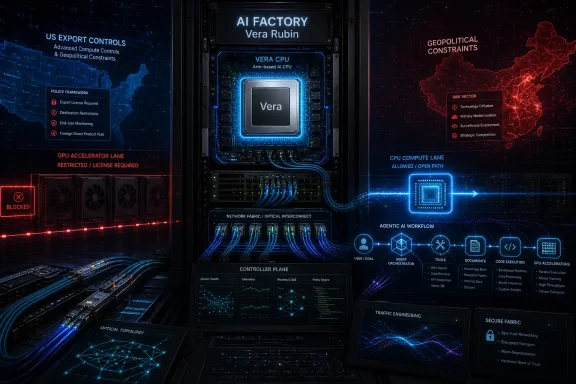
Vera is interesting precisely because it sits adjacent to that fight. It is a CPU, not the GPU engine that trains frontier models or powers the most sought-after inference clusters. But in modern AI data centers, “adjacent” does not mean secondary. The host processor feeds accelerators, manages memory movement, coordinates jobs, runs control-plane software, and increasingly supports the messy backend work of agentic systems.
That gives Nvidia a plausible argument to Chinese cloud providers: even if the accelerator pipeline is uncertain, the rest of the AI factory still needs to be built. If Chinese buyers cannot reliably get every Nvidia GPU they want, they may still be willing to standardize on Nvidia’s surrounding architecture. The company’s bet is that owning the CPU foothold today can preserve the software, networking, and rack-scale relationship for whatever export regime exists tomorrow.
There is a familiar pattern here. When a market becomes politically restricted, the incumbent does not simply walk away; it re-segments the product line, shifts the conversation, and tries to sell what remains permissible. Vera is Nvidia doing exactly that, but at a more strategic layer than the cut-down GPU variants that defined earlier rounds of U.S.-China chip maneuvering.
Agentic AI is an overused phrase, but it points to a real infrastructure change. A chatbot that answers a single prompt is one thing; a system that calls tools, retrieves documents, executes code, waits for external responses, manages state, and coordinates multiple models is another. Much of that orchestration is not glamorous tensor math. It is CPU-heavy systems work, and it needs memory bandwidth, low-latency communication, and tight integration with accelerators.
That is the commercial opening Vera is meant to occupy. Nvidia has positioned the chip as a host CPU for its Vera Rubin platform and as a standalone processor for AI servers. The pitch is that AI infrastructure should not be assembled from loosely coupled parts if the workload itself is becoming a rack-scale, software-defined machine.
For WindowsForum readers, the PC analogy is imperfect but useful. Nvidia is trying to do to the data center what platform vendors have long tried to do on the client side: collapse enough of the stack under one architecture that customers stop buying components and start buying a system. The CPU is not replacing the GPU in Nvidia’s story. It is helping Nvidia argue that the GPU is only one chapter in a much larger book.
That does not mean Nvidia has become irrelevant. Compatibility, performance, developer familiarity, and the CUDA ecosystem remain powerful advantages. Even when buyers are politically encouraged to diversify, the cost of abandoning a mature software and hardware stack is real. AI infrastructure is not purchased like a desktop CPU; it is embedded into compilers, schedulers, model-serving frameworks, networking assumptions, and operational playbooks.
Vera’s appeal in China therefore depends on a subtle proposition. Nvidia does not need every Chinese customer to abandon domestic accelerators. It needs enough of them to decide that Nvidia’s CPU, networking, and system architecture remain useful even in mixed or constrained deployments. A Vera-based server tested in an overseas data center is not just a benchmark exercise; it is a compatibility audition for a future in which Chinese AI capacity may be hybrid, fragmented, and politically hedged.
The danger for Nvidia is that China’s buyers may treat Vera as a bridge, not a destination. They may use it where it solves a near-term bottleneck while continuing to pour resources into domestic alternatives. That would still generate revenue, but it would not restore the market position Nvidia enjoyed before export controls turned procurement into strategy.
A CPU built for AI data centers is not a neutral office processor, but it is also not an H200-class accelerator. That distinction matters. If Washington’s primary concern is the direct acceleration of frontier model training and high-end inference, CPUs may draw less immediate attention. If the concern broadens to the entire AI factory, then host CPUs, networking chips, DPUs, optical interconnects, and system-level designs become part of the same strategic map.
Nvidia is not hiding the importance of Vera. The company’s own messaging emphasizes agentic AI, rack-scale integration, and tight coupling with the broader Vera Rubin platform. That makes the China push commercially coherent but politically delicate. The more Nvidia succeeds in proving Vera is essential to modern AI factories, the easier it becomes for policymakers to ask whether it should be treated as strategically sensitive.
This is the bind Nvidia has lived with since the first major AI chip restrictions. If it downplays a product, customers may not care. If it makes the product sound indispensable, regulators may care too much. Vera’s China debut sits directly on that fault line.
That does not mean Intel and AMD can dismiss the threat. Nvidia’s advantage is not that it has suddenly become the default server CPU vendor. Its advantage is that it can sell the CPU as part of an AI system rather than as a standalone line item. In an AI data center, the buyer may care less about traditional CPU procurement categories and more about whether the whole rack behaves predictably under model-serving pressure.
AMD has benefited from the hunger for high-core-count server processors, and Intel remains deeply entrenched across enterprise and cloud infrastructure. But both companies face a world in which the AI cluster is increasingly designed around the accelerator vendor’s assumptions. If Nvidia can make Vera the “natural” host for Nvidia-based AI factories, it can pull CPU share through GPU gravity.
China complicates that dynamic. Chinese cloud providers are already motivated to avoid overdependence on any one U.S. supplier. A Vera order may be attractive as a tactical deployment, but a full Nvidia CPU platform commitment invites the same strategic vulnerability that customers are trying to reduce in GPUs. For Intel and AMD, that creates an opening: they can position themselves as more conventional, more flexible, and perhaps less politically concentrated alternatives, even if Nvidia’s integrated story is technically compelling.
This is why the China push matters beyond the immediate order book. If Nvidia can seed Vera into Chinese cloud environments, it is also seeding expectations about how future AI data centers should be built. Networking, DPUs, switches, management software, liquid cooling designs, and reference architectures all become part of the vendor relationship.
The result is a different kind of lock-in from the old Windows-versus-Linux or x86-versus-Arm battles. It is not merely about instruction sets or operating systems. It is about whether the operator’s entire AI deployment model increasingly assumes Nvidia’s topology, Nvidia’s software layers, and Nvidia’s cadence.
That is a strong proposition for customers that value speed and coherence. It is a risky proposition for customers under pressure to localize supply chains. Nvidia’s challenge in China is to make the rack-scale efficiency argument persuasive enough that buyers accept some political and strategic friction.
Every Copilot feature, enterprise assistant, code-generation service, image model, meeting summarizer, and cloud-hosted agent depends on the economics of inference. If CPUs become a bottleneck in running those services at scale, the user eventually feels it through price, latency, availability, or feature limits. The data center is now part of the client experience, even when the client device is unchanged.
For sysadmins, the relevance is more immediate. Enterprises evaluating AI services are not only choosing models; they are inheriting the infrastructure assumptions of cloud providers. A service optimized around Nvidia’s full stack may behave differently from one built on mixed accelerators or domestic Chinese hardware. Compliance teams, procurement officers, and IT architects will increasingly need to understand not just where data is processed, but what supply chain and export-control constraints sit behind the service.
This is especially true for multinational organizations operating across U.S., European, and Chinese environments. AI workloads may be portable in theory, but infrastructure politics can make them fragmented in practice. Vera’s China push is another sign that the AI cloud will not be a single global fabric. It will be a set of partially compatible regions shaped by policy as much as performance.
Nvidia’s China-specific GPU variants were the first obvious expression of that reality. Vera is subtler because it is not simply a degraded version of a flagship accelerator. It is a product that already fits Nvidia’s global roadmap, now being pushed into China because the GPU lane is harder to navigate. That makes it both more defensible and more consequential.
This is how industrial policy reshapes markets without directly designing products. Washington did not tell Nvidia to sell CPUs in China. But by constraining the accelerator path, it made the CPU path more attractive. Beijing did not tell every cloud provider to test Vera. But by pushing domestic self-sufficiency and scrutinizing foreign GPUs, it changed how Chinese buyers evaluate risk.
The outcome is not clean decoupling. It is selective coupling, where companies keep doing business through the parts of the stack that remain viable. That is less dramatic than a total ban and more complex for everyone involved.
All four readings can be true at once. Nvidia is operating in a market where technical excellence no longer guarantees access. It can design the best AI infrastructure in the world and still find itself negotiating around export classifications, customer hesitancy, and national self-sufficiency campaigns.
The reported August availability matters because it gives the story a near-term clock. If Chinese customers test Vera quickly and place meaningful orders, Nvidia will have shown that its China business can adapt beyond GPUs. If interest remains cautious or limited to overseas evaluations, the episode will look more like a holding action than a comeback.
Either way, Vera gives Nvidia something it badly needs in China: a conversation that is not only about what it cannot sell. That alone has strategic value.
For WindowsForum’s audience, the practical read is less about buying Vera and more about understanding the direction of travel. The AI systems appearing in enterprise software, developer tools, and operating-system experiences are being built on hardware stacks that are increasingly regional, regulated, and vertically integrated.
 Nvidia Finds a Door the GPU Rules Did Not Fully Close
The central fact of Nvidia’s China problem has not changed: the company built the modern AI accelerator market, and the United States has steadily narrowed the class of accelerators that can be sold into China without scrutiny. The H100, H200, and their descendants are not just chips in this policy fight; they are symbols of strategic compute capacity. Once that frame took hold in Washington, Nvidia’s China business stopped being a normal export story and became a rolling negotiation between performance, paperwork, and politics.Vera is interesting precisely because it sits adjacent to that fight. It is a CPU, not the GPU engine that trains frontier models or powers the most sought-after inference clusters. But in modern AI data centers, “adjacent” does not mean secondary. The host processor feeds accelerators, manages memory movement, coordinates jobs, runs control-plane software, and increasingly supports the messy backend work of agentic systems.
That gives Nvidia a plausible argument to Chinese cloud providers: even if the accelerator pipeline is uncertain, the rest of the AI factory still needs to be built. If Chinese buyers cannot reliably get every Nvidia GPU they want, they may still be willing to standardize on Nvidia’s surrounding architecture. The company’s bet is that owning the CPU foothold today can preserve the software, networking, and rack-scale relationship for whatever export regime exists tomorrow.
There is a familiar pattern here. When a market becomes politically restricted, the incumbent does not simply walk away; it re-segments the product line, shifts the conversation, and tries to sell what remains permissible. Vera is Nvidia doing exactly that, but at a more strategic layer than the cut-down GPU variants that defined earlier rounds of U.S.-China chip maneuvering.
Vera Is Not a Console Prize for Losing H200
It would be easy to frame Vera as Nvidia’s consolation product for a wounded China GPU business. That reading is too simple. Nvidia did not invent Vera because China became difficult; it built Vera because the AI data center is becoming more CPU-dependent as workloads move from pure training into large-scale inference, tool use, and multi-step automation.Agentic AI is an overused phrase, but it points to a real infrastructure change. A chatbot that answers a single prompt is one thing; a system that calls tools, retrieves documents, executes code, waits for external responses, manages state, and coordinates multiple models is another. Much of that orchestration is not glamorous tensor math. It is CPU-heavy systems work, and it needs memory bandwidth, low-latency communication, and tight integration with accelerators.
That is the commercial opening Vera is meant to occupy. Nvidia has positioned the chip as a host CPU for its Vera Rubin platform and as a standalone processor for AI servers. The pitch is that AI infrastructure should not be assembled from loosely coupled parts if the workload itself is becoming a rack-scale, software-defined machine.
For WindowsForum readers, the PC analogy is imperfect but useful. Nvidia is trying to do to the data center what platform vendors have long tried to do on the client side: collapse enough of the stack under one architecture that customers stop buying components and start buying a system. The CPU is not replacing the GPU in Nvidia’s story. It is helping Nvidia argue that the GPU is only one chapter in a much larger book.
China Wants AI Capacity, Not Just Nvidia Silicon
China’s cloud providers and AI labs are not passive customers waiting for Nvidia’s next allowable SKU. They are operating in an environment where state policy, procurement pressure, and domestic competition all push them toward local alternatives. Huawei, Biren, Cambricon, and other Chinese suppliers have been elevated by necessity as much as nationalism.That does not mean Nvidia has become irrelevant. Compatibility, performance, developer familiarity, and the CUDA ecosystem remain powerful advantages. Even when buyers are politically encouraged to diversify, the cost of abandoning a mature software and hardware stack is real. AI infrastructure is not purchased like a desktop CPU; it is embedded into compilers, schedulers, model-serving frameworks, networking assumptions, and operational playbooks.
Vera’s appeal in China therefore depends on a subtle proposition. Nvidia does not need every Chinese customer to abandon domestic accelerators. It needs enough of them to decide that Nvidia’s CPU, networking, and system architecture remain useful even in mixed or constrained deployments. A Vera-based server tested in an overseas data center is not just a benchmark exercise; it is a compatibility audition for a future in which Chinese AI capacity may be hybrid, fragmented, and politically hedged.
The danger for Nvidia is that China’s buyers may treat Vera as a bridge, not a destination. They may use it where it solves a near-term bottleneck while continuing to pour resources into domestic alternatives. That would still generate revenue, but it would not restore the market position Nvidia enjoyed before export controls turned procurement into strategy.
Washington Drew the Line Around Accelerators, and Nvidia Is Testing the Edges
Export controls tend to lag architectures. Regulators write thresholds around known performance metrics, interconnect speeds, memory bandwidth, and accelerator capabilities, while chip companies redesign products around the letter and spirit of those thresholds. Vera now enters the gray space created by that process.A CPU built for AI data centers is not a neutral office processor, but it is also not an H200-class accelerator. That distinction matters. If Washington’s primary concern is the direct acceleration of frontier model training and high-end inference, CPUs may draw less immediate attention. If the concern broadens to the entire AI factory, then host CPUs, networking chips, DPUs, optical interconnects, and system-level designs become part of the same strategic map.
Nvidia is not hiding the importance of Vera. The company’s own messaging emphasizes agentic AI, rack-scale integration, and tight coupling with the broader Vera Rubin platform. That makes the China push commercially coherent but politically delicate. The more Nvidia succeeds in proving Vera is essential to modern AI factories, the easier it becomes for policymakers to ask whether it should be treated as strategically sensitive.
This is the bind Nvidia has lived with since the first major AI chip restrictions. If it downplays a product, customers may not care. If it makes the product sound indispensable, regulators may care too much. Vera’s China debut sits directly on that fault line.
Intel and AMD Are Now Fighting Nvidia on Less Comfortable Terrain
Nvidia’s GPU dominance often makes Intel and AMD look like supporting characters in AI infrastructure. Vera changes the comparison. In CPUs, Nvidia is the challenger, and the incumbents have decades of server relationships, platform validation, firmware maturity, and procurement familiarity behind them.That does not mean Intel and AMD can dismiss the threat. Nvidia’s advantage is not that it has suddenly become the default server CPU vendor. Its advantage is that it can sell the CPU as part of an AI system rather than as a standalone line item. In an AI data center, the buyer may care less about traditional CPU procurement categories and more about whether the whole rack behaves predictably under model-serving pressure.
AMD has benefited from the hunger for high-core-count server processors, and Intel remains deeply entrenched across enterprise and cloud infrastructure. But both companies face a world in which the AI cluster is increasingly designed around the accelerator vendor’s assumptions. If Nvidia can make Vera the “natural” host for Nvidia-based AI factories, it can pull CPU share through GPU gravity.
China complicates that dynamic. Chinese cloud providers are already motivated to avoid overdependence on any one U.S. supplier. A Vera order may be attractive as a tactical deployment, but a full Nvidia CPU platform commitment invites the same strategic vulnerability that customers are trying to reduce in GPUs. For Intel and AMD, that creates an opening: they can position themselves as more conventional, more flexible, and perhaps less politically concentrated alternatives, even if Nvidia’s integrated story is technically compelling.
The Real Product Is the Rack, Not the Chip
The most important phrase in Nvidia’s current AI strategy is not GPU, CPU, or even CUDA. It is AI factory. That language is deliberate. Nvidia wants customers to think of AI infrastructure as an industrial system, not a parts bin. Vera belongs to that story because the CPU helps turn a rack of accelerators into a managed, coherent, high-throughput machine.This is why the China push matters beyond the immediate order book. If Nvidia can seed Vera into Chinese cloud environments, it is also seeding expectations about how future AI data centers should be built. Networking, DPUs, switches, management software, liquid cooling designs, and reference architectures all become part of the vendor relationship.
The result is a different kind of lock-in from the old Windows-versus-Linux or x86-versus-Arm battles. It is not merely about instruction sets or operating systems. It is about whether the operator’s entire AI deployment model increasingly assumes Nvidia’s topology, Nvidia’s software layers, and Nvidia’s cadence.
That is a strong proposition for customers that value speed and coherence. It is a risky proposition for customers under pressure to localize supply chains. Nvidia’s challenge in China is to make the rack-scale efficiency argument persuasive enough that buyers accept some political and strategic friction.
The Windows Angle Is the Data Center Behind Every AI Feature
At first glance, Vera looks distant from the concerns of Windows users. It is a server CPU aimed at AI data centers, not a chip that will appear in a Surface or a gaming desktop. But the consumer AI experience now depends heavily on infrastructure decisions made far upstream.Every Copilot feature, enterprise assistant, code-generation service, image model, meeting summarizer, and cloud-hosted agent depends on the economics of inference. If CPUs become a bottleneck in running those services at scale, the user eventually feels it through price, latency, availability, or feature limits. The data center is now part of the client experience, even when the client device is unchanged.
For sysadmins, the relevance is more immediate. Enterprises evaluating AI services are not only choosing models; they are inheriting the infrastructure assumptions of cloud providers. A service optimized around Nvidia’s full stack may behave differently from one built on mixed accelerators or domestic Chinese hardware. Compliance teams, procurement officers, and IT architects will increasingly need to understand not just where data is processed, but what supply chain and export-control constraints sit behind the service.
This is especially true for multinational organizations operating across U.S., European, and Chinese environments. AI workloads may be portable in theory, but infrastructure politics can make them fragmented in practice. Vera’s China push is another sign that the AI cloud will not be a single global fabric. It will be a set of partially compatible regions shaped by policy as much as performance.
Export Controls Are Creating Product Strategy in Real Time
The most revealing part of the Vera story is not that Nvidia found a product it can still sell. It is that export controls are now visibly steering product strategy. Companies do not merely respond to demand; they respond to what regulators allow demand to become.Nvidia’s China-specific GPU variants were the first obvious expression of that reality. Vera is subtler because it is not simply a degraded version of a flagship accelerator. It is a product that already fits Nvidia’s global roadmap, now being pushed into China because the GPU lane is harder to navigate. That makes it both more defensible and more consequential.
This is how industrial policy reshapes markets without directly designing products. Washington did not tell Nvidia to sell CPUs in China. But by constraining the accelerator path, it made the CPU path more attractive. Beijing did not tell every cloud provider to test Vera. But by pushing domestic self-sufficiency and scrutinizing foreign GPUs, it changed how Chinese buyers evaluate risk.
The outcome is not clean decoupling. It is selective coupling, where companies keep doing business through the parts of the stack that remain viable. That is less dramatic than a total ban and more complex for everyone involved.
Nvidia’s China Business Becomes a Test of Patience
For investors, Vera may look like a clever way to reopen a revenue channel. For engineers, it may look like a natural extension of Nvidia’s rack-scale architecture. For policymakers, it may look like the next loophole to study. For Chinese customers, it may look like a useful product that arrives with geopolitical baggage.All four readings can be true at once. Nvidia is operating in a market where technical excellence no longer guarantees access. It can design the best AI infrastructure in the world and still find itself negotiating around export classifications, customer hesitancy, and national self-sufficiency campaigns.
The reported August availability matters because it gives the story a near-term clock. If Chinese customers test Vera quickly and place meaningful orders, Nvidia will have shown that its China business can adapt beyond GPUs. If interest remains cautious or limited to overseas evaluations, the episode will look more like a holding action than a comeback.
Either way, Vera gives Nvidia something it badly needs in China: a conversation that is not only about what it cannot sell. That alone has strategic value.
The Vera Gambit Narrows the Distance Between Silicon and Statecraft
The concrete lesson from this launch is that AI infrastructure has become too important to remain a normal technology market. Nvidia is not simply competing with Intel, AMD, Huawei, and other chip suppliers. It is competing inside a policy environment that can elevate or strand entire product lines.For WindowsForum’s audience, the practical read is less about buying Vera and more about understanding the direction of travel. The AI systems appearing in enterprise software, developer tools, and operating-system experiences are being built on hardware stacks that are increasingly regional, regulated, and vertically integrated.
- Nvidia is reportedly taking orders for Vera CPUs from Chinese customers, with shipments potentially beginning as early as August 2026.
- Vera is a CPU for AI data centers and agentic workloads, not a direct substitute for restricted high-end Nvidia GPUs.
- The China push gives Nvidia a way to maintain platform influence while advanced GPU sales remain politically and commercially uncertain.
- Intel and AMD face a new kind of competition in server CPUs because Nvidia can attach Vera to a broader AI factory architecture.
- Chinese cloud providers may test Vera tactically while still investing in domestic alternatives to reduce dependence on U.S. suppliers.
- The long-term impact will depend on whether regulators continue to distinguish between AI accelerators and the surrounding infrastructure that makes them useful.
References
- Primary source: Mobile World Live
Published: Mon, 15 Jun 2026 08:49:42 GMT
Nvidia targets China with Vera CPU push - Mobile World Live
Nvidia reportedly told Chinese customers its new Vera CPU for AI data centres could be available in as soon as August.www.mobileworldlive.com
- Independent coverage: Electronics For You BUSINESS
Published: 2026-06-15T08:20:10.664996
- Related coverage: investor.nvidia.com
NVIDIA Corporation - NVIDIA Unveils Vera, the CPU for Agents
1.8x Faster Than x86 Processors to Drive Diverse Workloads Across Industries, Generating More Data Center Token Revenue News Summary: NVIDIA launches high-performance, energy-efficient NVIDIA Vera CPUs to drive diverse workloads across industries, including agentic AI, reinforcement learning and...investor.nvidia.com - Related coverage: nvidianews.nvidia.com
NVIDIA Vera Rubin Opens Agentic AI Frontier | NVIDIA Newsroom
NVIDIA today announced the NVIDIA Vera Rubin platform is opening the next frontier of agentic AI, with seven new chips now in full production to scale the world’s largest AI factories.nvidianews.nvidia.com - Related coverage: tomshardware.com
Nvidia preps to sell its Vera CPUs into China as its GPU sales stay frozen — customers encouraged to place orders for CPU shipments as early as August | Tom's Hardware
Chinese cloud firms are reportedly testing more than 300 Vera servers overseas.www.tomshardware.com - Related coverage: trendforce.com
[News] NVIDIA Reportedly Opens Vera CPU Sales to China as Early as August as H200 Shipments Stall
While NVIDIA continues to face hurdles in shipping its H200 AI accelerators to China, the company may be opening a new channel into the market. Accord...www.trendforce.com
- Related coverage: banklesstimes.com
Nvidia Pitches Its First Standalone AI Data-Center CPU to China Buyers | BanklessTimes
NVIDIA has started pitching its new Vera central processors to Chinese clients and says they could arrive as early as August.www.banklesstimes.com - Related coverage: abhs.in
Nvidia Halts H200 China Production and Moves TSMC Capacity to Vera Rubin — What It Means for GPU Supply in 2026 | Abhishek Gautam
Nvidia has stopped all H200 chip production destined for China after both US export regulators and Chinese customs blocked shipments from both ends. TSMC capacity is now fully redirected to next-gen Vera Rubin. Here's what this means for global GPU availability, AI infrastructure pricing...www.abhs.in
- Related coverage: coinalertnews.com
Nvidia Opens Vera CPU Orders in China, Bolsters DC Policy Team to Navigate Chip Curbs
Nvidia starts taking orders for its Vera CPU in China, targeting $20B in sales, and hires a former Intel lobbyist to fortify its Washington influence amid tight chip export rules.coinalertnews.com - Related coverage: chinastrategy.org
- Related coverage: pcgamer.com
China reportedly approves imports of Nvidia's H200 GPU, but the US government may cap exports to individual Chinese companies | PC Gamer
The intricate US-China GPU export dance continues.www.pcgamer.com - Related coverage: axios.com
Nvidia restarting production for H200 chips for sales in China
CEO Jensen Huang said the company has received purchase orders "from many customers."www.axios.com
- Related coverage: techradar.com
Nvidia’s Rubin-powered DGX SuperPOD challenges Huawei’s AI dominance with fewer GPUs while delivering unmatched Exaflops performance at industrial scale | TechRadar
DGX racks integrate 600TB fast memory and NVMe storage per systemwww.techradar.com - Related coverage: cincodias.elpais.com

