

Nvidia is expected to make the second half of 2026 pivotal by pushing beyond its GPU stronghold into CPUs for AI data centers and Windows PCs, with Vera Rubin systems and RTX Spark machines scheduled to arrive from major infrastructure and PC partners. The claim is not merely that Nvidia has another fast chip coming. It is that the company is trying to turn the CPU from a rival’s territory into another layer of its own AI platform. If it succeeds, the next phase of Nvidia’s power will be measured less by graphics processors alone and more by how much of the computing stack it can make feel inseparable from Nvidia.
The easy version of the Nvidia story says the company won AI because it had the best GPUs when large language models needed brute-force parallel compute. That is true as far as it goes, but it understates what Nvidia actually sold. The company did not just sell silicon; it sold a working system at the moment the rest of the industry was still assembling parts.
CUDA made Nvidia’s hardware sticky long before generative AI became a boardroom emergency. Developers, researchers, hyperscalers, and software vendors built around the assumption that Nvidia was the default acceleration layer. Once that assumption became embedded in tooling, models, libraries, procurement habits, and engineering teams, the GPU became less like a component and more like a platform tax.
That is why every Nvidia “killer” tends to arrive with two burdens. It must be cheaper, faster, or more efficient than Nvidia on some benchmark, and it must persuade buyers to give up the surrounding machinery that made Nvidia the safer bet. In enterprise computing, “good enough and already integrated” often beats “better on paper and operationally unfamiliar.”
The Motley Fool’s argument that the second half of 2026 could be game-changing for Nvidia rests on this deeper platform logic. The interesting part is not simply that Nvidia is moving into CPUs. The interesting part is that Nvidia is moving into CPUs at the exact moment AI workloads are becoming less cleanly GPU-shaped.
Agentic AI changes the shape of demand. An AI agent is not merely answering a prompt; it may be calling tools, querying databases, writing and executing code, retrieving files, orchestrating workflows, maintaining state, and making repeated decisions over time. That kind of workload still needs GPUs, but it also needs fast host processors, memory movement, networking, storage coordination, and software plumbing that does not collapse under many small steps.
This is where Nvidia sees an opening. If agents become a major production workload, the winning architecture may be the one that minimizes friction between the CPU, GPU, network, storage, and software stack. Nvidia’s pitch is that the data center should be treated as the unit of compute, not the chip.
That framing is self-serving, but it is also directionally plausible. The AI industry is already moving from server-level thinking to rack-scale and cluster-scale design, because the cost of moving data and coordinating work can be as important as the arithmetic itself. Nvidia has spent years turning that reality into a sales advantage.
The timing is important. Nvidia is not entering the CPU market by promising to be a generic commodity supplier. It is entering with a specific thesis: AI factories need CPUs that are co-designed with the rest of the Nvidia stack. That is a much narrower target than “beat every x86 server in every workload,” and it is a much more Nvidia-like strategy.
The CPU market is large, but it is also conservative. Hyperscalers and enterprises do not replace server architectures because a keynote says the future has arrived. They care about performance per watt, software compatibility, supply chain diversity, serviceability, virtualization, security, and the practical pain of moving existing workloads.
That makes Vera both promising and exposed. Nvidia can use its AI dominance to pull Vera into infrastructure deals where Rubin GPUs, NVLink, BlueField, Spectrum networking, and CUDA are already part of the plan. But the company still has to prove that a CPU designed around Nvidia’s AI worldview is compelling outside the most Nvidia-centric deployments.
For customers building giant AI clusters, the promise is not just faster training or cheaper tokens. The promise is predictability. Nvidia wants buyers to believe that its integrated rack-scale systems will reduce deployment risk, squeeze more useful work out of expensive power envelopes, and keep software teams inside an ecosystem they already understand.
That is a strong pitch in a market where delays can be ruinously expensive. If an AI lab, cloud provider, or enterprise builder has committed billions to infrastructure, the cost of integration failure may dwarf the cost of individual chips. Nvidia’s pricing power has survived partly because buyers have been willing to pay for a lower-risk path to production.
Still, this is where competitors will press hardest. AMD, Intel, custom cloud silicon teams, and Arm server vendors do not need to destroy Nvidia’s whole stack to weaken its margins. They only need to convince enough buyers that certain workloads can be moved to cheaper or more open alternatives without breaking the operating model.
For WindowsForum readers, this is the part that may feel more immediate. The Windows PC has been through several attempted reinventions: ultrabooks, touch-first hybrids, Windows on Arm, Copilot+ PCs, NPUs, cloud-connected experiences, and now agentic computing. RTX Spark is not just another laptop chip; it is Nvidia and Microsoft arguing that the PC needs a more powerful local AI engine than today’s baseline NPU story provides.
That is a challenge to both Intel and AMD, but also to Qualcomm’s recent momentum in Arm-based Windows machines. Microsoft has spent years trying to make Windows less dependent on the old x86 duopoly. Nvidia now gives Microsoft a partner with enormous developer gravity, gaming credibility, and AI brand power.
The catch is that Windows compatibility is unforgiving. Consumers and IT departments will not judge RTX Spark only by demos of local agents. They will judge it by battery life, thermals, driver stability, app compatibility, docking behavior, manageability, security tooling, gaming performance, creative workflows, and whether the machines justify premium pricing.
An RTX Spark-class Windows machine gives Microsoft a more dramatic canvas. If the full Nvidia stack can run local models, accelerate creative applications, support gaming, and power richer agents from the Windows taskbar, the AI PC could become more than a sticker on a laptop palm rest. It could become a new performance tier, closer to the old workstation distinction than the mass-market NPU checklist.
But Microsoft has to walk a narrow line. If these machines are too expensive, they become developer toys and creator flagships. If the agent experiences feel intrusive, unreliable, or privacy-hostile, users will disable them. If the best features depend on cloud services anyway, buyers may wonder why they needed special local hardware in the first place.
This is why RTX Spark is strategically interesting but not automatically transformative. The hardware may be ready before the everyday software story is. Nvidia can supply the engine, but Microsoft must make the car worth driving.
A developer may want a portable CUDA-capable AI workstation. A creator may want better local acceleration for Adobe workflows. A gamer may want RTX-class performance in a thin system. Those are real markets, but they are not the same as the mass PC market.
For sysadmins, the questions will be practical before they are futuristic. Can these machines be imaged, secured, enrolled, updated, repaired, and supported as predictably as existing fleets? Will Arm-based Windows compatibility be good enough for line-of-business software? Will Nvidia’s drivers and Microsoft’s AI layers add new attack surface or management complexity?
Those questions do not kill the RTX Spark idea. They simply mean the second half of 2026 will be a proving ground, not a coronation. The first wave of machines will tell us whether Nvidia can translate its data center platform playbook into the messier, lower-margin world of Windows PCs.
Hyperscalers have been designing custom AI silicon because they do not want their cost structures dictated entirely by one supplier. AMD continues to push Instinct accelerators and EPYC CPUs into environments that value openness, x86 continuity, and pricing leverage. Intel remains battered but strategically relevant because enterprise infrastructure does not turn over overnight.
The CPU side is even more contested. Intel and AMD know how to sell CPUs into data centers. Arm server suppliers have spent years learning where the architectural openings are. Cloud providers can tune their own silicon for internal workloads in ways a merchant vendor cannot always match.
Nvidia’s answer is integration. It wants to make the comparison less about CPU versus CPU and more about system versus system. That is smart, but it also means Nvidia must keep executing across more layers of the stack at once.
For now, many buyers have tolerated Nvidia pricing because time-to-market matters more than optimization. If a model lab can ship months earlier, or a cloud provider can fill capacity immediately, the premium may be rational. But as AI infrastructure matures, finance departments will demand more granular answers about utilization, workload placement, and return on invested capital.
This is where CPUs complicate the story. If Nvidia can attach Vera CPUs to high-value AI systems and prove they reduce total cost of ownership, the company can defend or even expand its pricing power. If buyers see Vera as another expensive layer in an already expensive stack, competitors will have an opening.
The same is true in PCs. RTX Spark can command a premium if it creates a category users understand. If it feels like a pricey AI badge attached to niche software, the PC market will punish it quickly.
Nvidia’s revenue growth and share-price rise have been extraordinary because the company sat at the center of an emergency buildout. The world needed AI compute quickly, and Nvidia had the best-packaged answer. The next phase will be more complex, because customers are no longer merely racing to acquire accelerators; they are trying to rationalize entire AI operating models.
That shift could favor Nvidia. The more complex AI infrastructure becomes, the more valuable an integrated supplier can be. But complexity also creates room for specialization, internal silicon, second-source strategies, and software abstractions that reduce lock-in.
The market may want a simple answer: Vera and RTX Spark mean Nvidia wins CPUs too. The better answer is more conditional. Nvidia is using its GPU dominance to attack adjacent compute markets at the moment those markets are being reshaped by AI.
That is why Vera and RTX Spark belong in the same story. One targets the AI factory; the other targets the AI workstation and premium Windows PC. Both are attempts to make Nvidia the default answer when computing moves from passive applications to active agents.
The risk is that agentic AI itself remains overhyped in the near term. Many so-called agents are still brittle wrappers around models, tools, and workflow scripts. They can be impressive in controlled demos and frustrating in production, especially when reliability, permissions, auditability, and data governance matter.
If the agentic wave takes longer to mature, Nvidia may still sell plenty of hardware, but the transformational story becomes more gradual. Vera can serve data processing and orchestration workloads, and RTX Spark can serve creators and developers, but the grand narrative depends on agents becoming a real computing pattern rather than a marketing layer.
The real test is whether the software stack makes local AI feel native. Can a Windows PC use local models to search personal data, automate workflows, generate media, assist in development, and preserve privacy in ways that cloud-only tools cannot? Can those features work consistently enough that users trust them?
For IT pros, trust will be even harder to earn. Local agents touching files, apps, credentials, browsers, and enterprise data raise obvious governance questions. A machine that can do more on behalf of the user can also do more wrong if permissions, identity, logging, and policy controls are weak.
That is where Microsoft’s enterprise credibility matters. Nvidia can accelerate the workload, but Windows has to enforce the boundaries. If the AI PC becomes a security headache, the enterprise upgrade cycle will slow no matter how impressive the silicon looks.
Vera Rubin’s success will be measured by hyperscaler adoption, cloud instance availability, rack-scale reliability, and whether Nvidia can keep supply moving. RTX Spark’s success will be measured by laptop reviews, developer enthusiasm, Windows feature quality, and whether OEMs can make machines that feel premium rather than experimental.
The two markets can reinforce each other. Developers who use Nvidia-powered Windows machines may build for Nvidia infrastructure. Enterprises that standardize on Nvidia AI back ends may see value in Nvidia-accelerated client devices. Microsoft may use the combination to make Windows feel more relevant in an AI world increasingly shaped by cloud platforms and specialized hardware.
But they can also diverge. Vera Rubin could be a major data center success while RTX Spark remains a niche PC category. Or RTX Spark could energize premium Windows laptops while Vera faces tougher-than-expected competition from x86, Arm, and custom silicon. Nvidia does not need to win every front immediately, but investors should not treat all launches as equally validated.
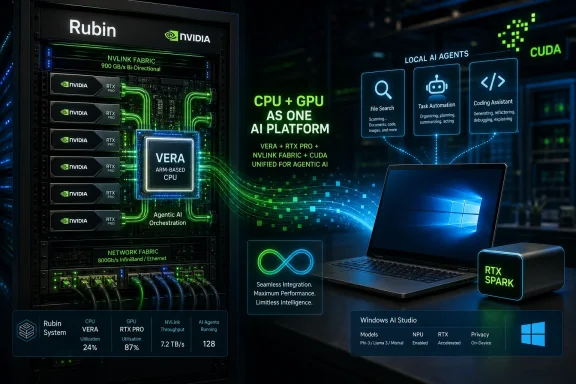 Nvidia’s Real Product Is No Longer Just the GPU
The easy version of the Nvidia story says the company won AI because it had the best GPUs when large language models needed brute-force parallel compute. That is true as far as it goes, but it understates what Nvidia actually sold. The company did not just sell silicon; it sold a working system at the moment the rest of the industry was still assembling parts.CUDA made Nvidia’s hardware sticky long before generative AI became a boardroom emergency. Developers, researchers, hyperscalers, and software vendors built around the assumption that Nvidia was the default acceleration layer. Once that assumption became embedded in tooling, models, libraries, procurement habits, and engineering teams, the GPU became less like a component and more like a platform tax.
That is why every Nvidia “killer” tends to arrive with two burdens. It must be cheaper, faster, or more efficient than Nvidia on some benchmark, and it must persuade buyers to give up the surrounding machinery that made Nvidia the safer bet. In enterprise computing, “good enough and already integrated” often beats “better on paper and operationally unfamiliar.”
The Motley Fool’s argument that the second half of 2026 could be game-changing for Nvidia rests on this deeper platform logic. The interesting part is not simply that Nvidia is moving into CPUs. The interesting part is that Nvidia is moving into CPUs at the exact moment AI workloads are becoming less cleanly GPU-shaped.
Agentic AI Moves the Bottleneck Around
The first wave of generative AI infrastructure was dominated by training and high-throughput inference. Those jobs played directly to the strengths of accelerators: huge matrices, massive parallelism, and expensive chips kept busy by enormous batches of work. In that world, the CPU mattered, but it was not the star of the investor narrative.Agentic AI changes the shape of demand. An AI agent is not merely answering a prompt; it may be calling tools, querying databases, writing and executing code, retrieving files, orchestrating workflows, maintaining state, and making repeated decisions over time. That kind of workload still needs GPUs, but it also needs fast host processors, memory movement, networking, storage coordination, and software plumbing that does not collapse under many small steps.
This is where Nvidia sees an opening. If agents become a major production workload, the winning architecture may be the one that minimizes friction between the CPU, GPU, network, storage, and software stack. Nvidia’s pitch is that the data center should be treated as the unit of compute, not the chip.
That framing is self-serving, but it is also directionally plausible. The AI industry is already moving from server-level thinking to rack-scale and cluster-scale design, because the cost of moving data and coordinating work can be as important as the arithmetic itself. Nvidia has spent years turning that reality into a sales advantage.
Vera Is a CPU With a Strategic Job
Vera, Nvidia’s Arm-based data center CPU for the Rubin generation, matters because it puts the company more directly into a market historically defined by Intel and AMD. Nvidia has previously used Grace CPUs in superchips and accelerated systems, but Vera is being positioned more aggressively as both a companion to Rubin GPUs and a standalone CPU platform for agentic AI, data processing, orchestration, storage management, and other workloads.The timing is important. Nvidia is not entering the CPU market by promising to be a generic commodity supplier. It is entering with a specific thesis: AI factories need CPUs that are co-designed with the rest of the Nvidia stack. That is a much narrower target than “beat every x86 server in every workload,” and it is a much more Nvidia-like strategy.
The CPU market is large, but it is also conservative. Hyperscalers and enterprises do not replace server architectures because a keynote says the future has arrived. They care about performance per watt, software compatibility, supply chain diversity, serviceability, virtualization, security, and the practical pain of moving existing workloads.
That makes Vera both promising and exposed. Nvidia can use its AI dominance to pull Vera into infrastructure deals where Rubin GPUs, NVLink, BlueField, Spectrum networking, and CUDA are already part of the plan. But the company still has to prove that a CPU designed around Nvidia’s AI worldview is compelling outside the most Nvidia-centric deployments.
Rubin Turns the Chip Launch Into a Rack-Level Argument
The Vera Rubin platform is not a single-chip story. It is Nvidia’s attempt to make the next AI buying decision feel like a systems decision, with the CPU, GPU, interconnect, networking, and data processing units sold as one coherent path to more efficient AI factories. This is where the company’s strategic ambition becomes clearest.For customers building giant AI clusters, the promise is not just faster training or cheaper tokens. The promise is predictability. Nvidia wants buyers to believe that its integrated rack-scale systems will reduce deployment risk, squeeze more useful work out of expensive power envelopes, and keep software teams inside an ecosystem they already understand.
That is a strong pitch in a market where delays can be ruinously expensive. If an AI lab, cloud provider, or enterprise builder has committed billions to infrastructure, the cost of integration failure may dwarf the cost of individual chips. Nvidia’s pricing power has survived partly because buyers have been willing to pay for a lower-risk path to production.
Still, this is where competitors will press hardest. AMD, Intel, custom cloud silicon teams, and Arm server vendors do not need to destroy Nvidia’s whole stack to weaken its margins. They only need to convince enough buyers that certain workloads can be moved to cheaper or more open alternatives without breaking the operating model.
RTX Spark Brings the Platform Fight Back to Windows
The data center story is only half the shift. RTX Spark is Nvidia’s move to put a CPU-GPU “superchip” into a new class of Windows laptops and compact desktops aimed at personal AI agents, creators, gamers, and developers. Microsoft, Dell, HP, Lenovo, ASUS, MSI, and Surface are all part of the first-wave ecosystem Nvidia has been describing for fall 2026.For WindowsForum readers, this is the part that may feel more immediate. The Windows PC has been through several attempted reinventions: ultrabooks, touch-first hybrids, Windows on Arm, Copilot+ PCs, NPUs, cloud-connected experiences, and now agentic computing. RTX Spark is not just another laptop chip; it is Nvidia and Microsoft arguing that the PC needs a more powerful local AI engine than today’s baseline NPU story provides.
That is a challenge to both Intel and AMD, but also to Qualcomm’s recent momentum in Arm-based Windows machines. Microsoft has spent years trying to make Windows less dependent on the old x86 duopoly. Nvidia now gives Microsoft a partner with enormous developer gravity, gaming credibility, and AI brand power.
The catch is that Windows compatibility is unforgiving. Consumers and IT departments will not judge RTX Spark only by demos of local agents. They will judge it by battery life, thermals, driver stability, app compatibility, docking behavior, manageability, security tooling, gaming performance, creative workflows, and whether the machines justify premium pricing.
Microsoft Gets Another Chance to Define the AI PC
Microsoft’s role in RTX Spark is not incidental. Windows needs a hardware narrative that makes local AI feel useful rather than decorative. The first generation of AI PCs often suffered from a mismatch between marketing and daily value: plenty of silicon, not enough must-have software.An RTX Spark-class Windows machine gives Microsoft a more dramatic canvas. If the full Nvidia stack can run local models, accelerate creative applications, support gaming, and power richer agents from the Windows taskbar, the AI PC could become more than a sticker on a laptop palm rest. It could become a new performance tier, closer to the old workstation distinction than the mass-market NPU checklist.
But Microsoft has to walk a narrow line. If these machines are too expensive, they become developer toys and creator flagships. If the agent experiences feel intrusive, unreliable, or privacy-hostile, users will disable them. If the best features depend on cloud services anyway, buyers may wonder why they needed special local hardware in the first place.
This is why RTX Spark is strategically interesting but not automatically transformative. The hardware may be ready before the everyday software story is. Nvidia can supply the engine, but Microsoft must make the car worth driving.
The Windows Ecosystem Is Not a Captive Market
Nvidia’s advantage in data centers comes from scarcity, software lock-in, and a buyer base willing to pay dearly for performance. The PC market is different. It is brutally price-sensitive, fragmented, and filled with customers who replace machines slowly unless there is a concrete reason to upgrade.A developer may want a portable CUDA-capable AI workstation. A creator may want better local acceleration for Adobe workflows. A gamer may want RTX-class performance in a thin system. Those are real markets, but they are not the same as the mass PC market.
For sysadmins, the questions will be practical before they are futuristic. Can these machines be imaged, secured, enrolled, updated, repaired, and supported as predictably as existing fleets? Will Arm-based Windows compatibility be good enough for line-of-business software? Will Nvidia’s drivers and Microsoft’s AI layers add new attack surface or management complexity?
Those questions do not kill the RTX Spark idea. They simply mean the second half of 2026 will be a proving ground, not a coronation. The first wave of machines will tell us whether Nvidia can translate its data center platform playbook into the messier, lower-margin world of Windows PCs.
Competition Will Not Disappear Just Because Nvidia Expands
The bullish case for Nvidia often implies that the company’s lead is self-reinforcing forever. That is dangerous. Nvidia’s lead is enormous, but the incentives to reduce dependence on Nvidia are just as enormous.Hyperscalers have been designing custom AI silicon because they do not want their cost structures dictated entirely by one supplier. AMD continues to push Instinct accelerators and EPYC CPUs into environments that value openness, x86 continuity, and pricing leverage. Intel remains battered but strategically relevant because enterprise infrastructure does not turn over overnight.
The CPU side is even more contested. Intel and AMD know how to sell CPUs into data centers. Arm server suppliers have spent years learning where the architectural openings are. Cloud providers can tune their own silicon for internal workloads in ways a merchant vendor cannot always match.
Nvidia’s answer is integration. It wants to make the comparison less about CPU versus CPU and more about system versus system. That is smart, but it also means Nvidia must keep executing across more layers of the stack at once.
The Price Umbrella Is Both Power and Vulnerability
Nvidia’s margins are a sign of strength, but they are also an invitation. When a supplier earns extraordinary margins, customers and competitors start looking for ways around the toll booth. That is especially true when AI spending becomes one of the largest capital expenditure lines in the technology industry.For now, many buyers have tolerated Nvidia pricing because time-to-market matters more than optimization. If a model lab can ship months earlier, or a cloud provider can fill capacity immediately, the premium may be rational. But as AI infrastructure matures, finance departments will demand more granular answers about utilization, workload placement, and return on invested capital.
This is where CPUs complicate the story. If Nvidia can attach Vera CPUs to high-value AI systems and prove they reduce total cost of ownership, the company can defend or even expand its pricing power. If buyers see Vera as another expensive layer in an already expensive stack, competitors will have an opening.
The same is true in PCs. RTX Spark can command a premium if it creates a category users understand. If it feels like a pricey AI badge attached to niche software, the PC market will punish it quickly.
The Stock Market Wants a Straight Line; Technology Rarely Gives One
The Motley Fool frames Nvidia’s second half of 2026 as potentially game-changing for the company’s growth trajectory. That is a reasonable investor thesis, but it should be separated from the messier technology reality. Product launches do not become platform shifts until customers deploy them at scale and find reasons to keep buying.Nvidia’s revenue growth and share-price rise have been extraordinary because the company sat at the center of an emergency buildout. The world needed AI compute quickly, and Nvidia had the best-packaged answer. The next phase will be more complex, because customers are no longer merely racing to acquire accelerators; they are trying to rationalize entire AI operating models.
That shift could favor Nvidia. The more complex AI infrastructure becomes, the more valuable an integrated supplier can be. But complexity also creates room for specialization, internal silicon, second-source strategies, and software abstractions that reduce lock-in.
The market may want a simple answer: Vera and RTX Spark mean Nvidia wins CPUs too. The better answer is more conditional. Nvidia is using its GPU dominance to attack adjacent compute markets at the moment those markets are being reshaped by AI.
The Second-Half Test Is About Control, Not Just Chips
The most concrete way to understand Nvidia’s 2026 push is to ask where the company wants control. In the data center, it wants control over the rack-scale AI system. In Windows PCs, it wants control over the local AI performance tier. In software, it wants developers to keep assuming that serious AI work begins with Nvidia.That is why Vera and RTX Spark belong in the same story. One targets the AI factory; the other targets the AI workstation and premium Windows PC. Both are attempts to make Nvidia the default answer when computing moves from passive applications to active agents.
The risk is that agentic AI itself remains overhyped in the near term. Many so-called agents are still brittle wrappers around models, tools, and workflow scripts. They can be impressive in controlled demos and frustrating in production, especially when reliability, permissions, auditability, and data governance matter.
If the agentic wave takes longer to mature, Nvidia may still sell plenty of hardware, but the transformational story becomes more gradual. Vera can serve data processing and orchestration workloads, and RTX Spark can serve creators and developers, but the grand narrative depends on agents becoming a real computing pattern rather than a marketing layer.
Windows Users Should Watch the Software, Not the Slogan
For enthusiasts, the temptation will be to focus on specs. How fast is RTX Spark? How does it compare with an RTX laptop GPU? How does the CPU perform against Intel, AMD, Qualcomm, or Apple? Those questions matter, but they are not the whole story.The real test is whether the software stack makes local AI feel native. Can a Windows PC use local models to search personal data, automate workflows, generate media, assist in development, and preserve privacy in ways that cloud-only tools cannot? Can those features work consistently enough that users trust them?
For IT pros, trust will be even harder to earn. Local agents touching files, apps, credentials, browsers, and enterprise data raise obvious governance questions. A machine that can do more on behalf of the user can also do more wrong if permissions, identity, logging, and policy controls are weak.
That is where Microsoft’s enterprise credibility matters. Nvidia can accelerate the workload, but Windows has to enforce the boundaries. If the AI PC becomes a security headache, the enterprise upgrade cycle will slow no matter how impressive the silicon looks.
The Fall Launches Will Reveal Whether Nvidia Can Bend Two Markets at Once
Nvidia’s second-half 2026 moment should be judged across two very different adoption curves. Data center buyers move slowly in design but massively in deployment once they commit. PC buyers move through OEM cycles, reviews, pricing, retail availability, and enterprise validation.Vera Rubin’s success will be measured by hyperscaler adoption, cloud instance availability, rack-scale reliability, and whether Nvidia can keep supply moving. RTX Spark’s success will be measured by laptop reviews, developer enthusiasm, Windows feature quality, and whether OEMs can make machines that feel premium rather than experimental.
The two markets can reinforce each other. Developers who use Nvidia-powered Windows machines may build for Nvidia infrastructure. Enterprises that standardize on Nvidia AI back ends may see value in Nvidia-accelerated client devices. Microsoft may use the combination to make Windows feel more relevant in an AI world increasingly shaped by cloud platforms and specialized hardware.
But they can also diverge. Vera Rubin could be a major data center success while RTX Spark remains a niche PC category. Or RTX Spark could energize premium Windows laptops while Vera faces tougher-than-expected competition from x86, Arm, and custom silicon. Nvidia does not need to win every front immediately, but investors should not treat all launches as equally validated.
The Vera-and-Spark Moment Has a Few Hard Edges
The hype around Nvidia can make every product sound inevitable. The better reading is that the company has identified the next contested terrain and is arriving with unusual leverage. The second half of 2026 matters because it gives customers something to buy, test, benchmark, deploy, and criticize.- Nvidia’s second-half 2026 push is best understood as a platform expansion from GPUs into CPU-led AI orchestration, not as a simple chip launch cycle.
- Vera gives Nvidia a more direct shot at data center CPU revenue, but its strongest case is inside integrated Nvidia AI systems rather than generic server replacement.
- RTX Spark gives Windows a more muscular AI PC story, though its success depends on software usefulness, compatibility, battery life, thermals, and price.
- Agentic AI is the demand-side assumption behind both moves, and that assumption still has to survive real enterprise deployment.
- Intel, AMD, Qualcomm, Arm vendors, and hyperscaler custom silicon teams will use Nvidia’s high margins as an opening, especially where customers want leverage or lower costs.
- For Windows users and IT departments, the most important test will be whether Nvidia and Microsoft can make local AI powerful without making PCs harder to manage, secure, or justify.
References
- Primary source: The Motley Fool
Published: Sat, 13 Jun 2026 09:10:00 GMT
Prediction: The Second Half of 2026 Will Be a Game-Changing Moment for Nvidia | The Motley Fool
The GPU giant is taking big steps in another multibillion-dollar market.www.fool.com - Related coverage: tomshardware.com
AMD fires back at Nvidia, claiming 256-core Zen 6 'Venice' CPU beats Vera by 3.3x in rack-level performance — company shares first estimated EPYC Venice benchmarks | Tom's Hardware
Mind the footnotes on this one.www.tomshardware.com - Related coverage: tomsguide.com
Nvidia RTX Spark vs Apple M5 Pro: Which laptop chip could win in 2026? | Tom's Guide
Apple Silicon has been transformative for Mac users, but could the RTX Spark be even better?www.tomsguide.com - Related coverage: investor.nvidia.com
NVIDIA Corporation - NVIDIA Launches Vera CPU, Purpose-Built for Agentic AI
NVIDIA Vera CPU Delivers the Highest Performance and Energy Efficiency for Data Processing, AI Training and Agentic Inference at Scale News Summary: The NVIDIA Vera CPU delivers results with twice the efficiency and 50% faster than traditional CPUs. Customers collaborating with NVIDIA to deploy...investor.nvidia.com - Related coverage: nvidianews.nvidia.com
NVIDIA and Microsoft Reinvent Windows PCs for the Age of Personal AI | NVIDIA Newsroom
NVIDIA today unveiled NVIDIA RTX Spark™, a new superchip that reinvents Windows PCs for the era of personal AI agents — offering a new class of computer that moves from tool to teammate.nvidianews.nvidia.com - Related coverage: nvidia.com
NVIDIA Vera CPU
Revolutionizes the modern data center with an advanced architecture and over 2x the performance of the prior-generation processor.www.nvidia.com
- Related coverage: techspot.com
Nvidia unveils Vera, an 88-core Arm CPU for AI and analytics racks | TechSpot
Unlike Nvidia's earlier Grace processors, which were primarily sold as companions to GPUs, Vera is positioned as a general-purpose data center CPU with a strong focus on...www.techspot.com - Related coverage: techtimes.com
Nvidia RTX Spark Superchip: Windows PC Chip With Full CUDA Stack Targets Dell, Microsoft This Fall
Nvidia RTX Spark Superchip launched at Computex 2026 as Nvidia’s first Windows PC processor, co-developed with Microsoft, pairing a Blackwell GPU with 6,144 CUDA cores and 128 GB unified memory in awww.techtimes.com - Official source: blogs.windows.com
Introducing a powerful new chapter for Windows PCs, accelerated by NVIDIA RTX Spark
Today at NVIDIA GTC, Microsoft and NVIDIA announced the world’s most powerful and efficient thin-and-light Windows PCs ever. Accelerated by NVIDIA RTX Sparkblogs.windows.com - Related coverage: gamesradar.com
Nvidia finally unveils Spark superchip, coming to laptops and mini PCs this Fall - here's everything we know so far | GamesRadar+
The Nvidia Spark will bring Arm-based gameplay to slimline laptops this Fall.www.gamesradar.com - Related coverage: windowscentral.com
Microsoft's biggest week of the year: Surface Laptop Ultra, NVIDIA RTX Spark, Build, and much more | Windows Central
A packed week filled with major announcements gives Windows 11 its strongest momentum in years.www.windowscentral.com - Related coverage: axios.com
Microsoft debuts Nvidia-powered Microsoft Surface Ultra laptop
Microsoft is trying again to redefine the PC for the AI era.www.axios.com
