

NVIDIA and Microsoft jointly teased “A new era of PC” on May 29, 2026, pointing to coordinates for Taipei Music Center, where Jensen Huang is scheduled to keynote GTC Taipei on June 1 ahead of Computex. The obvious read is not a new Windows release, but a new Windows hardware axis: NVIDIA silicon in PCs. If the long-rumored N1 and N1X chips finally surface, the announcement will be less about one flashy laptop launch than about Microsoft widening the Windows-on-Arm battlefield beyond Qualcomm. That would make Computex the place where the PC’s next platform fight stops being theoretical.
The phrase “a new era of PC” is exactly the kind of marketing line that invites overreading, but the coordinates narrow the field. They point not to Redmond, not to a Windows launch stage, and not to a Surface-only event, but to Taipei Music Center, where NVIDIA’s CEO is expected to command the room before Computex properly opens.
That matters because Microsoft has spent the past two years trying to make the PC feel newly alive without changing the name on the box. Copilot+ PCs, NPUs, Windows on Arm, local AI features, and thinner laptops with longer battery life have all been part of the same campaign: convince buyers that a “PC” is not just an x86 machine with a Windows license attached.
The problem is that Microsoft cannot declare a new era by software alone. Windows 11 has become a rolling platform, not a once-a-decade rupture. Windows 12, if it ever arrives under that name, is not the story being teased here; Microsoft’s own messaging has pointed away from a new OS version.
So the likely pivot is hardware. More precisely, it is silicon that lets Microsoft tell a more credible story about Windows PCs competing with Apple’s MacBooks, not merely matching old Intel and AMD laptops with better webcams and AI stickers.
None of that is official until NVIDIA says it on stage. But the pattern now looks familiar. PC launches rarely arrive as a single isolated announcement; they arrive as a choreography of chip vendor, operating-system partner, OEMs, retailers, reviewers, and accessory makers all stepping into formation at once.
The rumored N1X specs, if even broadly accurate, explain the excitement. A 20-core Arm CPU configuration paired with Blackwell-class graphics would not be another low-power Windows-on-Arm experiment hoping users forgive its limitations. It would be NVIDIA trying to bring its strongest consumer brand — RTX — into the system-on-chip era.
That is the real threat to the existing order. Qualcomm’s Snapdragon X line gave Windows on Arm a serious modern foundation, especially in battery life and responsiveness. NVIDIA could give it a different kind of credibility: gaming, creation, CUDA-adjacent developer interest, and the gravitational pull of a GPU brand that already shapes PC buying decisions.
If Microsoft attaches Surface to NVIDIA silicon, the signal would be stronger than a compatibility announcement. It would tell developers that Windows on Arm is no longer a Qualcomm-only bet. It would tell OEMs that Microsoft expects premium Windows laptops to diversify. And it would tell consumers that Arm is not a compromise tier reserved for battery-life purists.
That last point is crucial. Windows on Arm has suffered less from one fatal flaw than from a trust deficit built over years. Users remember app gaps, driver issues, weak performance, and the ghost of Windows RT. Even when modern devices are much better, the brand memory lingers.
A Microsoft-endorsed NVIDIA platform would not erase that history overnight, but it would change the conversation. Windows on Arm would stop sounding like a niche compatibility project and start sounding like a high-performance PC category.
That is a profound shift in the PC power map. For decades, the Windows PC revolved around Intel first, AMD second, and everyone else at the margins. The GPU was often the glamorous add-on, but the CPU vendor owned the platform story.
NVIDIA has spent the AI boom making that arrangement look obsolete in the data center. The CPU still matters, but the accelerator, software stack, memory architecture, and developer ecosystem now define the platform. Bringing that logic into laptops would be a very NVIDIA move.
The question is whether PC buyers will accept it. A laptop is not a server rack, and the disciplines are different. Battery life, thermals, sleep behavior, driver reliability, display handling, docking, firmware updates, and app compatibility all matter as much as peak performance. NVIDIA can dominate a keynote with numbers, but it must win daily trust in backpacks, conference rooms, classrooms, and help desks.
Qualcomm’s Snapdragon X Elite and X Plus devices were Microsoft’s first serious answer. They gave Windows laptops a way to talk about battery life, instant-on behavior, and AI acceleration without relying on Intel’s roadmap. But Apple’s advantage has never been only the ISA or the chip node; it is the integration of silicon, OS, developer tools, hardware design, and retail narrative.
NVIDIA could help Microsoft attack the performance side of that equation. An Arm CPU with a serious integrated NVIDIA GPU would let Windows OEMs build machines that are thin, efficient, and visibly different from traditional x86 notebooks. It could also give creators and developers a reason to care beyond battery life.
The catch is that Apple’s model works because Apple controls the whole stack. Microsoft does not. NVIDIA, Microsoft, Dell, Lenovo, ASUS, driver teams, app developers, game studios, enterprise administrators, and peripheral vendors all have to make the experience feel coherent. The PC ecosystem’s strength is diversity; its weakness is that diversity often arrives as friction.
That distinction matters. Windows on Arm has often needed flagship credibility but also volume distribution. A beautiful one-off machine can prove a concept; a multi-OEM wave can build a market.
Dell’s XPS brand would give NVIDIA a premium productivity halo. Lenovo’s potential involvement would matter for both consumer and enterprise channels. ASUS and ProArt would point toward creators, where NVIDIA’s GPU identity has particular force. A Legion-branded machine, if it appears, would be an even louder message: Arm is not being confined to quiet ultrabooks.
Still, leaked model names and embargo artifacts are not the same as shipping products. The PC industry is littered with devices that looked decisive in May and became scarce, expensive, or oddly configured by September. Launch breadth will matter less than actual availability, pricing, battery life, and whether the first reviewers can run the apps and games people care about.
But the pressure is real. Arm no longer has to defeat x86 everywhere to change the market. It only has to make enough premium laptops feel better enough that users, developers, and IT buyers begin treating ISA as a choice rather than a boundary.
That is already happening slowly. The old assumption was that “real Windows” meant x86, and Arm meant caveats. The new assumption Microsoft wants is that “real Windows” means Windows, with the underlying silicon chosen for the job.
NVIDIA’s entrance would sharpen that transition because it would attack x86’s comfort zone. Qualcomm competes on efficiency and integrated mobility. NVIDIA could compete on GPU capability, AI acceleration, creator workflows, and gaming-adjacent prestige. If those strengths appear in a credible thin-and-light package, Intel and AMD will have to answer not just with faster CPUs, but with more complete platform stories.
Microsoft has improved emulation significantly, and native Arm64 app support is far better than it was in the Windows RT or early Surface Pro X era. But “better” is not the same as invisible. For consumers, the pain usually appears as a game that will not run, a utility that misbehaves, or performance that does not match expectations. For enterprises, the pain appears as validation matrices, support tickets, and deployment risk.
NVIDIA complicates that picture in both directions. Its developer ecosystem is a strength, but much of NVIDIA’s PC identity is tied to software layers that users expect to “just work”: GeForce drivers, CUDA workflows, creative app acceleration, game optimizations, Broadcast, DLSS, Studio drivers, and more. If an N1X machine carries the NVIDIA badge, buyers will expect more than generic Arm compatibility.
That expectation could be healthy. It would force the platform to grow up. But it also raises the stakes for launch quality. A mediocre Arm laptop is disappointing; a mediocre NVIDIA RTX-branded Arm laptop would be a narrative problem.
But the PC market does not need another vague promise that tomorrow’s apps will be smarter. It needs machines that are clearly better at ordinary computing. Battery life must be excellent. Sleep and resume must be boring. Thermals must be sane. External monitors and docks must work. Browsers, Office, Teams, Adobe tools, developer environments, and games must behave predictably.
Local AI can be part of that, especially if NVIDIA’s GPU and NPU story gives developers more headroom than current thin laptops. But buyers have already seen too many “AI PC” claims that amount to branding ahead of software reality. The new era cannot be a sticker.
NVIDIA and Microsoft therefore have a messaging challenge. If they lead entirely with AI, they risk sounding like every other vendor. If they lead with performance per watt, graphics, and compatibility, they can make the AI story feel like a bonus rather than a tax on credibility.
Enterprise IT will look for predictable manageability, stable drivers, firmware update channels, security baselines, VPN compatibility, endpoint detection support, virtualization behavior, and peripheral reliability. It will also ask whether the performance story holds under real workloads, not just keynote demos.
The Arm question is especially tricky in businesses that depend on legacy Windows software. Even if 95 percent of apps work, the remaining 5 percent may be the reason a department cannot move. That does not mean Arm PCs have no enterprise future; it means they will likely enter through roles where the software stack is controlled, cloud-heavy, or modernized.
Developers are a different story. If Microsoft and NVIDIA can make Arm64 Windows development more attractive, especially for AI, graphics, and cross-platform work, the platform could gain momentum from the very people who historically exposed its gaps. But that requires excellent tools, native SDKs, and hardware that developers can actually buy.
But Windows is not the Mac market. Its strength is price diversity. A new platform that exists only in $2,000 creator laptops can influence perception, but it cannot transform the installed base. If NVIDIA’s chips remain expensive, rare, or reserved for halo devices, the “new era” language will outrun the market reality.
There is also a channel problem. Consumers buy PC specs with learned shortcuts: Core i7, Ryzen 7, RTX 4070, 16GB RAM, 1TB SSD. An NVIDIA Arm SoC with integrated RTX-class graphics will require a new mental model. Retailers will need to explain it, reviewers will need to test it fairly, and Microsoft will need Windows to present performance and compatibility in ways that do not confuse buyers.
The danger is not that people reject Arm on principle. Most people do not care what instruction set their laptop uses. The danger is that they buy a machine expecting a normal Windows laptop and encounter one edge case too many. The platform must either eliminate those edge cases or price the risk honestly.
That choreography suggests a coordinated reset rather than a single teaser. Microsoft can tell developers that Windows is becoming a broader Arm platform. NVIDIA can tell OEMs that it has a PC chip worthy of their best chassis. Laptop makers can show hardware that makes the announcement tangible.
It is also a reminder that the PC market has become geopolitical and supply-chain theater as much as consumer technology. Taiwan is where much of the industry’s practical future gets assembled, negotiated, and displayed. A “new era of PC” teased from Taipei is not accidental symbolism.
Still, coordination is not destiny. The announcement may be narrower than the speculation. It may involve developer hardware first, or a limited set of laptops, or a platform preview rather than broad retail availability. The right stance is to treat the teaser as significant without treating every rumor as confirmed.
That would be a bigger achievement than a benchmark win. The PC’s historical bargain has been messy openness in exchange for unmatched compatibility. Arm-based Windows machines have often threatened that bargain by adding uncertainty. NVIDIA’s job would be to make the trade feel worth it.
For now, the practical takeaways are straightforward:
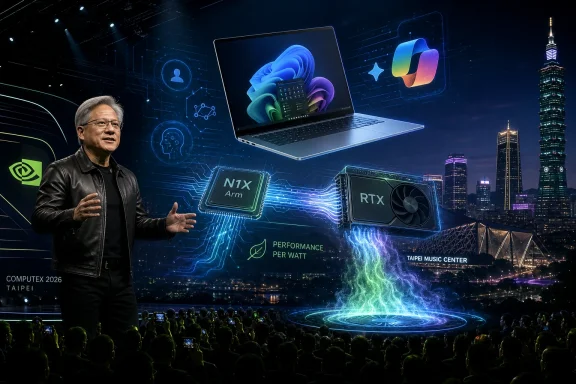 Microsoft’s Message Is Really About Silicon, Not Windows
The phrase “a new era of PC” is exactly the kind of marketing line that invites overreading, but the coordinates narrow the field. They point not to Redmond, not to a Windows launch stage, and not to a Surface-only event, but to Taipei Music Center, where NVIDIA’s CEO is expected to command the room before Computex properly opens.That matters because Microsoft has spent the past two years trying to make the PC feel newly alive without changing the name on the box. Copilot+ PCs, NPUs, Windows on Arm, local AI features, and thinner laptops with longer battery life have all been part of the same campaign: convince buyers that a “PC” is not just an x86 machine with a Windows license attached.
The problem is that Microsoft cannot declare a new era by software alone. Windows 11 has become a rolling platform, not a once-a-decade rupture. Windows 12, if it ever arrives under that name, is not the story being teased here; Microsoft’s own messaging has pointed away from a new OS version.
So the likely pivot is hardware. More precisely, it is silicon that lets Microsoft tell a more credible story about Windows PCs competing with Apple’s MacBooks, not merely matching old Intel and AMD laptops with better webcams and AI stickers.
The N1X Rumor Has Become Too Persistent to Ignore
The N1X has lived for months in that strange pre-launch zone where the industry behaves as though a product exists before any company is willing to say so. Leaks, benchmark sightings, partner slips, and supply-chain chatter have accumulated around the idea of an NVIDIA-designed Arm platform for Windows PCs, reportedly built with MediaTek involvement and aimed at higher-end laptops.None of that is official until NVIDIA says it on stage. But the pattern now looks familiar. PC launches rarely arrive as a single isolated announcement; they arrive as a choreography of chip vendor, operating-system partner, OEMs, retailers, reviewers, and accessory makers all stepping into formation at once.
The rumored N1X specs, if even broadly accurate, explain the excitement. A 20-core Arm CPU configuration paired with Blackwell-class graphics would not be another low-power Windows-on-Arm experiment hoping users forgive its limitations. It would be NVIDIA trying to bring its strongest consumer brand — RTX — into the system-on-chip era.
That is the real threat to the existing order. Qualcomm’s Snapdragon X line gave Windows on Arm a serious modern foundation, especially in battery life and responsiveness. NVIDIA could give it a different kind of credibility: gaming, creation, CUDA-adjacent developer interest, and the gravitational pull of a GPU brand that already shapes PC buying decisions.
Surface Would Give the Launch a Microsoft Seal of Approval
The Surface angle matters even if NVIDIA’s chips appear first in partner laptops. Microsoft has always used Surface as both product and argument. A Surface device says, “This is how we think Windows hardware should behave,” even when the broader OEM market goes in a dozen directions.If Microsoft attaches Surface to NVIDIA silicon, the signal would be stronger than a compatibility announcement. It would tell developers that Windows on Arm is no longer a Qualcomm-only bet. It would tell OEMs that Microsoft expects premium Windows laptops to diversify. And it would tell consumers that Arm is not a compromise tier reserved for battery-life purists.
That last point is crucial. Windows on Arm has suffered less from one fatal flaw than from a trust deficit built over years. Users remember app gaps, driver issues, weak performance, and the ghost of Windows RT. Even when modern devices are much better, the brand memory lingers.
A Microsoft-endorsed NVIDIA platform would not erase that history overnight, but it would change the conversation. Windows on Arm would stop sounding like a niche compatibility project and start sounding like a high-performance PC category.
NVIDIA Is Not Entering the PC Market as a Stranger
It is tempting to frame NVIDIA as a new entrant to CPUs, but that understates the company’s history. NVIDIA has been in and around Arm computing for years, from Tegra to Shield to Nintendo Switch to data-center Grace. What would be new is not Arm itself, but NVIDIA choosing the Windows laptop as a first-class arena again.That is a profound shift in the PC power map. For decades, the Windows PC revolved around Intel first, AMD second, and everyone else at the margins. The GPU was often the glamorous add-on, but the CPU vendor owned the platform story.
NVIDIA has spent the AI boom making that arrangement look obsolete in the data center. The CPU still matters, but the accelerator, software stack, memory architecture, and developer ecosystem now define the platform. Bringing that logic into laptops would be a very NVIDIA move.
The question is whether PC buyers will accept it. A laptop is not a server rack, and the disciplines are different. Battery life, thermals, sleep behavior, driver reliability, display handling, docking, firmware updates, and app compatibility all matter as much as peak performance. NVIDIA can dominate a keynote with numbers, but it must win daily trust in backpacks, conference rooms, classrooms, and help desks.
The Real Target Is Apple’s Integrated Model
Microsoft’s strategic anxiety is not mysterious. Apple proved that moving the Mac to in-house Arm silicon could improve performance per watt, simplify the platform story, and make laptops feel meaningfully different from their predecessors. Windows PC makers responded with incremental refinement first and platform rethinking later.Qualcomm’s Snapdragon X Elite and X Plus devices were Microsoft’s first serious answer. They gave Windows laptops a way to talk about battery life, instant-on behavior, and AI acceleration without relying on Intel’s roadmap. But Apple’s advantage has never been only the ISA or the chip node; it is the integration of silicon, OS, developer tools, hardware design, and retail narrative.
NVIDIA could help Microsoft attack the performance side of that equation. An Arm CPU with a serious integrated NVIDIA GPU would let Windows OEMs build machines that are thin, efficient, and visibly different from traditional x86 notebooks. It could also give creators and developers a reason to care beyond battery life.
The catch is that Apple’s model works because Apple controls the whole stack. Microsoft does not. NVIDIA, Microsoft, Dell, Lenovo, ASUS, driver teams, app developers, game studios, enterprise administrators, and peripheral vendors all have to make the experience feel coherent. The PC ecosystem’s strength is diversity; its weakness is that diversity often arrives as friction.
OEM Leaks Suggest This Is Bigger Than One Showcase Device
The most interesting reports are not merely that NVIDIA and Microsoft posted the same teaser. They are that major laptop vendors appear to be preparing hardware around the rumored chips. If Dell, Lenovo, ASUS, and others are lining up N1 or N1X machines, this is not a science project.That distinction matters. Windows on Arm has often needed flagship credibility but also volume distribution. A beautiful one-off machine can prove a concept; a multi-OEM wave can build a market.
Dell’s XPS brand would give NVIDIA a premium productivity halo. Lenovo’s potential involvement would matter for both consumer and enterprise channels. ASUS and ProArt would point toward creators, where NVIDIA’s GPU identity has particular force. A Legion-branded machine, if it appears, would be an even louder message: Arm is not being confined to quiet ultrabooks.
Still, leaked model names and embargo artifacts are not the same as shipping products. The PC industry is littered with devices that looked decisive in May and became scarce, expensive, or oddly configured by September. Launch breadth will matter less than actual availability, pricing, battery life, and whether the first reviewers can run the apps and games people care about.
The x86 Duopoly Is Being Pressured From Both Ends
Intel and AMD are not passive bystanders. Intel is trying to rebuild confidence with new process technology, new architectures, and a broader foundry strategy. AMD remains strong in performance laptops, gaming handhelds, and efficient x86 designs. Both companies understand that Windows buyers are conservative for a reason: compatibility is a feature.But the pressure is real. Arm no longer has to defeat x86 everywhere to change the market. It only has to make enough premium laptops feel better enough that users, developers, and IT buyers begin treating ISA as a choice rather than a boundary.
That is already happening slowly. The old assumption was that “real Windows” meant x86, and Arm meant caveats. The new assumption Microsoft wants is that “real Windows” means Windows, with the underlying silicon chosen for the job.
NVIDIA’s entrance would sharpen that transition because it would attack x86’s comfort zone. Qualcomm competes on efficiency and integrated mobility. NVIDIA could compete on GPU capability, AI acceleration, creator workflows, and gaming-adjacent prestige. If those strengths appear in a credible thin-and-light package, Intel and AMD will have to answer not just with faster CPUs, but with more complete platform stories.
Compatibility Remains the Tax Microsoft Must Pay
Every Windows-on-Arm story eventually returns to compatibility, because Windows is not an appliance OS. It is a cathedral of decades-old installers, drivers, plug-ins, anti-cheat systems, line-of-business tools, shell extensions, VPN clients, printer utilities, and strange little helper apps that someone in accounting absolutely still needs.Microsoft has improved emulation significantly, and native Arm64 app support is far better than it was in the Windows RT or early Surface Pro X era. But “better” is not the same as invisible. For consumers, the pain usually appears as a game that will not run, a utility that misbehaves, or performance that does not match expectations. For enterprises, the pain appears as validation matrices, support tickets, and deployment risk.
NVIDIA complicates that picture in both directions. Its developer ecosystem is a strength, but much of NVIDIA’s PC identity is tied to software layers that users expect to “just work”: GeForce drivers, CUDA workflows, creative app acceleration, game optimizations, Broadcast, DLSS, Studio drivers, and more. If an N1X machine carries the NVIDIA badge, buyers will expect more than generic Arm compatibility.
That expectation could be healthy. It would force the platform to grow up. But it also raises the stakes for launch quality. A mediocre Arm laptop is disappointing; a mediocre NVIDIA RTX-branded Arm laptop would be a narrative problem.
AI Is the Marketing Hook, but the PC Needs More Than AI
Computex 2026 will be saturated with AI language. That is unavoidable. NVIDIA’s corporate center of gravity is AI infrastructure, Microsoft’s consumer and enterprise strategy is wrapped around Copilot, and OEMs have learned that every spec sheet now needs an AI row.But the PC market does not need another vague promise that tomorrow’s apps will be smarter. It needs machines that are clearly better at ordinary computing. Battery life must be excellent. Sleep and resume must be boring. Thermals must be sane. External monitors and docks must work. Browsers, Office, Teams, Adobe tools, developer environments, and games must behave predictably.
Local AI can be part of that, especially if NVIDIA’s GPU and NPU story gives developers more headroom than current thin laptops. But buyers have already seen too many “AI PC” claims that amount to branding ahead of software reality. The new era cannot be a sticker.
NVIDIA and Microsoft therefore have a messaging challenge. If they lead entirely with AI, they risk sounding like every other vendor. If they lead with performance per watt, graphics, and compatibility, they can make the AI story feel like a bonus rather than a tax on credibility.
Enterprise IT Will Wait for the Second Wave
For WindowsForum’s sysadmin audience, the sensible posture is curiosity without haste. New silicon can be exciting and still be a deployment risk. The first N1X machines, if they launch at Computex, will be judged by enthusiasts and reviewers long before they become fleet candidates.Enterprise IT will look for predictable manageability, stable drivers, firmware update channels, security baselines, VPN compatibility, endpoint detection support, virtualization behavior, and peripheral reliability. It will also ask whether the performance story holds under real workloads, not just keynote demos.
The Arm question is especially tricky in businesses that depend on legacy Windows software. Even if 95 percent of apps work, the remaining 5 percent may be the reason a department cannot move. That does not mean Arm PCs have no enterprise future; it means they will likely enter through roles where the software stack is controlled, cloud-heavy, or modernized.
Developers are a different story. If Microsoft and NVIDIA can make Arm64 Windows development more attractive, especially for AI, graphics, and cross-platform work, the platform could gain momentum from the very people who historically exposed its gaps. But that requires excellent tools, native SDKs, and hardware that developers can actually buy.
Pricing May Decide Whether This Is a Platform or a Prestige Project
The rumored N1X sounds like a premium part, and premium parts create premium laptops. That may be fine for a launch. Apple’s transition did not begin by making the cheapest Macs interesting; it began by making the mainstream and high-end MacBooks difficult to ignore.But Windows is not the Mac market. Its strength is price diversity. A new platform that exists only in $2,000 creator laptops can influence perception, but it cannot transform the installed base. If NVIDIA’s chips remain expensive, rare, or reserved for halo devices, the “new era” language will outrun the market reality.
There is also a channel problem. Consumers buy PC specs with learned shortcuts: Core i7, Ryzen 7, RTX 4070, 16GB RAM, 1TB SSD. An NVIDIA Arm SoC with integrated RTX-class graphics will require a new mental model. Retailers will need to explain it, reviewers will need to test it fairly, and Microsoft will need Windows to present performance and compatibility in ways that do not confuse buyers.
The danger is not that people reject Arm on principle. Most people do not care what instruction set their laptop uses. The danger is that they buy a machine expecting a normal Windows laptop and encounter one edge case too many. The platform must either eliminate those edge cases or price the risk honestly.
The Calendar Makes This Feel Like a Coordinated Reset
The timing is almost too neat. Microsoft Build put developers in the foreground. Computex puts OEMs, chips, and hardware roadmaps in the foreground. NVIDIA’s GTC Taipei keynote gives Jensen Huang the stage in the geography where the PC supply chain is most visible.That choreography suggests a coordinated reset rather than a single teaser. Microsoft can tell developers that Windows is becoming a broader Arm platform. NVIDIA can tell OEMs that it has a PC chip worthy of their best chassis. Laptop makers can show hardware that makes the announcement tangible.
It is also a reminder that the PC market has become geopolitical and supply-chain theater as much as consumer technology. Taiwan is where much of the industry’s practical future gets assembled, negotiated, and displayed. A “new era of PC” teased from Taipei is not accidental symbolism.
Still, coordination is not destiny. The announcement may be narrower than the speculation. It may involve developer hardware first, or a limited set of laptops, or a platform preview rather than broad retail availability. The right stance is to treat the teaser as significant without treating every rumor as confirmed.
The Computex Clue Points to a Bigger Windows Bet
The most concrete reading is also the most important one: Microsoft wants more than one Arm partner, and NVIDIA wants to define more than GPUs in client computing. If N1 and N1X arrive, they will test whether Windows can finally become architecture-flexible in a way ordinary users do not have to think about.That would be a bigger achievement than a benchmark win. The PC’s historical bargain has been messy openness in exchange for unmatched compatibility. Arm-based Windows machines have often threatened that bargain by adding uncertainty. NVIDIA’s job would be to make the trade feel worth it.
For now, the practical takeaways are straightforward:
- NVIDIA and Microsoft’s shared “new era of PC” teaser points to Taipei Music Center, where Jensen Huang is scheduled to keynote GTC Taipei on June 1, 2026.
- The teaser is unlikely to be about Windows 12, because Microsoft has already steered expectations away from a new OS version.
- The strongest current interpretation is a Windows-on-Arm hardware push involving NVIDIA’s rumored N1 and N1X chips.
- Major OEM involvement would matter more than a single flagship device, because Windows-on-Arm needs ecosystem breadth as much as silicon performance.
- Compatibility, drivers, pricing, and availability will decide whether NVIDIA’s Windows PC push becomes a platform shift or just another premium experiment.
- Enterprise buyers should watch closely but wait for real validation before treating first-wave devices as fleet-ready PCs.
References
- Primary source: TweakTown
Published: Fri, 29 May 2026 21:50:06 GMT

NVIDIA and Microsoft tease 'a new era of PC' ahead of Computex, and it's hard not to link this to the fabled N1X chip
N1X sightings have been piling up for months, and with Windows 12 ruled out, the new era of PC is almost certainly NVIDIA chips and new Surface hardware. www.tweaktown.com
- Related coverage: tomshardware.com
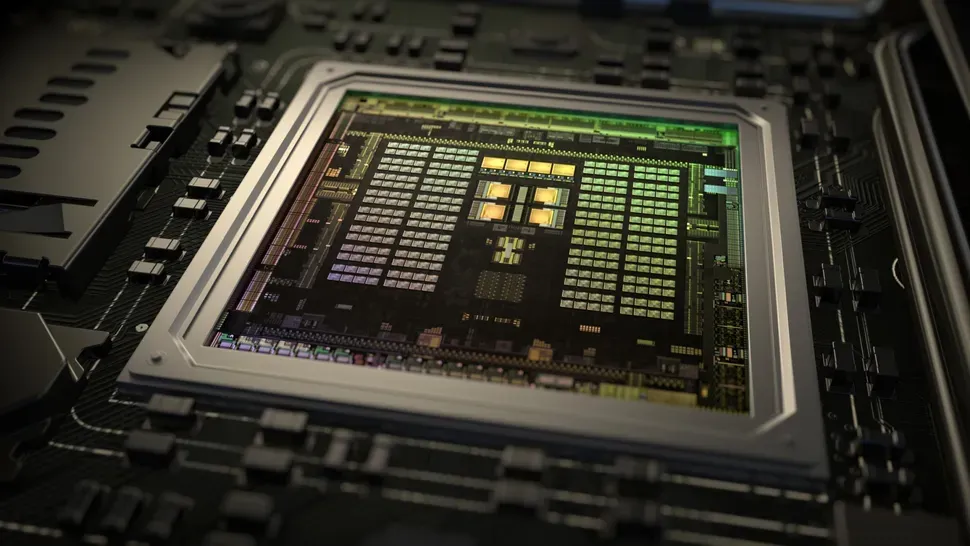
Nvidia and Microsoft tease "a new era of PC" ahead of Computex 2026 — coordinated social media posts could indicate that rumored N1X laptops will be Windows on Arm systems
An Nvidia-powered Arm PC running Windows could inspire new local AI experiences beyond Copilot+.www.tomshardware.com
- Related coverage: windowscentral.com
Microsoft and NVIDIA tease "new era of computing"
Microsoft and NVIDIA posted matching “new era of PC” teasers with coordinates for Computex, igniting predictions that the long‑rumored N1X chip is finally about to surface. www.windowscentral.com
- Related coverage: techspot.com
- Related coverage: cnbc.com

Intel stock drops on report Nvidia is working on an Arm-based PC chip
Intel currently has the majority of the market for PC chips, with AMD coming in second.www.cnbc.com
- Related coverage: windowslatest.com

Microsoft confirms it's not launching Windows 12, as it teases a big announcement
Microsoft officially shut down Windows 12 rumors to make way for a hardware breakthrough with the new NVIDIA N1X coming for Windows on ARM www.windowslatest.com
- Related coverage: que.es
Nvidia y Microsoft adelantan los procesadores N1X para portátiles: la nueva era del PC llega a Computex
Nvidia, Microsoft y Arm han publicado un teaser idéntico que anticipa los procesadores N1X para portátiles. La keynote de esta noche en Computex promete una nueva era para el PC. www.que.es
- Related coverage: profesionalreview.com

Microsoft y Nvidia anuncian de forma conjunta una "nueva era para el PC"
Microsoft y Nvidia han encendido las alarmas de la industria tras publicar en sus redes sociales un adelanto de "Una nueva era para la PC". www.profesionalreview.com
- Related coverage: technews.tw

NVIDIA 神祕數字宣傳 GTC Taipei,Arm、微軟助陣可望揭曉新款 PC
NVIDIA 一系列官方帳號以及 Arm、微軟 Windows 和 Surface、華碩、微星等貼文都在宣傳一串神祕數字「25.0528, 121.5990」,同時寫著「a new era of PC」(PC 的全新時代),似乎暗示新款 PC 即將到來。 NVIDIA 主帳號在 29 日貼文寫到「2...technews.tw
- Related coverage: numerama.com

« 25.0528, 121.5990 » : pourquoi Nvidia, Microsoft et Arm ont tous publié ces mêmes coordonnées GPS en même temps
Trois comptes officiels Nvidia, le compte Windows et celui d'Arm ont publié au même moment un message énigmatique accompagné de deux nombres. Ce sont des coordonnées GPS, et elles désignent l'endroit exact où Jensen Huang doit lever le voile, ce dimanche, sur la première puce maison pour PC... www.numerama.com
- Related coverage: investing.com
Intel stock selloff continues as analysts discuss implications from Reuters report By Investing.com
Intel stock selloff continues as analysts discuss implications from Reuters reportwww.investing.com
- Related coverage: timesofindia.indiatimes.com

A new Arm chip from Nvidia could be coming for Windows PCs this Computex
Nvidia looks set to launch its first Arm-based laptop chips at Computex on Sunday, and the build-up has been unusually coordinated. The Windows, GeForce, and Arm accounts on X all posted the same line, “A new era of PC,” alongside the coordinates 25.0528, 121.5990. timesofindia.indiatimes.com
- Related coverage: inside.com.tw

神秘數字發文「25.0528, 121.5990」NVIDIA、Arm、Windows 同步喊話「A new era of PC」:GTC Taipei 搶跑 COMPUTEX,N1X 晶片能否三度不跳票? - INSIDE
NVIDIA、Arm、Microsoft 結盟預告「PC 新紀元」,N1X Arm 晶片將於 GTC Taipei 亮相。此舉劍指 PC 市場,但也因高價與「AI 爛化」疑慮,引發反諷聲浪。www.inside.com.tw
- Related coverage: techradar.com
- Related coverage: computexdaily.com
- Related coverage: nvidia.com

NVIDIA GTC Taipei 2026 Keynote with CEO Jensen Huang | June 1
Catch NVIDIA CEO Jensen Huang’s GTC Taipei 2026 keynote on June 1 at 11:00 a.m. Taiwan Time, unveiling the latest innovations in AI, robotics & accelerated computing.www.nvidia.com - Related coverage: blogs.nvidia.com

NVIDIA GTC Taipei at COMPUTEX: Live Updates on What’s Next in AI
At NVIDIA GTC Taipei at COMPUTEX, the world’s developers, researchers and industry leaders are converging to dive into the latest breakthroughs shaping every industry, covering topics spanning AI factories and scaling infrastructure to agentic and physical AI and more.blogs.nvidia.com - Related coverage: taiwanplus.com
TaiwanPlus – Bringing Taiwan to the World
Your source of news, culture, and infotainment from Taiwan, a voice of freedom in Asia. Watch our 24/7 live stream.www.taiwanplus.com
- Related coverage: wilyer.com

Computex 2026 Taipei: Dates, Venues & AI Together Guide
Computex 2026 runs 2 to 5 June across four Taipei venues. 1,500 exhibitors, 6,000 booths, theme AI Together. A visitor guide to the AI and ICT trade show. wilyer.com
- Related coverage: computex-taipei.jp
開催概要 | COMPUTEX TAIPEI
COMPUTEX TAIPEI について台北国際コンピュータ見本市(COMPUTEX TAIPEI)は、世界を代表するAIとスタートアップの展示会として、世界中の起業家の皆様に産業の知識交流のためのプラットフォームを提供し、さらなる技術... computex-taipei.jp
- Related coverage: ti.com
Computex | TI.com
www.ti.com - Related coverage: forums.developer.nvidia.com

A Community Guide to NVIDIA GTC Taipei at COMPUTEX 2026
NVIDIA GTC is returning to COMPUTEX 2026 in Taipei, bringing the latest breakthroughs in physical AI. ✈️ Register now and save 25% on your conference pass with this link. At the center of GTC Taipei is NVIDIA CEO Jensen Huang’s keynote, where he will unveil the next wave of AI and accelerated... forums.developer.nvidia.com
- Related coverage: baxtel.com
NVIDIA GTC Taipei 2026 Event
NVIDIA GTC Taipei 2026 is hosted by NVIDIA in Taipei on June 01, 2026 baxtel.com
- Related coverage: tomsguide.com
