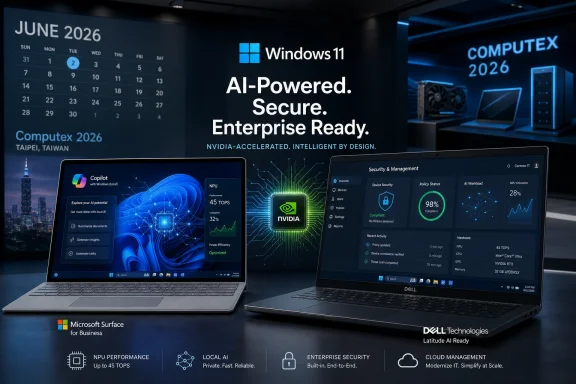
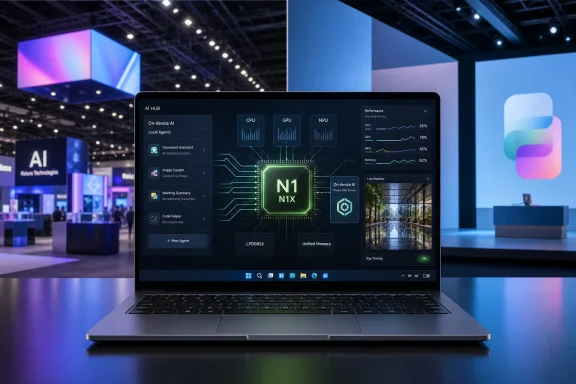
Microsoft and Nvidia are expected to unveil their first jointly developed Windows PCs powered by Nvidia chips during Nvidia’s June 1 GTC Taipei keynote at Computex and Microsoft’s June 2-3 Build conference in San Francisco, according to reporting and coordinated company teasers posted May 29. The announcement, if it lands as signaled, would mark Nvidia’s most serious attempt yet to move from powering Windows graphics to powering the Windows PC itself. For Microsoft, it is another push to make the “AI PC” feel less like a sticker on a laptop and more like a platform shift.
The phrase both companies chose — “a new era of PC” — is doing a lot of work. It suggests not merely another gaming laptop, workstation, or Copilot+ refresh, but a coordinated challenge to the old Windows hardware order: Intel and AMD CPUs at the center, Nvidia attached when graphics or CUDA are needed. The real story is not that Microsoft and Nvidia want to sell new laptops. It is that the Windows PC ecosystem may be preparing for its most consequential architecture fight since Apple proved Arm laptops could be premium computers rather than compatibility experiments.
For decades, the Windows PC has been less a single product than a treaty. Microsoft supplied the operating system, Intel and AMD supplied the processor roadmap, OEMs fought over industrial design and pricing, and Nvidia turned the high end into a graphics and compute upsell. That treaty survived netbooks, Ultrabooks, tablets, Windows RT, and the first wave of Windows on Arm because the center held: if you wanted the safest Windows experience, you bought x86.
The AI PC boom has weakened that certainty. Microsoft’s Copilot+ PC push established a new hardware threshold around local AI acceleration, initially giving Qualcomm’s Snapdragon X chips a rare opening in premium Windows laptops. Intel and AMD responded with NPUs of their own, but the message from Redmond had already changed. The CPU was no longer the only strategic component inside a Windows PC.
That matters because Nvidia is not entering this market as a generic Arm hopeful. It enters with the strongest AI hardware brand in the world, a massive developer ecosystem around CUDA, and a consumer reputation built through GeForce, Studio drivers, creator laptops, and gaming machines. If Nvidia can package CPU, GPU, and AI acceleration into a Windows device Microsoft is willing to promote onstage, the result is not just a new chip. It is a new negotiating position inside the PC industry.
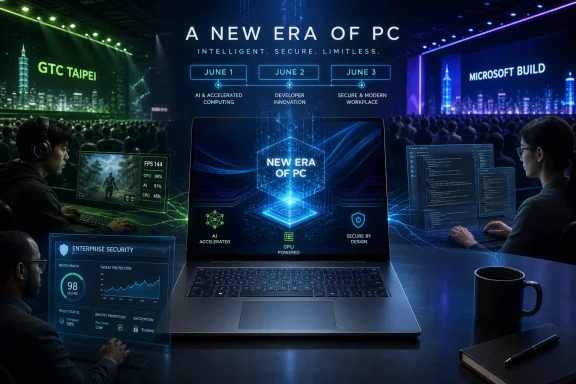
The timing is not subtle. Nvidia’s GTC Taipei keynote comes one day before Microsoft Build begins in San Francisco, allowing the two companies to stage the hardware and software halves of the same argument. Taipei is where Nvidia can speak to silicon, OEMs, thermals, and AI compute. Build is where Microsoft can tell developers why those machines deserve native apps, local models, and Windows features tuned for more than yesterday’s laptop assumptions.
Nvidia gives Microsoft a cleaner story. Rather than selling “AI PC” as a vague promise that the operating system might occasionally summarize, index, or generate, Microsoft can talk about local inference, creative acceleration, gaming, developer workloads, and hybrid cloud-to-device AI. Nvidia’s brand helps collapse those abstractions into something buyers already understand: more compute, closer to the user.
That does not automatically make the product compelling. Windows users have seen plenty of “new era” hardware campaigns disappear into driver issues, app gaps, thermal compromises, and OEM pricing. But Nvidia’s presence changes the credibility calculation. A Windows on Arm machine with Nvidia silicon is not merely chasing Apple’s battery-life narrative; it is trying to claim that the PC can become the local AI workstation for people who cannot or will not run everything in a cloud GPU instance.
This is where the rumored N1 or N1X chip matters. Reports have long described the part as a collaboration involving Nvidia and MediaTek, with Arm CPU cores and Nvidia graphics or AI acceleration in a single platform. Until Nvidia says so onstage, the exact configuration remains unconfirmed. But the market signal is already clear: Nvidia appears ready to put its name on a Windows client processor, not just the discrete GPU beside one.
That is why this move should not be read only as a laptop chip story. Nvidia already dominates discrete laptop graphics in gaming and creator machines. If all it wanted was more GeForce attach, it could keep doing what it has been doing. A Windows PC platform powered by Nvidia silicon suggests a more ambitious objective: making Nvidia’s software stack part of the default local compute story on Windows.
For developers, this could be attractive. The Windows AI story has been fragmented between DirectML, ONNX Runtime, Windows ML, vendor SDKs, NPUs, GPUs, and cloud APIs. Nvidia has the advantage of an ecosystem that developers already use for machine learning and acceleration, even if CUDA is not the only path Microsoft wants to encourage. If a new class of Nvidia-powered Windows machines ships with a clear developer target, Build becomes the right place to tell that story.
For IT departments, the question will be less romantic. They will want to know whether these PCs run existing Windows applications reliably, whether management tooling treats them like first-class corporate devices, whether endpoint security products behave normally, and whether the driver and firmware pipeline is boring enough for fleets. A PC revolution that makes life harder for administrators is just another pilot program waiting to be rejected.
That loop has been breaking, slowly. The Snapdragon X launch gave Windows on Arm its first broadly credible consumer and business hardware wave. Microsoft improved emulation, pushed native Arm64 versions of its own apps, and leaned on the Copilot+ PC label to create an architectural opening. Nvidia’s arrival would widen that opening from “Qualcomm alternative” to “multi-vendor Windows Arm ecosystem.”
That distinction is crucial. No platform shift succeeds if it looks like a single supplier exception. Apple could move the Mac to Arm because it controls the whole stack. Microsoft cannot simply order the Windows ecosystem to follow. It has to create enough hardware gravity that developers, OEMs, and enterprise buyers believe the transition is real.
Nvidia helps because it brings gravity from another direction. Qualcomm has the phone-to-laptop power efficiency story. Nvidia has the AI, GPU, gaming, and workstation story. If both can coexist in Windows on Arm, Microsoft can stop asking users to accept Arm as a compromise and start presenting it as a spectrum of machines with different strengths.
But the duopoly’s strategic comfort is being repriced. For years, Microsoft’s Windows hardware story depended on Intel and AMD roadmaps in a way that limited how aggressively Redmond could redefine the PC. Now Microsoft has Qualcomm shipping premium Arm laptops, Nvidia reportedly preparing its own Windows silicon, and a market narrative that rewards AI acceleration as much as traditional CPU benchmarks.
That does not mean Intel and AMD lose. It means they have to compete in a market where “runs Windows” is no longer enough, and where the most important software vendor in the ecosystem is openly encouraging new architectures. Intel’s advantage remains breadth, compatibility, vPro manageability, and manufacturing recovery if its roadmap execution improves. AMD’s advantage remains CPU and GPU efficiency, strong integrated graphics, and credibility in performance laptops. But neither can assume Microsoft’s platform ambitions will wait for x86 schedules.
For buyers, competition is good only if it produces clearer products rather than more confusing logos. The Windows laptop aisle is already overloaded with Core Ultra, Ryzen AI, Snapdragon X, Copilot+ PC, GeForce RTX, Studio, Evo-like branding, and OEM-specific AI labels. Nvidia’s entrance could sharpen the field if it delivers obvious performance advantages. It could also add another layer of alphabet soup if the software story is not tight.
That pitch has to answer several questions at once. What local AI workloads should developers target? Which APIs should they use? How should apps decide between CPU, NPU, GPU, and cloud inference? What happens when the same app runs on Intel, AMD, Qualcomm, and Nvidia-powered PCs with different accelerators and memory architectures?
Microsoft cannot afford another hardware category where the demos look good and the everyday developer path feels optional. Copilot+ PCs need software that makes the NPU relevant. Nvidia-powered PCs would need software that makes local GPU and AI acceleration feel native to Windows rather than bolted on from the gaming world. The company has to make the device useful for developers who are not building benchmark demos.
There is also a trust problem. Recall’s rocky rollout reminded users and administrators that local AI features are not automatically benign simply because they run on-device. More powerful local AI hardware raises the ceiling for private, fast, useful computing, but it also raises the stakes for data handling, permissions, and enterprise policy. Build is where Microsoft must show that its AI PC ambitions have absorbed that lesson.
That is why the coordinated teaser matters. A chip announcement without Microsoft would invite skepticism about Windows support. A Microsoft software keynote without Nvidia hardware would feel like another abstract AI platform promise. Together, the two companies can tell OEMs that there is a market, tell developers that there will be machines, and tell consumers that the category is not vapor.
Still, the first generation will be judged harshly. Laptop buyers do not care about strategic realignments if fans are loud, battery life disappoints, apps crash, webcams glitch, or enterprise VPN clients misbehave. OEMs can make or break a new platform through mundane execution: keyboard quality, display options, repairability, driver updates, firmware cadence, sleep reliability, and pricing. The future of the “new era of PC” may depend as much on BIOS teams as on keynote slides.
The best-case scenario is a small but convincing launch: a few premium systems from major OEMs, a clear developer kit story, native versions of important apps, and measurable advantages in AI, graphics, and creative workloads. The worst-case scenario is a confusing burst of prototypes and slogans that leaves buyers wondering whether to wait another year. The history of Windows hardware says both outcomes are possible.
But WindowsForum readers should look past the ticker tape. The more interesting question is not whether a new PC line moves Microsoft’s revenue next quarter. It is whether Microsoft is using the AI cycle to loosen the hardware assumptions that have defined Windows for a generation. That is a platform question, not a quarterly earnings question.
Microsoft’s More Personal Computing segment has often looked like the least glamorous part of the company beside Azure, Office, LinkedIn, and enterprise AI services. Yet Windows remains the company’s distribution layer into the daily work habits of users, developers, and businesses. If the PC becomes a local AI endpoint, Windows becomes more strategically important, not less.
For Nvidia, the PC can be a defensive and offensive move at the same time. It defends the company’s role as AI workloads spread beyond data centers. It also attacks the boundary between GPU supplier and platform owner. Nvidia has spent years moving up the stack; a branded Windows silicon platform would continue that pattern.
That is the tax Nvidia and Microsoft must pay. If the new PCs are Arm-based, emulation performance and native app availability will be central. If they rely on Nvidia-specific acceleration, developers will need stable tools and clear fallbacks. If they promise gaming, anti-cheat compatibility, driver maturity, and storefront behavior will matter as much as raw GPU throughput.
This is where Apple’s transition is a tempting but imperfect comparison. Apple could break things, offer Rosetta, update its own apps, and move the Mac base with uncommon discipline. Microsoft has to support a vastly more diverse ecosystem without forcing the same kind of hard migration. Windows transitions happen through persuasion, not decree.
That makes the first wave especially important. If reviewers and early adopters see a polished Windows experience with standout AI and graphics performance, the market will forgive some edge cases. If the devices feel like science projects, the old x86 default will reassert itself quickly. The Windows ecosystem has a long memory for promising hardware that required too many caveats.
Administrators will want these systems to enroll cleanly in Intune, honor existing security baselines, support Windows Update for Business, work with endpoint detection and response tools, and avoid driver channels that behave like enthusiast GPU updates. They will also want clarity on firmware support windows, repair logistics, image deployment, and app compatibility testing. In other words, they will want the platform to disappear into normal operations.
That is hard for any first-generation device family. It is harder when the pitch includes new silicon, new AI features, and potentially a different instruction set architecture. The promise of local AI is attractive for regulated industries because it can reduce data movement to the cloud. But local AI also creates new audit questions: what is being indexed, what models are running, what data is retained, and how policies are enforced.
Microsoft has an opportunity to make this a strength. If it presents Nvidia-powered PCs as manageable, policy-aware, enterprise-ready devices rather than shiny developer toys, it could broaden the AI PC market beyond enthusiasts. If it does not, many IT shops will wait for the second or third generation, as they usually do.
Nvidia gives Microsoft a better answer, but not a complete one. Apple’s advantage is integration. Microsoft’s advantage is ecosystem breadth. The challenge is turning breadth from a source of fragmentation into a source of choice.
A Nvidia-powered Windows PC could appeal to users Apple does not serve well: PC gamers, CUDA developers, AI researchers with Windows workflows, creative professionals dependent on specific Windows tools, and enterprises standardized on Microsoft management. It could also appeal to buyers who like Apple Silicon performance but cannot live inside macOS. That is a meaningful audience.
But Apple’s example also raises expectations. A premium Arm laptop cannot merely be “good for Windows on Arm.” It has to be good, full stop. If Microsoft and Nvidia want to call this a new era, the machines need to wake instantly, run quietly, last all day, accelerate real work, and avoid compatibility drama. Anything less will sound like the old era with better marketing.
That means driver cadence, app migration, developer documentation, OEM design discipline, and transparent performance claims will matter more than any single demo. Microsoft and Nvidia have to avoid the temptation to oversell local AI before the software is ready. The PC industry has spent two years teaching consumers to distrust vague AI branding. A genuinely new device class must be specific about what it does better.
The good news is that the ingredients are stronger than they were during previous Windows architecture experiments. Arm laptops are more credible. AI workloads are more real. Nvidia’s software ecosystem is deeper. Microsoft’s incentive to make Windows feel modern is sharper as the Windows 10 era recedes and Windows 11 matures.
The risk is that all of those ingredients produce a platform story that is technically impressive but commercially muddy. A machine for AI developers, gamers, creators, and enterprise users can easily become a machine with no clean identity. The first products need to show discipline: who they are for, why they exist, and what they do that current Intel, AMD, and Qualcomm systems cannot.
The phrase both companies chose — “a new era of PC” — is doing a lot of work. It suggests not merely another gaming laptop, workstation, or Copilot+ refresh, but a coordinated challenge to the old Windows hardware order: Intel and AMD CPUs at the center, Nvidia attached when graphics or CUDA are needed. The real story is not that Microsoft and Nvidia want to sell new laptops. It is that the Windows PC ecosystem may be preparing for its most consequential architecture fight since Apple proved Arm laptops could be premium computers rather than compatibility experiments.
 Microsoft Is Trying to Reopen the Windows Hardware Map
For decades, the Windows PC has been less a single product than a treaty. Microsoft supplied the operating system, Intel and AMD supplied the processor roadmap, OEMs fought over industrial design and pricing, and Nvidia turned the high end into a graphics and compute upsell. That treaty survived netbooks, Ultrabooks, tablets, Windows RT, and the first wave of Windows on Arm because the center held: if you wanted the safest Windows experience, you bought x86.The AI PC boom has weakened that certainty. Microsoft’s Copilot+ PC push established a new hardware threshold around local AI acceleration, initially giving Qualcomm’s Snapdragon X chips a rare opening in premium Windows laptops. Intel and AMD responded with NPUs of their own, but the message from Redmond had already changed. The CPU was no longer the only strategic component inside a Windows PC.
That matters because Nvidia is not entering this market as a generic Arm hopeful. It enters with the strongest AI hardware brand in the world, a massive developer ecosystem around CUDA, and a consumer reputation built through GeForce, Studio drivers, creator laptops, and gaming machines. If Nvidia can package CPU, GPU, and AI acceleration into a Windows device Microsoft is willing to promote onstage, the result is not just a new chip. It is a new negotiating position inside the PC industry.
The timing is not subtle. Nvidia’s GTC Taipei keynote comes one day before Microsoft Build begins in San Francisco, allowing the two companies to stage the hardware and software halves of the same argument. Taipei is where Nvidia can speak to silicon, OEMs, thermals, and AI compute. Build is where Microsoft can tell developers why those machines deserve native apps, local models, and Windows features tuned for more than yesterday’s laptop assumptions.
The AI PC Needed a Better Villain Than Battery Life
The first Copilot+ PC wave solved a real problem but struggled with a messaging problem. Qualcomm’s Snapdragon X systems brought strong battery life and competent performance to Windows on Arm, but Microsoft’s flagship AI experience, Recall, arrived wrapped in privacy controversy and then retreated into delay and redesign. That left the market with an awkward proposition: buy this new kind of PC now, and eventually the software will make the hardware feel inevitable.Nvidia gives Microsoft a cleaner story. Rather than selling “AI PC” as a vague promise that the operating system might occasionally summarize, index, or generate, Microsoft can talk about local inference, creative acceleration, gaming, developer workloads, and hybrid cloud-to-device AI. Nvidia’s brand helps collapse those abstractions into something buyers already understand: more compute, closer to the user.
That does not automatically make the product compelling. Windows users have seen plenty of “new era” hardware campaigns disappear into driver issues, app gaps, thermal compromises, and OEM pricing. But Nvidia’s presence changes the credibility calculation. A Windows on Arm machine with Nvidia silicon is not merely chasing Apple’s battery-life narrative; it is trying to claim that the PC can become the local AI workstation for people who cannot or will not run everything in a cloud GPU instance.
This is where the rumored N1 or N1X chip matters. Reports have long described the part as a collaboration involving Nvidia and MediaTek, with Arm CPU cores and Nvidia graphics or AI acceleration in a single platform. Until Nvidia says so onstage, the exact configuration remains unconfirmed. But the market signal is already clear: Nvidia appears ready to put its name on a Windows client processor, not just the discrete GPU beside one.
Nvidia Wants the Laptop to Become an AI Endpoint
Nvidia’s data center business turned the company into one of the central infrastructure suppliers of the AI economy. But the PC is a different kind of prize. It is messier, lower margin, more consumer-facing, and less forgiving of half-finished software. It also gives Nvidia something the cloud cannot: a path to put its AI stack directly in front of hundreds of millions of users and developers.That is why this move should not be read only as a laptop chip story. Nvidia already dominates discrete laptop graphics in gaming and creator machines. If all it wanted was more GeForce attach, it could keep doing what it has been doing. A Windows PC platform powered by Nvidia silicon suggests a more ambitious objective: making Nvidia’s software stack part of the default local compute story on Windows.
For developers, this could be attractive. The Windows AI story has been fragmented between DirectML, ONNX Runtime, Windows ML, vendor SDKs, NPUs, GPUs, and cloud APIs. Nvidia has the advantage of an ecosystem that developers already use for machine learning and acceleration, even if CUDA is not the only path Microsoft wants to encourage. If a new class of Nvidia-powered Windows machines ships with a clear developer target, Build becomes the right place to tell that story.
For IT departments, the question will be less romantic. They will want to know whether these PCs run existing Windows applications reliably, whether management tooling treats them like first-class corporate devices, whether endpoint security products behave normally, and whether the driver and firmware pipeline is boring enough for fleets. A PC revolution that makes life harder for administrators is just another pilot program waiting to be rejected.
Windows on Arm Is No Longer a Side Quest
Microsoft has been trying to make Arm matter on Windows for more than a decade. Windows RT was too constrained, early Snapdragon Windows PCs were too slow, and compatibility concerns became self-reinforcing. Developers did not prioritize Arm because users did not have Arm PCs; users avoided Arm PCs because too many apps were not native or fast enough.That loop has been breaking, slowly. The Snapdragon X launch gave Windows on Arm its first broadly credible consumer and business hardware wave. Microsoft improved emulation, pushed native Arm64 versions of its own apps, and leaned on the Copilot+ PC label to create an architectural opening. Nvidia’s arrival would widen that opening from “Qualcomm alternative” to “multi-vendor Windows Arm ecosystem.”
That distinction is crucial. No platform shift succeeds if it looks like a single supplier exception. Apple could move the Mac to Arm because it controls the whole stack. Microsoft cannot simply order the Windows ecosystem to follow. It has to create enough hardware gravity that developers, OEMs, and enterprise buyers believe the transition is real.
Nvidia helps because it brings gravity from another direction. Qualcomm has the phone-to-laptop power efficiency story. Nvidia has the AI, GPU, gaming, and workstation story. If both can coexist in Windows on Arm, Microsoft can stop asking users to accept Arm as a compromise and start presenting it as a spectrum of machines with different strengths.
The Intel-AMD Duopoly Is Not Dead, but It Is Being Repriced
It would be foolish to declare the end of x86 because of a teaser campaign. Intel and AMD still own the overwhelming majority of the Windows PC installed base, the broadest compatibility assumptions, and deep OEM relationships. They also have increasingly capable NPUs and integrated graphics, and both know exactly what is at stake.But the duopoly’s strategic comfort is being repriced. For years, Microsoft’s Windows hardware story depended on Intel and AMD roadmaps in a way that limited how aggressively Redmond could redefine the PC. Now Microsoft has Qualcomm shipping premium Arm laptops, Nvidia reportedly preparing its own Windows silicon, and a market narrative that rewards AI acceleration as much as traditional CPU benchmarks.
That does not mean Intel and AMD lose. It means they have to compete in a market where “runs Windows” is no longer enough, and where the most important software vendor in the ecosystem is openly encouraging new architectures. Intel’s advantage remains breadth, compatibility, vPro manageability, and manufacturing recovery if its roadmap execution improves. AMD’s advantage remains CPU and GPU efficiency, strong integrated graphics, and credibility in performance laptops. But neither can assume Microsoft’s platform ambitions will wait for x86 schedules.
For buyers, competition is good only if it produces clearer products rather than more confusing logos. The Windows laptop aisle is already overloaded with Core Ultra, Ryzen AI, Snapdragon X, Copilot+ PC, GeForce RTX, Studio, Evo-like branding, and OEM-specific AI labels. Nvidia’s entrance could sharpen the field if it delivers obvious performance advantages. It could also add another layer of alphabet soup if the software story is not tight.
Build Becomes the Software Trial, Not the Hardware Parade
Microsoft Build is often misunderstood as a place where Windows features are announced. It is really where Microsoft tells developers what kind of platform it wants Windows, Azure, GitHub, Visual Studio, and Copilot to become. If Nvidia-powered PCs appear at or around Build, the most important part will not be the laptop lid logo. It will be the developer pitch.That pitch has to answer several questions at once. What local AI workloads should developers target? Which APIs should they use? How should apps decide between CPU, NPU, GPU, and cloud inference? What happens when the same app runs on Intel, AMD, Qualcomm, and Nvidia-powered PCs with different accelerators and memory architectures?
Microsoft cannot afford another hardware category where the demos look good and the everyday developer path feels optional. Copilot+ PCs need software that makes the NPU relevant. Nvidia-powered PCs would need software that makes local GPU and AI acceleration feel native to Windows rather than bolted on from the gaming world. The company has to make the device useful for developers who are not building benchmark demos.
There is also a trust problem. Recall’s rocky rollout reminded users and administrators that local AI features are not automatically benign simply because they run on-device. More powerful local AI hardware raises the ceiling for private, fast, useful computing, but it also raises the stakes for data handling, permissions, and enterprise policy. Build is where Microsoft must show that its AI PC ambitions have absorbed that lesson.
Computex Is the Right Stage Because the Supply Chain Has to Believe
Nvidia’s Taipei stage is not just symbolic. Computex is where the PC supply chain listens for what to build next. Motherboard makers, laptop OEMs, cooling specialists, memory suppliers, ODMs, and component vendors all need to know which platforms deserve engineering time. If Nvidia wants Windows PC silicon to be more than a one-off showcase, it needs the Taipei ecosystem to believe a product cycle is forming.That is why the coordinated teaser matters. A chip announcement without Microsoft would invite skepticism about Windows support. A Microsoft software keynote without Nvidia hardware would feel like another abstract AI platform promise. Together, the two companies can tell OEMs that there is a market, tell developers that there will be machines, and tell consumers that the category is not vapor.
Still, the first generation will be judged harshly. Laptop buyers do not care about strategic realignments if fans are loud, battery life disappoints, apps crash, webcams glitch, or enterprise VPN clients misbehave. OEMs can make or break a new platform through mundane execution: keyboard quality, display options, repairability, driver updates, firmware cadence, sleep reliability, and pricing. The future of the “new era of PC” may depend as much on BIOS teams as on keynote slides.
The best-case scenario is a small but convincing launch: a few premium systems from major OEMs, a clear developer kit story, native versions of important apps, and measurable advantages in AI, graphics, and creative workloads. The worst-case scenario is a confusing burst of prototypes and slogans that leaves buyers wondering whether to wait another year. The history of Windows hardware says both outcomes are possible.
The Stock-Market Frame Misses the Windows Story
The source material circulating around this news has been wrapped in investor language: analyst ratings, price targets, AI cloud flywheels, and Microsoft’s broad business segments. That frame is understandable. Microsoft and Nvidia are two of the defining companies of the AI trade, and any collaboration between them invites Wall Street to ask who captures the margin.But WindowsForum readers should look past the ticker tape. The more interesting question is not whether a new PC line moves Microsoft’s revenue next quarter. It is whether Microsoft is using the AI cycle to loosen the hardware assumptions that have defined Windows for a generation. That is a platform question, not a quarterly earnings question.
Microsoft’s More Personal Computing segment has often looked like the least glamorous part of the company beside Azure, Office, LinkedIn, and enterprise AI services. Yet Windows remains the company’s distribution layer into the daily work habits of users, developers, and businesses. If the PC becomes a local AI endpoint, Windows becomes more strategically important, not less.
For Nvidia, the PC can be a defensive and offensive move at the same time. It defends the company’s role as AI workloads spread beyond data centers. It also attacks the boundary between GPU supplier and platform owner. Nvidia has spent years moving up the stack; a branded Windows silicon platform would continue that pattern.
The Compatibility Tax Still Comes Due
Every Windows architecture story eventually runs into compatibility. Users do not buy Windows PCs because they enjoy platform transitions. They buy them because Windows runs the messy collection of software, peripherals, drivers, games, utilities, management agents, and line-of-business applications that their lives or companies already depend on.That is the tax Nvidia and Microsoft must pay. If the new PCs are Arm-based, emulation performance and native app availability will be central. If they rely on Nvidia-specific acceleration, developers will need stable tools and clear fallbacks. If they promise gaming, anti-cheat compatibility, driver maturity, and storefront behavior will matter as much as raw GPU throughput.
This is where Apple’s transition is a tempting but imperfect comparison. Apple could break things, offer Rosetta, update its own apps, and move the Mac base with uncommon discipline. Microsoft has to support a vastly more diverse ecosystem without forcing the same kind of hard migration. Windows transitions happen through persuasion, not decree.
That makes the first wave especially important. If reviewers and early adopters see a polished Windows experience with standout AI and graphics performance, the market will forgive some edge cases. If the devices feel like science projects, the old x86 default will reassert itself quickly. The Windows ecosystem has a long memory for promising hardware that required too many caveats.
Enterprise IT Will Ask the Unromantic Questions First
Consumer coverage will focus on performance, battery life, gaming, and AI demos. Enterprise IT will focus on lifecycle and risk. That is where Microsoft’s involvement is both necessary and insufficient.Administrators will want these systems to enroll cleanly in Intune, honor existing security baselines, support Windows Update for Business, work with endpoint detection and response tools, and avoid driver channels that behave like enthusiast GPU updates. They will also want clarity on firmware support windows, repair logistics, image deployment, and app compatibility testing. In other words, they will want the platform to disappear into normal operations.
That is hard for any first-generation device family. It is harder when the pitch includes new silicon, new AI features, and potentially a different instruction set architecture. The promise of local AI is attractive for regulated industries because it can reduce data movement to the cloud. But local AI also creates new audit questions: what is being indexed, what models are running, what data is retained, and how policies are enforced.
Microsoft has an opportunity to make this a strength. If it presents Nvidia-powered PCs as manageable, policy-aware, enterprise-ready devices rather than shiny developer toys, it could broaden the AI PC market beyond enthusiasts. If it does not, many IT shops will wait for the second or third generation, as they usually do.
The Real Competition Is Apple’s Integrated Confidence
Apple is the unavoidable shadow over this announcement. The Mac’s Arm transition proved that a mainstream desktop operating system could move to custom silicon and improve performance, battery life, thermals, and product coherence. Microsoft has spent the years since trying to answer a question it cannot avoid: why should premium laptop buyers believe Windows has an equally coherent future?Nvidia gives Microsoft a better answer, but not a complete one. Apple’s advantage is integration. Microsoft’s advantage is ecosystem breadth. The challenge is turning breadth from a source of fragmentation into a source of choice.
A Nvidia-powered Windows PC could appeal to users Apple does not serve well: PC gamers, CUDA developers, AI researchers with Windows workflows, creative professionals dependent on specific Windows tools, and enterprises standardized on Microsoft management. It could also appeal to buyers who like Apple Silicon performance but cannot live inside macOS. That is a meaningful audience.
But Apple’s example also raises expectations. A premium Arm laptop cannot merely be “good for Windows on Arm.” It has to be good, full stop. If Microsoft and Nvidia want to call this a new era, the machines need to wake instantly, run quietly, last all day, accelerate real work, and avoid compatibility drama. Anything less will sound like the old era with better marketing.
The New PC Era Will Be Won in Software, Drivers, and Patience
The headline will be about Microsoft and Nvidia launching new PCs. The outcome will be decided by everything that happens after the keynote. Platform shifts are not won by one announcement; they are won by boring reliability repeated across product cycles.That means driver cadence, app migration, developer documentation, OEM design discipline, and transparent performance claims will matter more than any single demo. Microsoft and Nvidia have to avoid the temptation to oversell local AI before the software is ready. The PC industry has spent two years teaching consumers to distrust vague AI branding. A genuinely new device class must be specific about what it does better.
The good news is that the ingredients are stronger than they were during previous Windows architecture experiments. Arm laptops are more credible. AI workloads are more real. Nvidia’s software ecosystem is deeper. Microsoft’s incentive to make Windows feel modern is sharper as the Windows 10 era recedes and Windows 11 matures.
The risk is that all of those ingredients produce a platform story that is technically impressive but commercially muddy. A machine for AI developers, gamers, creators, and enterprise users can easily become a machine with no clean identity. The first products need to show discipline: who they are for, why they exist, and what they do that current Intel, AMD, and Qualcomm systems cannot.
The Next Windows Laptop Buying Decision Just Got More Complicated
The immediate lesson for Windows buyers is not to panic, but to pause before treating today’s laptop categories as settled. If the Microsoft-Nvidia announcement is real and shipping timelines are near, the premium Windows market could look different by the end of 2026 than it did at the start.- Microsoft and Nvidia appear ready to position new Windows PCs as part of a broader AI platform shift, not merely another laptop refresh.
- The expected timing around GTC Taipei on June 1 and Microsoft Build on June 2-3 suggests a coordinated hardware-and-software message.
- Nvidia’s rumored Windows silicon would pressure Intel, AMD, and Qualcomm by adding a powerful AI and graphics player to the processor conversation.
- The first devices will need to prove app compatibility, battery life, thermals, driver stability, and enterprise manageability before the “new era” label means anything.
- Developers should watch Build for the APIs, tooling, and local AI guidance that determine whether these machines become a real target or a niche showcase.
- Buyers who need a laptop immediately should still buy for today’s workloads, while those shopping for premium AI, creator, or developer systems may want to see what is announced next week.
References
- Primary source: intellectia.ai
Published: 2026-05-30T15:08:35.559286
- Related coverage: techradar.com
10 products that launched at Microsoft Build — and what happened to them | TechRadar
From Windows 8 to Copilot, here’s everything that was born at Buildwww.techradar.com - Related coverage: tomsguide.com
Computex 2026 preview: Intel Arc G3 handhelds and cheap laptops to fight MacBook Neo confirmed, and I'm hoping for Nvidia N1X | Tom's Guide
Computex 2026 is almost here, and Tom's Guide will be in Taipei for the event! Here's what to expect, from Nvidia N1X, to the big Windows fightback against MacBook Neo.www.tomsguide.com - Related coverage: tomshardware.com
Nvidia and Microsoft tease "a new era of PC" ahead of Computex 2026 — coordinated social media posts could indicate that rumored N1X laptops will be Windows on Arm systems | Tom's Hardware
An Nvidia-powered Arm PC running Windows could inspire new local AI experiences beyond Copilot+.www.tomshardware.com - Related coverage: windowscentral.com
"A new era of PC": Microsoft and NVIDIA tease major announcement experts predict to be the fabled N1X chip | Windows Central
Microsoft and NVIDIA just hinted at major announcements at Computex and Build 2026.www.windowscentral.com - Related coverage: blogs.nvidia.com
NVIDIA Rubin Platform, Open Models, Autonomous Driving: NVIDIA Presents Blueprint for the Future at CES | NVIDIA Blog
NVIDIA founder and CEO Jensen Huang opened CES in Las Vegas with Rubin — NVIDIA’s first extreme-codesigned AI platform — plus open models for healthcare, robotics and autonomy, and a Mercedes-Benz CLA showcasing AI-defined driving.blogs.nvidia.com
- Related coverage: techtimes.com
Nvidia ARM Laptop Chip N1X Confirmed for Computex: CUDA and RTX 5070 GPU Onboard
Nvidia ARM laptop chip N1X arrives at Computex 2026 with RTX 5070-class GPU and the full CUDA software stack — marking Nvidia’s first entry into Windows on ARM laptops. Jensen Huang reveals the chipwww.techtimes.com - Official source: news.microsoft.com
- Related coverage: axios.com
Microsoft, Dell to debut Nvidia-powered laptops
The chips will appear in Microsoft Surface computers and PCs from other manufacturers.www.axios.com
- Related coverage: tweaktown.com
NVIDIA and Microsoft tease 'a new era of PC' ahead of Computex, and it's hard not to link this to the fabled N1X chip
N1X sightings have been piling up for months, and with Windows 12 ruled out, the new era of PC is almost certainly NVIDIA chips and new Surface hardware. www.tweaktown.com
- Related coverage: bloomberg.com
- Related coverage: nvidianews.nvidia.com
- Related coverage: nvidia.com
NVIDIA GTC Taipei at COMPUTEX 2026
Explore the future of AI shown at NVIDIA GTC Taipei at Computex 2026. Watch sessions and keynote from NVIDIA CEO Jensen Huang’s keynote on-demand.www.nvidia.com - Official source: developer.microsoft.com
Microsoft Developer
Any platform. Any language. Our tools. Develop solutions, on your terms, using Microsoft products and services.developer.microsoft.com - Official source: microsoft.com
Microsoft Build 2026 sessions every startup should attend
Explore the Microsoft Build 2026 sessions every startup should attend, from AI prototyping and agentic workflows to cost optimization, production readiness, and go-to-market growth.www.microsoft.com - Related coverage: netris.io
NVIDIA GTC Taipei - Netris
Meet Netris at GTC Taipei COMPUTEX 2026 June 1 – June 5, 2026 Taipei International Convention Center Booth #N0008 · TaiNEX 1, Hall 1 GTC Taipei 2026 at a glance Book a Meeting Netris on Stage Netris Executive Reception Raffles & Prizes We’re excited to be back at GTC – this...netris.io