Microsoft and Nvidia “New Era of PC”: Nvidia-Powered Windows Laptops Explained

Microsoft and Nvidia are expected to unveil their first jointly developed Windows PCs powered by Nvidia chips during Nvidia’s June 1 GTC Taipei keynote at Computex and Microsoft’s June 2-3 Build conference in San Francisco, according to reporting and coordinated company teasers posted May 29. The announcement, if it lands as signaled, would mark Nvidia’s most serious attempt yet to move from powering Windows graphics to powering the Windows PC itself. For Microsoft, it is another push to make the “AI PC” feel less like a sticker on a laptop and more like a platform shift.
The phrase both companies chose — “a new era of PC” — is doing a lot of work. It suggests not merely another gaming laptop, workstation, or Copilot+ refresh, but a coordinated challenge to the old Windows hardware order: Intel and AMD CPUs at the center, Nvidia attached when graphics or CUDA are needed. The real story is not that Microsoft and Nvidia want to sell new laptops. It is that the Windows PC ecosystem may be preparing for its most consequential architecture fight since Apple proved Arm laptops could be premium computers rather than compatibility experiments.
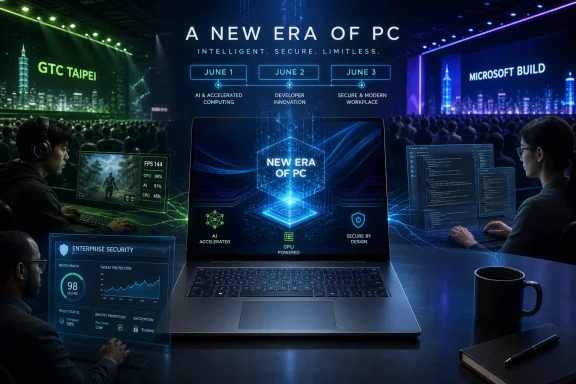
Futuristic conference stage with “A New Era of PC” branding, laptops, security dashboards, and glowing tech graphics.Microsoft Is Trying to Reopen the Windows Hardware Map​

For decades, the Windows PC has been less a single product than a treaty. Microsoft supplied the operating system, Intel and AMD supplied the processor roadmap, OEMs fought over industrial design and pricing, and Nvidia turned the high end into a graphics and compute upsell. That treaty survived netbooks, Ultrabooks, tablets, Windows RT, and the first wave of Windows on Arm because the center held: if you wanted the safest Windows experience, you bought x86.
The AI PC boom has weakened that certainty. Microsoft’s Copilot+ PC push established a new hardware threshold around local AI acceleration, initially giving Qualcomm’s Snapdragon X chips a rare opening in premium Windows laptops. Intel and AMD responded with NPUs of their own, but the message from Redmond had already changed. The CPU was no longer the only strategic component inside a Windows PC.
That matters because Nvidia is not entering this market as a generic Arm hopeful. It enters with the strongest AI hardware brand in the world, a massive developer ecosystem around CUDA, and a consumer reputation built through GeForce, Studio drivers, creator laptops, and gaming machines. If Nvidia can package CPU, GPU, and AI acceleration into a Windows device Microsoft is willing to promote onstage, the result is not just a new chip. It is a new negotiating position inside the PC industry.
The timing is not subtle. Nvidia’s GTC Taipei keynote comes one day before Microsoft Build begins in San Francisco, allowing the two companies to stage the hardware and software halves of the same argument. Taipei is where Nvidia can speak to silicon, OEMs, thermals, and AI compute. Build is where Microsoft can tell developers why those machines deserve native apps, local models, and Windows features tuned for more than yesterday’s laptop assumptions.

The AI PC Needed a Better Villain Than Battery Life​

The first Copilot+ PC wave solved a real problem but struggled with a messaging problem. Qualcomm’s Snapdragon X systems brought strong battery life and competent performance to Windows on Arm, but Microsoft’s flagship AI experience, Recall, arrived wrapped in privacy controversy and then retreated into delay and redesign. That left the market with an awkward proposition: buy this new kind of PC now, and eventually the software will make the hardware feel inevitable.
Nvidia gives Microsoft a cleaner story. Rather than selling “AI PC” as a vague promise that the operating system might occasionally summarize, index, or generate, Microsoft can talk about local inference, creative acceleration, gaming, developer workloads, and hybrid cloud-to-device AI. Nvidia’s brand helps collapse those abstractions into something buyers already understand: more compute, closer to the user.
That does not automatically make the product compelling. Windows users have seen plenty of “new era” hardware campaigns disappear into driver issues, app gaps, thermal compromises, and OEM pricing. But Nvidia’s presence changes the credibility calculation. A Windows on Arm machine with Nvidia silicon is not merely chasing Apple’s battery-life narrative; it is trying to claim that the PC can become the local AI workstation for people who cannot or will not run everything in a cloud GPU instance.
This is where the rumored N1 or N1X chip matters. Reports have long described the part as a collaboration involving Nvidia and MediaTek, with Arm CPU cores and Nvidia graphics or AI acceleration in a single platform. Until Nvidia says so onstage, the exact configuration remains unconfirmed. But the market signal is already clear: Nvidia appears ready to put its name on a Windows client processor, not just the discrete GPU beside one.

Nvidia Wants the Laptop to Become an AI Endpoint​

Nvidia’s data center business turned the company into one of the central infrastructure suppliers of the AI economy. But the PC is a different kind of prize. It is messier, lower margin, more consumer-facing, and less forgiving of half-finished software. It also gives Nvidia something the cloud cannot: a path to put its AI stack directly in front of hundreds of millions of users and developers.
That is why this move should not be read only as a laptop chip story. Nvidia already dominates discrete laptop graphics in gaming and creator machines. If all it wanted was more GeForce attach, it could keep doing what it has been doing. A Windows PC platform powered by Nvidia silicon suggests a more ambitious objective: making Nvidia’s software stack part of the default local compute story on Windows.
For developers, this could be attractive. The Windows AI story has been fragmented between DirectML, ONNX Runtime, Windows ML, vendor SDKs, NPUs, GPUs, and cloud APIs. Nvidia has the advantage of an ecosystem that developers already use for machine learning and acceleration, even if CUDA is not the only path Microsoft wants to encourage. If a new class of Nvidia-powered Windows machines ships with a clear developer target, Build becomes the right place to tell that story.
For IT departments, the question will be less romantic. They will want to know whether these PCs run existing Windows applications reliably, whether management tooling treats them like first-class corporate devices, whether endpoint security products behave normally, and whether the driver and firmware pipeline is boring enough for fleets. A PC revolution that makes life harder for administrators is just another pilot program waiting to be rejected.

Windows on Arm Is No Longer a Side Quest​

Microsoft has been trying to make Arm matter on Windows for more than a decade. Windows RT was too constrained, early Snapdragon Windows PCs were too slow, and compatibility concerns became self-reinforcing. Developers did not prioritize Arm because users did not have Arm PCs; users avoided Arm PCs because too many apps were not native or fast enough.
That loop has been breaking, slowly. The Snapdragon X launch gave Windows on Arm its first broadly credible consumer and business hardware wave. Microsoft improved emulation, pushed native Arm64 versions of its own apps, and leaned on the Copilot+ PC label to create an architectural opening. Nvidia’s arrival would widen that opening from “Qualcomm alternative” to “multi-vendor Windows Arm ecosystem.”
That distinction is crucial. No platform shift succeeds if it looks like a single supplier exception. Apple could move the Mac to Arm because it controls the whole stack. Microsoft cannot simply order the Windows ecosystem to follow. It has to create enough hardware gravity that developers, OEMs, and enterprise buyers believe the transition is real.
Nvidia helps because it brings gravity from another direction. Qualcomm has the phone-to-laptop power efficiency story. Nvidia has the AI, GPU, gaming, and workstation story. If both can coexist in Windows on Arm, Microsoft can stop asking users to accept Arm as a compromise and start presenting it as a spectrum of machines with different strengths.

The Intel-AMD Duopoly Is Not Dead, but It Is Being Repriced​

It would be foolish to declare the end of x86 because of a teaser campaign. Intel and AMD still own the overwhelming majority of the Windows PC installed base, the broadest compatibility assumptions, and deep OEM relationships. They also have increasingly capable NPUs and integrated graphics, and both know exactly what is at stake.
But the duopoly’s strategic comfort is being repriced. For years, Microsoft’s Windows hardware story depended on Intel and AMD roadmaps in a way that limited how aggressively Redmond could redefine the PC. Now Microsoft has Qualcomm shipping premium Arm laptops, Nvidia reportedly preparing its own Windows silicon, and a market narrative that rewards AI acceleration as much as traditional CPU benchmarks.
That does not mean Intel and AMD lose. It means they have to compete in a market where “runs Windows” is no longer enough, and where the most important software vendor in the ecosystem is openly encouraging new architectures. Intel’s advantage remains breadth, compatibility, vPro manageability, and manufacturing recovery if its roadmap execution improves. AMD’s advantage remains CPU and GPU efficiency, strong integrated graphics, and credibility in performance laptops. But neither can assume Microsoft’s platform ambitions will wait for x86 schedules.
For buyers, competition is good only if it produces clearer products rather than more confusing logos. The Windows laptop aisle is already overloaded with Core Ultra, Ryzen AI, Snapdragon X, Copilot+ PC, GeForce RTX, Studio, Evo-like branding, and OEM-specific AI labels. Nvidia’s entrance could sharpen the field if it delivers obvious performance advantages. It could also add another layer of alphabet soup if the software story is not tight.

Build Becomes the Software Trial, Not the Hardware Parade​

Microsoft Build is often misunderstood as a place where Windows features are announced. It is really where Microsoft tells developers what kind of platform it wants Windows, Azure, GitHub, Visual Studio, and Copilot to become. If Nvidia-powered PCs appear at or around Build, the most important part will not be the laptop lid logo. It will be the developer pitch.
That pitch has to answer several questions at once. What local AI workloads should developers target? Which APIs should they use? How should apps decide between CPU, NPU, GPU, and cloud inference? What happens when the same app runs on Intel, AMD, Qualcomm, and Nvidia-powered PCs with different accelerators and memory architectures?
Microsoft cannot afford another hardware category where the demos look good and the everyday developer path feels optional. Copilot+ PCs need software that makes the NPU relevant. Nvidia-powered PCs would need software that makes local GPU and AI acceleration feel native to Windows rather than bolted on from the gaming world. The company has to make the device useful for developers who are not building benchmark demos.
There is also a trust problem. Recall’s rocky rollout reminded users and administrators that local AI features are not automatically benign simply because they run on-device. More powerful local AI hardware raises the ceiling for private, fast, useful computing, but it also raises the stakes for data handling, permissions, and enterprise policy. Build is where Microsoft must show that its AI PC ambitions have absorbed that lesson.

Computex Is the Right Stage Because the Supply Chain Has to Believe​

Nvidia’s Taipei stage is not just symbolic. Computex is where the PC supply chain listens for what to build next. Motherboard makers, laptop OEMs, cooling specialists, memory suppliers, ODMs, and component vendors all need to know which platforms deserve engineering time. If Nvidia wants Windows PC silicon to be more than a one-off showcase, it needs the Taipei ecosystem to believe a product cycle is forming.
That is why the coordinated teaser matters. A chip announcement without Microsoft would invite skepticism about Windows support. A Microsoft software keynote without Nvidia hardware would feel like another abstract AI platform promise. Together, the two companies can tell OEMs that there is a market, tell developers that there will be machines, and tell consumers that the category is not vapor.
Still, the first generation will be judged harshly. Laptop buyers do not care about strategic realignments if fans are loud, battery life disappoints, apps crash, webcams glitch, or enterprise VPN clients misbehave. OEMs can make or break a new platform through mundane execution: keyboard quality, display options, repairability, driver updates, firmware cadence, sleep reliability, and pricing. The future of the “new era of PC” may depend as much on BIOS teams as on keynote slides.
The best-case scenario is a small but convincing launch: a few premium systems from major OEMs, a clear developer kit story, native versions of important apps, and measurable advantages in AI, graphics, and creative workloads. The worst-case scenario is a confusing burst of prototypes and slogans that leaves buyers wondering whether to wait another year. The history of Windows hardware says both outcomes are possible.

The Stock-Market Frame Misses the Windows Story​

The source material circulating around this news has been wrapped in investor language: analyst ratings, price targets, AI cloud flywheels, and Microsoft’s broad business segments. That frame is understandable. Microsoft and Nvidia are two of the defining companies of the AI trade, and any collaboration between them invites Wall Street to ask who captures the margin.
But WindowsForum readers should look past the ticker tape. The more interesting question is not whether a new PC line moves Microsoft’s revenue next quarter. It is whether Microsoft is using the AI cycle to loosen the hardware assumptions that have defined Windows for a generation. That is a platform question, not a quarterly earnings question.
Microsoft’s More Personal Computing segment has often looked like the least glamorous part of the company beside Azure, Office, LinkedIn, and enterprise AI services. Yet Windows remains the company’s distribution layer into the daily work habits of users, developers, and businesses. If the PC becomes a local AI endpoint, Windows becomes more strategically important, not less.
For Nvidia, the PC can be a defensive and offensive move at the same time. It defends the company’s role as AI workloads spread beyond data centers. It also attacks the boundary between GPU supplier and platform owner. Nvidia has spent years moving up the stack; a branded Windows silicon platform would continue that pattern.

The Compatibility Tax Still Comes Due​

Every Windows architecture story eventually runs into compatibility. Users do not buy Windows PCs because they enjoy platform transitions. They buy them because Windows runs the messy collection of software, peripherals, drivers, games, utilities, management agents, and line-of-business applications that their lives or companies already depend on.
That is the tax Nvidia and Microsoft must pay. If the new PCs are Arm-based, emulation performance and native app availability will be central. If they rely on Nvidia-specific acceleration, developers will need stable tools and clear fallbacks. If they promise gaming, anti-cheat compatibility, driver maturity, and storefront behavior will matter as much as raw GPU throughput.
This is where Apple’s transition is a tempting but imperfect comparison. Apple could break things, offer Rosetta, update its own apps, and move the Mac base with uncommon discipline. Microsoft has to support a vastly more diverse ecosystem without forcing the same kind of hard migration. Windows transitions happen through persuasion, not decree.
That makes the first wave especially important. If reviewers and early adopters see a polished Windows experience with standout AI and graphics performance, the market will forgive some edge cases. If the devices feel like science projects, the old x86 default will reassert itself quickly. The Windows ecosystem has a long memory for promising hardware that required too many caveats.

Enterprise IT Will Ask the Unromantic Questions First​

Consumer coverage will focus on performance, battery life, gaming, and AI demos. Enterprise IT will focus on lifecycle and risk. That is where Microsoft’s involvement is both necessary and insufficient.
Administrators will want these systems to enroll cleanly in Intune, honor existing security baselines, support Windows Update for Business, work with endpoint detection and response tools, and avoid driver channels that behave like enthusiast GPU updates. They will also want clarity on firmware support windows, repair logistics, image deployment, and app compatibility testing. In other words, they will want the platform to disappear into normal operations.
That is hard for any first-generation device family. It is harder when the pitch includes new silicon, new AI features, and potentially a different instruction set architecture. The promise of local AI is attractive for regulated industries because it can reduce data movement to the cloud. But local AI also creates new audit questions: what is being indexed, what models are running, what data is retained, and how policies are enforced.
Microsoft has an opportunity to make this a strength. If it presents Nvidia-powered PCs as manageable, policy-aware, enterprise-ready devices rather than shiny developer toys, it could broaden the AI PC market beyond enthusiasts. If it does not, many IT shops will wait for the second or third generation, as they usually do.

The Real Competition Is Apple’s Integrated Confidence​

Apple is the unavoidable shadow over this announcement. The Mac’s Arm transition proved that a mainstream desktop operating system could move to custom silicon and improve performance, battery life, thermals, and product coherence. Microsoft has spent the years since trying to answer a question it cannot avoid: why should premium laptop buyers believe Windows has an equally coherent future?
Nvidia gives Microsoft a better answer, but not a complete one. Apple’s advantage is integration. Microsoft’s advantage is ecosystem breadth. The challenge is turning breadth from a source of fragmentation into a source of choice.
A Nvidia-powered Windows PC could appeal to users Apple does not serve well: PC gamers, CUDA developers, AI researchers with Windows workflows, creative professionals dependent on specific Windows tools, and enterprises standardized on Microsoft management. It could also appeal to buyers who like Apple Silicon performance but cannot live inside macOS. That is a meaningful audience.
But Apple’s example also raises expectations. A premium Arm laptop cannot merely be “good for Windows on Arm.” It has to be good, full stop. If Microsoft and Nvidia want to call this a new era, the machines need to wake instantly, run quietly, last all day, accelerate real work, and avoid compatibility drama. Anything less will sound like the old era with better marketing.

The New PC Era Will Be Won in Software, Drivers, and Patience​

The headline will be about Microsoft and Nvidia launching new PCs. The outcome will be decided by everything that happens after the keynote. Platform shifts are not won by one announcement; they are won by boring reliability repeated across product cycles.
That means driver cadence, app migration, developer documentation, OEM design discipline, and transparent performance claims will matter more than any single demo. Microsoft and Nvidia have to avoid the temptation to oversell local AI before the software is ready. The PC industry has spent two years teaching consumers to distrust vague AI branding. A genuinely new device class must be specific about what it does better.
The good news is that the ingredients are stronger than they were during previous Windows architecture experiments. Arm laptops are more credible. AI workloads are more real. Nvidia’s software ecosystem is deeper. Microsoft’s incentive to make Windows feel modern is sharper as the Windows 10 era recedes and Windows 11 matures.
The risk is that all of those ingredients produce a platform story that is technically impressive but commercially muddy. A machine for AI developers, gamers, creators, and enterprise users can easily become a machine with no clean identity. The first products need to show discipline: who they are for, why they exist, and what they do that current Intel, AMD, and Qualcomm systems cannot.

The Next Windows Laptop Buying Decision Just Got More Complicated​

The immediate lesson for Windows buyers is not to panic, but to pause before treating today’s laptop categories as settled. If the Microsoft-Nvidia announcement is real and shipping timelines are near, the premium Windows market could look different by the end of 2026 than it did at the start.
  • Microsoft and Nvidia appear ready to position new Windows PCs as part of a broader AI platform shift, not merely another laptop refresh.
  • The expected timing around GTC Taipei on June 1 and Microsoft Build on June 2-3 suggests a coordinated hardware-and-software message.
  • Nvidia’s rumored Windows silicon would pressure Intel, AMD, and Qualcomm by adding a powerful AI and graphics player to the processor conversation.
  • The first devices will need to prove app compatibility, battery life, thermals, driver stability, and enterprise manageability before the “new era” label means anything.
  • Developers should watch Build for the APIs, tooling, and local AI guidance that determine whether these machines become a real target or a niche showcase.
  • Buyers who need a laptop immediately should still buy for today’s workloads, while those shopping for premium AI, creator, or developer systems may want to see what is announced next week.
If Microsoft and Nvidia deliver what their teaser implies, next week will not instantly replace the Windows PC we know. It will instead put a new version of the Windows bargain on the table: more architectures, more local AI, more GPU-driven computing, and more pressure on every vendor to justify its place inside the machine. That is exactly the kind of competition the PC needs, provided the companies remember that users do not live in keynote eras — they live with laptops that have to work every day.

References​

  1. Primary source: intellectia.ai
    Published: 2026-05-30T15:08:35.559286
  2. Related coverage: techradar.com
  3. Related coverage: tomsguide.com
  4. Related coverage: tomshardware.com
  5. Related coverage: windowscentral.com
  6. Related coverage: blogs.nvidia.com
 

Nvidia and Microsoft are expected to unveil the first Windows PCs using Nvidia chips as the main processor during the first week of June 2026, with reported systems from Microsoft Surface and Dell aimed at the AI PC market. The news matters because Nvidia is not merely adding another GPU badge to a laptop lid; it is pushing toward the center of Windows client computing. If the reports hold, this is the most serious new pressure on the Windows processor hierarchy since Qualcomm’s Copilot+ PC launch. It also gives Microsoft a second chance to make the AI PC feel like a category rather than a sticker.

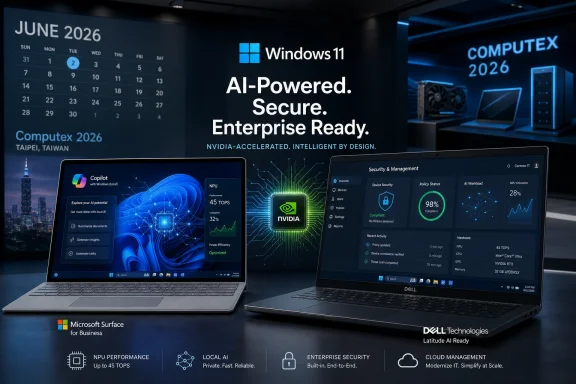
Two business laptops display Windows 11 and AI security ads at COMPUTEX 2026.Nvidia Wants the Whole PC, Not Just the Expensive Part​

For most Windows users, Nvidia has always been the company inside the machine but rarely the company of the machine. Its graphics chips powered gaming laptops, workstations, creator rigs, and AI development boxes, while Intel or AMD supplied the CPU that made the PC a PC. The reported Nvidia-powered Windows systems would change that balance by putting Nvidia silicon in the role of main processor, not just accelerator.
That distinction is the story. Windows laptops with Nvidia GPUs are everywhere; Windows laptops whose central computing platform is Nvidia are not. The PC industry has lived for decades around a relatively stable bargain: Microsoft owns the operating system, Intel and AMD own mainstream x86 client silicon, OEMs assemble and differentiate, and Nvidia sells premium graphics into the upper tiers.
AI has made that bargain look old. The workloads Microsoft now wants to promote — local copilots, generative image tools, live translation, developer assistants, background indexing, model inference — do not map neatly onto the CPU-first laptop model. They want a blend of CPU efficiency, GPU throughput, neural acceleration, memory bandwidth, and software tooling. Nvidia’s pitch, implicitly, is that it already owns the most important parts of that stack.
That is why the rumored Surface and Dell participation matters. Surface gives Microsoft a first-party showcase and a way to set the tone for Windows hardware. Dell gives the announcement commercial credibility beyond Redmond’s own design lab. Together they suggest this is not a one-off developer toy, but an attempt to open a new lane in the Windows PC market.

Microsoft’s AI PC Reset Needed a Second Act​

Microsoft launched Copilot+ PCs in May 2024 with a clear hardware line: a Windows 11 PC needed a neural processing unit capable of more than 40 trillion operations per second, plus baseline memory and storage requirements, to qualify for the new AI-focused class. The first wave leaned heavily on Qualcomm’s Snapdragon X Elite and X Plus chips. Microsoft’s message was simple enough: Windows laptops could finally compete with Apple Silicon on battery life and instant-on behavior while gaining local AI features.
The launch was ambitious, but it also exposed the problem with turning AI into a hardware category. Users understood battery life. They understood performance. They understood app compatibility. They did not always understand why Recall, Cocreator, live captions, or Studio Effects required a new machine, nor why some features arrived later or with narrower scope than the marketing implied.
The Snapdragon wave did something important anyway. It normalized Windows on Arm in a way earlier efforts did not. The original Windows RT era taught users to associate Arm Windows with compromise, missing apps, and confusing product boundaries. The Copilot+ generation did not erase every compatibility concern, but it moved the discussion from “Can Windows on Arm run my software?” to “How much of my software runs well enough, and when will the rest catch up?”
Nvidia’s reported arrival gives Microsoft a way to reframe that second question around performance rather than restraint. Qualcomm sold efficiency and mobility. Nvidia can sell compute density, creator workflows, local model experimentation, and gaming-adjacent credibility. That does not guarantee success, but it changes the emotional register of Windows on Arm from “thin-and-light alternative” to “AI workstation in laptop form.”

The Surface Angle Turns a Chip Story Into a Platform Story​

If Microsoft ships a Surface device around Nvidia silicon, it will be making a statement that goes beyond procurement. Surface has always been Microsoft’s argument with the rest of the PC industry. Sometimes it says, “Here is what a premium Windows device should feel like.” Sometimes it says, “Here is the hardware form factor OEMs are not building quickly enough.” Occasionally, it says, “We are willing to make the ecosystem uncomfortable to move Windows somewhere new.”
A Nvidia-powered Surface would fall into that last category. It would tell developers and OEMs that Microsoft sees Nvidia as a legitimate Windows client platform provider, not only a GPU vendor. It would also tell Intel, AMD, and Qualcomm that the Copilot+ PC race is not locked to any one architecture or incumbent relationship.
Surface has played this role before, with mixed results. The original Surface RT was an audacious but flawed attempt to pull Windows onto Arm tablets. The Surface Pro line eventually helped define the detachable PC category, but only after Microsoft returned to the fuller compatibility story users expected. The lesson is not that Microsoft should avoid experiments; it is that experiments become durable only when the software story is boring enough for normal people.
That is the burden for any Nvidia Windows PC. The industrial design can be excellent, and the AI demos can be dazzling, but the machine has to behave like a Windows PC first. It has to install the apps people use, handle drivers without drama, survive corporate endpoint management, and avoid turning every IT help desk into a compatibility lab.

Dell’s Involvement Would Make This Harder to Dismiss​

A Surface-only Nvidia PC would be interesting. A Surface-and-Dell Nvidia PC is harder to wave away. Dell is not a boutique gaming brand or a concept-hardware sideshow; it is one of the companies that sells Windows machines into offices, schools, engineering shops, managed fleets, and executive refresh cycles.
Dell’s presence would suggest that Nvidia’s Windows push has at least one route into mainstream commercial channels. That matters because the AI PC market has been long on forecasts and short on obvious user pull. Enterprises are curious about local inference, privacy-preserving AI features, and reducing cloud dependency, but curiosity does not automatically become a purchase order.
A Dell machine could give IT departments a more familiar procurement path. It could also create tension inside Dell’s own portfolio, which already spans Intel, AMD, Qualcomm, and discrete Nvidia GPU configurations. The more silicon diversity Windows embraces, the more important driver maturity, firmware quality, management tooling, and lifecycle support become.
For sysadmins, the brand on the lid is only the first reassurance. The second is whether the device can be imaged, enrolled, patched, secured, repaired, and retired with predictable tooling. Nvidia and Microsoft can win a keynote with demos; Dell’s contribution would be proving that the concept can survive a fleet pilot.

The Real Rival Is Apple Silicon’s Coherence​

The obvious competitive target is Apple, even if no one on stage says it directly. Apple changed the laptop conversation by making the processor transition feel like a product improvement rather than a science project. The M-series Macs delivered strong performance, long battery life, quiet operation, and a relatively smooth app transition because Apple controlled the silicon, operating system, developer tools, and retail narrative.
Microsoft does not have that luxury. Windows is broader, messier, more backward-compatible, and more dependent on third-party hardware and software ecosystems. That diversity is Windows’ strength, but it is also why every architecture shift becomes a negotiation with history.
Nvidia offers Microsoft one possible answer to Apple’s coherence: not vertical integration, but stack gravity. Nvidia has CUDA, AI libraries, developer mindshare, GPU architecture, enterprise AI relationships, and a brand that now means “AI infrastructure” as much as “graphics card.” If that stack can be pulled down into Windows PCs, Microsoft gets a more credible local AI platform.
The danger is that a Windows Nvidia PC becomes coherent only for a subset of users. Developers building AI apps may love it. Creators may see value if the media engines and GPU acceleration are right. Gamers may be intrigued but skeptical until compatibility and performance are proven. Office workers may wonder why the old laptop was not good enough.

Windows on Arm Is Better, But “Better” Is Not the Same as Invisible​

The likely architecture question hanging over these systems is Arm. Nvidia’s recent client ambitions have been widely associated with Arm-based designs, and Microsoft has spent the last two years improving Windows on Arm with better native apps and the Prism emulation layer for x86 and x64 software. That work is essential because the average Windows user does not buy an architecture; they buy the expectation that their existing world will keep working.
Prism has improved the story, especially for mainstream productivity apps that do not depend on unusual drivers, kernel components, anti-cheat systems, or obscure plug-ins. But emulation is still a tax, even when the tax is lower than it used to be. It can show up as reduced performance, higher battery draw, missing instruction support, or strange edge-case failures that are hard to diagnose.
This is where Nvidia’s reputation cuts both ways. Users associate Nvidia with performance. If a Nvidia-powered Windows laptop struggles with a legacy app, a specialized driver, or a game anti-cheat layer, the disappointment may be sharper than it was on earlier Arm machines. The brand creates expectations that the platform must meet.
Microsoft’s job is to make the architecture fade into the background. Nvidia’s job is to make the performance case strong enough that users accept the transition. OEMs’ job is to avoid shipping half-finished devices into a market that remembers every Windows-on-Arm misstep.

AI PCs Still Need a Killer Reason to Exist​

The PC industry has spent two years telling buyers that AI PCs are the next major refresh cycle. The claim is plausible, but the evidence has been uneven. A faster NPU is useful for certain local workloads, but “useful” is not the same as “urgent,” and many of the most popular AI services still run primarily in the cloud.
Local AI has real advantages. It can reduce latency, preserve privacy for sensitive inputs, work offline, lower cloud inference costs, and enable background features that would be too expensive or intrusive to run remotely. Those are meaningful benefits for enterprises, developers, healthcare environments, regulated industries, and security-conscious users.
But the consumer case remains blurrier. If the headline feature is a chat interface, the user will ask why it cannot run on the laptop they already own. If the headline feature is image generation, the user will compare it with cloud tools. If the headline feature is Recall-like activity indexing, privacy and trust questions return immediately.
Nvidia gives the AI PC a more muscular story. Instead of selling only the NPU as a low-power helper, Nvidia can sell the PC as a local AI compute node. That is a stronger pitch for developers and prosumers, but it also risks making the category feel expensive and specialized. The AI PC must avoid becoming the workstation of the 2020s: admired by everyone, bought by fewer people.

Intel and AMD Are Not Bystanders​

It is tempting to frame this as Nvidia versus Qualcomm, because both are associated with Arm-based Windows ambitions. That misses the larger strategic threat. Intel and AMD still anchor the overwhelming majority of Windows PCs, and both have spent the Copilot+ era adding stronger neural engines and AI branding to their client chips.
Their advantage is compatibility. An Intel or AMD Copilot+ PC does not need to persuade users that their old software will run. It does not need to rebuild decades of driver assumptions. It can promise AI acceleration while preserving the familiar x86 baseline that corporate IT already knows how to support.
Their disadvantage is that compatibility alone is not a growth story. Apple proved that users will accept architecture change when the benefits are obvious. Qualcomm proved that at least some Windows buyers will consider Arm when battery life and thermals improve. Nvidia may now test whether AI compute can be a similarly powerful reason.
The result could be good for Windows users even if Nvidia’s first systems remain niche. More competition forces Intel and AMD to sharpen efficiency, integrated graphics, NPU performance, and platform-level software. It also forces Microsoft to stop treating Windows hardware as a static compatibility substrate and start treating it as a competitive platform again.

The Gaming Question Will Not Stay Quiet​

Any Nvidia PC announcement will attract gamers, even if the first devices are framed around AI productivity. That is the blessing and curse of the Nvidia name. Users will want to know whether these machines can run Windows games, whether they support familiar graphics APIs, whether anti-cheat systems cooperate, and whether performance resembles an RTX laptop or something more constrained.
This is not a side issue. Gaming remains one of the strongest emotional anchors for Windows PCs. It also happens to be one of the hardest places for architecture transitions because the software stack includes launchers, drivers, overlays, copy protection, anti-cheat tools, mods, and performance-sensitive engines.
If Nvidia’s Windows silicon includes powerful integrated graphics, Microsoft will be tempted to position it as a gaming-capable platform. But the company should be careful. A laptop that runs many games well but fails unpredictably on a handful of popular competitive titles will generate louder complaints than a business laptop that never promised gaming in the first place.
The smarter initial pitch may be creator and AI developer performance, with gaming discussed only where compatibility is verified. Nvidia has the graphics credibility, but Windows users have learned to distinguish a GPU brand from a full gaming platform. That distinction will matter.

The Developer Story Is the One Microsoft Can Least Afford to Fumble​

The most important audience for these machines may not be consumers or procurement managers. It may be developers. Microsoft wants Windows to be a serious AI development environment at the edge, not just the client that calls models hosted somewhere else.
A Nvidia-powered Windows PC could be attractive for developers building smaller local models, testing inference pipelines, experimenting with agents, or prototyping workflows before deploying to cloud GPUs. If the tooling is smooth, the machine becomes more than a laptop. It becomes a bridge between desktop development and the Nvidia-heavy infrastructure many AI teams already use.
That bridge needs more than hardware. It needs reliable drivers, supported frameworks, container workflows, package compatibility, documentation, and examples that do not assume Linux is the only serious AI environment. Microsoft has improved Windows developer tooling significantly over the past decade, especially with Windows Subsystem for Linux, but AI development still often gravitates toward Linux-first assumptions.
This is where the Microsoft-Nvidia partnership could have teeth. If the companies make Windows a first-class local AI development target, the PC story becomes more than marketing. If they merely ship impressive silicon under a familiar OS while developers keep reaching for Linux workstations and cloud instances, the opportunity narrows.

Security and Privacy Will Decide Whether Enterprises Trust the Pitch​

Enterprise IT will look at Nvidia-powered Windows PCs through a different lens than enthusiasts. The questions will be less about TOPS and more about trust boundaries. What data is processed locally? What telemetry leaves the device? How are models updated? How are AI features governed by policy? Can sensitive workloads be isolated, audited, and disabled?
Local AI can be a privacy win, but it is not automatically one. A feature that indexes user activity, summarizes documents, or observes screen context can be safer on-device than in the cloud, yet still alarming if administrators cannot define retention, access, encryption, and user consent rules. The device location of computation is only one part of the security model.
Nvidia’s entrance may also complicate supply-chain and patch-management expectations. GPU drivers have long been a major part of Windows maintenance; a Nvidia-led system platform would expand the surface area. Firmware, chipset drivers, AI runtimes, model packages, and accelerator libraries all become part of the operational picture.
For managed fleets, the winning AI PC will not be the one with the biggest demo. It will be the one that lets IT say yes without losing control. Microsoft knows this, which is why policy, compliance, and management support must arrive alongside the hardware rather than as an afterthought.

The Calendar Makes This More Than a Rumor Cycle​

The reported timing — the first week of June 2026 — lands at a moment when the PC industry is primed for platform announcements. Computex traditionally pulls in silicon roadmaps and OEM hardware, while Microsoft’s developer calendar gives Windows and AI announcements a software stage. A joint Nvidia-Microsoft reveal across that window would let both companies tell a coordinated story: silicon, devices, software, and ecosystem.
That coordination matters because the AI PC category has suffered from fragmented messaging. Chip vendors talk about TOPS. OEMs talk about form factors. Microsoft talks about Copilot experiences. Enterprises talk about governance. Users ask whether the laptop is faster, lasts longer, and runs their apps.
A successful launch would connect those layers. It would say what Nvidia silicon does that Qualcomm, Intel, or AMD systems do not. It would explain which Windows features take advantage of the hardware on day one. It would show whether Surface and Dell machines are general-purpose PCs, developer devices, creator workstations, or premium AI laptops.
The worst version would be a teaser-heavy announcement full of “new era” language and thin practical detail. The Windows audience has heard enough era talk. It needs configurations, battery estimates, app compatibility commitments, enterprise support timelines, and honest boundaries.

The AI PC Race Finally Gets Its Missing Character​

The immediate facts are still based on reporting rather than a formal product launch, so the prudent stance is conditional. But the shape of the move is clear enough to judge. Nvidia entering Windows PCs as a main processor supplier would not be another incremental SKU. It would add a new axis to the Windows hardware map.
The near-term implications are concrete:
  • Nvidia and Microsoft are reportedly preparing the first Windows PCs that use Nvidia chips as the main processor, with Microsoft Surface and Dell among the expected device brands.
  • The announcement is expected in the first week of June 2026, placing it in the orbit of major PC and developer industry events.
  • The devices would give Microsoft another way to advance the Copilot+ and AI PC strategy beyond the Qualcomm-led first wave.
  • The success of the platform will depend as much on Windows compatibility, drivers, management, and developer tooling as on raw AI performance.
  • Intel, AMD, and Qualcomm will face a stronger competitive signal if Nvidia can turn AI compute leadership into credible everyday Windows hardware.
  • Enterprise buyers should watch policy controls, lifecycle support, and software compatibility more closely than launch-stage benchmark claims.
Nvidia’s reported Windows PC debut is best understood as a test of whether the AI boom can redraw the client PC, not merely decorate it. Microsoft has spent years trying to make Windows feel modern without breaking the compatibility promise that keeps the platform dominant. If Nvidia can bring serious local AI performance into machines that still behave like dependable Windows PCs, the category gets a reason to exist; if not, this will be another reminder that the PC market rewards revolutions only when they arrive disguised as normal upgrades.

References​

  1. Primary source: Blockonomi
    Published: Sun, 31 May 2026 11:17:31 GMT
  2. Independent coverage: Latest news from Azerbaijan
    Published: Sun, 31 May 2026 05:10:05 GMT
  3. Independent coverage: Axios
    Published: Sat, 30 May 2026 18:44:18 GMT
  4. Related coverage: techradar.com
  5. Related coverage: windowscentral.com
  6. Related coverage: tomsguide.com
 

Nvidia and Microsoft are expected in the week of June 1, 2026, to unveil the first Windows PCs using Nvidia chips as the main processor, with Axios reporting the debut and Reuters and Moneycontrol amplifying the claim. If it happens, this is not just another silicon launch. It is Microsoft’s most serious attempt yet to make Windows on Arm feel less like an accommodation and more like a front line in the PC wars.

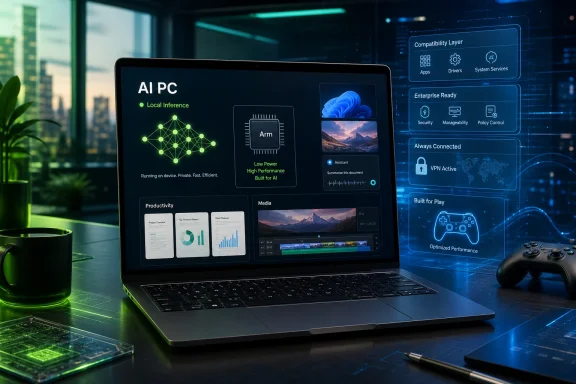
AI PC laptop display shows local inference and compatibility layers with secure, always-connected features in a tech office.Nvidia Is Not Entering the PC Market So Much as Reframing It​

For decades, Nvidia has been the company inside the Windows PC that mattered most when the CPU was not enough. Gamers bought GeForce cards, creators bought RTX laptops, workstation buyers looked for CUDA, and enterprise AI teams built procurement strategies around Nvidia accelerators. But the central processor — the chip around which the PC platform is organized — remained Intel’s kingdom, with AMD as the insurgent that eventually became indispensable.
That is why this reported debut matters. A Windows PC “powered by Nvidia chips” is not the same story as another laptop with a discrete GPU. It suggests a machine where Nvidia is no longer the performance accessory but the platform anchor.
The timing is not accidental. Microsoft has spent the last two years trying to make the AI PC more than a sticker on a palm rest, while Nvidia has become the most important hardware company in the AI economy. Windows still owns the enterprise desktop and much of the enthusiast market, but Apple has spent the Apple silicon era demonstrating how powerful a vertically tuned Arm laptop can feel when the hardware, operating system, battery profile, and developer story are aligned.
Microsoft has wanted that story. Qualcomm has carried much of the burden for Windows on Arm. Nvidia’s arrival would change the political economy of the whole effort.

Windows on Arm Needed a Star, Not Another Specification Sheet​

The uncomfortable truth for Microsoft is that Windows on Arm has rarely failed because the idea was bad. It failed because the experience was uneven, the software compatibility story was too caveated, and the machines were too easy to ignore. A PC buyer does not want to become a compatibility tester just to get better battery life.
Qualcomm’s Snapdragon X Elite and X Plus systems helped move the category forward, especially by giving Copilot+ PCs a credible low-power platform. But the first wave of Copilot+ enthusiasm quickly ran into the realities of Windows history. Users asked whether their apps would run, whether drivers would behave, whether games would work, and whether the promised AI features were useful enough to justify buying into a new class of device.
That is the gap Nvidia can exploit. The company brings not merely silicon but gravitational pull. Developers already optimize for Nvidia GPUs. Gamers already understand Nvidia branding. AI developers already associate the company with acceleration, frameworks, and ecosystem lock-in. If Nvidia can attach that credibility to a Windows Arm PC, Microsoft gets something it has lacked: a platform story with emotional weight.
The danger is that branding can carry a first announcement but not a first generation. Windows users are unforgiving when everyday compatibility breaks. If an Nvidia-powered Windows PC stumbles on printers, VPN clients, anti-cheat systems, niche productivity tools, or older x86 applications, the market will not grade it on a curve because the logo is green.

The Real Rival Is Apple’s Integration Model​

The obvious competitive target is not Intel or AMD alone. It is Apple’s proof that the laptop can be reimagined when the CPU, GPU, neural engine, memory architecture, operating system, and power management are treated as one design problem. The MacBook became a battery-life argument, a thermals argument, and a developer-platform argument all at once.
Windows has never been built that way. Its strength is hardware plurality. Its weakness is hardware plurality. Microsoft must support everything from a $300 budget laptop to a multi-GPU workstation to a fleet-managed corporate notebook running decade-old line-of-business software.
That makes an Nvidia Windows PC strategically fascinating. Nvidia has the technical incentive to build a system-on-chip that combines Arm CPU cores, Nvidia graphics, and AI acceleration in a way that looks more like Apple silicon than a traditional Wintel motherboard. Microsoft has the platform incentive to prove Windows can scale down in power draw and up in AI capability without surrendering its software inheritance.
But the Windows ecosystem cannot become Apple’s ecosystem without ceasing to be Windows. The best version of this product is not a MacBook clone. It is a Windows machine that feels modern without demanding that users abandon the messy, powerful compatibility that made Windows dominant in the first place.

The AI PC Pitch Gets a Second Draft​

Microsoft’s first AI PC pitch suffered from a classic platform problem: the hardware arrived before the killer reason to care. Neural processing units were described in TOPS, Copilot was repositioned repeatedly, and Recall became a privacy controversy before it became a productivity feature. For normal buyers, the question remained brutally simple: what does this PC do better today?
Nvidia gives Microsoft a chance to rewrite that pitch around local AI performance that users can actually see. If a Windows laptop can run useful models locally, accelerate creative workloads, enhance gaming, improve video production, and provide private on-device inference without turning into a space heater, then the AI PC becomes less abstract. The argument moves from “this computer is ready for future AI experiences” to “this computer is faster at things you already do.”
That distinction matters. Consumers are exhausted by AI marketing that feels detached from practical benefit. IT departments are even more skeptical. They hear “AI PC” and immediately think about data governance, endpoint security, software licensing, battery life, procurement cycles, and whether the promised capability will survive the next Windows feature update.
Nvidia’s challenge is therefore not merely to produce impressive silicon. It must help Microsoft turn AI acceleration into visible, reliable Windows behavior. The PC market has no shortage of theoretical performance. It has a shortage of trustworthy experiences.

Qualcomm Suddenly Has Company in the Arm Lane​

Qualcomm has spent years trying to become the non-x86 face of Windows PCs. It earned that position the hard way, through multiple generations of machines that often carried the burden of Microsoft’s unfinished Arm story. With Snapdragon X systems, Qualcomm finally had a credible answer to the old complaint that Windows on Arm was too slow or too compromised.
Nvidia’s reported arrival does not erase that work, but it does change the hierarchy. Qualcomm may have been Microsoft’s necessary partner; Nvidia could become its marquee partner. That matters in a market where OEM attention, developer optimization, and consumer perception are scarce resources.
It also sets up an unusual competition. Qualcomm wants Windows on Arm to be about battery life, mobility, integrated connectivity, and efficient general computing. Nvidia will likely want it to be about graphics, AI acceleration, creator workloads, and high-performance local compute. Those are not mutually exclusive, but they pull the category toward different buyers.
For Microsoft, this is a good problem. A single silicon partner makes Windows on Arm look fragile. Multiple serious partners make it look like a platform. The real test will be whether Microsoft can support that diversity without fragmenting the experience into device-specific promises and exceptions.

Intel and AMD Are No Longer Just Defending the CPU Socket​

Intel and AMD should not be treated as passive victims in this story. Both companies have improved laptop efficiency, added NPUs, and spent years integrating CPU and GPU capabilities more tightly. AMD in particular has made strong progress in integrated graphics and mobile performance, while Intel remains deeply embedded in enterprise purchasing, OEM design, and Windows validation.
But Nvidia attacks from an awkward angle. It does not need to win the entire PC market to shift the conversation. If Nvidia-powered Windows PCs define the premium AI laptop, the creator notebook, or the thin gaming system, Intel and AMD will be forced to compete not just on CPU benchmarks but on platform narrative.
That is a more dangerous fight. Intel’s historical advantage was that “Intel inside” meant the safe default. AMD’s advantage was that it could offer compelling performance and value against that default. Nvidia’s advantage is that in AI and graphics, it already owns the aspirational mindshare.
This could pressure Intel and AMD to make their Windows AI stories less incremental. An NPU included in a spec table is not enough. Buyers need to know what workloads improve, what software uses the hardware, and whether the machine will still feel fast three years from now. Nvidia’s presence makes vague AI claims harder to sustain.

The Gaming Question Will Be the First Enthusiast Stress Test​

Windows enthusiasts will immediately ask the obvious question: can it game? That is not a side issue. Gaming has long been the proving ground for Windows hardware compatibility, driver maturity, graphics APIs, thermal design, and vendor support. A Windows PC with Nvidia as the main processor but poor game compatibility would invite ridicule no matter how good its AI demos look.
The challenge is layered. Many Windows games are still built for x86. Anti-cheat systems can be hostile to emulation or unfamiliar architectures. Driver stacks must be mature. External device support must be predictable. Even when average performance is good, enthusiasts will notice frame pacing, latency, shader compilation, and weird edge-case failures.
Nvidia has strengths here that no other Arm PC entrant can match. Its graphics driver experience, developer relations, game optimization machinery, and brand credibility are enormous assets. If any company can make an Arm-based Windows gaming story feel plausible, Nvidia is near the top of the list.
But “plausible” is not “done.” The first wave of devices may be better understood as premium AI and creator PCs than as universal gaming laptops. If Microsoft and Nvidia overpromise on gaming, the backlash will write itself.

Enterprise IT Will Watch the Demo and Audit the Risk​

For sysadmins, the news lands differently. A new Windows silicon platform is exciting only after it survives the boring questions. Can it join the same management environment? Does endpoint protection behave? Are VPN clients ready? Are drivers signed and stable? Do deployment images work cleanly? Are recovery tools, firmware updates, and compliance controls mature?
Windows on Arm has improved, but enterprise adoption is not won by keynote demos. It is won by predictability. Most organizations do not want a second class of Windows endpoint that requires special handling unless the benefit is obvious and durable.
That does not mean Nvidia-powered Windows PCs have no enterprise path. On the contrary, local AI workloads could matter in industries where data cannot easily leave the device. Developers, analysts, engineers, and creative professionals may all benefit from portable machines with stronger local acceleration. If those systems can run models, process media, or accelerate workflows while preserving battery life, enterprise pilots will follow.
The likely near-term pattern is selective deployment, not fleet-wide replacement. IT departments may test these machines for developers, AI teams, design groups, executives, and mobile power users. The broader estate will wait for proof that the platform behaves like Windows first and a science project never.

Microsoft’s Biggest Job Is Compatibility, Not Hype​

The seductive version of this story is that Nvidia rides in and solves the Windows AI PC problem by force of engineering. That is unlikely. Silicon can make a platform possible; software makes it tolerable; ecosystem maturity makes it normal.
Microsoft’s burden is therefore enormous. It must continue improving x86 and x64 app translation on Arm. It must persuade developers to ship native Arm64 versions of important applications. It must ensure Windows Update, driver delivery, Store distribution, enterprise management, and security tooling treat these devices as first-class citizens.
The company also needs discipline in how it markets AI features. Recall’s troubled rollout showed that users will not accept invasive-feeling functionality simply because it is technically impressive. Local AI can be a privacy advantage, but only if Microsoft designs it as one. “Runs on device” is not a magic phrase that cancels concerns about indexing, screenshots, sensitive data, or administrative control.
Nvidia can make the box exciting. Microsoft must make the box trustworthy.

The OEMs Will Decide Whether This Is a Showcase or a Category​

The first announced devices will matter less for their raw existence than for who builds them and where they sit in the market. A single experimental reference design would make this a curiosity. Systems from major OEMs such as Dell, Lenovo, or Microsoft itself would make it a category signal.
OEMs have their own incentives. They want differentiation in a PC market that often collapses into price, screen size, and processor tier. An Nvidia-powered Windows laptop gives them a new premium story: AI acceleration, graphics pedigree, battery efficiency, and possibly thinner designs. That is a stronger shelf pitch than another minor CPU refresh.
But OEM enthusiasm can create its own confusion. If early models vary widely in thermals, memory, software support, and price, buyers may not know what an Nvidia Windows PC actually means. The Copilot+ PC label already showed how branding can become muddy when features, hardware requirements, and rollout schedules do not align cleanly.
The best launch would be narrow and excellent. A few polished machines with clear use cases would do more for the category than a flood of uneven SKUs. Windows on Arm does not need more theoretical breadth. It needs proof.

The PC’s Center of Gravity Is Moving Toward the Accelerator​

For most of PC history, the CPU was the identity of the machine. You bought an Intel or AMD system, then chose graphics, memory, storage, and display around it. AI changes that hierarchy. The accelerator increasingly defines what the system can do, especially when workloads involve inference, media generation, computer vision, language models, or real-time enhancement.
Nvidia understands that shift better than almost anyone. Its data center dominance is built on the idea that accelerated computing is not an accessory to modern computing but its main event. Bringing that worldview to Windows PCs could make the laptop feel like the edge node of a larger AI ecosystem.
That prospect is powerful and slightly unsettling. A PC that runs local models well could reduce dependence on cloud inference for some tasks. It could also deepen dependence on vendor-specific stacks, optimized runtimes, and proprietary acceleration paths. Windows users may gain capability while inheriting a new layer of platform lock-in.
The open question is whether Microsoft can keep the Windows PC broad enough to avoid becoming a set of competing AI islands. If every silicon vendor has its own best path for local models, developers will face another fragmentation problem. If Microsoft abstracts too much, it risks leaving performance on the table. That tension will define the next phase of Windows hardware.

The First Nvidia Windows PC Will Be Judged by the Boring Stuff​

The smartest way to read this launch is neither as a guaranteed revolution nor as overhyped vapor. It is a serious strategic move whose success will depend on mundane execution. Windows history is full of ambitious platform shifts that looked better on stage than in daily use.
The first reviews should focus less on peak benchmark numbers and more on lived behavior. Does the machine sleep and wake reliably? Does battery life hold up under real mixed workloads? Do browser tabs, Teams calls, Office documents, creative apps, developer tools, and games coexist without strange compromises? Does emulation feel invisible often enough that users stop thinking about it?
Price will also be decisive. Nvidia silicon will carry premium expectations, and premium Windows buyers have many options. If these machines cost MacBook Pro money, they will be compared to MacBook Pros. If they cost high-end gaming laptop money, they will be compared to high-end gaming laptops. A new architecture does not get immunity from old shopping behavior.
For Microsoft, the ideal outcome is that buyers stop asking whether the machine is Arm-based. That was Apple’s triumph: architecture became invisible to most users. Windows is not there yet. Nvidia may help it get closer.

The Part of the Launch That Will Matter Six Months Later​

The immediate announcement will generate the usual cycle of teaser analysis, hands-on impressions, benchmark leaks, and platform-war shouting. That is noise, but useful noise. Enthusiasts will pressure-test claims faster than any vendor lab can.
The more important story will appear months later. Are native Arm64 Windows apps increasing? Are game studios and anti-cheat vendors adjusting? Are Adobe, Autodesk, Blackmagic, JetBrains, Docker, security vendors, and enterprise software providers treating the platform as worth optimizing for? Are OEMs preparing second-generation designs, or merely shipping a showcase?
A platform shift becomes real when developers believe there will be users and users believe there will be software. Nvidia can accelerate both sides, but it cannot decree them into existence. Microsoft must prove that this is not another restart of the Windows on Arm story but the moment the story finally compounds.
That distinction is everything. Windows users have seen bold hardware experiments before: Windows RT, Lumia Continuum, Surface Neo, mixed reality headsets, and waves of convertible PCs that ranged from brilliant to baffling. The survivors were the ones that made the old Windows value proposition stronger, not the ones that asked users to admire a new abstraction.

The Green Chip Gives Windows Its Sharpest AI PC Test Yet​

The reported Nvidia-Microsoft debut is best understood as a referendum on whether the AI PC can become a real product category rather than a marketing overlay. The concrete takeaways are already visible, even before the first machines are formally shown.
  • Nvidia’s entry would make Windows on Arm a multi-vendor contest rather than a Qualcomm-led side project.
  • Microsoft will still have to prove app compatibility, driver maturity, and enterprise manageability before these systems move beyond early adopters.
  • The strongest early use cases are likely to be AI, creator, developer, and premium mobile workloads rather than universal replacement of x86 laptops.
  • Gaming credibility will depend on real compatibility and driver behavior, not Nvidia branding alone.
  • Intel and AMD will face pressure to explain their AI PC advantages in practical workloads instead of relying on familiar CPU positioning.
  • The launch will matter most if major OEMs ship polished systems and developers respond with native Arm64 support.
If Nvidia and Microsoft can make the first wave feel like Windows with fewer compromises rather than Windows with a new set of caveats, the PC market gets its most interesting architectural shake-up in years. If they cannot, the launch will become another reminder that Windows dominance was built not on elegance but on compatibility, and that any challenger — even one wearing an Nvidia badge — has to earn its place one app, one driver, and one skeptical administrator at a time.

References​

  1. Primary source: moneycontrol.com
    Published: Sun, 31 May 2026 04:01:47 GMT
  2. Independent coverage: Reuters
    Published: Sat, 30 May 2026 23:53:03 GMT
  3. Related coverage: tomshardware.com
  4. Related coverage: windowscentral.com
  5. Related coverage: tomsguide.com
  6. Related coverage: investing.com
 

Nvidia and Microsoft are expected to unveil the first Windows PCs using Nvidia chips as the main processor during the week of June 1, 2026, with appearances tied to Computex in Taipei and Microsoft Build in San Francisco. If the reports hold, this is not merely another laptop launch. It is Microsoft’s most serious attempt yet to turn Windows on Arm from a compatibility project into a competitive hardware platform. The stakes are simple: if Nvidia can bring credible CPU performance, RTX-class graphics, and local AI acceleration into one Windows PC package, the old Intel-versus-AMD map of the PC market starts to look obsolete.

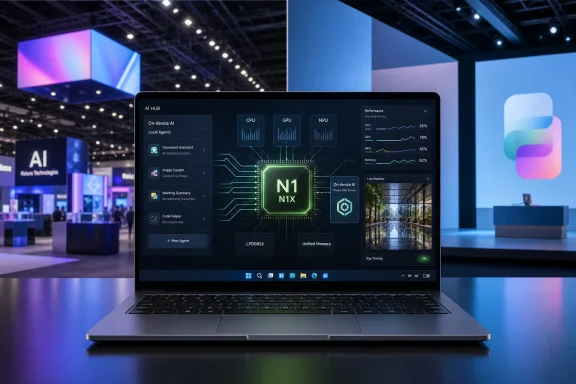
Laptop screen shows an AI hub dashboard with CPU/GPU/NPU metrics at a modern tech exhibition booth.Nvidia Is Not Entering the PC Market So Much as Rewriting the Job Description​

For decades, the Windows PC was organized around a familiar division of labor. Intel or AMD supplied the CPU, Nvidia or AMD supplied the discrete GPU when buyers needed more graphics horsepower, and Microsoft made Windows behave across a sprawling ecosystem of designs. Qualcomm’s Snapdragon X series challenged that arrangement by pushing Arm into premium Windows laptops, but even that shift preserved a fairly clean boundary: Qualcomm was the processor company, Nvidia remained the graphics and AI accelerator company.
The rumored Nvidia N1 and N1X chips would blur that boundary. Nvidia would not simply be offering a GPU for a Windows laptop; it would be supplying the main processor around which the PC is built. That moves the company from component supplier to platform contender, a far more ambitious role and one that inevitably drags Microsoft deeper into the silicon strategy game.
The timing is not accidental. Computex 2026 runs June 2–5 in Taipei, while Microsoft Build takes place June 2–3 in San Francisco. Nvidia, Windows, Arm, and reportedly other ecosystem accounts have teased “a new era of PC” with coordinates pointing to Taipei, a bit of marketing theater subtle enough to deny and obvious enough to serve its purpose.
That phrasing matters because “new era” is exactly how Microsoft framed Copilot+ PCs in 2024. Back then, the company’s wager was that a Windows laptop with a sufficiently powerful neural processing unit could become something meaningfully different from a conventional notebook. Two years later, the sales pitch still needs stronger proof. Nvidia may be the partner Microsoft hopes can supply it.

Windows on Arm Finally Gets the Partner It Always Needed​

Windows on Arm has never lacked strategic logic. Arm-based PCs promise better battery life, thinner designs, quieter thermals, and tighter integration between CPU, GPU, NPU, and modem-like functions. Apple proved with its M-series chips that a mainstream laptop platform could leave x86 behind without asking normal users to care about instruction sets.
Microsoft’s problem has been execution. The original Surface RT in 2012 made Arm feel like Windows with asterisks attached. Later Qualcomm-powered machines improved battery life but often lagged in performance, app compatibility, and buyer confidence. Even the Snapdragon X Elite generation, which significantly improved the picture, still had to overcome a decade of accumulated skepticism.
That is why Nvidia’s arrival would be so consequential. Nvidia brings a brand users already associate with performance, gaming, creative workloads, AI, and developer tooling. Qualcomm had to convince Windows buyers that Arm could be fast enough; Nvidia can enter the room with a different promise: Arm can be fast, graphically serious, and AI-native at the same time.
That does not guarantee success. Windows remains a software ecosystem with old drivers, obscure utilities, enterprise agents, VPN clients, anti-cheat systems, and line-of-business applications that can punish any architectural transition. But the psychological barrier is lower when the company attached to the chip is not an unfamiliar mobile silicon vendor but the dominant name in modern accelerated computing.

Surface Would Make the Bet Impossible to Ignore​

Reports that Microsoft’s Surface line could be among the first Nvidia-powered Windows PCs are especially important. Surface has never been the largest PC brand, but it functions as Microsoft’s hardware argument to the rest of the industry. When Microsoft wants to show what Windows should become, Surface is the product it uses to make the case.
A Surface device built around Nvidia silicon would therefore be more than a design win. It would be Microsoft telling developers, OEMs, and enterprise buyers that Nvidia-powered Windows on Arm is not an experiment happening somewhere off to the side. It would be part of the official Windows roadmap.
Dell’s reported involvement would add a different kind of credibility. Surface makes the vision legible; Dell makes it enterprise-plausible. IT departments may admire Surface hardware, but many still buy fleets from Dell, HP, and Lenovo because procurement, support, imaging, and lifecycle management matter more than industrial design.
The most interesting question is whether these systems are positioned as premium productivity laptops, AI workstations, creator machines, or a new hybrid category. Nvidia’s advantage is that it can plausibly speak to all of those audiences. Its risk is that trying to satisfy all of them at once could produce confused products with premium prices and unclear buyer targets.

The N1 and N1X Rumor Points to a Bigger Platform Play​

The names N1 and N1X remain unconfirmed, and the precise specifications should be treated cautiously until Nvidia and Microsoft put real silicon, benchmarks, and shipping dates on the table. Reports and leaks have pointed to Arm-based designs, advanced TSMC manufacturing, and tight integration with Nvidia’s graphics and AI technologies. That is enough to sketch the strategic outline, but not enough to declare victory.
The “X” branding, if accurate, suggests a higher-performance tier. That would fit Nvidia’s normal segmentation instincts. The company has long understood that halo parts shape perception even when mainstream parts drive volume.
What Nvidia needs is not merely a competent Arm CPU. It needs a Windows platform where the CPU, GPU, NPU, memory subsystem, drivers, developer stack, and power management feel like one coherent product. Apple’s M-series success was not just about Arm cores; it was about control over the whole experience.
Nvidia cannot control Windows the way Apple controls macOS. But it can bring a software stack unmatched by any other PC chipmaker. CUDA, RTX, DLSS, TensorRT, Studio drivers, game optimization pipelines, and a huge developer ecosystem give Nvidia a surface area that stretches far beyond raw CPU benchmarks.
That is why this potential launch should worry Intel, AMD, and Qualcomm in different ways. Intel and AMD must defend the x86 laptop base against a new Arm entrant with a stronger AI and graphics story. Qualcomm must defend its first-mover advantage in Windows on Arm against a company with far more PC enthusiast mindshare.

Microsoft’s AI PC Strategy Needs Local Compute to Feel Real​

The other half of the story is software. Reports indicate Microsoft may use Build to show new Windows features that let AI agents perform tasks locally on PCs. That phrase will make some users excited and others deeply uneasy, which is exactly why the hardware matters.
Cloud AI is powerful, but it is also expensive, latency-sensitive, and trust-limited. If Microsoft wants AI to become a routine part of Windows rather than a chatbot pinned to the taskbar, more work has to happen on the device. Local processing can reduce round trips, preserve privacy in some scenarios, and make AI features available even when connectivity is weak or policies block cloud services.
Copilot+ PCs were supposed to create the hardware foundation for that shift. Microsoft set the bar around NPUs capable of more than 40 trillion operations per second, along with memory and storage requirements meant to ensure that AI features had enough local resources. The idea was sound, but the first wave often felt like hardware waiting for software to catch up.
Nvidia changes the texture of that conversation. The company is not just an NPU vendor; it is the company whose GPUs trained and run much of the AI boom. If a Windows PC can combine local neural acceleration with Nvidia’s broader AI software ecosystem, Microsoft can pitch on-device AI with a credibility it has not always enjoyed.
The danger is that “AI agents” can quickly become another overpromised Windows feature if Microsoft fails to explain what they do, where data goes, and how administrators control them. The Recall controversy in 2024 showed that users and security professionals are willing to push back hard when Microsoft appears to treat the PC as an ambient data collection surface. Local AI is not automatically trusted AI.

The Enterprise Case Will Be Won in Policy, Not Keynotes​

For sysadmins, the most important part of any Nvidia-powered Surface or Dell machine will not be the keynote demo. It will be the management model. Can these PCs be imaged, secured, patched, monitored, and supported without carving out special exceptions? Can endpoint security tools run natively? Can VPNs, device control agents, DLP tools, smart card middleware, and legacy apps behave predictably?
Windows on Arm has improved substantially, especially with Microsoft’s Prism emulation layer and a growing list of native Arm64 applications. But enterprise compatibility is not a marketing category; it is a thousand boring things working at once. One unsupported driver can matter more than a dozen impressive benchmarks.
The Arm transition also lands differently in managed environments than it does for consumers. A home user can decide that a favorite app running under emulation is “good enough.” An enterprise buyer needs assurance that the weird payroll utility, barcode scanner driver, legal document plug-in, and remote support agent will still work three years from now.
That is where Nvidia and Microsoft must resist the temptation to sell only the shiny parts. IT buyers will want lifecycle commitments, driver maturity, firmware update discipline, Windows Update reliability, security baseline support, and clear guidance on what runs natively versus emulated. They will also want pricing that makes sense against known Intel and AMD alternatives.
If Microsoft wants Nvidia-powered PCs to be more than a developer-showcase curiosity, it needs to make the boring story excellent. Windows succeeds in business because it absorbs complexity. Any new architecture that adds complexity must pay for it with unmistakable gains.

Intel and AMD Are No Longer Competing Only With Each Other​

Intel and AMD have spent years trading blows over performance-per-watt, integrated graphics, manufacturing nodes, hybrid cores, and AI PC branding. Nvidia’s potential entrance changes the competitive geometry because it attacks from a different angle. It is not primarily saying, “Our CPU is better.” It is saying, “The PC workload has changed.”
That claim is not baseless. Modern computing increasingly mixes conventional CPU work with GPU acceleration, neural inference, media processing, video effects, image generation, language models, and always-on collaboration features. The old hierarchy, where the CPU was the center and everything else was peripheral, looks less convincing with each product cycle.
Intel has been trying to reassert itself with Core Ultra platforms and stronger NPUs. AMD has leaned on efficient CPU cores, Radeon graphics, and Ryzen AI branding. Both companies can build excellent Windows laptops, and neither is going away. But Nvidia brings a narrative advantage because the AI era already made it the company everyone else has to respond to.
Qualcomm faces a subtler threat. Snapdragon X gave Windows on Arm a fresh start and showed that Microsoft could ship compelling Arm laptops with mainstream OEM support. But if Nvidia joins the same architectural lane, Qualcomm can no longer define Windows on Arm largely on its own terms.
That may be good for Windows users. Competition among Arm suppliers could accelerate native app development, improve emulation, lower prices, and pressure OEMs to build better designs. The risk is fragmentation: different GPU stacks, different AI runtimes, different driver quirks, and different performance profiles under the same Copilot+ umbrella.

Gaming Is the Temptation and the Trap​

The phrase “Nvidia-powered Windows PC” will make many enthusiasts immediately think about gaming. That is reasonable. Nvidia’s consumer brand was built on GeForce long before AI made it a Wall Street obsession. A Windows laptop with Nvidia silicon and integrated RTX-class graphics sounds like the kind of machine that could collapse the space between thin-and-light productivity laptops and gaming notebooks.
But gaming on Windows on Arm remains complicated. Native Arm64 games are still rare compared with the enormous x86 Windows catalog. Emulation can work, but performance, anti-cheat compatibility, graphics APIs, launchers, and driver behavior all become variables. Enthusiasts who tolerate tinkering are not the same as mass-market buyers who expect Steam libraries to just run.
Nvidia’s software expertise could help here. The company has deep relationships with game developers, experience with driver-level optimization, and cloud-gaming infrastructure through GeForce Now. If anyone can make a compelling bridge between Arm Windows and PC gaming, Nvidia is a credible candidate.
Still, Microsoft and Nvidia should be careful not to imply that first-generation Arm-based Nvidia PCs are drop-in replacements for x86 gaming laptops unless they can prove it. Overpromising gaming compatibility would invite backlash from the very audience most likely to amplify disappointment.
The more realistic near-term pitch may be creator and AI workloads rather than broad gaming replacement. Video editing, image generation, local inference, coding assistants, streaming effects, and creative apps give Nvidia plenty of room to show value without promising that every legacy game and anti-cheat stack will behave perfectly on day one.

Developers Will Decide Whether the Platform Has a Second Act​

Build is the right venue for this announcement because the hard part is not getting people to look at new hardware. It is getting developers to target it. Windows on Arm needs native apps, optimized AI models, Arm-aware installers, compatible drivers, and development tools that make the platform feel ordinary rather than exotic.
Microsoft has made progress, but developer inertia is real. Windows developers historically target x86 because that is where the installed base lives. They adopt new architectures when the user base becomes large enough, the tools become painless enough, or the platform owner creates enough incentive.
Nvidia can provide a powerful incentive if its PC chips expose meaningful advantages through familiar frameworks. Developers who already optimize for CUDA, RTX, or Nvidia AI tooling may be more willing to treat an Nvidia Windows Arm PC as a serious target. That could give the platform a path Qualcomm could not easily replicate.
But this also raises a strategic tension. Microsoft wants Windows AI development to be broad, hardware-abstracted, and available across Qualcomm, Intel, AMD, and Nvidia systems. Nvidia naturally benefits when developers optimize for Nvidia-specific capabilities. The healthiest version of this future gives users a strong baseline everywhere and extra performance where vendor-specific acceleration is available.
If Microsoft lets the AI PC ecosystem become a maze of “works best on this chip” footnotes, it risks repeating the worst habits of the Windows driver era. If it enforces too much abstraction, it may blunt the very hardware advantages that make Nvidia interesting. That balance will matter long after the first keynote applause fades.

The Surface RT Ghost Still Haunts the Room​

Microsoft has been here before, at least emotionally. Surface RT was supposed to show that Windows could move beyond traditional PC assumptions. Instead, it became a shorthand for confusion: a Windows device that looked familiar but could not run the desktop software people expected.
That history explains why Microsoft has spent the last two years emphasizing compatibility, native Arm apps, and emulation improvements. The company understands that users do not buy architectures. They buy the promise that their work, games, peripherals, and habits will survive the upgrade.
The difference in 2026 is that the market itself has changed. Apple normalized Arm laptops. AI workloads gave local accelerators a consumer-facing purpose. Battery life and thermals matter more in hybrid work. Developers are more accustomed to cross-platform builds than they were in the Windows RT era.
Even so, memory is sticky. A new Nvidia-powered Surface would have to be marketed with precision. If Microsoft presents it as a premium Windows PC that happens to use Arm and delivers clear advantages, users may listen. If it feels like another special Windows branch with caveats buried below the fold, skepticism will return quickly.
The irony is that Microsoft’s best chance at escaping the Surface RT shadow may come from the company that powered Surface RT’s Tegra chip. Nvidia has changed dramatically since 2012, and so has Windows. The question is whether both have changed enough in the same direction.

The Real Fight Is Over Who Owns the AI PC Stack​

The PC industry likes to describe this moment as a race to build “AI PCs,” but that phrase hides the actual contest. The real fight is over who owns the stack where local AI work happens: the silicon vendor, the operating system vendor, the app developer, the cloud provider, or some uneasy combination of all four.
Microsoft wants Windows to be the place where AI agents act on behalf of users. Nvidia wants its hardware and software ecosystem to remain the default path for accelerated computing. OEMs want differentiated devices that can command premium margins. Enterprises want control. Users want useful features without surveillance, battery drain, or subscription sprawl.
Those interests overlap, but they are not identical. A local AI agent that helps a user summarize documents may be a productivity feature to Microsoft, a model workload to Nvidia, a selling point to Dell, and a governance problem to a corporate security team. The same feature can be innovation and risk depending on who is looking at it.
That is why the Nvidia-Microsoft partnership is so powerful and so fraught. It combines two companies with enormous leverage over the future of computing. It also concentrates more of the PC experience into vertically integrated decisions that may be harder for users and administrators to inspect.
The best outcome is a more capable Windows ecosystem with real competition among chip suppliers and better local AI features. The worst outcome is another branding fog bank: AI PCs, Copilot+ PCs, Nvidia PCs, Arm PCs, and Windows PCs all overlapping in ways that confuse buyers while vendors chase margin.

The Calendar Turns a Rumor Into a Market Signal​

The next week matters because it compresses several narratives into one stage. Computex is the hardware industry’s annual proof-of-life ritual, and Build is where Microsoft tells developers which bets are worth making. A joint Nvidia-Microsoft reveal spanning both would signal that this is not a side project.
It would also arrive at a moment when the PC market is searching for a new upgrade cycle. The Windows 10 end-of-support deadline pushed some hardware refresh planning, but forced replacement is not the same as excitement. AI PCs have promised a more positive reason to buy, yet many users still struggle to name the feature that justifies the label.
Nvidia could give the category a clearer identity. Instead of “this laptop has an NPU,” the pitch becomes “this Windows PC is built around the company defining accelerated AI computing.” That is not automatically a better product, but it is a stronger story.
Stories matter in the PC business because purchasing decisions are partly rational and partly atmospheric. Buyers need benchmarks and battery numbers, yes, but they also need confidence that a platform is going somewhere. Nvidia’s brand can create that confidence faster than most chip startups or second-tier silicon efforts ever could.
The danger is that expectations run ahead of reality. If the announcement is limited, if shipping dates are vague, if performance numbers are selective, or if the first devices are expensive halo machines, the “new era” language may look inflated. The PC market has seen enough revolutions that turned into refresh cycles.

The Nvidia Surface Moment Will Be Measured in Caveats​

The most useful way to read the coming announcement is neither hype nor dismissal. Nvidia-powered Windows PCs would be a major strategic development, but the first generation will almost certainly come with tradeoffs. The question is whether the advantages are concrete enough to make those tradeoffs acceptable.
For Windows enthusiasts, this is exciting because it breaks the stale assumption that the PC’s future is just a faster x86 laptop with more AI branding. For IT pros, it is a reason to test carefully rather than standardize quickly. For developers, it is a signal that Arm64 Windows support may become harder to ignore.
The early checklist is straightforward:
  • Nvidia and Microsoft are expected to show Windows PCs using Nvidia as the main processor during the week of June 1, 2026.
  • Surface and Dell systems are reportedly among the first devices, which would give the launch both Microsoft-first and enterprise-channel credibility.
  • The rumored N1 and N1X chips appear aimed at Windows on Arm, with AI and graphics integration as the core differentiators.
  • Copilot+ positioning will depend on local AI performance, but real value will come from useful Windows features rather than TOPS numbers alone.
  • Enterprise adoption will hinge on native app support, driver maturity, security tooling, management compatibility, and predictable lifecycle commitments.
  • Nvidia’s entry could pressure Intel, AMD, and Qualcomm at once, but it could also fragment the AI PC story if Microsoft does not keep the platform coherent.
This is the rare PC rumor that deserves attention even before the spec sheet lands. Not because every claim will prove true, but because the direction makes strategic sense. Microsoft needs a stronger hardware story for local AI. Nvidia needs growth paths beyond data centers and discrete GPUs. The Windows ecosystem needs a credible answer to Apple’s integrated silicon model without becoming Apple.
If Nvidia and Microsoft can turn that alignment into real products, next week may mark the point where Windows on Arm stops being a periodic Microsoft initiative and becomes a genuine market contest. If they cannot, “a new era of PC” will join the long archive of industry slogans that sounded grand on stage and faded at retail. Either way, the PC market is about to get less predictable, and for Windows users who have spent years watching laptops converge into minor variations on the same design, unpredictability may be the most welcome feature of all.

References​

  1. Primary source: RS Web Solutions
    Published: 2026-05-31T23:52:06.647349
  2. Independent coverage: The Business Times
    Published: 2026-05-31T09:52:06.646131
  3. Related coverage: tomshardware.com
  4. Related coverage: windowscentral.com
  5. Related coverage: pcgamer.com
  6. Related coverage: techradar.com
  1. Related coverage: axios.com
  2. Related coverage: techspot.com
  3. Related coverage: thetechoutlook.com
  4. Related coverage: techtimes.com
  5. Related coverage: nogentech.org
  6. Related coverage: windowsforum.com
  7. Related coverage: hothardware.com
  8. Related coverage: thurrott.com
  9. Related coverage: officechai.com
  10. Related coverage: nerova.ai
  11. Related coverage: nvidia.com
  12. Official source: learn.microsoft.com
  13. Official source: microsoft.com
  14. Related coverage: beebom.com
  15. Official source: support.microsoft.com
  16. Official source: news.microsoft.com
  17. Official source: cdn-dynmedia-1.microsoft.com
 

Back
Top