

LibreOffice has gone on the offensive — not just at Microsoft but at a fellow office-suite vendor — accusing ONLYOFFICE of being “fake open‑source” and partnering with Microsoft in a way that, LibreOffice says, reinforces format-based vendor lock‑in for users and governments alike. The Document Foundation (TDF) lays the charge in a recent post that reopens the long, bruising fight over document standards and places the debate about openness and interoperability squarely in the center of public‑sector procurement, corporate IT strategy, and everyday user risk.
The row echoes a familiar theme: when dominant productivity suites shape how documents are encoded, they shape the choices — and the future — of the organizations that use them. That argument has been going on since the OOXML vs ODF battles of the 2000s, when Microsoft’s Office Open XML (OOXML) specification and its route to ISO recognition sparked technical, political, and legal fights over whether a format controlled by one vendor can ever be a true open standard. Critics argued that OOXML was too large, too complex, and too entangled with Microsoft’s legacy behavior to be reliably implemented by third parties; defenders said Microsoft simply needed a practical way to preserve backward compatibility for billions of existing documents. The dispute ended with ISO/IEC 29500 being published, but not without lingering mistrust and demonstrable interoperability problems that persist in some scenarios.
Fast forward to 2026: LibreOffice, which champions the Open Document Format (ODF) and an explicitly community‑driven, vendor‑independent ecosystem, says that a new front in the format wars has opened — not between Microsoft and the open‑source community, but between competing open‑source and quasi‑open players. In TDF’s telling, ONLYOFFICE’s promotion of tight DOCX/XLSX/PPTX compatibility — combined with a mixed licensing strategy and deep functional integrations with Microsoft services and formats — moves it away from being a tool of user emancipation and toward being a vehicle that helps Microsoft keep users inside its ecosystem.
This is important for two linked reasons. First, users and institutions choose software not only for feature parity and cost but for long‑term access to their own data. Second, when a vendor competes on “compatibility with Microsoft Office” as a headline feature, the resulting behavior is often to prioritize accurate rendering of Microsoft’s idiosyncratic output — sometimes at the cost of actually promoting an independent, fully documented open standard such as ODF. TDF frames this as a modern replay of the browser wars: vendors pushing proprietary extensions to maintain market control, and standards bodies — sometimes imperfectly — resisting that drift.
Functionally, ONLYOFFICE markets high fidelity compatibility with Microsoft Office formats as a selling point. Users and administrators often pick ONLYOFFICE because it tends to render DOCX/XLSX/PPTX files more faithfully than some other alternatives, and because its collaborative cloud tools promote Microsoft‑style workflows. That fidelity is both a genuine technical achievement and a strategic positioning: it makes migration easier for organizations moving away from Microsoft’s desktop products while still needing to interoperate with Microsoft‑centric downstream partners. User reviews and comparison listings reflect that trade‑off, with some praising ONLYOFFICE for superior DOCX fidelity while others note limits in features and performance versus LibreOffice.
For users and customers, the calculus is different. The short‑term value of compatibility must be balanced against the long‑term value of independence, especially when public data retention, legal discovery, and transparency are involved. TDF’s critique explicitly appeals to that long‑term view: the visible convenience of compatibility should not obscure the hidden costs of dependence.
From a technical standpoint, BOTH sides are right about different things. ONLYOFFICE is right that compatibility matters in the real world and that investing in DOCX fidelity solves real business pain. LibreOffice and TDF are right that standards and governance matter for long‑term public‑interest outcomes. The productive middle ground is not to ban compatibility but to insist it be paired with robust portability, open archival defaults, and contractual protections that prevent vendor practices from becoming irreversible dependencies.
The practical answer for most IT teams is pragmatic: use compatibility tools where they reduce migration pain, but anchor your archives, your procurement rules, and your governance in documented open standards and contractual protections that preserve long‑term choice. The battle between LibreOffice and ONLYOFFICE is not merely about ideology — it is a real‑world contest over how we keep control of our digital words, numbers, and presentations in an era when formats are the rails that carry our civic and commercial record.
Source: Neowin LibreOffice blasts 'fake open source' OnlyOffice for working with Microsoft to lock users in
 Background
The row echoes a familiar theme: when dominant productivity suites shape how documents are encoded, they shape the choices — and the future — of the organizations that use them. That argument has been going on since the OOXML vs ODF battles of the 2000s, when Microsoft’s Office Open XML (OOXML) specification and its route to ISO recognition sparked technical, political, and legal fights over whether a format controlled by one vendor can ever be a true open standard. Critics argued that OOXML was too large, too complex, and too entangled with Microsoft’s legacy behavior to be reliably implemented by third parties; defenders said Microsoft simply needed a practical way to preserve backward compatibility for billions of existing documents. The dispute ended with ISO/IEC 29500 being published, but not without lingering mistrust and demonstrable interoperability problems that persist in some scenarios.Fast forward to 2026: LibreOffice, which champions the Open Document Format (ODF) and an explicitly community‑driven, vendor‑independent ecosystem, says that a new front in the format wars has opened — not between Microsoft and the open‑source community, but between competing open‑source and quasi‑open players. In TDF’s telling, ONLYOFFICE’s promotion of tight DOCX/XLSX/PPTX compatibility — combined with a mixed licensing strategy and deep functional integrations with Microsoft services and formats — moves it away from being a tool of user emancipation and toward being a vehicle that helps Microsoft keep users inside its ecosystem.
What The Document Foundation said — and why it matters
The core accusation
In a February series piece titled “Why ODF and not OOXML,” TDF’s author argues that OOXML — despite its ISO label — is not a practical open standard for users, and uses that argument to warn against suites that default to or overly embrace Microsoft formats. The piece explicitly calls out ONLYOFFICE as an example of “fake open‑source” because it offers an open‑source community edition while simultaneously pushing enterprise features and integrations under proprietary licenses and commercial agreements. The implication is that this hybrid strategy presents an appearance of openness while enabling business models that steer customers back toward Microsoft formats and services.This is important for two linked reasons. First, users and institutions choose software not only for feature parity and cost but for long‑term access to their own data. Second, when a vendor competes on “compatibility with Microsoft Office” as a headline feature, the resulting behavior is often to prioritize accurate rendering of Microsoft’s idiosyncratic output — sometimes at the cost of actually promoting an independent, fully documented open standard such as ODF. TDF frames this as a modern replay of the browser wars: vendors pushing proprietary extensions to maintain market control, and standards bodies — sometimes imperfectly — resisting that drift.
TDF’s wider narrative
TDF links the issue to digital sovereignty and public procurement: governments that adopt Microsoft‑centric formats risk creating long‑lived dependencies on a single commercial stack, which can have political, economic, and security implications. The foundation points to the historical OOXML controversy as a cautionary tale: standardization decisions carry downstream effects that are difficult to reverse, and once a de‑facto standard is entrenched, switching costs are high. The post urges a recommitment to ODF and to software whose governance and licensing align with community control, not single‑vendor control.ONLYOFFICE’s model: hybrid licensing and compatibility as a feature
What ONLYOFFICE offers and how it positions itself
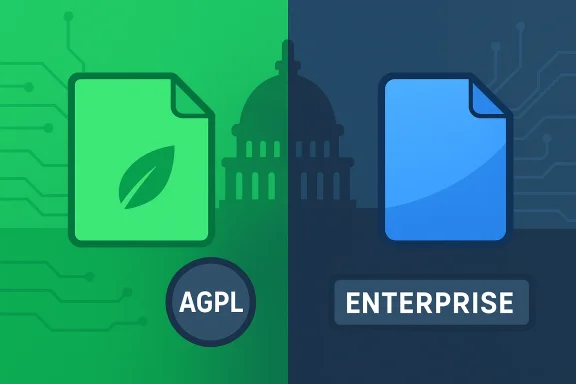
ONLYOFFICE publishes a Community Edition under the GNU Affero General Public License v3 (AGPL‑3.0) and offers commercial Enterprise/Developer/Cloud editions under proprietary terms. The vendor openly documents that the community product exists and that enterprise customers can buy support, advanced features, or different licensing options as needed. That hybrid model — open core or open + proprietary — is not unusual in commercial open‑source economics, but it is precisely the configuration TDF warns about when it calls something “fake open‑source.”Functionally, ONLYOFFICE markets high fidelity compatibility with Microsoft Office formats as a selling point. Users and administrators often pick ONLYOFFICE because it tends to render DOCX/XLSX/PPTX files more faithfully than some other alternatives, and because its collaborative cloud tools promote Microsoft‑style workflows. That fidelity is both a genuine technical achievement and a strategic positioning: it makes migration easier for organizations moving away from Microsoft’s desktop products while still needing to interoperate with Microsoft‑centric downstream partners. User reviews and comparison listings reflect that trade‑off, with some praising ONLYOFFICE for superior DOCX fidelity while others note limits in features and performance versus LibreOffice.
Why a hybrid license can be controversial
The AGPL community edition is indeed an OSI‑recognised free software license in spirit, but the AGPL’s network‑use provisions, original‑notice rules, and the vendor’s reserved rights over trademarks or proprietary add‑ons can make the user experience different from projects that are purely community governed. Critics of hybrid models point out several practical concerns:- The company controls which features are gated behind commercial tiers.
- Enterprise contracts can include integrations and services that require proprietary backends or cloud services.
- Marketing a project as “open source” while steering revenue through proprietary services can create lock‑in risk if migration paths rely on the vendor’s cloud or proprietary connectors.
The technical reality: compatibility vs. standard‑led interoperability
Why DOCX compatibility is complicated
Microsoft Office formats, especially in their practical day‑to‑day use, are not a single cleanly specified target. OOXML exists as ISO/IEC 29500, but Microsoft’s implementation historically relied on a set of transitional behaviors and legacy pragmatics to preserve thousands of bits of backward compatibility. That makes full, byte‑perfect interoperability exceedingly difficult. Implementers must contend with:- Ambiguities and enormous specification size: tens of thousands of pages and many implementation examples that still don’t validate against supplied schemas.
- Legacy compatibility behaviors: applications need to reproduce Microsoft Office’s implementation bugs and quirks to ensure visual and functional parity.
- Macro and extension models: macro languages (VBA) and embedded behaviors often cannot be replicated by third parties without proprietary dependencies.
Where LibreOffice’s approach diverges
LibreOffice prioritizes the Open Document Format (ODF), which is intentionally designed to be implementable by multiple projects without vendor capture. TDF argues that supporting ODF as the native or preferred interchange format — and ensuring public‑sector documents are stored and exchanged in ODF where possible — helps avoid the creeping entrenchment of proprietary semantics. In short: compatibility is useful, but it shouldn’t be the primary driver of procurement and policy when it substitutes for a commitment to open standards.Political economy: vendor lock‑in, procurement, and sovereignty
Why governments care
The stakes are not abstract. When public institutions adopt formats and workflows that hinge on proprietary vendor behavior, they create long‑term dependencies that affect procurement flexibility, auditability, and national policy choices. TDF explicitly couches its argument in terms of digital sovereignty: a government that stores official records in a format that is only reliably produced and consumed by one vendor faces a political cost and a security exposure. This is the same argument that animated the OOXML debates and that still resonates for ministries deciding whether to insist on ODF for archival and public data exchange.The business incentives
From a vendor’s perspective, promoting DOCX fidelity is an obvious market lever. It reduces friction for customers who work in Microsoft-heavy environments and increases the chance that migrating organizations can continue to interoperate with vendors and partners who still use Microsoft 365. For a company selling subscriptions, cloud services, or enterprise support, that interoperability is a revenue enabler.For users and customers, the calculus is different. The short‑term value of compatibility must be balanced against the long‑term value of independence, especially when public data retention, legal discovery, and transparency are involved. TDF’s critique explicitly appeals to that long‑term view: the visible convenience of compatibility should not obscure the hidden costs of dependence.
Facts, claims, and what can be independently verified
Before offering analysis, it’s worth separating what’s demonstrable from what’s rhetoric.- The Document Foundation published an article arguing that OOXML is not a practical open standard and explicitly naming ONLYOFFICE as an example of a product that behaves like “fake open‑source.” That primary document is public on TDF’s site.
- ONLYOFFICE does publish a Community Edition under AGPL‑3.0 and markets enterprise editions under commercial terms; the vendor’s licensing FAQ and download pages document this hybrid model.
- OnlyOffice and many third‑party reviewers advertise and confirm that ONLYOFFICE typically offers good fidelity with Microsoft formats, which is a major selling point for users. Independent user reviews and directory entries note DOCX fidelity as a common reason for adoption.
- The OOXML standardization process was highly controversial in the 2000s, with heated public debate, claims of improper influence, and sustained technical criticism — a well‑documented history across multiple reputable outlets. That historical record is relevant to TDF’s analogy.
Risks and trade‑offs — a technical and civic checklist
Here’s the practical checklist IT teams and procurement officers should consider when evaluating office‑suite choices and format policies:- Data portability: confirm that exported documents can be reliably consumed by at least two independent implementations, and test complex real‑world documents (templates, macros, tracked changes, scientific spreadsheets).
- Licensing governance: evaluate whether the software’s governance model is community driven or company controlled, and whether that distinction matters for your compliance and continuity plans.
- Default formats: prefer configurations that default to open, well‑documented interchange formats (e.g., ODF) for archival and inter‑agency exchange while allowing Microsoft formats where necessary for external interoperability.
- Cloud dependencies: beware of “ease of use” features that require the vendor’s cloud or proprietary connectors if your organization requires on‑premise control.
- Long‑term archival strategy: ensure that archival documents are convertible to neutral formats and that conversion tools are themselves under open governance or at least well‑documented.
- Interoperability testing: implement regular regression testing across your organization’s most important document types, not just single‑file taste tests.
Responses, pushback, and the marketplace
How ONLYOFFICE can — and often does — defend its position
ONLYOFFICE and similar vendors can make a straightforward, defensible case: users need tools that make their lives easier today, and many organizations accept modest proprietary risk in exchange for immediate fidelity and collaboration features. The hybrid licensing model funds ongoing development, security updates, and support — which enterprises value and sometimes require. Additionally, community editions under AGPL provide transparency and auditability that pure proprietary offerings do not. This is a legitimate marketplace position, even if it does not satisfy purists.LibreOffice’s counter‑proposal
TDF’s counter‑proposal is structural: insist on open standards (ODF), prioritize community‑governed implementations for public documents, and use compatibility layers for temporary interop rather than default workflows. That model aims to minimize future switching costs and to align public procurement with the principles of auditability and vendor neutrality. It is a political and technical strategy as much as it is a software preference.Recommendations for IT leaders and policy makers
- Run real‑world interoperability tests. Don’t rely on vendor demo files; test your actual templates, macros, and reporting spreadsheets across candidate suites.
- Set default archival formats. For records retention, choose open, documented formats (ODF or other neutral archival standards) and make export/conversion part of the workflow.
- Treat hybrid open‑core vendors as commercial partners, not as community governance substitutes. Require clear SLAs, data‑export guarantees, and documented migration paths in procurement contracts.
- Audit cloud dependencies. If features require vendor cloud services, demand contractual guarantees about data access, portability, and escrow.
- Use multi‑vendor strategies for critical workflows. Where possible, validate documents using two independent readers/writers to catch subtle interoperability failures early.
- Educate stakeholders about long‑term costs. Explain that short‑term convenience is often cheaper but that hidden switching costs can be a larger line item in future budgets.
A sober assessment
TDF’s language is pointed: calling a competitor “fake open‑source” is designed to mobilize community sentiment and influence procurement policy. That rhetorical move will galvanize LibreOffice supporters and public‑sector defenders of ODF, and it will likely put pressure on hybrid vendors to clarify governance and interoperability commitments. At the same time, it risks oversimplifying complex, pragmatic trade‑offs that many organizations face: fidelity to legacy documents, workforce productivity, vendor support, and cost.From a technical standpoint, BOTH sides are right about different things. ONLYOFFICE is right that compatibility matters in the real world and that investing in DOCX fidelity solves real business pain. LibreOffice and TDF are right that standards and governance matter for long‑term public‑interest outcomes. The productive middle ground is not to ban compatibility but to insist it be paired with robust portability, open archival defaults, and contractual protections that prevent vendor practices from becoming irreversible dependencies.
What to watch next
- Will ONLYOFFICE issue a public response clarifying its stance on default formats, migration guarantees, and how its enterprise services interact with Microsoft ecosystems? Observers should watch vendor channels for statements or updated licensing and migration documentation.
- Will public agencies revise procurement rules to require ODF‑native storage for records and interoperability proof for proprietary formats? Several European governments have signaled interest in this direction; procurement policy changes would materially shift vendor incentives.
- Will industry or standards bodies produce clearer certification programs for “interoperable implementations” that go beyond ISO labelling to practical, testable conformance suites? That would help convert abstract standards into everyday guarantees.
Conclusion
The Document Foundation’s charge against ONLYOFFICE has reignited a debate that is both technical and political. It is not enough to trade the rhetoric of “open‑source” back and forth; organizations must ask: who controls the semantics of our documents, who guarantees access over decades, and who answers when format mismatches imperil legal or operational requirements?The practical answer for most IT teams is pragmatic: use compatibility tools where they reduce migration pain, but anchor your archives, your procurement rules, and your governance in documented open standards and contractual protections that preserve long‑term choice. The battle between LibreOffice and ONLYOFFICE is not merely about ideology — it is a real‑world contest over how we keep control of our digital words, numbers, and presentations in an era when formats are the rails that carry our civic and commercial record.
Source: Neowin LibreOffice blasts 'fake open source' OnlyOffice for working with Microsoft to lock users in
