

The federal government is preparing to let OMB Memorandum M-25-03, the implementation guidance for the Federal Data Center Enhancement Act, expire on September 30, 2026, leaving agencies without a clear successor framework for federal data center operations, according to recent reporting and public policy documents. That is not a small paperwork lapse. It is a quiet retreat from centralized discipline at the same moment Washington is asking its infrastructure to carry heavier AI, cloud, cybersecurity, and public-service workloads. The result may not be an overnight collapse, but it does threaten something more familiar to federal IT: drift.
For more than a decade, federal data center policy has been animated by a simple idea: the government had too many server rooms, too little visibility, and not enough centralized accountability. The earliest consolidation efforts were blunt instruments, but they pushed agencies to inventory facilities, close redundant sites, and rethink whether every bureau needed its own bespoke infrastructure kingdom. That work was never glamorous, but it mattered because federal IT tends to sprawl when nobody is forced to count it.
M-25-03 was not a sweeping new industrial policy. It was implementation guidance, issued in January 2025, meant to translate the Federal Data Center Enhancement Act into operational expectations for agencies. It told agencies to think about data centers through the lenses of resilience, cybersecurity, availability, physical security, energy use, water use, automated monitoring, and CIO-level oversight.
That sounds bureaucratic because it is. But bureaucracy is often the difference between a federal agency having a defensible infrastructure plan and having a collection of facilities, contracts, and exceptions nobody can fully explain. The memo’s coming expiration matters because it removes a common operating grammar from agencies that already struggle to coordinate across missions, vendors, and budget cycles.
The uncomfortable irony is that the rule is expiring just as the federal data center is becoming more important, not less. Agencies are experimenting with AI models, expanding digital services, modernizing legacy systems, and depending more deeply on hybrid cloud designs. The workload is moving faster than the governance, and Washington appears ready to make the governance thinner.
Data center consolidation tried to change that. The Federal Data Center Consolidation Initiative and later optimization efforts pushed agencies to identify what they had, retire what they did not need, and move toward shared, virtualized, cloud, or colocation environments where appropriate. The work was imperfect, and some closures were easier to claim than to verify, but the direction was clear: fewer unmanaged islands and more accountable infrastructure.
M-25-03 belonged to the next phase of that project. Instead of merely asking whether a data center should exist, it asked whether a data center could support mission availability, withstand disruptions, manage energy use, and fit into agency-level IT planning. That shift was important because the federal infrastructure problem has changed. The question is no longer only “can we close this server room?” but “can this environment support the kind of workloads government is about to depend on?”
Letting the guidance expire risks nudging agencies backward. Not necessarily into rows of dusty departmental servers, but into a looser world where agency practices diverge, procurement language becomes inconsistent, and performance expectations become negotiable. Federal IT does not need a formal permission slip to fragment. It only needs ambiguity.
But that is also why the memo was more measured than its critics may suggest. It distinguished between agency-operated, contractor-operated, and broad commercial cloud environments. It recognized that applying federal data center requirements to every private facility supporting a commercial cloud service may not be practicable. It also leaned on risk management rather than pretending every federal workload needed identical uptime or identical architecture.
In other words, the guidance already reflected the messy reality of hybrid government computing. It did not order every agency to build new hardened facilities or impose a single technical design. It told agencies to centralize decision-making, assess availability needs, use automated management where appropriate, consider energy and water consumption, and treat physical and cyber risk as part of the same infrastructure conversation.
That is not regulatory overreach. That is basic portfolio hygiene. If anything, the memo’s weakness was that it depended on agencies doing the hard internal work of applying general requirements to specific environments. Removing it does not remove complexity; it removes one of the few shared mechanisms for managing complexity.
That “somewhere” matters. A chatbot for benefits navigation, an AI-assisted fraud detection tool, a cyber defense model, or an intelligence analysis workflow may depend on cloud regions, colocation facilities, agency data centers, edge environments, and contractor-operated systems. If agencies do not have consistent standards for availability, security, monitoring, and procurement oversight, the weakest link may be a facility decision made years earlier under a different budget justification.
The federal government is also not buying AI in a vacuum. It is buying AI from the same hyperscale ecosystem that is racing to secure power, chips, land, cooling systems, and network capacity for commercial customers. Amazon Web Services, Microsoft Azure, Google Cloud, Oracle, and specialized AI infrastructure firms will all continue to court government workloads. Agencies need clear standards not because vendors are inherently untrustworthy, but because procurement without benchmarks invites vague promises.
For WindowsForum readers, this is where the policy story intersects with everyday enterprise reality. Every sysadmin knows what happens when platform teams, facilities teams, procurement teams, and security teams operate from different assumptions. The outage postmortem writes itself: unclear ownership, undocumented dependencies, misunderstood redundancy, monitoring gaps, and a contract that looked fine until the service actually failed.
The M-25-03 framework acknowledged this distinction. It did not pretend that every commercial cloud facility could be governed like a server room inside a federal building. But it did try to ensure that when a data center is operated for an agency, or when an agency is making major infrastructure decisions, the CIO and procurement officials have a shared basis for evaluating risk.
That is especially important in hybrid environments, where Windows Server estates, identity infrastructure, endpoint management, databases, backup systems, and line-of-business applications may span on-premises facilities and public cloud. A federal agency can move an application front end to Azure or AWS and still depend on legacy authentication, data stores, network paths, or disaster recovery systems housed elsewhere. The data center problem follows the dependency graph.
The federal government has spent years telling agencies to modernize, adopt zero trust, improve identity security, and rationalize their IT portfolios. Those goals are hard to square with a retreat from infrastructure-level governance. You cannot meaningfully secure what you cannot inventory, measure, or assign to accountable leadership.
M-25-03 put energy and water into agency decision-making for a reason. Data centers consume significant resources, and efficiency is not merely a climate talking point. A facility that wastes power wastes money, reduces headroom, complicates resilience planning, and may become harder to expand when workloads grow.
The administration’s broader posture toward data centers has emphasized speed. Federal permitting policy has moved toward accelerating large AI data center and infrastructure projects, including projects with enormous power requirements. There is an argument for speed: the United States wants domestic AI infrastructure, supply chain resilience, and national security capacity. But speed without operational standards is not strategy. It is a bet that the market and agencies will coordinate themselves.
State and local governments are already discovering the political limits of that bet. Communities are pushing back on large data center projects over electricity bills, water use, noise, tax incentives, and land use. If the federal government is simultaneously accelerating buildout while relaxing its own internal operating framework, it risks sending a muddled signal: build faster, but do not expect Washington to define consistent rules for its own house.
That matters because cyber risk is not confined to software vulnerabilities. Power failures, cooling failures, poor physical access controls, brittle network paths, and weak monitoring can all become security incidents when they disrupt public services or expose sensitive systems. In federal environments, where systems may support law enforcement, health care, benefits, defense-adjacent functions, and critical public records, resilience is part of security.
The expiration of the memo does not repeal FISMA, zero trust mandates, FedRAMP requirements, CISA directives, or agency-specific security obligations. Agencies will still have many rules to follow. But that is exactly the point: the federal technology rulebook is already fragmented. M-25-03 helped connect data center operations to that broader security architecture.
Without it, agencies may still be secure on paper while losing a common operational bridge between facilities, infrastructure, cyber, and procurement teams. That gap is where real-world failures live. A policy can say “protect the system,” but someone still has to ask whether the facility hosting the system has the redundancy, monitoring, maintenance discipline, and physical controls the mission requires.
If the government removes a shared standard without replacing it, agencies will improvise. Some will borrow from the expired memo. Some will lean on internal policy. Some will defer to vendor language. Some will treat data center requirements as a technical appendix rather than a strategic risk issue. That unevenness is a gift to confusion.
Vendors, too, have a legitimate interest in clarity. Major cloud and infrastructure providers can comply with demanding requirements if those requirements are predictable. What they dislike is bespoke ambiguity: one agency asking for one interpretation of contractor-operated data center oversight, another asking for something different, and a third not asking at all until late in the procurement cycle.
The danger is not that every agency suddenly buys bad infrastructure. The danger is that the government loses leverage by becoming inconsistent. A single agency with unclear requirements is easier to manage around than an enterprise buyer with a coherent policy baseline. For a government that spends heavily on IT, coherence is part of market power.
But the answer to weak governance is better governance, not no governance. M-25-03 was valuable precisely because it pointed toward operational realities: CIO authority, automated monitoring, resource metrics, availability planning, and physical security. Those are not abstract compliance categories. They are the things administrators and infrastructure engineers actually care about when systems must stay online.
The administration may believe existing rules are enough. Agencies still operate under cybersecurity law, continuity requirements, acquisition regulations, and budget oversight. But data centers sit at the intersection of all those regimes, and intersections are where federal policy often fails. Without a coordinating framework, each discipline can assume another discipline owns the risk.
The federal government is very good at creating responsibility in the abstract. It is less good at creating ownership in practice. The expiring memo tried to make ownership more concrete by placing data center acquisition and operational management under agency CIO oversight. If that idea disappears, program-level autonomy may quietly reassert itself.
When federal agencies standardize around resilience and monitoring requirements, vendors tend to productize those expectations. When agencies fragment, vendors respond with more bespoke services, more contract-specific controls, and more integration burden. The ripple effects are not always obvious, but they show up in documentation, reference architectures, audit language, and the compliance assumptions baked into enterprise products.
This is also a reminder that “cloud-first” does not mean “infrastructure-last.” Windows environments in government and regulated industries often depend on hybrid identity, legacy application hosting, backup and recovery infrastructure, privileged access systems, and network segmentation that cannot be hand-waved away with a cloud migration slide. The facility layer still matters because the dependency layer still matters.
If anything, the AI boom makes traditional enterprise discipline more important. Models, copilots, and automated agents are only as trustworthy as the systems, data, permissions, and infrastructure beneath them. A brittle platform wrapped in AI is still brittle. It just fails faster and at larger scale.
OMB could still issue replacement guidance, extend the memo, or fold its requirements into another policy vehicle. Congress could also revisit the issue, though legislative calendars and technology governance rarely move at the same speed as infrastructure demand. The absence of a visible replacement today does not prove permanent abandonment, but it does create uncertainty at the worst possible moment.
The smartest agencies will not wait. They will keep CIO-level oversight of data center decisions, maintain inventories, use automated infrastructure monitoring, tie availability requirements to business impact analysis, and ensure procurement language includes resilience, physical security, energy, and water considerations. In other words, they will behave as if the memo’s core ideas remain useful even if the memo itself expires.
That is the odd thing about this policy fight. The disputed framework is not radical. It is the kind of operational baseline a mature enterprise would want anyway. If the federal government lets it vanish, the best-run agencies will likely preserve much of it locally, while weaker ones will be left with more room to drift.
That is how federal IT debt accumulates. Rarely through one catastrophic decision, and more often through thousands of local accommodations that seemed reasonable at the time. A server stays where it is because migration is expensive. A facility upgrade is deferred because the application owner promises modernization next year. A contract renews with yesterday’s availability assumptions because nobody wants to reopen the requirements.
The federal government has been here before. It spent years trying to unwind duplicative infrastructure and improve visibility because the old decentralized model produced waste and risk. Letting the current framework expire without replacement does not guarantee a return to that world, but it removes one of the safeguards against it.
The AI era should be forcing Washington toward sharper infrastructure governance. Instead, the federal government appears to be loosening the shared rules just as compute becomes more strategic, power becomes more contested, and cyber resilience becomes more inseparable from public trust. That is not modernization. It is optimism masquerading as policy.
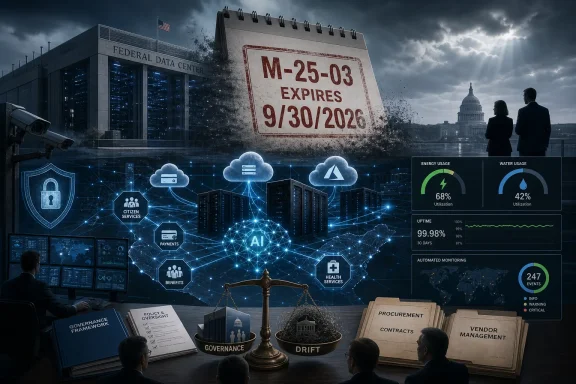 Washington Is Retiring the Rule Just as the Workload Gets Harder
For more than a decade, federal data center policy has been animated by a simple idea: the government had too many server rooms, too little visibility, and not enough centralized accountability. The earliest consolidation efforts were blunt instruments, but they pushed agencies to inventory facilities, close redundant sites, and rethink whether every bureau needed its own bespoke infrastructure kingdom. That work was never glamorous, but it mattered because federal IT tends to sprawl when nobody is forced to count it.M-25-03 was not a sweeping new industrial policy. It was implementation guidance, issued in January 2025, meant to translate the Federal Data Center Enhancement Act into operational expectations for agencies. It told agencies to think about data centers through the lenses of resilience, cybersecurity, availability, physical security, energy use, water use, automated monitoring, and CIO-level oversight.
That sounds bureaucratic because it is. But bureaucracy is often the difference between a federal agency having a defensible infrastructure plan and having a collection of facilities, contracts, and exceptions nobody can fully explain. The memo’s coming expiration matters because it removes a common operating grammar from agencies that already struggle to coordinate across missions, vendors, and budget cycles.
The uncomfortable irony is that the rule is expiring just as the federal data center is becoming more important, not less. Agencies are experimenting with AI models, expanding digital services, modernizing legacy systems, and depending more deeply on hybrid cloud designs. The workload is moving faster than the governance, and Washington appears ready to make the governance thinner.
The Old Data Center Sprawl Never Really Died
The federal government’s data center problem was never just about too many buildings. It was about duplicated spending, inconsistent security practices, underused equipment, weak energy visibility, and infrastructure decisions made too far from agency CIOs. In the old model, a program office could treat compute as a local procurement issue even when the consequences touched enterprise risk.Data center consolidation tried to change that. The Federal Data Center Consolidation Initiative and later optimization efforts pushed agencies to identify what they had, retire what they did not need, and move toward shared, virtualized, cloud, or colocation environments where appropriate. The work was imperfect, and some closures were easier to claim than to verify, but the direction was clear: fewer unmanaged islands and more accountable infrastructure.
M-25-03 belonged to the next phase of that project. Instead of merely asking whether a data center should exist, it asked whether a data center could support mission availability, withstand disruptions, manage energy use, and fit into agency-level IT planning. That shift was important because the federal infrastructure problem has changed. The question is no longer only “can we close this server room?” but “can this environment support the kind of workloads government is about to depend on?”
Letting the guidance expire risks nudging agencies backward. Not necessarily into rows of dusty departmental servers, but into a looser world where agency practices diverge, procurement language becomes inconsistent, and performance expectations become negotiable. Federal IT does not need a formal permission slip to fragment. It only needs ambiguity.
The Memo Was a Modest Guardrail, Not a Heavy-Handed Mandate
The case for letting M-25-03 lapse will probably be framed as deregulation, flexibility, and modernization. There is a plausible version of that argument. Federal agencies do not need another checklist that slows cloud adoption or forces them to retrofit every facility according to rigid central assumptions. Some workloads are unusual, some facilities are mission-specific, and commercial cloud infrastructure does not map neatly onto old government data center definitions.But that is also why the memo was more measured than its critics may suggest. It distinguished between agency-operated, contractor-operated, and broad commercial cloud environments. It recognized that applying federal data center requirements to every private facility supporting a commercial cloud service may not be practicable. It also leaned on risk management rather than pretending every federal workload needed identical uptime or identical architecture.
In other words, the guidance already reflected the messy reality of hybrid government computing. It did not order every agency to build new hardened facilities or impose a single technical design. It told agencies to centralize decision-making, assess availability needs, use automated management where appropriate, consider energy and water consumption, and treat physical and cyber risk as part of the same infrastructure conversation.
That is not regulatory overreach. That is basic portfolio hygiene. If anything, the memo’s weakness was that it depended on agencies doing the hard internal work of applying general requirements to specific environments. Removing it does not remove complexity; it removes one of the few shared mechanisms for managing complexity.
AI Turns Infrastructure Governance Into a Mission Risk
The AI angle is not a buzzword garnish here. AI workloads change the stakes of federal data center policy because they concentrate compute demand, increase power and cooling requirements, and create new dependencies between model development, sensitive data, cloud platforms, and specialized hardware. Even agencies that never train frontier models will increasingly consume AI-enabled services running somewhere in the government’s infrastructure chain.That “somewhere” matters. A chatbot for benefits navigation, an AI-assisted fraud detection tool, a cyber defense model, or an intelligence analysis workflow may depend on cloud regions, colocation facilities, agency data centers, edge environments, and contractor-operated systems. If agencies do not have consistent standards for availability, security, monitoring, and procurement oversight, the weakest link may be a facility decision made years earlier under a different budget justification.
The federal government is also not buying AI in a vacuum. It is buying AI from the same hyperscale ecosystem that is racing to secure power, chips, land, cooling systems, and network capacity for commercial customers. Amazon Web Services, Microsoft Azure, Google Cloud, Oracle, and specialized AI infrastructure firms will all continue to court government workloads. Agencies need clear standards not because vendors are inherently untrustworthy, but because procurement without benchmarks invites vague promises.
For WindowsForum readers, this is where the policy story intersects with everyday enterprise reality. Every sysadmin knows what happens when platform teams, facilities teams, procurement teams, and security teams operate from different assumptions. The outage postmortem writes itself: unclear ownership, undocumented dependencies, misunderstood redundancy, monitoring gaps, and a contract that looked fine until the service actually failed.
Cloud Does Not Magically Remove the Government’s Data Center Problem
One lazy interpretation of this story is that federal data center rules matter less because agencies are moving to cloud. That gets the architecture backward. Cloud changes where infrastructure is located and how capacity is consumed; it does not eliminate the government’s responsibility to understand resilience, security, availability, and cost.The M-25-03 framework acknowledged this distinction. It did not pretend that every commercial cloud facility could be governed like a server room inside a federal building. But it did try to ensure that when a data center is operated for an agency, or when an agency is making major infrastructure decisions, the CIO and procurement officials have a shared basis for evaluating risk.
That is especially important in hybrid environments, where Windows Server estates, identity infrastructure, endpoint management, databases, backup systems, and line-of-business applications may span on-premises facilities and public cloud. A federal agency can move an application front end to Azure or AWS and still depend on legacy authentication, data stores, network paths, or disaster recovery systems housed elsewhere. The data center problem follows the dependency graph.
The federal government has spent years telling agencies to modernize, adopt zero trust, improve identity security, and rationalize their IT portfolios. Those goals are hard to square with a retreat from infrastructure-level governance. You cannot meaningfully secure what you cannot inventory, measure, or assign to accountable leadership.
Energy and Water Are Now Operational Constraints, Not Public Relations Issues
Data centers used to be discussed inside government mostly as cost centers and security environments. In the AI era, they are also energy and water actors. Power availability, cooling strategy, grid interconnection, backup generation, and local environmental constraints are no longer peripheral concerns. They determine whether capacity can be built, whether it can be afforded, and whether communities will tolerate it.M-25-03 put energy and water into agency decision-making for a reason. Data centers consume significant resources, and efficiency is not merely a climate talking point. A facility that wastes power wastes money, reduces headroom, complicates resilience planning, and may become harder to expand when workloads grow.
The administration’s broader posture toward data centers has emphasized speed. Federal permitting policy has moved toward accelerating large AI data center and infrastructure projects, including projects with enormous power requirements. There is an argument for speed: the United States wants domestic AI infrastructure, supply chain resilience, and national security capacity. But speed without operational standards is not strategy. It is a bet that the market and agencies will coordinate themselves.
State and local governments are already discovering the political limits of that bet. Communities are pushing back on large data center projects over electricity bills, water use, noise, tax incentives, and land use. If the federal government is simultaneously accelerating buildout while relaxing its own internal operating framework, it risks sending a muddled signal: build faster, but do not expect Washington to define consistent rules for its own house.
Security Standards Do Not Enforce Themselves
The cyber implications are more subtle than the energy implications, but arguably more serious. M-25-03 tied data center operations to existing cybersecurity and physical security frameworks rather than inventing a separate security universe. It pushed agencies to consider availability risks, intrusion risks, physical countermeasures, continuity planning, and the relationship between infrastructure and mission impact.That matters because cyber risk is not confined to software vulnerabilities. Power failures, cooling failures, poor physical access controls, brittle network paths, and weak monitoring can all become security incidents when they disrupt public services or expose sensitive systems. In federal environments, where systems may support law enforcement, health care, benefits, defense-adjacent functions, and critical public records, resilience is part of security.
The expiration of the memo does not repeal FISMA, zero trust mandates, FedRAMP requirements, CISA directives, or agency-specific security obligations. Agencies will still have many rules to follow. But that is exactly the point: the federal technology rulebook is already fragmented. M-25-03 helped connect data center operations to that broader security architecture.
Without it, agencies may still be secure on paper while losing a common operational bridge between facilities, infrastructure, cyber, and procurement teams. That gap is where real-world failures live. A policy can say “protect the system,” but someone still has to ask whether the facility hosting the system has the redundancy, monitoring, maintenance discipline, and physical controls the mission requires.
Procurement Will Feel the Vacuum First
The most immediate pain may show up in acquisition offices. Federal procurement depends on language that can be reused, audited, and defended. When agencies buy colocation, managed infrastructure, cloud-adjacent services, or data center modernization work, they need benchmarks for availability, monitoring, security, resource efficiency, and operational accountability.If the government removes a shared standard without replacing it, agencies will improvise. Some will borrow from the expired memo. Some will lean on internal policy. Some will defer to vendor language. Some will treat data center requirements as a technical appendix rather than a strategic risk issue. That unevenness is a gift to confusion.
Vendors, too, have a legitimate interest in clarity. Major cloud and infrastructure providers can comply with demanding requirements if those requirements are predictable. What they dislike is bespoke ambiguity: one agency asking for one interpretation of contractor-operated data center oversight, another asking for something different, and a third not asking at all until late in the procurement cycle.
The danger is not that every agency suddenly buys bad infrastructure. The danger is that the government loses leverage by becoming inconsistent. A single agency with unclear requirements is easier to manage around than an enterprise buyer with a coherent policy baseline. For a government that spends heavily on IT, coherence is part of market power.
The Deregulatory Argument Mistakes Paperwork for Governance
There is a fair critique of federal technology policy that says Washington often confuses issuing memoranda with making systems better. Anyone who has worked near federal IT has seen compliance theater: dashboards that lag reality, inventories that depend on heroic manual updates, and modernization plans that outlive the systems they were meant to replace. A memo is not a data center strategy.But the answer to weak governance is better governance, not no governance. M-25-03 was valuable precisely because it pointed toward operational realities: CIO authority, automated monitoring, resource metrics, availability planning, and physical security. Those are not abstract compliance categories. They are the things administrators and infrastructure engineers actually care about when systems must stay online.
The administration may believe existing rules are enough. Agencies still operate under cybersecurity law, continuity requirements, acquisition regulations, and budget oversight. But data centers sit at the intersection of all those regimes, and intersections are where federal policy often fails. Without a coordinating framework, each discipline can assume another discipline owns the risk.
The federal government is very good at creating responsibility in the abstract. It is less good at creating ownership in practice. The expiring memo tried to make ownership more concrete by placing data center acquisition and operational management under agency CIO oversight. If that idea disappears, program-level autonomy may quietly reassert itself.
Windows Shops Should Read This as an Infrastructure Story, Not a Washington Oddity
For Windows administrators and enterprise architects, the federal data center rule may sound remote. It is not. Federal agencies remain massive Windows, Active Directory, Entra ID, Microsoft 365, SQL Server, Azure, endpoint management, and hybrid infrastructure customers. Their governance decisions influence procurement patterns, vendor roadmaps, compliance templates, and managed service expectations across the broader market.When federal agencies standardize around resilience and monitoring requirements, vendors tend to productize those expectations. When agencies fragment, vendors respond with more bespoke services, more contract-specific controls, and more integration burden. The ripple effects are not always obvious, but they show up in documentation, reference architectures, audit language, and the compliance assumptions baked into enterprise products.
This is also a reminder that “cloud-first” does not mean “infrastructure-last.” Windows environments in government and regulated industries often depend on hybrid identity, legacy application hosting, backup and recovery infrastructure, privileged access systems, and network segmentation that cannot be hand-waved away with a cloud migration slide. The facility layer still matters because the dependency layer still matters.
If anything, the AI boom makes traditional enterprise discipline more important. Models, copilots, and automated agents are only as trustworthy as the systems, data, permissions, and infrastructure beneath them. A brittle platform wrapped in AI is still brittle. It just fails faster and at larger scale.
The September Deadline Leaves Agencies With a Choice They Should Not Have to Make
The September 30, 2026 sunset creates a practical problem: agencies must decide whether to continue treating M-25-03 as a de facto best-practice document, wait for new direction, or reinterpret their obligations through existing rules. None of those options is ideal. Continuing voluntarily preserves discipline but weakens enforceability. Waiting invites paralysis. Reinterpreting obligations agency by agency creates inconsistency.OMB could still issue replacement guidance, extend the memo, or fold its requirements into another policy vehicle. Congress could also revisit the issue, though legislative calendars and technology governance rarely move at the same speed as infrastructure demand. The absence of a visible replacement today does not prove permanent abandonment, but it does create uncertainty at the worst possible moment.
The smartest agencies will not wait. They will keep CIO-level oversight of data center decisions, maintain inventories, use automated infrastructure monitoring, tie availability requirements to business impact analysis, and ensure procurement language includes resilience, physical security, energy, and water considerations. In other words, they will behave as if the memo’s core ideas remain useful even if the memo itself expires.
That is the odd thing about this policy fight. The disputed framework is not radical. It is the kind of operational baseline a mature enterprise would want anyway. If the federal government lets it vanish, the best-run agencies will likely preserve much of it locally, while weaker ones will be left with more room to drift.
The Real Cost of the Sunset Will Be Paid in Exceptions
The cleanest way to understand this story is not as a dramatic deregulation event, but as an exception factory. Once the common framework disappears, every agency, program, contract, and vendor relationship gains more room to define its own version of “good enough.” Some of those definitions will be responsible. Others will be shaped by budget pressure, schedule pressure, or institutional inertia.That is how federal IT debt accumulates. Rarely through one catastrophic decision, and more often through thousands of local accommodations that seemed reasonable at the time. A server stays where it is because migration is expensive. A facility upgrade is deferred because the application owner promises modernization next year. A contract renews with yesterday’s availability assumptions because nobody wants to reopen the requirements.
The federal government has been here before. It spent years trying to unwind duplicative infrastructure and improve visibility because the old decentralized model produced waste and risk. Letting the current framework expire without replacement does not guarantee a return to that world, but it removes one of the safeguards against it.
The AI era should be forcing Washington toward sharper infrastructure governance. Instead, the federal government appears to be loosening the shared rules just as compute becomes more strategic, power becomes more contested, and cyber resilience becomes more inseparable from public trust. That is not modernization. It is optimism masquerading as policy.
The Practical Read for September 30
The approaching sunset should be read less as an isolated bureaucratic deadline and more as a test of whether federal IT modernization can survive without a central referee. The following are the concrete implications to watch as September approaches:- Agencies will need to decide whether to preserve M-25-03 practices internally even if the formal guidance expires.
- Procurement teams may face more inconsistent requirements for colocation, managed infrastructure, and contractor-operated data center services.
- CIOs could lose a useful policy basis for centralizing data center acquisition and operational decisions across sprawling agency portfolios.
- Energy and water efficiency may become easier to sideline in facility decisions unless agencies keep those metrics in their own review processes.
- Security teams should watch for gaps between cyber compliance language and the physical, operational, and availability realities of the facilities supporting federal systems.
- Vendors serving federal customers should prepare for ambiguity rather than assume a lighter rulebook will mean simpler deals.
References
- Primary source: The Tech Buzz
Published: 2026-06-15T10:30:10.104340
Federal Data Center Rule Set to Expire With No Replacement | The Tech Buzz
Government agencies face uncertainty as key data center regulation sunsets in Septemberwww.techbuzz.ai - Related coverage: cryptobriefing.com
US government allows key data center regulation to expire in September
The US government will let federal data center regulation expire in September 2026 with no replacement, shifting oversight to states amid 300 new bills.cryptobriefing.com - Related coverage: epa.gov
EPA Prioritizes Review of New Chemicals Used in Data Center Projects, Supporting American Manufacturing and Technological Advancement | US EPA
Following a roundtable with AI and data center leaders at the White House on Monday, U.S. Environmental Protection Agency Administrator Lee Zeldin announced that it will be prioritizing the review of new chemicals under the Toxic Substances Control Act.www.epa.gov - Related coverage: whitehouse.gov
M 25 03 Implementation Guidance for the Federal Data Center Enhancement Act
PDF documentwww.whitehouse.gov
- Related coverage: centerforcybersecuritypolicy.org
CISA Shifts Federal Cyber Security Landscape with Sweeping Mandate to Replace End-Of-Life Network Devices
CISA issued a compulsory directive to all federal agencies targeting boundary network devices that are “end-of-service." www.centerforcybersecuritypolicy.org
- Related coverage: arstechnica.com
After banning foreign routers, FCC says existing ones can get updates until 2029 - Ars Technica
FCC extends waiver allowing routers and drones to get patches for two more years.arstechnica.com
- Related coverage: hsgac.senate.gov
- Related coverage: thefederalregister.org

Accelerating Federal Permitting of Data Center Infrastructure | 90 FR 35385
Executive Order 14318 of July 23, 2025 Accelerating Federal Permitting of Data Center Infrastructure By the authority vested in me as President by the Constitution and the laws ...
thefederalregister.org
- Related coverage: wired.com
The US Government Will Ask Data Centers How Much Power They Use | WIRED
In a letter obtained by WIRED, the Energy Information Administration tells two senators that it plans to develop a mandatory assessment of data centers' energy use.www.wired.com - Related coverage: energy-tech-summit.wired.com

