

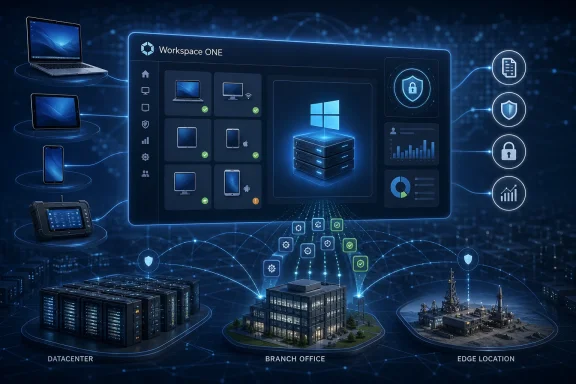
Omnissa added Windows Server management to Workspace ONE UEM on May 6, 2026, making server administration generally available in the same cloud-based console customers use for desktops, mobile devices, rugged endpoints, Linux systems and connected equipment across modern enterprise estates. The move is not just another checkbox in a UEM release; it is a bid to collapse one of enterprise IT’s most durable boundaries. Omnissa is arguing that servers have become endpoints in every way that matters operationally: distributed, policy-bound, security-sensitive and expensive to manage badly.
For years, unified endpoint management has carried an implicit boundary. Laptops, phones, tablets, kiosks and rugged handhelds belonged in the UEM estate; servers lived somewhere else, usually in a stack of older tools, scripts, domain assumptions and team-specific rituals. Omnissa’s Windows Server support challenges that line by saying the management plane should follow the device’s operational role, not its historical label.
That is a provocative argument because servers are not just “bigger endpoints.” They run line-of-business applications, identity-adjacent services, virtual desktop infrastructure, databases, middleware, AI workloads and internal automation. A bad mobile policy can irritate users; a bad server policy can interrupt revenue, compliance reporting or production operations.
Still, Omnissa’s thesis has force. The practical work of server administration increasingly overlaps with endpoint administration: baseline configuration, patch orchestration, inventory, compliance posture, remote troubleshooting and security remediation. If those workflows are duplicated across different products, organisations pay twice — once in licensing and again in operational drag.
The announcement also arrives as Omnissa continues to define itself after the former VMware end-user computing business became an independent workplace software company. Workspace ONE and Horizon have always been central to that identity. Extending Workspace ONE UEM into Windows Server management is a way of saying Omnissa is not content to be remembered as the company that managed employee devices; it wants to manage the digital work estate.
That comparison will raise eyebrows, because Configuration Manager is not merely a server-management tool. In many organisations it is a patching engine, software distribution system, reporting source, compliance mechanism and institutional memory bank. It is often surrounded by custom collections, task sequences, maintenance windows, SQL reporting and years of hard-won operational knowledge.
But that is exactly why Omnissa is attacking it. Legacy management platforms are sticky not only because they work, but because they have accumulated process around them. The downside is that they can become expensive to run, difficult to modernise and awkward to extend to distributed environments that no longer look like a neat corporate LAN.
Omnissa’s pitch is that Workspace ONE customers should not need a separate server administration island if the same policy engine, automation model and visibility layer can cover more of the estate. That promise will appeal most to organisations already paying for Workspace ONE, already training staff on its workflows and already looking for places to reduce infrastructure dependencies.
The harder sell is to server teams that see endpoint management as a different discipline. They will want evidence that Workspace ONE can handle the operational nuance of servers without flattening everything into mobile-device-style policy pushes. Omnissa does not have to convince every server administrator overnight, but it does have to prove that consolidation does not mean oversimplification.
For security teams, this cuts both ways. A cloud-native control plane can help maintain visibility when servers are not reliably attached to corporate networks. It can also reduce dependence on VPN paths, on-premises management servers and brittle firewall exceptions. In a world where ransomware operators routinely target management infrastructure, fewer privileged on-premises systems can be a meaningful reduction in attack surface.
But the same shift introduces new questions. If the UEM console becomes a management surface for servers, its identity controls, administrator roles, audit logs and conditional access posture become more important. A compromised endpoint-management platform is already a serious incident; a compromised endpoint-and-server-management platform is a larger blast radius.
That is why Omnissa’s security language deserves careful reading. Baseline enforcement, automated patching, remote inventory, access-log visibility and AI-assisted issue detection are valuable capabilities, but they are not magic. They are only as strong as the governance around them: who can assign policies, how changes are approved, how exceptions are documented and how quickly misconfigurations are detected.
The strongest case for the new capability is not that it eliminates server risk. It is that it may make risk more visible and more consistently governed. Many organisations already have servers outside ideal management coverage. Pulling them into a common console could be an improvement, provided the console itself is treated as critical infrastructure.
The company says administrators can gather remote inventory data, including installed roles and access logs. That is useful because Windows Server is not a uniform category. A lightly used file server, a Remote Desktop Session Host, a domain-joined application server and an infrastructure component supporting virtual desktops may all run Windows Server, but they have very different risk profiles.
Support for Windows Server 2016 and later through Workspace ONE Intelligent Hub gives Omnissa a plausible baseline. It also neatly aligns with the reality that enterprises rarely run only the newest server release. A management platform that ignores older supported versions would miss too much of the installed base to matter.
The more interesting point is the Intelligent Hub approach. Omnissa has been pushing a model of Windows management that relies less on traditional MDM plumbing and more on its agent-based capabilities. For desktops, that gives customers migration flexibility. For servers, it may be even more important, because administrators are unlikely to accept a management scheme that depends on consumer-device assumptions.
This is where Omnissa can differentiate itself from both legacy configuration management and narrower remote monitoring tools. If Workspace ONE can combine inventory, policy, application control, patching, remote support and compliance posture in a way that respects server operational constraints, it becomes more than a convenience feature. If it cannot, customers will treat it as a partial overlay and keep the old tools anyway.
That makes Omnissa’s positioning delicate. It cannot credibly pretend Microsoft is absent from server management, nor can it win by being a slightly different console for the same tasks. Its opportunity lies in customers whose endpoint and workplace operations already revolve around Workspace ONE, especially where they want one management fabric across physical, virtual and remote estates.
There is also an organisational angle. Microsoft’s tools often map to Microsoft-centric teams: endpoint teams in Intune or Configuration Manager, identity teams in Entra, cloud teams in Azure, server teams in Windows Admin Center or System Center. Omnissa is proposing a cross-cutting operational model instead, one that follows digital work rather than Microsoft product boundaries.
That may resonate with companies running mixed environments. Workspace ONE has long appealed to organisations managing diverse fleets rather than pure Windows estates. Adding Windows Server to that picture lets Omnissa argue that the same platform can govern more of the infrastructure behind employee experience, not just the devices employees hold.
But Microsoft’s advantage remains formidable. It owns the platform, the licensing relationships and much of the administrative muscle memory. Omnissa will need to win on simplicity, cost, visibility and cross-platform consistency, because it is unlikely to win by out-Microsofting Microsoft.
Server administration is a conservative discipline for good reason. Administrators may welcome recommendations, anomaly detection and prioritised remediation, but they will be wary of automated actions that lack context. A server with unusual CPU patterns may be under attack, misconfigured or simply running an expected month-end workload.
The useful version of AI here is not a dramatic autonomous administrator. It is triage, correlation and noise reduction. If Workspace ONE can surface which servers are missing a baseline, which ones are drifting from policy, which access events look abnormal and which patch failures require attention first, it can save time without pretending that judgement has been automated away.
That distinction matters because Omnissa is also using the phrase “autonomous endpoint management” as part of its broader platform story. Autonomy in client device management is already a sensitive topic; autonomy in server management will be more sensitive still. Enterprises will want guardrails, approval workflows and auditability before allowing automated remediation to touch critical systems.
The better reading of Omnissa’s move is that AI is seasoning, not the meal. The substantive product shift is bringing server inventory, configuration, patching and remote operations into a UEM model. If the automation is reliable, administrators will care. If it is merely branded as intelligent, they will not.
That matters because server management decisions are rarely made by one team in isolation. Endpoint administrators may like Workspace ONE. Server administrators may trust existing tools. Security teams may want stronger baseline enforcement. Finance may want fewer renewals. Integrators often become the translators among those groups.
Omnissa’s announcement gives partners a consolidation story they can take to customers already invested in Workspace ONE. The argument is straightforward: if you own the platform and trust it for desktops and mobile devices, why leave Windows Server outside the governance model? That is a compelling conversation in organisations where tool rationalisation is now a budget mandate.
The risk is that consolidation projects often uncover hidden dependencies. A server management tool may be tied to compliance reports, operational dashboards, service-desk processes or patch committees that no one fully documented. Replacing it with Workspace ONE may be possible, but it will not be as simple as enabling a new device type.
Omnissa will therefore need strong migration guidance, partner playbooks and clear coexistence patterns. Customers will not abandon established server tooling in one move. The likely path is phased adoption: inventory first, baseline policy next, patching and remote support later, with critical workloads moving only after confidence builds.
Windows Server management fits that moment. It extends Workspace ONE beyond the classic endpoint perimeter while staying close to Omnissa’s workplace roots. Servers are increasingly part of the employee experience, whether they deliver virtual desktops, host internal applications, power automation or support AI services used by staff.
That is an important framing shift. Omnissa is not trying to become a general-purpose data-center management company overnight. It is trying to argue that the infrastructure supporting work should be managed with the same visibility and policy discipline as the endpoints where work happens.
This also helps explain why the company is emphasizing cloud-native management and operational consistency. The post-VMware Omnissa needs a story that is not simply “we still sell the products you used before.” It needs a story about where workplace infrastructure is going. Server management gives it a credible bridge from endpoint administration to broader digital operations.
The challenge is focus. Workspace ONE already spans mobile, desktop, rugged, virtual and connected devices. Adding servers expands the surface area and raises expectations. If Omnissa spreads the platform too thin, it risks disappointing the very administrators it is trying to recruit.
Distributed infrastructure is another natural fit. Branch servers, edge systems, VDI support servers and smaller application hosts can be difficult to manage through traditional on-premises tooling, especially when network paths are inconsistent or security segmentation is strict. A cloud-delivered management plane may make those systems easier to see and govern.
Regulated organisations will be interested but cautious. Baseline enforcement and compliance visibility are attractive, yet auditors and internal risk teams will want evidence that controls are consistent, reports are reliable and privilege boundaries are clear. Omnissa’s job is to make the compliance story concrete rather than aspirational.
There is also a staffing angle. Many IT departments are being asked to support more devices, more locations and more security requirements without proportional headcount growth. A tool that lets existing Workspace ONE administrators extend familiar workflows to servers could help, particularly in midmarket and enterprise environments where specialist teams are stretched.
The slowest adopters may be those with highly customised System Center estates or heavily automated PowerShell and configuration-as-code workflows. They may still use Workspace ONE for visibility or selected policy tasks, but full replacement will require proof that the new model can match years of tailored operational logic.
Omnissa’s answer is yes, but that answer will not be universal. Some organisations will resist cloud-mediated server administration for sovereignty, latency, security or cultural reasons. Others will see the cloud console as a practical necessity because their infrastructure is already scattered across environments that a traditional management server cannot easily reach.
The broader market trend favours Omnissa’s argument. Endpoint management, identity, security posture management and vulnerability remediation are all moving toward cloud-connected control planes. Servers are no longer exempt from that trend, especially as workloads become more distributed and administrators expect remote visibility by default.
But the market also punishes vague convergence. “One console” is useful only if the underlying capabilities are deep enough. IT teams do not need another dashboard that shows incomplete status. They need a control plane that can execute, verify and report without becoming another silo.
That is the bar Omnissa has set for itself. By inviting Windows Server into Workspace ONE UEM, it is no longer speaking only to endpoint administrators. It is stepping into a tougher operational conversation where uptime, change control and server-specific nuance matter as much as policy elegance.
The weaker parts are the broad claims that every enterprise vendor now makes: autonomous operations, AI-driven insight, simplified everything. Those may become true in specific workflows, but administrators will believe them only after seeing fewer tickets, cleaner audits and more predictable patch cycles. Operational credibility is earned in production, not in launch copy.
The cost comparison to Microsoft’s traditional management stack is also important but incomplete. Licensing is only one part of cost. Migration effort, training, integration work, reporting changes, governance redesign and coexistence all count. A cheaper product can still be an expensive project if the transition is mishandled.
Even so, Omnissa has identified a real pressure point. Enterprise IT has spent years separating endpoint and server operations because the tools, teams and risks were different. Now the estate is more distributed, security demands are tighter and the need for consistent policy is harder to ignore. The old separation is becoming more costly to defend.
That trust will be easier to earn among existing Workspace ONE customers. They already understand the console, the policy model and the support relationship. For them, Windows Server management may feel like a natural extension of a platform they have already standardised on.
For organisations outside the Workspace ONE base, the argument is tougher. They will compare Omnissa not only with Microsoft, but with established server operations tooling, security platforms, remote monitoring products and cloud management services. Omnissa will need to show that the unified model creates enough value to justify another strategic platform decision.
The good news for Omnissa is that the industry is ready for this conversation. Tool sprawl is no longer a background annoyance; it is a budget, security and staffing problem. If Workspace ONE can reduce that sprawl without diluting server discipline, the company has a meaningful opening.
The bad news is that server administrators are hard to impress. They have seen many products promise unified management, only to become another console in the stack. Omnissa’s job now is to prove that Workspace ONE can remove tools, not merely sit beside them.
Source: channellife.co.nz https://channellife.co.nz/story/omnissa-adds-windows-server-management-to-workspace-one/
 Omnissa Wants the Server Room Inside the Endpoint Console
For years, unified endpoint management has carried an implicit boundary. Laptops, phones, tablets, kiosks and rugged handhelds belonged in the UEM estate; servers lived somewhere else, usually in a stack of older tools, scripts, domain assumptions and team-specific rituals. Omnissa’s Windows Server support challenges that line by saying the management plane should follow the device’s operational role, not its historical label.That is a provocative argument because servers are not just “bigger endpoints.” They run line-of-business applications, identity-adjacent services, virtual desktop infrastructure, databases, middleware, AI workloads and internal automation. A bad mobile policy can irritate users; a bad server policy can interrupt revenue, compliance reporting or production operations.
Still, Omnissa’s thesis has force. The practical work of server administration increasingly overlaps with endpoint administration: baseline configuration, patch orchestration, inventory, compliance posture, remote troubleshooting and security remediation. If those workflows are duplicated across different products, organisations pay twice — once in licensing and again in operational drag.
The announcement also arrives as Omnissa continues to define itself after the former VMware end-user computing business became an independent workplace software company. Workspace ONE and Horizon have always been central to that identity. Extending Workspace ONE UEM into Windows Server management is a way of saying Omnissa is not content to be remembered as the company that managed employee devices; it wants to manage the digital work estate.
The Real Target Is Not Windows Server, but Tool Sprawl
The most important part of Omnissa’s announcement is not that Windows Server can now be enrolled and inventoried. It is the cost argument wrapped around that capability. Omnissa is explicitly positioning Workspace ONE UEM as a lower-cost alternative to traditional on-premises server management tooling, including Microsoft System Center Configuration Manager environments that remain deeply embedded in many enterprises.That comparison will raise eyebrows, because Configuration Manager is not merely a server-management tool. In many organisations it is a patching engine, software distribution system, reporting source, compliance mechanism and institutional memory bank. It is often surrounded by custom collections, task sequences, maintenance windows, SQL reporting and years of hard-won operational knowledge.
But that is exactly why Omnissa is attacking it. Legacy management platforms are sticky not only because they work, but because they have accumulated process around them. The downside is that they can become expensive to run, difficult to modernise and awkward to extend to distributed environments that no longer look like a neat corporate LAN.
Omnissa’s pitch is that Workspace ONE customers should not need a separate server administration island if the same policy engine, automation model and visibility layer can cover more of the estate. That promise will appeal most to organisations already paying for Workspace ONE, already training staff on its workflows and already looking for places to reduce infrastructure dependencies.
The harder sell is to server teams that see endpoint management as a different discipline. They will want evidence that Workspace ONE can handle the operational nuance of servers without flattening everything into mobile-device-style policy pushes. Omnissa does not have to convince every server administrator overnight, but it does have to prove that consolidation does not mean oversimplification.
Cloud-Native Management Meets the Domain-Bound Enterprise
One of Omnissa’s sharper claims is that Windows Server management in Workspace ONE UEM can use over-the-air configuration management without relying on traditional network domains. That matters because domain assumptions are one of the quiet frictions in modern infrastructure. Servers may be in data centers, branch sites, cloud-hosted networks, lab environments, edge locations or segmented enclaves where old management paths are fragile or deliberately blocked.For security teams, this cuts both ways. A cloud-native control plane can help maintain visibility when servers are not reliably attached to corporate networks. It can also reduce dependence on VPN paths, on-premises management servers and brittle firewall exceptions. In a world where ransomware operators routinely target management infrastructure, fewer privileged on-premises systems can be a meaningful reduction in attack surface.
But the same shift introduces new questions. If the UEM console becomes a management surface for servers, its identity controls, administrator roles, audit logs and conditional access posture become more important. A compromised endpoint-management platform is already a serious incident; a compromised endpoint-and-server-management platform is a larger blast radius.
That is why Omnissa’s security language deserves careful reading. Baseline enforcement, automated patching, remote inventory, access-log visibility and AI-assisted issue detection are valuable capabilities, but they are not magic. They are only as strong as the governance around them: who can assign policies, how changes are approved, how exceptions are documented and how quickly misconfigurations are detected.
The strongest case for the new capability is not that it eliminates server risk. It is that it may make risk more visible and more consistently governed. Many organisations already have servers outside ideal management coverage. Pulling them into a common console could be an improvement, provided the console itself is treated as critical infrastructure.
Server Teams Will Judge the Feature by the Boring Details
Announcements about “single pane of glass” management tend to age badly because administrators do not live in panes of glass. They live in error codes, maintenance windows, failed agents, reboot coordination, change freezes, compliance exceptions and the uncomfortable moment when a patch behaves differently on a production server than it did in staging. Omnissa’s success will depend on those details.The company says administrators can gather remote inventory data, including installed roles and access logs. That is useful because Windows Server is not a uniform category. A lightly used file server, a Remote Desktop Session Host, a domain-joined application server and an infrastructure component supporting virtual desktops may all run Windows Server, but they have very different risk profiles.
Support for Windows Server 2016 and later through Workspace ONE Intelligent Hub gives Omnissa a plausible baseline. It also neatly aligns with the reality that enterprises rarely run only the newest server release. A management platform that ignores older supported versions would miss too much of the installed base to matter.
The more interesting point is the Intelligent Hub approach. Omnissa has been pushing a model of Windows management that relies less on traditional MDM plumbing and more on its agent-based capabilities. For desktops, that gives customers migration flexibility. For servers, it may be even more important, because administrators are unlikely to accept a management scheme that depends on consumer-device assumptions.
This is where Omnissa can differentiate itself from both legacy configuration management and narrower remote monitoring tools. If Workspace ONE can combine inventory, policy, application control, patching, remote support and compliance posture in a way that respects server operational constraints, it becomes more than a convenience feature. If it cannot, customers will treat it as a partial overlay and keep the old tools anyway.
Microsoft Is the Shadow in the Room
Any Windows Server management story inevitably runs through Microsoft’s gravitational field. Configuration Manager, Intune, Windows Admin Center, Azure Arc, Group Policy, PowerShell, Desired State Configuration and Defender tooling all touch parts of the same problem. Microsoft’s portfolio is not always simple, but it is native, familiar and deeply integrated into Windows administration culture.That makes Omnissa’s positioning delicate. It cannot credibly pretend Microsoft is absent from server management, nor can it win by being a slightly different console for the same tasks. Its opportunity lies in customers whose endpoint and workplace operations already revolve around Workspace ONE, especially where they want one management fabric across physical, virtual and remote estates.
There is also an organisational angle. Microsoft’s tools often map to Microsoft-centric teams: endpoint teams in Intune or Configuration Manager, identity teams in Entra, cloud teams in Azure, server teams in Windows Admin Center or System Center. Omnissa is proposing a cross-cutting operational model instead, one that follows digital work rather than Microsoft product boundaries.
That may resonate with companies running mixed environments. Workspace ONE has long appealed to organisations managing diverse fleets rather than pure Windows estates. Adding Windows Server to that picture lets Omnissa argue that the same platform can govern more of the infrastructure behind employee experience, not just the devices employees hold.
But Microsoft’s advantage remains formidable. It owns the platform, the licensing relationships and much of the administrative muscle memory. Omnissa will need to win on simplicity, cost, visibility and cross-platform consistency, because it is unlikely to win by out-Microsofting Microsoft.
The AI Language Is Less Important Than the Automation
Omnissa describes Workspace ONE as an AI-driven digital work platform and says the server management capability can use artificial intelligence and machine learning insights to identify performance and security issues. That language is now almost unavoidable in enterprise software announcements. The more practical question is whether the product reduces repetitive administrative work without hiding too much decision-making in a black box.Server administration is a conservative discipline for good reason. Administrators may welcome recommendations, anomaly detection and prioritised remediation, but they will be wary of automated actions that lack context. A server with unusual CPU patterns may be under attack, misconfigured or simply running an expected month-end workload.
The useful version of AI here is not a dramatic autonomous administrator. It is triage, correlation and noise reduction. If Workspace ONE can surface which servers are missing a baseline, which ones are drifting from policy, which access events look abnormal and which patch failures require attention first, it can save time without pretending that judgement has been automated away.
That distinction matters because Omnissa is also using the phrase “autonomous endpoint management” as part of its broader platform story. Autonomy in client device management is already a sensitive topic; autonomy in server management will be more sensitive still. Enterprises will want guardrails, approval workflows and auditability before allowing automated remediation to touch critical systems.
The better reading of Omnissa’s move is that AI is seasoning, not the meal. The substantive product shift is bringing server inventory, configuration, patching and remote operations into a UEM model. If the automation is reliable, administrators will care. If it is merely branded as intelligent, they will not.
The Channel Story Reveals the Buyer Omnissa Wants
CDW’s support for the launch is not incidental. Large resellers and integrators sit close to the pain Omnissa is trying to exploit: customers with overlapping tools, rising subscription costs, limited staff and an appetite for simplification that does not require a wholesale rebuild. When a partner says customers want to manage servers alongside endpoints, it is describing a sales motion as much as a technical need.That matters because server management decisions are rarely made by one team in isolation. Endpoint administrators may like Workspace ONE. Server administrators may trust existing tools. Security teams may want stronger baseline enforcement. Finance may want fewer renewals. Integrators often become the translators among those groups.
Omnissa’s announcement gives partners a consolidation story they can take to customers already invested in Workspace ONE. The argument is straightforward: if you own the platform and trust it for desktops and mobile devices, why leave Windows Server outside the governance model? That is a compelling conversation in organisations where tool rationalisation is now a budget mandate.
The risk is that consolidation projects often uncover hidden dependencies. A server management tool may be tied to compliance reports, operational dashboards, service-desk processes or patch committees that no one fully documented. Replacing it with Workspace ONE may be possible, but it will not be as simple as enabling a new device type.
Omnissa will therefore need strong migration guidance, partner playbooks and clear coexistence patterns. Customers will not abandon established server tooling in one move. The likely path is phased adoption: inventory first, baseline policy next, patching and remote support later, with critical workloads moving only after confidence builds.
This Is a Test of Omnissa’s Post-VMware Identity
Omnissa’s separation from VMware’s end-user computing business gave it both freedom and pressure. Freedom, because it can focus on digital work without being one business unit inside a much larger infrastructure vendor. Pressure, because it must prove that Workspace ONE and Horizon can grow as an independent platform story rather than a legacy inheritance.Windows Server management fits that moment. It extends Workspace ONE beyond the classic endpoint perimeter while staying close to Omnissa’s workplace roots. Servers are increasingly part of the employee experience, whether they deliver virtual desktops, host internal applications, power automation or support AI services used by staff.
That is an important framing shift. Omnissa is not trying to become a general-purpose data-center management company overnight. It is trying to argue that the infrastructure supporting work should be managed with the same visibility and policy discipline as the endpoints where work happens.
This also helps explain why the company is emphasizing cloud-native management and operational consistency. The post-VMware Omnissa needs a story that is not simply “we still sell the products you used before.” It needs a story about where workplace infrastructure is going. Server management gives it a credible bridge from endpoint administration to broader digital operations.
The challenge is focus. Workspace ONE already spans mobile, desktop, rugged, virtual and connected devices. Adding servers expands the surface area and raises expectations. If Omnissa spreads the platform too thin, it risks disappointing the very administrators it is trying to recruit.
Enterprises Will Adopt This First Where the Old Model Hurts Most
The customers most likely to move quickly are not those with perfectly tuned server management environments. They are the organisations with too many consoles, too many exceptions and too little staff. For them, “manage servers next to endpoints” is not a philosophical claim; it is a way to reduce daily friction.Distributed infrastructure is another natural fit. Branch servers, edge systems, VDI support servers and smaller application hosts can be difficult to manage through traditional on-premises tooling, especially when network paths are inconsistent or security segmentation is strict. A cloud-delivered management plane may make those systems easier to see and govern.
Regulated organisations will be interested but cautious. Baseline enforcement and compliance visibility are attractive, yet auditors and internal risk teams will want evidence that controls are consistent, reports are reliable and privilege boundaries are clear. Omnissa’s job is to make the compliance story concrete rather than aspirational.
There is also a staffing angle. Many IT departments are being asked to support more devices, more locations and more security requirements without proportional headcount growth. A tool that lets existing Workspace ONE administrators extend familiar workflows to servers could help, particularly in midmarket and enterprise environments where specialist teams are stretched.
The slowest adopters may be those with highly customised System Center estates or heavily automated PowerShell and configuration-as-code workflows. They may still use Workspace ONE for visibility or selected policy tasks, but full replacement will require proof that the new model can match years of tailored operational logic.
The Server Console War Moves to the Management Plane
The old debate over server management was often about where the tool lived: on premises, in the domain, inside the data center, adjacent to the systems it controlled. The newer debate is about the management plane itself. Is it acceptable — or preferable — for server control to sit in the same cloud platform that governs laptops, phones and rugged devices?Omnissa’s answer is yes, but that answer will not be universal. Some organisations will resist cloud-mediated server administration for sovereignty, latency, security or cultural reasons. Others will see the cloud console as a practical necessity because their infrastructure is already scattered across environments that a traditional management server cannot easily reach.
The broader market trend favours Omnissa’s argument. Endpoint management, identity, security posture management and vulnerability remediation are all moving toward cloud-connected control planes. Servers are no longer exempt from that trend, especially as workloads become more distributed and administrators expect remote visibility by default.
But the market also punishes vague convergence. “One console” is useful only if the underlying capabilities are deep enough. IT teams do not need another dashboard that shows incomplete status. They need a control plane that can execute, verify and report without becoming another silo.
That is the bar Omnissa has set for itself. By inviting Windows Server into Workspace ONE UEM, it is no longer speaking only to endpoint administrators. It is stepping into a tougher operational conversation where uptime, change control and server-specific nuance matter as much as policy elegance.
The Practical Wins Are Clear, but the Migration Will Decide the Outcome
Omnissa’s announcement is strongest when it sticks to practical administration. Enrolling Windows Server 2016 and later, viewing server-specific inventory, applying baselines, automating patching and using remote-control tooling are concrete capabilities. They map to real pain in real IT shops.The weaker parts are the broad claims that every enterprise vendor now makes: autonomous operations, AI-driven insight, simplified everything. Those may become true in specific workflows, but administrators will believe them only after seeing fewer tickets, cleaner audits and more predictable patch cycles. Operational credibility is earned in production, not in launch copy.
The cost comparison to Microsoft’s traditional management stack is also important but incomplete. Licensing is only one part of cost. Migration effort, training, integration work, reporting changes, governance redesign and coexistence all count. A cheaper product can still be an expensive project if the transition is mishandled.
Even so, Omnissa has identified a real pressure point. Enterprise IT has spent years separating endpoint and server operations because the tools, teams and risks were different. Now the estate is more distributed, security demands are tighter and the need for consistent policy is harder to ignore. The old separation is becoming more costly to defend.
The Workspace ONE Bet Comes Down to Trust
Omnissa’s Windows Server support is ultimately a trust exercise. Customers must trust Workspace ONE not only with user devices but with systems that carry business workloads. They must trust its automation, its access controls, its reporting and its ability to coexist with existing server practices while gradually replacing some of them.That trust will be easier to earn among existing Workspace ONE customers. They already understand the console, the policy model and the support relationship. For them, Windows Server management may feel like a natural extension of a platform they have already standardised on.
For organisations outside the Workspace ONE base, the argument is tougher. They will compare Omnissa not only with Microsoft, but with established server operations tooling, security platforms, remote monitoring products and cloud management services. Omnissa will need to show that the unified model creates enough value to justify another strategic platform decision.
The good news for Omnissa is that the industry is ready for this conversation. Tool sprawl is no longer a background annoyance; it is a budget, security and staffing problem. If Workspace ONE can reduce that sprawl without diluting server discipline, the company has a meaningful opening.
The bad news is that server administrators are hard to impress. They have seen many products promise unified management, only to become another console in the stack. Omnissa’s job now is to prove that Workspace ONE can remove tools, not merely sit beside them.
The New Workspace ONE Pitch in Five Operational Realities
Omnissa’s move is best understood as a consolidation play with security consequences, rather than a simple feature addition. The company is trying to make the server estate visible to the same workflows that already govern other managed devices, while giving customers a reason to question how much legacy management infrastructure they still need.- Omnissa has made Windows Server management generally available in Workspace ONE UEM, extending the platform beyond its traditional endpoint-management center of gravity.
- The strongest near-term appeal is for existing Workspace ONE customers that want fewer consoles and more consistent policy enforcement across distributed systems.
- The feature set matters most where it supports concrete work such as server inventory, baseline configuration, patch automation, access-log visibility and remote troubleshooting.
- The security upside depends on governance, because a platform that manages both endpoints and servers must be treated as a high-value administrative control plane.
- Microsoft remains the default reference point for Windows Server management, so Omnissa must win through operational simplicity, cost reduction and cross-estate consistency.
- Adoption will likely be phased, with lower-risk servers and visibility use cases moving before critical workloads and deeply customised legacy processes.
Source: channellife.co.nz https://channellife.co.nz/story/omnissa-adds-windows-server-management-to-workspace-one/
