

One Button Games 5-in-1 vol. 7 (Windows), a digital Windows release from developer ABA Games and publisher Xitilon, is listed by TrueAchievements for July 7, 2026, as the next PC entry in the minimalist arcade compilation series built around one-button play. That sounds slight, almost deliberately so, but it lands in a corner of the Windows gaming market that has become surprisingly durable. These games are not competing with prestige PC blockbusters; they are competing for idle minutes, achievement streaks, handheld compatibility, and the long tail of Xbox-connected Windows play. The real story is not that another five-game micro-collection exists, but that the Windows Store ecosystem still has room for this kind of sharply packaged, low-friction arcade product.
The modern PC storefront conversation tends to orbit Steam, Epic, Game Pass, and the occasional launcher controversy. The Microsoft Store on Windows is usually treated as infrastructure: something that delivers apps, Xbox services, and the odd first-party blockbuster. Yet releases like One Button Games 5-in-1 vol. 7 show that the store also functions as a small-game shelf, where inexpensive, lightweight titles can reach Xbox-account users without pretending to be more than they are.
That matters because Windows gaming is no longer a single behavior. Some players sit at a desk with a graphics card and a 144 Hz monitor. Others dip into games on a laptop, handheld PC, mini desktop, or couch-connected Windows box. A one-button arcade compilation is built for the latter rhythm: quick launch, quick fail, quick restart, quick achievement pop.
Xitilon has long understood that market better than many larger publishers. Its catalog is full of small digital games whose value proposition is plainly legible from the store page: low price, simple mechanics, easy installation, and often a very direct relationship with achievements. That strategy can draw criticism, especially from players who see achievement design as a prestige economy rather than a participation economy. But it is also a rational response to how many people actually use digital storefronts.
The TrueAchievements listing gives this particular release a date, a platform, a developer, and a publisher, but little of the grand theater that surrounds bigger launches. There is no months-long marketing campaign to decode. There is no hardware showcase. There is just a new Windows entry in a known series, arriving on a known schedule, serving a known audience.
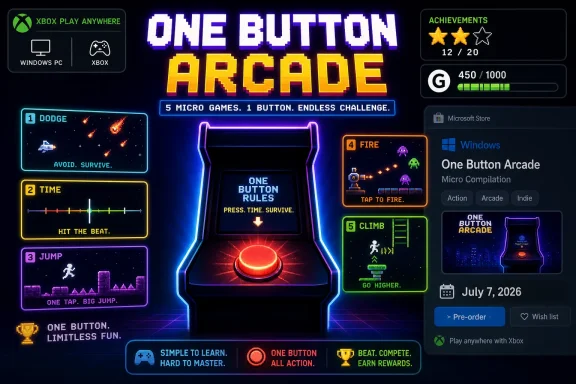
That makes the format especially well suited to compilation releases. Five tiny games can share a control philosophy while still feeling different enough to justify the package. One may ask the player to dodge. Another may ask for timing. Another may turn the same button into thrust, fire, jump, brake, or reversal. The appeal is not breadth in the blockbuster sense; it is variation inside a deliberately narrow design box.
ABA Games is a fitting name to see attached to this kind of project. The developer’s work has often leaned into compact arcade systems, abstract presentation, and fast readability. In a marketplace overloaded with crafting trees, seasonal currencies, and onboarding cinematics, there is something almost stubborn about a game that says: here is the button, here is the danger, now play.
The Windows version also changes the texture of that simplicity. On a console, one-button play can feel like a novelty built around the controller. On Windows, it can become keyboard-friendly, handheld-friendly, and accessible in a broader sense. A game that does not demand twelve bindings or a tutorial overlay has an obvious advantage on devices where comfort and context vary wildly.
That does not mean the game is reducible to Gamerscore, but it would be naive to pretend achievements are incidental here. The One Button Games 5-in-1 line sits squarely inside a marketplace where players often weigh entertainment value alongside completion time and score efficiency. That is not a corruption of gaming culture so much as one of its many subcultures becoming visible.
The site’s listing structure reinforces this. A game page with news, screenshots, achievements, pricing, walkthroughs, and community data turns a small Windows release into something measurable. Players can follow it, wishlist it, discuss it, and eventually route it into their personal completion pipeline. For a micro-release, that kind of discoverability can matter more than a trailer.
It also shows how the Xbox ecosystem extends beyond the console box. A Windows game with Xbox integration can matter to achievement hunters, Xbox-profile loyalists, and PC players who treat the Microsoft account as a persistent gaming identity. In that world, a modest Windows-only listing still has platform significance.
The original One Button Games 5-in-1 release on Windows was listed with a short completion estimate and a large achievement spread, the kind of profile that immediately catches the eye of completion-focused players. Later volumes appear to continue the pattern: small compilations, digital-only distribution, and clear appeal to players who like discrete, finishable games. Vol. 7, by arriving as another Windows entry, looks less like an isolated release than a continuation of a repeatable publishing cadence.
There is a cultural divide here. Some players view easy Gamerscore as harmless fun, a way to keep streaks alive or decompress between larger games. Others see it as inflation, arguing that achievements lose meaning when they are packaged so efficiently. Both readings can be true, because achievements serve different purposes depending on the player.
For WindowsForum readers, the interesting part is how this mirrors software more broadly. Metrics change behavior. Once a platform measures something publicly, an ecosystem grows around optimizing it. Achievements are no different from app rankings, benchmark scores, uptime badges, or social-media counters. The metric becomes a game layered on top of the game.
Small digital games sometimes appear with minimal advance notice, and their public footprint can be thin until store pages, achievement lists, or community trackers fill in the gaps. That creates a familiar pattern for achievement hunters: the database page appears, screenshots follow, pricing may surface region by region, and then the game either arrives quietly or briefly spikes in community attention. The pre-release window is where wishlist behavior and forum chatter do most of the marketing.
There is also a practical Windows angle. A lightweight release arriving in July may be a natural fit for handheld PC owners, laptop users, or players looking for something that will run without fuss. The earlier One Button Games entries have not been marketed as technical showcases, and that is part of their value. Small install sizes and modest requirements are not glamorous, but they are deeply useful.
The open question is not whether vol. 7 can surprise the industry. It almost certainly will not. The better question is whether it can continue delivering exactly what its audience expects without wearing out the format.
Handheld PC players often live between modes. They suspend and resume. They play in short sessions. They fight battery constraints, launcher friction, scaling oddities, and control-mapping weirdness. A small arcade collection that can be understood instantly has an advantage over a game that needs thirty minutes of settings work before the first meaningful interaction.
This is where the One Button Games concept becomes more contemporary than it first appears. The design resembles a mobile-era interaction model, but the distribution sits inside the Xbox-on-Windows ecosystem. That hybrid identity makes it useful for a platform that is still trying to reconcile PC openness with console-like convenience.
Microsoft has spent years talking about reducing friction in Windows gaming. Game Bar, Xbox app updates, cloud saves, controller improvements, and handheld UI experiments all point in the same direction. But friction is not only an operating-system problem. It is also a game-design problem. One-button games solve it at the source.
A series like One Button Games 5-in-1 tells the buyer what is inside before the store page finishes loading. Five games. One button. Another volume. Windows release. That clarity is a feature. In a market where many games bury their actual loop under lore, trailers, editions, and roadmaps, Xitilon’s packaging is almost aggressively plain.
The risk, of course, is sameness. A numbered sequence can reassure existing fans while signaling to everyone else that they have already seen enough. Vol. 7 has to justify itself within a formula whose appeal depends on repetition but whose longevity depends on variation. Five more one-button games are only valuable if each finds a slightly different tension.
Still, small publishers do not need universal appeal. They need a defined audience, a reliable production model, and distribution channels that make discovery possible. Xitilon appears to have all three. That does not make every release essential, but it does explain why the pipeline keeps moving.
One Button Games 5-in-1 vol. 7 belongs to that quieter layer. It is not trying to define the summer release calendar. It is not a showcase for DirectX features or upscaling technology. It is a reminder that Windows gaming includes the humble executable, the fast arcade loop, and the completionist snack.
That humility can be refreshing. Not every game needs to be a lifestyle. Not every release needs a battle pass, a creator program, or a ten-year content plan. Some games exist to be played for a few minutes, mastered for an hour, and remembered as a tidy little diversion in a much larger library.
For sysadmins and IT pros who game, this is not an alien idea. The best tools often do one thing well. The best scripts are short. The best utilities respect the user’s time. A one-button arcade collection is not enterprise software, obviously, but it shares that same minimalist ethic: reduce the interface until the task is obvious.
Small Windows Store titles often accumulate public information in fragments. The achievement list may appear before reviews. Screenshots may precede meaningful coverage. Pricing can be regional, delayed, or simply unnoticed until the store listing is live. Community pages become the early record because traditional marketing assets are minimal.
This makes careful wording important. We can say the game is listed for Windows, tied to ABA Games and Xitilon, and dated July 7, 2026. We should not pretend to know the full minigame roster, achievement count, price, install size, or feature set unless those details are confirmed by the live store or achievement database. In the small-game ecosystem, assumptions travel faster than facts.
That uncertainty does not weaken the story. It clarifies it. The news today is not a review, not a buying guide, and not a technical breakdown. It is the appearance of another entry in a recognizable Windows micro-series, with enough metadata to place it on the calendar and enough history to understand why its audience will care.
That is a valid value proposition in 2026. If anything, it may be more valuable now than it was a decade ago. Players are drowning in subscriptions, sales, free weekly claims, live-service obligations, and half-finished libraries. A small game that ends is not a lesser product. It is a different kind of relief.
The achievement layer intensifies that appeal. Completion-focused players often look for games that can be finished cleanly and filed away. That can sound transactional, but it also reflects a desire for closure. In a medium increasingly built around endless engagement, closure has become a feature worth paying for.
The danger is that efficiency can crowd out artistry. If players buy only for the completion, the game risks becoming a wrapper around notifications. The best version of this model gives both sides what they want: a quick Gamerscore path for the hunter and a genuinely clever set of arcade loops for the player who sticks around after the pop-ups.
There is also the matter of hardware breadth. A Windows game can run on traditional desktops, laptops, mini PCs, and handhelds, but that variety creates a higher bar for predictable behavior. Even simple games benefit from clean scaling, sensible input handling, quick launch times, and cloud-save sanity. The simpler the game, the more obvious any platform friction becomes.
That is why lightweight releases should not be treated as technically irrelevant. A small game that launches instantly, respects input devices, and behaves properly in windowed and full-screen modes can feel better on Windows than a much larger game that fights the OS at every turn. Good Windows citizenship is not measured only by graphical ambition.
For Microsoft, these releases add texture to the store. They may not drive hardware sales, but they help populate the ecosystem with low-cost choices that keep Xbox-profile users engaged on PC. That is strategically useful, especially as Microsoft continues to blur the line between console, PC, cloud, and handheld gaming.
Achievement hunters do not merely ask whether a game is good. They ask whether it is completable, whether it has missables, whether it requires skill spikes, whether the Windows version stacks with console versions, whether title updates add more score, and whether the time estimate is honest. Those questions form a parallel review language.
Xitilon’s catalog has often been discussed in that language. The publisher’s games can attract players who are optimizing for Gamerscore, streaks, leaderboards, or annual targets. Some will play only long enough to finish the list. Others may discover a fondness for the mechanics along the way. Both behaviors are part of the ecosystem.
This is where the moral panic around “easy achievements” tends to overreach. Achievements were never a pure measure of mastery. They have always mixed progression, discovery, persistence, skill, collection, and marketing psychology. A short arcade compilation does not break that system; it exposes the system’s incentives.
Numbered micro-releases can blur together if they do not establish identity. A player who owns several previous volumes may wonder whether this one brings enough new mechanical flavor. A player outside the achievement scene may see the title and move on. A storefront algorithm may treat it as another small tile in an endless grid of small tiles.
The counterargument is that predictability is exactly the point. Nobody buys volume seven of a plainly named arcade compilation expecting reinvention. They expect another serving of a familiar format. The commercial question is whether that serving feels fairly priced and competently made.
There is a broader lesson here for Windows developers. Small games can survive when they are honest about scope. The trouble begins when small games pretend to be large, or when large games pretend that bloat is depth. One Button Games 5-in-1 vol. 7 appears to be small on purpose.
 The Windows Store Still Has a Place for Tiny Games
The modern PC storefront conversation tends to orbit Steam, Epic, Game Pass, and the occasional launcher controversy. The Microsoft Store on Windows is usually treated as infrastructure: something that delivers apps, Xbox services, and the odd first-party blockbuster. Yet releases like One Button Games 5-in-1 vol. 7 show that the store also functions as a small-game shelf, where inexpensive, lightweight titles can reach Xbox-account users without pretending to be more than they are.That matters because Windows gaming is no longer a single behavior. Some players sit at a desk with a graphics card and a 144 Hz monitor. Others dip into games on a laptop, handheld PC, mini desktop, or couch-connected Windows box. A one-button arcade compilation is built for the latter rhythm: quick launch, quick fail, quick restart, quick achievement pop.
Xitilon has long understood that market better than many larger publishers. Its catalog is full of small digital games whose value proposition is plainly legible from the store page: low price, simple mechanics, easy installation, and often a very direct relationship with achievements. That strategy can draw criticism, especially from players who see achievement design as a prestige economy rather than a participation economy. But it is also a rational response to how many people actually use digital storefronts.
The TrueAchievements listing gives this particular release a date, a platform, a developer, and a publisher, but little of the grand theater that surrounds bigger launches. There is no months-long marketing campaign to decode. There is no hardware showcase. There is just a new Windows entry in a known series, arriving on a known schedule, serving a known audience.
One Button Is a Constraint, Not a Gimmick
The phrase one-button game can sound like a joke until you remember how much arcade history is built on ruthless constraints. A single input forces designers to make timing, spacing, rhythm, and anticipation carry the load. It removes the luxury of complex control schemes and leaves behind the raw loop: see the pattern, press at the right moment, survive a little longer.That makes the format especially well suited to compilation releases. Five tiny games can share a control philosophy while still feeling different enough to justify the package. One may ask the player to dodge. Another may ask for timing. Another may turn the same button into thrust, fire, jump, brake, or reversal. The appeal is not breadth in the blockbuster sense; it is variation inside a deliberately narrow design box.
ABA Games is a fitting name to see attached to this kind of project. The developer’s work has often leaned into compact arcade systems, abstract presentation, and fast readability. In a marketplace overloaded with crafting trees, seasonal currencies, and onboarding cinematics, there is something almost stubborn about a game that says: here is the button, here is the danger, now play.
The Windows version also changes the texture of that simplicity. On a console, one-button play can feel like a novelty built around the controller. On Windows, it can become keyboard-friendly, handheld-friendly, and accessible in a broader sense. A game that does not demand twelve bindings or a tutorial overlay has an obvious advantage on devices where comfort and context vary wildly.
TrueAchievements Is the Right Place for This News to Surface
It is telling that this release is currently most visible through TrueAchievements rather than a mainstream games-news blast. TrueAchievements is not merely a database; it is a map of how a particular class of player discovers, evaluates, and prioritizes games. For that audience, release date, platform, achievement list, completion estimate, and publisher history are not secondary metadata. They are the product.That does not mean the game is reducible to Gamerscore, but it would be naive to pretend achievements are incidental here. The One Button Games 5-in-1 line sits squarely inside a marketplace where players often weigh entertainment value alongside completion time and score efficiency. That is not a corruption of gaming culture so much as one of its many subcultures becoming visible.
The site’s listing structure reinforces this. A game page with news, screenshots, achievements, pricing, walkthroughs, and community data turns a small Windows release into something measurable. Players can follow it, wishlist it, discuss it, and eventually route it into their personal completion pipeline. For a micro-release, that kind of discoverability can matter more than a trailer.
It also shows how the Xbox ecosystem extends beyond the console box. A Windows game with Xbox integration can matter to achievement hunters, Xbox-profile loyalists, and PC players who treat the Microsoft account as a persistent gaming identity. In that world, a modest Windows-only listing still has platform significance.
The Achievement Economy Is the Subtext
There is an uneasy but important truth around Xitilon-style releases: achievements are part of the business model. That does not automatically make the games cynical. It does mean they are designed for a marketplace where completion time, Gamerscore density, and stackable platform versions can influence buying decisions.The original One Button Games 5-in-1 release on Windows was listed with a short completion estimate and a large achievement spread, the kind of profile that immediately catches the eye of completion-focused players. Later volumes appear to continue the pattern: small compilations, digital-only distribution, and clear appeal to players who like discrete, finishable games. Vol. 7, by arriving as another Windows entry, looks less like an isolated release than a continuation of a repeatable publishing cadence.
There is a cultural divide here. Some players view easy Gamerscore as harmless fun, a way to keep streaks alive or decompress between larger games. Others see it as inflation, arguing that achievements lose meaning when they are packaged so efficiently. Both readings can be true, because achievements serve different purposes depending on the player.
For WindowsForum readers, the interesting part is how this mirrors software more broadly. Metrics change behavior. Once a platform measures something publicly, an ecosystem grows around optimizing it. Achievements are no different from app rankings, benchmark scores, uptime badges, or social-media counters. The metric becomes a game layered on top of the game.
The July 2026 Date Makes This a Future Release, Not a Shadow Drop
The listed July 7, 2026 date is important because it places One Button Games 5-in-1 vol. 7 just ahead of launch rather than in the rearview mirror. As of June 21, 2026, this is a forthcoming Windows release. That distinction matters for anyone tracking Microsoft Store availability, achievement scans, regional pricing, or launch-day visibility.Small digital games sometimes appear with minimal advance notice, and their public footprint can be thin until store pages, achievement lists, or community trackers fill in the gaps. That creates a familiar pattern for achievement hunters: the database page appears, screenshots follow, pricing may surface region by region, and then the game either arrives quietly or briefly spikes in community attention. The pre-release window is where wishlist behavior and forum chatter do most of the marketing.
There is also a practical Windows angle. A lightweight release arriving in July may be a natural fit for handheld PC owners, laptop users, or players looking for something that will run without fuss. The earlier One Button Games entries have not been marketed as technical showcases, and that is part of their value. Small install sizes and modest requirements are not glamorous, but they are deeply useful.
The open question is not whether vol. 7 can surprise the industry. It almost certainly will not. The better question is whether it can continue delivering exactly what its audience expects without wearing out the format.
Minimalism Travels Well on Windows Handhelds
The Windows handheld market has made small games feel newly relevant. Devices from ASUS, Lenovo, MSI, Ayaneo, GPD, and others have turned Windows into a portable gaming environment, even if the operating system still sometimes behaves like a desktop OS squeezed into a console shell. In that context, a game with one-button input is not primitive. It is convenient.Handheld PC players often live between modes. They suspend and resume. They play in short sessions. They fight battery constraints, launcher friction, scaling oddities, and control-mapping weirdness. A small arcade collection that can be understood instantly has an advantage over a game that needs thirty minutes of settings work before the first meaningful interaction.
This is where the One Button Games concept becomes more contemporary than it first appears. The design resembles a mobile-era interaction model, but the distribution sits inside the Xbox-on-Windows ecosystem. That hybrid identity makes it useful for a platform that is still trying to reconcile PC openness with console-like convenience.
Microsoft has spent years talking about reducing friction in Windows gaming. Game Bar, Xbox app updates, cloud saves, controller improvements, and handheld UI experiments all point in the same direction. But friction is not only an operating-system problem. It is also a game-design problem. One-button games solve it at the source.
Xitilon’s Strategy Is Small, Repetitive, and Hard to Dismiss
It is easy to sneer at volume-numbered micro-compilations. The naming is functional rather than romantic, the production values are modest, and the release pattern can look industrial. But there is a discipline in that approach that larger publishers often lack.A series like One Button Games 5-in-1 tells the buyer what is inside before the store page finishes loading. Five games. One button. Another volume. Windows release. That clarity is a feature. In a market where many games bury their actual loop under lore, trailers, editions, and roadmaps, Xitilon’s packaging is almost aggressively plain.
The risk, of course, is sameness. A numbered sequence can reassure existing fans while signaling to everyone else that they have already seen enough. Vol. 7 has to justify itself within a formula whose appeal depends on repetition but whose longevity depends on variation. Five more one-button games are only valuable if each finds a slightly different tension.
Still, small publishers do not need universal appeal. They need a defined audience, a reliable production model, and distribution channels that make discovery possible. Xitilon appears to have all three. That does not make every release essential, but it does explain why the pipeline keeps moving.
Windows Gaming Is Bigger Than the Blockbuster Calendar
The PC gaming press tends to follow spectacle: GPU-punishing releases, platform wars, studio closures, anti-cheat controversies, Game Pass strategy, and the occasional live-service implosion. Those stories matter. But they can obscure the quieter fact that Windows remains a home for thousands of small, strange, cheap, and highly specific games.One Button Games 5-in-1 vol. 7 belongs to that quieter layer. It is not trying to define the summer release calendar. It is not a showcase for DirectX features or upscaling technology. It is a reminder that Windows gaming includes the humble executable, the fast arcade loop, and the completionist snack.
That humility can be refreshing. Not every game needs to be a lifestyle. Not every release needs a battle pass, a creator program, or a ten-year content plan. Some games exist to be played for a few minutes, mastered for an hour, and remembered as a tidy little diversion in a much larger library.
For sysadmins and IT pros who game, this is not an alien idea. The best tools often do one thing well. The best scripts are short. The best utilities respect the user’s time. A one-button arcade collection is not enterprise software, obviously, but it shares that same minimalist ethic: reduce the interface until the task is obvious.
The Store Page Is Sparse Because the Product Is Sparse
The TrueAchievements page, as supplied, is notably lean: name, platform, release date, developer, publisher, news tab, forum tab, screenshots, and the usual surrounding site navigation. That sparseness would be a warning sign for a large release. For this kind of game, it is almost expected.Small Windows Store titles often accumulate public information in fragments. The achievement list may appear before reviews. Screenshots may precede meaningful coverage. Pricing can be regional, delayed, or simply unnoticed until the store listing is live. Community pages become the early record because traditional marketing assets are minimal.
This makes careful wording important. We can say the game is listed for Windows, tied to ABA Games and Xitilon, and dated July 7, 2026. We should not pretend to know the full minigame roster, achievement count, price, install size, or feature set unless those details are confirmed by the live store or achievement database. In the small-game ecosystem, assumptions travel faster than facts.
That uncertainty does not weaken the story. It clarifies it. The news today is not a review, not a buying guide, and not a technical breakdown. It is the appearance of another entry in a recognizable Windows micro-series, with enough metadata to place it on the calendar and enough history to understand why its audience will care.
The Value Proposition Is Time, Not Scale
Most game marketing sells scale: bigger worlds, longer campaigns, richer systems, more content. One Button Games 5-in-1 sells the opposite. Its implied promise is that the player can understand it quickly, sample several loops, and possibly complete a meaningful chunk of the experience without making an appointment with their backlog.That is a valid value proposition in 2026. If anything, it may be more valuable now than it was a decade ago. Players are drowning in subscriptions, sales, free weekly claims, live-service obligations, and half-finished libraries. A small game that ends is not a lesser product. It is a different kind of relief.
The achievement layer intensifies that appeal. Completion-focused players often look for games that can be finished cleanly and filed away. That can sound transactional, but it also reflects a desire for closure. In a medium increasingly built around endless engagement, closure has become a feature worth paying for.
The danger is that efficiency can crowd out artistry. If players buy only for the completion, the game risks becoming a wrapper around notifications. The best version of this model gives both sides what they want: a quick Gamerscore path for the hunter and a genuinely clever set of arcade loops for the player who sticks around after the pop-ups.
The Windows Angle Is More Than a Platform Tag
Calling this a Windows release is not just a clerical detail. Windows versions of Xbox-adjacent games often create separate achievement stacks, separate completion paths, and separate purchasing decisions. For players embedded in the Xbox ecosystem, platform tags can change the calculus immediately.There is also the matter of hardware breadth. A Windows game can run on traditional desktops, laptops, mini PCs, and handhelds, but that variety creates a higher bar for predictable behavior. Even simple games benefit from clean scaling, sensible input handling, quick launch times, and cloud-save sanity. The simpler the game, the more obvious any platform friction becomes.
That is why lightweight releases should not be treated as technically irrelevant. A small game that launches instantly, respects input devices, and behaves properly in windowed and full-screen modes can feel better on Windows than a much larger game that fights the OS at every turn. Good Windows citizenship is not measured only by graphical ambition.
For Microsoft, these releases add texture to the store. They may not drive hardware sales, but they help populate the ecosystem with low-cost choices that keep Xbox-profile users engaged on PC. That is strategically useful, especially as Microsoft continues to blur the line between console, PC, cloud, and handheld gaming.
Achievement Hunters Will Read This Differently From Everyone Else
For a general player, One Button Games 5-in-1 vol. 7 may register as a curiosity. For an achievement hunter, it is a scheduled event. That difference explains why a small Windows title can matter disproportionately on sites like TrueAchievements.Achievement hunters do not merely ask whether a game is good. They ask whether it is completable, whether it has missables, whether it requires skill spikes, whether the Windows version stacks with console versions, whether title updates add more score, and whether the time estimate is honest. Those questions form a parallel review language.
Xitilon’s catalog has often been discussed in that language. The publisher’s games can attract players who are optimizing for Gamerscore, streaks, leaderboards, or annual targets. Some will play only long enough to finish the list. Others may discover a fondness for the mechanics along the way. Both behaviors are part of the ecosystem.
This is where the moral panic around “easy achievements” tends to overreach. Achievements were never a pure measure of mastery. They have always mixed progression, discovery, persistence, skill, collection, and marketing psychology. A short arcade compilation does not break that system; it exposes the system’s incentives.
The Risk Is Fatigue, Not Failure
The most obvious challenge for vol. 7 is not whether it can find buyers. The series and publisher already point toward a market that knows what to do with it. The bigger issue is fatigue: player fatigue, achievement fatigue, and storefront fatigue.Numbered micro-releases can blur together if they do not establish identity. A player who owns several previous volumes may wonder whether this one brings enough new mechanical flavor. A player outside the achievement scene may see the title and move on. A storefront algorithm may treat it as another small tile in an endless grid of small tiles.
The counterargument is that predictability is exactly the point. Nobody buys volume seven of a plainly named arcade compilation expecting reinvention. They expect another serving of a familiar format. The commercial question is whether that serving feels fairly priced and competently made.
There is a broader lesson here for Windows developers. Small games can survive when they are honest about scope. The trouble begins when small games pretend to be large, or when large games pretend that bloat is depth. One Button Games 5-in-1 vol. 7 appears to be small on purpose.
Five Small Games Say Something About the State of PC Play
The concrete news is simple, but the implications are useful.- One Button Games 5-in-1 vol. 7 is listed as a Windows release from ABA Games and Xitilon with a July 7, 2026 date.
- The game fits a continuing pattern of small, digital arcade compilations aimed at quick play and Xbox-connected discovery.
- TrueAchievements visibility matters because achievement hunters are likely to evaluate the release through completion time, score value, and platform stacking.
- The one-button format is especially well suited to Windows handhelds, laptops, and short-session play.
- The biggest unknowns remain the final achievement list, price, store availability, and the specific five-game lineup.
- The release is unlikely to change the PC market, but it usefully illustrates how much of Windows gaming happens below the blockbuster layer.
References
- Primary source: TrueAchievements
Published: 2026-06-21T03:06:46.753995
One Button Games 5-in-1 vol. 7 (Windows) News and Videos
All the latest One Button Games 5-in-1 vol. 7 (Windows) news, sales, achievements, videos and screenshots.www.trueachievements.com
- Related coverage: xbox.com
Buy One Button Games 5-in-1 vol. 5 (Windows) | Xbox
All 5 games are fast-paced and controlled with a single button. R WHEEL Try to survive inside a spinning wheel with spikes. Press a button to jump and hold a button to stay in the air longer. But your jumps release a wave that spawns the spikes. Collect bonus items to release a wave that clears...www.xbox.com - Related coverage: thexboxhub.com
One Button Games 5-in-1 vol. 5 Review | TheXboxHub
Review - One Button Games 5-in-1 vol. 5 is a fascinating exploration of what you can achieve with one button. The result sounds gimmicky... www.thexboxhub.com
- Related coverage: gamefaqs.gamespot.com
- Related coverage: dekudeals.com
One Button Games 5-in-1 | Deku Deals
Find the best prices for One Button Games 5-in-1, see the full price history, and be the first to find out about its next big sale at Deku Deals www.dekudeals.com
- Official source: microsoft.com
- Related coverage: dexerto.com
One Button Games 5-in-1 vol. 2 Game Details - Dexerto Database
One Button Games 5-in-1 vol. 2 release date, trailers, screenshots, developers, cover art, platforms, age rating, game engine, and more information from Dexerto's video game database.www.dexerto.com
- Related coverage: xboxone-hq.com
- Related coverage: d1gszp1bmamha.cloudfront.net

