
OneStream’s move to embed its SensibleAI™ Agents directly into Microsoft 365 — including Microsoft 365 Copilot, Teams, and Excel — marks a significant step in bringing domain‑aware, finance‑first AI into the flow of daily work for CFOs and finance teams, promising faster forecasting, real‑time analysis, and tighter Microsoft‑native governance for enterprise finance workloads.
OneStream has steadily positioned SensibleAI as a finance‑centric layer of intelligence built on top of its unified finance data model. The SensibleAI portfolio — launched earlier in 2025 and expanded throughout the year — includes purpose‑built Agents (Finance Analyst, Operations Analyst, Search, Deep Analysis), SensibleAI Studio, and targeted forecasting and reconciliation tools designed to run on OneStream’s Microsoft‑stack architecture. These offerings are explicitly framed to reduce manual spreadsheet work, increase forecasting accuracy, and provide explainable, auditable AI outputs for the Office of the CFO. The announcement — made publicly at the time of Microsoft Ignite — describes a strategic alliance with Microsoft that embeds OneStream’s SensibleAI Agents into Microsoft 365 Copilot, Microsoft Teams, and Excel. OneStream states these Agents will run on Microsoft Azure and be available through Microsoft’s commercial channels, including the Microsoft Marketplace and Azure procurement vehicles. The vendor also highlights recent partner recognition from Microsoft as evidence of deepening collaboration. This integration sits at the intersection of three major enterprise trends:
Key benefits OneStream and early messaging promise:
High‑value pilot ideas:
However, the promise depends on three capabilities being operationalized across customers:
In short: SensibleAI in Microsoft 365 is a major convenience and capability win for finance teams — but it’s not a silver bullet. The next 6–12 months will be decisive: early adopters who enforce governance and validate financial logic will move fastest; others should watch closely while building the governance scaffolding that agentic finance requires.
Source: Stock Titan OneStream (NASDAQ: OS), Microsoft integrate SensibleAI into Teams, Excel, 365 Copilot
 Background / Overview
OneStream has steadily positioned SensibleAI as a finance‑centric layer of intelligence built on top of its unified finance data model. The SensibleAI portfolio — launched earlier in 2025 and expanded throughout the year — includes purpose‑built Agents (Finance Analyst, Operations Analyst, Search, Deep Analysis), SensibleAI Studio, and targeted forecasting and reconciliation tools designed to run on OneStream’s Microsoft‑stack architecture. These offerings are explicitly framed to reduce manual spreadsheet work, increase forecasting accuracy, and provide explainable, auditable AI outputs for the Office of the CFO. The announcement — made publicly at the time of Microsoft Ignite — describes a strategic alliance with Microsoft that embeds OneStream’s SensibleAI Agents into Microsoft 365 Copilot, Microsoft Teams, and Excel. OneStream states these Agents will run on Microsoft Azure and be available through Microsoft’s commercial channels, including the Microsoft Marketplace and Azure procurement vehicles. The vendor also highlights recent partner recognition from Microsoft as evidence of deepening collaboration. This integration sits at the intersection of three major enterprise trends:- The rise of agentic AI and in‑canvas Copilot Agents inside Microsoft 365 (Agent Mode, Copilot Studio, Agent 365 governance).
- Finance teams’ continued reliance on Excel and Teams as primary collaboration and analysis surfaces.
- The increasing demand for domain‑aware AI that is grounded in trusted enterprise data rather than generic LLM outputs.
What OneStream announced (the essentials)
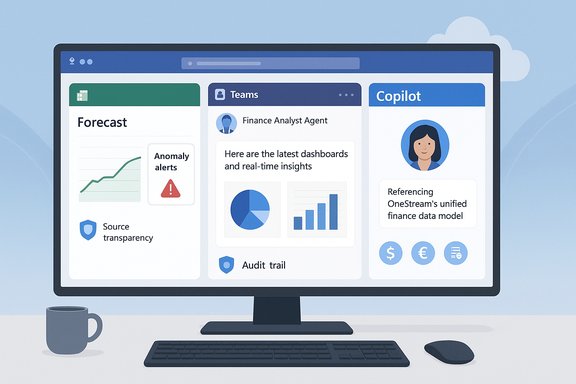
- OneStream will deliver SensibleAI™ Agent extensions into Microsoft 365 Copilot, Microsoft Teams, and Microsoft Excel to allow finance professionals to query, analyze, visualize, and act on verified finance and operational data without leaving Microsoft productivity surfaces.
- Initial agent capabilities called out include:
- SensibleAI Agent extensions inside Microsoft 365 Copilot for role‑tuned finance interactions.
- A SensibleAI Search Agent in Teams for searching financial and business documents with source transparency.
- A Finance Analyst Agent in Teams that accepts natural‑language queries and returns dashboards, visualizations, and real‑time analysis.
- Finance Analyst extensions for Microsoft Excel that introduce predictive analytics, anomaly detection, and intelligent forecasting into spreadsheets.
- OneStream confirms the platform runs on Azure and that SensibleAI Agents are optimized for the Microsoft cloud to deliver scale, security, and performance, and that the Agents will be made available via Microsoft Marketplace and enterprise procurement flows. The vendor also cites recognition in Microsoft partner programs to underline the partnership.
Why this matters for finance teams
Finance has unique constraints: auditability, traceability to systems of record, compliance with accounting rules, and the heavy use of Excel as both source and output. OneStream’s pitch is that SensibleAI is financially intelligent — i.e., the Agents are aware of financial constructs (rollups, consolidations, currency translations, compliance calculations) and operate on the unified OneStream data model so outputs map back to a single version of the truth.Key benefits OneStream and early messaging promise:
- Reduced context switching: Analysts can ask questions in Teams or Copilot and get results that are grounded in OneStream data rather than exported CSVs.
- Faster, explainable forecasting: In‑sheet forecasting and scenario modeling driven by finance‑aware ML and SensibleAI Forecast tooling.
- Actionable automation: Agents can not only answer questions but trigger workflows, run reconciliations, and generate audit trails tied to enterprise security and governance controls.
Technical footprint and integration model
Architecture and hosting
OneStream’s SensibleAI stack is built to run on Microsoft Azure and, per the announcement, is optimized for Azure performance and security. That means:- Agents will execute within Azure environments, leveraging tenant identity and Azure security primitives.
- Integrations will surface within Microsoft 365 services (Copilot, Teams, Excel) while tying back to OneStream’s unified data model as the system of record.
How Agents appear to users
- Copilot integration: SensibleAI Agents will appear as domain‑tuned agents inside Microsoft 365 Copilot, allowing finance and frontline teams to search, analyze, and visualize verified data via Copilot chat and agent canvases.
- Teams extensions: Search and Finance Analyst Agents will be available inside Teams — enabling natural‑language queries, document search with source transparency, and dashboarding within channels or chats.
- Excel extensions: Finance Analyst features will arrive as Excel add‑ins or Agent Mode integrations that can create formulas, run anomaly detection, generate forecasts, and produce explainable narrative outputs inside workbooks.
Governance, security and compliance — practical considerations
Embedding agentic AI into finance workflows improves productivity but changes the risk surface. Three governance lines must be managed:- Data grounding and provenance: Finance outputs must be traceable to source ledgers, mappings, and policies. OneStream’s SensibleAI emphasizes explainability (complexity scores, “thoughts”, linked sources) to support auditability — but organizations should validate how provenance is surfaced and exported during audits.
- Permissions and least privilege: Agents given broad access to ERP, payroll, or contracts increase exposure risk. Microsoft’s Agent 365 and Work IQ governance models (announced alongside Copilot agent capabilities) create identity‑bound agent lifecycles, short‑lived credentials, audit trails, and admin control, but tenant admins must configure least‑privilege access and SIEM ingestion. Enterprises should integrate agent logs into existing monitoring and compliance tooling.
- Model and connector risk: Agents that call external connectors (market data, LSEG, Moody’s, third‑party services) should be validated for licensing, SLAs, and data freshness. Where models or connectors are optional, finance teams should document which sources feed critical outputs and maintain manual review gates for high‑impact artifacts. OneStream’s go‑to‑market notes show planned marketplace availability through Microsoft procurement — meaning standard enterprise procurement and contractual controls will apply.
- Define which OneStream Agents get tenant permissions and which users can call them.
- Map data lineage: ensure every AI output references the exact OneStream record IDs and reconciliation steps.
- Pipeline agent telemetry into enterprise monitoring and retention policies.
- Pilot with a controlled data set and impose human approvals on high‑risk decisions.
Competitive and ecosystem context
The broader market is moving rapidly:- Microsoft has invested heavily in Copilot as a platform with in‑canvas Agent Mode, Copilot Studio, and an Agent Store — making it easier for ISVs to surface domain agents inside the Office surface. Many ISVs are racing to deliver verticalized, domain‑aware agents inside Excel and Teams.
- Anthropic, Snowflake, and other vendors push finance‑focused agents for Excel (for example, Claude for Excel and Snowflake Cortex Agents have similar aims), which places OneStream in a competitive field that blends model choice, data connectors, and domain engineering. Expect direct comparisons around explainability, financial formula fidelity, and audit trails.
- OneStream’s core claim is that SensibleAI runs on the same unified finance model that customers already use, which reduces the “last mile” risk of reconciling AI outputs back to ledgers and consolidations.
- Deep integration with Microsoft 365 surfaces those capabilities where finance already collaborates — Teams and Excel — rather than requiring separate UIs.
Deployment scenarios and business use cases
Finance teams should consider starting with controlled, high ROI pilots where both benefits and risks are easily measured.High‑value pilot ideas:
- Reconciliation automation: use SensibleAI + Copilot to accelerate account reconciliations and exception triage inside Excel and Outlook for confirmation emails. This shortens close cycles and is auditable.
- Variance and narrative synthesis: have Finance Analyst Agents automatically generate variance narratives for management packs, linking each narrative to source rows in OneStream.
- Forecast scenario generation: embed SensibleAI Forecast capabilities into Excel models to produce “what‑if” scenarios and allow analysts to accept or modify agent suggestions.
- Document synthesis: use Deep Analysis to surface contract or policy impacts on revenue recognition schedules for audit teams.
- Pilot with non‑reporting datasets and non‑regulatory artifacts.
- Validate outputs with domain experts and run parallel manual checks.
- Add automation gates once confidence and monitoring are sufficient.
Risks, unknowns, and areas to watch
- Model behavior in edge cases: financial logic often involves complex, jurisdictional accounting rules. Any automated agent must be validated for local GAAP/IFRS behavior; OneStream’s transparency features mitigate but do not eliminate the need for human oversight.
- Licensing and cost: embedding SensibleAI in enterprise workflows will require Microsoft 365 Copilot licensing (and possibly additional OneStream entitlements). Organizations should model incremental costs against productivity gains. Microsoft’s agent licensing and tenant enablement rules vary by SKU and region — confirm with procurement before large rollouts.
- Integration latencies and SLAs: real‑time queries through Teams or Copilot depend on connector performance, Azure region latency, and model sizing. Mission‑critical close activities should include performance testing under expected peak loads.
- Regulatory scrutiny: auditors and regulators will increasingly ask how AI‑generated outputs were produced and whether there is an audit trail. Ensure AI outputs are archived, explainable, and align with internal control frameworks.
- Some press phrasing implies immediate, broad availability inside Copilot and Excel — availability is often staged by tenant, region, and licensing. Organizations should treat initial releases as staged previews until vendor release notes and tenant admin portals confirm GA status.
Strategic advice for CFOs and IT leaders
- Treat agents as software services, not features. Assign ownership, SLAs, and a lifecycle plan that includes deprecation and retraining windows.
- Start with high‑value, low‑risk use cases that demonstrate measurable time saved and improved accuracy (reconciliations, variance narratives).
- Integrate agent telemetry with controls: connect audit logs to SIEM/SOAR and maintain evidence trails for significant financial adjustments.
- Build user education and change management into deployment plans; explainability features reduce resistance but do not replace training.
- Negotiate procurement with clarity on usage metrics, data residency guarantees, and support SLAs for the Microsoft Marketplace and Azure procurement flows.
The bigger picture — what this means for finance operations
Embedding finance‑aware agents into Microsoft’s productivity layer signals a realization of the “system of action” concept: instead of exporting data for analysis, teams will increasingly ask natural‑language questions and accept grounded, auditable answers inside the apps where work gets done. When executed well, this reduces friction between finance and operations, speeds decision cycles, and elevates the CFO’s role from rear‑view reporting to forward‑leaning strategy.However, the promise depends on three capabilities being operationalized across customers:
- True grounding to systems of record and transparent provenance.
- Strong tenant governance and lifecycle controls for agents.
- Clear procurement, cost models, and operational SLAs for mission‑critical finance functions.
Conclusion
OneStream’s SensibleAI integration into Microsoft 365 Copilot, Teams, and Excel is a logical evolution for an ISV that has long focused on unifying finance data and automating core finance workflows. The move brings finance‑specific, explainable AI into the Microsoft surfaces where analysts and controllers already work, and leverages Azure and Microsoft’s Copilot agent ecosystem for delivery and governance. The rollout accelerates the broader trend toward domain‑aware agents embedded in productivity tools, but it also raises familiar enterprise questions around provenance, permissions, cost, and regulatory readiness. Organizations that pilot carefully, align agents to auditable workflows, and incorporate governance and telemetry from day one will capture the most value — while those that skip due diligence may trade short‑term convenience for long‑term risk.In short: SensibleAI in Microsoft 365 is a major convenience and capability win for finance teams — but it’s not a silver bullet. The next 6–12 months will be decisive: early adopters who enforce governance and validate financial logic will move fastest; others should watch closely while building the governance scaffolding that agentic finance requires.
Source: Stock Titan OneStream (NASDAQ: OS), Microsoft integrate SensibleAI into Teams, Excel, 365 Copilot
