

ReliaQuest disclosed on June 5, 2026, that a newly tracked China-linked threat cluster called OP-512 compromised a Microsoft Internet Information Services server, deployed a custom three-part web shell framework, and used the exposed Windows host as a likely espionage foothold. The important part is not that another web shell landed on another forgotten server. It is that the boring middle of enterprise Windows infrastructure is becoming the preferred edge. OP-512 is a reminder that attackers do not need novel zero-days when organizations keep placing old IIS applications between the public internet and the corporate network.
For years, the phrase edge device has conjured images of VPN appliances, routers, firewalls, and email gateways. That mental model is now too narrow. An internet-facing IIS server running an aging ASP.NET application can be just as useful to a state-aligned operator as a compromised VPN concentrator, especially when it sits in a demilitarized zone with carefully rationed but still meaningful access to internal systems.
That is the uncomfortable lesson in OP-512. The server ReliaQuest examined was not described as a domain controller, a crown-jewel database, or a privileged management host. It was a web server, the sort of system many organizations treat as a business application dependency rather than a strategic security boundary.
But IIS often lives in the exact place an intruder wants to begin: close enough to the internet to be reachable, close enough to the intranet to be useful, and old enough that ownership may be blurred between infrastructure, application, and business teams. The result is an asset class that can fall through the seams of modern security programs. Everyone knows it matters, but no one wants to be the team that breaks the legacy app by forcing change.
ReliaQuest’s assessment that OP-512 is a newly observed China-linked cluster adds geopolitical weight, but the operational lesson is broader. Attackers are not merely exploiting software defects. They are exploiting the institutional habit of treating old web infrastructure as a maintenance problem rather than an intelligence risk.
That behavior matters because it speaks to scale and discipline. A commodity criminal operation might drop a web shell and return manually. OP-512’s tooling, by contrast, appears designed so the operator can plant an implant and have the infrastructure record where it landed. That turns a compromised IIS server into an entry in a hostile asset inventory.
This is also why the case should interest defenders beyond the affected victim. Automated self-reporting changes the economics of intrusion. It allows an operator to compromise, catalog, revisit, and selectively exploit systems over time without relying on memory, spreadsheets, or noisy manual follow-up.
ReliaQuest said it found suspicious access roughly 75 days before the main incident. That gap is the kind of timeline that separates espionage from opportunistic monetization. A ransomware crew usually wants to move quickly from access to payout. An intelligence operator can afford to wait, return, observe, and decide whether a foothold is worth developing.
The Windows community has seen this pattern before in Exchange, SharePoint, VPN, and firewall campaigns. The product changes, the rhythm does not. Internet-facing enterprise software becomes a map of organizations that have not finished the hard work of modernization.
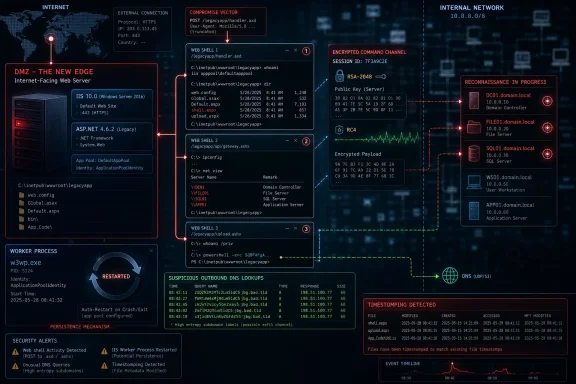
OP-512’s framework reportedly consisted of three web shells. One handled file management and location reporting, while two others acted as command handlers. ReliaQuest said each deployment was generated in a unique form, undercutting signature-based detection that depends on recognizing a known file hash, string, or static pattern.
That uniqueness is not just an evasion trick. It is a statement about the defender’s disadvantage. If every implant is slightly different, security teams cannot wait for someone else’s indicators to solve their problem. They have to hunt for behavior: unexpected ASP.NET compilation, odd DNS requests, reflective .NET loading, unusual child processes from IIS worker processes, and suspicious file writes in web-accessible directories.
The reported use of RSA and RC4 authentication is another notable design choice. It means the command handlers were not just open backdoors waiting for anyone to stumble across them. Only an operator with the right key material could talk to them usefully. That makes the implant harder for defenders to interrogate and harder for rival criminals to hijack.
This is where the phrase “custom tooling” can mislead. Custom does not always mean glamorous. Sometimes it means patient, practical engineering around all the boring details that make an intrusion survive contact with defenders.
If a malicious file can make itself appear years old, the first pass of the investigation becomes less reliable. A newly planted shell may no longer stand out in a directory sorted by modification date. A responder may waste precious time reconstructing a history the attacker has deliberately polluted.
The deeper issue is that legacy web servers often accumulate clutter. Temporary files, old application versions, forgotten test pages, vendor remnants, and one-off administrative scripts can create a noisy file system where malicious artifacts have plenty of cover. A clean, well-managed server gives defenders contrast. A neglected server gives attackers camouflage.
That is why the OP-512 case should push teams to think beyond vulnerability patching. File hygiene, deployment discipline, and baseline integrity matter. If no one can say what should be in an IIS application directory, no one can quickly prove what should not be there.
For defenders, however, availability behavior can become attacker resilience. Killing a process may feel like containment, but on an application server, the service manager, application pool, or runtime may simply recreate the execution environment. If the malicious page remains in place, the next request may bring the attacker’s capability back to life.
This is a classic mismatch between endpoint prevention and application-layer compromise. EDR can interrupt a bad process tree, but it may not understand the web application state that produced it. A web shell is not merely a process; it is a file, a route, a runtime compilation artifact, a network behavior, and sometimes a credentialed workflow.
That means incident responders cannot treat IIS the way they treat a compromised workstation. The question is not just “what process ran?” It is “what request caused it, what file handled it, what runtime compiled it, what identity executed it, and what access did that identity have?”
OP-512’s reported survival after partial prevention illustrates a broader defensive blind spot. Automated containment is valuable, but it is not the same as eradication. On a web server, the difference can be measured in minutes.
Windows Server 2016 itself remains familiar in enterprise environments, and that familiarity can breed complacency. The operating system may still appear in asset inventories as a supported Windows server, while the application framework above it tells a more troubling story. Attackers do not care which layer makes the host vulnerable. They care whether the exposed service gives them a way in.
Legacy .NET applications are especially difficult to retire because they are often tied to business processes rather than technical preferences. A vendor may be gone, a rewrite may be expensive, and the app may only be “temporary” in the way enterprise temporary systems become permanent. The risk is easy to describe and hard to budget.
That is why “patch your systems” is insufficient advice here. Some of these environments cannot simply be patched into modernity. They need segmentation, compensating controls, application replacement, code review, upload restrictions, runtime hardening, and a political decision that keeping an obsolete application online is no longer cheaper than migrating it.
The OP-512 case turns that decision into a security argument. If an old IIS application is reachable from the internet, it is not just technical debt. It is a potential intelligence collection point.
That convergence is important. When multiple threat clusters with overlapping geopolitical alignment keep returning to the same technology class, defenders should stop treating each campaign as an isolated curiosity. IIS is not merely being exploited because it exists. It is being selected because it offers the right blend of exposure, persistence, and access.
The overlap around encoded DNS subdomain queries is a good example. DNS remains one of the most useful channels for attackers because it is ubiquitous, frequently allowed, and often monitored less aggressively than web traffic. In OP-512’s case, the web shell’s ability to report its own location over DNS gave the operator a low-friction way to maintain awareness of deployed implants.
Attribution should still be handled carefully. “China-linked” is not the same as a courtroom finding, and threat clusters are analytical constructs rather than neat organizational charts. But operational patterns matter even when the actor labels remain provisional. The practical defender’s question is not whether OP-512 has a perfect name. It is whether the behavior described by ReliaQuest matches risks inside their own environment.
For many Windows shops, the answer will be yes. They have IIS. They have old ASP.NET. They have internet exposure. They have upload paths. They have DNS logs no one reviews until after something goes wrong.
OP-512’s activity apparently involved pieces that might not have looked decisive in isolation: suspicious access, web shell deployment, process behavior, DNS signaling, compiled ASP.NET artifacts, privilege-escalation attempts, and probing of an adjacent server. The defender’s challenge is stitching those signals together fast enough to matter.
That is exactly the kind of problem security analytics should help solve. A single alert may be ambiguous. A timeline is not. If a web server receives unusual access, writes new ASP.NET files, spawns unexpected behavior through a worker process, and starts emitting encoded DNS lookups, the question should escalate from “is this suspicious?” to “why is this host still online?”
But AI does not remove the operational burden. Someone still has to isolate the server, preserve evidence, identify the original access path, remove web shells, examine compiled artifacts, rotate credentials, review adjacent systems, and decide whether the application can safely return to service. Correlation can shorten the time to suspicion. It cannot modernize a legacy stack.
This is where the security industry often oversells detection. Finding the intruder is only the midpoint. The harder task is forcing an organization to confront the architectural conditions that made the compromise durable.
A team that deletes the visible web shell and calls the server clean may miss the residue created by the runtime. Even if those compiled files are not enough on their own to preserve attacker access, they can preserve evidence, confuse later analysis, and signal that the cleanup process was incomplete. In some scenarios, overlooked application artifacts can also contribute to reactivation risk if the underlying conditions remain unchanged.
This is the difference between removing an indicator and closing an incident. Indicator removal is tactical. Incident closure requires a theory of access, execution, persistence, and containment. Without that theory, responders are just sweeping the floor while the door remains unlocked.
For IIS administrators, the lesson is immediate. Temporary ASP.NET compilation paths deserve attention during investigations. So do application pool identities, upload directories, web roots, scheduled tasks, service configurations, and any server reachable from the compromised host.
For executives, the lesson is simpler. If the team cannot prove how the attacker got in, it cannot prove the attacker will not return.
That is dangerous because many DMZ systems are treated as less sensitive than internal servers while still holding credentials, configuration files, application secrets, database paths, and network routes. An IIS server may have access to backend databases, internal APIs, file shares, authentication systems, or management interfaces. It may not be the crown jewel, but it may know where the crown jewels are kept.
OP-512 reportedly began probing an adjacent server after establishing its foothold. That is the expected move. Once a web server is compromised, the attacker’s next job is to learn what the server can see, what it can authenticate to, and which internal systems trust it.
Network segmentation is supposed to limit that blast radius. Yet segmentation is often designed around broad zones rather than application-specific necessity. A web server may be allowed to talk to more internal services than it actually needs because no one wants to risk breaking an old workflow.
The result is a quiet privilege problem. The IIS server is not privileged in the domain-admin sense, but it is privileged by placement. It can receive traffic from the world and initiate traffic toward parts of the business. That makes it valuable.
The better detection surface is behavioral. IIS worker processes should not casually spawn command interpreters, load suspicious assemblies, perform strange outbound DNS activity, or write unexpected files into application directories. Web uploads should not become executable code. Application pools should not have broad file-system or network privileges.
This is easier to write than to implement. Many legacy IIS applications behave messily even when they are legitimate. They write to odd directories, compile dynamically, call local utilities, and depend on permissions that no one would approve in a greenfield design. Attackers benefit from that mess.
Still, defenders can make progress by baselining what is normal for each application pool and narrowing what is allowed. The goal is not perfection. It is to make an attacker’s web shell behave differently enough from the application that it becomes visible.
That means Windows administrators and security teams need to collaborate more closely than they often do. The SOC may see the alert, but the IIS admin knows which application behavior is plausible. The app owner knows which upload paths should exist. The network team knows whether outbound DNS from the web server should be direct, proxied, or impossible.
If an organization has an internet-facing IIS server running unsupported .NET components, the durable fix is probably not a rule. It is migration, isolation, or retirement. That may mean moving the application behind stronger access controls, placing a reverse proxy or web application firewall in front of it, removing direct internet exposure, segmenting backend access, restricting upload execution, or replacing the application entirely.
There is no universal answer because legacy applications vary. Some can be rebuilt quickly. Some are vendor-locked. Some are mission-critical but poorly understood. Some are used by three people and kept alive only because no one has dared ask whether they still matter.
Security teams should use OP-512 as leverage for that conversation. The question should not be framed as “can we patch this server?” It should be framed as “why does this server still have this exposure, this runtime, and this network position?”
That reframing matters because it moves the discussion from maintenance to risk ownership. If the business chooses to keep an obsolete IIS application online, it should also accept the cost of monitoring, segmentation, compensating controls, and faster incident response. Legacy is not free. It is financed through future breach risk.
The most useful response is not panic; it is inventory with consequences. Organizations should identify internet-facing IIS servers, enumerate their .NET versions, map application owners, review upload paths, inspect outbound DNS behavior, and test whether EDR containment actually prevents malicious IIS behavior from recurring. They should also verify what backend systems those servers can reach.
The uncomfortable part is that this work will expose old compromises between availability and security. Some servers will be too important to take down and too old to defend comfortably. Some applications will have no clear owner. Some firewall rules will exist because of a migration that never finished.
Those findings are not failures of the scan. They are the point of doing it.
The most concrete lessons are refreshingly unglamorous:
 The Edge Is Not Just Firewalls Anymore
For years, the phrase edge device has conjured images of VPN appliances, routers, firewalls, and email gateways. That mental model is now too narrow. An internet-facing IIS server running an aging ASP.NET application can be just as useful to a state-aligned operator as a compromised VPN concentrator, especially when it sits in a demilitarized zone with carefully rationed but still meaningful access to internal systems.That is the uncomfortable lesson in OP-512. The server ReliaQuest examined was not described as a domain controller, a crown-jewel database, or a privileged management host. It was a web server, the sort of system many organizations treat as a business application dependency rather than a strategic security boundary.
But IIS often lives in the exact place an intruder wants to begin: close enough to the internet to be reachable, close enough to the intranet to be useful, and old enough that ownership may be blurred between infrastructure, application, and business teams. The result is an asset class that can fall through the seams of modern security programs. Everyone knows it matters, but no one wants to be the team that breaks the legacy app by forcing change.
ReliaQuest’s assessment that OP-512 is a newly observed China-linked cluster adds geopolitical weight, but the operational lesson is broader. Attackers are not merely exploiting software defects. They are exploiting the institutional habit of treating old web infrastructure as a maintenance problem rather than an intelligence risk.
OP-512 Looks Less Like Smash-and-Grab and More Like Inventory Management
The most striking detail in the OP-512 report is not a single exploit or privilege-escalation attempt. It is the way the web shell framework appears to manage compromise as a catalogued resource. One of the implanted web shells reportedly sent its own URL back to attacker-controlled infrastructure using a DNS request, with an HTTP fallback if that route failed.That behavior matters because it speaks to scale and discipline. A commodity criminal operation might drop a web shell and return manually. OP-512’s tooling, by contrast, appears designed so the operator can plant an implant and have the infrastructure record where it landed. That turns a compromised IIS server into an entry in a hostile asset inventory.
This is also why the case should interest defenders beyond the affected victim. Automated self-reporting changes the economics of intrusion. It allows an operator to compromise, catalog, revisit, and selectively exploit systems over time without relying on memory, spreadsheets, or noisy manual follow-up.
ReliaQuest said it found suspicious access roughly 75 days before the main incident. That gap is the kind of timeline that separates espionage from opportunistic monetization. A ransomware crew usually wants to move quickly from access to payout. An intelligence operator can afford to wait, return, observe, and decide whether a foothold is worth developing.
The Windows community has seen this pattern before in Exchange, SharePoint, VPN, and firewall campaigns. The product changes, the rhythm does not. Internet-facing enterprise software becomes a map of organizations that have not finished the hard work of modernization.
Custom Web Shells Are Still Web Shells, but These Were Built for a Better Operator
Web shells are one of the oldest intrusion tools on the internet. The basic idea is simple: place a script or page on a web server, then use ordinary web requests to issue commands, upload files, browse directories, or pivot deeper. The reason they persist is just as simple. They blend into the operating model of a web server.OP-512’s framework reportedly consisted of three web shells. One handled file management and location reporting, while two others acted as command handlers. ReliaQuest said each deployment was generated in a unique form, undercutting signature-based detection that depends on recognizing a known file hash, string, or static pattern.
That uniqueness is not just an evasion trick. It is a statement about the defender’s disadvantage. If every implant is slightly different, security teams cannot wait for someone else’s indicators to solve their problem. They have to hunt for behavior: unexpected ASP.NET compilation, odd DNS requests, reflective .NET loading, unusual child processes from IIS worker processes, and suspicious file writes in web-accessible directories.
The reported use of RSA and RC4 authentication is another notable design choice. It means the command handlers were not just open backdoors waiting for anyone to stumble across them. Only an operator with the right key material could talk to them usefully. That makes the implant harder for defenders to interrogate and harder for rival criminals to hijack.
This is where the phrase “custom tooling” can mislead. Custom does not always mean glamorous. Sometimes it means patient, practical engineering around all the boring details that make an intrusion survive contact with defenders.
Timestomping Turns the File System Into a Liar
ReliaQuest said the OP-512 web shells altered their timestamps to resemble surrounding files. This technique, often called timestomping, is not new, but it remains effective because many investigations begin with time. Responders ask what changed, when it changed, and what else happened nearby.If a malicious file can make itself appear years old, the first pass of the investigation becomes less reliable. A newly planted shell may no longer stand out in a directory sorted by modification date. A responder may waste precious time reconstructing a history the attacker has deliberately polluted.
The deeper issue is that legacy web servers often accumulate clutter. Temporary files, old application versions, forgotten test pages, vendor remnants, and one-off administrative scripts can create a noisy file system where malicious artifacts have plenty of cover. A clean, well-managed server gives defenders contrast. A neglected server gives attackers camouflage.
That is why the OP-512 case should push teams to think beyond vulnerability patching. File hygiene, deployment discipline, and baseline integrity matter. If no one can say what should be in an IIS application directory, no one can quickly prove what should not be there.
The IIS Worker Process Became a Persistence Partner
One of the more revealing details in the incident is that endpoint security reportedly terminated a malicious process, but the IIS service restarted worker processes afterward, allowing the attacker’s tooling to reload. That is not a failure of IIS. It is IIS doing what it is designed to do: keep web applications available.For defenders, however, availability behavior can become attacker resilience. Killing a process may feel like containment, but on an application server, the service manager, application pool, or runtime may simply recreate the execution environment. If the malicious page remains in place, the next request may bring the attacker’s capability back to life.
This is a classic mismatch between endpoint prevention and application-layer compromise. EDR can interrupt a bad process tree, but it may not understand the web application state that produced it. A web shell is not merely a process; it is a file, a route, a runtime compilation artifact, a network behavior, and sometimes a credentialed workflow.
That means incident responders cannot treat IIS the way they treat a compromised workstation. The question is not just “what process ran?” It is “what request caused it, what file handled it, what runtime compiled it, what identity executed it, and what access did that identity have?”
OP-512’s reported survival after partial prevention illustrates a broader defensive blind spot. Automated containment is valuable, but it is not the same as eradication. On a web server, the difference can be measured in minutes.
The Forgotten .NET Layer Is Now Part of the Attack Surface
The victim server was reportedly running Windows Server 2016 with .NET Framework 4.0, a legacy framework that has long since fallen out of the mainstream security comfort zone. ReliaQuest did not conclusively identify the initial access route, and that distinction matters. The point is not that .NET 4.0 has been proven as the entry vector in this case; it is that an end-of-life web stack on an internet-facing system is exactly the kind of environment attackers can probe patiently.Windows Server 2016 itself remains familiar in enterprise environments, and that familiarity can breed complacency. The operating system may still appear in asset inventories as a supported Windows server, while the application framework above it tells a more troubling story. Attackers do not care which layer makes the host vulnerable. They care whether the exposed service gives them a way in.
Legacy .NET applications are especially difficult to retire because they are often tied to business processes rather than technical preferences. A vendor may be gone, a rewrite may be expensive, and the app may only be “temporary” in the way enterprise temporary systems become permanent. The risk is easy to describe and hard to budget.
That is why “patch your systems” is insufficient advice here. Some of these environments cannot simply be patched into modernity. They need segmentation, compensating controls, application replacement, code review, upload restrictions, runtime hardening, and a political decision that keeping an obsolete application online is no longer cheaper than migrating it.
The OP-512 case turns that decision into a security argument. If an old IIS application is reachable from the internet, it is not just technical debt. It is a potential intelligence collection point.
China-Linked Clusters Keep Finding Value in the Same Windows Real Estate
ReliaQuest framed OP-512 as at least the fourth publicly documented China-linked cluster in the past year to target IIS servers. The company compared the activity with other reported clusters and campaigns, including CL-STA-0048, GhostRedirector, and DragonRank, noting some tactical overlap but enough difference to treat OP-512 as distinct.That convergence is important. When multiple threat clusters with overlapping geopolitical alignment keep returning to the same technology class, defenders should stop treating each campaign as an isolated curiosity. IIS is not merely being exploited because it exists. It is being selected because it offers the right blend of exposure, persistence, and access.
The overlap around encoded DNS subdomain queries is a good example. DNS remains one of the most useful channels for attackers because it is ubiquitous, frequently allowed, and often monitored less aggressively than web traffic. In OP-512’s case, the web shell’s ability to report its own location over DNS gave the operator a low-friction way to maintain awareness of deployed implants.
Attribution should still be handled carefully. “China-linked” is not the same as a courtroom finding, and threat clusters are analytical constructs rather than neat organizational charts. But operational patterns matter even when the actor labels remain provisional. The practical defender’s question is not whether OP-512 has a perfect name. It is whether the behavior described by ReliaQuest matches risks inside their own environment.
For many Windows shops, the answer will be yes. They have IIS. They have old ASP.NET. They have internet exposure. They have upload paths. They have DNS logs no one reviews until after something goes wrong.
AI Found the Pattern, but Humans Still Own the Mess
ReliaQuest said its AI correlated suspicious activity across a customer network and elevated the incident for validation by researchers. That detail will attract attention because “agentic AI” is now welded onto nearly every security product pitch. In this case, though, the more interesting point is not the branding. It is the detection problem.OP-512’s activity apparently involved pieces that might not have looked decisive in isolation: suspicious access, web shell deployment, process behavior, DNS signaling, compiled ASP.NET artifacts, privilege-escalation attempts, and probing of an adjacent server. The defender’s challenge is stitching those signals together fast enough to matter.
That is exactly the kind of problem security analytics should help solve. A single alert may be ambiguous. A timeline is not. If a web server receives unusual access, writes new ASP.NET files, spawns unexpected behavior through a worker process, and starts emitting encoded DNS lookups, the question should escalate from “is this suspicious?” to “why is this host still online?”
But AI does not remove the operational burden. Someone still has to isolate the server, preserve evidence, identify the original access path, remove web shells, examine compiled artifacts, rotate credentials, review adjacent systems, and decide whether the application can safely return to service. Correlation can shorten the time to suspicion. It cannot modernize a legacy stack.
This is where the security industry often oversells detection. Finding the intruder is only the midpoint. The harder task is forcing an organization to confront the architectural conditions that made the compromise durable.
The Compiled Artifacts Are a Warning Against Shallow Cleanup
ReliaQuest also recovered malicious dynamic link libraries from an ASP.NET temporary compilation directory. That detail is likely to matter in real-world response. ASP.NET applications can compile pages into temporary assemblies when they are first accessed, which means the obvious malicious.aspx or .ashx file may not be the only artifact left behind.A team that deletes the visible web shell and calls the server clean may miss the residue created by the runtime. Even if those compiled files are not enough on their own to preserve attacker access, they can preserve evidence, confuse later analysis, and signal that the cleanup process was incomplete. In some scenarios, overlooked application artifacts can also contribute to reactivation risk if the underlying conditions remain unchanged.
This is the difference between removing an indicator and closing an incident. Indicator removal is tactical. Incident closure requires a theory of access, execution, persistence, and containment. Without that theory, responders are just sweeping the floor while the door remains unlocked.
For IIS administrators, the lesson is immediate. Temporary ASP.NET compilation paths deserve attention during investigations. So do application pool identities, upload directories, web roots, scheduled tasks, service configurations, and any server reachable from the compromised host.
For executives, the lesson is simpler. If the team cannot prove how the attacker got in, it cannot prove the attacker will not return.
DMZ Does Not Mean Disposable
The demilitarized zone has always been a compromise. It exists because some systems must face outward, but organizations do not want those systems sitting directly on the internal network. In theory, the DMZ absorbs risk. In practice, it often becomes a place where legacy exceptions accumulate.That is dangerous because many DMZ systems are treated as less sensitive than internal servers while still holding credentials, configuration files, application secrets, database paths, and network routes. An IIS server may have access to backend databases, internal APIs, file shares, authentication systems, or management interfaces. It may not be the crown jewel, but it may know where the crown jewels are kept.
OP-512 reportedly began probing an adjacent server after establishing its foothold. That is the expected move. Once a web server is compromised, the attacker’s next job is to learn what the server can see, what it can authenticate to, and which internal systems trust it.
Network segmentation is supposed to limit that blast radius. Yet segmentation is often designed around broad zones rather than application-specific necessity. A web server may be allowed to talk to more internal services than it actually needs because no one wants to risk breaking an old workflow.
The result is a quiet privilege problem. The IIS server is not privileged in the domain-admin sense, but it is privileged by placement. It can receive traffic from the world and initiate traffic toward parts of the business. That makes it valuable.
Signature-Based Defense Is Losing the IIS File Fight
ReliaQuest’s observation that OP-512 deployments were uniquely generated should worry any team leaning heavily on file signatures. Signature-based detection still has value, especially for known commodity tooling, but custom web shells invert the defender’s advantage. If each file is different, the hash is nearly useless outside the original victim.The better detection surface is behavioral. IIS worker processes should not casually spawn command interpreters, load suspicious assemblies, perform strange outbound DNS activity, or write unexpected files into application directories. Web uploads should not become executable code. Application pools should not have broad file-system or network privileges.
This is easier to write than to implement. Many legacy IIS applications behave messily even when they are legitimate. They write to odd directories, compile dynamically, call local utilities, and depend on permissions that no one would approve in a greenfield design. Attackers benefit from that mess.
Still, defenders can make progress by baselining what is normal for each application pool and narrowing what is allowed. The goal is not perfection. It is to make an attacker’s web shell behave differently enough from the application that it becomes visible.
That means Windows administrators and security teams need to collaborate more closely than they often do. The SOC may see the alert, but the IIS admin knows which application behavior is plausible. The app owner knows which upload paths should exist. The network team knows whether outbound DNS from the web server should be direct, proxied, or impossible.
The Real Patch Is Often an Architecture Change
The industry likes clean remediation steps because they fit ticketing systems. Apply update. Block IP. Delete file. Reset password. Close case. OP-512 resists that tidy model because the root risk may be an old application architecture rather than a single missing patch.If an organization has an internet-facing IIS server running unsupported .NET components, the durable fix is probably not a rule. It is migration, isolation, or retirement. That may mean moving the application behind stronger access controls, placing a reverse proxy or web application firewall in front of it, removing direct internet exposure, segmenting backend access, restricting upload execution, or replacing the application entirely.
There is no universal answer because legacy applications vary. Some can be rebuilt quickly. Some are vendor-locked. Some are mission-critical but poorly understood. Some are used by three people and kept alive only because no one has dared ask whether they still matter.
Security teams should use OP-512 as leverage for that conversation. The question should not be framed as “can we patch this server?” It should be framed as “why does this server still have this exposure, this runtime, and this network position?”
That reframing matters because it moves the discussion from maintenance to risk ownership. If the business chooses to keep an obsolete IIS application online, it should also accept the cost of monitoring, segmentation, compensating controls, and faster incident response. Legacy is not free. It is financed through future breach risk.
The Practical Test Is Whether Your Old IIS Server Can Surprise You
The OP-512 report lands because it describes an environment many administrators will recognize. Windows Server 2016 is not exotic. IIS is not exotic. ASP.NET temporary compilation is not exotic. DMZ placement is not exotic. That is precisely the problem.The most useful response is not panic; it is inventory with consequences. Organizations should identify internet-facing IIS servers, enumerate their .NET versions, map application owners, review upload paths, inspect outbound DNS behavior, and test whether EDR containment actually prevents malicious IIS behavior from recurring. They should also verify what backend systems those servers can reach.
The uncomfortable part is that this work will expose old compromises between availability and security. Some servers will be too important to take down and too old to defend comfortably. Some applications will have no clear owner. Some firewall rules will exist because of a migration that never finished.
Those findings are not failures of the scan. They are the point of doing it.
OP-512 Turns Routine IIS Hygiene Into Counter-Espionage Work
This incident is not a reason to treat every old IIS server as already owned. It is a reason to stop treating them as low-drama infrastructure. The difference between a dusty business app and an espionage foothold may be one exposed upload path, one vulnerable framework, or one unreviewed application pool identity.The most concrete lessons are refreshingly unglamorous:
- Organizations should prioritize internet-facing IIS servers running end-of-life .NET components for migration, isolation, or retirement.
- Incident responders should inspect ASP.NET temporary compilation directories, not just the visible web roots where web shells are first discovered.
- Security teams should hunt for unusual DNS patterns from IIS hosts, especially encoded subdomain activity and unexpected direct lookups.
- Endpoint containment should be tested against IIS restart behavior, because killing a malicious worker process may not remove the malicious file or route that recreates it.
- Application owners should document legitimate upload paths, executable directories, and backend dependencies so responders can distinguish normal web behavior from attacker tradecraft.
- Incident closure should require evidence that the initial access path has been fixed, not merely that the latest malicious artifact has been deleted.
References
- Primary source: SecurityBrief UK
Published: 2026-06-11T08:40:43.720694
Loading…
securitybrief.co.uk - Related coverage: reliaquest.com
Loading…
reliaquest.com - Related coverage: scworld.com

New China-linked threat cluster OP-512 targets Microsoft IIS servers
OP-512 deploys a custom web shell framework consisting of three distinct web shells, designed to provide attackers with remote access while evading detection.www.scworld.com
- Related coverage: thecybersignal.com

OP-512: China-Linked Web Shells Hit Microsoft IIS Servers
ReliaQuest disclosed OP-512, a previously unreported, China-linked espionage cluster that plants a custom three-web-shell framework on Microsoft IIS servers — the fourth such group to target IIS in a year. For anyone running IIS, it is a prompt to go hunting. www.thecybersignal.com
- Related coverage: thehackernews.com
Loading…
thehackernews.com - Related coverage: windowsforum.com

OP-512: China-Linked IIS Web Shell Framework Targets Windows Servers
ReliaQuest researchers disclosed on June 5, 2026, that a newly tracked threat cluster called OP-512 is targeting Microsoft Internet Information Services servers with a custom three-part web shell framework, and they assess with moderate to high confidence that the espionage activity is linked to... windowsforum.com
- Related coverage: ibgids.nl

Nieuwe dreigingsgroep OP-512 richt zich op Microsoft IIS-servers met web shell framework — IBgidsNL Nieuws
Cybersecurityonderzoekers ontdekken OP-512, een China-gerelateerde dreigingscluster die Microsoft IIS-servers besmet met een op maat gemaakte web shell voor spionage. ibgids.nl
- Related coverage: mirror.gpmidi.net
