OP-512 Turns the Forgotten IIS Box Into a Strategic Asset
The story begins with an old truth of enterprise IT: the most important systems are not always the most modern ones. IIS servers often sit behind business-critical portals, partner applications, intranet workflows, document systems, and middleware that predates the current cloud-first security architecture. They are the kind of machines that survive because nobody is quite sure what will break if they are rebuilt.
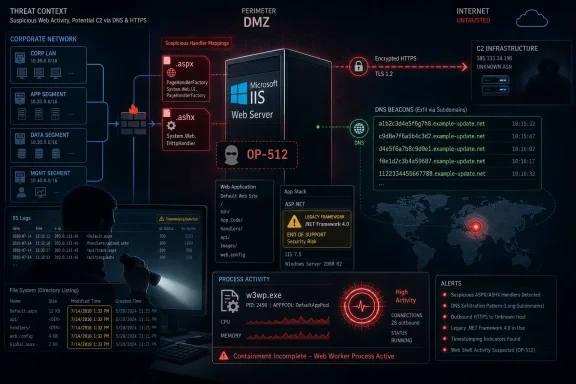
OP-512 appears to understand that terrain. According to reporting based on ReliaQuest’s research, the group has been observed targeting legacy IIS environments, including at least one Windows Server 2016 system running an outdated .NET Framework. That detail matters because “legacy” in this context does not mean abandoned Windows 2003 relics hiding in a basement. It can mean a still-supported operating system carrying an application stack whose dependencies are old, fragile, and politically difficult to upgrade.
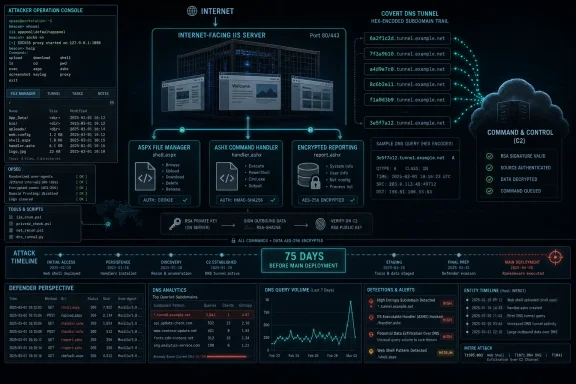
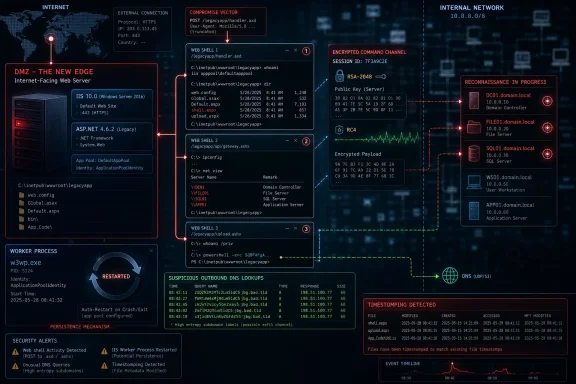
The attackers’ tooling reflects that pragmatism. OP-512 does not appear to be spraying generic commodity web shells and hoping one survives. Its framework reportedly consists of three distinct web shells, each serving a role in remote access, stealth, and operational control. That is a different posture from opportunistic compromise. It looks more like an operator building infrastructure for repeatable intrusions against a class of target.
For Windows administrators, this is the part that should raise eyebrows. IIS is not simply “the web server” in many Microsoft-heavy environments; it is the front door to custom code, authentication flows, service accounts, file shares, and database connectivity. Once a web shell lands there, the attacker is not just inside a website. They are often one misconfiguration away from the Windows estate beneath it.
The Web Shell Is No Longer Just a File on Disk
The phrase web shell can make an intrusion sound smaller than it is. In its simplest form, a web shell is a server-side script that gives an attacker command execution through ordinary web requests. On IIS, that can mean an ASP.NET file blended into an application directory, a handler that looks unremarkable, or a module that rides the same request pipeline as legitimate code.
OP-512’s reported framework shows how far that concept has matured. ReliaQuest’s account describes individually generated deployments, cryptographic access controls, and automated reporting back to attacker infrastructure. In plain English, the shell is not just a backdoor; it is a managed implant that can authenticate its operator, identify its own position inside the victim environment, and report into a broader command structure.
That self-reporting behavior is especially important. The attack sequence reportedly involves a web shell being dropped through the IIS worker process and then notifying an attacker-controlled domain of its location. This solves a practical problem for intruders: after compromise, they need to know which payload landed where, whether it is accessible, and how it should be used. Manual discovery is noisy and slow. Automated check-in turns compromise into inventory.
The use of cryptographic access controls points in the same direction. It suggests the operators are not merely hiding from defenders, but also protecting their own tooling from hijacking, sinkholing, or casual reuse by other attackers. State-aligned tooling increasingly treats the target environment as contested space. The implant has to defend itself not only against blue teams, but against other criminals, researchers, and rival intelligence shops that may stumble onto it.
That makes signature-based defense brittle. If each deployment is generated separately, simple hash matching becomes a weak control. If access requires crypto material, defenders may see a dormant file that does nothing obvious during casual testing. If reporting is centralized and automated, a compromised server can become part of an attacker’s operational map before the SOC has decided whether an odd timestamp deserves escalation.
Timestomping Is Boring, Which Is Why It Works
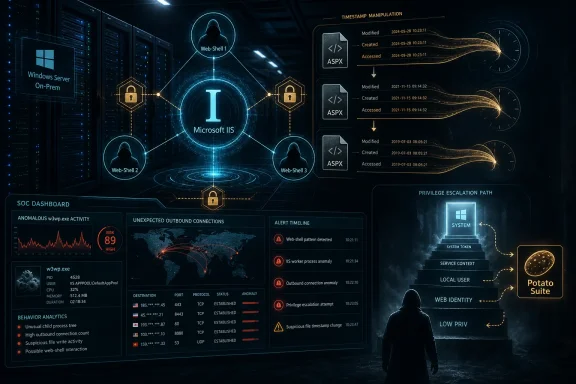
The most telling technique in the OP-512 reporting may be timestomping. Changing file timestamps is not glamorous. It is not a zero-day, not an AI-assisted exploit chain, not a cinematic lateral movement trick. It is an old anti-forensics move that works because defenders still sort directories by modified date when they are under pressure.
On a compromised IIS server, timestamps carry narrative value. A newly written ASPX file in a web root is suspicious. A file whose timestamps align with the rest of the application looks less urgent, especially if the server hosts hundreds or thousands of application artifacts. Timestomping attacks that human habit directly.
The technique also exploits the difference between incident response theory and operational reality. In theory, responders correlate file creation times, web logs, process execution, deployment records, endpoint telemetry, and backup history. In practice, many legacy IIS boxes do not have rich telemetry. Logging may be incomplete, retention may be short, and endpoint agents may be tuned carefully to avoid breaking the very application the business refuses to modernize.
This is why OP-512 is less interesting as a malware novelty than as a study in defender psychology. The tooling appears designed for environments where defenders know China-linked IIS activity exists, but have built detection around yesterday’s samples. The attacker’s answer is not necessarily to become invisible. It is to become unfamiliar enough that the existing playbook hesitates.
That hesitation is costly. A web shell on an IIS server can be a staging point for credential theft, internal reconnaissance, database access, and privilege escalation. If the first few hours are lost to “is this legitimate?” triage, the attacker gains the one commodity espionage operations prize most: dwell time.
China-Linked Does Not Mean Copy-Paste Attribution
ReliaQuest reportedly assesses OP-512 with moderate to high confidence as linked to China, but the public reporting also notes no firm overlap with known China-aligned adversaries. That distinction is worth preserving. Attribution in intrusion reporting is not a courtroom verdict; it is an analytical judgment based on targeting, infrastructure, tooling, timing, victimology, and tradecraft.
The absence of overlap is itself part of the story. OP-512 is described as the fourth China-linked or China-aligned cluster in the past year to focus on IIS servers, following other named activity sets such as CL-STA-0048, DragonRank, and GhostRedirector. The temptation is to flatten that into one monolithic “China hacks IIS” storyline. The more useful reading is that multiple teams, possibly with different tasking and tooling, have converged on IIS as a productive layer of enterprise compromise.
That convergence should worry defenders more than any single brand-new cluster name. When several espionage-oriented groups keep returning to the same technology stack, it usually means the cost-benefit ratio is favorable. IIS servers expose custom application code. They often run with meaningful privileges. They sit close to identity and data. They can be difficult to rebuild without business disruption.
There is also a strategic logic to targeting web servers rather than endpoints. Endpoint security has improved markedly over the past decade, especially on managed Windows workstations. Servers, particularly application servers, remain more uneven. They may have exclusions for performance reasons, fragile vendor software, and change windows measured in quarters rather than days.
So the China-linked assessment matters, but it should not become the only frame. Whether OP-512 is one team, a contractor ecosystem, or a newly distinguished slice of broader activity, the operational lesson is the same: defenders who treat IIS as boring infrastructure are leaving a high-value Windows control point under-watched.
The Potato Suite Detail Points Below the Web Layer
The reported attempt to escalate privileges using the Potato Suite is a useful reminder that web compromise is usually only the first act. Potato-family techniques have long targeted Windows privilege boundaries, often abusing token impersonation and service-account behavior to climb toward SYSTEM under the right conditions. The specifics vary by variant and patch level, but the strategic purpose is simple: turn application-level execution into machine-level control.
That matters because many organizations still think about web shells as a web team problem. The application owner asks whether the public site was defaced. The infrastructure team asks whether IIS needs a restart. The SOC looks for a suspicious script. But if the attacker reaches SYSTEM, the incident has moved decisively into Windows platform territory.
At SYSTEM, an intruder can tamper with security tooling, dump sensitive material, stage additional payloads, create persistence, and pivot into adjacent services. Even a failed privilege escalation attempt is valuable signal. It tells defenders the operator was not content with a foothold in the web application. They were probing the boundary between IIS and the underlying host.
The presence of Potato Suite-style escalation also reinforces the legacy angle. Modern, hardened Windows Server builds with current patches and constrained service privileges are less hospitable to these techniques. Older configurations, overprivileged app pools, and weak service isolation are another story. The attacker does not need every server to be vulnerable. They need the one server still carrying the assumptions of a previous Windows generation.
For sysadmins, the takeaway is not merely “patch.” It is to audit what identity an IIS application pool runs under, what privileges that identity has, what local rights exist on the server, and whether compromise of the web process would expose credentials or administrative paths. The web root is the visible surface. The app pool identity is often the blast radius.
Microsoft’s Old Server Problem Is Also the Customer’s Old App Problem
It is easy to frame this kind of campaign as a Microsoft problem, because IIS is Microsoft’s web server and Windows Server is the operating platform. That is only partly fair. Microsoft owns the platform, the defaults, the hardening guidance, and the patch stream. Customers own the messy application estates that keep old .NET versions, fragile deployment models, and permissive service accounts alive long after everyone agrees they should be replaced.
Windows Server 2016 is a good example of why the word “legacy” can mislead. It is not prehistoric in the way Windows Server 2008 now is. Many enterprises still operate it at scale. But a server is not secured by its OS name alone. Its effective risk is the composite of IIS configuration, .NET Framework level, installed components, application code, patch state, exposed endpoints, identity model, and monitoring coverage.
The application layer is where many modernization plans stall. A line-of-business app built for a specific .NET Framework version may not tolerate upgrades cleanly. A vendor may have disappeared, raised prices, or tied support to a larger migration project. A business unit may insist the app is too critical for disruption while refusing to fund its replacement. Attackers do not need to defeat the ideal Microsoft stack; they need to find the one frozen in time by business convenience.
This is why web shell campaigns remain stubbornly effective. The initial access vector may vary, but the persistence model thrives in the same place: writable directories, permissive app pools, weak deployment hygiene, poor file integrity monitoring, insufficient logging, and an incident response process that treats application servers as snowflakes. OP-512’s sophistication does not erase those basics. It weaponizes them.
The uncomfortable implication is that defenders cannot buy their way out with a single tool category. EDR helps. Web application firewalls help. Vulnerability scanners help. SIEM correlation helps. But each has blind spots when a purpose-built implant is designed for a specific server pattern and a specific operational workflow. The fix has to include architecture and ownership, not just detection content.
Signature-Based Comfort Is the Trap OP-512 Exploits
The public reporting around OP-512 emphasizes a gap for defenders relying on signatures tuned to other known China-linked groups. That is the heart of the matter. Security teams often improve by learning from prior incidents: add indicators, tune detections, block infrastructure, hunt for filenames, hash known payloads, and encode observed behaviors. This is necessary work, but it can become a rearview mirror.
A custom framework with unique deployments changes the economics. If every victim receives slightly different artifacts, hash-based detection degrades. If file timestamps are manipulated, simple recency hunts miss the mark. If access is cryptographically gated, sandboxing may fail to reveal behavior. If the shell phones home in a controlled way, network detections need to focus on patterns and context rather than only known domains.
This is where behavior-based detection earns its keep. A healthy IIS server has patterns: which worker processes write files, which directories change after deployments, which accounts spawn child processes, which scripts appear in which paths, which outbound connections are normal, and which command-line behaviors never happen during legitimate operations. The hard part is that many organizations have never baselined those patterns.
The result is a defensive asymmetry. Attackers can study common enterprise IIS habits and build implants that blend into them. Defenders, meanwhile, may not know what “normal” looks like for their own servers. They know what malware looked like in last month’s report, but not what their app pool did at 2:13 a.m. on a quiet Wednesday.
OP-512 should therefore be read as an argument for asset-specific visibility. IIS servers deserve file integrity monitoring on web roots and configuration paths. They deserve process monitoring that treats w3wp.exe spawning shells, scripting engines, archivers, or privilege-escalation tools as urgent. They deserve outbound network controls that make self-reporting to attacker domains harder. Most of all, they deserve owners who can distinguish a legitimate deployment artifact from a disguised implant.
The IIS Pattern Is Bigger Than One Cluster
The most significant fact in the OP-512 disclosure may be that it is reportedly the fourth such China-linked cluster to focus on IIS servers in the past year. One cluster can be an anomaly. Four clusters begin to look like an operational preference. IIS is not being discovered by attackers; it is being selected.
Part of the appeal is architectural. IIS often terminates authentication, brokers application sessions, and touches sensitive back-end systems. In Microsoft-centric organizations, it may sit alongside Active Directory-integrated services, Windows file paths, SQL Server connections, and internal APIs. A foothold there can be less noisy than a phishing campaign and more persistent than a single stolen laptop session.
Another part is cultural. Servers are still treated differently from endpoints. Workstations are rebuilt, reimaged, and cycled aggressively. Servers accumulate exceptions. The phrase “do not touch, it works” is practically an engraved invitation for espionage operators. If a server has survived three reorgs and two cloud migrations, it may also have survived three generations of security assumptions.
There is also a visibility imbalance between public-facing exploitation and internal consequence. A compromised IIS server may not immediately trigger the spectacle of ransomware encryption or customer-facing outage. Espionage prefers quiet success. A web shell that maintains access, collects data, and enables selective movement can be more damaging precisely because it does not announce itself.
That makes OP-512 a WindowsForum story in the deepest sense. This is not just about one adversary or one report. It is about the lived reality of Windows infrastructure: the old app that cannot be moved, the server that cannot be patched this month, the SOC rule written for the last incident, and the adversary patient enough to connect those facts.
The Hardening Work Is Unglamorous and Unavoidable
There is no single magic control that makes IIS immune to OP-512-style operations. The defensive answer is layered, tedious, and very familiar. That does not make it optional. It makes it the work.
Administrators should start by finding the IIS servers they actually have, not the ones listed in last year’s CMDB export. Internet-facing instances are the obvious priority, but internal IIS servers should not be ignored. A web shell on an internal application can be just as useful after a VPN compromise, stolen credential, or partner-network intrusion.
Patch state comes next, but with more precision than a green dashboard. The operating system, IIS components, .NET Framework, third-party controls, application frameworks, and vendor packages all matter. A fully patched Windows Server hosting an ancient vulnerable application is not fully safe. Likewise, an updated application running under an overprivileged app pool remains a pivot opportunity.
Monitoring should focus on the behaviors OP-512 reportedly uses. File writes by IIS worker processes into unexpected locations deserve scrutiny. Timestamp anomalies should be investigated against deployment records and backup metadata. New ASPX files, handler mappings, modules, and configuration changes should be treated as security-relevant events, not just application noise.
Privilege boundaries deserve equal attention. App pools should run with the least privilege possible. Service accounts should not have broad local administrative rights. Credential material should not live in plaintext configuration files. Outbound network access from web servers should be restricted so that a newly dropped shell cannot casually report home over arbitrary destinations.
The larger shift is organizational. IIS security cannot belong solely to the Windows team, the web developers, the SOC, or the application owner. OP-512-style intrusions cross all of those boundaries. The defense has to do the same.
The IIS Box in the Corner Just Became a Board-Level Risk
The practical message for Windows shops is sharper than the usual “keep systems updated” refrain. OP-512’s reported behavior shows an attacker model built around real enterprise weakness: old application stacks, incomplete telemetry, and defenders conditioned to look for yesterday’s China-linked indicators.
- Organizations should inventory IIS servers by exposure, application owner, Windows version, .NET version, and business criticality rather than treating them as generic web assets.
- Security teams should hunt for IIS worker processes writing unexpected files, spawning command interpreters, or initiating unusual outbound connections.
- Administrators should compare web-root timestamps against known deployment windows because timestomping is designed to defeat casual file-review workflows.
- Application pool identities should be reviewed for excessive privileges, especially local administrator rights and access to sensitive network resources.
- Detection programs should prioritize behavior and server baselines over hashes and filenames, because OP-512’s reported framework appears designed to vary by deployment.
- Incident response plans should treat an IIS web shell as possible Windows host compromise, not merely as a website cleanup task.
OP-512 may fade into the taxonomy of threat clusters, or it may become the name defenders remember from the next wave of IIS incident reports. Either way, the lesson is already clear: attackers are finding value in the neglected seams of Microsoft server estates, and the organizations that fare best will be the ones that stop treating legacy IIS as a maintenance nuisance and start treating it as exposed strategic infrastructure.
References
- New China-linked threat cluster OP-512 targets Microsoft IIS servers SC Media · 2026-06-05T21:59:18.609885