

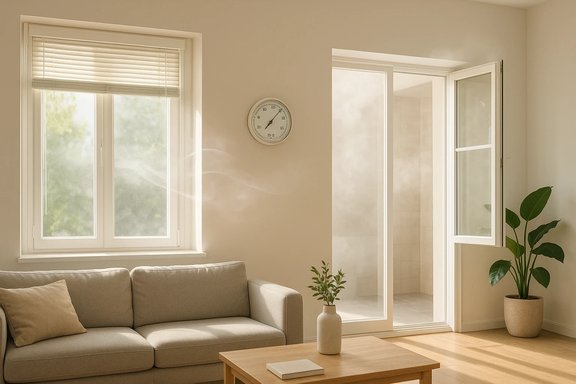
Households across the country are being urged to open their windows for roughly ten minutes a day to reduce condensation, lower indoor humidity and cut the risk of mould — a simple habit that experts say can protect buildings and health while limiting needless energy waste when done correctly.
Condensation forms when warm, moisture-laden indoor air meets cold surfaces and turns into liquid droplets. Everyday activities — showering, cooking, drying clothes indoors and even breathing — pump significant amounts of water vapour into the home. If that moisture has nowhere to escape, it collects on windows, external walls and cold corners and creates the damp patches that allow mould to take hold.
Mould is not only a fabric and decorating problem; it’s also linked to respiratory irritation and worsening asthma. Public-health and building‑science guidance consistently treats moisture control as the first line of defence: prevent excess humidity, ensure adequate ventilation, and remediate any dampness or visible mould promptly.
The now-common “open windows for 10 minutes” advice is a practical translation of those principles — a short, deliberate airing designed to exchange humid indoor air for drier outdoor air without leaving rooms cold for long periods. That recommendation mirrors long-established ventilation habits used in several European countries and appears frequently in practical homeowner guidance.
Short, deliberate ventilation — often called “shock ventilation” or the German practice lüften — aims to remove that moist air quickly and replace it with colder, drier outdoor air. Because the airing is brief, the overall room temperature does not drop dramatically, and central heating only needs to work a little to restore comfort. Repeated briefly airing throughout the day keeps average indoor humidity lower than leaving a house sealed for long periods.
Key points:
The “10-minute” guidance is a useful, easy-to-remember starting point, but it is not a universal prescription. Householders should monitor indoor humidity, adapt timings to local conditions and use the full suite of moisture‑control measures available: targeted ventilation, building fabric improvements and, where necessary, technological solutions such as dehumidifiers or MVHR systems. Address moisture at its source, and short, regular airing will serve as an effective daily habit that protects both homes and the people who live in them.
Source: Irish Mirror Households urged to open their windows for 10 minutes a day for crucial reason
 Background
Condensation forms when warm, moisture-laden indoor air meets cold surfaces and turns into liquid droplets. Everyday activities — showering, cooking, drying clothes indoors and even breathing — pump significant amounts of water vapour into the home. If that moisture has nowhere to escape, it collects on windows, external walls and cold corners and creates the damp patches that allow mould to take hold.Mould is not only a fabric and decorating problem; it’s also linked to respiratory irritation and worsening asthma. Public-health and building‑science guidance consistently treats moisture control as the first line of defence: prevent excess humidity, ensure adequate ventilation, and remediate any dampness or visible mould promptly.
The now-common “open windows for 10 minutes” advice is a practical translation of those principles — a short, deliberate airing designed to exchange humid indoor air for drier outdoor air without leaving rooms cold for long periods. That recommendation mirrors long-established ventilation habits used in several European countries and appears frequently in practical homeowner guidance.
Why brief, regular airing works
The science in plain language
Air can hold more water vapour when it’s warm. When that warm, humid indoor air touches a cold surface (windows, uninsulated walls, inside corners), the air cools and water vapour condenses into droplets. Those droplets create the persistent damp patches that allow mould spores to settle and multiply.Short, deliberate ventilation — often called “shock ventilation” or the German practice lüften — aims to remove that moist air quickly and replace it with colder, drier outdoor air. Because the airing is brief, the overall room temperature does not drop dramatically, and central heating only needs to work a little to restore comfort. Repeated briefly airing throughout the day keeps average indoor humidity lower than leaving a house sealed for long periods.
What changes in 10 minutes
- Relative humidity drops — a short, high‑volume exchange removes much of the water vapour that accumulates during cooking, showering or drying laundry.
- CO₂ and volatile compounds dilute — stale air, cooking smells, and volatile organic compounds from furnishings and cleaning products are reduced.
- Surfaces warm more evenly — eliminating trapped cold, moist pockets reduces the chance of condensation forming on cold walls and window reveals.
How long and when to open windows
Practical timing rules
- In winter, aim for short bursts of 5–15 minutes rather than prolonged opening. Two or three such airings a day, timed around high-moisture activities, are a pragmatic target.
- After showering or bathing, open bathroom windows and run extractor fans for at least 10 minutes to clear steam at the source.
- When cooking, use the cooker hood and open a window briefly while cooking and for several minutes afterward.
- Bedrooms benefit from airing in the morning — open windows for 5–10 minutes to remove overnight moisture and CO₂ before remaking beds.
Cross‑ventilation vs single-window airing
- Cross‑ventilation (opening windows on opposite sides) exchanges air much faster and is more efficient at removing moisture. When possible, create a short, straight airflow path through the house for 5–10 minutes.
- If cross‑ventilation isn’t practical, opening a single window briefly still helps — concentrate on the wet rooms (bathroom, kitchen) where moisture is produced.
Technology and household upgrades that reduce mould risk
Simple, low-tech measures
- Keep extractor fans in bathrooms and kitchens in good working order and use them during and after wet activities.
- Wipe visible condensation from window frames and sills daily in cold weather.
- Avoid drying clothes indoors where possible; if unavoidable, ventilate the room well or use a vented tumble dryer.
- Keep furniture a few centimetres from external walls so air can circulate behind it.
Smart and mechanical solutions
- Humidity sensors — inexpensive digital hygrometers let you monitor relative humidity. Aim to keep daily averages broadly between 40% and 60% where practical; sustained levels above 65–70% materially increase mould risk.
- Smart thermostats and scheduling — a thermostat that controls heating to maintain a stable baseline temperature prevents surfaces becoming extremely cold (which increases condensation).
- Timed extractor controls and smart plugs — automate extractor fans to run for a fixed period after showers or cooking.
- Mechanical Ventilation with Heat Recovery (MVHR) — for tightly insulated homes, MVHR systems provide continuous ventilation while recovering most of the heat from exhausted air. This is a higher‑cost option but is energy efficient over time in well-insulated dwellings.
- Dehumidifiers — effective in zones with persistent high humidity, basements or rooms used for drying laundry. Note that they consume electricity and are not a replacement for source ventilation.
Energy, cost and comfort: balancing ventilation with heating bills
Opening a window does let heat escape, but the short-burst strategy is designed to limit energy loss. A brisk 5–10 minute airing will cool surfaces briefly but requires less heating energy overall than running extractors or leaving windows ajar for extended periods.Key points:
- A quick cross‑vent reduces humidity rapidly and minimizes heat loss compared with leaving a window partly open all day.
- Maintaining a low, steady heat in the home (rather than cold‑to‑hot swings) reduces condensation risk and often uses less energy overall.
- Heat recovery ventilation offers the best balance of continuous ventilation and energy efficiency where installation and home fabric justify it.
Sealing draughts without losing ventilation
Heat escapes via gaps at doors, windows, letterboxes and chimneys. Reducing uncontrolled draughts and cold spots while still ventilating deliberately is key.- Fit or service weatherstripping and window seals to reduce uncontrolled air infiltration.
- Install door excluders, letterbox brushes and chimney draught excluders if rooms are unused.
- Insulate vulnerable cold bridges (e.g., around window reveals and poorly insulated external walls) — this reduces the surfaces where condensation forms.
- After addressing these uncontrolled losses, brief scheduled airing will be more effective and less costly in terms of heat.
When airing is not the right immediate action
- High outdoor pollution: If the outside air quality is poor (heavy traffic, nearby construction or wildfire smoke), opening windows may worsen indoor air quality. In these situations use extractors, air purifiers with HEPA filters and, if available, heat‑recovery ventilation.
- Security concerns or severe weather: Don’t compromise safety — use alternative measures like extractor fans, dehumidifiers, or air purifiers.
- Immediate visible mould on structural surfaces: For significant mould that’s widespread or on porous structural materials, simple airing and cleaning are insufficient; professional remediation and investigation of moisture ingress are needed.
If mould is already present
- Small, limited areas of visible mould may be cleaned with detergent and water or a specialist mould cleaner, following manufacturer instructions and wearing appropriate protection (gloves, eye protection and a suitable mask).
- Porous materials (plasterboard, carpets, upholstered furniture) with heavy contamination usually need replacement.
- If mould recurs after cleaning, this is a sign of ongoing moisture problems. Investigate the moisture source — leaks, rising damp, inadequate ventilation or thermal bridging — and address that before relying on surface cleaning.
- For extensive contamination or where occupants have respiratory vulnerability, seek professional assessment and remediation.
Practical “how-to” steps you can implement today
- Place a small hygrometer in the living room and bedroom to establish baseline relative humidity.
- After cooking, open windows for 5–10 minutes and run the extractor hood during and for a short time after cooking.
- After showering, run the bathroom extractor and open the window for 10 minutes where safe and practical.
- In the morning, open bedroom windows for 5–10 minutes before making the bed.
- If you have smart blinds or electric blinds, schedule them to open with morning sunlight to gain passive solar heat while airing.
- Seal obvious draughts around doors and windows to reduce uncontrolled heat loss.
- If persistent humidity exceeds 65%, consider a dehumidifier or consult a professional to evaluate ventilation and fabric issues.
Tech-savvy additions for connected homes
- Integrate humidity sensors with Home Assistant, SmartThings or other home automation platforms to trigger extractor fans or smart plugs automatically.
- Use combined temperature/humidity/CO₂ monitors to get a fuller picture of indoor air quality; CO₂ spikes indicate poor air exchange even when humidity seems controlled.
- Program smart thermostats to maintain a minimal background temperature through the day to keep surface temperatures above condensation thresholds.
- For homes with electric blinds, coordinate blinds and ventilation to use free solar gain where possible — open blinds south-facing when the sun shines, then briefly ventilate once temperatures drop.
Notable strengths and limitations of the “10-minute” guidance
Strengths:- Simplicity — it’s an easy habit for households to adopt without expensive equipment.
- Effectiveness — brief airing reduces humidity and dilutes indoor pollutants quickly when executed properly.
- Energy-aware — short bursts avoid the heavy energy penalty of prolonged window opening.
- The 10-minute rule is a rule of thumb, not a one-size-fits-all prescription. Homes vary in size, airtightness, occupant behaviour, and local climate. What’s sufficient in one building may be inadequate in another.
- This advice assumes outdoor air is relatively dry and clean; it’s counterproductive where outside humidity or air pollution is high.
- Relying only on window opening ignores other critical measures: extraction in wet rooms, insulation, fixing leaks, and addressing thermal bridging.
- Where structural moisture ingress (plumbing leaks, rising damp, penetrative damp) exists, airing will not solve the underlying problem.
Action checklist for households (quick reference)
- Invest in a basic hygrometer. Aim for average indoor humidity below roughly 60% and spot readings below 65–70% to minimise mould risk.
- Use extractors when bathing or cooking. If none are fitted, open windows immediately and for 10 minutes afterward.
- Air rooms briefly twice daily, more often after moisture-creating activities.
- Seal obvious draughts and insulate cold surfaces to reduce condensation-prone areas.
- For continuous ventilation without losing heat, consider MVHR in well‑insulated homes.
- If you find persistent mould, address moisture sources and get professional help for extensive contamination.
Conclusion
A short, deliberate airing routine — opening windows for a few minutes several times a day, timed around wet activities — remains a low-cost, practical measure that reduces condensation and the risk of mould without dramatically increasing heating bills when done correctly. It should be combined with extractor fans, sensible heating, draught sealing and, in energy‑efficient homes, mechanical ventilation with heat recovery.The “10-minute” guidance is a useful, easy-to-remember starting point, but it is not a universal prescription. Householders should monitor indoor humidity, adapt timings to local conditions and use the full suite of moisture‑control measures available: targeted ventilation, building fabric improvements and, where necessary, technological solutions such as dehumidifiers or MVHR systems. Address moisture at its source, and short, regular airing will serve as an effective daily habit that protects both homes and the people who live in them.
Source: Irish Mirror Households urged to open their windows for 10 minutes a day for crucial reason
