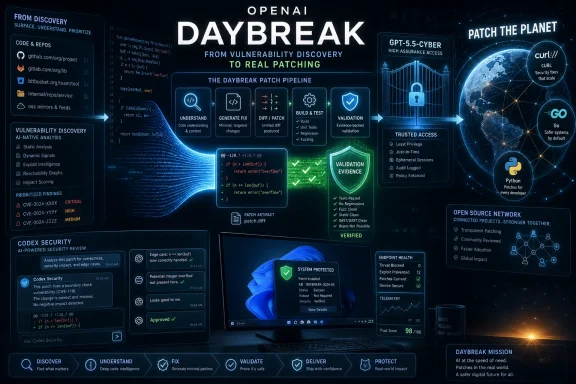
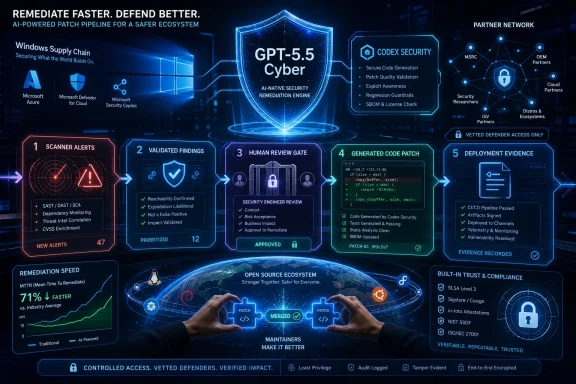
OpenAI on Monday, June 22, 2026, announced a more capable and more permissive GPT-5.5-Cyber release for vetted defenders, expanded government and institutional access, a Codex Security plugin, and a new open-source remediation effort called Patch the Planet. The company is not merely shipping another model variant; it is trying to define who gets access to AI systems that can find, validate, and help fix serious software flaws. That makes this less a product launch than a governance move. The question for Windows users, sysadmins, and software maintainers is whether that governance can move as quickly as the vulnerabilities these models are now expected to surface.
The most important word in OpenAI’s announcement is not cyber. It is vetted.
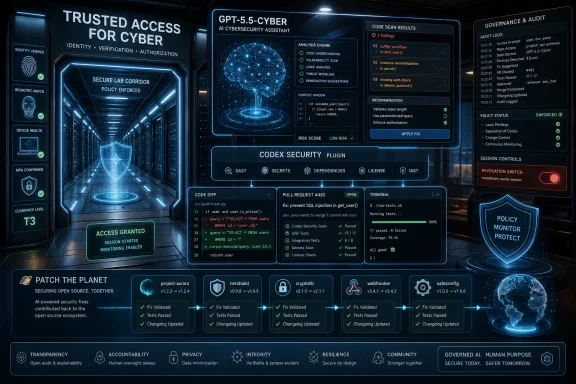
GPT-5.5-Cyber is being positioned as a more permissive model for advanced, authorized security work, not as a general-purpose ChatGPT upgrade for anyone who wants to poke at live systems. OpenAI’s Trusted Access for Cyber program is the gate: approved security companies, researchers, enterprises, and government-linked defenders get reduced friction for legitimate workflows while the model is still supposed to refuse plainly malicious tasks.
That sounds tidy in a press release. In practice, it is a bet that identity, intent, and monitoring can become part of the model’s safety boundary. OpenAI is saying, in effect, that the same prompt should not always receive the same answer; the model’s usefulness depends on who is asking, what environment they are working in, and whether the activity has been authorized.
That is a meaningful departure from the public ChatGPT safety model many users understand. The consumer experience is built around broad refusals, blunt policy edges, and a lowest-common-denominator assumption that dual-use security work can easily shade into abuse. The cyber-defender experience OpenAI wants to sell is different: fewer false refusals, more operational detail, and more room to work with malware analysis, reverse engineering, vulnerability triage, detection engineering, and patch validation.
For IT professionals, this is the familiar enterprise software bargain in a new form. The tool becomes more powerful once the vendor trusts your organization. The risk is that the vendor also becomes a gatekeeper for a class of defensive capability that may soon be too important to leave entirely to vendor discretion.
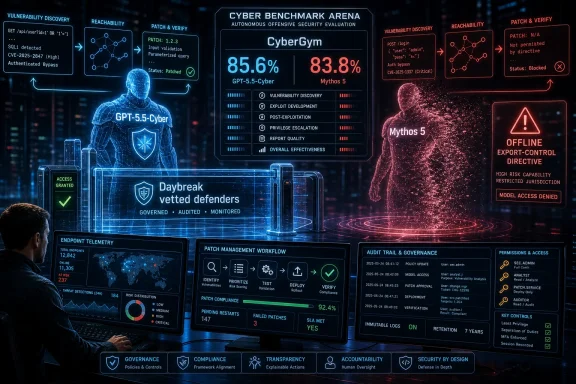
That is the backdrop against which GPT-5.5-Cyber lands. OpenAI does not need to claim that its system is identical to Mythos for the competitive signal to be obvious. The industry has entered a phase where frontier AI labs are no longer just demonstrating that models can answer security questions; they are building access regimes for models that may materially change the economics of vulnerability discovery.
This is where the public debate can become misleading. A model that finds bugs is not automatically a model that makes everyone safer. Vulnerability discovery is only the first act in a much longer play involving validation, disclosure, patch engineering, regression testing, downstream adoption, and sometimes months of operational cleanup.
The security community has always known this. The difference now is scale. If AI systems can generate credible findings faster than maintainers can process them, the bottleneck moves from “Can we find the flaw?” to “Can anyone responsibly absorb the queue?”
That is why OpenAI’s broader package matters more than the model name. GPT-5.5-Cyber is the shiny object. Patch the Planet, Codex Security, and trusted access are the scaffolding around it.
OpenAI says the effort is being founded with Trail of Bits and developed in collaboration with vulnerability-management players including HackerOne. The idea, as described in reporting, is to pair AI-generated vulnerability discovery with a more serious path to remediation. That distinction matters because the open-source world is already drowning in low-quality, AI-assisted bug reports.
Anyone who maintains a public project has seen the failure mode. A tool emits a plausible-sounding warning. A submitter wraps it in confident prose. A maintainer then spends unpaid time proving that the report is duplicate, unexploitable, out of scope, or simply wrong.
The cruel irony is that better AI can worsen this before it improves it. A mediocre model produces obvious slop. A stronger model produces reports that are harder to dismiss, even when they still require careful validation. The cost of triage rises with plausibility.
That is why the “patch” side of Patch the Planet is the only part worth taking seriously. Finding a bug and handing it to an overworked maintainer is not enough. The valuable unit is a validated finding with a minimal, reviewable fix, tests that demonstrate the issue, and a disclosure path that does not turn maintainers into unpaid incident-response staff.
The pitch is that Codex Security can build a threat model for a codebase, explore attack paths, validate findings in isolated environments, and propose patches for human review. In the best case, that pushes AI security work closer to how software actually changes. A proposed fix is not a PDF. It is a diff.
This is also where enterprise Windows shops should pay attention. Many Windows environments depend on a hybrid stack: Microsoft identity, Windows endpoints, Linux containers, Node or Python services, third-party agents, and open-source libraries buried several layers deep in the dependency graph. A vulnerability in an upstream package can become a Windows operational problem without ever being a Windows vulnerability in the classic Patch Tuesday sense.
Security teams have spent years asking developers to “shift left.” Developers have spent years complaining that security tools create noise, block releases, and lack context. Agentic code review promises a compromise: security analysis that can read the code, understand the project’s assumptions, and propose a fix rather than merely waving a red flag.
But the compromise only works if the agent’s work is auditable. A patch generated by an AI model is still a patch. It can introduce regressions, break undocumented behavior, or fix the obvious symptom while leaving the underlying trust boundary intact. The human review burden does not vanish; it changes shape.
Identity tells a vendor who is using the tool. It does not guarantee that the tool is being used wisely, that the target is properly scoped, or that the output will be handled responsibly. A legitimate security team can still make a mistake. A contractor can still overreach. A compromised account can still turn a defensive tool into an offensive accelerator.
OpenAI appears aware of that problem, requiring stronger account protections for high-trust access. That is sensible. If a model tier can help validate high-severity vulnerabilities or automate red-team workflows, phishing-resistant authentication is not a nice-to-have; it is table stakes.
Still, access control is only one layer. The real governance challenge is operational. What logs are kept? How are suspicious workflows detected? How quickly can access be revoked? What happens when a model produces a working exploit chain in the course of authorized testing? Who decides whether a customer is a defender, a gray-area broker, or a liability?
Those are not abstract questions for sysadmins. They are the same questions administrators already ask about privileged access management, EDR consoles, vulnerability scanners, and remote monitoring tools. The difference is that an AI security model can synthesize steps, adapt to context, and produce new artifacts at a speed conventional tools do not match.
The first-order effect of AI cyber models will likely be felt upstream. More bugs will be found in libraries, frameworks, build tools, parsers, runtimes, and services that Windows organizations use indirectly. Some of those findings will become CVEs. Some will become hurried patches. Some will become noisy advisories that security teams must triage before they know whether any Windows asset is exposed.
The second-order effect is cadence. If AI-assisted discovery accelerates, the old rhythm of vulnerability management becomes less comfortable. Monthly patch cycles, quarterly dependency updates, and “we’ll pick that up in the next maintenance window” all begin to look dated when exploitability can be analyzed quickly and at scale.
The third-order effect is asymmetry. Large vendors and well-funded enterprises may get access to the best defensive models first. Small maintainers and smaller IT teams may get the fallout first: more reports, more patches to evaluate, and more pressure to move quickly without the same tooling.
That is the central tension in OpenAI’s announcement. The company is trying to prevent advanced cyber AI from becoming a general-purpose weapon. But by limiting access, it also risks creating a defensive class system in which the best automation reaches the organizations already best positioned to absorb it.
AI breaks that balance. The cost of producing a vulnerability report has fallen dramatically, while the cost of determining whether it matters has not fallen nearly as fast. That is why maintainers have grown hostile to AI-generated submissions and why some bounty programs have tightened rules or paused participation.
OpenAI’s effort with HackerOne and Trail of Bits should be read against that backdrop. If Patch the Planet is merely a pipeline for more findings, it will add to the burden. If it funds validation, remediation, and maintainer support, it could become part of the answer.
The phrase “AI-generated bug report” is already developing the same reputation as “automated scanner finding” had in earlier eras: sometimes useful, often noisy, and rarely sufficient on its own. What maintainers need is not another alert. They need a reproducible case, a clear impact statement, a patch that does not vandalize the project architecture, and help shepherding the fix through release.
This is where OpenAI’s incentives are complicated. The company wants to show that frontier models can help defenders, not just alarm policymakers. Open-source remediation is an attractive proof point because it is public-spirited, technically concrete, and easy to explain. But open-source projects are not demonstration surfaces for AI labs. They are communities with governance, norms, limited time, and long memories.
The strongest version of OpenAI’s case is that refusing to deploy defensive AI does not freeze attacker capability. Open-weight models, private research, and competing labs will continue to push the field forward. If that is true, the defensive side needs automation for code review, detection engineering, patch validation, and incident response.
The weaker version is that every new capability can be justified by saying defenders need it. Security vendors have used that line for decades, sometimes while selling tools that increased operational complexity more than actual resilience. A powerful AI model that creates thousands of findings but only a modest number of deployable fixes is not an unambiguous win.
OpenAI’s credibility will depend on outcomes it cannot fully control. Do maintainers actually receive useful patches? Do enterprises reduce exposure windows? Do government partners improve disclosure coordination? Do the models avoid becoming privileged exploit assistants for anyone who can clear a vetting process?
The company also has to prove that its own systems can be trusted as security infrastructure. That includes mundane but critical issues: account security, auditability, data handling, and protection of customer code. A model that reads private repositories and proposes fixes becomes part of the software supply chain. That raises the stakes for every integration decision.
A more capable AI assistant could help. It could summarize exploitability, draft detections, compare vulnerable and patched versions, generate safe proof-of-concept checks, and validate whether a mitigation actually closes the path. Those are valuable workflows, especially when teams are short-staffed.
But the moment an organization gets access to a more permissive cyber model, it also inherits governance obligations. The access should not be treated like a ChatGPT Plus subscription with a scarier name. It belongs in the same control family as privileged security tooling.
That means role-based access, logging, approved scopes, review procedures, and incident handling for model outputs. If an analyst asks the model for exploit detail during an authorized internal test, the organization needs a policy for storing, sharing, and eventually destroying that material. If the model proposes a patch, the organization needs code review and regression testing. If the model flags a third-party vulnerability, the organization needs a disclosure path that does not create legal or operational chaos.
The uncomfortable truth is that many enterprises will want the capability before they have the process. That is not new in cybersecurity. It is how many powerful tools arrive: first as a promise of speed, then as another system administrators must govern.
When AI systems can help find and validate bugs faster, organizations with poor software inventory will suffer. You cannot patch what you cannot identify. You cannot assess exposure if you do not know which applications bundle which libraries. You cannot prioritize fixes if every alert enters the queue with the same urgency.
This is where boring security fundamentals become newly valuable. Software bills of materials, dependency tracking, least privilege, network segmentation, application control, phishing-resistant authentication, and reliable rollback procedures are not glamorous. They are what let an organization survive when the patch tempo accelerates.
Windows administrators should also expect more pressure on third-party application patching. Microsoft’s own update machinery is mature compared with the sprawl around it. Browsers, developer runtimes, VPN clients, backup agents, remote support tools, endpoint security products, and line-of-business applications often represent the messier part of the estate.
AI-assisted vulnerability discovery will not respect the boundary between “Microsoft patch” and “everything else.” Attackers do not care whether the vulnerable component arrived through Windows Update, winget, an MSI from a vendor portal, a bundled library, or a forgotten internal tool. Defenders cannot afford to care too much either.
 OpenAI Wants to Turn Cyber Capability Into Controlled Infrastructure
The most important word in OpenAI’s announcement is not cyber. It is vetted.GPT-5.5-Cyber is being positioned as a more permissive model for advanced, authorized security work, not as a general-purpose ChatGPT upgrade for anyone who wants to poke at live systems. OpenAI’s Trusted Access for Cyber program is the gate: approved security companies, researchers, enterprises, and government-linked defenders get reduced friction for legitimate workflows while the model is still supposed to refuse plainly malicious tasks.
That sounds tidy in a press release. In practice, it is a bet that identity, intent, and monitoring can become part of the model’s safety boundary. OpenAI is saying, in effect, that the same prompt should not always receive the same answer; the model’s usefulness depends on who is asking, what environment they are working in, and whether the activity has been authorized.
That is a meaningful departure from the public ChatGPT safety model many users understand. The consumer experience is built around broad refusals, blunt policy edges, and a lowest-common-denominator assumption that dual-use security work can easily shade into abuse. The cyber-defender experience OpenAI wants to sell is different: fewer false refusals, more operational detail, and more room to work with malware analysis, reverse engineering, vulnerability triage, detection engineering, and patch validation.
For IT professionals, this is the familiar enterprise software bargain in a new form. The tool becomes more powerful once the vendor trusts your organization. The risk is that the vendor also becomes a gatekeeper for a class of defensive capability that may soon be too important to leave entirely to vendor discretion.
The Mythos Shadow Is the Real Competitive Context
OpenAI’s timing is not subtle. Anthropic’s Mythos Preview has become the comparison point for the entire AI-cybersecurity conversation: a model reportedly able to find large numbers of vulnerabilities across major operating systems, browsers, and open-source projects, with the dangerous implication that AI-assisted exploit development may compress timelines from weeks to hours.That is the backdrop against which GPT-5.5-Cyber lands. OpenAI does not need to claim that its system is identical to Mythos for the competitive signal to be obvious. The industry has entered a phase where frontier AI labs are no longer just demonstrating that models can answer security questions; they are building access regimes for models that may materially change the economics of vulnerability discovery.
This is where the public debate can become misleading. A model that finds bugs is not automatically a model that makes everyone safer. Vulnerability discovery is only the first act in a much longer play involving validation, disclosure, patch engineering, regression testing, downstream adoption, and sometimes months of operational cleanup.
The security community has always known this. The difference now is scale. If AI systems can generate credible findings faster than maintainers can process them, the bottleneck moves from “Can we find the flaw?” to “Can anyone responsibly absorb the queue?”
That is why OpenAI’s broader package matters more than the model name. GPT-5.5-Cyber is the shiny object. Patch the Planet, Codex Security, and trusted access are the scaffolding around it.
Patch the Planet Is a Patch Queue Wearing a Moonshot Hoodie
Patch the Planet is an unusually grand name for a brutally practical problem: open-source projects are not staffed like commercial software giants, yet their code underpins commercial software giants, cloud platforms, developer tools, container images, routers, desktop apps, and the Windows software supply chain.OpenAI says the effort is being founded with Trail of Bits and developed in collaboration with vulnerability-management players including HackerOne. The idea, as described in reporting, is to pair AI-generated vulnerability discovery with a more serious path to remediation. That distinction matters because the open-source world is already drowning in low-quality, AI-assisted bug reports.
Anyone who maintains a public project has seen the failure mode. A tool emits a plausible-sounding warning. A submitter wraps it in confident prose. A maintainer then spends unpaid time proving that the report is duplicate, unexploitable, out of scope, or simply wrong.
The cruel irony is that better AI can worsen this before it improves it. A mediocre model produces obvious slop. A stronger model produces reports that are harder to dismiss, even when they still require careful validation. The cost of triage rises with plausibility.
That is why the “patch” side of Patch the Planet is the only part worth taking seriously. Finding a bug and handing it to an overworked maintainer is not enough. The valuable unit is a validated finding with a minimal, reviewable fix, tests that demonstrate the issue, and a disclosure path that does not turn maintainers into unpaid incident-response staff.
Codex Security Moves the Scanner Into the Developer Workflow
OpenAI’s Codex Security plugin is the more immediate product move for developers. Rather than treating security scanning as a separate portal or outside audit, OpenAI wants the security workflow to sit inside Codex interfaces such as the app or CLI. That makes sense: developers do not live in vulnerability dashboards; they live in editors, terminals, pull requests, and issue trackers.The pitch is that Codex Security can build a threat model for a codebase, explore attack paths, validate findings in isolated environments, and propose patches for human review. In the best case, that pushes AI security work closer to how software actually changes. A proposed fix is not a PDF. It is a diff.
This is also where enterprise Windows shops should pay attention. Many Windows environments depend on a hybrid stack: Microsoft identity, Windows endpoints, Linux containers, Node or Python services, third-party agents, and open-source libraries buried several layers deep in the dependency graph. A vulnerability in an upstream package can become a Windows operational problem without ever being a Windows vulnerability in the classic Patch Tuesday sense.
Security teams have spent years asking developers to “shift left.” Developers have spent years complaining that security tools create noise, block releases, and lack context. Agentic code review promises a compromise: security analysis that can read the code, understand the project’s assumptions, and propose a fix rather than merely waving a red flag.
But the compromise only works if the agent’s work is auditable. A patch generated by an AI model is still a patch. It can introduce regressions, break undocumented behavior, or fix the obvious symptom while leaving the underlying trust boundary intact. The human review burden does not vanish; it changes shape.
The New Safety Boundary Is Identity, Not Just Policy
OpenAI’s trusted-access model assumes that advanced cyber capability can be distributed safely if access is tied to verified people and organizations. That is the same premise behind export controls, classified networks, bug bounty vetting, and enterprise admin roles. It is not absurd. It is just incomplete.Identity tells a vendor who is using the tool. It does not guarantee that the tool is being used wisely, that the target is properly scoped, or that the output will be handled responsibly. A legitimate security team can still make a mistake. A contractor can still overreach. A compromised account can still turn a defensive tool into an offensive accelerator.
OpenAI appears aware of that problem, requiring stronger account protections for high-trust access. That is sensible. If a model tier can help validate high-severity vulnerabilities or automate red-team workflows, phishing-resistant authentication is not a nice-to-have; it is table stakes.
Still, access control is only one layer. The real governance challenge is operational. What logs are kept? How are suspicious workflows detected? How quickly can access be revoked? What happens when a model produces a working exploit chain in the course of authorized testing? Who decides whether a customer is a defender, a gray-area broker, or a liability?
Those are not abstract questions for sysadmins. They are the same questions administrators already ask about privileged access management, EDR consoles, vulnerability scanners, and remote monitoring tools. The difference is that an AI security model can synthesize steps, adapt to context, and produce new artifacts at a speed conventional tools do not match.
Microsoft’s Ecosystem Will Feel This Even Without Being the Headline
This is not a Microsoft announcement, but Windows professionals should not treat it as someone else’s story. Windows environments are dense dependency ecosystems. They are patched by Microsoft, extended by OEMs, managed by third-party security agents, scripted through PowerShell, joined to cloud identity, and increasingly connected to open-source components.The first-order effect of AI cyber models will likely be felt upstream. More bugs will be found in libraries, frameworks, build tools, parsers, runtimes, and services that Windows organizations use indirectly. Some of those findings will become CVEs. Some will become hurried patches. Some will become noisy advisories that security teams must triage before they know whether any Windows asset is exposed.
The second-order effect is cadence. If AI-assisted discovery accelerates, the old rhythm of vulnerability management becomes less comfortable. Monthly patch cycles, quarterly dependency updates, and “we’ll pick that up in the next maintenance window” all begin to look dated when exploitability can be analyzed quickly and at scale.
The third-order effect is asymmetry. Large vendors and well-funded enterprises may get access to the best defensive models first. Small maintainers and smaller IT teams may get the fallout first: more reports, more patches to evaluate, and more pressure to move quickly without the same tooling.
That is the central tension in OpenAI’s announcement. The company is trying to prevent advanced cyber AI from becoming a general-purpose weapon. But by limiting access, it also risks creating a defensive class system in which the best automation reaches the organizations already best positioned to absorb it.
Bug Bounties Are Becoming a Triage Crisis
The open-source security economy has always depended on a fragile exchange. Researchers find issues, platforms coordinate reports, organizations pay bounties, and maintainers review fixes. It works tolerably well when reports are scarce enough and credible enough.AI breaks that balance. The cost of producing a vulnerability report has fallen dramatically, while the cost of determining whether it matters has not fallen nearly as fast. That is why maintainers have grown hostile to AI-generated submissions and why some bounty programs have tightened rules or paused participation.
OpenAI’s effort with HackerOne and Trail of Bits should be read against that backdrop. If Patch the Planet is merely a pipeline for more findings, it will add to the burden. If it funds validation, remediation, and maintainer support, it could become part of the answer.
The phrase “AI-generated bug report” is already developing the same reputation as “automated scanner finding” had in earlier eras: sometimes useful, often noisy, and rarely sufficient on its own. What maintainers need is not another alert. They need a reproducible case, a clear impact statement, a patch that does not vandalize the project architecture, and help shepherding the fix through release.
This is where OpenAI’s incentives are complicated. The company wants to show that frontier models can help defenders, not just alarm policymakers. Open-source remediation is an attractive proof point because it is public-spirited, technically concrete, and easy to explain. But open-source projects are not demonstration surfaces for AI labs. They are communities with governance, norms, limited time, and long memories.
The Defender-First Story Still Needs Evidence
OpenAI’s framing is straightforward: models are becoming more capable, attackers will eventually get similar tools, so defenders should get responsible access now. That argument is plausible. It is also self-serving in the way every vendor’s public-interest argument is self-serving.The strongest version of OpenAI’s case is that refusing to deploy defensive AI does not freeze attacker capability. Open-weight models, private research, and competing labs will continue to push the field forward. If that is true, the defensive side needs automation for code review, detection engineering, patch validation, and incident response.
The weaker version is that every new capability can be justified by saying defenders need it. Security vendors have used that line for decades, sometimes while selling tools that increased operational complexity more than actual resilience. A powerful AI model that creates thousands of findings but only a modest number of deployable fixes is not an unambiguous win.
OpenAI’s credibility will depend on outcomes it cannot fully control. Do maintainers actually receive useful patches? Do enterprises reduce exposure windows? Do government partners improve disclosure coordination? Do the models avoid becoming privileged exploit assistants for anyone who can clear a vetting process?
The company also has to prove that its own systems can be trusted as security infrastructure. That includes mundane but critical issues: account security, auditability, data handling, and protection of customer code. A model that reads private repositories and proposes fixes becomes part of the software supply chain. That raises the stakes for every integration decision.
The Enterprise Buyer Gets Power and Liability Together
For CISOs and IT administrators, GPT-5.5-Cyber-style access will be tempting. The backlog is real. Vulnerability management teams are overrun. AppSec teams cannot review every pull request. Detection engineers are perpetually translating new threat intelligence into rules, queries, and playbooks.A more capable AI assistant could help. It could summarize exploitability, draft detections, compare vulnerable and patched versions, generate safe proof-of-concept checks, and validate whether a mitigation actually closes the path. Those are valuable workflows, especially when teams are short-staffed.
But the moment an organization gets access to a more permissive cyber model, it also inherits governance obligations. The access should not be treated like a ChatGPT Plus subscription with a scarier name. It belongs in the same control family as privileged security tooling.
That means role-based access, logging, approved scopes, review procedures, and incident handling for model outputs. If an analyst asks the model for exploit detail during an authorized internal test, the organization needs a policy for storing, sharing, and eventually destroying that material. If the model proposes a patch, the organization needs code review and regression testing. If the model flags a third-party vulnerability, the organization needs a disclosure path that does not create legal or operational chaos.
The uncomfortable truth is that many enterprises will want the capability before they have the process. That is not new in cybersecurity. It is how many powerful tools arrive: first as a promise of speed, then as another system administrators must govern.
The Patch Race Will Punish Slow Software Hygiene
For WindowsForum readers, the practical consequence is not that GPT-5.5-Cyber will suddenly hack your laptop. It is that the entire vulnerability lifecycle may speed up around you.When AI systems can help find and validate bugs faster, organizations with poor software inventory will suffer. You cannot patch what you cannot identify. You cannot assess exposure if you do not know which applications bundle which libraries. You cannot prioritize fixes if every alert enters the queue with the same urgency.
This is where boring security fundamentals become newly valuable. Software bills of materials, dependency tracking, least privilege, network segmentation, application control, phishing-resistant authentication, and reliable rollback procedures are not glamorous. They are what let an organization survive when the patch tempo accelerates.
Windows administrators should also expect more pressure on third-party application patching. Microsoft’s own update machinery is mature compared with the sprawl around it. Browsers, developer runtimes, VPN clients, backup agents, remote support tools, endpoint security products, and line-of-business applications often represent the messier part of the estate.
AI-assisted vulnerability discovery will not respect the boundary between “Microsoft patch” and “everything else.” Attackers do not care whether the vulnerable component arrived through Windows Update, winget, an MSI from a vendor portal, a bundled library, or a forgotten internal tool. Defenders cannot afford to care too much either.
The Week OpenAI Tried to Make Vulnerability Discovery Someone Else’s Patch
This announcement leaves IT leaders with a short list of concrete realities, most of them less futuristic than the model branding suggests.- OpenAI is expanding GPT-5.5-Cyber as a limited-access tool for vetted defenders, not as a general public model for unrestricted security work.
- The company’s Trusted Access for Cyber strategy makes identity verification and account security part of the safety model for advanced dual-use capabilities.
- Patch the Planet is important only if it produces validated fixes and maintainer support, not merely a larger stream of vulnerability reports.
- Codex Security’s plugin approach suggests that AI security tools are moving into everyday developer workflows rather than remaining separate scanner dashboards.
- Windows administrators should expect faster vulnerability churn in third-party dependencies, open-source components, and developer tooling that sit around Windows estates.
- Enterprises that gain access to more permissive cyber models need governance, logging, scope control, and patch-review processes before treating the tools as operational infrastructure.
References
- Primary source: Axios
Published: Mon, 22 Jun 2026 17:00:58 GMT
OpenAI gives GPT-5.5-Cyber more powerful cybersecurity capabilities
Even as Anthropic's Fable remains in limbo, the race to get advanced AI models in the hands of defenders continues to heat up.www.axios.com
- Independent coverage: WIRED
Published: Mon, 22 Jun 2026 17:00:00 GMT
OpenAI Launches Full-Scale Effort to Patch Open-Source Bugs as It Takes on Anthropic’s Mythos | WIRED
Amid concerns about AI models’ cybersecurity capabilities, OpenAI revealed an improved version of GPT-5.5-Cyber and its “Patch the Planet” initiative to fix open-source software bugs.www.wired.com - Official source: openai.com
Introducing Aardvark: OpenAI’s agentic security researcher | OpenAI
OpenAI introduces Aardvark, an AI-powered security researcher that autonomously finds, validates, and helps fix software vulnerabilities at scale. The system is in private beta—sign up to join early testing.openai.com - Related coverage: tomshardware.com
Anthropic's latest AI model identifies 'thousands of zero-day vulnerabilities' in 'every major operating system and every major web browser' — Claude Mythos Preview sparks race to fix critical bugs, some unpatched for decades | Tom's Hardware
Anthropic holds back its most advanced model yet to allow companies and institutions to prepare.www.tomshardware.com - Related coverage: semafor.com
OpenAI launches cybersecuity model to rival Anthropic’s Mythos | Semafor
Mythos was only released to a select few organizations to help them patch problems; OpenAI will do likewise.www.semafor.com - Related coverage: techradar.com
Patch window is officially dead as AI finds bugs faster than humans can squash them | TechRadar
AI-driven vulnerability discovery outpaces traditional patching defenseswww.techradar.com
- Official source: help.openai.com
Codex Security | OpenAI Help Center
 help.openai.com
- Official source: red.anthropic.com
Anthropic's coordinated vulnerability disclosure dashboard
red.anthropic.com
- Related coverage: techcrunch.com
OpenAI says hackers stole some data after latest code security issue | TechCrunch
OpenAI said the damage was limited to the employees’ devices and did not affect user data nor its production systems, and none of its intellectual property was stolen.techcrunch.com - Official source: deploymentsafety.openai.com
- Official source: cdn.openai.com