

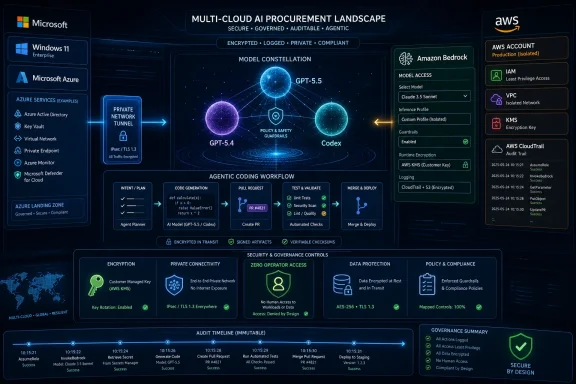
OpenAI’s GPT-5.5, GPT-5.4, and Codex became officially available on Amazon Bedrock on June 1, 2026, giving AWS customers managed access to OpenAI’s latest frontier and coding models through Bedrock’s inference, identity, networking, encryption, audit controls, and existing cloud commitments. This is not just another model-card update. It is the clearest sign yet that the OpenAI era is becoming less of a Microsoft channel story and more of a multi-cloud procurement war. For Windows shops, enterprise developers, and security teams, the question is no longer whether OpenAI is “on Azure”; it is which control plane gets to own the work.
For years, the commercial OpenAI story had a simple shape: OpenAI built the models, Microsoft wrapped them in Azure, and enterprise buyers consumed them through a familiar Redmond procurement machine. That arrangement made strategic sense when OpenAI needed vast compute and Microsoft needed a generational cloud differentiator. It also created an unusually tight coupling between a model company and a cloud platform.
The revised Microsoft-OpenAI agreement in late April changed that geometry. Microsoft remains OpenAI’s primary cloud partner, and Azure still matters enormously, but the license and cloud relationship are no longer the same kind of exclusive gate. OpenAI can now put its models in places where enterprises already run workloads, and AWS has moved quickly to turn that contractual opening into a product fact.
Amazon Bedrock is the obvious beachhead because it already sells itself as the model-neutral layer for enterprise AI. Bedrock customers can choose from competing model families, wire them into AWS identity and networking, and keep their operational posture inside the AWS estate. Adding OpenAI to that menu removes one of Bedrock’s most conspicuous gaps.
The result is awkward for Microsoft but not necessarily catastrophic. Azure OpenAI remains deeply integrated into Microsoft’s developer, data, and productivity stack, and Copilot remains the front door for millions of Windows and Microsoft 365 users. But the aura of inevitability around Azure as the OpenAI enterprise endpoint is gone.
That matters because enterprise AI buying is often less romantic than model benchmarks suggest. CIOs do not only ask which model writes the best refactor or summarizes the longest contract. They ask which platform fits their audit process, their private networking model, their committed spend, their incident response playbook, and their existing vendor leverage.
For large AWS customers, the phrase “existing cloud commitments” carries real weight. Enterprises routinely negotiate multi-year spend agreements with hyperscalers, and AI adoption is increasingly shaped by whether new workloads help consume those commitments. A model that might have required a separate OpenAI or Azure purchasing path can now be folded into the economics many AWS customers already live under.
That does not make Bedrock automatically cheaper, and buyers should resist simplistic claims that moving through AWS will always lower the bill. Frontier inference remains expensive, agentic coding can burn tokens at surprising speed, and high-context workloads are not magically costless because they run behind a familiar API. But procurement friction is a cost too, and AWS has just removed a meaningful slice of it.
The more subtle benefit is platform consistency. If a company already uses IAM, VPC endpoints, PrivateLink, KMS, CloudTrail, GuardDuty, Security Hub, and AWS-native policy machinery, Bedrock lets AI projects inherit governance patterns instead of inventing them from scratch. That is exactly the kind of boring advantage that makes new technology deployable at scale.
This is where Amazon’s model-neutral strategy becomes more dangerous. Bedrock does not need every customer to standardize on OpenAI. It needs customers to standardize on Bedrock as the place where model comparisons, routing decisions, and governance decisions happen. Once that happens, the model provider becomes an option inside AWS’s control plane rather than the owner of the enterprise relationship.
That shift changes what “good” means. A model that produces a brilliant answer in a single prompt is useful, but an agent that can keep track of a codebase, reason through dependencies, survive interruptions, and complete a workflow across multiple systems is operationally different. It begins to resemble a junior automation layer sitting on top of software delivery and business process infrastructure.
Codex is the sharpest expression of that ambition. OpenAI describes it as capable of code generation, refactoring, debugging, testing, validation, and repository-scale reasoning. In practice, that is the category every software organization is now trying to evaluate: not autocomplete, not a chatbot in an IDE, but a persistent engineering assistant that can take a messy task and move it toward a pull request.
For WindowsForum’s audience, the immediate relevance is not limited to cloud-native startups. Many enterprise Windows environments are full of PowerShell scripts, .NET services, legacy internal tools, SQL Server glue code, deployment pipelines, Group Policy edge cases, and compliance-driven change windows. A coding agent that can understand a whole repository and verify assumptions with tools is appealing precisely because enterprise code is rarely clean.
But this is also where the risk expands. The more capable the agent, the more consequential its mistakes become. A bad code suggestion is one thing; an agent that edits multiple files, updates tests, changes dependencies, and misreads an authentication boundary is another. Bedrock’s governance can help contain that risk, but it does not eliminate the need for review, staging, policy, and human accountability.
That split is already familiar to IT buyers. They do not run every database workload on the largest instance, and they do not run every endpoint policy through the most expensive security workflow. AI will be no different. Cost-aware model selection will become a standard architecture pattern.
AWS benefits from that reality because Bedrock is built around the idea that organizations will use multiple models. If GPT-5.4 is “good enough” for production-scale work and GPT-5.5 is reserved for deeper reasoning or agentic tasks, Bedrock can become the place where that routing logic lives. The customer may think they are choosing OpenAI, but operationally they are choosing a platform for model management.
This is also where Microsoft faces a more complicated fight than simple model access. Azure can offer OpenAI models, Microsoft 365 integration, GitHub integration, and Windows developer gravity. AWS can counter with workload gravity: the data lakes, application backends, queues, containers, logs, and private networks where many production systems already reside.
For enterprises, the new question is not whether GPT-5.4 or GPT-5.5 is “better.” It is which model belongs in which workflow, under which identity boundary, with which logging, at which price, and with which rollback plan. That is architecture, not hype.
The Zero Operator Access pitch is particularly pointed. AWS says Bedrock’s architecture, based on the Nitro system, is designed to eliminate remote login paths and operator-level access to customer environments. That language is meant for regulated industries and risk committees, not hobbyists comparing benchmark charts.
IAM permissions, VPC isolation, PrivateLink, KMS encryption, and CloudTrail logging are not glamorous features. They are the controls that allow a bank, manufacturer, hospital system, or government contractor to move from prototype to production. In AI, the line between experiment and data exposure can be thin, so familiar control surfaces matter.
OpenAI’s statement that customer data is not used for model training and is not shared with model providers is also central to the sales motion. The training-data concern has been one of the most persistent blockers for enterprise adoption of external AI systems. If Bedrock can make that assurance operationally credible inside AWS governance, it becomes a major advantage.
Still, enterprises should read the fine print with the same care they apply to any managed service. Data retention, abuse monitoring, regional availability, logging configuration, cross-region failover, and support access are not abstract details. They are the difference between a system that passes internal review and one that becomes a shadow IT incident.
Traditional chat interactions can fail and be retried with minimal state. Agentic workflows are different. A coding agent may inspect files, run tests, modify code, call tools, revise its plan, and wait on intermediate outputs. Losing state halfway through that chain is not just inconvenient; it can corrupt the workflow or leave users unsure what the system actually did.
AWS is therefore selling Bedrock not merely as an API endpoint but as an execution environment. That distinction matters. If AI systems are going to perform multi-step tasks across repositories, documents, spreadsheets, and operational systems, the infrastructure has to manage continuity, capacity, failure, and auditability.
Automatic capacity management fits the same story. Enterprises care about predictable response times because AI workloads are increasingly embedded into business processes rather than used as occasional assistants. A support workflow, code review pipeline, or document processing queue cannot rely on a model that works beautifully until demand spikes.
This is where the cloud providers have a structural advantage over standalone AI labs. They already understand how to sell reliability, regions, SLAs, quotas, observability, and capacity planning. OpenAI brings the model; AWS brings the operational grammar that enterprise IT expects.
Language support is one piece of that. GPT-5.5 and GPT-5.4 supporting Korean matters for customer service, internal knowledge management, software development, legal workflows, and document-heavy industries. But language support alone does not win enterprise deployments.
Local procurement relationships, data residency expectations, regional cloud footprints, and industry-specific compliance norms all matter. AWS already has deep enterprise relationships across Asia-Pacific markets, and Bedrock gives OpenAI another route into organizations that may not want to build around Azure or a direct OpenAI contract. In that sense, the AWS launch is not just a U.S. cloud rivalry story; it is a distribution story.
For Microsoft, this global angle cuts both ways. The company has enormous reach through Windows, Office, Azure, GitHub, and enterprise licensing. But in markets where AWS is the dominant cloud partner for a particular conglomerate, manufacturer, platform company, or public-sector workload, OpenAI’s availability through Bedrock removes a reason to leave the existing architecture.
That is the larger strategic shift. OpenAI no longer has to persuade every enterprise to come to its preferred cloud channel. It can increasingly meet customers where their infrastructure already lives. For a model company chasing scale, that flexibility is almost irresistible.
A company can run Windows endpoints, Microsoft 365, Entra ID, Intune, Defender, and GitHub while still hosting major application workloads on AWS. In that environment, OpenAI on Bedrock creates a split-brain possibility: user-facing AI through Microsoft, workload-facing AI through Amazon. That is not necessarily bad, but it demands architecture discipline.
The temptation will be to let each department pick the easiest entry point. Developers may use Codex through Bedrock for repository automation, analysts may use ChatGPT or Microsoft 365 Copilot for documents, and platform teams may build Bedrock agents into AWS-hosted applications. Without governance, that becomes a patchwork of prompts, permissions, logs, and data-handling assumptions.
Windows admins have seen this movie before with SaaS sprawl, endpoint agents, identity bridges, and cloud storage. The lesson is not to block everything new. The lesson is to establish ownership early: which teams approve model use, which data classes can be sent, which logs must be retained, which identities can invoke agents, and which environments are off-limits.
The arrival of OpenAI on AWS also pressures Microsoft to make its own AI platform story cleaner. If Azure OpenAI, Copilot Studio, GitHub Copilot, Windows Copilot experiences, and Microsoft 365 Copilot feel like overlapping product lanes, customers will compare that complexity against Bedrock’s pitch as a unified model marketplace. Microsoft has the advantage of integration, but integration only wins when customers understand the map.
Codex on Bedrock is especially interesting because software engineering agents need proximity to code, build systems, tests, secrets policies, and deployment workflows. Many of those already live in cloud-adjacent environments. A coding agent that can operate under AWS identity and network boundaries may be easier to justify than a tool that feels bolted on from outside.
But optionality can harden into lock-in. Once teams build prompt routing, agent orchestration, logging, evaluation, and cost controls around Bedrock, switching away may become harder even if the underlying model is theoretically portable. The abstraction layer becomes the sticky layer.
That is not unique to AWS. Azure, Google Cloud, and OpenAI’s own platform all have incentives to own the orchestration layer above the model. The lesson for developers is to keep an eye on where business logic accumulates. If the most important parts of an AI system live in provider-specific agent frameworks, migration will be more expensive than a model-name swap suggests.
The healthier pattern is to treat cloud AI services as powerful managed infrastructure, not magic. Use the native controls where they help, but document assumptions, maintain evaluation suites, track prompt and model versions, and avoid burying critical policy decisions in opaque agent behavior. The more autonomous the system, the more boring its engineering discipline needs to be.
That should make enterprise buyers cautious about assuming today’s AI platform boundaries are permanent. The market is still young, the compute demands are extreme, and the largest players are renegotiating relationships in public. What looks like a settled ecosystem in one quarter can become a multi-cloud marketplace in the next.
It also complicates the narrative that any single vendor “owns” the AI future. Microsoft owns key productivity surfaces and remains deeply tied to OpenAI. AWS owns a vast share of enterprise cloud workloads and now has official access to OpenAI models through Bedrock. OpenAI owns the model brand and increasingly wants distribution flexibility. Each party has leverage, but none has total control.
For customers, that is good and bad. Competition should improve access, commercial terms, and integration quality. But it also means buyers must navigate a shifting matrix of capabilities, regions, prices, controls, and contractual promises.
The safest assumption is that the AI stack will remain plural. Enterprises will use multiple models, multiple clouds, and multiple agent frameworks. The winners will be the teams that can impose governance and measurement across that plurality without slowing every project to a crawl.
 Microsoft’s Exclusive AI Lane Just Became a Roundabout
For years, the commercial OpenAI story had a simple shape: OpenAI built the models, Microsoft wrapped them in Azure, and enterprise buyers consumed them through a familiar Redmond procurement machine. That arrangement made strategic sense when OpenAI needed vast compute and Microsoft needed a generational cloud differentiator. It also created an unusually tight coupling between a model company and a cloud platform.The revised Microsoft-OpenAI agreement in late April changed that geometry. Microsoft remains OpenAI’s primary cloud partner, and Azure still matters enormously, but the license and cloud relationship are no longer the same kind of exclusive gate. OpenAI can now put its models in places where enterprises already run workloads, and AWS has moved quickly to turn that contractual opening into a product fact.
Amazon Bedrock is the obvious beachhead because it already sells itself as the model-neutral layer for enterprise AI. Bedrock customers can choose from competing model families, wire them into AWS identity and networking, and keep their operational posture inside the AWS estate. Adding OpenAI to that menu removes one of Bedrock’s most conspicuous gaps.
The result is awkward for Microsoft but not necessarily catastrophic. Azure OpenAI remains deeply integrated into Microsoft’s developer, data, and productivity stack, and Copilot remains the front door for millions of Windows and Microsoft 365 users. But the aura of inevitability around Azure as the OpenAI enterprise endpoint is gone.
That matters because enterprise AI buying is often less romantic than model benchmarks suggest. CIOs do not only ask which model writes the best refactor or summarizes the longest contract. They ask which platform fits their audit process, their private networking model, their committed spend, their incident response playbook, and their existing vendor leverage.
AWS Turns Model Choice Into a Procurement Weapon
AWS’s strongest argument is not that GPT-5.5 is better on Bedrock than anywhere else. The argument is that OpenAI can now be bought, governed, and monitored like the rest of an AWS customer’s infrastructure. That is a procurement story disguised as a developer story.For large AWS customers, the phrase “existing cloud commitments” carries real weight. Enterprises routinely negotiate multi-year spend agreements with hyperscalers, and AI adoption is increasingly shaped by whether new workloads help consume those commitments. A model that might have required a separate OpenAI or Azure purchasing path can now be folded into the economics many AWS customers already live under.
That does not make Bedrock automatically cheaper, and buyers should resist simplistic claims that moving through AWS will always lower the bill. Frontier inference remains expensive, agentic coding can burn tokens at surprising speed, and high-context workloads are not magically costless because they run behind a familiar API. But procurement friction is a cost too, and AWS has just removed a meaningful slice of it.
The more subtle benefit is platform consistency. If a company already uses IAM, VPC endpoints, PrivateLink, KMS, CloudTrail, GuardDuty, Security Hub, and AWS-native policy machinery, Bedrock lets AI projects inherit governance patterns instead of inventing them from scratch. That is exactly the kind of boring advantage that makes new technology deployable at scale.
This is where Amazon’s model-neutral strategy becomes more dangerous. Bedrock does not need every customer to standardize on OpenAI. It needs customers to standardize on Bedrock as the place where model comparisons, routing decisions, and governance decisions happen. Once that happens, the model provider becomes an option inside AWS’s control plane rather than the owner of the enterprise relationship.
GPT-5.5 Is Being Sold as the Agent Model, Not Just the Smart Model
The launch centers on GPT-5.5 as OpenAI’s strongest frontier model for complex coding, knowledge work, document generation, data analysis, and multi-step tool use. That positioning is deliberate. The enterprise market is moving away from chat demos and toward systems that can hold context, call tools, modify artifacts, test their own output, and continue tasks over time.That shift changes what “good” means. A model that produces a brilliant answer in a single prompt is useful, but an agent that can keep track of a codebase, reason through dependencies, survive interruptions, and complete a workflow across multiple systems is operationally different. It begins to resemble a junior automation layer sitting on top of software delivery and business process infrastructure.
Codex is the sharpest expression of that ambition. OpenAI describes it as capable of code generation, refactoring, debugging, testing, validation, and repository-scale reasoning. In practice, that is the category every software organization is now trying to evaluate: not autocomplete, not a chatbot in an IDE, but a persistent engineering assistant that can take a messy task and move it toward a pull request.
For WindowsForum’s audience, the immediate relevance is not limited to cloud-native startups. Many enterprise Windows environments are full of PowerShell scripts, .NET services, legacy internal tools, SQL Server glue code, deployment pipelines, Group Policy edge cases, and compliance-driven change windows. A coding agent that can understand a whole repository and verify assumptions with tools is appealing precisely because enterprise code is rarely clean.
But this is also where the risk expands. The more capable the agent, the more consequential its mistakes become. A bad code suggestion is one thing; an agent that edits multiple files, updates tests, changes dependencies, and misreads an authentication boundary is another. Bedrock’s governance can help contain that risk, but it does not eliminate the need for review, staging, policy, and human accountability.
GPT-5.4 Is the Model Finance Teams Will Ask About First
OpenAI’s positioning of GPT-5.4 as a more cost-efficient production model may prove just as important as the splashier GPT-5.5 launch. In real enterprise deployments, the best model is often reserved for the hardest tasks, while cheaper models handle the bulk of summarization, extraction, classification, routing, and routine generation. The frontier model gets the keynote; the efficient model gets the recurring workload.That split is already familiar to IT buyers. They do not run every database workload on the largest instance, and they do not run every endpoint policy through the most expensive security workflow. AI will be no different. Cost-aware model selection will become a standard architecture pattern.
AWS benefits from that reality because Bedrock is built around the idea that organizations will use multiple models. If GPT-5.4 is “good enough” for production-scale work and GPT-5.5 is reserved for deeper reasoning or agentic tasks, Bedrock can become the place where that routing logic lives. The customer may think they are choosing OpenAI, but operationally they are choosing a platform for model management.
This is also where Microsoft faces a more complicated fight than simple model access. Azure can offer OpenAI models, Microsoft 365 integration, GitHub integration, and Windows developer gravity. AWS can counter with workload gravity: the data lakes, application backends, queues, containers, logs, and private networks where many production systems already reside.
For enterprises, the new question is not whether GPT-5.4 or GPT-5.5 is “better.” It is which model belongs in which workflow, under which identity boundary, with which logging, at which price, and with which rollback plan. That is architecture, not hype.
Bedrock’s Security Pitch Is Aimed at the People Who Say No
AWS is emphasizing security and governance because that is where AI pilots often go to die. Developers may want frontier models immediately, but security teams ask where the data goes, who can access it, whether prompts are logged, how keys are managed, and whether the provider can inspect customer environments. Bedrock’s answer is to wrap OpenAI access in the same enterprise controls AWS customers already use.The Zero Operator Access pitch is particularly pointed. AWS says Bedrock’s architecture, based on the Nitro system, is designed to eliminate remote login paths and operator-level access to customer environments. That language is meant for regulated industries and risk committees, not hobbyists comparing benchmark charts.
IAM permissions, VPC isolation, PrivateLink, KMS encryption, and CloudTrail logging are not glamorous features. They are the controls that allow a bank, manufacturer, hospital system, or government contractor to move from prototype to production. In AI, the line between experiment and data exposure can be thin, so familiar control surfaces matter.
OpenAI’s statement that customer data is not used for model training and is not shared with model providers is also central to the sales motion. The training-data concern has been one of the most persistent blockers for enterprise adoption of external AI systems. If Bedrock can make that assurance operationally credible inside AWS governance, it becomes a major advantage.
Still, enterprises should read the fine print with the same care they apply to any managed service. Data retention, abuse monitoring, regional availability, logging configuration, cross-region failover, and support access are not abstract details. They are the difference between a system that passes internal review and one that becomes a shadow IT incident.
Persistent Agents Need Persistent Infrastructure
One of the more interesting technical claims around the Bedrock launch is persistent request-state management, which is designed to let tasks continue even if hardware fails or nodes restart. That sounds like plumbing, but for agentic AI it is closer to a prerequisite. Long-running tasks are only useful if they can survive the messy reality of cloud infrastructure.Traditional chat interactions can fail and be retried with minimal state. Agentic workflows are different. A coding agent may inspect files, run tests, modify code, call tools, revise its plan, and wait on intermediate outputs. Losing state halfway through that chain is not just inconvenient; it can corrupt the workflow or leave users unsure what the system actually did.
AWS is therefore selling Bedrock not merely as an API endpoint but as an execution environment. That distinction matters. If AI systems are going to perform multi-step tasks across repositories, documents, spreadsheets, and operational systems, the infrastructure has to manage continuity, capacity, failure, and auditability.
Automatic capacity management fits the same story. Enterprises care about predictable response times because AI workloads are increasingly embedded into business processes rather than used as occasional assistants. A support workflow, code review pipeline, or document processing queue cannot rely on a model that works beautifully until demand spikes.
This is where the cloud providers have a structural advantage over standalone AI labs. They already understand how to sell reliability, regions, SLAs, quotas, observability, and capacity planning. OpenAI brings the model; AWS brings the operational grammar that enterprise IT expects.
The Korea Angle Shows How Global AI Demand Is Becoming Local
The announcement’s emphasis on South Korea is not incidental. OpenAI says demand is rising across multiple Korean industries, and AWS availability is expected to improve access for Korean enterprises. That reflects a broader pattern: AI adoption is global, but the deployment conversation is increasingly local.Language support is one piece of that. GPT-5.5 and GPT-5.4 supporting Korean matters for customer service, internal knowledge management, software development, legal workflows, and document-heavy industries. But language support alone does not win enterprise deployments.
Local procurement relationships, data residency expectations, regional cloud footprints, and industry-specific compliance norms all matter. AWS already has deep enterprise relationships across Asia-Pacific markets, and Bedrock gives OpenAI another route into organizations that may not want to build around Azure or a direct OpenAI contract. In that sense, the AWS launch is not just a U.S. cloud rivalry story; it is a distribution story.
For Microsoft, this global angle cuts both ways. The company has enormous reach through Windows, Office, Azure, GitHub, and enterprise licensing. But in markets where AWS is the dominant cloud partner for a particular conglomerate, manufacturer, platform company, or public-sector workload, OpenAI’s availability through Bedrock removes a reason to leave the existing architecture.
That is the larger strategic shift. OpenAI no longer has to persuade every enterprise to come to its preferred cloud channel. It can increasingly meet customers where their infrastructure already lives. For a model company chasing scale, that flexibility is almost irresistible.
Windows Shops Now Have to Think Beyond Copilot
For Windows administrators and Microsoft-centric IT departments, this announcement lands in a complicated place. On the desktop, Copilot remains Microsoft’s most visible AI surface, and GitHub Copilot remains a major coding assistant for developers. But the enterprise backend story is no longer as Microsoft-contained as it once looked.A company can run Windows endpoints, Microsoft 365, Entra ID, Intune, Defender, and GitHub while still hosting major application workloads on AWS. In that environment, OpenAI on Bedrock creates a split-brain possibility: user-facing AI through Microsoft, workload-facing AI through Amazon. That is not necessarily bad, but it demands architecture discipline.
The temptation will be to let each department pick the easiest entry point. Developers may use Codex through Bedrock for repository automation, analysts may use ChatGPT or Microsoft 365 Copilot for documents, and platform teams may build Bedrock agents into AWS-hosted applications. Without governance, that becomes a patchwork of prompts, permissions, logs, and data-handling assumptions.
Windows admins have seen this movie before with SaaS sprawl, endpoint agents, identity bridges, and cloud storage. The lesson is not to block everything new. The lesson is to establish ownership early: which teams approve model use, which data classes can be sent, which logs must be retained, which identities can invoke agents, and which environments are off-limits.
The arrival of OpenAI on AWS also pressures Microsoft to make its own AI platform story cleaner. If Azure OpenAI, Copilot Studio, GitHub Copilot, Windows Copilot experiences, and Microsoft 365 Copilot feel like overlapping product lanes, customers will compare that complexity against Bedrock’s pitch as a unified model marketplace. Microsoft has the advantage of integration, but integration only wins when customers understand the map.
Developers Gain Optionality, But Also Another Layer of Lock-In
For developers, the upside is obvious: more ways to access high-end OpenAI models inside existing workflows. If your application stack is already on AWS, calling GPT-5.5 or GPT-5.4 through Bedrock may be simpler than routing sensitive workloads through another cloud. If your security team already approves Bedrock, experimentation becomes easier.Codex on Bedrock is especially interesting because software engineering agents need proximity to code, build systems, tests, secrets policies, and deployment workflows. Many of those already live in cloud-adjacent environments. A coding agent that can operate under AWS identity and network boundaries may be easier to justify than a tool that feels bolted on from outside.
But optionality can harden into lock-in. Once teams build prompt routing, agent orchestration, logging, evaluation, and cost controls around Bedrock, switching away may become harder even if the underlying model is theoretically portable. The abstraction layer becomes the sticky layer.
That is not unique to AWS. Azure, Google Cloud, and OpenAI’s own platform all have incentives to own the orchestration layer above the model. The lesson for developers is to keep an eye on where business logic accumulates. If the most important parts of an AI system live in provider-specific agent frameworks, migration will be more expensive than a model-name swap suggests.
The healthier pattern is to treat cloud AI services as powerful managed infrastructure, not magic. Use the native controls where they help, but document assumptions, maintain evaluation suites, track prompt and model versions, and avoid burying critical policy decisions in opaque agent behavior. The more autonomous the system, the more boring its engineering discipline needs to be.
The New AI Stack Is Being Built by Lawyers as Much as Engineers
The April revision of Microsoft and OpenAI’s partnership is a reminder that AI platform strategy is not driven by benchmarks alone. Contract terms, revenue-sharing arrangements, licensing rights, cloud commitments, and capacity guarantees shape what users can buy. In this case, one legal change unlocked a major distribution change.That should make enterprise buyers cautious about assuming today’s AI platform boundaries are permanent. The market is still young, the compute demands are extreme, and the largest players are renegotiating relationships in public. What looks like a settled ecosystem in one quarter can become a multi-cloud marketplace in the next.
It also complicates the narrative that any single vendor “owns” the AI future. Microsoft owns key productivity surfaces and remains deeply tied to OpenAI. AWS owns a vast share of enterprise cloud workloads and now has official access to OpenAI models through Bedrock. OpenAI owns the model brand and increasingly wants distribution flexibility. Each party has leverage, but none has total control.
For customers, that is good and bad. Competition should improve access, commercial terms, and integration quality. But it also means buyers must navigate a shifting matrix of capabilities, regions, prices, controls, and contractual promises.
The safest assumption is that the AI stack will remain plural. Enterprises will use multiple models, multiple clouds, and multiple agent frameworks. The winners will be the teams that can impose governance and measurement across that plurality without slowing every project to a crawl.
The Bedrock Launch Redraws the Enterprise AI Map
The practical meaning of OpenAI on Bedrock is not that every AWS customer should immediately rebuild their AI plans. It is that the default assumptions have changed. OpenAI is now a multi-cloud enterprise supplier in a way that matters operationally, not just rhetorically.- OpenAI’s GPT-5.5, GPT-5.4, and Codex are now officially available through Amazon Bedrock, moving AWS from an OpenAI outsider to an official distribution channel.
- Microsoft remains central to OpenAI’s business, but the end of strict exclusivity weakens Azure’s position as the unavoidable enterprise path to OpenAI models.
- AWS is competing less on model identity than on governance, procurement, private networking, encryption, audit logging, and integration with existing cloud commitments.
- GPT-5.5 is being positioned for high-end agentic coding and knowledge work, while GPT-5.4 is likely to matter for cost-sensitive production workloads.
- Codex on Bedrock could accelerate enterprise software automation, but it also raises the stakes for code review, permission design, test discipline, and auditability.
- Windows and Microsoft-centric IT teams now need AI governance that spans Copilot, Azure, GitHub, OpenAI’s direct services, and AWS Bedrock rather than assuming one vendor boundary.
References
- Primary source: thelec.net
Published: 2026-06-02T08:30:10.228975
OpenAI Launches GPT-5.5 and Codex on Amazon Bedrock - The Elec Inc.
OpenAI's latest frontier models, GPT-5.5 and GPT-5.4, along with coding agent Codex, are nwww.thelec.net - Related coverage: aboutamazon.com
OpenAI Models on Amazon Bedrock: OpenAI models GPT-5.5 and GPT-5.4—and Codex—now on Amazon Bedrock
For the first time, the most advanced OpenAI models are available on Amazon Bedrock, with pricing that matches OpenAI first-party rates and no additional fees. www.aboutamazon.com
- Official source: openai.com
Introducing GPT-5.4 | OpenAI
Introducing GPT-5.4, OpenAI’s most most capable and efficient frontier model for professional work, with state-of-the-art coding, computer use, tool search, and 1M-token context.openai.com - Official source: help.openai.com
Configure Codex with Amazon Bedrock | OpenAI Help Center
 help.openai.com
- Related coverage: aws.amazon.com
Get started with OpenAI GPT-5.5, GPT-5.4 models, and Codex on Amazon Bedrock | AWS News Blog
OpenAI frontier models GPT-5.5 and GPT-5.4, and Codex, the OpenAI coding agent, are available on Amazon Bedrock. Deploy frontier models on Bedrock's high performance inference engine with built-in security, governance, and pay-per-token pricing.aws.amazon.com - Related coverage: gihyo.jp
OpenAIのGPT-5.5やCodexがAWS/Amazon Bedrockで利用可能に | gihyo.jp
OpenAIとAmazonは2026年6月1日、OpenAIのGPT-5.5、GPT-5.4とCodexがAWSの生成AIサービスであるAmazon Bedrockで利用可能となったことを発表した。gihyo.jp
- Related coverage: lushbinary.com
OpenAI Models on AWS Bedrock: GPT-5.5, Codex & Agents Guide | Lushbinary
OpenAI GPT-5.5, GPT-5.4, Codex & Managed Agents now on Amazon Bedrock. $50B partnership, enterprise security, Stateful Runtime & architecture patterns. April 2026.lushbinary.com
- Related coverage: doolpa.com
OpenAI Models and Codex Land on Amazon Bedrock (April 2026) | Doolpa
OpenAI GPT-5.5, Codex and Managed Agents arrived on Amazon Bedrock April 28, 2026 — a day after Microsoft's exclusive cloud deal with OpenAI ended.doolpa.com - Related coverage: aiweekly.co
- Related coverage: wowhow.cloud
OpenAI on Amazon Bedrock: GPT-5.5, Codex & Managed Agents Guide 2026 | WOWHOW
OpenAI GPT-5.5, Codex, and Bedrock Managed Agents on AWS: how to get access, developer setup, IAM policies, pricing, and what it means for AWS-native teams.wowhow.cloud - Related coverage: hawkdive.com
Explore OpenAI GPT-5.5, GPT-5.4, and Codex on Amazon Bedrock - Hawkdive.com
OpenAI GPT-5.5 and Codex Now Available on Amazon Bedrock OpenAI has announced the general availability of its latest models, GPT-5.5 and GPT-5.4, along with Codex, on Amazon Bedrock as of this week. These advanced AI models are designed to enhance coding capabilities and streamline complex... www.hawkdive.com
- Related coverage: axios.com
OpenAI releases "Spud" GPT-5.5 model
AI releases are getting faster, more efficient and more powerful.www.axios.com
- Related coverage: techradar.com
AWS and OpenAI confirm cloud partnership — a day after ChatGPT maker ended its Microsoft exclusivity | TechRadar
OpenAI deepens its relationship with AWSwww.techradar.com - Related coverage: tomsguide.com
GPT-5.4 is here — and OpenAI just made every other AI model look slow | Tom's Guide
OpenAI's newest flagship brings native computer control, a 1-million token context window, and benchmark-shattering professional performance. Here's what actually changes for you.www.tomsguide.com - Official source: cdn.openai.com
- Official source: deploymentsafety.openai.com
- Related coverage: tech-insider.org
OpenAI on AWS Bedrock: $38B Deal Ends Azure Lock-In [2026]
OpenAI launches GPT-5.5 on Amazon Bedrock April 28, 2026, ending 7-year Azure exclusivity. Inside the $38B AWS deal reshaping enterprise AI.tech-insider.org - Related coverage: arstechnica.com
OpenAI ends its exclusive partnership with Microsoft - Ars Technica
Amended agreement clears the way for OpenAI models to run on Amazon Bedrock.arstechnica.com - Related coverage: latimes.com
OpenAI breaks free from Microsoft's exclusive grip
OpenAI and Microsoft are ending their exclusive partnership agreement, allowing OpenAI, the maker of ChatGPT, to distribute its models through rival cloud providers such as Amazon Web Services for the first time.www.latimes.com - Related coverage: tomshardware.com
Microsoft and OpenAI end exclusivity agreement, opening up potential partnerships with Amazon and Google — Microsoft will continue to receive revenue share through 2030 | Tom's Hardware
OpenAI has broken Microsoft's containment.www.tomshardware.com - Related coverage: windowscentral.com
"The work we’re doing together remains ambitious": OpenAI ends Microsoft exclusivity in a tone that doesn’t match last week’s leaked memo | Windows Central
OpenAI’s official announcement sounds optimistic, but last week’s leaked memo told a different story.www.windowscentral.com - Related coverage: neuralwired.com
OpenAI Ends Microsoft Exclusivity: AWS & Google Cloud 2026 - NeuralWired
OpenAI ends Microsoft exclusivity — models now deploy on AWS and Google Cloud. Revised deal terms, market reaction, GPT-5.5 context. Read the full breakdown. neuralwired.com
- Related coverage: techcrunch.com
OpenAI ends Microsoft legal peril over its $50B Amazon deal | TechCrunch
OpenAI has won major concessions from its largest shareholder, Microsoft, that will allow it to sell products on AWS, while Microsoft gets more cash in a revenue-share agreement.techcrunch.com - Related coverage: vectrel.ai
OpenAI Lands on AWS as Microsoft Exclusivity Ends: Multi-Cloud AI Is Now Real | Vectrel
Microsoft lost OpenAI exclusivity April 27, 2026, and GPT-5.5 launched on AWS Bedrock a day later. Here is what multi-cloud OpenAI means for enterprises.www.vectrel.ai

