

Opera GX’s official X post on January 14 signalled what many Linux gamers have been asking for: a native Linux build of the gaming-focused Opera GX browser, with the company setting a Q1 2026 release window — a move that places a mainstream, feature-rich gaming browser squarely into the Linux ecosystem and onto devices such as the Steam Deck.
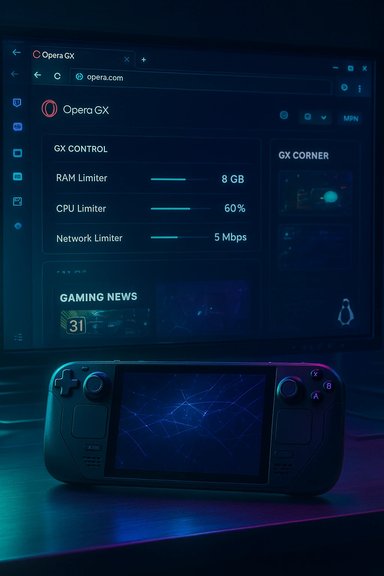
Opera GX launched in 2019 as a distinct, gamer-oriented spin on Opera’s Chromium-based browser. It bundled a visual identity, soundscapes, and a collection of features aimed at streamers and heavy multitaskers: GX Control (RAM, CPU and network limiters), built-in Twitch and Discord sidebars, Razer Chroma lighting integration, and gaming-focused content hubs. These capabilities made GX attractive to users who wanted to balance browsing with gaming without sacrificing system resources. The announcement arrived inside a broader narrative: Linux desktop interest — especially among gamers — has increased as some PC users react to Microsoft’s aggressive rollout of Copilot and other AI-first features inside Windows. That discontent has helped drive attention to distros designed to ease the switch from Windows, most visibly Zorin OS 18, which recently crossed two million downloads. Those numbsing Linux usage in Steam’s hardware survey, are the context underpinning the Opera GX decision.
Source: Windows Central Opera GX Linux version confirmed for Q1 2026, challenges Windows 11
 Background / Overview
Opera GX launched in 2019 as a distinct, gamer-oriented spin on Opera’s Chromium-based browser. It bundled a visual identity, soundscapes, and a collection of features aimed at streamers and heavy multitaskers: GX Control (RAM, CPU and network limiters), built-in Twitch and Discord sidebars, Razer Chroma lighting integration, and gaming-focused content hubs. These capabilities made GX attractive to users who wanted to balance browsing with gaming without sacrificing system resources. The announcement arrived inside a broader narrative: Linux desktop interest — especially among gamers — has increased as some PC users react to Microsoft’s aggressive rollout of Copilot and other AI-first features inside Windows. That discontent has helped drive attention to distros designed to ease the switch from Windows, most visibly Zorin OS 18, which recently crossed two million downloads. Those numbsing Linux usage in Steam’s hardware survey, are the context underpinning the Opera GX decision. Why Opera GX on Linux matters now
A practical acceptance of Linux’s gaming momentum
For years, Linux desktop gaming was niche — useful for enthusiasts, not a destination for mainstream PC players. That’s changing in measurable ways: Steam’s Linux share has climbed into the low single digits as Proton and driver improvements reduce the friction for many titles, and Valve continues to strengthen SteamOS (the Deck’s Linux distribution). The arrival of a major gaming browser on Linux is more than symbolic; it expands the toolkit available to gamers who already run Linux or are considering the switch.Timing and optics: a jab at Windows’ AI direction
Opera GX’s social announcement pointedly replied to reporting about Microsoft embedding Copilot into File Explorer and other parts of Windows 11. That juxtaposition — “we’re shipping to Linux while Windows pushes Copilot everywhere” — is deliberately rhetorical, framed to appeal to users who value control, minimal telemetry, or lighter-weight desktops. The message isn’t just product news; it’s positioning: Opera wants to be the browser of choice for gamers who reject perceived Windows bloat.What Linux users can realistically expect from Opera GX
Feature parity and what’s feasible at launch
Opera GX is built on Chromium and reuses much of Opera’s existing desktop codebase. That suggests the company can reasonably deliver a Linux variant that includes the core GX experience: the GX Control resource limiters, Twitch/Discord sidebars, GX Corner, built-in VPN and ad‑blocker, and visual/audio customizations. Opera’s own documentation and press releases have long described these elements as central to GX’s identity. Expect those core features at or near parity with the Windows/macOS releases, though implementation details (e.g., integration with system-level RGB stacks) may vary.- Likely at launch:
- GX Control (RAM/CPU/Network limiters)
- Sidebars for Twitch and Discord
- GX Corner and gaming news/deals
- Built-in ad‑blocker and VPN
- Likely deferred or platform-dependent:
- Full Razer Chroma feature parity (depends on Linux driver support)
- Deep kernel-level optimizations tied to Windows-only APIs
Steam Deck and handhelds: the native opportunity
Because Steam Deck and SteamOS use a Linux stack, a native Opera GX package can be installed there — bringing GX’s sidebar integrations and resource limiters to a true handheld gaming environment. That said, the Deck is an AMD x86-64 device running a customized SteamOS; Opera’s packaging and UI scaling for smaller, gamepad-first screens will determine how comfortable the browser is to use on the Deck. Straightforward desktop builds will work, but a polished Deck experience requires attention to input, UI density, and power profiles.Packaging, distribution, and the “Linux” problem
Linux is not a single platform — it’s a family of distributions with distinct packaging systems (DEB, RPM, Flatpak, AppImage, etc. and multiple display servers (X11 vs Wayland). Opera will need a sensible distribution strategy:- Provide universally usable installers (Flatpak or AppImage) for broad compatibility.
- Offer distro-specific packages (deb/rpm) for tighter integration on major desktop environments.
- Support Wayland compositors and modern GPU stacks (Mesa, Vulkan) to avoid regressions on popular distros and SteamOS variants.
Technical challenges and risks
1) System integrations (GX Control and resource management)
GX Control limits resources by monitoring and interacting with the OS scheduler and the Chromium process tree. Implementing consistent and predictable limiters across Linux kernels, cgroups versions, and desktop compositors is non-trivial. Differences in cgroup setup, CPU affinity behaviour, and memory reporting can make a feature behave differently on Ubuntu, Arch/SteamOS, or enterprise kernels.- Risk: Users could see inconsistencies where GX Control either fails to enforce limits or imposes undesired throttling, harming gaming performance.
2) Wayland vs X11 and GPU acceleration
Wayland is increasingly the default on many distros; Chromium builds have matured on Wayland but still encounter edge cases with screen capture, video codecs and GPU acceleration. Opera must verify hardware-accelerated video playback, WebGL, and DRM-encrypted media across driver stacks (Mesa, proprietary drivers) to avoid regressions.- Risk: Poor hardware acceleration or broken WebRTC/screen-sharing can badly impact streamers and those using Twitch/Discord overlays.
3) Razer Chroma, Corsair iCUE and other RGB ecosystems
RGB ecosystems on Linux are improving but still fragmented. Full parity with Windows-level SDKs for Razer or Corsair lighting will require supporting multiple vendor tooling, and in some cases community drivers rather than vendor-supplied SDKs.- Risk: Lighting features may be limited or delivered via community integrations, resulting in feature mismatch compared with Windows.
4) Anti-cheat and gaming middleware
One of the largest limitations for Linux gaming remains anti-cheat middleware and DRM. Opera GX itself is not a game runtime, but any browser that facilitates streaming, overlays, or game-launcher integrations must be tested against anti-cheat-sensitive titles. Valve and Proton continue to make progress, but middleware vendors' policies and kernel-level drivers remain a wildcard.- Risk: Users expecting a seamless “full gaming PC” experience on Linux may run into titles that remain effectively Windows‑only, limiting the practical impact of a Linux GX port.
Business and strategic implications
For Opera
- Expanded audience: Opera GX already recorded strong user engagement in recent years; a Linux launch broadens the growth runway and helps Opera compete in the gaming ecosystem where user loyalty matters.
- Market positioning: By publicly timing the announcement as a contrast to Windows’ AI push, Opera is engaging in a competitive narrative that may win attention among privacy-conscious and performance-focused users.
- Monetization: Opera’s gaming offerings have historically included partnerships, curated content, and a way to increase user time‑on‑product. Linux users can be lucrative if Opera can successfully localize features and integrations to the new platform.
For Microsoft and Windows
- Perception risk: Microsoft’s aggressive Copilot integration and broader AI-first messaging have pushed some users to explore alternatives; Opera’s announcement signals that major desktop software vendors see Linux as a place worth investing in.
- Competitive pressure: This is a niche skirmish rather than a platform-loss event for Microsoft, but it underlines the need for Windows to maintain core strengths (performance, hardware compatibility, low-friction gaming) while rolling out new features.
For Valve and the Linux ecosystem
- Validation: More first‑class apps for Linux strengthen the platform’s ecosystem and make devices like the Steam Deck more attractive to users who need a desktop-grade browser for streaming or productivity.
- Distribution: Wider adoption of apps like Opera GX could pressure package maintainers, store operators, and distribution maintainers to improve packaging and driver support across more hardware.
Community reaction and reputation risks
Opera’s brand is polarizing. Some Linux communities view Chromium-based entries skeptically, worrying about telemetry, data collection, and the proliferation of more proprietary forks. Opera’s own history of integrating services and experiments with ad content has generated wariness among privacy‑focused users. Expect the announcement to be welcomed by gamers and criticized by privacy advocates in equal measure. Community threads and social platforms already show a range of reactions from enthusiasm to outright distrust.- Strengths Opera can leverage:
- Feature set tailored to gamers (resource limiters, Twitch/Discord integrations).
- Strong brand recognition in gaming circles and existing GX user base.
- Reputational risks to manage:
- Telemetry and privacy concerns on Linux users who moved specifically to avoid “big vendor” telemetry.
- Perception that a Chromium-based Opera will bring the same privacy trade-offs to Linux.
What to watch in Q1 2026
- Packaging and distribution model: Will Opera ship a Flatpak/AppImage for maximum distro-agnostic compatibility or supply DEB/RPM packages first?
- Wayland and hardware acceleration: Will the initial release support Wayland sessions robustly and provide GPU‑accelerated video?
- Steam Deck polish: Is there a Deck‑optimized UI or an announcement about Deck verification or an entry in the Steam storefront?
- Feature parity statements: Which GX features are explicitly guaranteed at launch and which are “coming soon”?
- Privacy disclosures: Will Opera publish a Linux‑specific privacy/telemetry statement to address the community’s concerns?
Strengths and opportunities
- Native UX for Linux gamers: A well-integrated Opera GX could offer faster workflows for streaming, browser-based overlays, and multitasking — particularly on devices like the Steam Deck where screen real estate and resource budgeting matter.
- Competitive differentiation: Opera GX’s resource limiters and built-in streaming integrations are distinct features that set it apart from Chrome, Edge, or Firefox, and those features carry real value for streamers and high‑tab users.
- Ecosystem momentum: As more consumer apps adopt Linux, the perceived cost of switching away from Windows decreases; Opera’s move could accelerate that perception among casual switchers.
Caveats and unverifiable claims
- Some reports and social posts have repeated numbers (for example, recent Opera GX MAU figures or statements about how many users will switch) without primary-source confirmation. Where hard numbers appear, prefer Opera investor releases or audited reports. Opera’s 25‑million MAU announcement (September 2023) is a confirmed milestone; later user-count figures circulating online should be treated cautiously until verified by Opera’s investor relations.
- The exact Q1 2026 timeframe was reported by multiple outlets and comes from Opera’s social announcement framing; however, precise release dates, build artifacts, package formats and Deck-specific optimizations are not yet public. Treat the Q1 window as a target rather than a guarantee.
- Broad claims about a mass exodus from Windows to Linux remain speculative. Zorin OS’s strong download numbers are notable and reflect interest, but they do not equate to a near-term equivalence with Windows market share. The Linux desktop remains a small fraction of overall desktop usage despite clear pockets of momentum.
Practical guidance for readers and administrators
- If you’re considering making the switch or testing Opera GX on Linux:
- Keep a recovery plan (dual‑boot or a restore snapshot) in case you need to revert.
- Test critical workflows (video playback, WebRTC conferencing, Twitch/Discord overlays) before making the browser your primary tool.
- On Valve devices (Steam st GX in both Desktop and Gaming modes to understand input and scaling issues.
- For IT teams: Evaluate telemetry and policy controls Opera publishes for Linux. If your organization is sensitive about data collection, validate Opera’s privacy defaults in a lab environment.
Conclusion
Opera GX’s move to Linux is a pragmatic endorsement of a slowly maturing Linux desktop — particularly the gaming segment driven by Proton, SteamOS, and devices like the Steam Deck. Its arrival in Q1 2026 (as reported by Opera and multiple independent outlets) fills an obvious gap for gamers who want GX’s resource controls and streaming integrations on a native Linux stack. That said, the significance of the launch depends on execution. To become a genuine alternative to Windows‑centric workflows, Opera must ship a well‑packaged, Wayland‑friendly build that respects Linux users’ expectations around privacy and system integration. If it does, Opera GX on Linux could be a useful, widely adopted tool in the gaming toolkit — and another clear sign that the desktop ecosystem is becoming more plural and competitive.Source: Windows Central Opera GX Linux version confirmed for Q1 2026, challenges Windows 11
