

October’s string of announcements left the AI industry with a clear theme: vendors are shifting from raw capability showmanship to operational maturity—shipping observability, governance, and compute at scale so enterprises can run AI reliably, securely, and at lower latency.
The last month saw major platform, chip, and national-scale compute news that together change the practical picture for developers, IT leaders, and power users. Vendors are not only releasing faster models; they are adding the plumbing—logging, dataset export, agent connectors, and managed data contexts—that lets organizations debug, audit, and integrate AI into regulated workflows. At the same time, new silicon and compact supercomputer builds are pushing peak on-device performance toward petaflop-class thresholds and making local inference or fine-tuning a realistic option for many teams.
This convergence matters: operational features reduce time-to-production, while higher-density compute and on-device acceleration reduce latency and dependence on costly cloud cycles. But it also tightens the industry’s control points—ownership of model IP, compute access, and auditability are now first-order strategic levers. The rest of this feature breaks down the key announcements, validates the major technical claims where possible, and analyzes practical implications for Windows users, developers, and enterprise architects.
Why this matters: observability is the difference between a one-off demo and a production service. Teams can now trace a user complaint to the exact API call, run regression tests against curated failure sets, and maintain audit trails that help with compliance. The trade-offs are administrative: default retention and storage quotas mean organizations must decide what to keep, and sharing datasets with vendors brings clear privacy and contractual implications.
Caveats and context: the 13,000× figure is a specific algorithmic result under controlled conditions and depends critically on the chosen classical comparator, problem encoding, and performance assumptions. This is a credible milestone for quantum-native algorithms—especially in chemistry and materials simulation where verifiable outputs matter—but it does not imply general-purpose quantum supremacy across AI workloads. Independent reproduction, peer-reviewed publication, and open benchmarks remain the standards for assessing broad impact, so treat the headline number as an important but narrow scientific advance rather than a universal speedup.
What that changes: on-device inference and multimodal models become far more practical. Higher neural and GPU throughput helps with low-latency assistants, local fine‑tuning, and privacy-sensitive workflows that prefer to avoid cloud roundtrips. For Windows and cross-platform developers, Apple's jump heightens pressure on Intel, AMD, and Arm-based OEMs to accelerate their neural engines and GPU architectures to remain competitive. However, vendor peak-power claims often reflect specific internal workloads or synthetic peaks; real-world throughput must be measured on representative LLM and multimodal tasks to determine true comparative performance. Independent benchmarking is necessary before concluding definitive lead times or power-efficiency advantages.
Operationally, the deal preserves deep Azure integration and multi‑year Azure purchasing commitments while removing absolute exclusivity: OpenAI may source compute from other providers for training and research workloads even as some product distribution and API channels remain preferentially aligned with Azure. This recalibration aims to give OpenAI access to broader capital and compute while preserving Microsoft’s long-term product levers.
Technical interpretation: a petaflop denotes roughly one quadrillion floating‑point operations per second under a peak metric; real-world effective throughput will depend on memory bandwidth, interconnects, and the software stack (including CUDA and optimized kernels). For Windows-focused users, the implication is clear: compact, high-density AI workstations accelerate experimentation cycles and lower the friction to test new models locally, but adoption depends on price, manageability, and thermal/space constraints. Benchmarking on real workloads (LLM inference, fine‑tuning, and multimodal pipelines) will determine whether a desktop petaflop delivers expected developer impact.
Practical note: process node announcements are an essential indicator of roadmap direction but do not translate to immediate application-level gains. Software stacks, compiler optimizations, and neural-acceleration IP remain equally decisive. For enterprise IT teams, the relevant metric is how Panther Lake’s real-world performance affects LLM inference latency and throughput on representative enterprise workloads.
Why this matters: sovereign compute projects reduce single-vendor or single-region bottlenecks for critical scientific and defense workloads. They also influence global partnerships, talent flows, and procurement strategies for academic and enterprise labs that may access these systems for large-scale experiments. The flipside is that building and operating such systems is capital- and energy-intensive, raising long-range considerations about sustainability and equitable access.
Operational risks: developer and enterprise teams must validate default model behavior and data-handling defaults at the tenant level. Vendor defaults for signed-out users can drive public expectations and influence how the model behaves in downstream tools, so administrators should verify rollout status and pinned defaults before embedding them in production flows. Use logging and dataset export tools to create evaluation pipelines that capture expected and edge behaviors.
Key enterprise implications:
The industry is building both the instruments and the rulebook at the same time. The choices organizations make now—about observability, on‑device versus cloud compute, and vendor lock‑in—will determine whether they reap productivity gains without inheriting disproportionate operational, legal, or strategic exposure.
Source: WNDU Artificial Intelligence (A.I. Update | Nov. 7, 2025
 Background / Overview
The last month saw major platform, chip, and national-scale compute news that together change the practical picture for developers, IT leaders, and power users. Vendors are not only releasing faster models; they are adding the plumbing—logging, dataset export, agent connectors, and managed data contexts—that lets organizations debug, audit, and integrate AI into regulated workflows. At the same time, new silicon and compact supercomputer builds are pushing peak on-device performance toward petaflop-class thresholds and making local inference or fine-tuning a realistic option for many teams.This convergence matters: operational features reduce time-to-production, while higher-density compute and on-device acceleration reduce latency and dependence on costly cloud cycles. But it also tightens the industry’s control points—ownership of model IP, compute access, and auditability are now first-order strategic levers. The rest of this feature breaks down the key announcements, validates the major technical claims where possible, and analyzes practical implications for Windows users, developers, and enterprise architects.
Google: observability in AI Studio and a quantum milestone
AI Studio — logs and datasets for observability
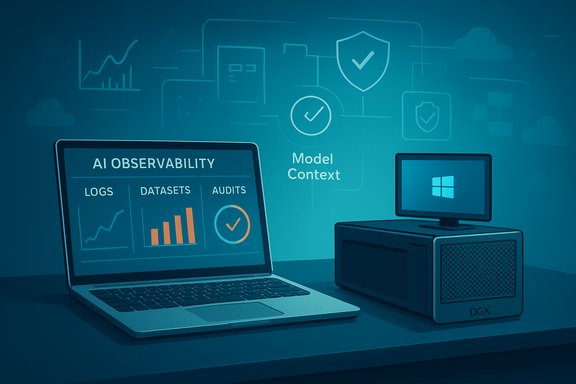
Google expanded AI Studio with built-in logs and dataset tooling to capture GenerateContent interactions, permit exports in CSV/JSONL, and create curated datasets from problematic or representative interactions for offline evaluation and retraining. This is a classic MLOps upgrade: it moves teams from ad‑hoc debugging to reproducible evaluation pipelines and makes it simpler to integrate human-in-the-loop remediation. The details reported include default log retention and a workflow to convert logs into persistent datasets for audits.Why this matters: observability is the difference between a one-off demo and a production service. Teams can now trace a user complaint to the exact API call, run regression tests against curated failure sets, and maintain audit trails that help with compliance. The trade-offs are administrative: default retention and storage quotas mean organizations must decide what to keep, and sharing datasets with vendors brings clear privacy and contractual implications.
Willow and “Quantum Echoes”: a verifiable quantum advantage claim
Google’s Quantum AI group reported that its Willow chip executed an algorithm named Quantum Echoes with a claimed verifiable speed advantage of roughly 13,000× compared to a chosen classical baseline for the same encoded problem. The announcement emphasizes verifiability: the quantum output can be repeatedly checked against expectations, which is a meaningful scientific step beyond earlier, noisier demonstrations.Caveats and context: the 13,000× figure is a specific algorithmic result under controlled conditions and depends critically on the chosen classical comparator, problem encoding, and performance assumptions. This is a credible milestone for quantum-native algorithms—especially in chemistry and materials simulation where verifiable outputs matter—but it does not imply general-purpose quantum supremacy across AI workloads. Independent reproduction, peer-reviewed publication, and open benchmarks remain the standards for assessing broad impact, so treat the headline number as an important but narrow scientific advance rather than a universal speedup.
Apple’s M5 family: pushing on-device AI performance
Apple launched the M5 family and positioned it as a major leap for on-device GPU and neural compute, with vendor messaging claiming more than four times the M4’s peak GPU power for AI. The M5-equipped MacBook Pro, iPad Pro, and Vision Pro product lines began shipping and rolling into availability in late October, bringing this on-device performance to consumer and creative professionals.What that changes: on-device inference and multimodal models become far more practical. Higher neural and GPU throughput helps with low-latency assistants, local fine‑tuning, and privacy-sensitive workflows that prefer to avoid cloud roundtrips. For Windows and cross-platform developers, Apple's jump heightens pressure on Intel, AMD, and Arm-based OEMs to accelerate their neural engines and GPU architectures to remain competitive. However, vendor peak-power claims often reflect specific internal workloads or synthetic peaks; real-world throughput must be measured on representative LLM and multimodal tasks to determine true comparative performance. Independent benchmarking is necessary before concluding definitive lead times or power-efficiency advantages.
Microsoft and OpenAI: a definitive agreement that reshapes IP, governance, and compute access
The deal in plain terms
Late October brought a comprehensive definitive agreement between Microsoft and OpenAI that restructures OpenAI’s operating arm as a Public Benefit Corporation (PBC), gives Microsoft a large post‑recapitalization economic stake (reported by the parties at roughly 27% and valued in company materials at about $135 billion on an as‑converted diluted basis), and extends Microsoft’s model and product IP rights into the early 2030s. The agreement also introduces an independent expert panel to verify any AGI claim before AGI‑linked contractual changes can be triggered.Operationally, the deal preserves deep Azure integration and multi‑year Azure purchasing commitments while removing absolute exclusivity: OpenAI may source compute from other providers for training and research workloads even as some product distribution and API channels remain preferentially aligned with Azure. This recalibration aims to give OpenAI access to broader capital and compute while preserving Microsoft’s long-term product levers.
Why the agreement matters (and what to watch)
- Long-term product advantage: Microsoft secured extended IP windows and distribution advantages that materially strengthen Copilot-era integrations across Microsoft 365 and Windows ecosystems.
- Governance innovation: requiring independent verification before AGI-triggered changes adds a public-facing gate to an otherwise private commercial milestone—this reduces unilateral action risk but places the design and authority of the expert panel under heavy scrutiny.
- Concentration risk: a large economic stake and extended IP rights create durable competitive moats that will attract antitrust and policy attention; the deal amplifies questions about access to frontier models and pricing power for cloud compute.
NVIDIA: DGX Spark and compact petaflop-class desktop systems
At GTC in Washington, NVIDIA showcased DGX Spark, a compact Grace‑Blackwell system intended to put up to one petaflop of AI performance into a desktop form factor for researchers and advanced developers. NVIDIA’s pitch is that this class of hardware enables local prototyping, fine‑tuning, and inference without requiring a datacenter instance.Technical interpretation: a petaflop denotes roughly one quadrillion floating‑point operations per second under a peak metric; real-world effective throughput will depend on memory bandwidth, interconnects, and the software stack (including CUDA and optimized kernels). For Windows-focused users, the implication is clear: compact, high-density AI workstations accelerate experimentation cycles and lower the friction to test new models locally, but adoption depends on price, manageability, and thermal/space constraints. Benchmarking on real workloads (LLM inference, fine‑tuning, and multimodal pipelines) will determine whether a desktop petaflop delivers expected developer impact.
Intel: Panther Lake and the 18A process node
Intel detailed Panther Lake, its first client chips built on the new 18A process, with plans for high-volume production in Arizona. This is Intel’s explicit move to regain process-edge competitiveness, and it carries significance for PC OEMs and the Windows ecosystem: better process density and efficiency directly influence on-device AI performance and battery life, especially for inference and local model acceleration.Practical note: process node announcements are an essential indicator of roadmap direction but do not translate to immediate application-level gains. Software stacks, compiler optimizations, and neural-acceleration IP remain equally decisive. For enterprise IT teams, the relevant metric is how Panther Lake’s real-world performance affects LLM inference latency and throughput on representative enterprise workloads.
AMD and the U.S. Department of Energy: Lux AI and Discovery at Oak Ridge
AMD and the U.S. Department of Energy announced the Lux AI and Discovery supercomputers at Oak Ridge National Laboratory, projects designed to advance sovereign U.S. AI infrastructure and secure supply chains for frontier compute. These national-scale systems underscore the trend that public institutions are investing in bespoke AI capacity to support scientific discovery and ensure national research independence.Why this matters: sovereign compute projects reduce single-vendor or single-region bottlenecks for critical scientific and defense workloads. They also influence global partnerships, talent flows, and procurement strategies for academic and enterprise labs that may access these systems for large-scale experiments. The flipside is that building and operating such systems is capital- and energy-intensive, raising long-range considerations about sustainability and equitable access.
ChatGPT and OpenAI product updates: GPT‑5 Instant, Shared Projects, and Pulse
OpenAI rolled out several product-level changes: it made GPT‑5 Instant the default for signed-out users, enabled Shared Projects for collaborative development, and began rolling out ChatGPT Pulse on the web. These moves emphasize faster, collaborative workflows for both casual and professional users and lower the friction for group‑based agent development.Operational risks: developer and enterprise teams must validate default model behavior and data-handling defaults at the tenant level. Vendor defaults for signed-out users can drive public expectations and influence how the model behaves in downstream tools, so administrators should verify rollout status and pinned defaults before embedding them in production flows. Use logging and dataset export tools to create evaluation pipelines that capture expected and edge behaviors.
Finance and data interoperability: Microsoft + LSEG and Model Context Protocol (MCP)
Microsoft and the London Stock Exchange Group (LSEG) announced steps to integrate licensed, auditable market data into customer workflows via Microsoft Copilot Studio and Microsoft 365 Copilot, connected through an LSEG‑managed Model Context Protocol (MCP) server. The work aims to let institutions plug licensed market data into custom AI agents securely, preserving data lineage, auditability, and interoperability with existing internal systems and third‑party apps.Key enterprise implications:
- Licensed data, auditable ingestion, and managed MCP servers address compliance demands in finance and regulated sectors.
- Interoperability reduces bespoke engineering: agents built in Copilot Studio can interoperate with bank systems and partner apps, lowering integration friction.
- The success of this approach depends on contractual clarity about data lineage, model access controls, and audit logs—areas that IT and legal teams must vet before production use.
Practical analysis: strengths, strategic risks, and what Windows users should do next
Strengths and practical opportunities
- Operational Maturity: Built-in logs, dataset exports, and agent governance make it feasible to move from prototypes to production with reproducibility and audit trails. This materially lowers engineering overhead for enterprises that need traceability.
- On‑device AI acceleration: Apple’s M5, Intel’s process roadmap, and NVIDIA’s compact DGX offerings provide multiple hardware pathways for low-latency inference and on‑device privacy gains. This is a win for responsive Copilots and creative tools that need immediate results.
- Sovereign and national-scale compute: AMD + DOE supercomputers reduce reliance on a single commercial vendor for critical research workloads and create new options for large-scale scientific AI.
Strategic risks and governance concerns
- Concentration of control: Extended IP windows, large equity stakes, and preferential distribution channels create durable market moats that attract regulatory scrutiny and could limit access or raise costs for smaller players. Microsoft‑OpenAI deal terms are a clear example.
- Vendor-driven defaults: Default models and signed-out experiences shape public expectations and may not match regulated enterprise policies. Admins must vet defaults before broad rollout.
- Security and data leakage: Expanding logging and dataset export features increase the attack surface; logs often contain sensitive context and must be handled with the same controls as primary data.
- Interpretation of headline performance claims: Vendor peak metrics (peak GPU power, petaflop figures, or quantum speedups) are useful directional signals but require independent benchmarking and domain-specific validation before being taken as production-grade guarantees. Examples: Apple’s M5 four‑times claim, NVIDIA’s petaflop desktop framing, and Google’s 13,000× quantum claim. Treat them as milestones that require follow-on verification.
Action checklist for Windows developers and IT leaders
- Inventory: map where models and agents are used across workflows, and identify tenant/consumer defaults.
- Governance: enable logging and dataset exports, but treat logs as sensitive artifacts—apply encryption, retention limits, and role‑based access for exported datasets.
- Pilot on-device options: benchmark realistic LLM inference and multimodal pipelines on representative hardware (M5, Panther Lake, discrete GPUs, or DGX Spark-like systems) before choosing on-device vs cloud architectures.
- Contract review: for licensed data (finance, health), insist on MCP-like managed connectors, clear SLA/audit clauses, and data lineage guarantees before production onboarding.
- Legal & compliance: monitor regulator commentary on market concentration and AGI verification mechanisms; the Microsoft–OpenAI agreement is likely to be a focal point for future policy debate.
Longer-term implications and unanswered questions
- Will the new governance mechanisms (like AGI verification panels) become standard across industry partnerships, and how transparent will their adjudications be? The design and authority of such panels will shape future commercial triggers and regulatory expectations.
- How quickly will independent benchmarking close the gap between vendor-claimed peaks and real-world throughput for inference and fine‑tuning workloads? Expect a burst of third‑party tests over the next 6–12 months.
- Can sovereign compute projects and DOE collaborations materially alter the supply‑side constraints (GPU scarcity, energy demands) that currently throttle the fastest-moving labs? These projects are substantial but costly, so their effect will be partial and sector-specific.
Conclusion
October’s announcements collectively mark a transition from headline-grabbing model releases to pragmatic ecosystem engineering: observability, data context management, interoperable connectors, and compact high-performance compute are now the levers vendors are using to make AI useful at scale. For Windows users, developers, and enterprise IT teams, the message is straightforward: take advantage of new logging and governance tools to move models into production responsibly, benchmark hardware claims on real workloads, and treat contractual details about IP, data licensing, and verification gates as first-order risks that will shape access to frontier models for years to come.The industry is building both the instruments and the rulebook at the same time. The choices organizations make now—about observability, on‑device versus cloud compute, and vendor lock‑in—will determine whether they reap productivity gains without inheriting disproportionate operational, legal, or strategic exposure.
Source: WNDU Artificial Intelligence (A.I. Update | Nov. 7, 2025
