

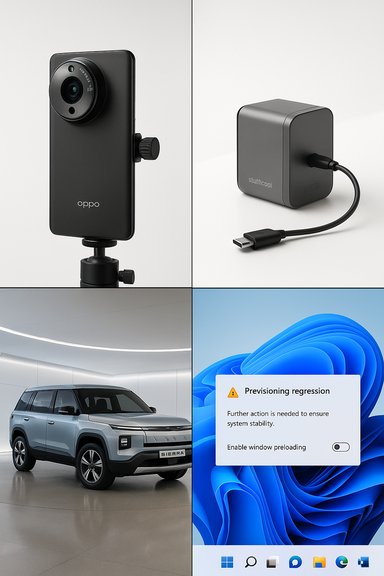
Oppo’s extravagant telephoto accessory, an Indian start‑up’s clever GaN charger, the revival of the Tata Sierra, and a string of worrying Windows 11 regressions — this week’s tech headlines form an odd but instructive quartet: premium hardware pushing smartphone photography forward, small makers finding practical product niches, legacy auto names returning with bold design bets, and a reminder that OS complexity still fails the basics. The themes are connected by a single thread: capability without polish will always expose trade‑offs, and consumers — not companies or investors — bear most of the friction when trade‑offs are poorly managed.
The headlines split neatly into consumer hardware and platform problems. On the hardware side, Oppo’s latest Find X9 Pro and an optional Hasselblad Teleconverter Kit extend what a phone can do for telephoto photography; Indian accessory maker Stuffcool shipped the compact Zeno 30 GaN charger with a retractable USB‑C cable; and Tata Motors relaunched the Sierra name for a modern midsize SUV built on a new ARGOS platform. On the platform side, Windows 11’s 24H2 servicing cycle exposed two separate but related reliability problems — an ongoing provisioning/regression issue that can break Start, Taskbar and File Explorer in certain update/provisioning flows, and an experimental shift by Microsoft to preload File Explorer to mask cold‑start slowness. These are not minor release notes: they touch everyday workflows and fleet operations for millions of users.
The week’s stories are a reminder that progress takes multiple shapes: beautiful, expensive engineering that widens capability; small, clever design that fixes an annoyance; design‑led product returns that bet on identity and packaging; and platform work that must ultimately protect stability before novelty. Each of these is a useful case study in trade‑offs — and each one is telling us the same thing: capability without reliable, human‑centered execution will always ask users to do the extra work.
Source: Hindustan Times HT Wired Wisdom
 Background / Overview
The headlines split neatly into consumer hardware and platform problems. On the hardware side, Oppo’s latest Find X9 Pro and an optional Hasselblad Teleconverter Kit extend what a phone can do for telephoto photography; Indian accessory maker Stuffcool shipped the compact Zeno 30 GaN charger with a retractable USB‑C cable; and Tata Motors relaunched the Sierra name for a modern midsize SUV built on a new ARGOS platform. On the platform side, Windows 11’s 24H2 servicing cycle exposed two separate but related reliability problems — an ongoing provisioning/regression issue that can break Start, Taskbar and File Explorer in certain update/provisioning flows, and an experimental shift by Microsoft to preload File Explorer to mask cold‑start slowness. These are not minor release notes: they touch everyday workflows and fleet operations for millions of users. OPPO & HASSELBLAD: a phone that now accepts a real telephoto lens
What Oppo shipped and how it works
Oppo’s Find X9 Pro is a flagship smartphone that pairs a high‑resolution sensor platform with an optional optical accessory: the Oppo Hasselblad Teleconverter Kit. The phone itself ships in a 16GB + 512GB configuration in India at an introductory price around ₹109,999, while the teleconverter kit is sold separately for ₹29,999. The kit is a magnetic, adapter‑based external lens system: you attach a magnetic case, fit a mounting ring, and then screw on the teleconverter lens; an additional tripod support is included. When attached, the phone’s camera app exposes a special “Hasselblad Converter” mode with preset zoom stops (10x, 20x, 40x) and a dial that can be held to extend to claimed magnifications up to 200x. Hardware specs that Oppo and reviewers list include a 200MP telephoto unit, a 1/1.56‑inch sensor, and the teleconverter’s optical equivalent of 230mm focal length with an f/2.1 aperture; video capture is supported at 4K HDR@60fps though practical stability needs a tripod at higher zooms.Strengths: photographic reach and practical integration
- Optical reach without a DSLR — The teleconverter supplies meaningful optical magnification so images at 10x–40x come from optical extension rather than pure high‑magnification digital crops.
- Integrated software mode — Hasselblad mode in ColorOS means post‑processing and exposure controls are tuned for the converter, reducing the “foreign lens” experience many clip‑on systems suffer.
- High base specs — The Find X9 Pro’s big battery, Dimensity flagship chipset, and a seasoned camera stack make the phone a capable platform for an unusual accessory.
Weaknesses and real‑world trade‑offs
- Cost fragmentation — The accessory’s separate price tag (₹29,999) pushes total spend well beyond the average flagship buyer’s budget. Oppo’s decision not to bundle the kit or offer a meaningful starter package is an odd commercial choice; many buyers will balk at near‑₹140k combined pricing.
- Usability concerns — The teleconverter is heavy, creates a forward‑tilt balance issue, and requires both hands or a tripod at moderate to high zoom. There’s also no soft storage case in the package, which increases the risk of damage when not in use.
- AI interpolation remains part of the story — At extreme zooms (over ~60x) the camera pipeline supplements missing detail by inference; results are lively but can’t match true large‑sensor DSLR optics in subtle fidelity. Oppo’s processing, however, is conservative and avoids obvious oversaturation or fake sharpening in many real tests.
Verdict and context
For photographers who prioritize telephoto reach and value an integrated, smartphone‑native experience, Oppo’s Find X9 Pro + Hasselblad Teleconverter is one of the most compelling combinations in 2025. It is not a mass‑market buy: the accessory’s ergonomics and separate price make it a specialist add‑on. But from an engineering perspective it demonstrates what the smartphone camera platform can be when manufacturers stop treating optics as a software afterthought and give telephoto capability physical tools to work with.TECH SPOTLIGHT: Stuffcool Zeno 30 — small idea, high utility
What it is
The Stuffcool Zeno 30 is a compact 30W GaN charger that includes a built‑in retractable USB‑C cable. Stuffcool positions the product as an on‑the‑go charger for phones and small devices; the cable extends to roughly 75 cm (~25 inches) and the charger supplies a full 30W via either the port or the cable (shared when both are used). The listed Indian retail price in launch coverage is ₹1,899, making it an inexpensive travel accessory.Why this matters (and where it wins)
- Convenience — For travelers and commuters, a charger with a built‑in, retractable cable eliminates the “where’s my cable” friction that often forces suboptimal charging choices.
- GaN efficiency — Using GaN enables a smaller form factor while still delivering 30W, matching fast‑charge expectations for midrange and many flagship phones.
- Thoughtful output sharing — The charger divides power across port + cable intelligently, allowing simultaneous charging of a phone and a small accessory (earbuds, smartwatch) without carrying two bricks.
Caveats
- Thermal behaviour — Side‑by‑side testing and reviewer notes report the charger warms initially and settles; users should avoid heavy charging cycles on heat‑sensitive devices in poorly ventilated setups.
- Durability concerns — Retractable cable mechanisms require careful use; the cable is a convenience feature that becomes a single point of fragility if mishandled.
Practical recommendation
For under ₹2,000, the Zeno 30 hits a practical sweet spot: small, useful, and designed for a real use case. It is a typical example of where accessory makers can win by aligning product design closely with everyday habits rather than chasing headline specs alone.CAR CORNER: The Tata Sierra returns — a design play with volume ambition
The new Sierra in brief
Tata Motors resurrected the Sierra nameplate with a 2025 midsize SUV built on the new ARGOS platform. The launch strategy includes three trims (Pure, Adventure, Accomplished), multiple powertrains including NA petrol, turbo‑petrol, and diesel, and a long list of features (triple‑screen TheatrePro layout, Level‑2 ADAS, large panoramic sunroof, and a class‑leading interior space and boot). The launch price headline was aggressive: starting at ₹11.49 lakh (ex‑showroom) as an introductory figure. Tata is aiming for broad volume and wants to differentiate on design and usable space rather than chasing niche premium margins.Why it could work
- Design identity — Tata’s recent design language has been bold and consistent; Sierra’s boxy, upright silhouette and details (variant‑specific alloys, large glasshouse cues) stand out in a crowded midsize SUV market.
- Practical packaging — ARGOS delivers a longer wheelbase and greater interior volume than many rivals; Tata is promising best‑in‑class boot space and rear legroom in marketing materials.
- Variant breadth — Offering NA and turbo petrol as well as diesel and both manual and DCT choices widens the Sierra’s appeal across buyer segments.
Risks and exposure
- Pricing pressure — Introductory pricing is often followed by adjustments; the entry price will raise expectations that dealers and variant mix must meet to defend value perceptions.
- Execution on quality and delivery — For a high‑volume play, aftersales, build consistency, and supply‑chain staging will determine whether Sierra becomes a long‑term winner or an initial sales spike followed by warranty noise.
Bottom line
Tata’s Sierra is a strategic product: a design halo with a practical claim for volume. If Tata executes on quality and delivers the promised safety and interior refinement, the Sierra will unsettle rivals between ₹11–18 lakh price bands.SECOND THOUGHTS: Windows 11 — preloading File Explorer and a deeper provisioning regression
The headline problem
Windows 11’s servicing through 2025 has exposed two high‑visibility issues. First, Microsoft has acknowledged a provisioning‑time regression that can leave core shell components — Start, Taskbar, File Explorer, and Settings — failing to initialize after installing certain monthly cumulative updates (traced to updates released on or after July 2025). The company documented the problem and published mitigations under a support bulletin tracked as KB5072911; suggested short‑term workarounds include manual re‑registration of AppX/XAML packages and synchronizing package registration during logon for non‑persistent images. The practical effect is severe for image‑based provisioning, VDI pools and first‑logon flows: end users see “critical error” dialogs, blank taskbars, or Explorer crashes.Microsoft’s second response: preloading Explorer
In parallel, Microsoft is experimenting with a background preload for File Explorer in Insider Preview builds (for example Build 26220.7271 / KB5070307) to reduce the perceived cold‑start time of Explorer windows. The experiment keeps a lightweight Explorer skeleton resident and exposes a Folder Options toggle labeled “Enable window preloading for faster launch times.” The move mirrors tactics used previously for Office and Edge, where prelaunch tasks reduced click‑to‑open latency. But preloading trades a small background memory and battery cost for perceived responsiveness, and it introduces compatibility and shell‑extension loading concerns.Why both moves matter — and why the reaction is mixed
- Preloading is a pragmatic UX hack to make Explorer feel snappier for everyday users, but it also signals a surprising admission: a file browser, the most fundamental UI element, is being warmed artificially to cover underlying cold‑start inefficiencies.
- The provisioning regression is more serious: it is not a performance tweak but a correctness problem. The modularization of Windows UI into AppX/XAML packages has introduced an ordering and registration dependency that servicing must honor. When it fails, core desktop elements fail to render or crash — a much larger class of problem than any single feature misfire.
Practical guidance and risks for users and IT
- For home users: avoid installing preview or optional builds unless you want early features and accept risk. If you rely on stable behavior, wait for Microsoft’s mainstream patches and check Release Health notes.
- For IT/provisioning teams: implement Microsoft’s documented mitigations (manual Add‑AppxPackage registration or controlled synchronous registration at logon) and test image update flows before wide deployment.
- For power users: preloading can be toggled off when visible; but expect some future builds to toggle it on by default if telemetry favors responsiveness over minimal background footprint.
A concluding caution
The combination of a provisioning regression and a preloading experiment speaks to a broader engineering tension: modularity and faster iteration can accelerate feature velocity, but they also raise the bar for release‑level testing. User trust depends on predictable fundamentals — a file browser that launches reliably is a baseline expectation. When those basics get patched with workarounds or warmed with background tricks, the message is clear: Microsoft must rebalance its cadence between cutting new ground with agentic AI and preserving the deterministic stability millions of users expect.Final analysis — strengths, risks and what to watch next
- Oppo’s Find X9 Pro and its Hasselblad Teleconverter show where smartphone photography can go when optics and software are treated as a joint system. Strength: real telephoto capability in a smartphone ecosystem. Risk: ergonomics, cost and niche usage will limit mass adoption.
- Stuffcool’s Zeno 30 proves small innovation matters: a retractable cable in a compact GaN brick solves a real user problem at a low price. Strength: practicality and clear product fit. Risk: durability of mechanical parts and thermal management under stress.
- Tata’s Sierra is a smart mix of nostalgia and practical packaging. Strength: standout design plus usable interior space. Risk: execution at scale (quality, pricing discipline) will decide whether the Sierra becomes a long‑term platform or a short buzz.
- Windows 11’s problems are the most consequential: a provisioning regression that breaks shell elements and an experimental preloading approach reveal a platform under stress. Strength: Microsoft actively documents and publishes mitigations, and its Insider channel gives early visibility. Risk: user trust erosion, operational headaches for IT, and the possibility that preloading masks rather than fixes root causes.
What readers should do now
- If you are considering the Oppo Find X9 Pro, treat the Hasselblad Teleconverter as a specialty optical tool: evaluate how often you’ll use long‑range telephoto shots before buying. Verify price and availability in your market.
- Buy the Stuffcool Zeno 30 if you value a compact travel charger and accept careful handling of the retractable cable; it’s an inexpensive, high‑utility accessory.
- If you manage Windows fleets, prioritize testing of images with the latest cumulative updates, apply Microsoft’s registered mitigations where appropriate, and resist pushing preview bits into production before pilot validation. Keep an eye on Microsoft’s support advisories (KB5072911 and associated KB numbers) for permanent fixes.
- For car buyers attracted to Tata Sierra’s cabin space and features, wait for full variant pricing and test drives; the design is a differentiator but real ownership value will depend on trim options and service experience.
The week’s stories are a reminder that progress takes multiple shapes: beautiful, expensive engineering that widens capability; small, clever design that fixes an annoyance; design‑led product returns that bet on identity and packaging; and platform work that must ultimately protect stability before novelty. Each of these is a useful case study in trade‑offs — and each one is telling us the same thing: capability without reliable, human‑centered execution will always ask users to do the extra work.
Source: Hindustan Times HT Wired Wisdom
