

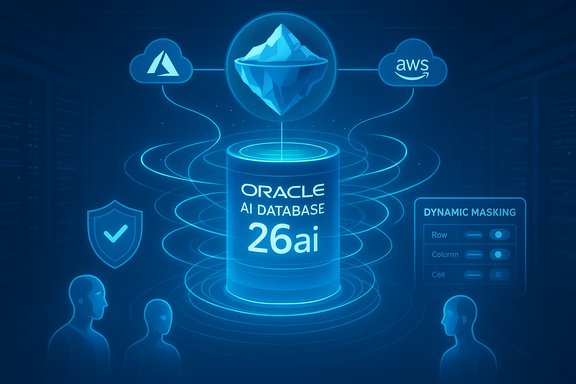
Oracle’s pitch at AI World in Las Vegas was simple and unapologetic: put AI inside the database, not beside it, then add open lakehouse connectivity and enterprise-grade controls so organizations can run retrieval, reasoning, and agentic workflows without moving sensitive data around. The result is Oracle AI Database 26ai and the companion Autonomous AI Lakehouse — a converged, AI-native data stack that promises unified vector search, in-database agents, Iceberg-backed lakehouse interoperability, and built‑in data privacy controls designed for regulated enterprises.
Background
AI changes the relationship between humans and data. Where business users once needed SQL and DBA help to extract value from schematized stores, retrieval‑augmented generation, vector search, and agentic AI workflows are reframing the database as an interactive AI substrate. Oracle argues this trend makes the database — the source of truth for transactions and enterprise metadata — more critical than ever. Juan Loaiza, Oracle’s EVP of Database Technologies, framed AI as a way to make data accessible (natural language to SQL), actionable (agents and RAG inside the engine), and trusted (per‑agent, row/column/cell controls at the data layer). This announcement is not a minor patch. Oracle has repositioned its flagship database as an “AI Database” (26ai), replacing the 23ai lineage and declaring long‑term support for an AI‑first release. That positioning comes with two major platform updates: the AI‑infused Oracle Database 26ai and the Autonomous AI Lakehouse, a lakehouse stack that natively reads and writes Apache Iceberg tables while exposing Oracle’s engine features to multi‑cloud analytics. Oracle’s messaging is intentionally broad: on‑prem, OCI, and now Oracle‑operated services in hyperscalers (Azure, AWS, Google), with pay‑as‑you‑go and BYOL options.What Oracle announced (high level)
- Oracle AI Database 26ai: a long‑term support release that architects AI into the database core, adding built‑in vector search, agentic AI support, integrated model protocols, and a set of privacy and cryptography enhancements. Advanced AI features are included at no additional charge in the database distribution.
- Oracle Autonomous AI Lakehouse: an Iceberg‑compatible lakehouse offering that brings Oracle’s Exadata performance and SQL surface area to Iceberg tables across multiple clouds. It provides a unified catalog experience and query acceleration targeted at multi‑platform AI/analytics workflows.
- Exadata and performance accelerations: vector offload, RDMA optimizations, Exadata table cache for Iceberg data, and a serverless pay‑per‑use accelerator for lakehouse queries. These are positioned as the performance plumbing for latency‑sensitive inference and RAG pipelines.
- Built‑in data privacy and governance: per‑agent, row/column/cell visibility controls; dynamic masking; SQL firewalling; and NIST‑approved quantum‑resistant in‑flight encryption (ML‑KEM) combined with existing at‑rest protections. Oracle positions these as data‑layer protections that prevent unauthorized views even when agents execute SQL.
- Multicloud and on‑prem delivery: Autonomous AI Lakehouse and AI Database are available on OCI and via Oracle‑operated services inside major hyperscalers (Azure, AWS, Google Cloud), and Exadata Cloud@Customer for on‑premises needs. Oracle stresses feature parity and managed operation as a differentiation.
Technical deep dive: What’s actually new in Oracle AI Database 26ai
Unified Hybrid Vector Search and multimodal retrieval
Oracle’s core claim is that vector search is no longer a sidecar capability; it’s a first‑class operator that can be combined in the same SQL engine with relational, JSON, text, graph, and spatial predicates. Unified Hybrid Vector Search promises so‑called hybrid queries that retrieve rows, documents, and vectors in a single execution plan — thereby reducing data movement and orchestration complexity for RAG scenarios. This approach aims to make it easier for developers to join semantic results with authoritative transactional data inside the DBMS. From a practical standpoint, the benefits are clear: single‑engine joins avoid eventual consistency and synchronization lags between a transaction DB and a separate vector store. But the trade‑offs are real: native vector indices and operator implementations must scale for persistent, high‑QPS inference workloads, and performance characteristics will vary by workload, vector dimensionality, and index choice (HNSW, product quantization, etc.. Vendors’ lab figures are helpful, but expect rigorous, workload‑matched benchmarks before production rollouts.Agentic AI inside the database
Oracle has made agents a first‑class construct: Select AI Agent and a Private Agent Factory let organisations build, deploy, and govern AI agents that run either entirely inside Autonomous AI Database or call external tools via REST/MCP servers. Agents can fetch incremental context (queries), iterate reasoning steps, and produce not only answers but also actions that can change state (create records, trigger processes). This reduces round‑trip complexity between LLM servers and data stores — but it increases the importance of robust auditability and runtime controls.Data governance, privacy, and cryptography
Oracle explicitly built data privacy rules into the data layer so that an AI agent or end user can only see what the policy allows — at row, column, or cell granularity, plus dynamic masking. In addition, Oracle announced the use of NIST‑approved ML‑KEM quantum‑resistant algorithms for data‑in‑flight and maintains quantum‑resistant at‑rest protections. These capabilities are aimed at environments where leakage risk and regulatory controls are high. Oracle’s approach treats the database as the gatekeeper — a sensible design when the database is the authoritative data plane. A caution: while the controls are powerful in concept, enterprises must validate policy enforcement under complex agentic workflows and third‑party model integrations. Policy gaps — especially at the LLM boundary or in temporary caches and embeddings — are risky and require operational proof (logs, immutable audit trails, data lineage) to prove compliance in audits.Lakehouse interoperability (Apache Iceberg)
Autonomous AI Lakehouse adds native Iceberg read/write support, a unified catalog (Autonomous AI Database Catalog), and query acceleration that scales network/compute for large Iceberg scans. By endorsing Iceberg — an open table format — Oracle is making a strategic bet on multi‑vendor, cross‑platform interoperability (Databricks, Snowflake, and others). This reduces vendor lock‑in risk for AI/analytics pipelines that rely on shared Iceberg tables. Oracle pairs Iceberg access with Exadata features like the Exadata Table Cache and Data Lake Accelerator to achieve performance parity with managed warehouse queries. Those architectural choices are pragmatic: customers can keep Exadata performance for hot Iceberg tables while using object stores for capacity. InfoWorld’s coverage highlights that this is a substantive shift in Oracle strategy toward an open ecosystem.How Oracle positions Exadata for AI workloads
Exadata is central to Oracle’s performance narrative. Oracle claims Exadata can offload vector operations to “intelligent storage,” and that Exadata Exascale and RDMA improvements dramatically reduce latency for vector and analytic queries. The practical implication is that when Exadata powers the lakehouse or DB instance, vector queries and mixed workloads should see materially lower end‑to‑end latency compared with commodity stacks — especially for high‑concurrency OLTP + vector inference mixes. Two important operational notes:- Exadata‑driven acceleration matters most when your workload mixes high‑volume transactional traffic with low‑latency inference; not every organization needs Exadata.
- Oracle’s performance claims are vendor‑reported; independent verification (pilot tests) remains essential before attributing real‑world SLA guarantees to these architectural claims.
Multicloud and deployment options: the two‑pronged strategy
Oracle deliberately reframed its go‑to‑market posture: ship the technology where customers run it. That means:- Oracle Cloud Infrastructure (OCI),
- Oracle‑operated Oracle Database within Azure / AWS / Google Cloud datacenters,
- Exadata Cloud@Customer and on‑prem Exadata, and
- Hybrid/multicloud data lake interoperability (Iceberg).
Strengths: Why this matters for enterprises and Windows/DBA teams
- Single‑engine simplicity for RAG and inference: running vector search, SQL, and agents within one converged engine reduces orchestration and synchronization risk. This can accelerate time‑to‑value for AI use cases that need authoritative answers grounded in current transactional data.
- Open lakehouse interoperability: Iceberg support and catalog unification mean enterprises can share data between Oracle, Databricks, Snowflake, and vendor‑neutral tools — a meaningful step toward multi‑vendor AI pipelines. Independent coverage acknowledges this as a strategic shift for Oracle.
- Enterprise controls built‑in: data‑layer privacy rules, dynamic masking, and SQL firewalling are designed for regulated industries where governance, audit trails, and least‑privilege enforcement are non‑negotiable. For security‑conscious organizations, keeping policy enforcement inside the database simplifies compliance posture.
- Deployment flexibility: the ability to run Oracle‑operated databases inside hyperscalers reduces migration friction for organizations that cannot refactor decades of business logic quickly. This is an important real‑world advantage for large enterprises.
Risks, caveats, and operational realities
Oracle’s announcements are substantial, but several risks and questions remain:- Vendor‑reported performance and scale claims: many headline numbers (acceleration percentages, “over 48 billion queries per hour” claims, Exadata speedups) originate with Oracle and accompanying press materials. Treat them as directional; require representative proof‑of‑value tests under realistic concurrency and dataset conditions before relying on them for production SLAs.
- Operational complexity of agentic workflows: running agents that can change state raises governance demands — model provenance, immutable audit trails, human‑in‑the‑loop controls, and traceable data lineage. Enterprises must extend change control and incident response runbooks to include agentic behaviors. Oracle provides guardrails, but operationalizing them across teams is non‑trivial.
- Hidden costs and licensing nuance: while Oracle says advanced AI features are included “at no additional charge,” the total cost of ownership depends on infrastructure (Exadata vs. standard compute), network egress, accelerator usage, storage, and paid models or GPU instances used for private inference. Procurement and license mobility (BYOL vs marketplace buying) deserve careful contract review.
- Data‑in‑transit and cache leakage points: embedding models, temporary caches, and external model servers (even in private containers) create potential leakage vectors. The database‑layer policy is necessary but not sufficient — operational controls around model hosting, key management, and telemetry are required to prevent data exfiltration.
- Dependency on hyperscaler cooperation: Oracle’s multicloud model is cooperative with hyperscalers; changes in marketplace policies or strategic relationships could alter availability, pricing, or operational handoffs. Multicloud reduces lock‑in but introduces new cross‑vendor operational handoffs that must be contractually clarified.
- Regulatory and audit scrutiny: some sectors (government, defense, certain financial services) require extreme controls and sovereign hosting; in‑region availability does not automatically satisfy such requirements. Customers must map controls to regulatory obligations and run compliance tests.
Practical guidance: how to evaluate Oracle AI Database 26ai and Autonomous AI Lakehouse
- Start with a focused pilot: choose a representative, latency‑sensitive slice of your application that combines transactional data and AI retrieval. Validate vector index throughput, RAG latency, and agentic actions under production‑like load.
- Test policy enforcement: run scenarios where agents query and attempt to act on data that should be masked or blocked. Verify logs, immutable audit trails, and incident escalation flows.
- Benchmark cost: model 12–36 months of expected inference traffic, storage growth for embeddings, Exadata cache sizing, and accelerator (GPU) usage. Include egress and marketplace billing constructs in total cost analysis.
- Validate interoperability: if Iceberg compatibility and cross‑platform sharing are key, test catalog integration with Databricks Unity, AWS Glue, and Snowflake Polaris. Confirm expected behavior for ACID, partition evolution, and schema changes.
- Clarify SLAs and support responsibilities: with Oracle‑operated services in hyperscalers, define RACI for incident root cause, escalation, and patching. Confirm contractual remedies for missed SLAs.
How Windows admins, DBAs, and architects should think about migration
For Windows‑centric enterprise teams, the practical lift to AI Database 26ai will follow familiar patterns, but with AI‑specific additions:- Inventory: catalog DB versions, RAC/Data Guard/GG usage, schema dependencies, and nightly vs transactional loads. Map workloads by latency and regulatory sensitivity.
- Plan networking: measure round‑trip latencies for your Azure/AWS/GCP interconnects, test ExpressRoute/Direct Connect setups, and validate RDMA/Exadata network paths where applicable.
- Security: integrate Azure Entra (or equivalent) with Oracle identity mappings, validate key custody strategies (Azure Key Vault / OCI Vault), and test key rotation and recoverability.
- Automation: codify deployments in IaC (Terraform or Azure ARM) so lakehouse connectors, catalog entries, and agent configurations are reproducible and auditable.
- Exit tests: exercise restore and portability — replicate an Oracle DB to an alternative target and validate data exports and GoldenGate‑driven failover scenarios. Lock‑in risk is real; portability testing reduces surprises.
Verification notes and cautionary flags
- Multiple core product claims (Iceberg support, agentic agent frameworks, per‑agent privacy rules, Exadata vector offload) are documented in Oracle’s own press release, blogs, and release notes. These are the authoritative product statements.
- Independent trade coverage (InfoWorld, industry writers) corroborates the Iceberg and lakehouse direction and highlights the strategic shift to interoperability. Such journalists evaluate the announcements and provide third‑party perspective, but do not replace workload‑specific validation.
- Vendor‑reported performance figures and customer claims (including examples cited by Oracle and partners about latency or throughput gains) are useful for directional evaluation but must be validated in a customer’s own context. Where Oracle or partners publish numeric benchmarks, treat them as starting points for proof‑of‑value testing.
- Any forward‑looking business or revenue assertions (for example, broad Oracle projections about multicloud revenue potential) are strategy statements and should be evaluated against independent financial reporting and subsequent execution. These are not technical guarantees of product outcomes.
Final assessment: pragmatic innovation with a governance requirement
Oracle AI Database 26ai and the Autonomous AI Lakehouse represent a pragmatic and well‑engineered approach to bringing AI to enterprise data: marry vector and semantic capabilities into a mission‑critical DBMS, add an open lakehouse layer with Iceberg, and bake governance into the data plane. For enterprises with large Oracle estates — particularly those that cannot or will not refactor core business applications — this is a practical path to accelerate RAG and agentic AI without wholesale rewrites. That said, the transition from proof‑of‑concept to responsible production depends on operational rigor. Organizations must treat agentic AI and in‑database inference as new operational domains: verify policy enforcement under adversarial and edge‑case scenarios, define auditability for automated actions, and benchmark cost and performance across expected production loads. The technology reduces integration friction and opens new possibilities, but it also expands the governance surface. In plain terms: Oracle has delivered a comprehensive product narrative and an enterprise‑grade engineering stack for “AI for Data.” The technology is compelling — and, for the right customers with careful validation, it will materially shorten the path from data to trustworthy AI outcomes. However, success will be earned in pilots, not press conferences.Source: Cloud Wars Oracle AI Database: Enterprise-Ready AI with Built-In Data Privacy Controls
