

Oracle has introduced an AI-native builder for Fusion Cloud Applications that lets customers and partners create “Fusion Agentic Applications” inside Oracle’s existing business-process, security, approval, and audit framework. The company announced the update on July 14, positioning governance—not just AI-assisted development—as the reason to build and run agents within Fusion rather than through a separate automation layer.
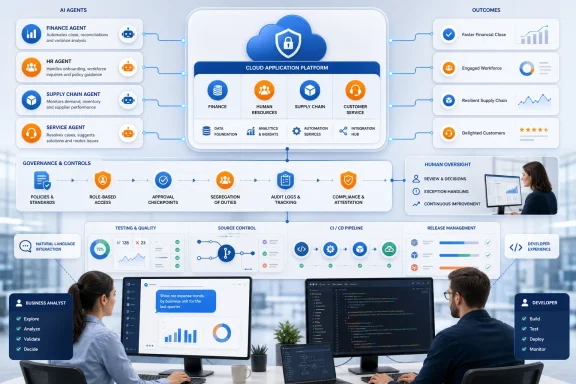
According to Oracle’s announcement, the builder spans no-code, low-code, and pro-code workflows. Business users can begin with natural-language prompts, while developers can use Visual Studio Code, command-line tools, Git-based lifecycle management, CI/CD pipelines, OpenAI Codex, and Claude Code through Oracle’s AI Studio Skill.
Oracle’s pitch is that agentic applications should inherit the controls already applied to finance, HR, customer experience, and supply-chain workflows. The resulting applications can use Fusion business objects, launch workflows, follow policies, seek approvals, and record actions in audit logs.
That is a more credible enterprise proposition than placing an autonomous agent beside a line-of-business system and hoping permissions, observability, and exception handling can be reconstructed later. Oracle says its studio includes testing, validation, debugging, security controls, and governance features as part of the development environment.
For IT teams, that integration could reduce a common production gap: an AI proof of concept may answer questions or draft content successfully, but it becomes considerably harder to authorize it to change customer records, approve purchasing actions, trigger collections activity, or alter workforce processes.
That does not eliminate governance work. It raises the stakes for it. Organizations will need explicit policies defining who can create an agentic application, which data and actions it may access, who approves deployment, how behavior is monitored, and how the application is retired or rolled back.
Oracle also plans a public GitHub repository with templates, starter projects, sample applications, reusable assets, and reference architectures. That should speed up development, but imported templates and third-party agents still need security review, ownership, and testing against a customer’s specific Fusion configuration.
Those outcomes remain the meaningful test. Native controls can make agent execution safer and easier to govern, but they do not guarantee accurate decisions, resilient exception handling, or measurable process improvements. Enterprises should measure error rates, approval bypass attempts, time-to-resolution, rollback performance, and audit completeness before expanding autonomous actions.
Oracle’s Fusion-native approach may remove much of the governance plumbing, but customers still have to prove that each agentic workflow deserves permission to act.
According to Oracle’s announcement, the builder spans no-code, low-code, and pro-code workflows. Business users can begin with natural-language prompts, while developers can use Visual Studio Code, command-line tools, Git-based lifecycle management, CI/CD pipelines, OpenAI Codex, and Claude Code through Oracle’s AI Studio Skill.
 Governance Is the Point
Oracle’s pitch is that agentic applications should inherit the controls already applied to finance, HR, customer experience, and supply-chain workflows. The resulting applications can use Fusion business objects, launch workflows, follow policies, seek approvals, and record actions in audit logs.That is a more credible enterprise proposition than placing an autonomous agent beside a line-of-business system and hoping permissions, observability, and exception handling can be reconstructed later. Oracle says its studio includes testing, validation, debugging, security controls, and governance features as part of the development environment.
For IT teams, that integration could reduce a common production gap: an AI proof of concept may answer questions or draft content successfully, but it becomes considerably harder to authorize it to change customer records, approve purchasing actions, trigger collections activity, or alter workforce processes.
More Builders, More Controls Needed
The other half of the announcement is broader access. A business analyst familiar with a collection or service workflow may now be able to describe an application in plain language, while an engineering team can extend the same project with code and standard development tooling.That does not eliminate governance work. It raises the stakes for it. Organizations will need explicit policies defining who can create an agentic application, which data and actions it may access, who approves deployment, how behavior is monitored, and how the application is retired or rolled back.
Oracle also plans a public GitHub repository with templates, starter projects, sample applications, reusable assets, and reference architectures. That should speed up development, but imported templates and third-party agents still need security review, ownership, and testing against a customer’s specific Fusion configuration.
Architecture Is Not Proof
Oracle previously launched 22 Fusion Agentic Applications in March across functions including finance, HR, supply chain, and customer experience. The company says these applications can improve collections, reduce service escalations, accelerate financial close, and streamline operations.Those outcomes remain the meaningful test. Native controls can make agent execution safer and easier to govern, but they do not guarantee accurate decisions, resilient exception handling, or measurable process improvements. Enterprises should measure error rates, approval bypass attempts, time-to-resolution, rollback performance, and audit completeness before expanding autonomous actions.
Oracle’s Fusion-native approach may remove much of the governance plumbing, but customers still have to prove that each agentic workflow deserves permission to act.
References
- Primary source: The Futurum Group
Published: 2026-07-20T15:01:02.102611
Will Oracle’s Fusion-Native Approach Solve Agentic AI Governance? - Futurum
Oracle’s Fusion Agentic Applications combine no-code and pro-code development with native workflows, governance, approvals, and auditability.futurumgroup.com - Related coverage: oracle.com
Oracle Introduces AI-Native Builder Experience to Create and Run Agentic Applications in Oracle Fusion Applications | Oracle United Kingdom
Oracle today announced a new AI-native builder experience for Oracle AI Agent Studio for Fusion Applications that enables customers and partners to create and run Fusion Agentic Applications natively within Oracle Fusion Cloud Applications.www.oracle.com
- Related coverage: docs.oracle.com
How do I use AI Agent Studio?
You can create agentic apps from the Apps tab in AI Agent Studio. To build agentic apps, do these steps:docs.oracle.com
- Related coverage: blogs.oracle.com
- Related coverage: northamericaoutlookmag.com
Oracle Unveils AI-Native Builder Experience for Oracle AI Agent Studio - North America Outlook
Oracle has introduced an AI-native builder experience for Oracle AI Agent Studio, enabling customers and partners to create, deploy, and govern enterprise-ready Fusion Agentic Applications directly within Oracle Fusion Applications.www.northamericaoutlookmag.com - Related coverage: nasdaq.com
Oracle Introduces AI-Native Builder Experience to Create and Run Agentic Applications in Oracle Fusion Applications | Nasdaq
--Oracle today announced a new AI-native builder experience for Oracle AI Agent Studio for Fusion Applications that enables customers and partners to create and run Fusion Agentic Applications natively within Oracle Fusion Cloud Applications. Business users can start with natural language using...www.nasdaq.com
