

Oracle’s placement as a Leader in Forrester’s latest Data Fabric Platforms evaluation marks a notable moment in the evolving debate over how enterprises connect, manage, and operationalize data across hybrid and multicloud estates. The recognition calls attention to a suite of capabilities Oracle has been assembling—Autonomous AI Database, GoldenGate replication, and OCI-native services—that together aim to deliver real-time integration, governance, and AI-driven automation for complex enterprise data landscapes.
Forrester’s Wave for Data Fabric Platforms (Q4 2025) assessed 14 vendors across a broad set of criteria—spanning current offering, strategy, and customer feedback—to judge which platforms are best suited to unify, govern, and operationalize data for AI and analytics at scale. Multiple vendors earned Leader placements in that evaluation, reflecting a market where different architectural approaches (cloud-native fabric, hybrid-first platforms, and data-layer orchestration) all have valid, market-proven use cases.
“Data fabric” has become a shorthand for a set of architectural goals rather than a single product: unified metadata and cataloging, real-time streaming and replication, consistent governance and lineage, AI-enabled metadata enrichment, and the ability to federate queries and workloads across clouds and on-premises systems. Organizations increasingly treat the fabric as the connective tissue that lets AI agents, analytics, and transactional systems share trusted data without rebuilding pipelines for each use case.
Key vendor claims called out in Oracle’s own summary of the Wave include:
At the same time, the practical success of any fabric project hinges less on vendor positioning and more on operational realities: multicloud parity, cost dynamics, the maturity of agentic AI governance, and the complexity of integrating decades-old systems. For many enterprises, the smartest path forward will be pragmatic—pilot where Oracle’s stack accelerates outcomes, benchmark against open or hybrid competitors where cloud neutrality and portability matter most, and build governance and human oversight into every step of agentic AI adoption.
By treating the Forrester recognition as a signal—not a guarantee—architecture and procurement teams can extract the best of Oracle’s offerings while guarding against the common pitfalls of fabric implementations: overcommitment to a single vendor, underestimation of operational cost, and insufficient controls around automated decisioning. The vendors named as Leaders today reflect real technical advances; the challenge for enterprises is turning those advances into repeatable, governed, and cost-effective outcomes.
Source: Oracle https://www.oracle.com/data-platform/data-fabric-platforms-leader/
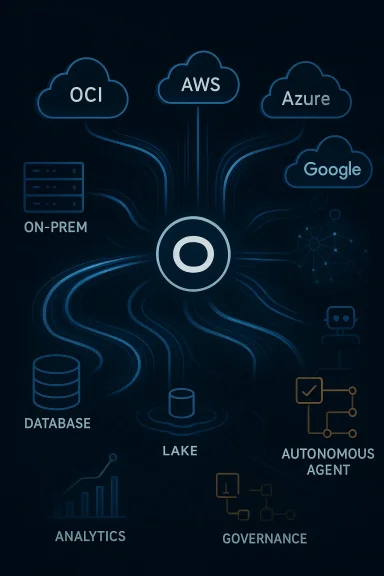 Background: why the Forrester Wave matters (and what “data fabric” means right now)
Forrester’s Wave for Data Fabric Platforms (Q4 2025) assessed 14 vendors across a broad set of criteria—spanning current offering, strategy, and customer feedback—to judge which platforms are best suited to unify, govern, and operationalize data for AI and analytics at scale. Multiple vendors earned Leader placements in that evaluation, reflecting a market where different architectural approaches (cloud-native fabric, hybrid-first platforms, and data-layer orchestration) all have valid, market-proven use cases.“Data fabric” has become a shorthand for a set of architectural goals rather than a single product: unified metadata and cataloging, real-time streaming and replication, consistent governance and lineage, AI-enabled metadata enrichment, and the ability to federate queries and workloads across clouds and on-premises systems. Organizations increasingly treat the fabric as the connective tissue that lets AI agents, analytics, and transactional systems share trusted data without rebuilding pipelines for each use case.
Overview: Oracle’s claim — what the vendor says and what Forrester highlighted
Oracle’s dossier to buyers centers on three linked value promises: AI-driven intelligence, hybrid and multicloud deployment flexibility, and end-to-end data management. Oracle’s public materials position Autonomous AI Database and Autonomous AI Lakehouse as the analytic/AI cores, GoldenGate as the proven replication engine for real-time movement and change data capture (CDC), and Oracle Cloud Infrastructure (OCI) as the operational backbone that ties the fabric together across locations. Forrester’s commentary cited Oracle’s long history in enterprise data management and emphasized its expanding vision to support data “on any cloud and in any location.”Key vendor claims called out in Oracle’s own summary of the Wave include:
- AI-driven, automated data transformation and modeling that enables “agentic AI” and autonomous agents to operate over governed data.
- Native OCI integration plus connectors and runtime capabilities that enable unified access and real-time data movement across OCI, AWS, Azure, Google Cloud, and on-premises systems.
- Integrated streaming, lineage, search, and governance features designed to deliver operational and analytical consistency across an enterprise fabric.
What Oracle brings to the table: capabilities and engineering signals
Autonomous AI Database & Autonomous AI Lakehouse
Oracle has evolved the Autonomous Database family into a broader “AI for data” story. The vendor positions its Autonomous AI Lakehouse as an enterprise-ready lakehouse with Exadata performance characteristics and open table-format support (Apache Iceberg), and the vendor states that the Lakehouse now runs across all major hyperscalers for customers who need cross-cloud parity. Those moves reduce friction for organizations that want a single operational model across OCI, AWS, Azure, and Google Cloud while still leveraging high-performance Exadata infrastructure.GoldenGate for real-time replication and heterogeneous integration
GoldenGate’s long-standing role as a low-latency change-data-capture and replication engine is central to Oracle’s fabric story. Oracle points to GoldenGate (including variants deployed on Azure) as the mechanism by which operational data and transactional changes flow into the fabric in near real time—an indispensable capability when AI agents need fresh, consistent context for decisions or when analytic pipelines must reflect operational reality.OCI as the native control plane and an execution substrate
Oracle builds its fabric services natively on OCI and frames OCI as a unifying control plane for orchestration, governance, and data movement. The vendor’s message stresses unified access and operational consistency across multiple clouds and on-premises systems. OCI’s role is both technical (compute, networking, low-latency connectivity) and strategic (vendor-managed integrations, automation, and billing).Platform-level governance, lineage, and search
A modern data fabric requires more than movement and storage: it needs enterprise-grade cataloging, lineage tracing, policy enforcement, and search. Oracle emphasizes integrated metadata services, searchable indexes across fabric assets, lineage for audit and compliance, and policy-driven governance that can be applied consistently across clouds and data domains. For organizations subject to regulation or internal compliance requirements, those capabilities are not optional.Strengths: where Oracle’s approach is most convincing
- Enterprise pedigree and familiarity. Oracle’s decades of database experience, installed base in mission-critical operational systems, and large ERP/finance customer footprint mean many enterprises already have deep skill sets and migration incentives to consider Oracle-led fabrics. That historical trust shortens procurement and platform adoption cycles for many organizations.
- Proven replication and CDC (GoldenGate). GoldenGate is a mature, battle-tested engine for low-latency replication and heterogeneous source/target topologies. Enterprises that require near-real-time synchronization between legacy OLTP systems and modern analytics/AI pipelines will find GoldenGate’s pedigree reassuring.
- Integrated stack reduces integration toil. Packaging Autonomous Database, Lakehouse, integration tools, and governance into a more cohesive stack reduces the number of vendor handoffs and custom glue code needed to stand up a consistent fabric—especially for organizations that standardize on Oracle technology. That translates into faster time-to-value for some classes of projects.
- Multicloud reach for certain components. Oracle’s messaging and product updates show explicit work to run core Lakehouse and database features on multiple hyperscalers. For organizations seeking an option to place workloads in different clouds (for latency, regulatory, or existing cloud commitments), this is a strategically useful capability—provided the cross-cloud behavior is consistent in practice.
Risks, caveats, and the important “but”s
- Multicloud parity vs. operational reality. Saying a product “runs on multiple clouds” is not the same as delivering identical SLAs, performance, or integration complexity everywhere. Differences in networking latency, storage tiers, cloud interconnects, and third‑party service availability often mean “multicloud” deployments require bespoke engineering and careful benchmarking. Don’t assume identical behavior across clouds without proof.
- Vendor lock-in vs. platform efficiency. Oracle’s integrated stack reduces glue-code complexity—but the more you adopt Oracle-native components (Autonomous Database, OCI services, GoldenGate), the harder it becomes to untangle and migrate workloads later. That trade-off between short-term acceleration and long-term flexibility should be explicit in ROI models.
- Agentic AI maturity and governance gaps. Forrester’s Wave explicitly calls out agentic AI as a rising influence on data fabric requirements. But agentic agents and autonomous decision loops raise governance, explainability, and risk-containment questions that many firms are still figuring out. Automating model-driven decisions on production data without rigorous guardrails invites bias, compliance exposure, and difficult incident response. Treat agentic AI as a capability that must be adopted with staged validation, not a switch you flip across the enterprise.
- Cost and complexity of broad-scale fabrics. Building a fabric that spans many clouds and includes streaming, replication, cataloging, lineage, and AI tooling is expensive and operationally intensive. Total cost of ownership must account for cloud egress, cross‑region replication, licensed software, engineering staff, and governance overhead. Expect proof-of-value pilots and careful scope management.
- Integration of legacy sources. A fabric’s value is determined by how effectively it brings legacy and siloed data into an operational plane. The technical difficulty of integrating decades-old ERP, mainframe, and bespoke data sources should not be underestimated—CDC at scale, schema drift, and semantic harmonization remain practical hurdles. GoldenGate helps, but transformation and ongoing reconciliation require process and tooling investments.
How to validate vendor claims in practice — a pragmatic evaluation checklist
When your organization evaluates Oracle’s data fabric (or any competitor named in Forrester’s Wave), validate these items with short, measurable experiments:- Define the business-critical flows. Identify 2–3 high-value, real-time use cases (fraud detection, inventory optimization, SLA monitoring) and map the sources, sinks, and latency goals.
- Run a cross-cloud performance POC. Deploy the same pipeline topology across OCI and at least one other cloud the vendor claims to support. Measure end-to-end latency, throughput, and failure recovery behavior.
- Test replication and schema evolution. Use GoldenGate (or claimed CDC component) to replicate complex transactional workloads, then introduce schema changes and verify automatic handling, downtime, and data integrity.
- Verify metadata, lineage, and search. Populate real datasets and run discovery, lineage queries, and policy enforcement scenarios. Confirm that governance objects are enforced similarly across clouds.
- Exercise agentic workflows. If agentic AI components are in scope, create a controlled agent that reads fabric data, makes a decision, and triggers an action. Audit the decision path, establish rollback/kill switches, and confirm explainability artifacts are available.
- Run cost projection tests. Simulate expected workload volumes for three years and model licensing, data egress, storage, and compute across clouds. Include scenarios for increased model retraining frequency.
Use cases where Oracle’s fabric story maps well
- Large transactional enterprises with Oracle-heavy stacks. Organizations that already run mission-critical databases on Oracle and want to extend analytics, AI, and real-time integration onto a unified platform will benefit from lower migration friction and consistent operational patterns.
- Real-time analytics and decisioning at scale. Use cases that require sub-second replication and consistent updates into analytics systems—like trading systems, dynamic pricing engines, and operational risk platforms—map well to GoldenGate plus a performant lakehouse.
- Regulated industries needing strong lineage and governance. Financial services, healthcare, and telecommunications often need tight provenance for data and decisions; integrated lineage, catalog, and policy enforcement are essential in those environments.
- Enterprises pursuing AI at scale but reluctant to refactor workloads off existing databases. Oracle’s converged database plus Lakehouse approach reduces the need to scatter data across dozens of systems and allows some ML/AI workflows to run closer to operational data.
Competitive context: other Leaders in the Wave and what they emphasize
Forrester’s Data Fabric Wave identified multiple Leaders with different emphases. For example, Cloudera and Teradata publicly called out their Leader status and highlighted strengths in hybrid data processing, open table formats, agentic AI features, and real-time performance. Those vendors emphasize hybrid-first or open-source rooted approaches—appealing to organizations that prioritize open architectural choices and broad cloud neutrality. Comparing these approaches side-by-side is essential because the right fabric design depends on constraints like regulatory needs, existing skill sets, and the degree of vendor consolidation an organization is willing to accept.Practical recommendations for procurement and architecture teams
- Prioritize use-case driven evaluation. Start with concrete business outcomes and test vendors only on those outcomes rather than generic feature checklists.
- Demand cross-cloud, measurable SLAs. If a vendor promises the same experience across clouds, require latency and reliability measurements from live or simulated POCs.
- Insist on transparent data egress and cost modeling. Multicloud fabrics frequently incur egress and replication costs; require vendors to model costs for scale.
- Build governance-by-design. Treat lineage, access controls, and model audit trails as first-class deliverables for any fabric deployment that will feed production AI.
- Stage agentic AI adoption. Use canary agents in low-impact workflows first, instrument them for auditability, and only expand after governance and safety metrics meet thresholds.
- Plan staff and operational tooling. Data fabrics fail without people and processes; invest in SRE/DevOps for data, platform engineering, and integrated monitoring.
Technical caution: what to benchmark and what to watch for in POCs
- Replication fidelity under load: confirm CDC does not drop or reorder transactions during schema evolution or failover.
- Cross-cloud replication latency and cost: measure steady-state and burst cost models.
- Operational failover behavior: simulate region outages and test the fabric’s ability to resume with intact lineage and no data loss.
- Agentic AI safety controls: ensure agents have throttles, circuit breakers, and human-in-the-loop escalation paths.
- Metadata reconciliation and catalog freshness: verify that automatic metadata ingestion and tag propagation meet governance SLAs.
A realistic timeline for adoption (recommended phased plan)
- Discovery and outcomes mapping (4–6 weeks): business sponsors, data owners, and security define target outcomes, SLAs, and success criteria.
- Small-scale POC (6–12 weeks): deploy a single real-time use case across OCI and one other cloud; measure performance, governance, and operational overhead.
- Controlled pilot (3–6 months): broaden to 2–3 mission-critical data domains, refine templates for replication, schema change handling, and ML model pipelines.
- Production rollouts (6–18 months): adopt fabric patterns across lines of business, automate platform provisioning, and onboard central governance.
Final assessment: balanced verdict for enterprise decision-makers
Oracle’s Leader placement in Forrester’s Data Fabric Platforms Wave is a defensible recognition of the company’s long-standing database strength, its investment in replication and integration technologies like GoldenGate, and its recent push to integrate AI-native features across a unified stack. Oracle’s ability to articulate an integrated fabric—combining Autonomous Database, Lakehouse, replication, and governance—gives enterprises with large Oracle footprints a credible, lower-friction path to AI-enabled data operations.At the same time, the practical success of any fabric project hinges less on vendor positioning and more on operational realities: multicloud parity, cost dynamics, the maturity of agentic AI governance, and the complexity of integrating decades-old systems. For many enterprises, the smartest path forward will be pragmatic—pilot where Oracle’s stack accelerates outcomes, benchmark against open or hybrid competitors where cloud neutrality and portability matter most, and build governance and human oversight into every step of agentic AI adoption.
By treating the Forrester recognition as a signal—not a guarantee—architecture and procurement teams can extract the best of Oracle’s offerings while guarding against the common pitfalls of fabric implementations: overcommitment to a single vendor, underestimation of operational cost, and insufficient controls around automated decisioning. The vendors named as Leaders today reflect real technical advances; the challenge for enterprises is turning those advances into repeatable, governed, and cost-effective outcomes.
Source: Oracle https://www.oracle.com/data-platform/data-fabric-platforms-leader/
