

The idea that hyperscale AI might soon leave Earth for energy, cooling, and regulatory relief is no longer sci‑fi thinking: in the last 12 months major cloud providers have published concrete programs, test missions, and timelines that move orbital compute from thought experiment to an engineering road map. Google’s Project Suncatcher proposes TPU‑equipped, solar‑powered satellites linked by free‑space optical networks; Microsoft’s Azure Space is stitching cloud services and virtualized ground networks to satellite operators; and Amazon has rebranded Project Kuiper as Amazon Leo and is racing to field production terminals and a mass‑manufactured satellite fleet. These efforts together mark the opening chapter of what industry participants now call the orbital cloud — and they raise technical, economic, legal, and security questions every IT leader should be preparing to answer.
Satellite internet has matured from experimental networks to global services in less than a decade. SpaceX’s Starlink demonstrated the commercial viability of LEO broadband, prompting others to scale up: Amazon’s Leo (formerly Project Kuiper) targets multi‑hundred‑megabit consumer and gigabit enterprise options, while Google and Microsoft are exploring compute and cloud integration above the atmosphere. These parallel moves reflect two simple pressures — energy and location: AI’s hunger for electricity and cooling increasingly collides with terrestrial limits, and orbit promises abundant solar power and radiative cooling that terrestrial data centers cannot match.
The concept of the orbital cloud bundles three related capabilities:
Key technical notes Google has published:
Practical capabilities Microsoft highlights:
Strengths: Amazon couples massive manufacturing and cloud integration (Direct to AWS) with aggressive launch plans. The chief challenges are logistics and schedule risk: meeting regulatory milestones (FCC license conditions), securing launch capacity, and ramping manufacturing without introducing quality or reliability regressions. Bloomberg and industry reporting also note skepticism that Amazon will meet all mid‑2026 population targets, though the company has contingency plans.
Enterprises should treat orbital compute as an evolving, complementary capability rather than a near‑term replacement for ground infrastructure. Practical steps for IT decision‑makers:
For IT leaders, the sensible posture is neither breathless adoption nor reflexive dismissal. Treat orbital compute as an emergent capability with promising niche value today and speculative mass value tomorrow. Demand audited telemetry, design hybrid fallbacks, and prepare your legal and security playbooks for a world where compute and connectivity may increasingly live off‑planet. The next decade will tell whether the orbital cloud becomes a fundamental layer of digital infrastructure or an expensive adjunct — but the companies and governments building prototypes right now have already made one thing clear: chips in space have moved from an abstract possibility to a programmatic priority.
Source: BOSS Publishing https://thebossmagazine.com/article/ai-infrastructure-space/
 Background / Overview
Satellite internet has matured from experimental networks to global services in less than a decade. SpaceX’s Starlink demonstrated the commercial viability of LEO broadband, prompting others to scale up: Amazon’s Leo (formerly Project Kuiper) targets multi‑hundred‑megabit consumer and gigabit enterprise options, while Google and Microsoft are exploring compute and cloud integration above the atmosphere. These parallel moves reflect two simple pressures — energy and location: AI’s hunger for electricity and cooling increasingly collides with terrestrial limits, and orbit promises abundant solar power and radiative cooling that terrestrial data centers cannot match. The concept of the orbital cloud bundles three related capabilities:
- Space solar power and near‑continuous energy capture.
- On‑orbit compute nodes (AI accelerators, inference appliances, or even training racks) hardened for radiation and vacuum.
- High‑bandwidth optical intelow‑latency gateways to terrestrial cloud regions.
Why space? The energy and thermal case for orbital compute
Sunlight on demand
A core technical argument for orbital compute is energy density. In sun‑synchronous low‑Earth orbit (LEO) or carefully chosen dawn‑dusk orbits, solar arrays see sunlight far more often than comparable arrays on Earth — Google quotes up to eight times the per‑panel productivity of terrestrial PV in its initial work on Project Suncatcher. That multiplier materially changes the energy equation for compute‑heavy workloads: less storage, fewer battery cycles, and a much higher ratio of power produced to mass launched.Radiative cooling at vacuum scale
Space is an exceptionally effective heat sink: radiators that reject heat by radiation to cold space avoid the large water and air‑handling infrastructure terrestrial data centers require. For GPU and TPU racks where cooling is a major operational cost and design constraint, the passive thermal profile of orbit is attractive — provided system designers can manage hot spots and ensure effective thermal contact between chips and radiators.The limits of terrestrial scale
The global data‑centding with siting, permitting, and power‑grid realities. Large, concentrated training centers need huge, steady power draws that stress local grids and water supplies. The orbital argument reframes part of that constraint: move the energy‑capture and some compute to where sunlight is nearly continuous, and only ferry results to Earth. That said, moving energy or data between orbits and ground remains the central economic and technical barrier.The big three programs: what each company is building and why it matters
Google — Project Suncatcher: TPUs, tight formations, and a 2027 learning mission
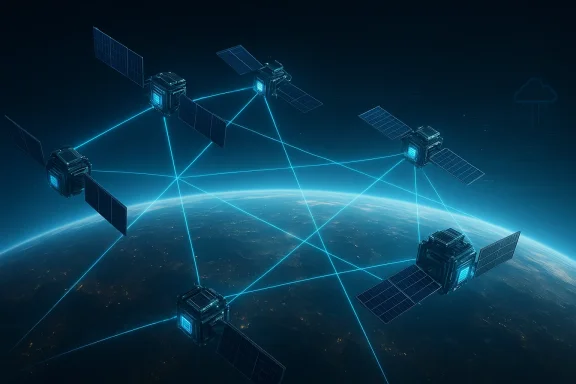
Google’s Project Suncatcher is the most explicit R&D roadmap toward a true orbital data center. The company published a research blog and a preprint describing the system design: clusters of solar‑powered satellites carrying Tensor Processing Units (TPUs) linked by free‑space optical (laser) interconnects to form a distributed, space‑native compute fabric. Google’s own framing is clear: “In the future, space may be the best place to scale AI compute,” wrote Travis Beals, senior director for Paradigms of Intelligence. The plan includes a learning‑mission partnership with Planet to launch two prototype satellites in early 2027 to validate hardware survivability and link concepts.Key technical notes Google has published:
- Radiation testing: Google reports proton‑beam testing of TPUs (the company points to survivability consistent with an expected five‑year mission life under a shielded dose model). Radiation tolerance and long‑term reliability remain open research questions for continuous training workloads.
- Formation flying and links: To achieve tens‑of‑terabits‑per‑second aggregate throughput the design envisions satellites flying within kilometers or less of each other and using free‑space optical links for rack‑level connectivity — a departure from current constellations that space satellites tens to hundreds of kilometers apart. Achieving and managing such tight formations safely is nontrivial.
- Timeline and costs: Google expects initial prototypes in 2027 and projects fuller deployments when launch costs fall — mid‑2030s is the horizon most analyses place where per‑kW economics could compare with terrestrial data centers, assuming continued launch and manufacturing cost declines.
Microsoft — Azure Space, Orbital Cloud Access, and the satellite‑cloud bridge
Microsoft’s approach is pragmatic and partnership‑centric. Rather than launching hyperscale compute into orbit itself, Azure Space focuses on integrating satellite connectivity with Azure services, virtualizing ground‑station functions, and enabling space actors to treat cloud services as first‑class citizens. Microsoft launched the Azure Orbital Cloud Access preview and made Azure Orbital Ground Station broadly available while expanding partnerships — notably a Satellite Communications Virtualization Program with SES to create a virtualized ground‑network blueprint. These moves aim to make satellite connectivity behave like another transport in a multi‑access cloud stack (fiber, cellular, satellite).Practical capabilities Microsoft highlights:
- Azure Orbital Cloud Access Preview provides single‑hop cloud access via satellite networks with integrated SD‑WAN and prioritization across terrestrial and space links — a clear product fit for field operations, disaster response, and enterprise edge scenarios.
- Virtualized ground network with SES intends to standardize software‑defined hubs, edge VNFs, and remote upgrades — a crucial step to accelerate service innovation across multi‑orbit operators.
Amazon Leo (Project Kuiper) — mass production, three consumer tiers, and direct cloud links
Amazon’s Project Kuiper has been rebranded publicly as Amazon Leo, reflecting a push to market consumer and enterprise satellite broadband under a unified brand that integrates with AWS. Amazon emphasizes industrial production capacity: its Kirkland, WA, facility can build up to five satellites per day at peak, and the company reports hundreds of satellites launched already as it scales. Amazon’s marketed customer terminals (Leo Nano, Leo Pro, Leo Ultra) map to three tiers — 100 Mbps, 400 Mbps, and up to 1 Gbps downlink — explicitly positioning Leo to out‑compete or complement Starlink on performance and cloud integration, including Direct to AWS pathways. Amazon began limited previews in late 2025 and plans wider service rollouts through 2026 as capacity and launches increase.Strengths: Amazon couples massive manufacturing and cloud integration (Direct to AWS) with aggressive launch plans. The chief challenges are logistics and schedule risk: meeting regulatory milestones (FCC license conditions), securing launch capacity, and ramping manufacturing without introducing quality or reliability regressions. Bloomberg and industry reporting also note skepticism that Amazon will meet all mid‑2026 population targets, though the company has contingency plans.
Technical hurdles that will determine success or failure
Radiation, reliability, and hardware lifetime
Operating COTS or lightly modified accelerators in LEO exposes electronics to proton and heavy‑ion fluxes that terrestrial parts never see. Google’s proton‑beam tests are encouraging at prototype scale — the company reported TPUs surviving simulated five‑year doses in bench tests — but sustained training workloads produce continual state changes across memory and interconnects, increasing the long‑tail risk of silent data corruption and performance degradation. Radiation‑hardening, shielding mass, and in‑orbit fault tolerance will all increase launch mass and cost.Inter‑satellite bandwidth and latency
Google proposes free‑space optical links and tight formations to achieve tens of terabits per second between nodes. While laser communications have seen rapid progress, sustaining terabit‑class links across many nodes with low error rates is still a major engineering challenge. Optical pointing, thermal alignment, and jitter control at formation scales of hundreds of meters to a kilometer require precise station‑kision‑avoidance tooling. Failure modes include lost crosslinks during solar occultations, atmospheric scintillation on downlinks, and tight positional errors amplifying pointing loss.Launch, servicing, and refresh economics
Even optimistic launch‑cost curves still place a nontrivial price tag on lifting terawatts of compute hardware into orbit. The mid‑2030s economics Google cites assume further cost drops and operational advances such as on‑orbit servicing or modular replacement strategies. Without affordable, high‑cadence launch and reliable in‑orbit maintenance, orbital compute becomes an expensive toy rather than a scalable platform. This also ties into supply‑chain risk: accelerator obsolescence on a five‑year orbit cycle would create complex logistics for upgrades, spares, and end‑of‑life deorbiting.Policy, legal, and security complications
Data sovereignty and export control
Who governs code, keys, and data in orbit? On‑orbit compute raises thorny jurisdictional questions: satellites may pass over many countries, and operators often seek to programmatically claim tethering to one legal regime while physically traversing others. Export controls that restrict advanced accelerator exports can apply to hardware launched abroad, and remote management of cryptographic keys and firmware must respect cross‑border rules. Enterprise buyers will demand clear contractual models and audited compliance: until these are settled, regulated industries are unlikely to push sensitive training workloads to orbit.Space traffic management and debris risk
A successful orbital compute layer implies tight satellite formations and a much denser LEO population. Close proximity increases collision risk and con. Recent incidents and community analysis show that even established constellations like Starlink are involved in the majority of close approaches; adding hundreds or thousands of compute satellites without robust coordination invites reputational, regulatory, and systemic risk. Autonomous collision avoidance and robust end‑of‑life plans will be nonnegotsatellitetoday.com)Cybersecurity and supply‑chain attack surface
On‑orbit systems present new attack vectors: uplink compromise, compromised deployment images, or supply‑chain insertions that are impossible to patch without physical access. The virtualization of ground networks (Microsoft/SES program) helps by moving security to software stacks in trusted clouds, but it also concentrates critical functions in fewer codebases — raising the consequence of a single exploited VNF. Strong firmware signing, remote attestation, and multilayered key management are mandatory for trust in any commercial orbital compute offering.Practical timelines and what to expect in the next decade
Industry consensus and company roadmaps point to a phased runway:- 0–2 years (near term): prototype satellites andlots. Expect limited in‑orbit experiments, edge inference nodes, and more sector‑specific services (maritime, energy, defense). Google’s Planet partnership and Microsoft’s Azure Orbital ground push are examples of these pilots.
- 3–7 years (mid term): modular clusters and vertical use cases. If launch and manufacturing scale as planned, operators could field modest compute constellations for preprocessing, ephemeral training bursts, or commercial broadband at larger scales. Regulatory frameworks will likely tighten in this window.
- 8+ years (long term): utility‑scale orbital cloud. This is the contingent phase where space solar power and orbital compute become cost‑competitive with terrestrial centers — a possibility, not a certainty. Achieving it requires sustained advances in launch economics, in‑orbit servicing, debris mitigation, and a stable international regulatory regime.
Business and enterprise implications — who wins, who must adapt
Large cloud providers and hyperscalers are obvious winners if they can translate R&D into durable service offerings. Governments will win operationally (defense, scientific computing), and remote industries (maritime, extraction, disaster response) may see immediate benefits from improved connectivity and edge compute.Enterprises should treat orbital compute as an evolving, complementary capability rather than a near‑term replacement for ground infrastructure. Practical steps for IT decision‑makers:
- Prioritize pilot workloads that are space‑native: image preprocessing, compression, telemetryinistic inference tasks.
- Insist on audited mission telemetry and independent performance numbers before committing to long contracts.
- Build hybrid architectures that allow graceful fallbacks to terrestrial cloud if orbital links degrade or regulatory issues arise.
- Engage legal and compliance teams early on export controls and data sovereignty scenarios.
Strengths, risks, and the critical unknowns
Notable strengths
- Energy density and thermal advantages create a fundamentally different cost profile for compute if launch and manufacturing costs continue to fall. Google’s prototypes and Microsoft’s virtualization work show real system thinking beyond mere marketing.
- Rapid manufacturing and integration (Amazon’s five‑per‑day facility) demonstrates industrial capability to scale constellations if supply chains and launch partners align.
- Cloud‑space integration (Azure Orbital Cloud Access, SES virtualization) removes a chicken‑and‑egg problem by making satellite connectivity consumable like any other cloud transport.
Key risks
- Radiation and long‑term reliability for active training workloads remain unproven at scale; bench‑tests are necessary but not sufficient.
- Orbital safety and debris are existential risks for these business models — tighter formations mean higher collision and cascading‑debris risks.
- Economic sensitivity to launch pricing and servicing: if launch costs plateau or in‑orbit servicing lags, the mid‑2030s economic case could erode quickly.
Unverifiable claims to watch
Some public statements (projections of cost parity by specific years, or optimistic lifetimes for space‑qualified accelerators) are still modeling assumptions rather than demonstrated outcomes. Treat vendor timelines as conditional upon launch and regulatory success; demand independent telemetry and cost‑of‑service audits before signing long‑term capacity purchases.What IT teams and procurement should do now
- Require pilots with measurable KPIs (latency, throughput, error rates, and cost per GB computed) and insist on independent validation of vendor claims.
- Consider low‑risk pilot workloads: preprocessing of satellite imagery, deterministic edge inference, backups for critical remote fieldwork, and burst inference that benefits from orbital energy economics.
- Harden governance: add clauses for firmware provenance, key management, and export compliance in any procurement for orbital compute or satellite‑provided services.
- Stay informed on policy: follow national and international rulemaking around space traffic management and data jurisdiction, as those will dramatically alter timelines and vendor obligations.
Conclusion
Space is no longer the exclusive province of launchers and broadcasters; it is becoming a contested, instrumented, and cloud‑centric frontier. Google’s Project Suncatcher, Microsoft’s Azure Space ecosystem, and Amazon’s Leo represent three different strategic responses to the same problem: how to grow AI and connectivity without being throttled by terrestrial energy and siting limits. Each approach has real technical merits and sharp risks — from radiation and link engineering to debris and legal complexity.For IT leaders, the sensible posture is neither breathless adoption nor reflexive dismissal. Treat orbital compute as an emergent capability with promising niche value today and speculative mass value tomorrow. Demand audited telemetry, design hybrid fallbacks, and prepare your legal and security playbooks for a world where compute and connectivity may increasingly live off‑planet. The next decade will tell whether the orbital cloud becomes a fundamental layer of digital infrastructure or an expensive adjunct — but the companies and governments building prototypes right now have already made one thing clear: chips in space have moved from an abstract possibility to a programmatic priority.
Source: BOSS Publishing https://thebossmagazine.com/article/ai-infrastructure-space/
